
Quick Answer
Yes. Under fatca for individuals, you file Form 8938 when you are required to file a U.S. income tax return and your specified foreign financial assets exceed the threshold for your category. Form 8938 is attached to that return, while FBAR is a separate filing as FinCEN Form 114. Build tracking early, then get professional review before filing if asset scope or value support is uncertain.
If you work across borders, use modern fintech, and build wealth in multiple currencies, financial complexity is normal. What often sits in the background is the fear of a U.S. tax compliance misstep. One of the main concerns is the Foreign Account Tax Compliance Act, or FATCA, and its name alone can create uncertainty.
That uncertainty usually comes from ambiguity, not from the work itself. If you are used to managing complex projects and strategic decisions, compliance is less a legal mystery than an operational problem. The shift that matters is moving from hoping you are compliant to knowing how you are managing it.
This article lays out that shift. Rather than just listing rules, it gives you a repeatable way to handle FATCA obligations with more control. The three-step process, Assess, Systematize, and Execute, is built to replace guesswork with a quieter, more reliable kind of confidence.
Step 1: ASSESS - Are You Subject to FATCA Reporting?#
Use this decision path. If you may need to file a U.S. income tax return and your aggregate foreign financial assets may exceed your Form 8938 threshold, treat reporting as live and start tracking now. Form 8938 is filed with your annual U.S. income tax return.
1) Confirm status first#
Start with filing status, not with the account list. Before you review assets, confirm whether you fall into the IRS group of certain U.S. taxpayers who may have Form 8938 reporting obligations.
Your first gate is simple. If you do not have to file a U.S. income tax return for the year, you do not file Form 8938 for that year. If that gate is unclear, stop and verify it before moving on.
If a foreign financial institution asks about your citizenship when you open an account, treat that as a prompt to review compliance. Do not treat it as proof by itself that Form 8938 is required.
2) Run the threshold test by category#
Once a U.S. return may be due, the next gate is your threshold category. The IRS states a minimum reporting-threshold floor of at least $50,000, and higher thresholds apply to some individuals, including married joint filers and certain taxpayers in a foreign country.
- Certain U.S. taxpayers with foreign financial assets: Verify the current threshold for your filing status and location category, then apply the current Form 8938 instructions for your filing year.
- Married filing jointly and certain taxpayers in a foreign country: Verify whether a higher threshold applies, then confirm your category and apply the current Form 8938 instructions.
Do not rely on memory. Verify the current Form 8938 instructions for your filing year and category.
3) Build a full inventory before excluding anything#
Do not exclude anything too early. Specified foreign financial assets is a technical category, so start with a broad list and then classify items with the current instructions.
Keep a basic evidence file with:
- statements and records needed to calculate aggregate values for the year
- institution, country, account or policy identifier, and ownership type
- supporting records for assets that are not straightforward bank accounts
If records are incomplete, note that gap immediately instead of assuming you can rebuild it later. That gives you time to request documents or flag an item for professional review before filing pressure sets in.
Handoff to Step 2#
If any threshold trigger may apply, start tracking now. Escalate to a tax professional when your status or asset classification is ambiguous, especially if your totals may be near a threshold.
For a step-by-step walkthrough, see Form 8233 for Foreign Individuals With U.S. Scholarship or Fellowship Income.
Step 2: SYSTEMATIZE - Build Your 'Always-On' FATCA Dashboard#
If Step 1 shows FATCA reporting might be live, your next job is visibility. Run one controlled dashboard so you can see your USD totals, your in-year high, and your filing risk without guesswork.
This should be a single source of truth, not scattered notes. Assign one owner for updates and one reviewer for checks, even if both roles are you. Use one spreadsheet or database with these minimum fields:
| Field | What to record | Why it matters |
|---|---|---|
| Asset/account name | Consistent item label | Prevents duplicate or missing entries |
| Institution | Bank/platform/insurer/broker name | Ties each line to source documents |
| Country | Institution or issuer country | Supports foreign-status review |
| Ownership type | Individual, joint, spouse-related, entity interest | Affects review and reporting treatment |
| Asset type | Foreign account, non-account asset, entity interest | Flags classification risk |
| Native currency | Currency code (EUR, GBP, SGD, etc.) | Required before USD conversion |
| Statement/valuation date | Date on the source record | Anchors timing and audit trail |
| Native value | Balance or fair market value in local currency | Required input for conversion |
| USD value | Converted amount using your fixed method | Supports threshold tracking |
| Year-end value | Tax-year-end value | Supports last-day test |
| Period high | Highest reasonable estimate during the year | Supports any-time test |
| Trigger state | Normal, early-warning, filing-risk, escalate | Turns data into decisions |
| Evidence link | Statement file, report, or valuation memo | Lets you prove each number |
Update on a fixed cadence you can sustain, then reconcile each line to a dated statement, platform report, or valuation record. If a number cannot be traced to evidence, flag it before you close that cycle. Keep unresolved items on a short exception list so they do not disappear between review cycles.
Pick one FX rule and apply it consistently#
For Form 8938, determine value in local currency first, then convert to USD. Use the U.S. Treasury Bureau of the Fiscal Service rate as your default method. If no Treasury rate exists for that currency, use a public fallback source and document that source for disclosure.
Lock the rule in the dashboard header and do not switch methods midyear. Document the approved rate source and timing rule once you have verified it. The point is not elegance. It is being able to explain, line by line, how a local-currency amount became the USD amount you tested against your threshold.
Track three control views so escalation is obvious#
A good dashboard does not just store data. It tells you when to act. Use three control views:
| Control view | What it answers | Action |
|---|---|---|
| Current total (USD) | Where you stand now | Monitor trend and data freshness |
| Period high (USD) | Highest aggregate value during the year | Compare to your any-time test |
| Trigger state | Whether action is required | Move to prep or escalation when triggered |
Map the trigger logic to your Step 1 category. For example, the general rule uses a last-day test and an any-time test, with higher thresholds for joint filers and certain individuals living abroad. Set the filing-risk trigger using the current threshold for your category.
If classification or valuation is uncertain, escalate to a tax professional instead of guessing, especially for non-account assets and entity interests. A clean escalation note should identify the item, the open issue, the records you have, and the filing decision that depends on the answer. For more detail, see How to Handle Tax Form 8938 (Statement of Specified Foreign Financial Assets).
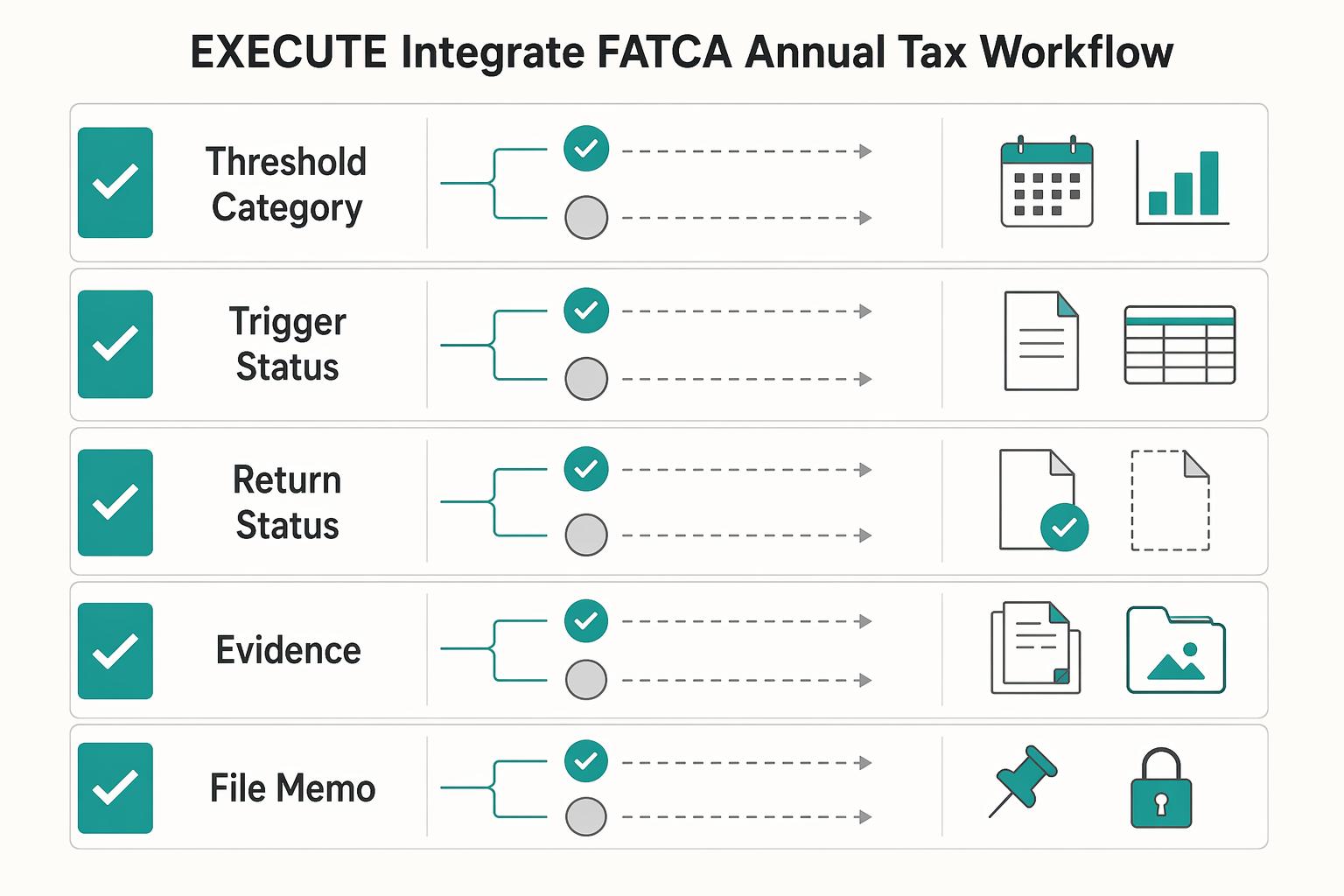
Step 3: EXECUTE - Integrate FATCA into Your Annual Tax Workflow#
At year-end, this becomes a binary decision. Either Form 8938 is required and attached to your return, or it is not required and you document why. Keep this review short and disciplined:
| Review item | What to confirm |
|---|---|
| Threshold category | Confirm your threshold category from Step 1 and use it consistently under filing pressure |
| Trigger status | Use your dashboard year-end total and period high against the correct threshold set |
| Return status | If you do not have to file an income tax return for the year, Form 8938 is not required |
| Support records | Assemble institution, identifier, country, value data, and supporting statements or valuations for each potentially reportable item |
| File memo | Write either "Form 8938 required and attached" or "Form 8938 not required," plus any issues escalated before filing |
For example, if you are a specified individual living in the U.S. and filing unmarried or married filing separately, test >$50,000 on the last day of the tax year or >$75,000 at any time during the year.
A short checklist works because it forces one final alignment between category, threshold, values, and evidence. If one of those pieces is still unsettled, the issue is not clerical. It is a filing decision that needs to be resolved before submission.
Attach Form 8938 to the return, not as a standalone filing#
Form 8938 must be attached to your annual income tax return and follows that return's due date, including extensions. Your control check is simple: confirm Form 8938 is actually present in the filed return package, not just prepared in draft.
Keep FATCA and FBAR separate in your workflow. Filing Form 8938 does not replace FBAR, and FBAR is not filed with the IRS.
Use a practical accountant handoff that reduces errors#
If you use a preparer, consider sending one review-ready package:
| Package item | What to include | Why it helps |
|---|---|---|
| One-page summary | Your filing conclusion and open questions | Lets the preparer understand your conclusion before digging into documents |
| Dashboard export | The export used for threshold testing | Shows the data used for threshold testing |
| Supporting records | Grouped by asset or account | Makes it easier to spot when a record is missing or a classification question is still open |
Use consistent file labels your preparer can scan quickly, such as institution, country, asset or account label, and statement date. That is an operations choice, not an IRS-mandated format. Even with a preparer, confirm Form 8938 inclusion before submission.
A useful handoff order is summary first, dashboard second, support third. That lets the preparer understand your conclusion before digging into documents. It also makes it easier to spot when a record is missing or a classification question is still open.
Keep the risk view compact#
The cost of small misses rises quickly once the year is closed.
| Risk event | Operational miss | IRS-stated consequence |
|---|---|---|
| Form 8938 missing or incomplete | Threshold crossed, but form omitted or assets missing | $10,000 failure-to-file penalty |
| Failure continues after IRS notice | No timely correction after notification | Up to $50,000 additional penalty exposure |
| Underpayment tied to undisclosed foreign assets | Omitted assets lead to related tax understatement | Additional 40% substantial understatement penalty |
Small pre-file checks are cheaper than post-notice cleanup.
Escalate before filing when facts are ambiguous#
Do not file through ambiguity if the open issue affects scope or value. Bring in a qualified tax professional before filing if any of these apply:
| Escalation trigger | Open issue | Why to escalate |
|---|---|---|
| Unclear asset status | You are unsure whether an item is a specified foreign financial asset | The open issue affects scope or value |
| Value cannot be determined | You cannot determine value from readily accessible information | Do not guess before filing |
| Conflicting institution records | You cannot determine a reliable value confidently | The filing decision depends on resolving the conflict |
| Gray-area nonreportable treatment | An item is being treated as nonreportable without clear written rationale | The filing decision depends on the answer |
If your dashboard shows no trigger and your reasoning is documented, archive the memo and close the year. If a threshold is crossed or classification is unclear, move Form 8938 into return prep early and resolve open issues before filing.
If you want a deeper dive, read our guide to a defensible 2026 filing plan. Before you finalize your filing checklist, run a quick self-check with the FBAR calculator so your FATCA and FBAR workflows stay aligned.
FATCA vs. FBAR: Run the Two Reporting Tests Separately#
This is where people often blur two separate rules into one task. Keep FATCA/Form 8938 and FBAR on separate decision tracks, and document each outcome from current official guidance.
- FATCA: Foreign Account Tax Compliance Act, an IRS topic.
- Form 8938: The IRS form used to report specified foreign financial assets when you are above the appropriate reporting threshold.
- FBAR: A separate reporting regime referenced on the IRS comparison page. Verify the current official rules before filing.
| Decision point | FATCA / Form 8938 | FBAR |
|---|---|---|
| What it is for | Report specified foreign financial assets (Form 8938) | Separate reporting regime referenced by the IRS comparison page; confirm current scope in official FBAR materials |
| Main document | Form 8938, Statement of Specified Foreign Financial Assets | Confirm the current official FBAR form/document |
| Administered by | Use current IRS Form 8938 materials | Confirm in current official FBAR materials |
| What you do if triggered | Complete Form 8938 using the current IRS form and instructions | Follow the current FBAR process in official materials |
| Trigger rule | File when you are above the appropriate reporting threshold for Form 8938 | Confirm the current FBAR trigger in official materials |
| Filing channel | Confirm in current Form 8938 instructions | Confirm in current official FBAR materials |
| Attachment vs separate filing | Confirm in current Form 8938 instructions | Confirm in current official FBAR materials |
| Valuation basis | Confirm in current Form 8938 instructions | Confirm in current official FBAR materials |
| Recordkeeping expectation | Confirm in current Form 8938 instructions | Confirm in current official FBAR materials |
Use the IRS Form 8938 page as your first control point, then open the linked Form 8938 PDF and instructions before finalizing your workflow. As of 23-Jan-2026, that page shows "None at this time" under recent developments, and the instructions link text is "Instructions for Form 8938 (11/2021)".
Quick both-may-apply checklist#
- If you may have reporting exposure, evaluate Form 8938 and FBAR separately using current official guidance.
- If your conclusion depends on a gray-area classification or a value you cannot support from records, escalate to a qualified tax professional before filing.
- If you are reusing last year's checklist, verify the current official forms and instructions first so you do not carry forward an outdated trigger or filing-method assumption.
You might also find this useful: FBAR and FATCA Reporting for US Expats.
Conclusion: Run the Assess, Systematize, and Execute Cycle Every Year#
Run the same three-step cycle every year: assess, systematize, execute. Confirm whether you are a specified individual and whether you are required to file a U.S. income tax return, keep a clean asset and valuation record, then test Form 8938 and FBAR separately.
For a business of one, this is recurring operations work, not a one-time fix. Form 8938 is attached to your annual U.S. income tax return when required, while FBAR is FinCEN Form 114 and is not filed with the IRS. One result never substitutes for the other.
| Annual cycle | Form 8938 | FBAR |
|---|---|---|
| What you monitor | Specified foreign financial assets and whether you cross the applicable threshold | Foreign financial accounts and whether aggregate value crosses the separate FBAR trigger |
| What you document | Maximum value, statements, valuations, threshold workpapers, and any exception analysis from Form 8938 instructions | Account list, highest balances during the year, and supporting statements |
| What you file | Attached to your U.S. income tax return if required | FinCEN Form 114 if required |
Your main checkpoint is classification before valuation. Do not assume an asset is out of scope because it is not a bank account, and do not treat IRS examples as exhaustive. Directly held foreign real estate is not itself a specified foreign financial asset for Form 8938. But an interest in a foreign entity that holds that real estate can be reportable.
Escalate to a qualified cross-border tax professional when classification is unclear, you are unsure how a new foreign entity should be treated, your Form 8938 and FBAR signals conflict, your U.S. status is uncertain, or your maximum-value support is incomplete. Escalate immediately if you missed prior filings or received an IRS notice.
Treat penalties as compliance guardrails, not drama, and confirm the current amounts and conditions before you file. Then keep the handoff disciplined each cycle: update your inventory, preserve your evidence pack, test both filing regimes, and file both when required. FATCA/Form 8938 and FBAR are separate ongoing obligations.
We covered this in detail in How to Handle Tax on a Foreign Life Insurance Policy.
If your cross-border setup is getting harder to operate year over year, talk to Gruv to map a compliant, audit-ready money workflow for your situation.
Frequently Asked Questions
What is FATCA / Form 8938?
FATCA, for individuals, is an IRS reporting regime for certain U.S. taxpayers with financial assets outside the United States. Form 8938 is the form you use to report specified foreign financial assets when you are above the applicable threshold, and you attach it to your tax return. If you do not have to file an income tax return for the year, you do not file Form 8938.
What is FBAR / FinCEN Form 114?
FBAR is a separate foreign account reporting requirement, and the form referenced in Form 8938 instructions is FinCEN Form 114. You should test FBAR independently each year, because filing Form 8938 does not satisfy FBAR.
What does “U.S. person” mean here?
The full legal definition is outside this section. Here, treat "U.S. person" as a status question that can trigger U.S. reporting obligations, and confirm your status under current IRS rules before deciding you are out of scope.
What are “specified foreign financial assets”?
These are foreign financial assets in which you have an interest that are tested against Form 8938 reporting thresholds. Start with a full asset list, then check each item against current Form 8938 instructions and exceptions before deciding what to report.
Do you file Form 8938 if you live abroad?
Yes, you may still need to file. IRS states assets must exceed $50,000 to be reportable in general, but thresholds can be higher in some cases, so verify the current instructions for your category before filing.
Do Wise, Revolut, and other modern accounts count?
Treat modern accounts as review-required items, not automatic exclusions. Then confirm each item using current Form 8938 instructions and IRS Form 8938 FAQs, especially for valuation questions and exceptions.
What should you verify before you file?
Two practical checks on Form 8938 are central: maximum value reporting and whether foreign assets were acquired or sold during the tax year. Keep statements, valuations, and your threshold-calculation file to support those entries.
What are the penalties if you miss Form 8938?
Use this as a guardrail: IRS states a $10,000 baseline failure-to-file penalty, potential continuation penalties up to $50,000 after IRS notice, and a 40% penalty on certain underpayments tied to non-disclosed foreign financial assets. Before filing, confirm the current amounts and conditions in the latest IRS materials.
When should you talk to a qualified cross-border tax professional?
Escalate early if your filing decision depends on an edge-case asset, an exception, uncertain valuation, or uncertain U.S.-person status. Also get help if you missed prior filings, received an IRS notice, or cannot substantiate your maximum-value calculations.
Try a related tool
Researched and edited by the Gruv editorial team. Gruv builds cross-border billing, payouts, and finance-operations software for global businesses.
Sources
Educational content only. Not legal, tax, or financial advice.
Related Posts

Digital Nomad Taxes in 2026 With a Defensible Filing Plan
With digital nomad taxes, the first move is not optimization. It is figuring out where you may be taxable, where filings may be required, and what proof supports that position.
How to Handle Tax Form 8938 Without Missing FBAR
Start with one decision: are you filing an income tax return for the year? Form 8938 attaches to that return, and this guide is meant to help you handle Statement of Specified Foreign Financial Assets reporting under FATCA without guesswork. Treat current IRS instructions as something you check live, not as a one-time read, because the Form 8938 materials are updated as needed.

The Freelance Payment Penalty: A Modeled Audit of Platform Fees, FX Spreads, and Payout Delays
The money rarely disappears through a single, easy-to-spot fee. The real loss is stacked. A marketplace takes its commission, a processor adds a charge for international cards, a bank or payment company converts the currency at a spread, a platform holds the funds before release, and a wire sheds a little to intermediaries on the way in. Each layer looks defensible on its own, but the worker feels the combined result as a smaller deposit and a later payday.