
Quick Answer
Platforms should offer scheduled, same-day, or on-demand instant payouts based on rail behavior, unit economics, controls, and rollout readiness, not speed alone. Same-day and instant are different promises: on-demand controls request timing, but true instant settlement depends on a real-time rail, while ACH may still take several business days. Model each mode separately, define fallback rules, and expand only after eligibility, reconciliation, and support signals hold.
How to treat payout speed as a product and margin decision before choosing same-day or instant rails#
Treat payout speed as a product and margin decision, not a feature race. This guide helps platform teams choose between scheduled payouts, same-day payouts, and on-demand instant payouts for contractor and creator programs based on economics, controls, and rollout order.
The scope is marketplace payouts: the timing promise you make, what that promise costs, and what must be true operationally before you expand access. This is not worker budgeting advice or a blanket case for paying everyone faster by default.
The pressure to move faster is real. Customers and suppliers increasingly expect faster payment options, and providers have expanded those options in response. More precise payment timing can improve cash-flow and working-capital management and support stronger vendor and customer relationships. But speed only helps if the economics and controls hold.
Rail behavior is the practical constraint behind every payout promise.
| Rail behavior | What it means for timing | Operating implication |
|---|---|---|
| Real-time payments | Funds can be available within seconds, on networks that run 24/7, year-round | Payments are final and irrevocable, with immediate confirmation |
| ACH transfers | Typically process over several business days | Timing is slower and less aligned with "instant" expectations |
The goal is not to prove that faster is always better. It is to choose the right payout mix without creating avoidable operational issues, then validate behavior in a sandbox and monitor performance after go-live. Evaluate more than speed, including pricing transparency, security, integration fit, and support quality.
Define payout speed modes before modeling economics#
Treat payout speed as three separate promises, or your economics will blur the real costs and risks. Start by getting product, finance, and operations to use the same labels.
| Mode | Working definition for this guide | Trigger | What the recipient expects |
|---|---|---|---|
| scheduled payouts | Paid on a fixed cycle | Platform-scheduled batch | Predictable timing, not immediate access |
| same-day payouts | Paid in preset intraday windows on the same day | Platform-initiated during defined windows | Faster access, still tied to cutoffs and operational timing |
| on-demand instant payouts | Paid when the user requests it | User-triggered | Near-immediate access when the available path supports it |
A product label is not the same as payment behavior. Fast payments are near-real-time transfers between end users, and the operating scope is broader than a single rail. Infrastructure, participating providers, end-user service, and rules all have to line up before "instant" is a reliable promise.
Before you model margin, define one fallback answer: if the preferred path is unavailable, does the payout delay, downgrade, or fail? If that answer is unclear, the cost model is not ready.
Use a slower batch payout flow as your internal baseline. It gives finance and product a clean control for incremental provider cost, support load, reconciliation effort, and working-capital effects as you move faster. Delayed and batch payouts can leave funds idle, while payout exceptions can increase finance workload during peak periods. Do not carry one generic "fast payout" line item. Model scheduled, same-day, and user-triggered payouts separately against that baseline.
If you want a deeper dive, read Instant Payouts Economics: What It Really Costs Platforms to Offer Same-Day and On-Demand Pay.
What market demand signals actually justify faster payouts#
Demand signals should trigger testing, not a launch decision. Use broader market signals on instant payments as directional indicators, then confirm demand in your own cohorts before you commit margin.
Do not treat all recipients as one "wants cash faster" segment. People who rely on platform earnings for near-term cash flow may behave differently from users who cash out occasionally and care more about predictability, fee clarity, or fewer failed transfers.
Turn demand into testable hypotheses#
Once the payout modes are defined, turn demand into measurable hypotheses before pricing or build work starts. Use your current settlement baseline and specify what has to change for faster access to be worth it:
| Hypothesis area | What to test |
|---|---|
| Adoption rate | What share of eligible users chooses faster payout options after seeing the real fee and timing promise? |
| Repeat supply participation | For dependency-heavy cohorts, does faster access change active days, completed work, or return behavior? |
| Support contact volume | Do "where is my payout?" contacts drop, or do payout-status and exception contacts rise? |
| Payout timing sensitivity | When users skip faster options, is the blocker price, trust, eligibility, or timing windows? |
What to verify before calling it demand#
Call it real demand only if it holds up in operations. Your evidence set should include cohort definitions, fee treatment, selection rates, support reason codes, and finance exception logs. Delayed-settlement environments can already drive manual reconciliation, spreadsheet tracking, and status follow-ups. A faster payout program can simply move that work around instead of removing it.
If the use case is still unclear, modernization costs are hard to justify, or fraud and exception pressure starts to strain finance capacity, pause and re-scope.
Compare scheduled same-day and on-demand instant payouts#
Scheduled and on-demand modes solve different timing needs. Compare them by separating the payout label from the rail that actually settles the transfer.
| Mode | User control | Operational load | Support burden | Failure handling | Rail and provider reality |
|---|---|---|---|---|---|
| Scheduled payouts | Low. Release follows a fixed cadence, for example every 14 or 30 days. | Cycle-based by design. | Access is delayed until the next payout cycle. | Release timing follows the cycle. | A scheduled release does not imply real-time settlement; settlement speed still depends on the rail used. |
| Same-day payouts | Depends on program design. | Varies by provider design. | Varies by provider design. | Varies by provider process. | "Same-day" is a product label, not proof of real-time rails. Rail choice still determines whether funds move within seconds or over business days. |
| On-demand instant payouts | High. Eligible users request payout when they choose. | Varies by provider design. | "Instant" expectations can clash with actual settlement timing. | Needs clear status and fallback handling when settlement is not real time. | On-demand requests can still settle in 1 to 3 business days. True instant behavior depends on a real-time rail, such as RTP. |
Rail behavior sets the real promise. Real-time payments run on networks operating 24/7, year-round, can complete within seconds, and are final and irrevocable with immediate confirmation. ACH transfers are typically slower and may take several business days. So "on-demand" means the user controls request timing, not that settlement is guaranteed to be instant.
In evaluation, separate four things every time: the user-facing label, who controls the trigger, the rail used for completion, and fallback behavior when the preferred path is unavailable.
Related: Same-Day vs. Next-Day vs. T+2 Payouts: What Settlement Speed Actually Costs Your Platform.
Build the unit economics model your finance team can defend#
Model faster payout options against your current baseline payout cadence at the payout-request level, not as a blended monthly average. If your finance team cannot trace a single payout from request to settlement, cost, exception, support touchpoint, and ledger outcome, the model is hard to defend.
For marketplace payouts, use verified, granular data and document assumptions where attribution is messy. Pull data by cohort, payout mode, and week at minimum. As a starting heuristic from adjacent unit-economics playbooks, use about 3 months of history when available, then test assumptions against your own seasonality. Treat payout-rail pricing, settlement-time effects, and failure-rate assumptions as unknowns until your own records validate them.
Start with a shadow cost sheet#
Start with a payout version of a Shadow COGS worksheet so every cost layer is visible. The goal is not to copy retail logic blindly. It is to make speed-related cost changes explicit. If the program is broad, start with your highest-dollar cohorts first, for example a top 25 cut, then scale to the full population once the method is stable.
| Mode | Payout frequency | Average ticket size | Expected adoption | Fee treatment | Exception handling cost |
|---|---|---|---|---|---|
| Baseline payouts | Current default cadence | Enter actual cohort average | Baseline | Baseline treatment | Include normal retries, support contacts, and reconciliation time |
| Faster-window payouts | Predefined faster windows | Enter actual cohort average | Model expected mix | Absorb, pass-through, or partial recovery | Add mode-specific exception handling and extra status contacts |
| User-triggered instant payouts | User-triggered | Enter actual cohort average | Model eligible-user take rate | Absorb, pass-through, or tiered | Add failed-transfer review, duplicate-attempt handling, disputes, and manual ledger checks |
Only use numbers that tie back to source records: payout counts, ticket sizes, support tags, and sampled analyst time.
Split direct costs from operating costs#
Separate direct provider costs from operating costs so the tradeoffs stay visible. Pull provider charges from your contract and billing records, and map each cost to a payout state, for example success, failure, reversal, or retry. If launch required material engineering effort, allocate build and maintenance costs instead of leaving them outside the model.
Keep support operations, failed-transfer handling, and reconciliation effort as explicit rows. Hidden operational work can be where fast-payout models break.
Scenario test against the baseline#
Run three scenarios against the same baseline payout cadence: absorb fees, full pass-through, and hybrid pricing by tier. That keeps incremental margin impact comparable.
| Scenario | Pricing stance | What to validate |
|---|---|---|
| Absorb fees | Treat speed as commercial spend | Test whether the value is concentrated in the cohorts using it |
| Full pass-through | Margin protection is clearer | Validate adoption and support impact rather than assuming the operational cost disappears |
| Hybrid by tier | Often a practical middle ground | Finance, product, and support all have to align on added policy and operational complexity |
Set finance checkpoints before launch#
Set approval gates in advance so decisions do not become ad hoc:
- Minimum volume for viability: the lowest volume where adoption, support load, and reconciliation effort are stable enough to evaluate.
- Maximum acceptable margin compression: the largest contribution-margin decline allowed versus the baseline cadence.
- Eligibility revision triggers: predefined conditions that force rule or pricing changes.
Keep the model editable by cohort and keep assumptions explicit. Some costs are hard to allocate cleanly, and that is normal. Assumptions need to be documented, tied to records, and updated as usage changes.
Before finalizing fee policy, run your absorb vs pass-through scenarios in a pricing calculator.
Decide who pays for speed and when to pass through fees#
Avoid assuming one fee policy fits every cohort. For on-demand instant payouts, keep first access low-friction when supply acquisition is the constraint, then test partial pass-through on repeat use when margin pressure is the constraint.
This is often a behavior problem, not just a pricing problem. Instant access behaves like an opt-in upgrade whose value changes with timing, urgency, and price, and users are sensitive to visible fees and friction. If the instant option feels too costly or too constrained, usage can shift back to slower methods.
| Policy option | When it usually fits | Main upside | Main risk | What to verify before expanding |
|---|---|---|---|---|
| Platform-paid | Early acquisition, first payout experience, or priority cohorts where delays can create real user cost | Lowest friction and stronger initial uptake | Margin compression as usage scales | First-payout adoption, repeat participation, net cost per payout, timing-related support contacts |
| Recipient-paid | Mature cohorts that already value speed and choose it selectively | Better margin protection | Visible fees can push usage back to slower rails | Reversion to same-day payouts or T+2, fee-related disputes, drop-off after fee disclosure |
| Mixed by segment or urgency | Different cohorts have different timing sensitivity, or first use is subsidized and repeat urgency is paid or shared | Better adoption-margin balance | Policy complexity and edge-case confusion | Whether eligibility and fee timing are clearly understood and consistently explained by support |
Match the policy to your actual bottleneck#
If contractor acquisition is the bottleneck, consider platform-paid first access. Delays can create direct user harm, including late or overdraft fees, and some users may turn to expensive alternatives when funds are delayed.
If margin is the bottleneck, avoid subsidizing urgency for all repeat payouts. A mixed model can be easier to defend: keep same-day payouts broadly accessible, and apply partial pass-through when a recipient actively chooses on-demand instant payouts.
Make the policy legible before scaling it#
Before you scale a pricing policy, make the two experiences easy to distinguish:
- Treat same-day payouts and on-demand instant payouts as distinct experiences in your copy and UI.
- If instant payouts are recipient-triggered, show any fee before confirmation.
- Avoid implying universal instant availability.
Before rollout, align fee and timing language across the payout UI, help-center copy, support macros, and payout receipts.
Review on evidence, not competitor claims#
Do not reset policy just because competitors market speed aggressively. Availability and primary-use behavior are not the same thing. Even with headline adoption figures like 74%, not all users rely on instant payouts most of the time.
Set a fixed review cadence using the same evidence each cycle: cohort uptake, repeat-use rate, margin impact versus T+2, reversion to slower methods after fee exposure, and support tickets tied to fee or timing confusion.
You might also find this useful: Same-Day ACH for Platforms: How to Speed Up Contractor Payments Without Wire Transfer Fees.
Choose rails and coverage constraints before promising timing#
Set routing and fallback rules before you publish any timing promise. Trust breaks when "instant" is presented as universal but payouts still move through slower routes.
Map payout routes as a promise ladder#
If your program has a faster payout option and a standard bank-transfer route, define each as a separate promise tier rather than one blanket claim.
| Route | Product role | Safe promise language | Verify before showing timing |
|---|---|---|---|
| Faster payout route | Eligible on-demand faster path | "Instant payout where supported and enabled" | Route availability, eligibility checks, routing success |
Standard bank payout route (ACH/wire) | Default or fallback disbursement path | "Standard payout timing applies when instant is unavailable" | Fallback behavior, payout status visibility, confirmation copy |
One source describes standard Stripe bank payouts as ACH or wire, often taking 2-3 business days in the US and 3-5 days or more internationally. Product labels can sound instant while actual timing still depends on the route used.
Write promise rules by corridor, not by marketing label#
Attach the promise to a corridor definition, not the button name. If you cannot confirm support before confirmation, do not promise instant receipt.
Use plain copy in the payout UI, help-center copy, support macros, and receipts:
- "Instant payout available where supported and when enabled."
- "If the instant route is unavailable, payout moves to the standard scheduled route."
If your program has request thresholds, show them early. Examples here include $50 or $100 minimums.
Define downgrade paths before launch#
Define downgrades before launch so product, engineering, and finance handle them the same way.
- Check eligibility before final timing is shown.
- Return the selected route in the payout record and receipt.
- If routing downgrades, show revised timing and any fee change before confirmation.
- Send unsupported or failed requests to a visible exception queue, not silent retries.
Keep the caveat consistent everywhere: availability is where supported and when enabled.
Put risk controls and reconciliation in the critical path#
A payout should move fast only when it is eligible and fully traceable. For marketplace payouts, speed should come after controls and records are in place, so finance can explain each outcome later.
The OCC payment systems handbook explicitly covers operational risk and fraud risk management, so the fast path should stay inside the same control framework as slower disbursements.
Gate speed behind eligibility, not just user demand#
If you offer on-demand instant payouts, gate access with your program's eligibility checks before final timing is shown, then recheck key conditions at submission. Typical gates can include identity and business verification, AML-related checks, and fraud checks.
A platform example in this space advertises identity and business verification plus fraud detection, which reinforces the point: faster disbursement and verification should run together.
Define failure states before you scale#
Use a simple operating template for common failure modes so teams can resolve issues consistently.
| Failure mode | Product and engineering handling | Finance ops record |
|---|---|---|
| Duplicate request attempt | Prevent duplicate processing and return a clear repeat-request status | Duplicate-check record, provider reference, created-at timestamp |
| Insufficient balance | Stop before rail submission and return a clear status | Ledger check result, no outbound transfer, exception owner |
| Rail downtime or unsupported route | Downgrade only within your promise rules and show timing change before confirmation | Selected route, downgraded route, status reason |
| Delayed confirmation from the payment rail | Keep payout pending until confirmation is received or reconciled | Provider reference, pending event, resolution event |
If status is ambiguous, send it to a visible exception queue with a named finance ops owner.
Reconciliation needs a fixed artifact pack#
Use the same artifact pack for every payout: provider reference, internal ledger posting, payout status event history, and exception ownership. Missing any one of these can create uncertainty about whether money moved, posted correctly, or still needs action.
ISDA describes reconciliation as good market practice and lays out concrete checkpoints: generate a reconciliation report, review results, and resolve breaks. That discipline translates well to faster payouts.
Make duplicate and event handling explicit#
Define duplicate-request and event-replay handling before launch, then test it in non-production. If repeated events cause extra postings, status drift, or new payouts, the fast-payout path is not ready.
Launch in phases with explicit go no-go checkpoints#
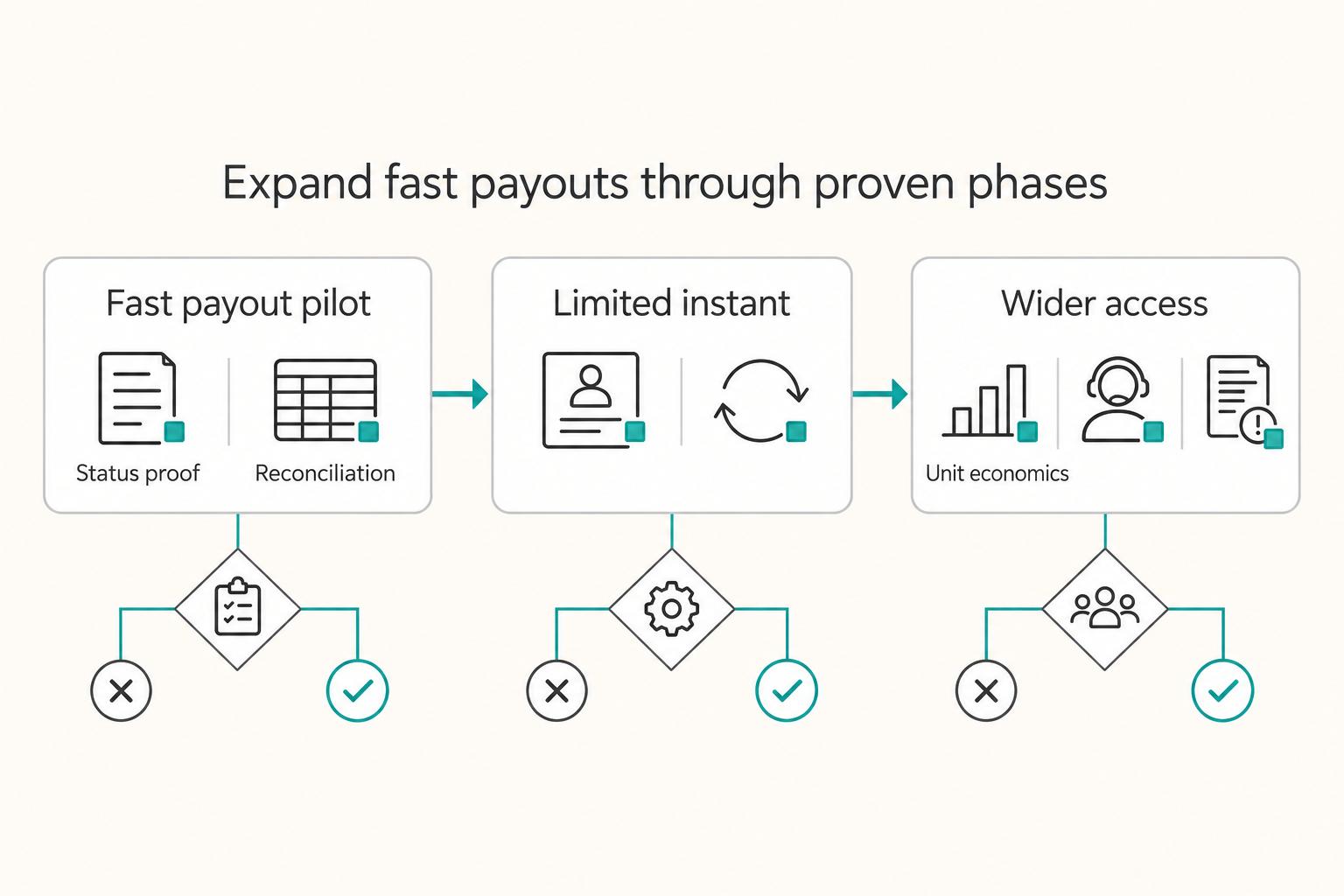
Do not launch fast payouts to everyone at once. Expand in phases only when operations data shows each step is holding. One practical pattern is to start with a narrow cohort, add limited on-demand instant payouts for eligible users, then widen access only after predefined operational and cost checks hold.
Use phased scope, not a broad launch#
Treat each phase as a separate go or no-go decision.
| Phase | Scope | Go/no-go checks before expansion |
|---|---|---|
| Phase 1 | Pilot fast payouts for one predictable cohort | Payout-status visibility is complete, reconciliation closes within your normal window, support pressure is stable, and cost impact is understood |
| Phase 2 | Add limited on-demand instant payouts for eligible users | Eligibility gates still hold, retries stay controlled, exception queues remain manageable, and operators can explain fast-path cost |
| Phase 3 | Expand access, volume, or eligible segments | Unit economics remain acceptable after support load, failure handling, and reconciliation effort |
This sequence is an operating pattern, not a universal standard: prove the simpler speed path before adding a mode with more urgency and user-triggered behavior.
Keep checkpoints objective and pre-defined: payout success signals, reconciliation lag, support ticket trend, and cost variance versus your existing baseline. If you cannot pull those cleanly from payout-status data, reconciliation records, and support tooling, fix instrumentation first. Pine Labs' emphasis on complete payout-status visibility reflects the level of visibility you need before widening scope.
Make the checkpoint pack concrete#
Run each launch review on the same evidence pack for the review window:
- Payout status report by route and cohort
- Reconciliation break report with aging of open items
- Support ticket trend for payout timing, failures, and fee disputes
- Cost-variance view versus your existing baseline
- Retry counts and low-balance alerts
Before each scope increase, test full workflow behavior in sandbox, including degraded paths, not just a happy-path API call. Also monitor retries directly. Auto-retry may improve completion, but it can hide routing issues if you only look at final success.
Define rollback before launch day#
Write rollback rules before launch day. If you wait for an incident, decisions become subjective.
Possible rollback or review triggers include sustained failure spikes, unresolved reconciliation breaks past your normal close window, or policy abuse that pushes excessive volume to the costly fast path. The World Bank fast-payments framing on review triggers is a useful governance model here. Some signals should force review.
Put named owners on the decision#
Use named owners for each decision, adapted to your org:
- Product: offer design and audience eligibility
- Engineering: routing, retry behavior, and status integrity
- Finance ops: reconciliation and checkpoint evidence pack
- Risk: policy gates and escalations when pre-settlement checks fail
Where available, add maker-checker roles early for manual overrides and exception releases so expansion decisions and emergency actions stay auditable.
Track performance after launch and know when to adjust#
After launch, use one shared scorecard and adjust quickly when speed, cost, or exception signals drift. If payout costs rise or exception queues age while fast-payout usage stays flat, do not expand by default. Reprice, tighten eligibility, or move the wrong cohort back to slower payout options.
Keep one operator scorecard#
Use one scorecard across product, finance ops, and risk so decisions come from the same operating view.
| Metric | What to measure | What it tells you |
|---|---|---|
| Adoption of faster payout options | Share of eligible users or payouts choosing the faster option | Whether faster access is actually valued |
| Usage of on-demand instant payouts | Requests per eligible user, not per total user base | Whether urgency is sustained or just novelty |
| Net cost per payout | Direct payout cost plus support and exception handling | Whether the fast path is still commercially defensible |
| Exception resolution time | Time from failed or flagged payout to clean resolution | Whether finance ops and support can keep up |
Track usage against the eligible base, not the full population. If instant access depends on setup, for example an eligible debit card linked before requests, low usage may reflect eligibility friction rather than weak demand. Also verify that immediate confirmation on real-time rails is visible in payout status views for both sides of the transaction. If those systems lag, your scorecard can look healthier than operations actually are.
Review by segment, not in aggregate#
Review outcomes by cohort on a regular cadence. Some segments will value speed enough to justify the cost, while others are better served by scheduled payouts. That mixed model is normal, and scheduled ACH deposits can still fit a meaningful share of users.
Check realized timing by cohort instead of assuming uniform performance. Early-access reporting that funds arrived within a minute or two is useful as observed segment behavior, not a universal promise.
Adjust scope or pricing quickly#
When economics drift, act quickly. If a cohort uses on-demand speed without clear operational benefit, reduce access, reprice, or steer that cohort toward scheduled payouts. If exceptions climb, tighten approvals and fraud checks before routing more volume to real-time paths, since those payments are final and irrevocable.
Conclusion#
The right decision is usually not "fastest everywhere." It is the payout mix your margins, routing coverage, and controls can sustain when exceptions happen.
| Method | Example cost | Qualification |
|---|---|---|
| ACH | $0.20 to $1.50 per transaction | Source-specific example, not a market guarantee |
| RTP | $0.50 to $1.50 | Source-specific example, not a market guarantee |
| Card methods | 1.5% to 3%; about $15 to $30 on a $1,000 payout | Source-specific example, not a market guarantee |
| Checks | $3 to $10 all-in | Source-specific example, not a market guarantee |
Demand for faster access is strong, but it is not a blanket promise. PYMNTS reports that 65% of tip earners, 54% of gig workers, and 55% of property owners need same-day access, while only 36% of platforms consistently offer that option. Use that gap as a targeting signal. Prioritize faster paths for cohorts that depend on timing, and keep lower-urgency cohorts on scheduled or same-day options that are easier to run and forecast.
Keep product language aligned with routing reality. Instant routes can require fallback when endpoint coverage is missing, including RTP fallback to same-day ACH in some provider setups. That fallback can keep payouts moving when RTP is unavailable, but it changes the promise. If you cannot confirm the route before confirmation, present timing conditionally and make fallback outcomes visible in support and finance reporting.
Do not model cost on network price alone. One provider comparison cites ACH at $0.20 to $1.50 per transaction and RTP at $0.50 to $1.50. It also cites card methods at 1.5% to 3%, about $15 to $30 on a $1,000 payout, and checks at $3 to $10 all-in. These are source-specific examples, not market guarantees, but they show why failed transfers, support load, reconciliation effort, and fee policy can change the decision.
Controls belong in the critical path. The Faster Payments Council study says broadly available real time fraud tools remain a key need, and business and consumer interface deployment is still a constraint. Expand only when each payout mode can show eligibility, matched money movement and ledger records, and a clearly owned exception path with final resolution.
- Build a comparison table across scheduled, same-day ACH, and on-demand instant paths, including routing limits, fee treatment, support burden, and fallback behavior.
- Convert that into a unit economics model against your current baseline, including absorbed fees, passed-through fees, and exception-handling cost.
- Pilot one cohort first, then expand only if settlement outcomes, reconciliation lag, support volume, and margin variance stay within acceptable bounds.
When your model is ready for rollout planning, align your implementation checklist with Gruv payouts.
Frequently Asked Questions
Is same-day payouts always cheaper than on-demand instant payouts for platforms?
No. The article does not support a universal cost advantage for same-day payouts. Total cost depends on routing, support load, reconciliation effort, and fee policy.
Can a platform truly offer 24/7 instant access if it still relies on ACH transfers in some cases?
Not as a universal promise. Real-time rails are described as operating 24/7 and completing within seconds, while ACH paths still use batch timing and can take several business days. If ACH fallback exists, describe instant access as conditional on supported and enabled routing.
How should we decide between RTP, FedNow, and Same-Day ACH for contractor payouts?
Use RTP or FedNow when your promise is real-time delivery and funds availability within seconds. Use Same Day ACH when batch timing is operationally acceptable. Before committing, verify API quality, settlement behavior, payee experience, and compliance features with your provider or bank.
Should platforms absorb instant payout fees or pass them through to recipients?
There is no single right fee policy in the article. Treat absorb versus pass-through as a business policy decision based on your bottleneck, cohort behavior, and margin pressure. Keep the policy explicit before confirmation.
What eligibility rules should be in place before enabling instant payouts?
The article does not define universal eligibility thresholds. It says speed should be gated behind your program's checks, which can include identity and business verification, AML-related checks, and fraud checks. Recheck key conditions at submission and make duplicate-request protection explicit before scaling.
What is the minimum evidence we should collect before expanding beyond a pilot?
At minimum, confirm that timing outcomes are visible across both real-time routes and ACH fallback paths. Review results by cohort and fallback path so downgrades or delayed confirmations are clear. Use the same evidence pack each cycle, including payout status, reconciliation breaks, support ticket trends, cost variance, and retry counts.
How do we communicate timing promises safely when coverage varies by bank and program?
Use separate labels for real-time, same-day, and ACH delivery, tied to actual routing conditions. Avoid blanket coverage language and promise only what the confirmed path can reliably deliver. Keep the same conditional wording across the payout UI, help-center copy, support macros, receipts, and fallback messaging.
Researched and edited by the Gruv editorial team. Gruv builds cross-border billing, payouts, and finance-operations software for global businesses.
Sources
- acquisition.gov/far/2.101trusted
- bis.org/publ/qtrpdf/r_qt2403c.htmtrusted
- cdtfa.ca.gov/taxes-and-fees/manuals/am-04.pdftrusted
- congress.gov/bill/119th-congress/senate-bill/1071/text/eahtrusted
- courts.ca.gov/system/files/2026-03/tcfppm_full_manual_2024...trusted
- ecfr.gov/current/title-30/chapter-II/subchapter-B/par...trusted
- ecfr.gov/current/title-21/chapter-I/subchapter-B/part...trusted
- faculty.haas.berkeley.edu/shapiro/comppolicy.pdftrusted
Educational content only. Not legal, tax, or financial advice.
Related Posts

The Freelance Payment Penalty: A Modeled Audit of Platform Fees, FX Spreads, and Payout Delays
The money rarely disappears through a single, easy-to-spot fee. The real loss is stacked. A marketplace takes its commission, a processor adds a charge for international cards, a bank or payment company converts the currency at a spread, a platform holds the funds before release, and a wire sheds a little to intermediaries on the way in. Each layer looks defensible on its own, but the worker feels the combined result as a smaller deposit and a later payday.

How to Respond to a Subpoena for Business Records
Move fast, but do not produce records on instinct. If you need to **respond to a subpoena for business records**, your immediate job is to control deadlines, preserve records, and make any later production defensible.
A US Expat's Guide to Investing in UCITS ETFs to Avoid PFIC Issues
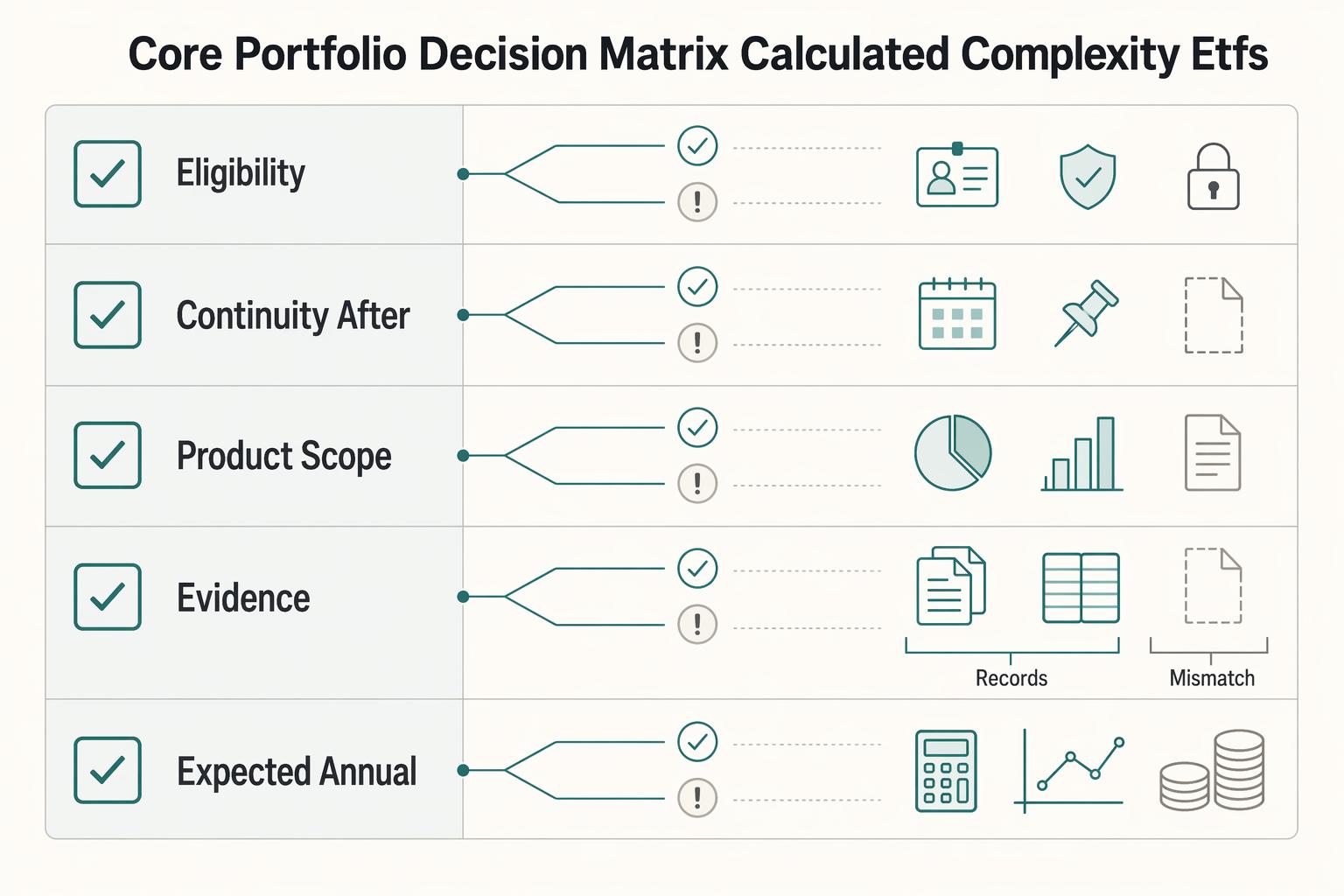
The real problem is a two-system conflict. U.S. tax treatment can punish the wrong fund choice, while local product-access constraints can block the funds you want to buy in the first place. For **us expat ucits etfs**, the practical question is not "Which product is best?" It is "What can I access, report, and keep doing every year without guessing?" Use this four-part filter before any trade: