
Quick Answer
A correspondent wire can involve intermediary banks, so message delivery and account credit are different milestones. Agree the currency, beneficiary details, fee allocation and expected arrival before invoicing. If funds are late or short, obtain the bank’s payment confirmation and UETR, identify the current status, and reconcile the actual sent and credited amounts.
Why an international wire can arrive late or short#
When a client says they paid but your money arrives late, lands short, or is hard to trace, that is a cash-flow risk, not a minor inconvenience. If the amount and timing are uncertain, planning your next moves gets harder.
If you want correspondent banking explained in one line: your transfer usually depends on bank-to-bank correspondent relationships, while SWIFT carries payment instructions between institutions. SWIFT is a messaging layer, not the settlement rail itself. When the sender and receiver banks do not have a direct relationship, intermediary banks and correspondent account structures, including nostro and vostro, may be used to complete the payment.
That setup still works, but it was built around bank-to-bank operations, not lean international teams that need predictable timing, clear fees, and simple tracing. Cross-border payments still lag domestic payments on cost, speed, access, and transparency. That is why the same invoice can arrive on different days and with different deductions depending on the route.
| Path | Speed predictability | Fee transparency | Traceability |
|---|---|---|---|
| Legacy correspondent path | Moderate to low. Banks often publish broad windows (for example, 1 to 2 business days or 1 to 3 days), not a universal SLA | Low to moderate. Other institutions in the chain may deduct fees from principal | Often partial unless your bank shares tracking details such as a UETR |
| Modern networked payout path | Higher in some supported corridors and systems | Varies by provider and corridor | Often better in app or dashboard channels, but not uniform across all routes |
Before you invoice, focus on three practical risks:
- Timeline uncertainty: each handoff may add processing time.
- Compliance interruption risk: incomplete or unclear payment data can trigger additional checks.
- Margin erosion: charges by institutions in the payment chain can reduce what you receive.
Before you invoice, confirm the send currency, the sending bank, and what proof the payer can provide after payment, including UETR details if tracing is needed. Then spot route risk early and choose a collection setup with fewer avoidable failure points.
How the Correspondent Banking Machine Works#
To predict delays and deductions, treat one international wire as two separate processes: a message process and a money-settlement process. Most surprises happen when those two tracks move at different speeds.
| Role | What it does |
|---|---|
| Originator (sender) bank | Starts the payment after your client instructs it |
| Beneficiary (receiving) bank | Should credit your account |
| Correspondent bank | Sits in the middle to help complete the transfer if those banks do not have the needed direct relationship |
Map those roles to your transfer and the chain gets easier to follow. Your client's bank is the originator. Your bank is the beneficiary bank. If they do not have the needed direct relationship, a correspondent bank sits in the middle to help complete the transfer, and some sources use overlapping intermediary terminology.
The accounts that move the money#
SWIFT instructions do not move funds by themselves. Banks settle through accounts they hold with one another. A nostro account is our bank’s account held at another bank; from that other bank’s perspective it is a vostro account. These two names describe the same relationship from opposite sides, not two independent pots of money.
In a typical chain, the sending side can debit a Nostro balance as the instruction moves forward. The process ends when your bank credits your account and the banks reconcile their records.
One wire, two tracks#
A fast message does not guarantee fast settlement. SWIFT carries standardized instructions between institutions; credit to your account depends on the banks completing the settlement and receiving-bank processing.
A typical path looks like this:
- Your client initiates payment at their bank.
- The sender bank sends a SWIFT payment instruction.
- If no direct relationship exists, one or more correspondent or intermediary banks pass the instruction onward.
- In parallel, funds settle through interbank accounts, including Nostro and Vostro structures.
- Your beneficiary bank receives what it needs and credits your account.
Use the sending bank’s estimate for the actual currency, destination, cutoff and route. An intermediary review, holiday, or missing detail can delay the expected credit. Message delivery alone is not evidence that funds are available to you.
| Layer | Purpose | Who controls it | What you can usually see | Common failure points |
|---|---|---|---|---|
| SWIFT message layer | Sends standardized payment instructions | Banks sending and receiving messages over SWIFT | Visibility varies by bank and is often partial | Extra routing hops, message and settlement timing mismatch |
| Funds settlement layer | Moves actual money between interbank accounts | Banks managing the relevant interbank balances | End-to-end visibility is not guaranteed; updates usually come via your bank | Delays at handoffs, correspondent fee deductions, lag before final credit |
For cash-flow planning, use a simple rule: once a middle bank is involved, expect more timing uncertainty and a higher chance of deductions. That is why the next two risks matter so much: compliance scrutiny inside the chain and stacked fees before the funds reach you.
Why another bank can pause a payment#
Once your wire enters a correspondent chain, your bank is no longer the only decision-maker. Intermediary and beneficiary institutions may apply their own sanctions screening and AML controls. So your payment can be paused even if your own bank already knows you and accepted the transfer.
Cross-border flows are less transparent and involve multiple independent actors. In practice, a middle bank often has to judge risk from the payment message it receives. If legal names, account identifiers, beneficiary fields, and remittance details do not line up, that bank may process, reject, or suspend the transfer while it investigates.
Why your bank cannot clear this for everyone else#
A correspondent bank is not just passing a message through. It is an independent risk gatekeeper in the chain. In U.S. correspondent-account rules, institutions are expected to detect potential money-laundering activity on an ongoing basis and review whether activity matches expected account behavior.
That is why a payment that looks normal to you can still be flagged mid-route. Sanctions screening and name screening are central here. A true match can stop movement for legal reasons, and an ambiguous match can still trigger manual review. Holds can happen on legitimate payments when data is incomplete, inconsistent, or unclear.
The triggers you can actually control#
The practical takeaway from FATF's June 2025 Recommendation 16 update is straightforward: cleaner, more consistent payment-message data can reduce avoidable holds. Focus on the fields you can control before invoicing:
| Common trigger | What the bank sees | What you can do before invoicing |
|---|---|---|
| Vague remittance text | Unclear business purpose and weak payment transparency | Use specific descriptors (project name, invoice number, service period) instead of generic text |
| Legal-name mismatch | Name-screening alert or inconsistency across invoice, beneficiary, and bank message fields | Use the exact legal beneficiary name on the account and share reusable payment instructions clients can copy exactly |
| Pattern deviation | Activity that appears inconsistent with expected account purpose or profile | Pre-flag first-time countries, unusually large invoices, or payer-entity changes with your bank and client |
Counterparty profile matters too. Even with a legitimate client, scrutiny can rise if the payer entity differs from the contract, the corridor is unusual for the account, or the beneficiary and remittance fields tell different stories.
What the black box feels like in practice#
When a payment is flagged, your bank may receive only partial updates while an investigation moves institution by institution. Keep the original estimated arrival date and the latest bank-confirmed status together so you can distinguish an overdue payment from one still within its expected processing window.
| Evidence | Why keep it |
|---|---|
| Invoice | Include it in the evidence pack before payment is sent |
| Contract or SOW | Include it in the evidence pack before payment is sent |
| Exact beneficiary instructions | Include them in the evidence pack before payment is sent |
| Payment reference details | Include them for tracing |
You feel the impact as delayed cash flow and client-trust pressure when funds were sent but have not been credited yet. For material invoices, prepare an evidence pack before payment is sent. Include the invoice, contract or SOW, exact beneficiary instructions, and payment reference details for tracing.
A clean payment cannot guarantee zero review. But consistent legal names, clear invoice metadata, and standardized instructions can reduce holds caused by preventable data issues. For more on why credits land short, see Decoding International Wire Transfers: Why You're Losing Money.
How charges reduce the amount you receive#
Your margin is determined by what gets credited, not what gets invoiced. If you rely on international wires, plan around net receipt from the start, because deductions can accumulate across the correspondent chain and can affect profit and cash-flow timing.
Cross-border wires often pass through multiple banks when there is no direct payer-to-payee link. So even if your client pays an outgoing fee, other institutions can still deduct from principal before funds arrive. In practice, the sent amount, converted amount (if conversion occurs), and credited amount can be three different numbers. Use this structure when you price and reconcile payments:
- Sender charge: outgoing wire fee at the sender's bank.
- Intermediary lifting charge: fee deducted by one or more correspondent or intermediary banks in transit.
- FX spread or markup: exchange-rate margin applied during conversion, separate from transfer fees.
- Receiving charge: fee charged by the beneficiary bank for incoming wire processing.
Where the money disappears#
Count fees in the currency and place where they actually apply. A sender fee charged separately does not reduce transfer principal. If the executed exchange rate already includes a markup, do not subtract that spread again. For example, a hypothetical $1,000 principal less $20 in pre-conversion deductions at €0.90 per dollar, then a €5 receiving fee, credits €877. A separate $10 sender fee raises the sender’s cost to $1,010 without reducing that principal again.
| Stage | Calculation | Currency and fee basis |
|---|---|---|
| Transfer principal | P | Amount instructed, which may differ from the invoice amount |
| After principal deductions | P - F_s - F_i | Source currency; F_s is only a sender fee actually deducted from principal, F_i is intermediary deductions before conversion |
| After conversion | (P - F_s - F_i) × r | Destination currency; r is the actual executed rate in destination units per source unit |
| Net credited | (P - F_s - F_i) × r - F_d | Destination currency; F_d includes deductions after conversion and receiving fees charged against the credit |
Set charge code before payment#
Your main lever is the SWIFT charge code: OUR, SHA, or BEN. It sets who is meant to absorb transaction charges. Confirm it in writing before payment is sent.
| Charge code | Sender bank charges | Intermediary charges | Receiving charges | Practical effect for you |
|---|---|---|---|---|
OUR | Sender pays | Sender intends to pay | Sender intends to pay | Stronger principal predictability, but not guaranteed in every corridor due to local practices |
SHA | Sender pays | Beneficiary pays | Beneficiary pays | Shared model, expect deductions from the received amount |
BEN | Beneficiary pays | Beneficiary pays | Beneficiary pays | Highest deduction risk to your net receipt |
If your contract depends on full net receipt, state OUR and the settlement currency explicitly. Keep some tolerance in your forecasts, because some routes can still produce a short credit.
Pre-invoice controls#
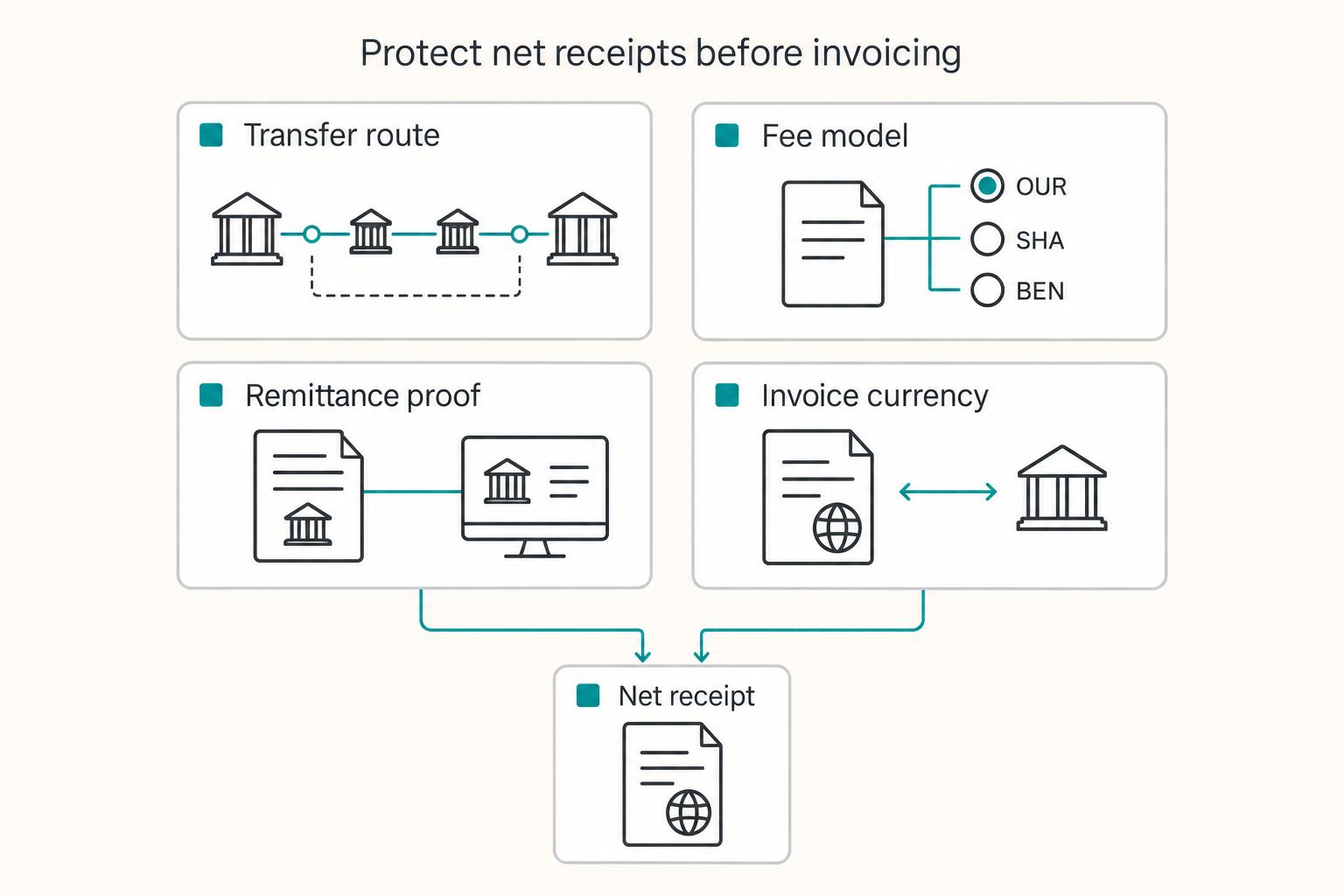
Fee variability is not just a nuisance. It is a control issue. Before the first payment on a route, check the items that actually affect your net receipt:
- Confirm the transfer route: ask whether intermediaries are involved and verify that routing details are complete.
- Confirm the fee model in writing: specify
OUR,SHA, orBENin contract terms, invoice notes, or payment instructions. - Request full remittance details: for material invoices, ask for payment confirmation and complete transfer details when tracing is needed.
- Align invoice currency where possible: matching the invoice currency and receiving-account currency helps reduce avoidable conversion drag.
If the agreed route uses SHA or BEN, state how shortfalls are handled in the contract. OUR can improve predictability but is not available or honored on every route; confirm the bank’s permitted charge options and any full-value service rather than relying on invoice wording alone.
Before you choose a payment route, run your usual invoice scenario through the Payment Fee Comparison tool to check total cost, not just headline fees.
Change the Route: Local Receipt and Local Payout Where Supported#
If the route itself is creating the problem, the cleanest fix is often to change the route. Where your payer corridor is supported, a practical way to reduce delays and surprise deductions is to use a platform flow built on local receipt and local payout rather than a correspondent-wire chain. The main benefit is operational: often a shorter payment path, clearer routing, and fewer handoffs.
What actually changes#
In a traditional wire, one payment can move through a chain of correspondent and intermediary banks before final credit. Those banks pass SWIFT instructions to debit and credit accounts. That adds steps that neither you nor your client directly control.
In a local-rail platform flow, your client pays into local receiving details and you are paid out locally where that route is available. In practice, that can replace one cross-border bank chain with local transfers connected inside the platform model, for example domestic rails such as ACH or BACS.
Compliance checks still apply in both models. AML and transaction monitoring can still trigger a review or a request for more information, so this is not a no-checks path.
| Attribute | Traditional correspondent wire | Modern platform using local rails |
|---|---|---|
| Transfer path | Cross-border wire through correspondent or intermediary banks | Local receipt and local payout where supported |
| Fee transparency | Sender fees may be visible, but intermediary or beneficiary deductions can appear later | Varies by provider and route; confirm fee and conversion terms before confirmation |
| FX handling | May include route-dependent deductions and bank-side conversion decisions | Conversion and payout rules are set by the platform flow for that route |
| Traceability | Often relies on bank-side tracing | Depends on provider tooling; SWIFT traces apply when the route is a wire |
| Exception handling | Delays can occur anywhere in the bank chain | Reviews and unsupported routes can still delay payout |
How you implement it#
Start with your real payer corridors, not brand preference. Route availability depends on country, currency, account type, and eligibility.
| Action | What to confirm |
|---|---|
| Pick your highest-volume corridors first | Confirm local receiving support for the payer side and local payout support for your side |
| Verify exact receiving details | Use the named local details provided for that route and confirm the payer is not defaulting to an international wire |
| Standardize payment instructions | Use one invoice template with receiving currency, account name, account details, and the required payment reference |
| Run a low-risk test payment first | Confirm the credited amount, timing, and reconciliation trail before full rollout |
Where wires still matter#
Wires still matter because some corridors, banks, or payer setups require SWIFT. Even platforms with local receiving options note cases where local routes are not available.
When a wire is delayed, ask the sending bank for payment confirmation, including the ISO 20022 details or legacy MT103 where supplied, plus the UETR. CBPR+ interbank payment instructions moved to ISO 20022 after coexistence ended in November 2025, so the bank may provide pacs.008-based details rather than an original MT103. Use the confirmation to initiate a trace; it does not prove beneficiary credit.
Use local-rail routes where they are supported and tested, and keep a wire fallback process ready for exceptions. We covered this in detail in A Guide to the 'For Further Credit' (FFC) Instruction in Wire Transfers.
Conclusion: Treat Cross-Border Payments as a Repeatable Process#
What changes is control: treat cross-border payments as a repeatable process, not a guess. Before each invoice, decide the route you want, define the records you need, and set an escalation path in advance. This can reduce reactive follow-up and make cash-flow operations more predictable, because you have a clearer way to verify what was sent and what to do next if timing slips.
Use this short checklist on every payment:
- Choose the payment route by corridor, and confirm the payer will use that exact route.
- Standardize invoice and payment details so your records stay consistent.
- Predefine trace and escalation steps for each route, including who can confirm current status.
- Document a fallback path for the next invoice if the first route becomes unavailable.
If your next step is building a cross-border payout workflow with clearer status tracking, review Gruv Payouts and confirm coverage for your market.
Frequently Asked Questions
Why is my international wire transfer slow and expensive?
Correspondent payments can move through third-party intermediary banking relationships, and transaction and fee tracking in that path can add complexity. Exact timelines and total deductions are route-specific. First confirm the route used, then collect the send date, amount, currency, beneficiary details, and payment reference from the sender and your bank.
Are SWIFT and correspondent banking the same thing?
No. SWIFT is the messaging network, while correspondent banking is the bank-to-bank intermediary relationship used to support cross-border transactions. For a specific transfer, ask your bank to confirm both the messaging channel and the settlement route.
What is the difference between a correspondent bank and an intermediary bank?
An intermediary bank is the broad role: a bank acting between the sender and receiver. A correspondent bank is a specific intermediary relationship used to support cross-border transactions, including managing nostro and vostro accounts that track transactions and fees. If route details are unclear, ask your bank or platform which institutions handled the payment and whether a correspondent relationship was part of that path.
Can a correspondent bank hold or reject my payment?
A third-party bank in the chain may be part of the review path, and correspondent banking is treated as higher risk because it relies on third-party KYC controls. Do not assume the reason unless your bank or platform confirms it. Ask whether the payment is pending, returned, or under review, and keep your invoice, payment instructions, remittance proof, and notices in one evidence file.
Why did I receive less than my client sent?
Transactions and fees are tracked across correspondent routes, so differences can appear between sent and credited amounts. Reconcile by comparing your invoice amount, sent amount and currency, credited amount, and sender or bank records. If the payment used a platform route, check what fees and conversion terms were disclosed before confirmation.
When should I use a local-rail platform payout instead of a wire?
Choose based on the route that was actually used and the records your provider can supply for that route. There is no universal winner from route type alone, so confirm the path before troubleshooting and keep route-specific records.
What should I ask my bank or platform when a payment is delayed?
Ask in this order: what route was used, what status the payment is in now, and which institutions handled it. Then ask what payment record they can provide for that route.
What should I document before escalating a missing payment?
Keep one record set with your invoice, exact payment instructions, payer proof of payment, payment reference, date, amount, and currency. Add screenshots of the selected route or payout method so you can spot mismatches quickly. For the wire tracing document path, use What is a SWIFT MT103 and How to Use It to Trace a Wire Transfer.
Try a related tool
Researched and edited by the Gruv editorial team. Gruv builds cross-border billing, payouts, and finance-operations software for global businesses.
Sources
Includes 4 external sources outside the trusted-domain allowlist.
- bsaaml.ffiec.gov/docs/manual/BSA_AML_Man_2014_v2_CDDBO.pdftrusted
- ecfr.gov/current/title-31/subtitle-B/chapter-X/part-1...trusted
- occ.gov/publications-and-resources/publications/comp...trusted
- egypt.hsbc.com/terms/schedule-of-services-and-tariffsexternal
- fatf-gafi.org/en/publications/Fatfrecommendations/update-R...external
- swift.com/standards/iso-20022/iso-20022-programmeexternal
- swift.com/sites/default/files/files/pmpg_end-of-coexis...external
Educational content only. Not legal, tax, or financial advice.
Related Posts

How LLC Owners Separate Business and Personal Finances
For an LLC, separating business and personal money is best treated as a weekly habit, not a one-time bank setup. It keeps records cleaner, cuts month-end cleanup, and creates clearer boundaries as the company grows.

How to Use a SWIFT MT103 to Trace a Delayed Wire Transfer
If you have an MT103 copy, start with `Field 20` and the UETR when available, then verify the core details before you contact the bank. The identifiers help its wire team locate the instruction; ask the bank to authenticate the status rather than relying on the appearance of the copy.

The Freelance Payment Penalty: A Modeled Audit of Platform Fees, FX Spreads, and Payout Delays
The money rarely disappears through a single, easy-to-spot fee. The real loss is stacked. A marketplace takes its commission, a processor adds a charge for international cards, a bank or payment company converts the currency at a spread, a platform holds the funds before release, and a wire sheds a little to intermediaries on the way in. Each layer looks defensible on its own, but the worker feels the combined result as a smaller deposit and a later payday.