
Quick Answer
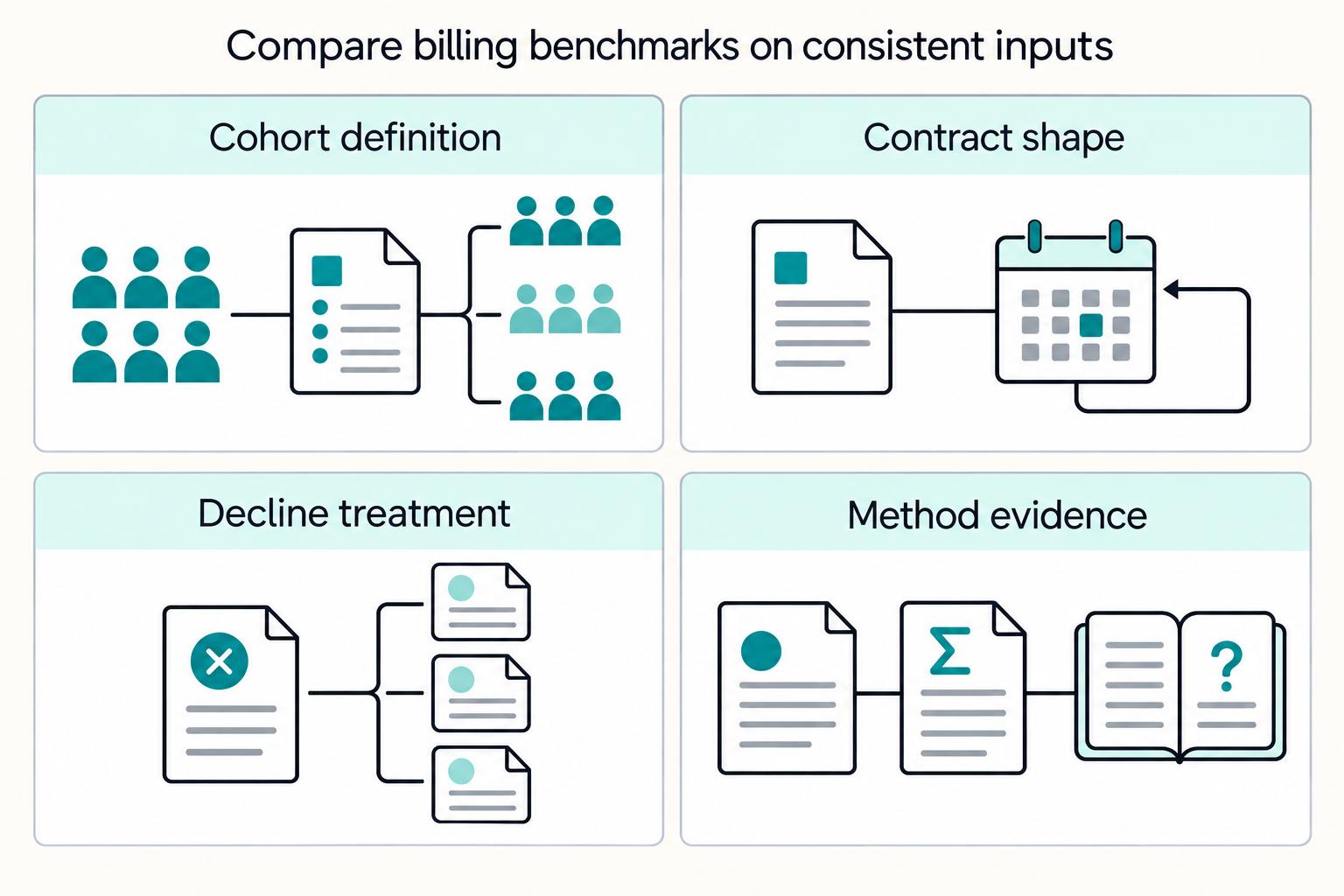
Start by normalizing one vertical-country cohort before comparing benchmark figures. Keep formulas fixed for gross churn, net churn, expansion, and NRR, and measure decline behavior with a method that removes retry noise. Hold ACV tier, contract term, and billing interval constant so differences reflect operating reality rather than mixed definitions. Then run a 90-day intervention cycle and decide to scale only if retention economics improve in that same slice.
How to Read SaaS Billing Benchmarks Before Expansion#
For expansion decisions, treat payment decline rate, churn, and expansion as one system, not three separate metrics. That gives product, finance, and GTM a view they can defend before rollout resources are committed. If you own the budget call, you need that view before your team starts treating one good month as a trend.
The linkage is practical. Payment failures can drive involuntary churn through declined transactions, expired cards, and bank errors. Expansion reflects the additional recurring revenue existing customers generate each month. A business can show strong account growth and still leak revenue through billing failures. When expansion outweighs churn, you can reach net negative churn, but only if the underlying billing picture is real. If you cannot show where failed payments are leaking revenue, your team can mistake billing noise for healthy expansion.
Start with measurement quality. Track decline rate over time using unique declines, and exclude failed retries so authorization health is not distorted. Apply the same discipline to churn and expansion math so teams are not comparing mismatched definitions. We recommend locking one definition set before you show benchmark slides, because mixed formulas will give your team false confidence. We would rather pause the deck than ask your team to defend metrics built on mixed formulas.
Benchmarks help, but they do not prove anything on their own. Benchmark sources stress filtering by comparable attributes such as company size, ACV, GTM motion, and pricing model. Some also use explicit comparison windows, including a 14-month default. If formulas, cohorts, or time windows differ, the numbers can all be true and still not be comparable. If you are comparing sources, you need one comparison rule before you carry those numbers into planning.
Build a practical evidence pack with:
- metric definitions and formulas for churn, expansion, and net effects
- cohort filters matched to comparable attributes (company size, ACV, GTM motion, pricing model)
- decline analysis based on unique declines with failed retries excluded
- methodology notes, glossary, and comparison window
If those pieces are missing, treat any benchmark as directional.
Related reading: How OTT Platforms Handle Billing Trials and Churn in Streaming Subscriptions.
Define the metrics before you compare anything#
Benchmark comparisons only hold up when each metric uses a fixed denominator and a consistent formula. Before you rank markets, keep customer-count metrics separate from revenue-based metrics.
| Metric | Definition |
|---|---|
| MRR | Predictable recurring monthly income from customers. |
| Expansion MRR | Additional MRR from existing subscribers who upgrade or add services or features. |
| Logo churn | Customer loss rate, measured against paying customers at the start of the period. |
| Revenue churn | The rate at which subscription revenue leaves the business. |
| Gross MRR churn | Loss only: churned MRR plus contraction MRR, excluding expansion. |
| Net MRR churn | Churn and contraction minus expansion and reactivation. |
| NRR | Retained revenue from existing customers after churn, contraction, and expansion; published formulas vary across sources, and it is commonly measured over 12 months. |
A common mistake is mixing business models and denominators in one benchmark set. A B2B logo churn figure with a customer-count denominator and a B2C revenue churn figure with an MRR denominator can both be accurate and still not be directly comparable. At least one vendor documents separate formula treatment for B2B and Shopify-style B2C, so treat formula variance as the default until you verify it.
Formula guardrails#
Use these formulas consistently across internal reporting and any external source you compare:
- Logo churn = churned paying customers during period / paying customers at start of period
- Gross MRR churn = (churn MRR + contraction MRR) / starting MRR
- Net MRR churn = (churn MRR + contraction MRR - expansion MRR - reactivation MRR) / starting MRR
- Expansion MRR = added recurring revenue from existing customers only (not new logos)
- NRR = retained existing-customer revenue, using one explicitly defined formula consistently across the sources you compare
Before you use any benchmark, run two checks. First, confirm free-trial and free-plan users are excluded from paid churn. Second, confirm formula settings and history. For example, ChartMogul retired its churn-rate formula setting on August 15, 2022, which can affect comparability across historical setups. If formula choice, denominator, or customer eligibility is unclear, treat the benchmark as directional.
For scenario planning around MRR and churn, read Subscription Revenue Forecaster for MRR and Churn Scenarios.
Normalize your benchmark inputs so results are comparable#
Do not rank markets until your input pack is standardized. If sources use different cohort definitions, churn formulas, or retry treatment, you are comparing method noise, not market reality.
Standardize around the same five fields across internal cohorts and external sources:
- Segment: a clearly bounded group (for example, B2B SaaS, self-serve, enterprise, SMB)
- Annual Contract Value (ACV) band: ChurnZero recommends ACV segmentation for retention context, and Maxio supports ACV-based filtering
- Contract term: monthly, annual, multi-year, or usage-based with minimum commit
- Billing interval: monthly invoice, annual prepay, quarterly, or another recurring pattern
- Payment decline rate: unique declines only, with failed retries excluded
Decline handling is one of the easiest ways to break comparability. Stripe explicitly recommends analyzing unique declines and excluding failed retries. Raw failed-payment counts can reflect retry policy rather than underlying authorization performance.
Keep gross loss separate from recovery#
Track gross lost MRR before recovery as the loss signal, and track dunning and recovery separately. Stripe notes that many failed subscription payments are recoverable, so do not blend recovery wins into the initial loss rate.
For each cohort, keep three views side by side: starting MRR, gross lost MRR before recovery, and recovered MRR after retries or dunning. If Smart Retries is enabled, document it. Stripe's recommended default is 8 tries within 2 weeks. Also split hard and soft declines, because Smart Retries does not retry hard declines.
Grade the evidence before you use it#
Different sources are useful for different jobs, so check method quality before you turn any figure into a target.
| Source | Useful for | What to verify | Planning posture |
|---|---|---|---|
| Stripe | Decline analysis and recovery mechanics | Unique declines, retry treatment, hard vs soft decline handling | Operations guidance, not cross-company benchmark targets |
| ChurnZero | B2B SaaS retention context | Cohort construction, ACV segmentation, respondent scope | Stronger when your profile matches its cohort |
| Maxio | B2B SaaS peer filtering by size and ACV | Churn formula used, segment filters, report year and sample | Useful when cohort matching is close |
| Churnfree | Directional niche context | It states figures are estimated from multiple studies and averages | Directional until replicated with primary data |
| Vena Solutions | Market narrative with cited research | Underlying Oracle research design | Do not set hard targets from the article alone |
Method variance is the real risk here. Maxio states that churn has no firm universal calculation method, while other sources use specific cohort constructions. Both can be useful, but they are not automatically comparable.
What your evidence pack should include#
For each number, record the report date, sample description, formula, cohort window, retry treatment, and any missing-methodology flags. If a source cannot clearly document those items, keep it out of budget assumptions.
Once ACV band, contract shape, billing interval, and decline treatment are aligned, market comparisons become more useful and less method-driven.
Compare verticals with one operator scorecard#
Use one scorecard across all candidate verticals. Favor the vertical where Net MRR churn improves when dunning and recovery interventions are tested, not the one with the biggest headline MRR growth.
Logo churn and revenue churn need to be read together. ChartMogul distinguishes logo churn from revenue churn, and the two can diverge when revenue is unevenly distributed across accounts.
| Candidate vertical | Logo churn | Revenue churn | Expansion | Payment failure rate | Observed NRR sensitivity | Billing exceptions | Dunning burden | Data quality requirement |
|---|---|---|---|---|---|---|---|---|
| Core vertical | % of starting customers in matched cohort | Gross and net % of starting MRR | % of MRR gained from existing customers only | First-attempt failure % on recurring subscription payments | Does NRR move after recovery interventions? | Low / medium / high, with examples | Low / medium / high, by invoice volume and retry load | Record source, formula, cohort window, exclusions |
| Candidate vertical A | Fill from same cohort rules | Fill from same cohort rules | Fill from same cohort rules | Fill from same cohort rules | Compare pre- and post-dunning result | Score with notes | Score with notes | Confirm method parity with core vertical |
| Candidate vertical B | Fill from same cohort rules | Fill from same cohort rules | Fill from same cohort rules | Fill from same cohort rules | Compare pre- and post-dunning result | Score with notes | Score with notes | Confirm method parity with core vertical |
Read the scorecard in order#
Read the scorecard in sequence. Start with logo churn and revenue churn together, then separate growth from recovery. Expansion is revenue from existing customers. Recovery is revenue reclaimed after failed payments through retries, emails, or related interventions.
For decline comparisons, keep metric scope consistent. Stripe defines failure rate as first-attempt failures on subscription payment volume. Its recovery analytics cover recurring subscription payments while excluding the first invoice payment after a trial.
Add operating load, not just outcome#
A vertical can look good on top-line metrics and still be painful to scale if billing operations are heavy. Keep these columns explicit:
- Billing exceptions: manual overrides, off-cycle credits, or custom handling that increase operational friction
- Dunning burden: effort required to protect revenue after failed payments; Recurly frames involuntary churn as measurable and preventable, and estimates a 7.2% monthly subscriber risk without decline management
- Data quality: whether you can cleanly separate gross churn, recovered revenue, and reactivation using consistent cohort rules
High expansion can still be the wrong choice#
High expansion is not enough if recovery is weak and reactivation stays low. In practice, two verticals can show similar growth while only one improves net churn after recovery changes.
Observed NRR sensitivity can be the tie-breaker. If recovery improvements materially move NRR, billing operations are likely a real growth lever in that vertical.
Stripe reports that recovery tools recover 56% of failed recurring payments on average on its platform, and Smart Retries recover 9% more revenue than set-schedule retries. Recurly reports over $155 million recovered in software and nearly $100 million in digital media in 2025. These are platform-specific results, not universal market benchmarks, but they support treating decline recovery as a strategic expansion variable.
For a step-by-step walkthrough, see Subscription Churn Benchmarks by Vertical.
Compare countries by payment constraints before GTM rollout#
Before you broaden GTM, score countries on payment constraints first. Persistent billing friction is a rollout risk, not something to clean up later. If you cannot reliably authorize and settle recurring payments in a country, stage that market behind a narrower B2B SaaS cohort first.
A country comparison is not about finding one global decline benchmark. It is about checking how local authorization, authentication, settlement, payout, and compliance rules can affect renewal and expansion metrics.
| Country | Reliability signal to verify first | Local failure pattern to watch | Settlement/payout constraint | Compliance and tax checkpoint | Likely metric impact if missed |
|---|---|---|---|---|---|
| India | Recurring mandate creation and off-session renewal success | Off-session recurring payments without a mandate are declined; recurring transactions over 15,000 INR require AFA each time | Banks must send a pre-debit alert at least 24 hours before charge; Stripe states it delays collection by 26 hours in this flow | Keep mandate and AFA handling in recurring billing ops | More failed renewals can raise Gross MRR churn and limit off-session collection |
| Netherlands | Payment-method fit for intended segment | iDEAL is widely used (70% of e-commerce transactions) and only works with EUR | Settlement timing varies by method | For in-scope online card payments, PSD2 SCA requires 3D Secure; EU B2C VAT rules changed on 1 July 2021 with an EU-wide EUR 10 000 threshold | Method mismatch can suppress conversion and payment completion even when product demand is present |
| Belgium | Entity onboarding readiness before go-live | Verification requirements differ by country and entity type | Processing and payouts can be blocked until verification completes; credit-card settlement depends on issuer country or region and is typically up to 7 days | A sole proprietorship in Belgium requires a registration number | Onboarding friction slows billing velocity and can look like weak market demand |
Decline diagnostics alone are not enough for country decisions. Issuers decide authorization outcomes, and many issuer declines come back as generic, so you need method-level and onboarding evidence, not just decline labels.
KYC, KYB, AML, and tax checks belong in the same launch checklist as payment performance. These controls are jurisdiction-specific, and payout availability also varies by country and industry. A single global compliance template creates avoidable launch delays.
Before you call a country attractive, verify these items:
- payment-method mix for your target segment
- share of issuer declines that are generic versus practical
- 3D Secure completion for in-scope card flows
- recurring mandate setup and renewal outcomes where applicable
- settlement timing by method and payout availability and timing by country and industry
- KYC or KYB document requirements by legal entity type
- VAT handling for the planned selling motion
If country evidence shows persistent decline friction or repeated compliance blocking, hold the broad GTM rollout and run a tighter B2B SaaS phase first.
If expansion will add more trial conversions or plan changes, read Subscription Billing for SaaS Teams Handling Trials and Plan Changes.
Connect payment declines to churn and expansion with clear triggers#
Treat a rising Payment decline rate as a retention and expansion risk first, not a side metric. Higher declines can drive involuntary churn, increase churn-related revenue loss, suppress expansion collection, and reduce Net Revenue Retention (NRR) even when customers still value the product.
The causal chain is simple. Failed renewals can still create churn without an active cancel because involuntary churn is often caused by payment or banking issues. Since NRR nets churn losses against expansion gains, decline-driven losses will drag it down unless expansion offsets them.
Separate recoverable failures from structural ones#
Dunning management matters because many failed payments are recoverable, but not every failure should be retried the same way. Soft declines are temporary and can respond to controlled retries. Hard declines usually need intervention first, and automatic retries do not apply when no payment method is available or when the issuer returns a hard decline code. We recommend telling your team which declines you retry automatically and which ones require human review.
Before you change product or GTM assumptions, split failures into two groups:
- Avoidable or potentially recoverable: soft declines, temporary issuer or banking issues, and cases where reminders plus later retries may succeed
- Structural or intervention-led: hard declines, missing payment methods, and other cases where dunning alone is unlikely to recover payment
Instrumentation is the checkpoint. Capture a coded decline field such as refusalReasonCode or equivalent, along with first attempt versus retry, payment method, country, and invoice outcome. Without that, you cannot reliably separate billing friction from customer intent. If your team cannot query those fields, you cannot defend the diagnosis.
Use trigger logic instead of one magic benchmark#
Do not use one universal decline threshold across SaaS models. Braintree cites about 10% as an acceptable decline-ratio reference point, but also says it varies by industry and business model.
| Action category | Trigger to use | What to verify before acting |
|---|---|---|
| Instrumentation fix | Declines rise while usage and voluntary cancellations are stable, and many failures are uncategorized | Capture refusalReasonCode (or equivalent), split first attempts from retries, and segment by country, payment method, and invoice type |
| Retry logic update | Soft declines rise and automated recovery is weak | Restrict retries to recoverable cases; Stripe's 8 tries within 2 weeks is a starting pattern, not a universal schedule |
| Billing UX change | Hard declines or missing payment methods dominate, and customers do not complete update flows after reminders | Check payment-method update completion, reminder timing, and clarity of the in-app and invoice-email recovery path |
| Market escalation review | Declines remain elevated after instrumentation, retry, and UX fixes, especially in one country or method | Use your own scorecard and internal thresholds; this does not validate universal country-level hold/go cutoffs |
Also separate unique failed invoices from total retry attempts. Repeated attempts on the same payment method can inflate decline ratios, and excessive retries can create network-cost and compliance pressure.
If declines climb while product usage stays stable, diagnose billing risk first. Check involuntary churn exposure, recoverability mix, and dunning behavior before you label the problem as product-market churn or rewrite your expansion thesis. If you skip that check, you can spend on growth while your billing stack is still the leak.
For a clearer view of MRR, ARR, and churn in pricing decisions, read Subscription Metrics MRR ARR and Churn for Better Pricing Decisions.
Choose segment targets by ACV and contract shape#
Avoid benchmarking churn or expansion on blended cohorts alone. Start by comparing performance inside one Annual Contract Value (ACV) band and one contract shape, so one cohort does not hide another.
ACV is the annualized recurring value of a customer contract, and retention benchmarks explicitly call for ACV segmentation. ChurnZero recommends segmenting by ACV for retention analysis, and ChartMogul shows why pooled comparisons mislead: businesses below $10 ARPA can see 6-7% monthly churn, while $500+ ARPA businesses are closer to 1-2%. A single "good churn" number across both is not useful.
Use ACV bands before judging churn quality#
The point is comparability, not that one band is inherently better. The same churn rate means different risk depending on account value and contract expectations. ChartMogul also notes that 5% monthly churn compounds to about 46% annual customer loss, so a monthly figure that seems acceptable can still be severe.
SaaS Capital also reports growth-rate differences across ACV within similarly sized SaaS companies. If you are comparing markets, products, or GTM motions, keep ACV fixed or you can mistake mix shift for real retention improvement.
| Segment lens | How to read churn | What stronger expansion looks like | What to verify |
|---|---|---|---|
| Lower-ARPA monthly accounts | Monthly churn is typically higher in lower-ARPA bands | Upsell or cross-sell that remains recurring and helps offset churn | Churn formula, downgrade patterns, payment recovery, and whether added MRR persists over time |
| Mixed-term accounts | Read churn separately by monthly versus annual mix | Cross-sell or upsell that converts into recurring contracted revenue | Term conversion, billing interval, and whether expansion is truly recurring |
| Higher-ARPA annual or contracted accounts | Compare churn with renewal timing and contract structure in view | Expansion MRR that survives renewal and offsets churn | Renewal outcomes, usage of added product or tier, and downgrade behavior at renewal |
Contract shape changes the benchmark, not just the invoice#
Do not treat monthly B2C subscription and annual or contracted B2B SaaS as directly comparable. ChartMogul separates B2B and B2C churn formulas, so normalize methodology before you compare rates.
Contract shape also creates real tradeoffs. SaaS Capital found that month-to-month can be a stronger growth driver than expected despite churn concerns. Recurly highlights the other side: annual plans can produce 50-60% higher revenue per user, while monthly plans offer flexibility and higher recoverability. Neither structure is universally better. Fit it to the segment you are targeting.
Judge expansion by durability, not the initial lift#
Expansion is becoming a larger share of growth: ChartMogul reports expansion ARR share rising from 28.8% in 2020 to 32.3%. But upsell and cross-sell quality still depends on segment and contract shape.
Use a durability test. Expansion is high quality when it consistently offsets churn. For each ACV band, review the exact churn formula, contract term, billing interval, churn, expansion, downgrade outcomes, and renewal outcomes. For planning an expansion wave, evaluate each ACV band on its own economics before blending results across bands. We would rather see you approve one segment with clean evidence than three segments with mixed math.
Related: B2B SaaS vs. B2C Subscription: How Billing Models and Churn Drivers Differ.
Build subscription billing operations that protect retention economics#
Once you choose an ACV band and contract shape, billing reliability becomes the prerequisite for monetization. Follow this order: instrument key billing events, reconcile billing states to money movement, enforce idempotent request handling for retries, then optimize upsell and expansion. We recommend treating that order as your baseline so you do not optimize upsell on top of broken collections.
Start with events and state, not offers#
Build visibility from invoice creation through payment success, failure, recovery, and payout. If you cannot trace those state changes, you can misread involuntary churn and over-credit expansion before losses are fully visible.
Design that event spine for finance and payments operations, not just growth dashboards. Queryable audit records should cover user activity, configuration changes, and business object changes across billing, payments, and finance. Reconciliation should tie transactions to payouts and support close. If finance cannot trace the state changes without engineering help, your rollout case is weaker than it looks. We recommend putting that trace in the same review pack your finance lead uses for approval.
Stripe guidance emphasizes automatic payouts to preserve transaction-to-payout linkage, with asynchronous payout ingestion from payout.paid or payout.reconciliation_completed webhook events. If you rely on Stripe Bank reconciliation, keep its current scope in mind: direct US-based accounts on an automated payout schedule.
Make retries intelligent and duplicate-safe#
Retries should recover revenue without creating duplicate operations. Use idempotent request handling so repeated requests map to the same operation instead of creating extra charges after timeouts or client retries. Stripe also notes that idempotency keys can be pruned after at least 24 hours, so keep enough request and object history if investigations may happen outside that window.
Branch retry logic by decline type. Preserve card-network context in your decline taxonomy too, because decline-code meaning can vary by network.
- Hard declines: do not retry until payment details change
- Soft declines: retry based on error category and recovery likelihood
- Customer communications: pair retries with dunning messages; failed-payment emails can be automated after each failed event
Use defaults as starting points, not targets. Stripe Smart Retries recommends 8 tries within 2 weeks. Chargebee Smart Dunning can retry up to 12 times, with a maximum of 2 retries for Direct Debits.
Keep a monthly QA pack for churn math#
Maintain a monthly operating pack with four artifacts: decline reason taxonomy, retry policy matrix by payment method and decline type, dunning message schedule, and a metric QA check for churn. You need this because there is no single industry-standard churn formula. Your reviewer should be able to open that pack and see which control changed the outcome.
| Artifact | Details |
|---|---|
| Decline reason taxonomy | Preserve card-network context in the decline taxonomy, because decline-code meaning can vary by network. |
| Retry policy matrix | Keep retry policy by payment method and decline type; hard declines should not be retried until payment details change, while soft declines can be retried. |
| Dunning message schedule | Pair retries with dunning messages; failed-payment emails can be automated after each failed event. |
| Metric QA check for churn | Document how gross churn and Net MRR churn are calculated, keep denominators consistent, and review both every month because there is no single industry-standard churn formula. |
Document how you calculate gross churn and Net MRR churn, keep denominators consistent, and review both every month. Net churn is offset by expansion, so it can look healthy while underlying leakage worsens. If expansion rises while gross loss or decline recovery trends worsen, treat it as a billing-operations issue first, not as proof of stronger retention economics. Your team should read a widening gap there as a billing signal before it calls it product churn.
For a deeper look at how teams model MRR growth, churn, and expansion, read Subscription Revenue Forecasting: How Platforms Model MRR Growth Churn and Expansion.
Add verification checkpoints before approving expansion budgets#
Do not approve expansion budget from benchmark headlines alone. Approve only when the evidence is transparent, cohort-comparable, formula-defined, and current. If a source cannot survive that review, you should not let it shape your spend. We recommend treating that review as a budget gate, not a cleanup step.
Use a four-part evidence checklist#
| Checkpoint | What must be explicit | Example from current benchmark sources |
|---|---|---|
| Source transparency | How much underlying data supports the claim | ChartMogul states its report analyzes anonymized, aggregated data from over 2,100 SaaS businesses. |
| Cohort comparability | The attribute most correlated to the metric | Benchmarkit says comparisons should be evaluated in the context of Annual Contract Value (ACV). |
| Formula consistency | Metric formulas, definitions, and survey logic | HiBob's 2025 benchmark PDF says its formulas, definitions, and survey logic are in the glossary. |
| Recency | Whether a newer vintage exists before planning | RevenueCat's 2025 page points to a 2026 report preview. |
For each source, keep an evidence pack with URL, publication date, sample size or respondent count, geography mix if available, and where metric definitions are documented (page text or glossary).
Force each approval into knowns, unknowns, and in-market validation#
Before budget sign-off, force the decision into three buckets:
- What is known: source, date, cohort, and exact metric definition
- What is unknown: sampling frame, geography bias, pricing-model mix, or whether churn construction matches your use case
- What must be validated in-market: your own churn and expansion behavior for the target ACV band
Recurly shows the level of detail you should require. Its churn benchmarks are calculated monthly, and churn classification includes a defined start state: a subscriber with a non-expired subscription at the beginning of the month. If a source does not disclose this level of cohort logic, treat cross-source comparisons as uncertain.
Set a no-go condition#
If key claims rely only on Vena Solutions or Maxio summary pages, treat them as directional only, not as budget-setting evidence. Vena publishes headline churn values, references external research, and shows September 19, 2025. Maxio's trend article is dated July 3, 2025 and attributes charts to Benchmarkit. Use them for context, then validate the underlying report, cohort rules, and formulas before you approve spend.
Related guide: Subscription Billing Software for SaaS Platforms Without Guesswork.
If your go/no-go memo is close, map your constraints to one operational workflow with Gruv Payouts.
Watch red flags that should pause rollout#
Pause rollout when growth quality deteriorates even as top-line MRR still rises. A common risk pattern is visible revenue growth with worsening retention, weaker recovery, or unstable cohort performance underneath. If you see that pattern, your team should pause the story before it accelerates the rollout.
Treat rising net churn as a diagnosis problem first#
If product usage weakens and Net MRR churn rises, treat it as a diagnosis problem before you scale further. Net churn nets MRR lost and gained from your existing subscriber base, so deterioration means expansion and reactivation are no longer strong enough to offset losses.
Start by splitting performance into gross revenue loss, expansion, reactivation, and payment-failure recovery. Because many failed payments are recoverable, falling recovery is a billing-operations warning that should be fixed before you add GTM spend.
Be suspicious of promo-led growth#
MRR growth driven by discounts or short-term promotions is not proof of durable market fit. Promo-led cohorts can churn faster, and NRR can hide weakening retention quality.
Treat this three-part pattern as a pause signal:
- promotions increase MRR
- Logo churn worsens
- decline recovery weakens
If all three appear together, inspect promo cohorts separately before you expand. Track offer type, acquisition source, billing interval, and early retention by cohort so temporary pull-forward is not mistaken for durable expansion.
Do not scale a narrow upsell pocket#
Expansion concentrated in one Upsell pocket is fragile unless it repeats across segments. If one ACV band expands while adjacent bands do not, you have a local result, not rollout proof.
Also pause when benchmark narratives conflict across Stripe, ChurnZero, and your internal data without a normalization pass. If metric definitions, time basis, and cohort shape are not mapped like for like, cross-source agreement is noise rather than decision-grade evidence.
Execute a 90-day decision sequence for one expansion market#
Once the obvious pause signals are cleared, run one market through a controlled 90-day test. Then force a clear decision: scale, hold, or exit based on whether billing interventions improved retention economics enough to justify more GTM and product spend. We would rather see you hold one market than scale a test your team cannot explain.
| Phase | Focus | Key checks |
|---|---|---|
| Days 1 to 30 | Lock definitions and baseline Gross MRR churn, Net MRR churn, Expansion MRR, and Payment decline rate by segment and country. | Analyze unique declines, exclude failed retries, and validate payment method, presentment-currency, and location-based verification requirements. |
| Days 31 to 60 | Run billing interventions that can change outcomes without changing product or pricing: dunning management, retry policy, and checkout-friction fixes. | Keep segment and country fixed, track failure rate, recovery rate, gross revenue loss, and net revenue impact together, and remember hard declines are a structural limit for automatic retries. |
| Days 61 to 90 | Compare pre and post results against the vertical-country scorecards and make the rollout call. | Look for repeatable improvement across the same segment-country slice; if unsupported payment methods, checkout friction, or verification delays still distort collections, narrow or exit before adding GTM budget. |
Days 1 to 30#
Lock definitions before you read performance so your pre and post comparison is valid. Baseline Gross MRR churn, Net MRR churn, Expansion MRR, and Payment decline rate by segment and country, using the same denominators as your scorecards. Keep definitions strict: expansion is recurring revenue added from existing customers, gross churn excludes gains, and net churn offsets losses with gains from the existing subscriber base.
For declines, follow Stripe's baseline guidance: analyze unique declines and exclude failed retries. Counting each retry failure as a new decline can overstate billing friction and distort country risk. Also align scope before you compare periods. Stripe recovery analytics covers recurring subscription payments and excludes the first invoice after a trial, so your windows should match that scope.
Before you move forward, validate country constraints directly. Confirm payment method and presentment-currency support for that market, and confirm any location-based verification requirements that may delay onboarding or payouts. If these checks are incomplete, your 90-day result mixes demand with setup friction.
Days 31 to 60#
In this window, run billing interventions that can change outcomes without changing product or pricing: dunning management, retry policy, and checkout-friction fixes.
Keep segment and country fixed, and test one intervention set at a time so gross and net effects stay interpretable. Track failure rate, recovery rate, gross revenue loss, and net revenue impact together. Stripe defines failure rate as first-attempt subscription payment failures as a share of subscription payment volume. It defines recovery rate as the share of failed subscription payment volume recovered after failure.
Watch two interpretation risks. Hard declines are a structural limit for automatic retries, so not all failed payments are recoverable. And if you change a Recurly dunning campaign mid-test, those edits are versioned and do not retroactively affect invoices already in dunning.
If you use Smart Retries, Stripe's recommended default is 8 tries within 2 weeks, with configurable windows of 1 week, 2 weeks, 3 weeks, 1 month, or 2 months. Use that as a test baseline, not a universal setting.
Days 61 to 90#
Use the final 30 days to compare pre and post results against your vertical-country scorecards and make the rollout call. Look for repeatable improvement across the same segment-country slice, not one recovery spike or one upsell pocket. If you cannot point to the exact intervention that improved results, you are not ready to scale.
If gross churn remains high and net churn improves mainly from short-term recovery, that can be a hold signal. If declines improve, recovery strengthens, and expansion holds in the same slice, you may have a stronger scale case. If unsupported payment methods, checkout friction, or verification delays still distort collections, narrow or exit before you add GTM budget.
Keep benchmark usage disciplined. Stripe benchmarking eligibility matters: at least five active subscriptions to access benchmarking, and at least 100 active subscriptions to be included in another user's peer group. If you do not meet those conditions, treat peer comparisons as directional.
End with a decision-ready output package:
- Metric table: pre and post values for payment decline rate, recovery rate, Gross MRR churn, Net MRR churn, and expansion by segment and country
- Risk register: unresolved country constraints, hard-decline concentration, scope mismatches, and in-flight dunning-version effects
- Recommendation memo: explicit scale, hold, or exit decision, requested resources, and the evidence behind the call
Conclusion#
For expansion decisions, treat benchmark numbers as inputs, not answers. The view that actually supports a decision is the relationship between churn, expansion, and payment decline rate, read against each market's payment and compliance constraints. If churn, expansion, and decline rate tell different stories, slow the decision down until your team can reconcile them. We recommend pausing the budget call until that view lines up cleanly.
These metrics can point in different directions when you read them in isolation. Expansion can rise while involuntary churn increases from payment failures, and net churn can improve while issuer-side declines, mandate requirements, or authentication friction still weaken billing reliability. NRR helps because it combines expansion and reactivation with contraction and churn, but you still need to identify what is moving it.
Keep the rollout test narrow before you scale:
- Baseline one vertical-country cohort with consistent definitions: starting MRR, Net MRR churn, Expansion MRR, payment decline rate, and NRR.
- If you use a 90-day sequence, track billing interventions and market-constraint checks separately from product or pricing changes.
- Scale only if post-test results hold in verified operating data, not just top-line MRR.
Make the verification checkpoint explicit. Confirm that your denominator and treatment of expansion, reactivation, contraction, and churn match across internal reporting and any external comparison set, because methodology differences can materially change churn interpretation.
Use one evidence pack instead of disconnected charts. At minimum, include a metric table, decline-reason summary, cohort-definition note, and country-constraint memo. Your team should be able to hand that pack to finance leadership without a side conversation. We use that pack to force one decision trail across finance and GTM.
If India is in scope, recurring-payment flows can require a pre-debit notification at least 24 hours before payment, a 26-hour delayed collection window, and an added AFA step above 15,000 INR or the mandate maximum. Without a mandate for an off-session payment, the payment can be declined. In the EU context, strong customer authentication under PSD2 should be treated as a core payment constraint to validate before rollout.
One failure mode is treating payment friction as product churn. If usage is stable but declines rise, address billing risk first. If NRR is above the 100% reference point but depends on a narrow upsell cohort while declines and contraction worsen elsewhere, that is not a clean scale signal.
Pick one vertical-country pair, run the sequence, and decide from verified results. If you need implementation detail, review A Guide to Dunning Management for Failed Payments and your forecasting assumptions. Then confirm market coverage, mandate requirements, and authentication constraints before launch. If you cannot explain why that pair passed, you should not widen the rollout yet. We recommend keeping that pass or fail reason in the same approval memo your team reviews later.
Before committing budget to a new vertical-country rollout, confirm coverage, policy gates, and implementation fit with Gruv.
Frequently Asked Questions
What is `Expansion MRR`, and how is it different from revenue from new customers?
Expansion MRR is additional recurring revenue from existing customers, not new customer acquisition. It usually comes from upsells, cross-sells, add-ons, and reactivations. Keep it separate from new-customer revenue so you can see whether growth is coming from retention and account expansion or from new-logo sales.
How do you calculate `MRR churn` without mixing in `Upsell` and `Cross-sell` incorrectly?
Use beginning-period MRR as the denominator, and separate losses from gains first. Gross MRR churn includes churn and contraction only, while expansion stays in its own bucket. Then calculate net churn using a clearly defined method, because formula conventions vary by source.
What is the difference between `Gross MRR churn` and `Net MRR churn` in planning decisions?
Gross MRR churn shows how much starting MRR you lost from churn and contraction before offsets. Net MRR churn shows those losses after expansion is applied. Negative net churn can be a healthy signal when expansion outpaces losses.
Is a low monthly churn figure enough to call a market attractive?
No. A single churn figure is not universally portable across SaaS companies, segments, or markets. Read churn with the rest of your operating context instead of treating one low number as a standalone go signal.
How should `Payment decline rate` change how you read churn benchmarks?
It helps you separate potential involuntary churn from customer-intent churn. Failed payments can affect churn outcomes, and decline causes are not all equivalent. Retries can reduce involuntary churn, but results can vary by decline type, so decline mix matters when you compare benchmarks.
Which matters more for expansion decisions: `Logo churn` or `Revenue churn`?
Revenue churn measures recurring revenue leaving the business, while logo churn measures customer-count loss. They answer different questions. For uneven contract sizes, read both together instead of treating either as a substitute.
When should a team pause rollout even if `MRR` is still growing?
Consider pausing when growth is mostly being carried by expansion while churn or contraction remains unresolved. That pattern can make net outcomes look stronger than underlying retention quality. Also pause when your churn methodology does not match the benchmark method you are using, because the comparison is not decision-safe until definitions align.
Try a related tool
Researched and edited by the Gruv editorial team. Gruv builds cross-border billing, payouts, and finance-operations software for global businesses.
Sources
Includes 2 external sources outside the trusted-domain allowlist.
- docs.stripe.com/billing/revenue-recovery/smart-retriestrusted
- docs.stripe.com/declinestrusted
- eba.europa.eu/legacy/regulation-and-policy/regulatory-acti...trusted
- stripe.com/resources/more/involuntary-churn-101-what-it...trusted
- stripe.com/resources/more/expansion-mrr-explainedtrusted
- vat-one-stop-shop.ec.europa.eu/index_entrusted
- chartmogul.com/saas-metrics/revenue-churnexternal
- chartmogul.com/saas-metrics/customer-churnexternal
Educational content only. Not legal, tax, or financial advice.
Related Posts

The Freelance Payment Penalty: A Modeled Audit of Platform Fees, FX Spreads, and Payout Delays
The money rarely disappears through a single, easy-to-spot fee. The real loss is stacked. A marketplace takes its commission, a processor adds a charge for international cards, a bank or payment company converts the currency at a spread, a platform holds the funds before release, and a wire sheds a little to intermediaries on the way in. Each layer looks defensible on its own, but the worker feels the combined result as a smaller deposit and a later payday.

How to Respond to a Subpoena for Business Records
Move fast, but do not produce records on instinct. If you need to **respond to a subpoena for business records**, your immediate job is to control deadlines, preserve records, and make any later production defensible.

A US Expat's Guide to Investing in UCITS ETFs to Avoid PFIC Issues
The real problem is a two-system conflict. U.S. tax treatment can punish the wrong fund choice, while local product-access constraints can block the funds you want to buy in the first place. For **us expat ucits etfs**, the practical question is not "Which product is best?" It is "What can I access, report, and keep doing every year without guessing?" Use this four-part filter before any trade: