
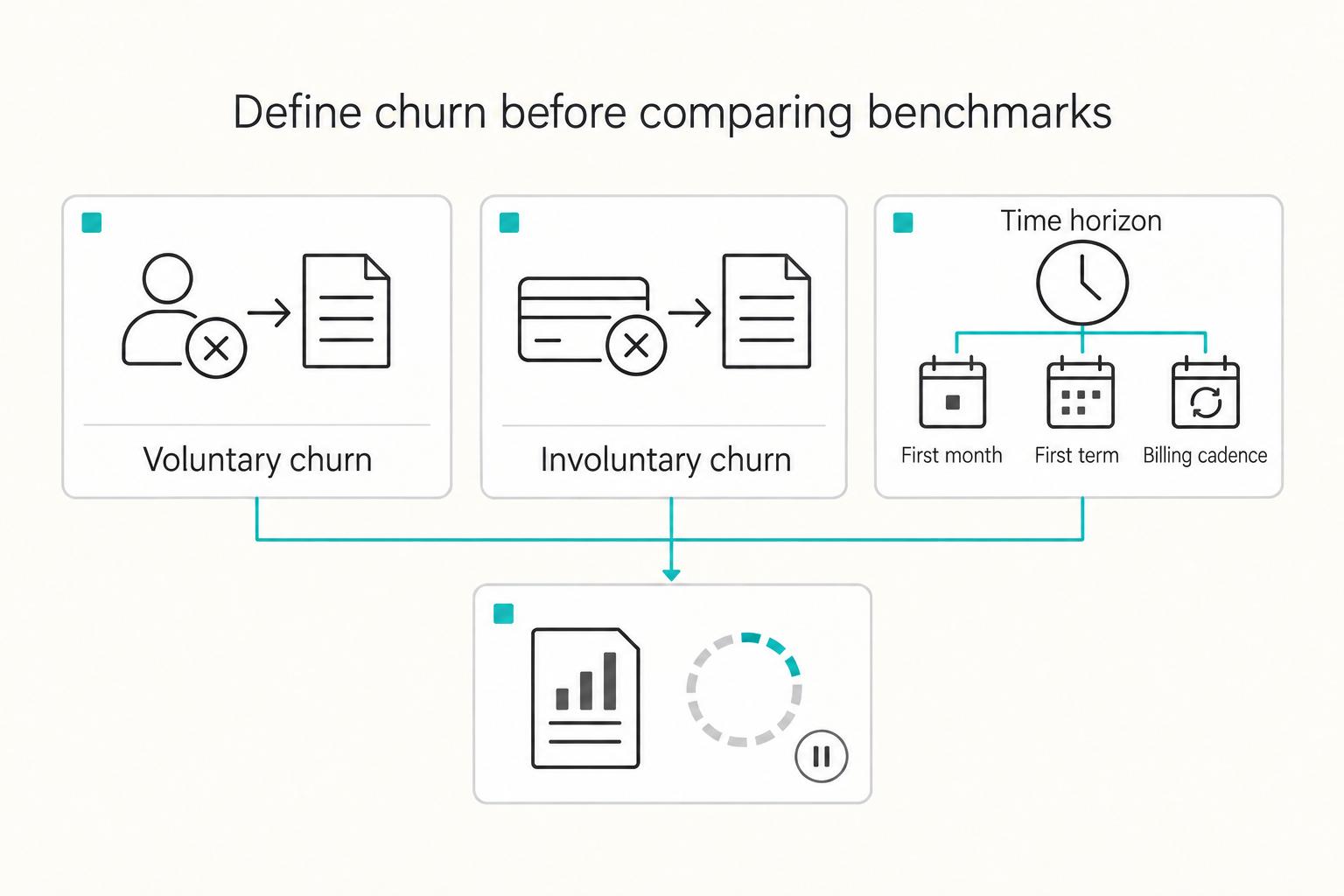
Quick Answer
Match paid units, loss endpoints, customer segments and time horizons before using a churn benchmark. Recurly’s July 2026 chart labels its vertical rates annual; its page contains conflicting prose values requiring clarification. RevenueCat app cohort retention is a different metric. Choose targets from comparable evidence and actual renewal exposure.
Read a vertical benchmark as an observation before setting a target#
An observed churn benchmark describes a particular provider’s measured population. A target is a result your business chooses to pursue. They are different: an industry label alone does not make the population, customer price, paid unit or observation period comparable to yours.
Start with the published metric and its scope. Then compare your own like-for-like result, identify the loss mechanism and choose a target justified by your economics and measurement horizon. Do not relabel a consultant’s suggested “healthy” rate as a measured industry median.
Current published vertical figures and their limits#
As checked on October 3, 2026, Recurly’s industry chart labels the following as median annual churn rates from its network, July 2026. These are the chart’s published observations, not universal targets or independently verified calendar-year cohort survival rates.
| Recurly chart vertical | Total | Voluntary | Involuntary |
|---|---|---|---|
| SaaS | 3.22% | 2.16% | 1.06% |
| Business and professional services | 3.44% | 2.27% | 1.18% |
| Travel, hospitality and entertainment | 3.91% | 2.63% | 1.28% |
| Digital media and entertainment | 4.14% | 2.55% | 1.59% |
| Ecommerce | 4.25% | 2.87% | 1.38% |
| Education | 4.99% | 3.30% | 1.69% |
The page contains inconsistencies: introductory prose gives software’s median as 3.04%, while the industry chart and FAQ give 3.22%; a high-ARPC prose value also differs from its chart. Keep the chart attribution and annual label intact, and request methodological clarification before using these figures for a financial commitment. Do not average conflicting versions or silently call them monthly. Rounded split figures may not exactly sum to the total.
For subcategories such as replenishment boxes, beauty products or wellness memberships, this broad ecommerce category does not establish a separate observed median. Likewise, its SaaS category is not an isolated enterprise or B2C sample. Use your own segmented cohorts and a genuinely matched dataset rather than inserting an unsupported subvertical range.
Subscription apps require a different comparison#
RevenueCat’s 2026 report draws on apps using its platform that meet activity thresholds. Its main measurement timeframe is 2025, with older cohorts for longer renewal calculations. This is an app-subscription population across supported ecosystems, not a representative survey of every enterprise contract, gym or subscription box.
| Report metric | Published medians for the 2023 → 2024 cohorts | Meaning |
|---|---|---|
| Year-one retention: yearly plans | 31% → 28% | Paid cohort retention at a year horizon |
| Year-one retention: monthly plans | 10% → 8% | Paid cohort retention at the same year horizon |
| Year-one retention: weekly plans | 1.7% → 1.2% | Paid cohort retention at the same year horizon |
Those are the report’s year-one retention figures by plan duration. They are not monthly churn rates, nor proof that annual pricing caused better retention. Cadence, acquisition, category and customer selection differ. Compare the relevant category and contract term before making an intervention decision.
RevenueCat’s retention-chart definition starts with paid subscriptions and measures paid periods reached among subscriptions with enough time to reach them. Resubscription creates a new cohort; incomplete periods need separate interpretation. That metric is different from a business’s customer-level cancellation counter or revenue churn.
Define your own unit and loss endpoint#
| Metric for this operating scorecard | Formula or endpoint | Do not substitute |
|---|---|---|
| Customer churn | Opening paid customers who end all paid service in the window / opening paid customers | Subscription cancellations if one customer has several subscriptions |
| Subscription churn | Opening paid subscriptions whose paid service ends in the window / opening paid subscriptions | Trial exits or downloads |
| Renewal completion | Unique paid renewal invoices / unique renewals due in the defined window | Payment attempts including retries |
| Paid cohort survival | Original paid subscriptions still in paid service at the horizon / original paid cohort | Reactivations treated as uninterrupted survival |
| Net revenue retention | Closing normalized recurring revenue from opening customers / their opening normalized recurring revenue | New-customer revenue or cash receipts |
Choose the timing rule before comparing. A scheduled cancellation can leave access active until the paid term ends. A failed invoice can be in recovery before service ends. Record intent, entitlement, payment and cash separately. For this scorecard, count voluntary or payment-failure churn at the defined end-of-paid-service endpoint, with an unknown-reason category when evidence is missing.
First-month paid-cohort loss is measured over the first month after paid start. First-term nonrenewal is measured among subscriptions whose first renewal became due and has reached the chosen resolution endpoint. For annual plans that endpoint comes much later. State the grace/recovery policy and pending cases; do not compare a thirty-day cancellation intention with a resolved annual renewal loss.
Worked churn, recovery and revenue examples#
In an invented opening group of 1,000 paid customers, 15 end service voluntarily and 5 end after failed-payment recovery is exhausted. Customer churn is 20 / 1,000 = 2%; voluntary loss is 1.5% and involuntary loss 0.5%. Assume no customer has multiple subscriptions here and no other exits occur. These are illustrative counts, not a vertical benchmark.
Suppose 50 unique renewal invoices initially failed and 45 paid within the defined recovery window. Recovery is 45 / 50 = 90%. The remaining five count as involuntary customer loss only if the agreed service-end endpoint actually occurs. A first failure alone would have overstated that final loss tenfold. If some invoices remain pending, report them instead of treating them as resolved failures.
Separately, consider $100,000 opening normalized recurring revenue, $3,000 lost to churn, $1,000 contraction and $6,000 expansion from that opening base. Closing base revenue is $102,000, so NRR is 102%. Exclude $10,000 of new-customer revenue. This separate revenue example does not turn a 2% customer-loss rate into 2% revenue loss; customers can have different values.
Use compounding as a scenario, not measured annual churn#
For a closed starting cohort with constant monthly loss c, no reactivation and the same definition each month, implied twelve-month loss is 1 − (1 − c)^12. At 3% monthly, that is 30.62%; at 5%, 45.96%; at 10%, 71.76%. These are arithmetic scenarios, not observed annual vertical rates.
Do not compound a median across businesses as if it were one cohort’s constant monthly hazard. Do not apply this formula to a mixed population with changing acquisition, annual renewals or net revenue churn without establishing the assumptions. If monthly hazards vary, multiply each month’s survival factors for the same cohort instead.
A calendar-year renewal cohort is also different from “annualized” monthly loss. An annual-plan customer can remain entitled for ninety days without having faced a renewal. Early usage, refund and cancellation-intent data are useful, but cannot establish that a newly acquired annual cohort will renew.
Make the vertical change the diagnosis#
| Your model | Segment to compare | Mechanism to investigate |
|---|---|---|
| Enterprise or contract SaaS | Customer value, contract term, seats and renewal opportunity | Deployment value, adoption, procurement and actual renewal loss |
| Self-serve app | Paid-start cohort, app category, platform, geography and plan duration | Useful activation, repeat use and store/direct-web billing outcomes |
| Replenishment or boxes | Paid delivery cohort, interval and product mix | Unused inventory, fulfilment, delivery cadence and paid repeat orders |
| Media or education | Offer, course/content schedule and paid term | Continuing value, completion versus repeat use, and renewal collection |
A vertical label helps identify relevant mechanisms; it does not prove one cause. Compare an acquisition promotion with a similar regular cohort before calling early exits a product failure. Separate insufficient use, fulfilment issues, completed learning goals and price concerns from collection failures. Test an intervention on the population it addresses.
Recovery affects the measured loss, not every customer’s intent#
Stripe’s retry documentation describes supported recovery settings and important exceptions. Some failures require a new payment method or action; scheduled attempts after a hard decline can remain unexecuted. Update the payment-method field actually used by the subscription, and respect mandates and cancellation. There is no universal retry schedule for every country and method.
Measure unique initially failed renewal invoices, recovered invoices and final service-ending losses after a fixed window. Track collection method, country and billing channel. Store-managed subscriptions need the store’s recovery process; a direct Stripe policy is not a control over every app-store renewal.
For a timeout with an unknown collection result, look up the original attempt before starting another. A new request key or processor cannot deduplicate an earlier charge. Authenticate and durably retain payment notifications, deduplicate their local effects and preserve actual payment or refund movement even if later local checks fail.
Set targets from comparable evidence and observed exposure#
- Write the paid unit, churn endpoint, observation window and customer segment beside every benchmark.
- Retain the source, chart version and publication/measurement dates; keep annual labels separate from monthly metrics.
- Resolve inconsistent definitions or published values before using a number in a committed forecast.
- Choose your own target and explain its basis: current cohort, margin, customer value and the measured change you can make.
- Review uncertainty and cohort size. One lost customer out of ten changes the rate by ten percentage points.
In ninety days, a new monthly cohort can provide several renewal opportunities and evidence about onboarding and recovery. A new annual cohort can provide early engagement and intent, while its renewal outcome remains unobserved. Review a mature annual cohort if you need annual renewal evidence now, or continue following the new cohort through its actual due window.
Keep the benchmark, scenario and target separate#
Use a published figure to understand its measured population, a transparent calculation to explore assumptions, and your own comparable cohorts to set a target. That makes vertical comparisons useful without turning a broad label or incomplete annual exposure into false precision.
Frequently Asked Questions
What is a good subscription churn rate by vertical?
Use a comparable observed population and your own economics to choose a target. The published Recurly chart describes its network, while RevenueCat’s report covers app cohorts. Neither establishes a universal healthy threshold for every business in a vertical.
How should SMB SaaS and enterprise SaaS use different churn targets?
Match contract term, customer value, seat structure and renewal opportunity. Do not copy an enterprise recommendation into monthly self-serve planning or present that recommendation as an observed median.
How should I annualize monthly churn?
For a closed cohort with constant monthly loss and no reactivation, use 1 − (1 − c)^12. Treat it as a scenario under those assumptions, not a measured annual churn benchmark.
Why might physical-goods subscriptions lose customers?
Investigate delivery cadence, unused inventory, fulfilment, product value and collection separately. A broad ecommerce benchmark does not establish an observed rate or cause for your particular box or replenishment offer.
What is the difference between first-month and first-term churn?
First-month cohort loss uses a month after paid start. First-term nonrenewal uses the first actual renewal opportunity and its resolution endpoint. Annual subscriptions need annual renewal exposure; ninety days of access is insufficient.
How do payment declines and recovery change churn interpretation?
An initial failed invoice can recover before service ends. Measure unique failed invoices, recovered invoices and final service-ending losses separately, with a fixed window and pending cases disclosed.
What should I do when sources disagree?
Keep the exact source version, metric label and population visible. Request clarification, avoid averaging incompatible figures, and leave unresolved values out of committed forecast targets.
Try a related tool
Researched and edited by the Gruv editorial team. Gruv builds cross-border billing, payouts, and finance-operations software for global businesses.
Sources
Includes 3 external sources outside the trusted-domain allowlist.
Educational content only. Not legal, tax, or financial advice.
Related Posts
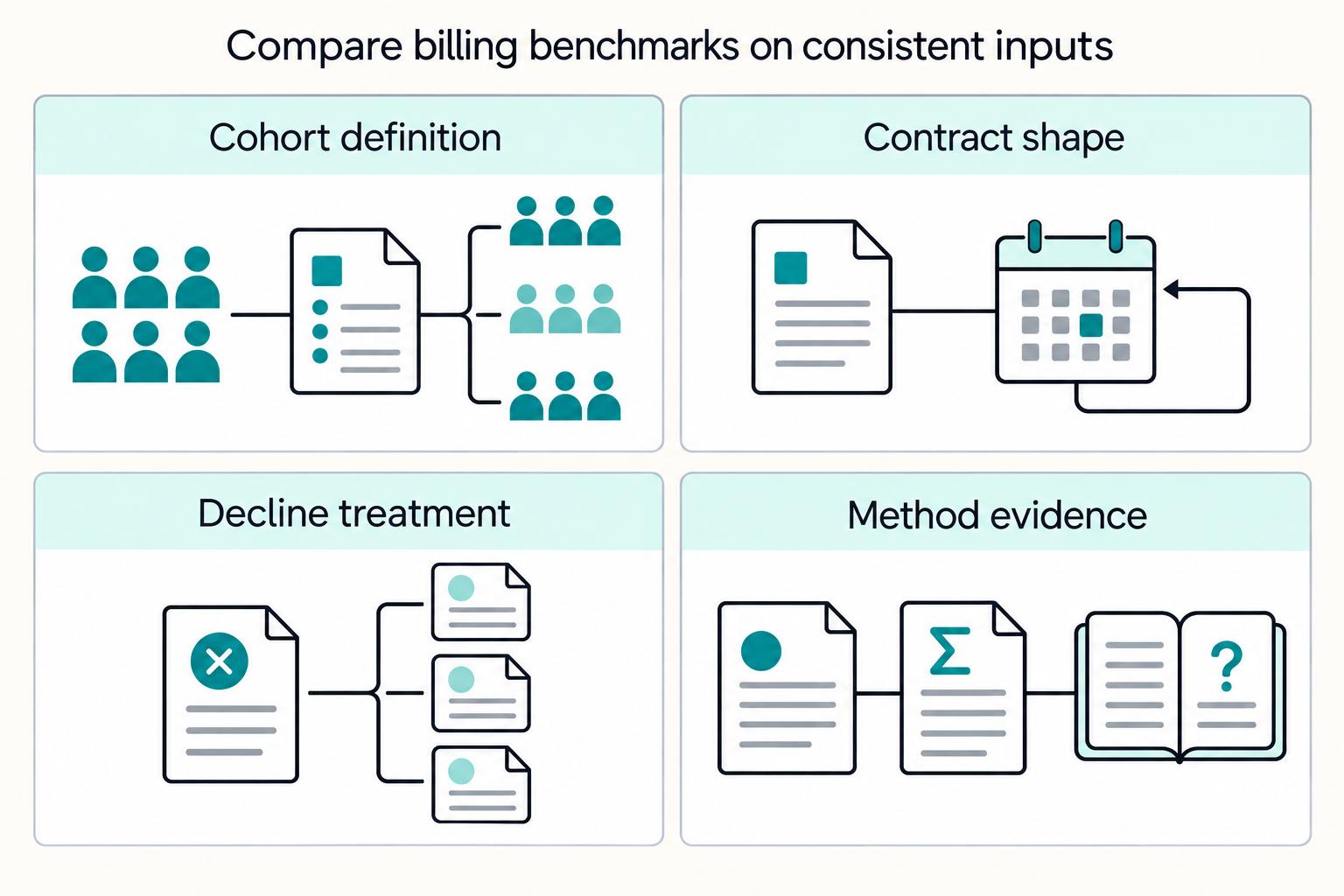
How to Compare SaaS Billing Benchmarks Before Expansion
For expansion decisions, treat payment decline rate, churn, and expansion as one system, not three separate metrics. That gives product, finance, and GTM a view they can defend before rollout resources are committed. If you own the budget call, you need that view before your team starts treating one good month as a trend.
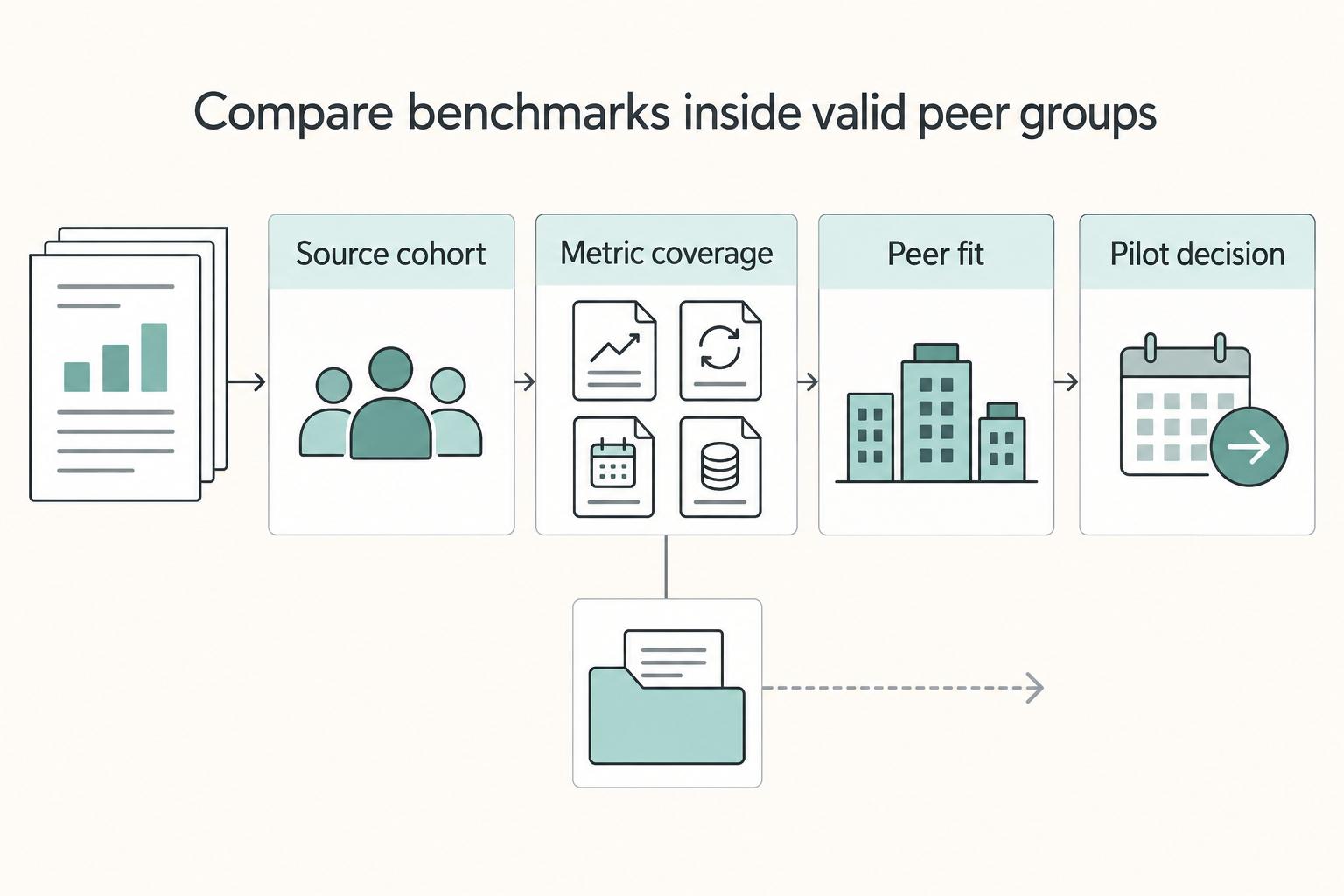
Subscription Business Benchmarks by Industry Vertical
The useful question is not which vertical has the loudest growth story. It is whether the benchmark evidence behind that story is comparable enough to support a real expansion decision. Founders and platform teams usually see headline growth, category excitement, or broad market reports first. That context can help, but on its own it is a weak basis for committing product, payments, or GTM budget.

A Guide to Dunning Management for Failed Payments
If you run recurring invoices, failed payments are not back-office noise. They create cashflow gaps, force extra follow-up work, and increase **Involuntary Churn** when good clients lose access after payment friction.