
Quick Answer
Build a subscription revenue forecaster as an operating model, not a spreadsheet projection. Start with explicit drivers for MRR movement, keep ARR as a rollup view, and separate forecast outputs from Revenue Recognition and cash reporting. Pick a baseline method that matches your data quality, log assumptions with owner and date, and recheck projections against billings, ledger impact, and collections evidence before making payout or budget commitments.
Model subscription revenue with clear MRR and churn drivers#
A subscription revenue forecast is only useful when it survives real subscription operations, not a neat spreadsheet version of the business. For a capable finance or RevOps team, the job is to project recurring revenue clearly enough to support decisions, then test whether those projections still hold once billing, churn, and exceptions show up.
At its core, a subscription revenue forecast is a projection of the recurring revenue your business expects to generate over a defined period. That period can be monthly, quarterly, or annual, and the cadence matters because each view answers a different question. Monthly Recurring Revenue, or MRR, helps you see short-term movement quickly. Annual Recurring Revenue, or ARR, helps you understand the longer-term effect of those movements. Used together, they give you a fuller view than either one alone.
The constraint that matters most is this: MRR and ARR are not stand-ins for everything else. They are useful operating views, but they are not the same as recognized revenue, cash, or reconciliation status. If your team mixes those meanings, trust breaks early. A model can look directionally right and still be unusable for planning because the inputs, outputs, and downstream checks are describing different things.
What drives the forecast is usually simpler than the model built around it. Subscription forecasting depends on a small set of business drivers: customer acquisition, retention, upgrades, and churn. When one of those assumptions moves, the forecast moves with it. That is why a credible model makes each assumption visible and reviewable by period instead of burying everything inside one growth rate.
This article follows a practical path. You will build from MRR, churn, and related operating signals. Then you will connect those projections to decisions like budgeting and expansion planning. The goal is not a perfect number. It is a model your team can trust for budgeting, expansion planning, and day-to-day decisions about what is changing in the business.
A good starting rule is simple: if an assumption cannot be checked later, it does not belong in the core model. In practice, that means setting a forecast cadence you can actually support, keeping driver definitions stable, and watching for the first signs of drift when realized results stop matching the story your model is telling. The sections that follow focus on that discipline, because a forecast only becomes valuable when it survives contact with operations.
Define the forecaster before you model anything#
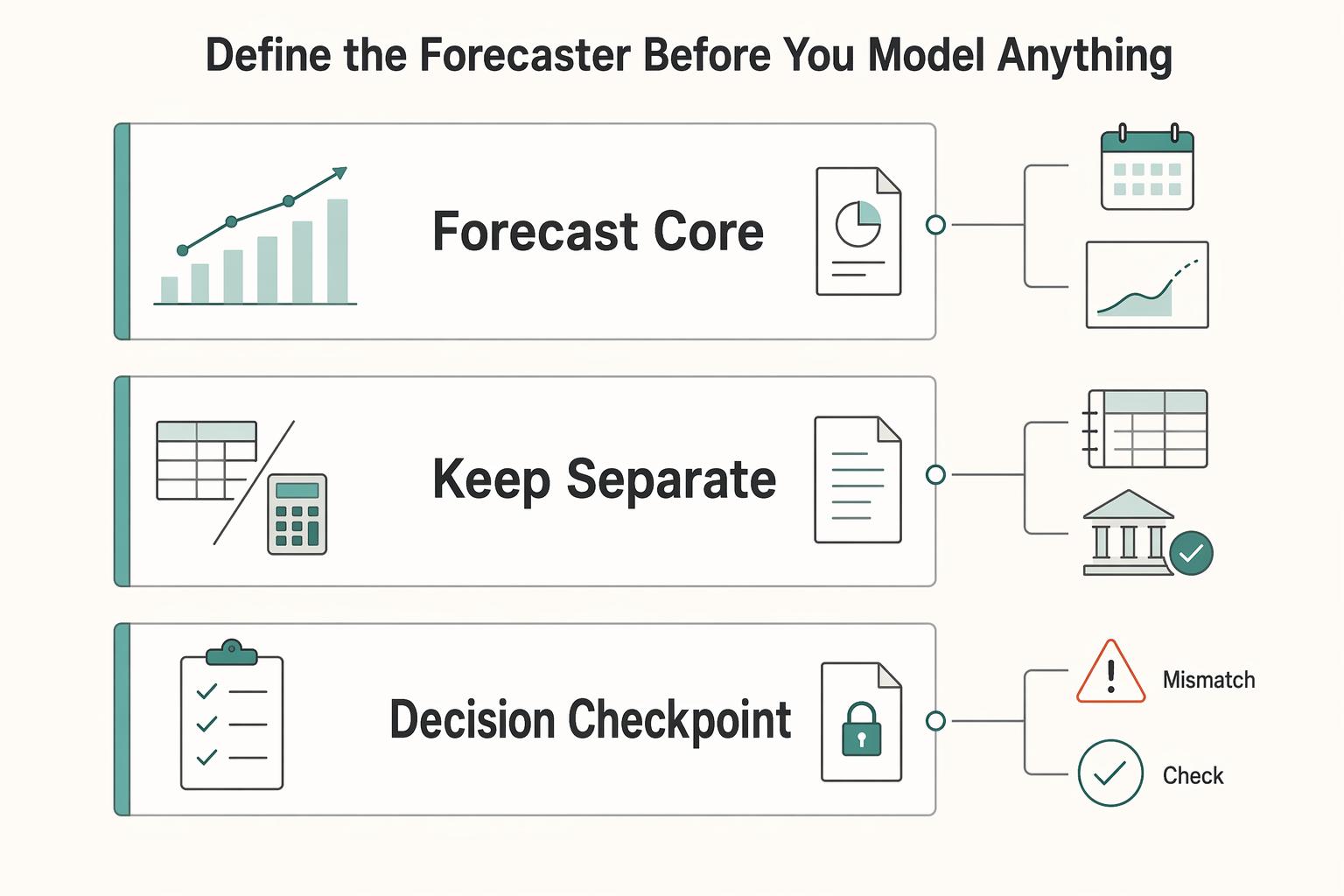
Start by defining the model as a planning forecast: a subscription revenue forecaster projects future recurring revenue, usually through MRR and ARR, from explicit assumptions. Keep that separate from accounting and cash reporting so the forecast can be trusted for decisions on budgeting, hiring, and planning.
| Area | Included items |
|---|---|
| Forecast core | MRR, ARR, and the assumptions used to project them |
| Keep separate views | Bookings, Billings, Deferred Revenue, recognized revenue, and cash |
| Decision checkpoint | one finance owner, one RevOps owner, one shared definition doc |
Before you build formulas, lock scope in a short shared definition doc and set the forecast horizon (next month, quarter, or year) so teams are modeling the same question. Disconnected forecasting methods across teams can drive bad outcomes, so resolve definition conflicts before you add complexity.
Set one boundary for the core model: if an output will not change a real operating decision, keep it out of the main forecast.
For a step-by-step walkthrough, see Subscription Billing Platforms for Plans, Add-Ons, Coupons, and Dunning.
Pick the right model for your operating reality#
Pick the model that matches your data quality and how your subscription revenue actually moves, not the one that looks most advanced on paper. In practice, many teams start with a Straight Line Forecast as a baseline, then move to Cohort Based Forecasting once segment-level retention and expansion differences are consistently captured and decision-relevant.
A straight line model is useful when you need a clear baseline from recent recurring-revenue trends and core assumptions. It is easier to maintain while finance and RevOps are still tightening source consistency across active subscriptions, cancellations, price changes, contract continuation, and upsell events.
Its main risk is oversimplification. Average trends can hide volatility across plan types, billing structures, and customer segments, especially when pricing is tiered, usage-based, or hybrid. Churn, onboarding delays, and usage drops can also pull actuals away from the projection.
Cohort Based Forecasting becomes more useful when behavior no longer averages out. If retention and expansion differ by segment, contract type, start period, or pricing model, cohort views usually provide a more decision-ready picture than one blended line. This is also where Net Revenue Retention can help validate whether expansion is offsetting churn; see How to Calculate Net Revenue Retention (NRR) for a Subscription Platform.
The failure mode on cohorts is false precision. Detailed outputs are not trustworthy if the underlying event history is inconsistent, so validate cohort definitions and event mapping before treating model detail as signal.
Scenario Planning should be built into both approaches. Treat price, upsell, and renewal assumptions as testable inputs, and keep an assumption log with owner, date, and rationale.
| Approach | Required inputs | Failure risk | Maintenance effort | Where it misleads operators |
|---|---|---|---|---|
| Straight Line Forecast | Clean recent recurring-revenue history, churn/renewal/upsell assumptions | Masks segment differences and volatility | Low | When average trends hide plan-level churn, contract timing, or pricing-mix shifts |
| Cohort Based Forecasting | Consistent cohort definitions, retention history, renewal behavior, expansion patterns by segment | False precision when source events are inconsistent | Medium to high | When dirty inputs make detailed retention curves look more reliable than they are |
| Scenario Planning overlay | Named assumptions for price, upsell, and renewals, plus owner and rationale | Wishful thinking when scenarios are undocumented or not compared to actuals | Medium | When teams treat one case as a commitment instead of a tested range |
If you are undecided, use sequence over complexity: establish a baseline first, then add cohorts once data quality and segment behavior support it. For a deeper walkthrough, see Subscription Revenue Forecasting: How Platforms Model MRR Growth Churn and Expansion.
Build a source-of-truth input contract across teams#
After you choose a model, the bigger risk is usually input drift, not formula design. Your forecast stays decision-useful only when teams align on what enters the model, where each input comes from, when it is considered complete, and how updates are logged for plan-versus-actuals review.
Static spreadsheet snapshots are a weak fit for subscription forecasting. Churn, onboarding delays, and usage changes can move actuals after the snapshot is taken, so your first control should be an explicit input contract.
Define the contract in plain language#
Document the inputs your forecast depends on and define each one the same way across teams. Keep it practical: what it means, which system provides it, which timestamp rule applies, and how changes are recorded between cycles.
A useful test is to trace one account from initial booking through renewal and later changes. If teams classify the same event differently, forecast drift starts before close.
Assign ownership and refresh expectations#
For each input, set a clear owner, expected refresh timing, and known latency behavior for your own systems. Forecasting tools can combine data across company systems and reduce manual work, but only if you treat source readiness as an explicit operating checkpoint.
Manual renewal forecasting is often labor-intensive and partly subjective, so prioritize connected data capture where you can and document when each source is considered final for the cycle.
Make late updates auditable#
Do not silently overwrite late-arriving updates. Preserve what changed, when it changed, and when that change entered the forecast cycle so variance review stays trustworthy.
Each cycle, keep a compact evidence pack with:
- source extracts and extraction timestamps
- transformation or load logs
- assumption changes since the prior cycle
- variance notes for late updates
- reviewer sign-offs
Connect forecast outputs to ledger and payout operations#
Use the forecast to plan operations, but keep the ledger as the approval gate. Let projected MRR and ARR guide billings, collections, and payout capacity planning, then require every meaningful delta to reconcile to ledger-backed events before you approve cash-sensitive decisions.
Forecast timing and cash timing are not interchangeable. A contract continuation can improve the forward view immediately, while a rules-based cash forecast tied to cleared payments may not reflect it for 45-60 days. Treating those as the same can overstate liquidity and pull payouts forward too early.
Tie forecast layers to execution layers#
Map each forecast signal to the operational checkpoint that can confirm it. Forecasted ARR is a planning signal. Expected billings indicate whether invoices should exist. Collections and settlement timing show whether cash is moving. Payout capacity should be decided at the end of that chain.
If your stack connects live bank and payment data, these checks can tighten because models can update daily. A unified ERP data model can also keep finance and related module data current in real time. That does not remove judgment, but it reduces lag between a commercial event and the evidence needed to act.
Before you approve downstream cash commitments, verify:
- the commercial event that created the uplift (for example, term continuation, expansion, or new start)
- billing evidence (for example, expected invoice creation or amendment)
- ledger impact (for example, posted journals, cash application, or a traceable open receivable)
If one is missing, treat the uplift as provisional.
Keep ledger journals as the approval gate#
The control is straightforward: the general ledger stays the source of truth, and forecast outputs stay advisory until tied to underlying transactions. Do not approve operational moves because the model says revenue is coming; approve when the expected movement is visible through billings, journals, or cash events that can be reviewed.
Reconciliation can auto-match a large share of transactions to invoices and bills, including vendor examples at 95%+, but exception review is still required. High match rates help only when unmatched items are surfaced and resolved.
| Forecast signal | Operational checkpoint | What to verify | Red flag |
|---|---|---|---|
| Expected billings | Invoice creation and receivable entry | Invoice exists, amount matches contract change, posting date aligns to period | Forecast uplift with no invoice or open receivable |
| Recognized revenue | Ledger journals tied to delivered obligations | Posted journal lines reconcile to underlying transactions and period logic | Revenue appears in model but not in journals |
| Unresolved exceptions | Reconciliation and exception queue review | Unmatched cash, invoice disputes, failed collections, aging items | Variance is explained away without ticketed follow-up |
| Payout readiness status | Cash application and settlement visibility | Collected or reliably collectible funds support planned payout timing | Payout plan assumes cash that is still in dispute or dunning |
Include failed collections and dunning in the operating view#
Include failed collections in the same operating view as growth signals, or your churn and retention assumptions will look better than operational reality. If invoices are issued but collections fail, CRM may still show activity while finance carries risk through aging receivables, reversals, or delayed settlement.
| Status | Meaning |
|---|---|
| Billed and current | likely cash |
| Billed but in dunning | remains provisional |
| Unresolved after dunning | should trigger risk review |
At minimum, separate billed and current, billed but in dunning, and unresolved after dunning. That split clarifies what is likely cash, what remains provisional, and what should trigger risk review. For a deeper look at recovery workflows, see A Guide to Dunning Management for Failed Payments.
Keep a compact evidence pack for this stage: invoice references, journal identifiers, cash-application status, and an exception list with owner and aging. That keeps forecasting connected to execution instead of creating a competing source of truth. Related: Choosing Between Subscription and Transaction Fees for Your Revenue Model.
Run scenario tests that force concrete decisions#
Use scenario tests as decision gates, not commentary. Once forecast outputs are tied to ledger evidence, each scenario should clearly authorize or block spend, staffing, and collections actions.
Keep the scenario set small and repeatable#
Run the same four cases each cycle: base case, churn stress, contract continuation drop, and upsell upside. Keep each case anchored to the drivers that matter most for subscription outcomes, especially MRR, churn, continuation assumptions, and the NRR direction implied by those inputs.
Before refreshing assumptions, compare the last cycle's projections to actual results. If churn worsened or contract events closed later than planned, log the assumption change, record the operational reason, and recast outputs so teams can act on what changed.
| Scenario | What changes | What to verify first | Likely action |
|---|---|---|---|
| Base case | Current churn, continuation, and expansion assumptions continue | Prior-cycle actual MRR, billed contract events, open receivables trend | Maintain approved operating plan |
| Churn stress | Higher cancellation or failed-collection pressure | Recent churn events, dunning volume, aging receivables, downgrade patterns | Slow discretionary spend, prioritize retention and collections |
| Renewal drop | Contract continuations flatten or slip | Contract end dates, pipeline status, invoice timing for expected continuations | Hold hiring tied to future ARR, review customer risk list |
| Upsell upside | Expansion closes faster or larger | Signed amendments, billing readiness, onboarding capacity, success staffing | Protect implementation and customer success capacity before adding demand |
Use if-then rules, not narrative#
If churn rises while continuation flattens, treat it as a retention-and-collections problem first, then revisit acquisition spend. If expansion leads, protect onboarding and success capacity so forecasted growth can be delivered and retained.
Define reforecast triggers in advance#
Set reforecast trigger types up front: assumption breach, material contract change, or unresolved reconciliation variance. Avoid universal numeric thresholds; align on event types that force a model refresh.
For each trigger, document what changed, who approved the update, which decisions are now allowed, and what stays blocked until billing, ledger, or collections evidence catches up. That is how the model drives decisions instead of slides.
We covered this in detail in How to Calculate and Manage Churn for a Subscription Business.
Catch failure modes early with explicit controls#
Treat forecast drift as a control problem, not only a modeling problem. Forecast misses are often driven by weak data foundations, process design, and unclear ownership, and the result is usually false confidence, misallocated budgets, and missed opportunities.
Control the breaks you already know will happen#
The recurring breaks are usually predictable: stale assumptions, definition drift between RevOps and finance, delayed source updates, and manual overrides without traceability. If your team cannot clearly align core forecast inputs and terms before publication, the control has already failed.
Source latency is another common break. Add a visible freshness check for each critical source in the cycle evidence pack, and mark outputs as provisional when key inputs are stale.
Manual overrides should be tightly governed. If people can overwrite the forecast without clear ownership, timing, and evidence, forecast discipline breaks down.
Use checks that compare forecast intent to operating evidence#
Use a small recurring control set each cycle:
| Control | Review focus |
|---|---|
| Assumption age | when key assumptions were last refreshed and by whom |
| Source freshness | when core source data was last updated, with known lag called out |
| Forecast vs realized billings variance | where expected and realized billings diverge and require review |
| Unresolved Deferred Revenue mismatches | where forecasted movements do not reconcile and should block dependent decisions |
Keep versioned outputs and run history so teams can see who changed what and when, including overwrite behavior.
Make overrides expensive enough to be visible#
Require an exception ticket for every override, with:
- reason code
- approver
- affected metric or cohort
- supporting evidence
- expected reversal date
Without a reversal date, temporary judgment calls often become permanent assumptions.
Set governance cadence and ownership#
Set governance before each cycle: assign one accountable forecast owner, make decision rights explicit, and define how often the forecast is reviewed. Controls catch bad changes, but governance determines who can make changes, who must explain them, and when assumptions get challenged.
Use a clear owner map by data domain. Forecast misses often come from siloed teams using different data and processes, and RevOps is meant to close that gap by aligning teams, data, and execution around one revenue goal. If multiple teams touch inputs but no one owns the final decision trail, drift is likely even when the model math is sound.
Make decision rights visible#
You do not need a large committee. You do need a written owner map that answers:
- who approves policy and metric definitions
- who is accountable for driver quality and business-event quality
- who is accountable when a source feed, transform, or sync breaks
Test the map against one recent miss. If the team cannot quickly tell whether the issue came from assumptions, event capture, or pipeline reliability, ownership is still unclear.
Match review rhythm to decision use#
Set forecasting cadence based on decision use, not habit. Operating decisions usually need tighter review than board reporting, and major contract, packaging, or pricing changes should trigger an off-cycle review.
Keep one change log for model assumptions, schema changes, and validation outcomes. Include date, owner, reason, affected metric, and validation status. Splitting logging across docs, tickets, and chat is a common path to version drift.
Related reading: How Solo SaaS Operators Use RevOps to Stabilize Revenue.
Conclusion#
A credible forecast is not the spreadsheet itself. It is the discipline around it: clear metric definitions, clean records, and a repeatable review cycle that turns expected subscription revenue into decisions you can actually defend.
That matters because recurring revenue planning is only useful when it helps you manage cash flow, scale operations, and choose where to invest. In practice, the inputs that keep showing up are not exotic: MRR, ARR, churn rate, and ARPU, plus the lifecycle movements that change them, such as upgrades and downgrades. If those definitions are mixed across different revenue views, trust drops and the model can start answering the wrong question.
The practical standard is simple. Your forecast should explain expected revenue over a defined horizon such as a month, quarter, or year using observable drivers, not a top-line guess. A useful check is whether the output is consistent with the assumptions and underlying lifecycle records. If you cannot validate the records behind churn, expansion, or downgrade activity, treat the output as directional only, not decision-grade.
The main failure mode is usually not math. It is weak data quality and weak operating discipline. Forecasting subscription revenue is hard because you have to track the customer lifecycle, account for leakage, and reflect changes in behavior over time. That is where teams get misled: stale assumptions stay in place, or upgrades and downgrades are handled inconsistently. Clean, consistent data and record validation are what make the forecast dependable.
So the next move should be one full operating cycle, not a grand redesign. Pick the horizon that matches your planning need, lock the definitions, and run one forecast with aligned team review, clear source records, and documented assumption changes. Then review results and tighten where drift is real. If variance shows up and no one can tie it to a driver, stop adding complexity and fix the input layer first.
That is the real bar for dependability. When your model is built on defined metrics, validated data, and regular team review, it becomes useful for allocating resources, mitigating risk, and spotting growth opportunities with more confidence. If it cannot survive those checks, it is still a spreadsheet artifact, not an operating tool. Want to talk through your setup? Talk to Gruv.
Frequently Asked Questions
What is a subscription revenue forecaster, and what minimum inputs does it need?
A subscription revenue forecaster predicts how much recurring revenue you expect over a future period. At minimum, it needs a starting recurring-revenue base (commonly MRR, and sometimes ARR for rollups) plus the movements that change it: new MRR, expansion MRR, contraction MRR, and churned MRR. For SaaS, include renewals and usage-based charges explicitly rather than folding them into one growth assumption.
Which variables matter most for forecast accuracy in subscription businesses?
The biggest drivers are recurring revenue, churn, expansion or contraction, retention, renewals, and any usage-based component. In practice, the model gets more reliable when those drivers are tracked against plan versus actuals, because churn, onboarding delays, and usage drops can shift results quickly. A useful checkpoint is whether ending MRR can be explained from driver movements rather than a manual top-line adjustment.
How should we model Churn and Upsell together without double counting?
Track gross churn and expansion separately first, then calculate net churn after that. Gross churn is the revenue you lost, while net churn includes expansion revenue and can even go negative if expansion more than offsets losses. The failure mode is netting everything too early, which hides whether the forecast improved because retention got better or because a few accounts expanded.
What is the difference between subscription forecasting and Revenue Recognition reporting?
Forecasting is forward-looking and estimates future revenue from subscriptions, renewals, and usage-based charges. This guide does not define revenue-recognition rules, so treat revenue-recognition reporting as a separate accounting view and avoid using it as a direct substitute for operating forecasts.
How often should finance and RevOps refresh the model assumptions?
Use your plan-versus-actual review cycle as the trigger, and refresh off-cycle when churn, onboarding timing, or usage patterns materially shift. This guide does not provide a fixed weekly or monthly cadence.
What are the first warning signs that a subscription forecast is no longer reliable?
Start with widening variance between forecast and realized MRR or ARR, especially when no one can trace the gap to a driver. Another early sign is when ending MRR cannot be reconciled through starting MRR plus new and expansion, minus contraction and churn. Persistent churn shifts, onboarding delays, or usage drops without assumption updates are also reliability red flags.
When should we use Straight-Line Forecast vs Cohort-Based Forecasting?
This guide supports cohort analysis alongside ARR or MRR breakdowns. It does not provide a definitive rule for choosing straight-line versus cohort-based forecasting. A practical approach is to keep a straight-line baseline and add cohort views when cohort-level retention, churn, or expansion differences materially affect results.
Try a related tool
Researched and edited by the Gruv editorial team. Gruv builds cross-border billing, payouts, and finance-operations software for global businesses.
Sources
Includes 4 external sources outside the trusted-domain allowlist.
- leg.colorado.gov/initiative_files/3308/downloadtrusted
- online.hbs.edu/blog/post/financial-forecasting-methodstrusted
- stripe.com/resources/more/how-to-use-monthly-recurring-...trusted
- hackernoon.com/steal-my-subscription-revenue-forecasting-mo...external
- netsuite.com/portal/resource/articles/financial-managemen...external
- terret.ai/resources/blog/renewal-forecastingexternal
- workwithpod.com/post/the-sales-ai-operating-model-owners-cad...external
Educational content only. Not legal, tax, or financial advice.
Related Posts
A Guide to Dunning Management for Failed Payments
If you run recurring invoices, failed payments are not back-office noise. They create cashflow gaps, force extra follow-up work, and increase **Involuntary Churn** when good clients lose access after payment friction.

Calculate NRR for a Subscription Platform Without Reconciliation Gaps
The formula is the easy part. In practice, the hard part is producing a single Net Revenue Retention number that finance, ops, and product can all trace to the same recurring revenue base and the same set of in-period movements.
Subscription Revenue Forecasting for Platform Teams Modeling MRR Churn and Expansion
A usable forecast starts with shared definitions, not sharper formulas. If finance, ops, and product define MRR, Expansion MRR, or churn differently, the model can look precise and still fail the first serious review.