
Quick Answer
Start by running revenue operations revops for saas as a solo-friendly system: secure each deal with clear agreement terms, keep invoicing checkable, and move every client through visible handoffs from lead to onboarding to renewal. Then track a small dashboard you can act on, not a large report set. The practical goal is steadier cash flow, fewer dropped follow-ups, and less admin drag.
Why Corporate RevOps Fails the Solopreneur (And How 'Personal RevOps' Creates Freedom)#
Corporate RevOps is often built to coordinate teams. If you work alone, that is usually not your main problem. The bigger constraint is balancing many responsibilities with one person's time and attention.
A lot of RevOps advice for SaaS is still useful, but it often reflects team-oriented lifecycle work. Even practical GTM material centers on nurturing content, aligning it with funnels, and serving different intents like buy, use, help, and trust. That framing makes sense in multi-person environments. If you are solo, one person owns all of it, and the risk is trying to play too many roles in one day.
Here, "Personal RevOps" means a lightweight operating model you can run by yourself. Marketing ops brings attention into a simple qualification step. Sales ops turns qualified interest into a clear proposal and decision. Customer success starts at signature and carries through onboarding, delivery, renewal, and referral. The handoffs should be visible: inquiry, qualified lead, proposal sent, client active, next expansion or renewal point. If you cannot point to where each prospect sits right now, work slips more easily.
| Area | Corporate RevOps | Personal RevOps |
|---|---|---|
| Goal | Cross-team coordination | Revenue stability and manageable workload |
| Main constraint | Department silos | One person's time and attention |
| Decision owner | Multiple leaders | You |
| Success signal | Cleaner funnel alignment across functions | Fewer dropped leads, clearer next steps, less admin drag |
That difference matters because solo work is tied to real-life constraints, not just funnel math. Available material on solopreneurship explicitly mentions freedom and flexibility, and it also highlights the challenge of balancing entrepreneurship with parenting, including a chapter called "Setting Clear Goals and Boundaries" at 19:04. Copying a corporate model too early often fails because it adds process before it reduces risk. First secure the revenue chain you can run alone. Then improve automation and metrics.
For a step-by-step walkthrough, see A Guide to Channel Sales for SaaS Businesses.
The Foundation: Lock Down Agreements, Invoicing, and Client Concentration#
If you want steadier revenue as a solo operator, lock down three control points in order: your agreement, your invoice process, and your client concentration.
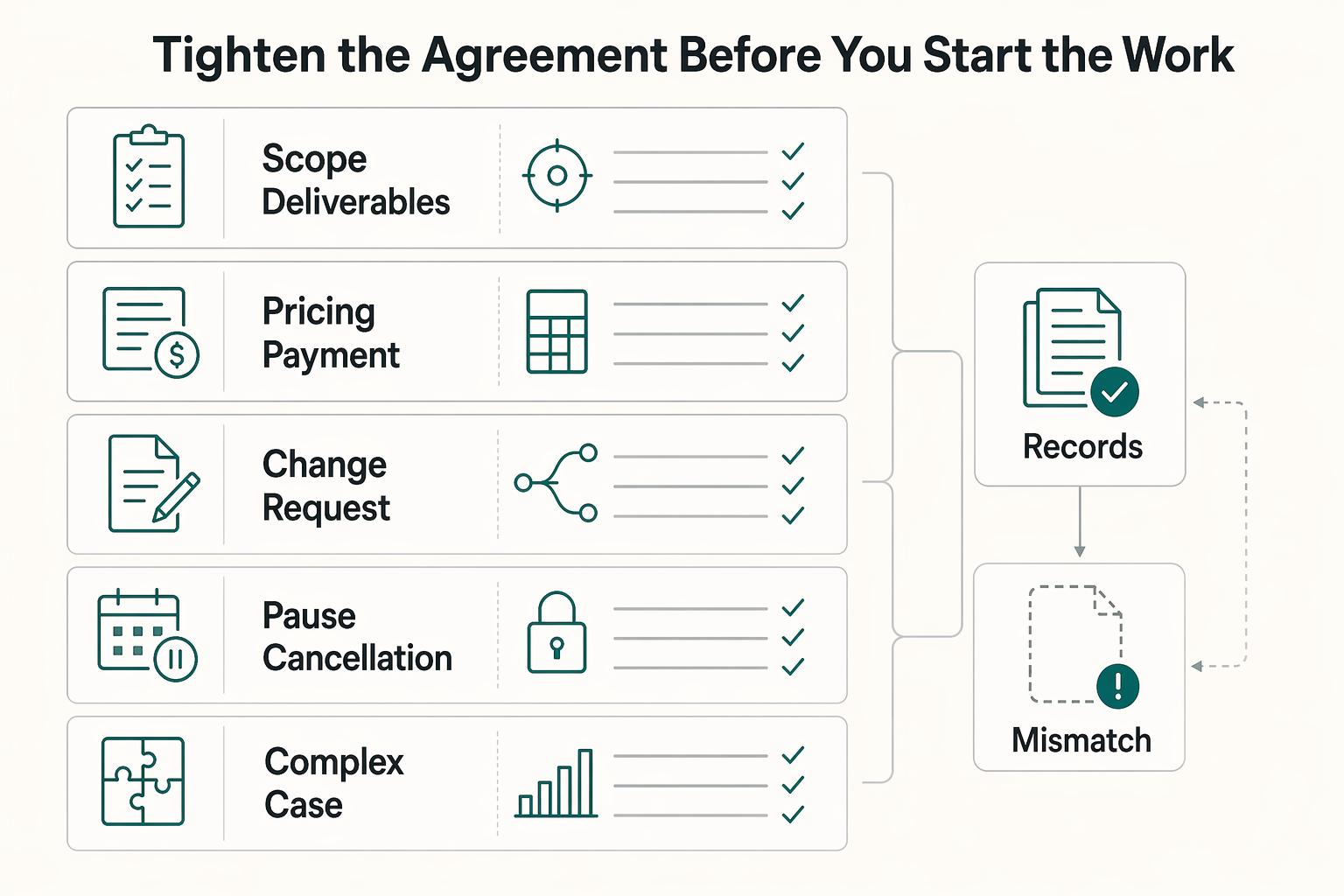
Tighten the agreement before you start the work#
Your contract and SOW are your first revenue controls, not paperwork. The goal is simple: make scope, payment, and change handling explicit before delivery starts, then verify final deal details before signature.
| Agreement check (define for this deal) | Why it protects revenue | Confirm before signature |
|---|---|---|
| Scope and deliverables | Reduces ambiguity that can turn into unpaid extra work | Final deliverables, acceptance point, revision boundaries, and out-of-scope language from the source agreement |
| Pricing and payment terms | Lowers dispute risk and protects cash timing | Fee structure, invoice trigger, due timing, and term structure from the source agreement |
| Change request process | Keeps mid-project changes from bypassing pricing control | How changes are requested, approved, priced, and documented |
| Pause/cancellation/termination handling | Clarifies what happens if work slows or stops | Notice flow, payment treatment for completed work, and capacity/rescheduling treatment from the source agreement |
| Legal entity and signer details | Prevents avoidable billing and approval friction | Correct buying entity, authorized signer, billing contact, and any client-required purchase reference |
Store the signed agreement, final SOW, and approval trail together. If those records are hard to retrieve, they become dark data and weaken your position when payment questions come up.
Make invoicing boring and checkable#
Invoice friction is usually an operations issue first: inconsistent details create rework and delay cash. Treat invoice data as a recurring discipline, not a one-time setup.
| Checkpoint | Domestic invoice | Cross-border invoice |
|---|---|---|
| Party details | Verify current legal names and required local fields after jurisdiction check | Verify both parties' legal details and any additional cross-border identifiers after jurisdiction check |
| Tax treatment | Confirm applicable local treatment and required fields from official source records before sending | Confirm applicable cross-border treatment, including reverse-charge handling if relevant, from official source records before sending |
| Payment references | Confirm currency, due timing, remittance details, and buyer references if required | Confirm currency, international remittance details, and any extra cross-border reference fields against bank, platform, and source records before sending |
| Final pre-send review | Run your local compliance checklist before sending | Run jurisdiction-specific cross-border checks before sending |
If activity stays high but outcomes stay weak, treat it as a leakage signal and fix the upstream data and process issues first.
Watch concentration risk on a monthly cadence#
Review concentration monthly so you can rebalance before a single account change hits your cash flow. Before you use a threshold, verify it against internal revenue records, then track it consistently.
Use a simple monthly review:
- Largest-client share of trailing revenue versus your internal threshold. Confirm the current threshold against your internal revenue records.
- Pipeline mix by client type, service line, or channel.
- Near-term committed work versus open opportunities, so you can spot overdependence early.
The pattern to avoid is being busy without protection: lots of activity, weak resilience. Once these controls are stable, automate the handoffs so admin load drops without losing visibility. We covered this in detail in A Guide to International Expansion for SaaS Businesses.
The Automation Engine: Aligning Your Sales, Marketing & Success Stack#
Once contracts and invoicing are stable, automate your handoffs first. That is usually where duplicate entry, missed follow-ups, and unclear ownership start draining time and revenue.
At solo scale, RevOps is not about adding tools. It is about keeping one reliable customer record from first contact through renewal. If lead notes, proposal status, and onboarding details live in separate places, you have handoff leakage.
Map the journey by bottleneck, not by department#
Start with observable friction, not broad labels. "Marketing is messy" is hard to fix. "Form submissions arrive without source data, so I cannot attribute leads" is fixable.
Look for these four bottlenecks:
- handoff delays between inquiry, qualification, and proposal
- duplicate data entry across form, CRM, invoicing, and delivery tools
- missed follow-ups after a lead, signature, or milestone
- unclear ownership as clients move from sale to onboarding to support
If you keep seeing these patterns, you are usually looking at a RevOps problem. Disconnected systems create messy data and unreliable reporting, and clunky handoffs slow execution. If your CRM feels more like a data graveyard than a working system, your automation is missing or disconnected.
Choose a lean stack by connection fit#
Use fewer tools, but require each one to pass core fields forward without retyping.
| Function | What it must pass forward | Integration requirement | Failure risk if disconnected |
|---|---|---|---|
| Lead capture and CRM | Contact details, source, lifecycle stage, owner | Form or webhook intake into one central record; enrichment if used | Leads go unassigned, source data is lost, follow-up is missed |
| Proposal and e-signature | Approved scope, signer, client entity, close status | Signed deal updates customer record and triggers finance or onboarding | Closed deals remain open in the system, onboarding starts late, wrong entity is billed |
| Invoicing and payment tracking | Client entity, billing contact, amount, payment status | Invoice creation tied to signed agreement and visible to delivery | Work starts before payment checks, finance status is unclear, cash follow-up becomes manual |
| Onboarding and delivery tracking | Kickoff status, project owner, key dates, client documents | New client record creates delivery workspace and assigns next actions | Welcome steps fail, kickoff slips, client has no clear first step |
If a tool cannot reliably move those fields to the next stage, it is adding admin overhead.
Build onboarding as a trigger-action sequence#
Set one trigger, then verify a short list of outcomes.
- Trigger: signed proposal or e-signature received.
- Action: create or update the client record with legal entity, primary contact, service sold, and source.
- Action: generate the initial invoice using agreed terms; verify payment timing against the source agreement before sending.
- Action: create the delivery workspace from your template, including kickoff agenda, document request list, and owner.
- Action: send the welcome message with kickoff link, next step, and document checklist.
- Checkpoint: confirm invoice sent, project created, welcome message delivered, and owner assigned.
For form-based intake, include one fast audit check. In one implementation guide, webhook-triggered intake and enrichment are set to complete within 30 seconds of submission. If that fails, route the record to a manual review queue and create a cleanup task so the failure is visible.
Manage success with a light cadence#
Keep customer success simple and repeatable: run check-ins, send outcome recaps after meaningful work, and raise expansion only when the client has already seen clear value.
Your recap should cover what was completed, what changed, open risks, and the next client decision. That keeps ownership clear and creates a clean record for renewal, testimonial, or retainer conversations.
If you want a deeper retention lens, pair this with How to Calculate and Manage Churn for a Subscription Business.
Standardized handoffs can improve speed, but only if stage definitions and ownership stay consistent. Related: How to Align Sales and Marketing Teams in a SaaS Business.
The Dashboard: Keep It Small Enough to Drive Decisions#
Keep your dashboard small so you can make faster decisions, not prettier reports. You need just enough signal to decide where to focus your time, which work is worth protecting, and where cash is slowing down.
Before you trust any metric, lock your stage definitions and data flow. RevOps terms are not universal, and when lifecycle labels drift, downstream metrics become unreliable. Your baseline checkpoint is one connected record: first-party website data, CRM account data, and customer success inquiries tied to the same client from first touch through renewal or expansion.
Track three numbers you can actually act on#
Use these as working templates, then keep your definitions consistent month to month.
- CLTV
Plain-language formula: (average revenue per client across your chosen period x average repeat purchases, renewals, or expansions) across average client lifespan. Confirm the current benchmark from your own source records before relying on it. If CLTV trends down, review pricing, onboarding quality, and whether strong clients have a clear renewal or expansion path.
- Personal CAC
Plain-language formula: (non-billable hours spent winning clients in a channel x your loaded hourly cost) + direct channel spend. Confirm the current benchmark from your own source records before relying on it. If CAC rises in one channel, tighten qualification earlier and reduce effort where buying intent is weak.
- Pipeline velocity
Plain-language formula: Average days from your defined starting stage to signed agreement or first cash received. Confirm the current benchmark from your own source records before relying on it. If velocity slows, check where records sit untouched: follow-up, proposal turnaround, signature, or invoice-to-payment handoff.
Compare channels and client types with one lens#
Use the same comparison lens every time so you do not mistake volume for quality.
| Channel or client type | Action if weak |
|---|---|
| Referrals | Raise minimum engagement size if effort is low but value stays low |
| Website inbound | Fix form and source capture before judging channel quality |
| Outbound outreach | Narrow targeting and reduce volume if effort is high and cash is slow |
| Existing client expansion | Review recap notes and renewal prompts if expected value is not converting |
If a channel looks weak, confirm the failure point first. The issue may be in a disconnected handoff later in the lifecycle, not in acquisition.
Review on two cadences#
Use a weekly and monthly rhythm, each with a different job.
- Weekly (operational): check open deals, stuck stages, missing source fields, and pending proposals or invoices. Then fix follow-up gaps, shorten turnaround, or route incomplete records into manual review.
- Monthly (directional): review CLTV by client type, personal CAC by channel, and velocity from first serious conversation to first payment. Then make one concrete operating change in pricing, channel focus, follow-up process, or onboarding handoff.
That is the point of this dashboard in a solo SaaS or freelance business: keep definitions clear, keep records connected, and adjust one operating decision at a time.
You might also find this useful: A Guide to Revenue Recognition for SaaS Companies.
Conclusion: Stop Managing Tasks. Start Operating Your Business.#
If you still rely on memory, inbox search, or manual copy-paste to move revenue forward, you are not operating the business yet. You are covering gaps. At your scale, the point of RevOps is simpler than the corporate version: make revenue more secure, keep the customer lifecycle moving cleanly, and make decisions from one trusted view.
A practical end state is not complicated. You should have three things in place. First, a shared revenue foundation: one data model, one set of definitions, and one set of dashboards. Second, lifecycle execution from first touch through renewal, with clear handoffs instead of retyping the same details in different tools. Third, a simple operating dashboard everyone trusts. If your stage names or key fields change depending on where you look, fix that before you add anything else.
That checkpoint matters because the common failure mode is cosmetic change. Renaming Sales Ops to RevOps without changing definitions, governance, or handoffs is just a title change. Centralizing messy data is not a win either. A single source of truth helps only when the source is clean enough to trust. It also helps only when your data dictionary defines fields such as qualified stage, active user, and renewal status the same way every time.
For your next operating cycle, keep it tight:
- Review: trace one recent customer from first touch to renewal.
- Standardize: lock your stage names and metric definitions in one shared reference.
- Automate: remove one recurring manual handoff between stages or tools.
That is how your business starts serving your life: not by doing more, but by becoming more predictable, more professional, and easier to trust in 2026.
If you want to confirm what is supported for your specific setup, Talk to Gruv.
Frequently Asked Questions
What should I set up first if I am doing this alone?
Start where revenue is most likely to leak: stage definitions, a reliable customer record, and the handoff from lead to sale to delivery. There is no single correct starting order, and one source explicitly notes there is no right time to build a RevOps function. Trace one recent customer from first touch to payment and write down every place data was retyped or lost.
How lean can my stack be without breaking revenue operations revops for saas?
It can stay very lean if your tools pass data and trigger the next action without manual intervention. What matters is not how many apps you own, but whether your website, CRM, sales steps, and customer success records communicate cleanly enough that one record can move end to end. To check this, pick three recent deals and verify that source, lifecycle stage, owner, and renewal or follow-up status match across every tool you use.
What is the difference between Sales Ops and RevOps for a solo business?
Sales Ops is narrower. It focuses on sales execution details like pipeline hygiene, CRM updates, and reporting. RevOps connects sales, marketing, and customer success across the whole customer lifecycle. If your problem shows up after the deal closes, stop treating it as only a sales issue. | Scope | Sales Ops | Personal RevOps | |---|---|---| | Main focus | Closing deals more cleanly | Running the full revenue cycle with shared data | | Typical work | Pipeline management, CRM hygiene, sales reporting | Handoffs, stack integration, dashboards, process design | | Common failure mode | Clean pipeline, weak post-sale follow-through | Broader scope, with cross-functional issues that are easier to miss when definitions drift | | Best next move | Tighten sales stages | Audit lifecycle from first touch to renewal |
Which metrics should I start with?
Start with a small set you can act on: lifecycle value, acquisition effort and cost, and speed from serious opportunity to cash. Keep formulas consistent until your inputs are clean. Define each input in plain language, verify the current benchmark from source records before use, and keep that definition unchanged for one full month.
How do I know my numbers are trustworthy?
Trust the record before the dashboard. If sales, marketing, and customer success use different stage names, dates, or owners, your reporting can look precise while hiding the real bottleneck. Review five records for missing source fields, inconsistent stage labels, and gaps between close, onboarding, and renewal activity.
What usually goes wrong when someone tries to do revops too early or too loosely?
A common failure mode is not “too early.” It is siloed tools, siloed goals, and a fragmented customer experience, which creates missed opportunities and revenue leaks even in lean operations. If your process depends on memory, inbox search, or copying data between tools, you likely have a scope problem. Fix one recurring manual handoff this week before you add any new reporting.
Try a related tool
Researched and edited by the Gruv editorial team. Gruv builds cross-border billing, payouts, and finance-operations software for global businesses.
Sources
Includes 8 external sources outside the trusted-domain allowlist.
- 45113294.fs1.hubspotusercontent-na1.net/hubfs/45113294/Revenue%20Operations%20Organi...external
- altiorco.com/resources/blog/win-rate-optimizationexternal
- atherial.ai/how-to-build-a-complete-revops-crm-system-wi...external
- binarystream.com/the-7-most-frequently-asked-revenue-operatio...external
- chargebee.com/revenue-operations-faqexternal
- highspot.com/blog/revenue-operations-frameworkexternal
- martechdo.com/what-is-revenue-operationsexternal
- nektar.ai/data-analytics-to-improve-customer-experienceexternal
Educational content only. Not legal, tax, or financial advice.
Related Posts

Digital Nomad Health Insurance Comparison for Long-Stay Moves
Use focused time now to avoid expensive mistakes later. Start with a practical `digital nomad health insurance comparison`, then map your route in [Gruv's visa planner](/tools/visa-for-digital-nomads) so we anchor policy checks to your real plan before pricing pages pull you off course.
How to Align Sales and Marketing Teams in a SaaS Business
For your first month, do less than you think. If you want to align sales and marketing in a SaaS team without adding enterprise overhead, start by tightening definitions, handoffs, and CRM hygiene before you add scoring models, routing rules, or another dashboard.
How to Calculate and Manage Churn for a Subscription Business
If you treat churn as a report you glance at after month end, you find the problem after cash flow has already tightened. Turn churn from an after-the-fact metric into a repeatable control loop so you can protect renewals, keep forecast confidence, and reduce the pressure to buy replacement revenue.