
Quick Answer
Pick pause when you can enforce a temporary stop with explicit renewal, access, and return behavior; pick cancel when you need a cleaner exit with fewer moving parts. For pause vs cancel subscription decisions, the practical test is whether billing records, user messaging, and support responses all describe the same outcome. If those surfaces disagree, pause usually creates more disputes and recovery work than it saves. If they align, pause can preserve a recoverable customer path.
Why Clear Pause and Cancel States Protect Revenue#
Teams lose money when they treat pause vs cancel subscription as a copy choice instead of a state choice. The real decision is whether you are changing renewal, changing access, or ending the relationship. Each path creates different churn, billing, and support outcomes.
| Primitive | Question to define | Risk if unclear |
|---|---|---|
| Renewal flag | Does auto-renewal switch off, or does the next billing cycle still open unless the user returns? | Billing and support risk rises if messaging implies no further charges while renewal stays on. |
| Access state | Do users keep access through the paid term, or does entitlement stop right away? | Confusion follows if something is labeled pause but the backend behavior is effectively cancel. |
| Reactivation path | Does the user return to the same plan, a new term, or a fresh checkout? | Support risk rises if finance, product, and support do not describe the same outcome. |
A pause option can be a real retention tactic, not just a softer cancel screen. Recurly describes a subscription pause button as an alternative to cancellation, and its January 13, 2025 piece argues that giving consumers the option to pause can reduce churn and support revenue over time. That is useful framing, but it is not proof that every product should add pause. The simpler operating question is whether you can define what happens to charges, access, and reactivation clearly enough that finance, product, and support will all describe the same outcome.
That precision starts with billing primitives. If a subscriber pauses, does auto-renewal switch off, or does the next billing cycle still open unless the user returns? If they cancel, do they keep access through the paid term, or does entitlement stop right away? If they come back, are they reactivated into the same plan, a new term, or a fresh checkout?
Those are not minor details. They determine whether your ledger, customer emails, and support macros agree when a user says, "I thought I had only taken a break."
The biggest early red flag is policy language that outruns actual state control. If something is labeled "pause" but the backend behavior is effectively cancel, confusion follows. If messaging implies no further charges while renewal stays on, billing and support risk rises. Before you launch any middle option, verify three things in one place: the renewal flag, the access state, and the reactivation path. If those three do not line up, you are creating support risk faster than you are reducing churn.
This is why examples need careful handling. Labels shape user expectations, but expectations are not definitions. Do not infer lifecycle behavior from the label alone. Look at the state underneath it: whether the account is active, paused, canceled, still entitled until term end, or able to reactivate without friction.
The goal of this article is to make that operational choice clearer. If you can define the state transitions cleanly, pause may protect revenue that a cancel-only flow would lose. If you cannot, a cleaner cancel experience is usually safer than shipping an ambiguous middle path.
At a glance comparison of pause and cancel#
Use this rule first: pause is a retention state, cancel is an exit state. If you cannot define renewal, access, and entitlement outcomes clearly for each action, a clean cancel-only flow is safer.
Terms like "pause payments" and "cancel subscription" are familiar from places like Google Play and Blizzard forum discussions, but labels are not mechanics. Your decision should follow the actual state transitions underneath.
| Criteria | Pause payments | Cancel subscription | No middle option |
|---|---|---|---|
| Renewal behavior | Intended as a temporary billing stop, but you must define whether renewal resumes automatically or requires user action. | Intended to stop future renewal, with timing defined by your policy. | Renewal continues unless the user cancels. |
| Access window | Must be explicit: full access, limited access, or no access during pause. | Must be explicit: access through term end or immediate cutoff. | Access remains normal while active. |
| Entitlement handling | Highest complexity: you need one clear paused-state rule across billing, product, and support systems. | Simpler than pause, but still requires a clear post-cancel entitlement rule. | Simplest state model until a cancel event occurs. |
| Reactivation friction | Can be low if resume keeps the same account and plan; rises if resume requires extra checks or remapping. | Often higher after cancellation, especially after term end. | No reactivation step because the customer stays active. |
| Support burden | Highest when "pause" copy and backend state do not match. | More familiar support flow if emails, policy text, and system behavior align. | Lower operational complexity, but fewer save options for hesitant users. |
| Revenue risk | Lower immediate cash collection can trade for higher recovery potential. This can be described as routing by exit intent and reactivation probability. | Cleaner short-term accounting but higher risk of losing users who needed a break. At 5% monthly churn, losses can compound over a year. | Highest forced-churn risk when users only see a hard exit. |
| Known vs Unknown | Unknown in this evidence pack for Google Play or Blizzard-specific pause mechanics. | Commonly treated as the familiar path, but no Google Play policy excerpt is provided here, so platform-specific cancel mechanics remain unverified in this section. | Known only if you define and enforce it clearly in your own lifecycle. |
Operator note: if your product cannot define entitlement state transitions clearly, do not launch pause yet.
A middle option helps only when every surface gives the same answer about access now and billing next. For implementation detail, see How to Use Pause Subscriptions as a Retention Tool: Implementation Guide for Platform Builders.
Define the states before debating the button text#
Define your internal states first, then pick button text. If your team cannot describe active, paused, canceled, grace, and reactivated with one shared vocabulary, the copy will hide disagreement instead of fixing it.
| State rule | What to document | Why it matters |
|---|---|---|
| Billing unit | One internal state, one billing meaning. | Copy will hide disagreement instead of fixing it if the team cannot describe the states with one shared vocabulary. |
| Current billing cycle behavior | Document it for each state and leave none blank. | Canceled without a billing-cycle rule is where finance and support start giving different answers. |
| Auto-renewal | Document on or off for each state and leave none blank. | Paused without an auto-renewal rule is not a complete state. |
| Stop renewal vs stop access | Keep a hard split between them. | One label cannot safely mean both. |
Use a simple rule: one internal state, one billing meaning. For each state, document all three billing primitives and leave none blank:
- Billing unit
- Current billing cycle behavior
- Auto-renewal on/off
That is where ambiguity usually shows up. "Paused" without an auto-renewal rule is not a complete state, and "canceled" without a billing-cycle rule is where finance and support start giving different answers.
Keep a hard split between stop renewal and stop access. A customer can stop renewal and still keep access through the paid term, or access can end immediately. Either approach can work, but one label cannot safely mean both. Vague language creates the same pattern teams see elsewhere: everyone agrees, but everyone pictures something different.
The practical checkpoint is a short state-definition doc with clear acceptance criteria for every user-facing label, plus support-facing and ledger-facing meanings. Define first, label second.
Model the revenue tradeoff you are actually making#
Model this as a tradeoff, not a universal win: pause can preserve an easier path back, while cancel can give cleaner near-term billing clarity.
Recurring revenue can make cost commitments easier because it is more predictable. But recurring models also come with tradeoffs, and pause versus cancel is one of them.
| Economic lens | Pause | Cancel | What to verify in your own data |
|---|---|---|---|
| Short-term cash view | Can reduce immediate collections if users stop paying without fully exiting | Can simplify near-term renewal visibility for that user | Forecast paused accounts separately from active paying accounts |
| Reactivation pool | Can keep more users in a recoverable middle state | Can move more users into a fully exited state | Track paused, resumed, and paused-then-canceled separately |
| Churn recovery path | Depends on whether resume is easy and reliable | Depends on win-back effectiveness outside the product | Test reminders, payment recovery, and entitlement restoration end to end |
The deciding point is operational: lower exit friction only helps if reactivation actually works. If resume fails at payment, access restoration, or UX handoff, pause behaves more like delayed cancellation plus support overhead.
A practical checkpoint is to measure, in separate buckets, immediate revenue change from pauses, paused-to-reactivated outcomes, and paused-to-canceled outcomes. If paused accounts are blended into headline retention, the forecast can look healthier than realized cash.
If your own data shows voluntary exits are the larger problem, pause is often the better first test before a hard cancel-first flow. If failed-payment churn is your larger issue, pause is less likely to address the root cause on its own.
Caveat on Amazon Prime threads
User threads about Amazon Prime or similar subscriptions can help you spot expectation gaps. They are directional, not policy truth, so validate decisions against your own terms, billing behavior, and support rules.
Verdict: choose pause when you can support a dependable return path and want to preserve optionality; choose cancel-first when cleaner immediate billing treatment matters more than maintaining an intermediate state. For a step-by-step walkthrough, see Building Subscription Revenue on a Marketplace Without Billing Gaps.
Should you offer pause, cancel, or both#
Offer both only when pause and cancel are truly different states that users can predict before they click.
| Option | Choose it when | Verify before launch |
|---|---|---|
| Cancel only | You need one clear exit path and tighter state control first | Renewal stops when promised, access timing is explicit, and reactivation is straightforward |
| Pause only | You can define a temporary stop without blurring it with cancellation | Pause behavior is distinct in product logic, billing logic, and reporting |
| Both pause and cancel | You can support two clear paths end to end without conflicting language | Each CTA means the same thing across app copy, terms, help content, emails, and support macros |
The main failure mode is unclear wording, not the number of buttons. If your support volume is already high, fix the language first so users get one consistent answer on renewal, access, and reversibility across the account page, checkout terms, help article, renewal email, and cancellation confirmation.
Compliance pressure points the same way. The FTC Negative Option Rule entry is listed on 11/15/2024 as 89 FR 90476, and the FederalRegister.gov page also says its web display is not the official legal edition and should be verified against an official edition. Operationally, keep the model simple until legal, billing, and product teams can describe each state change the same way.
Verdict: start simpler when state handling is still messy; add pause after language and post-action behavior are precise enough that users can predict outcomes without contacting support. For a deeper implementation walkthrough, see Subscription Pause vs. Cancel: How to Give Users a Middle Option That Protects Your Revenue.
Implement pause without breaking billing or trust#
Treat pause as a product and billing state change first, and a UI choice second. If the state logic is unclear, do not ship it yet.
Recurly and Chargebee both position pause as a retention lever, and Recurly reports pauses grew by 66% year-over-year in 2024. Use that as directional context, not as proof that pause will work without clean execution.
Build the state before you build the screen#
Use this order every time:
- Define the policy
- Map the state machine
- Update the billing engine
- Update UI copy
- Release support macros and analytics events
If you reverse that sequence, teams often ship language that does not match actual billing or access behavior.
Require one evidence pack before launch#
Before release, require one shared evidence pack that product, engineering, finance, and support review together:
| Evidence item | What it must show | Red flag |
|---|---|---|
| State-transition spec | Exact transitions into and out of pause | One label maps to multiple backend outcomes |
| Entitlement matrix | What access each state allows | Access behavior differs across app, billing, and help content |
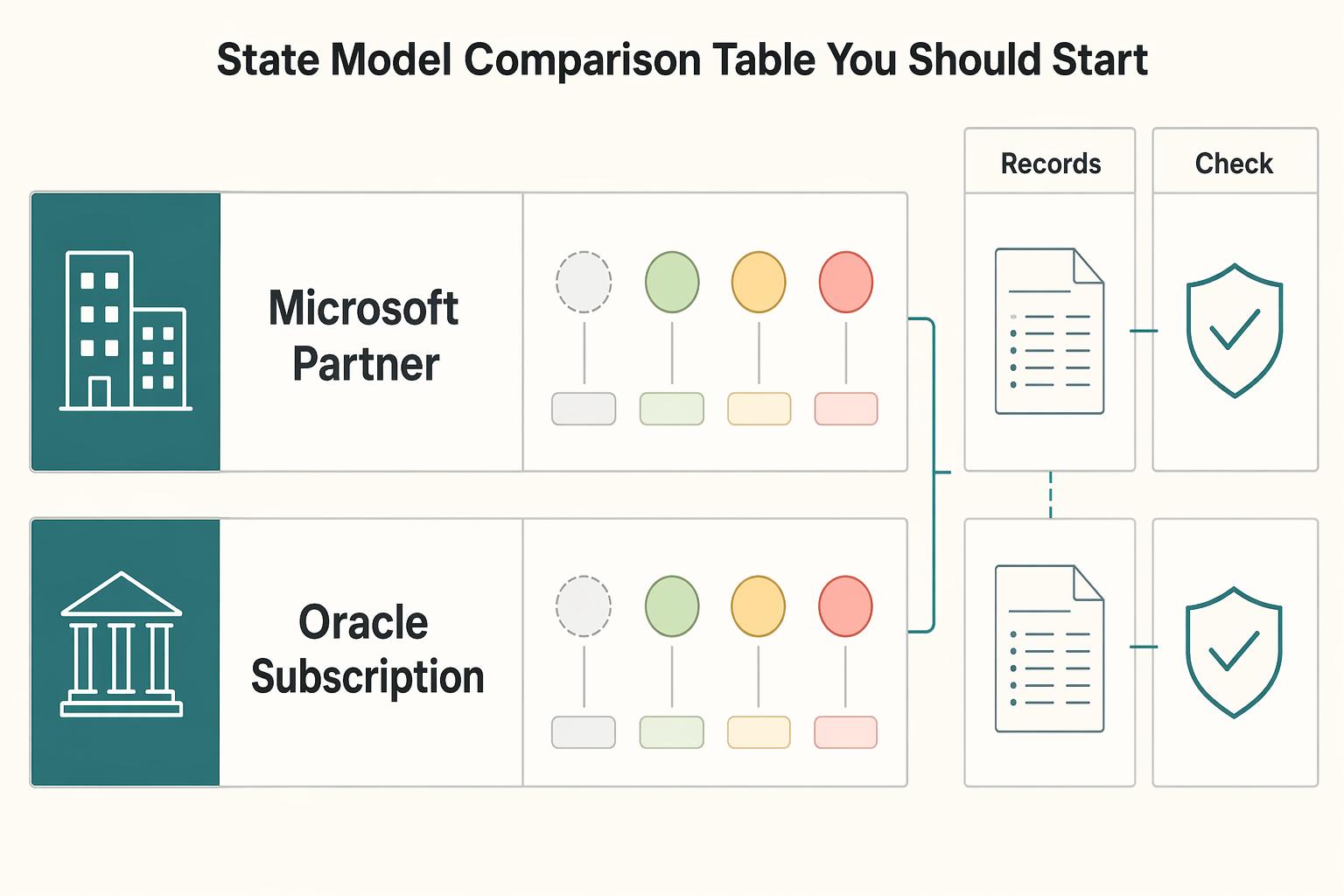
| Reconciliation check | How subscription records map to the customer identity in your systems | Conflicting records for the same customer |
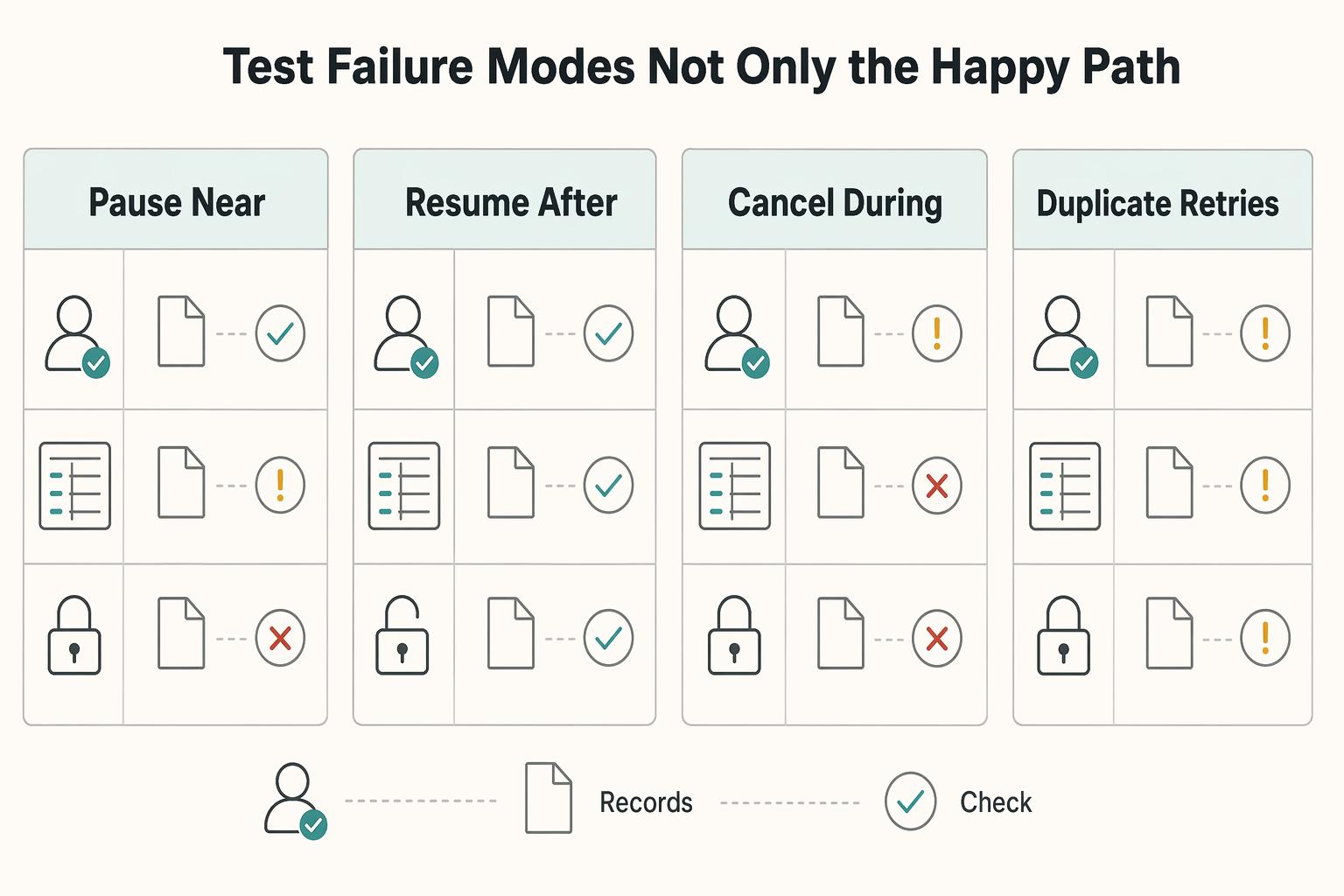
Test failure modes, not only the happy path#
Pause flows usually fail at boundaries and retries. Test at least:
| Scenario | Compare against | If they do not match |
|---|---|---|
| Pause near renewal timing boundaries | Customer confirmation, billing record, and actual entitlement result | The flow is not launch-ready. |
| Resume after failed payment | Customer confirmation, billing record, and actual entitlement result | The flow is not launch-ready. |
| Cancel during paused status | Customer confirmation, billing record, and actual entitlement result | The flow is not launch-ready. |
| Duplicate retries around renewal-state changes | Customer confirmation, billing record, and actual entitlement result | The flow is not launch-ready. |
For each test, compare the customer confirmation, the billing record, and the actual entitlement result. If they do not match, the flow is not launch-ready.
Set explicit internal sign-off checkpoints before launch: finance on billing and ledger outcomes, product on entitlement behavior, and support on customer-facing outcomes. Related: What Is a Subscription Lifecycle? How Platforms Manage Trial Active Paused and Churned States.
Common failure modes competitors skip#
Most revenue leakage in this setup comes from contradiction mistakes, not strategy mistakes. A cancellation flow can improve retention, but only when the options it presents are operationally real.
Teams get into trouble when the customer promise, billing behavior, and return path are not aligned. If your "pause" or "resume anytime" language does not hold up against real billing and account-state outcomes, a plain cancel subscription path is safer than a misleading middle option.
| Failure mode | What the user assumes | What to verify before launch | Cost if missed |
|---|---|---|---|
| Promise exceeds system behavior | "Pause" or "resume" will work exactly as described | Product copy, billing logic, and account-state outcomes match the same policy | Refund pressure and trust erosion |
| Reactivation blocked by payment issues | Returning later will be quick | Resume flow handles expired cards and failed transactions cleanly | Lost recoveries and involuntary churn |
| Payment-failure blind spot | Churn is mostly voluntary | Recovery prompts and payment retry paths are tested in resume/cancel journeys | Preventable revenue loss; one source says payment failures may account for up to 33% of losses |
| Policy drift across channels | App, help, and support all mean the same thing | UI copy, billing emails, and help-center language are aligned line by line | Conflicting agent answers and escalations |
The reactivation row is where retention claims often break down. "Come back anytime" only works if the return path can clear payment problems and complete a valid billable outcome.
One compliance caution: the FTC Negative Option Rule entry dated 11/15/2024 with citation 89 FR 90476 appears on FederalRegister.gov as an informational prototype. Verify against an official Federal Register edition before treating it as final legal authority.
Decision rule: if you cannot prove your cancellation flow, payment recovery path, and channel messaging all match the same backend policy, do not market pause as a retention feature yet. Related reading: The Best Tools for Managing Subscription Billing.
Launch checklist for finance, product, and support#
Do not ship pause or cancel changes until ownership, measurement, and rollback are explicit. If your team cannot clearly answer who owns the customer promise, who owns billing records, and who owns dispute resolution, you are not launch-ready.
| Area to lock down | Suggested owner | Pre-launch checkpoint |
|---|---|---|
| Customer-facing state language | Product | UI, help content, and subscription terms use the same language for access, renewal, and return |
| Billing and reconciliation | Finance | pause payments, cancel events, and reactivation events are traceable in billing records and reviewable in the month-end close process |
| Disputes and recovery paths | Support | Agents have approved macros for disputed renewals, entitlement complaints, and resume/cancel outcomes |
This split is an operating choice, not a universal standard. The practical point is that stakeholder alignment should happen early, and finance needs an accurate view of financial state at close. If pause introduces states finance cannot reconcile, the retention upside is not worth the operational cost.
Before go-live, build one shared evidence pack and have all three teams review it: final UI copy, the matching help article, the relevant subscription-terms excerpt, sample billing-event records for paused and canceled accounts, and audit-log visibility for who changed what and when. If a customer disputes renewal or access, that pack should let you reconstruct the sequence quickly.
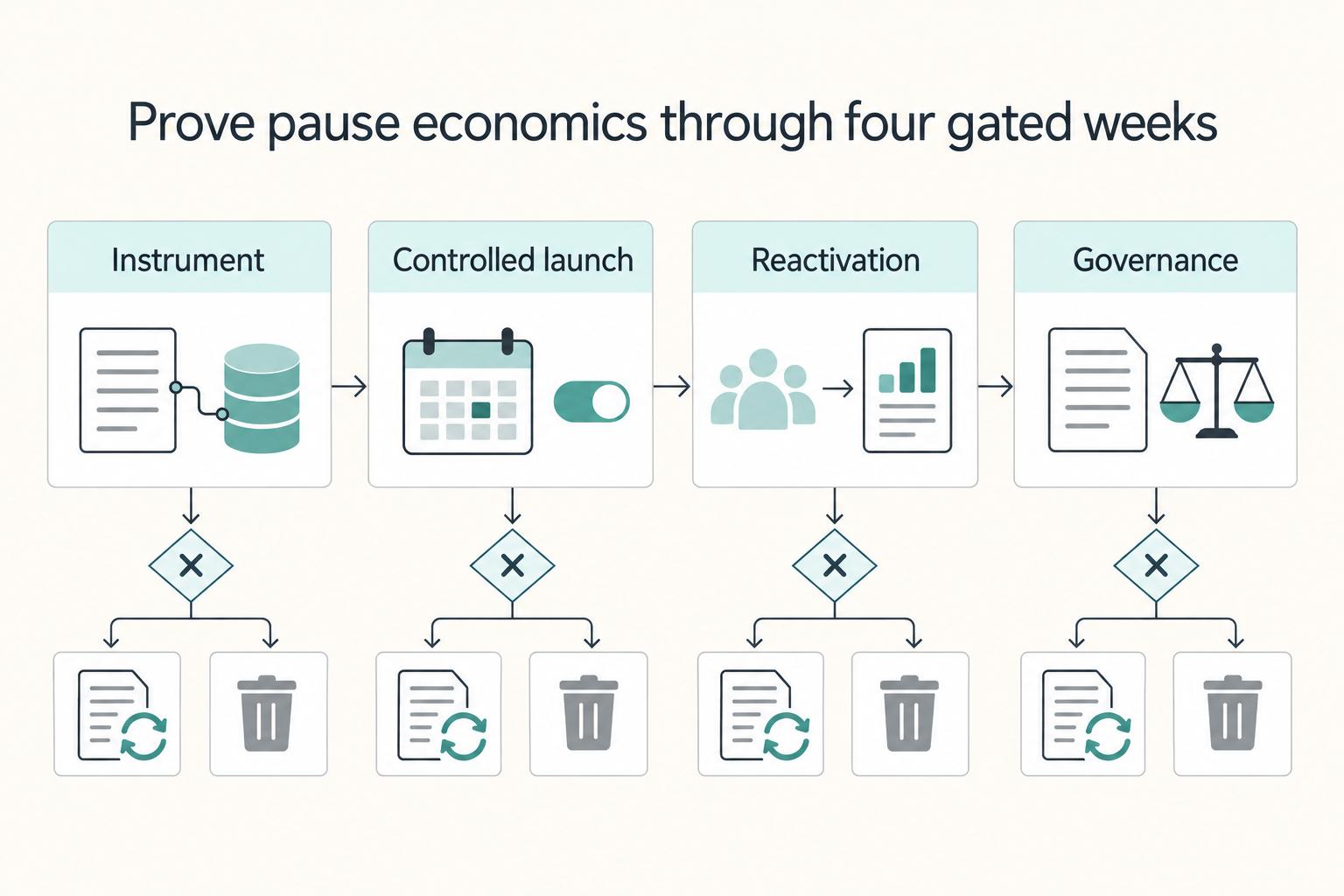
Set KPI gates on day one: paused-to-reactivated rate, paused-to-canceled rate, support contacts per state change, and net churn impact. Define success before rollout, then pause the release if those signals move in the wrong direction. We covered related model tradeoffs in Choosing Between Subscription and Transaction Fees for Your Revenue Model.
Conclusion#
The real decision is not about button text. It is about whether your product, billing-cycle logic, and reactivation path all produce the same customer outcome every time. If you cannot define that outcome clearly, ship a clean cancellation flow first and add pause later.
A pause is only useful when it means something specific. Paid Memberships Pro describes pause subscriptions as a way to "temporarily skip subscription payments" and frames it as an alternative to cancelling the member account. That is a practical definition, but it still leaves the hard work to you: when the pause starts, what happens to entitlement during the paused period, when billing resumes, and what the customer sees in their account. If your team cannot answer those questions in one sentence each, the pause offer is not ready.
The revenue case is real enough to test, but not strong enough to assume. Recharge uses the headline claim "Reduce your cancellations by 10% with pause subscriptions," and Circuly positions skip, cancel, and pause options as a way to encourage hesitant customers. Treat both as directional vendor-side signals, not proof that your version will work. The operator move is simple: launch only if you can measure paused-to-reactivated rate, paused-to-canceled rate, and support contacts after each state change. A common risk is offering a softer exit, then discovering your resume flow breaks on expired payment methods or restored access never matches billing status.
There is also a trust and policy layer that deserves more care than most teams give it. The FTC Negative Option Rule appears in Federal Register metadata as a rule published on 11/15/2024, with citation 89 FR 90476. But FederalRegister.gov also says the web version "is not an official legal edition of the Federal Register" and that anyone relying on it for legal research should verify against an official edition. So if your legal or compliance review depends on cancellation or renewal rules, do not build policy from blog summaries or unofficial web text alone. Verify the actual source before you freeze customer promises.
That leaves one sensible end state. Define the billing-cycle behavior, entitlement behavior, and reactivation behavior up front, then make your UI say exactly that and nothing more. If pause truly means skipped payments with a reliable return path, it may protect revenue without weakening cancellation trust. If it is just a nicer label for an opaque backend action, it can cost you more in disputes, confusion, and support than it saves.
Frequently Asked Questions
Is pause the same as cancel for subscriptions?
No. In the source examples, pause usually means delaying renewal, not ending the relationship. FantasyPros says pausing means "delaying your subscription renewal to a future date," while Codecademy says cancellation "will terminate your Pro or Plus access" and requires resubscription to get it back.
Do users lose access immediately after they cancel?
Not always. Sling says cancellation stops future charges but access continues until the next regular billing date, so "cancel" there does not mean instant cutoff. If you run a subscription product, your help article, billing email, and subscription terms need to say the same post-cancel access date.
Does uninstalling an app on Android cancel the subscription?
You should not assume that it does. There is no basis to say uninstalling an Android app cancels billing, and FantasyPros adds an important channel detail: iOS and Android/Google Play subscriptions cannot be paused. The practical check is simple: verify the status in the billing channel itself, such as Google Play or the provider account page, instead of treating app removal as proof of cancellation.
When should a business offer pause instead of only cancel?
Offer pause when temporary budget or usage dips are common and you can explain the return date clearly. The strongest examples here are monthly plans with bounded options: Codecademy offers pause for 1, 2, or 3 months, and Sling also offers 1, 2, or 3 months. If most customers are annual, short-pass, or marketplace-billed users, cancel-only may be cleaner because availability is often limited by plan type or billing channel.
What is still unknown until you check each platform’s policy?
A lot more than teams usually expect: whether pause exists at all, which plans qualify, when the pause starts, whether access continues during the paused period, and whether billing resumes automatically. The sources show real variation: Codecademy limits pause to monthly subscriptions and says it resumes automatically when the pause ends; Sling says pause periods match the existing billing cycle and begin at the next scheduled billing date. If you are comparing pause vs cancel subscription behavior, check the exact policy page for each product and channel before writing UX copy.
How should teams explain pause and cancel in plain language to reduce support tickets?
Use one sentence per action and make the billing consequence explicit. Good plain language looks like this: "Pause delays your next renewal until the pause end date" and "Cancel stops future renewal; your access ends on the current period end date." Before shipping, verify those lines against the actual billing record and one test account per channel, because a common failure is a front-end label that promises pause while the backend performs a full cancellation.
Try a related tool
Researched and edited by the Gruv editorial team. Gruv builds cross-border billing, payouts, and finance-operations software for global businesses.
Sources
- calosba.ca.gov/al-chiletrusted
- cio.gov/assets/resources/Cloud%20Operations%20Best%2...trusted
- congress.gov/event/119th-congress/senate-event/LC74989/texttrusted
- congress.gov/117/plaws/publ103/PLAW-117publ103.htmtrusted
- dau.edu/sites/default/files/2025-02/FullBook_JulyAug...trusted
- eac.gov/sites/default/files/TestingCertification/Vol...trusted
- federalregister.gov/documents/2024/11/15/2024-25534/negative-opt...trusted
- ftc.gov/system/files/ftc_gov/pdf/p064202_negative_op...trusted
Educational content only. Not legal, tax, or financial advice.
Related Posts
Subscription Pause vs Cancel and the Middle Option That Protects Revenue
Subscription pause is not a nicer cancel button. It is a revenue decision. When cancel is the only path, you lose the current subscription and, in many cases, the chance to re-engage that customer later. A paused state can reduce churn, support loyalty, and preserve longer-term revenue. It also affects how you track revenue and churn across future billing cycles.
What Is a Subscription Lifecycle? How Platforms Manage Trial Active Paused and Churned States
Subscription lifecycle states matter only when they tell your team what happens next. In **subscription lifecycle states platform management**, a label like `Active` or `Suspended` should tell finance, billing ops, and product what changes in charges, access, edits, and reconciliation.

How Platform Builders Implement Subscription Pause for Retention
Treat subscription pause as a policy decision in your subscription lifecycle, not a nicer-looking button in the cancellation flow. If you only surface pause when someone tries to leave, you may see short-term retention wins while creating unclear billing behavior and status handling across systems.