
Quick Answer
Offer pause or a discount as an optional alternative to direct cancellation. Disclose effective dates, access, invoices, remaining amounts and any resumed price/date before acceptance. Track internal lifecycle, provider status and payment health separately. Measure paid returns and contribution across mature eligible cohorts, and recover unknown operations before retrying.
When a pause option can support subscription revenue#
A pause gives a customer with a temporary need a way to stop or modify service without ending the relationship. It can support later revenue, but current billing, access and return behavior determine the result. A cancellation can also be followed by a new purchase; neither label proves lifetime value.
Product and finance need an explicit choice: what stops, when it stops, what remains due and how billing resumes. Offer pause where it meets the customer’s need and the operation can honor it. Keep cancellation available regardless of the retention offer.
Recurly’s January 12, 2025 article reports 66% year-over-year growth in pauses in 2024. That vendor-reported usage trend does not establish an incremental retention or revenue gain for your customers.
The commercial promise is simple: keep more wavering customers in the relationship and support revenue retention over time. The operational warning is just as simple: if you rush it, you can end up with broken billing and messy metrics. The first recommendation is blunt. If you cannot reliably distinguish Active, Paused, and fully canceled accounts in your billing and reporting, keep cancellation final until you can. A middle option you cannot measure can look better in the funnel than it looks in revenue.
One checkpoint matters from day one: can your team verify who paused, when they paused, what prompted the choice, and whether they ever came back? If that evidence is missing, your pause policy is opinion, not monetization strategy. The rest of this article is about making that call with finance-grade discipline, so you can keep the customers worth saving without masking real demand loss. Start by comparing pause, discount, and cancel side by side on the criteria that actually move revenue and operating clarity.
At-a-glance comparison of pause, discount, and cancel#
Use this as a decision frame, not a default rule: pause can protect long-term revenue when the user needs a temporary break, discount is a targeted response to price friction, and cancel should remain a clear final path. If you cannot reliably track Active, Paused, and Churned, keep the flow simple until your lifecycle data is dependable.
| Criteria | Subscription pause | Discount | Subscription cancellation |
|---|---|---|---|
| Revenue and ARPU impact | A zero-price service pause removes current billable MRR; ARPU depends on the stated denominator | Discount lowers billable MRR and average revenue at an unchanged subscriber count | Effective cancellation removes recurring MRR; scheduled cancellation may retain it through the paid period |
| Revenue floor risk | Near-term risk is real because paused users are not paying now | Revenue may continue, but at a lower level while discounted | Recurring revenue ends at the effective end date; prior invoices, final usage or refunds need separate handling |
| Operational overhead | Requires clear pause rules, billing behavior, and return handling | Requires offer controls and margin discipline | Operationally simpler at exit, but still needs clean churn tracking |
| Expected reactivation behavior | Temporary intent may support return; test accepted pause, paid return and later retention separately | Customer stays active, so this is less about reactivation and more about discount discipline | A canceled customer can return through a new purchase/subscription; track it separately |
| Exit intent quality | High. Best when the reason is temporary non-use | High. Best when the reason is clearly price-related | Still useful to capture, even when you allow immediate exit |
| Cancellation flow instrumentation | High. Track reason, offer shown, pause start, pause end, and return status | High. Track who saw the offer, accepted it, and what happened after | Medium to high. Track reason, cancellation timing, and state transition |
| Reliable reactivation sequence | Required, or pause becomes delayed churn | Helpful but less central than in pause flows | Optional win-back, not a pause-to-active flow |
| Best fit | Temporary customer need, affordable carrying costs and reliable billing/access/return controls; no universal CAC threshold | Verified price friction and enough margin room to support temporary ARPU compression | Poor-fit or low-intent users, or teams that cannot yet run pause cleanly |
| Worst fit | Weak billing controls, unclear lifecycle state handling, or no way to measure return | Weak unit economics or broad untargeted discounting | Users who likely need a short break rather than a full exit |
Compare current billable MRR, later collected revenue and contribution after offer/support costs. A zero-price pause removes current MRR; a discount reduces it; cancellation removes it at the effective end date. Define each metric before selecting a route.
Before trusting results, confirm you can pull a clean record of cancellation intent, reason, offer shown, offer accepted, resulting state, and later return to Active. Without that, pause can look like retention while it is actually delayed churn.
If you want a deeper dive, read Pause vs Cancel: Why Subscription Pause Options Protect Revenue.
Match exit intent to the right offer with explicit decision rules#
Use an optional reason to suggest a relevant offer: a temporary break may fit pause, price pressure may fit a discount, and poor fit may warrant cancellation. Present cancellation clearly at every step, allow the customer to skip the survey or offer, and require affirmative selection before replacing a cancellation request with pause.
| Exit signal | Default route | Minimum check before showing it | Risk if overused |
|---|---|---|---|
| Temporary timing friction (seasonality, short-term non-use, short-term capacity limits) | Subscription pause | The account still looks healthy and has a believable path back | You hide likely churn inside Paused |
| Clear price-only objection | Targeted discount | Product fit is still intact and margin impact is acceptable | You compress ARPU and train discount-seeking behavior |
| Poor fit, low intent, weak usage, or no credible return case | Subscription cancellation | The issue is not temporary and reactivation is unlikely | You may miss a recoverable account if diagnosis was wrong |
Route by reason, then by account quality#
Treat stated reason and account condition as a pair. A currently healthy account with a temporary constraint is a different case than a low-usage account already drifting out, even if both pick similar exit wording. That distinction is what keeps pause from turning into a holding bucket.
Scenario contrast operators can use#
A high-engagement account with a temporary timing issue is the stronger pause candidate because the return path is plausible. A low-usage account near churn is usually a weaker pause candidate, even when the stated reason sounds temporary.
Do not route to pause#
| Condition | Why not pause |
|---|---|
| Unit economics do not support carrying a larger paused population | Larger paused population is not supported |
| Reactivation probability appears low based on account history | Reactivation probability appears low |
| No defined, measurable path from Paused back to Active | Path back to Active is not defined or measurable |
| The event is a payment-recovery issue | Should stay in dunning, not lifecycle routing |
Your verification checkpoint is simple: outcomes must be reportable by decision path, including reason captured, offer shown, accept/decline, resulting state, and later return or churn. Without that chain, pause policy is opinion, not evidence.
Set finance guardrails before rollout#
Set finance guardrails before launch so pause is measured as a revenue decision, not a save-flow win. Define ARPU dilution tolerance, what LTV preservation looks like, and the revenue-floor conditions that determine whether pause is protecting value or only delaying churn.
| Guardrail | What finance should approve before launch | What product must show | Trigger to revisit policy |
|---|---|---|---|
| ARPU dilution | Acceptable temporary revenue compression when users pause | Cohort ARPU before pause, during Paused, and after return to Active | Reactivated cohorts fail to recover revenue quality |
| LTV preservation | Minimum commercial outcome for pause versus immediate cancellation | Return-to-Active rate and post-return retention for paused cohorts | Users return briefly, then churn fast enough to erode lifetime value |
| Revenue floor protection | Minimum recurring revenue base the policy must defend | Revenue that resumes billing versus revenue still parked in Paused | Paused balance grows while resumed revenue stays flat or declines |
Mark the pre-pause recurring amount as at risk, not retained MRR, when a zero-price pause takes effect. Report billable MRR restored, invoices issued, cash collected and retained paid returns separately. Provider or product Active status alone is not proof of payment or recovered revenue.
To keep that split clear, report Paused aging alongside return-to-Active rates. If older paused cohorts accumulate and return rates weaken with age, policy performance is slipping and ownership should trigger updates.
Ownership that holds up under pressure#
Ownership should be explicit. Product owns cancellation-flow design, eligibility logic, and lifecycle instrumentation. Finance owns commercial definitions in reporting, approves guardrails, and signs off on policy changes when lifecycle transitions underperform.
Use a fixed observation window and a comparable control where feasible. Publish segment sizes and maturity alongside current MRR, collections, costs and post-return retention. A short operational pilot can establish reliable execution; it cannot establish lifetime value before the relevant cohorts mature.
Launch pause only with finance-approved definitions, cohort reporting that separates resumed from parked revenue, and named owners for policy updates.
Design the cancellation flow and lifecycle states so teams can operate it#
Keep a direct cancellation path. If the customer chooses to consider a retention offer, ask an optional reason, show one relevant offer with its terms, record explicit acceptance, and confirm the resulting action. A survey or rejected offer must not block cancellation. Commit the effective date, billing behavior and access change before promising completion.
As checked October 4, 2026, the FTC’s March 2026 notice identifies the 2024 expanded Negative Option Rule as vacated and describes a new rulemaking inquiry. Do not use the 2024 rule as a current mandate. US online consumer negative-option transactions remain subject to ROSCA, including material-term disclosure, express informed consent and a simple mechanism to stop recurring charges, alongside other applicable rules. Disclose pause end date, resumed price, billing date, access and cancellation route before acceptance.
State logic that prevents drift#
Use one internal lifecycle state per subscription, while keeping provider status, collection behavior, access entitlement and cancellation schedule as separate fields. An account can hold multiple subscriptions in different states. Map the internal model to actual provider behavior rather than replacing it with four labels.
| State | Operational meaning | Typical entry path | Billing expectation | Minimum transition evidence |
|---|---|---|---|---|
| Trial state | User has access under trial terms and has not entered normal recurring billing | Signup or trial extension | Trial rules apply, not normal paid billing | trial_start, trial_end, current offer, consent record |
| Active state | User is in normal paid service | Trial conversion or verified resume under agreed terms | Billable according to plan; payment health is a separate field | prior_state, activation reason, billable plan, effective_at |
| Paused state | Access and billing behavior follow your approved pause policy | Routed offer accepted during cancellation flow | Explicit policy specifies whether service, invoicing and/or collection stop; existing amounts remain separately tracked | accepted terms/version, pause_start, duration/end rule, price/anchor on resume, access and invoice handling |
| Churned state | Subscription is ended and should not be treated as recoverable recurring revenue | Direct cancellation, pause expiry to cancel, admin termination | No future normal renewal after effective end; existing/final amounts and credits/refunds remain separate | cancellation reason, effective_end_at, actor, confirmation sent |
One subscription should have one internal lifecycle state at a given effective time. A cancellation scheduled for period end can coexist with current paid access: retain its effective_end_at and show cancel_scheduled rather than reporting it as already ended. Track past_due/unpaid payment health separately, and do not equate provider Active with your internal billable state.
Map the policy to the actual billing operation#
For example, Stripe payment-collection pause leaves provider status active and keeps generating invoices. Choose draft, uncollectible or void behavior; pre-existing invoices can still retry. Resuming collection does not automatically advance held draft invoices. A draft balance intended for later collection is deferred billing, not a free service pause.
Stripe’s service-pause documentation describes a separate flexible-billing operation that moves status to paused and suspends new invoices, with configured unused-time/usage effects. Existing invoices continue independently. Verify account/API support and limitations for the exact configuration; the linked API parameters include a preview version. Apply entitlement changes from verified outcomes, and record the resume invoice and payment outcome separately from status.
| Decision at acceptance | What to record and check |
|---|---|
| Pause effective time | Immediate or period-end; exact date/time zone and paid-access cutoff |
| New and existing invoices | Suppress, void, defer or collect as agreed; list existing drafts/open amounts and prevent conflicting automation |
| Service and data | Access during pause, retained data and restoration behavior |
| Resume billing | Action-required or agreed automatic date; plan, price, tax, billing anchor and credits/usage |
| Resume failure or cancellation | Verified outcome, payment recovery lane, confirmation and no duplicate subscription/charge |
Cancellation is also distinct: scheduled period-end cancellation retains the subscription through the paid period; a canceled Stripe subscription cannot be restarted and a return needs a new subscription. Cancellation does not automatically refund prior charges or resolve final usage and open invoices. Record those adjustments individually.
Instrumentation that holds up under pressure#
Log subscription ID, prior/next internal state, provider state, reason when supplied, offer ID, actor, accepted terms, requested/effective timestamps and request/event IDs. Use a durable operation record and stable idempotency key for each logical change; deduplicate events and recover an unknown provider response before retrying. Send confirmation once the actual outcome is known.
Keep transition history append-only, with separate invoice, payment and entitlement references. An application event does not make billing and access changes atomic. If one side fails, mark the operation pending/failed with an owner, reconcile the provider’s current state, and complete or compensate only the intended change.
Reconstruct each outcome from the operation record: customer choice, terms, intended/effective dates, provider result, access, invoice treatment and confirmation. Use cancellation_started and cancel_scheduled events even when the final state is delayed. Do not expand pause until these handoffs agree.
Related: What Is a Subscription Lifecycle? How Platforms Manage Trial Active Paused and Churned States.
Build the reactivation sequence and measurement loop#
Your reactivation sequence should move the right users from Paused back to Active without mixing that path with billing-failure recovery. Keep pause reactivation and dunning distinct: reactivation handles voluntary pause intent, while dunning handles failed recurring payments that can cause involuntary churn.
Make the path back to Active obvious#
Confirm the start/effective date, what access remains, and whether invoicing or collection stops. State the resume date or required action, plan/price, billing anchor, credits or amounts still due, and how to cancel during the pause. Reminders should repeat the actual agreed terms without changing them.
| Touchpoint | What to make explicit |
|---|---|
| Pause confirmation | Accepted duration, effective time, access, invoices/old balance, resumed price/date or required action, cancellation link |
| Optional reminders | Relevant return instructions and agreed terms; respect messaging preferences |
| Before resume/expiry | Exact next action/date/price, cancellation choice and any payment update needed; no surprise automatic charge |
Run an operator check on every reminder link. If the message promise and resume page do not match the account record, pricing, or billing status, recovery quality drops for execution reasons, not demand reasons.
Match message and channel to the original exit intent#
Route reminders by the reason captured at exit, not with one generic win-back stream. Churn analysis is useful here because it combines quantitative patterns with qualitative feedback on why and when users leave.
| Paused cohort | What the reminder should emphasize | Best-fit channel rule | Success event to log |
|---|---|---|---|
| Timing-based pause | "Ready when you are" return timing and clear resume path | Email first, plus in-app reminder on return visit | Resume outcome verified; billable state and payment result recorded separately |
| Usage or value gap | Value reminder tied to the missed use case | In-app on revisit, plus one clear email path back | Resume verified plus product action; separately track paid return |
| Payment issue with intent to stay | Payment update and recovery guidance | Dunning sequence, not pause reactivation | Payment recovered with verified provider/payment-health outcome |
Treat that last cohort as billing recovery, not voluntary win-back. Dunning is specifically a coordinated process of payment retries plus customer messaging after failed recurring payments, so keep those recoveries separate in reporting and workflow. For that lane, use dunning management.
Measure quality, not just returns#
Segment by reason when supplied, offer, plan and pause duration. Freeze the cohort and observation dates, then distinguish acceptance, attempted resume, verified resume, first paid return and paid retention at a chosen horizon. Include nonreturns and still-paused members in the appropriate denominator; do not compare only successful returners.
| Segment by | Track |
|---|---|
| reason_code | reactivation rate; time-to-reactivation; post-reactivation retention; ARPU normalization |
| routed_offer_id | reactivation rate; time-to-reactivation; post-reactivation retention; ARPU normalization |
| plan | reactivation rate; time-to-reactivation; post-reactivation retention; ARPU normalization |
| pause length | reactivation rate; time-to-reactivation; post-reactivation retention; ARPU normalization |
Report revenue per original eligible subscriber alongside ARPU for the defined current paying base. If pause removes nonpaying users from that base, ARPU can rise even while revenue falls. Compare equally mature cohorts and use a control or clearly disclose selection limits before claiming the offer caused an improvement.
Worked cohort and contribution checks#
Illustrative cohort: 100 eligible cancellation attempts include 20 accepted zero-price pauses and 80 cancellations. By a fixed 90-day observation date, 12 of the 20 have resumed, 10 have made a successful payment, and 8 remain paid subscribers at the chosen retention checkpoint. Acceptance is 20/100 = 20%; verified resume is 12/20 = 60%; first paid return is 10/20 = 50%; retained paid return is 8/20 = 40%, or 8/100 = 8% of the original eligible cohort. The observation date includes every member’s full agreed pause and post-return window. Keep the other 12 pause members’ canceled, still-paused or unpaid outcomes visible.
If all 100 previously paid USD100/month, their original MRR was USD10,000. During a zero-price pause and after the other cancellations take effect, this cohort contributes zero billable MRR. At the later checkpoint, eight paid subscriptions at the unchanged price restore USD800 MRR. Current-paying-base ARPU is still USD100, while recurring revenue per original eligible subscriber is USD8. Neither a 40% retained-return rate among pause accepters nor unchanged ARPU proves that pause caused a gain.
For an equally mature randomized comparison of 100 eligible customers in each arm, suppose the offer arm collects USD6,000 over 90 days and incurs USD1,500 in defined service/offer/support costs after refunds are netted from receipts. The control collects USD5,000 and incurs USD800 comparable costs. Contribution under this definition is USD4,500 versus USD4,200, a USD300 or USD3-per-eligible-customer difference. These are hypothetical operational cash figures, not recognized revenue or proven LTV. Check sample uncertainty and longer retention before expanding.
Failure modes that make pause look good while hurting revenue#
Pause can improve retention optics while still weakening outcomes if you treat activity as success instead of economics.
| Failure mode | What looks good | What to check before you call it a win |
|---|---|---|
| Every resumed account is marked "saved" | Reactivation counts rise | Confirm returns hold and revenue normalizes, rather than dropping again after reactivation |
| Pause becomes the default for poor-fit users | Paused-state volume grows | Check whether pause is masking real cancellation demand instead of preserving healthy customers |
| Dunning and voluntary pause get blended | "Save rate" appears stronger | Separate payment-recovery events from true keep-or-leave intent so billing noise is not counted as retention |
| Benchmark claims drive strategy | Confidence increases fast | Validate external claims against your own unit economics before you copy the playbook |
Treat cancellation data as diagnostic, not as noise to hide. If pause absorbs too many poor-fit exits, you lose the signal you need to fix the underlying offer and experience. Keep the bar practical: pause should function as a clear contract choice, not a vanity bucket.
For a step-by-step walkthrough, see Building Subscription Revenue on a Marketplace Without Billing Gaps.
30-day execution checklist for a finance-grade pause policy#
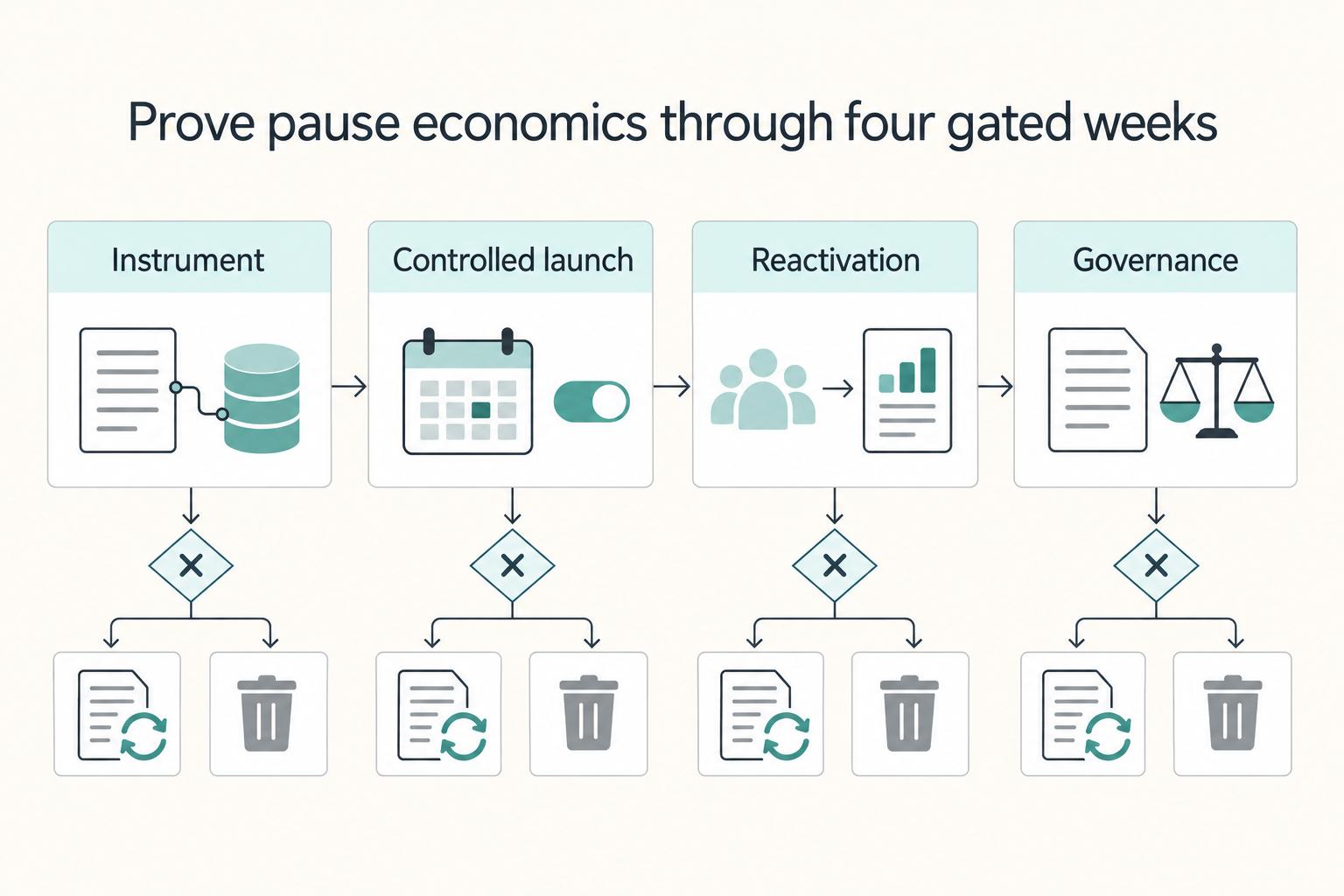
Use the first 30 days to check execution, consent, billing and data quality in a constrained segment. A month may not include a full pause plus post-return window. Keep longer-term effectiveness provisional until cohorts mature; the diagram below illustrates the four operating gates, not proof of LTV.
| Week | Primary objective | What must be true before you move on | Red flag |
|---|---|---|---|
| 1 | Instrument the Cancellation flow and baseline finance metrics | States, denominators, observation dates, MRR/collection/cost baseline and offer terms are frozen for the test segment | Teams still debate what counts as pause, cancel, or payment recovery |
| 2 | Launch pause decision rules to a controlled segment | Every routed outcome logs a clear lifecycle transition (for example, Active to Paused or Active to Churned) | Manual interpretation is needed to explain why a user saw an offer |
| 3 | Activate the Reactivation sequence and monitor state aging | You can track time in Paused, return to Active, and leakage to Churned by cohort | Reactivations rise, but post-return retention and ARPU are still unclear |
| 4 | Run product-finance review and reset guardrails | Each route receives an operational keep/revise/stop decision, with immature economic outcomes marked pending longer observation | Routes are declared proven from immature return or retention data |
Week 1 is data-discipline week. Use a required-data-elements mindset: define the minimum fields before anyone reads results. Log the original reason, routed offer, resulting state, and dated event markers. Also timestamp batch/document dates so actions and records are auditable later.
Week 2 is evidence week. Launch to a segment small enough for account-level inspection, and require an activity-log-style record for each lifecycle change. If you cannot reconstruct the path from cancellation flow to final state from system logs, treat the outcome as unproven.
Week 3 is outcome-validation week. Track Paused aging, return to Active, and leakage to Churned together, and keep voluntary pause separate from dunning-related payment recovery. A rescued invoice is not proof the pause route worked unless the user actually chose pause and later behaved like a recovered subscriber.
Week 4 is the product-finance operating review. Fix billing, access or consent defects immediately; decide whether to continue, revise or stop new offers based on execution and available mature evidence. Do not shorten accepted customer pauses or restart charges by changing the experiment. Preserve longer-term measurement and verify the current rules for the actual consumer market.
Conclusion#
A pause policy must specify whether it suspends service, invoice generation, payment collection or some combination. End-of-period service pauses and immediate pauses have different credit and usage effects. Keep existing obligations, customer balances and later invoices separate instead of assuming all pauses skip charges without adjustment.
Suggest a relevant pause or discount where the customer wishes to consider it, while preserving direct cancellation. Test whether the accepted offer improves later paid revenue and contribution, not only whether it prevents an immediate ended state.
Your verification checkpoint is simple: every state change should be explainable from records, not memory. You should be able to reconstruct how an account moved from Active to Paused or Churned, when that happened, and what happened after reactivation. Then measure by cohort, not by headline save rate. The metrics that matter are return to Active, post-return retention, ARPU normalization, and whether LTV holds up after the pause period ends.
The biggest failure mode is delayed churn dressed up as success. A pause can prevent some outright cancellations, but it does not guarantee better long-term retention. Another red flag is assuming feature availability solves the hard part. Implementing pause still requires operational effort and a clear understanding of the work involved. That means clear lifecycle definitions, reminder communications, ownership between product and finance, and rules for removing underperforming routes.
So the next move is not philosophical. Implement the checklist, review the cohorts, and keep only the paths that improve both customer lifetime value and operating clarity. If your middle option makes reporting fuzzier or hides real demand loss, cut it. If reason-based routing, subscription lifecycle tracking, and finance guardrails are solid, then pause can protect revenue without distorting reality.
Frequently Asked Questions
Does subscription pause reduce churn more than discounts?
There is no supported universal winner here. Treat it as a test: pause can fit timing or temporary-need cases, while discounts may fit clear price pressure. Judge both by post-return retention and ARPU, not by the raw number of accounts that avoided immediate cancellation.
When should you avoid offering a subscription pause?
Avoid pause when the operation cannot honor its access, billing and return terms, or carrying cost and expected returns fail the test. A payment failure belongs in the payment-recovery workflow; do not silently convert it to an accepted voluntary pause. The customer can still cancel through the direct path.
How long should a paused state last before auto-reactivation or cancellation?
Set a duration suited to the actual temporary need and disclose the end behavior before acceptance. A 30-day seasonality pause can be an illustrative pilot, not a universal limit. Track aging and paid returns through a mature post-return window; do not shorten an agreed pause because an early dashboard looks weak.
Should a subscription pause auto-reactivate by default?
Choose and disclose either a specific automatic resume or an action-required return. For auto-resume, obtain agreement to the resumed price/date, provide a usable cancellation route, and send the required or promised notices. An action-required pause must not restart charges merely because the customer ignores a reminder. Verify actual provider and market rules.
How do you prevent subscription pause from becoming delayed churn?
Track each original eligible cohort through pause, verified resume, paid return and later paid retention. Include nonreturners and carrying costs, compare matched observation windows and use a comparable control where feasible. A larger Paused population or an Active status alone is not retained revenue.
What is the minimum data needed to trust a pause vs cancel decision?
Capture the choice/terms version, subscription ID, optional reason, offer, requested/effective dates, internal and provider states, access, invoice/payment effects and confirmation references. Keep each transition traceable with durable request/event IDs and unknown-result recovery. Record scheduled cancellation separately from its effective completion.
Try a related tool
Researched and edited by the Gruv editorial team. Gruv builds cross-border billing, payouts, and finance-operations software for global businesses.
Sources
Includes 1 external source outside the trusted-domain allowlist.
Educational content only. Not legal, tax, or financial advice.
Related Posts
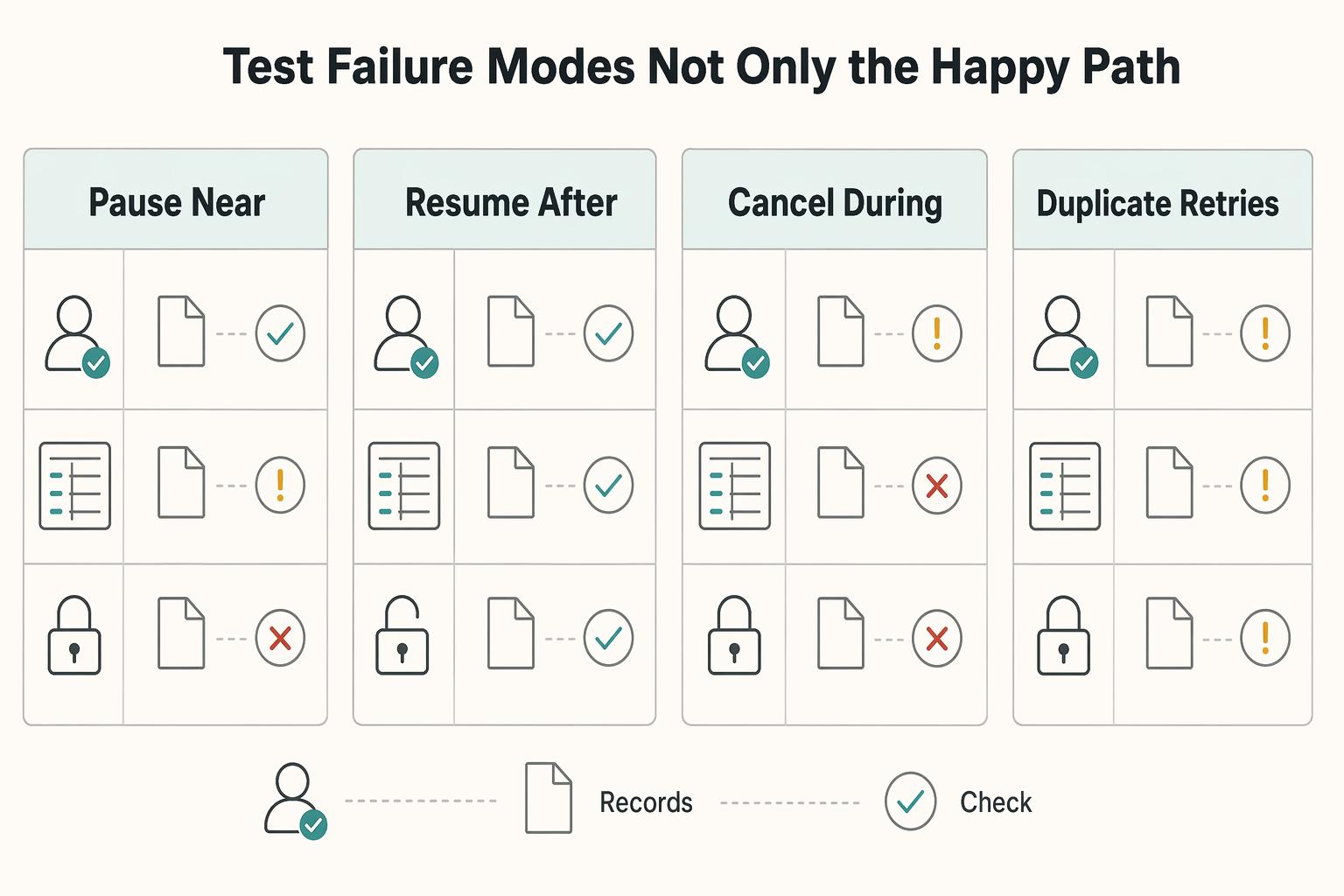
Pause vs Cancel Subscription and the Revenue Impact of Getting States Right
Teams lose money when they treat **pause vs cancel subscription** as a copy choice instead of a state choice. The real decision is whether you are changing renewal, changing access, or ending the relationship. Each path creates different churn, billing, and support outcomes.

A Guide to Dunning Management for Failed Payments
If you run recurring invoices, failed payments are not back-office noise. They create cashflow gaps, force extra follow-up work, and increase **Involuntary Churn** when good clients lose access after payment friction.
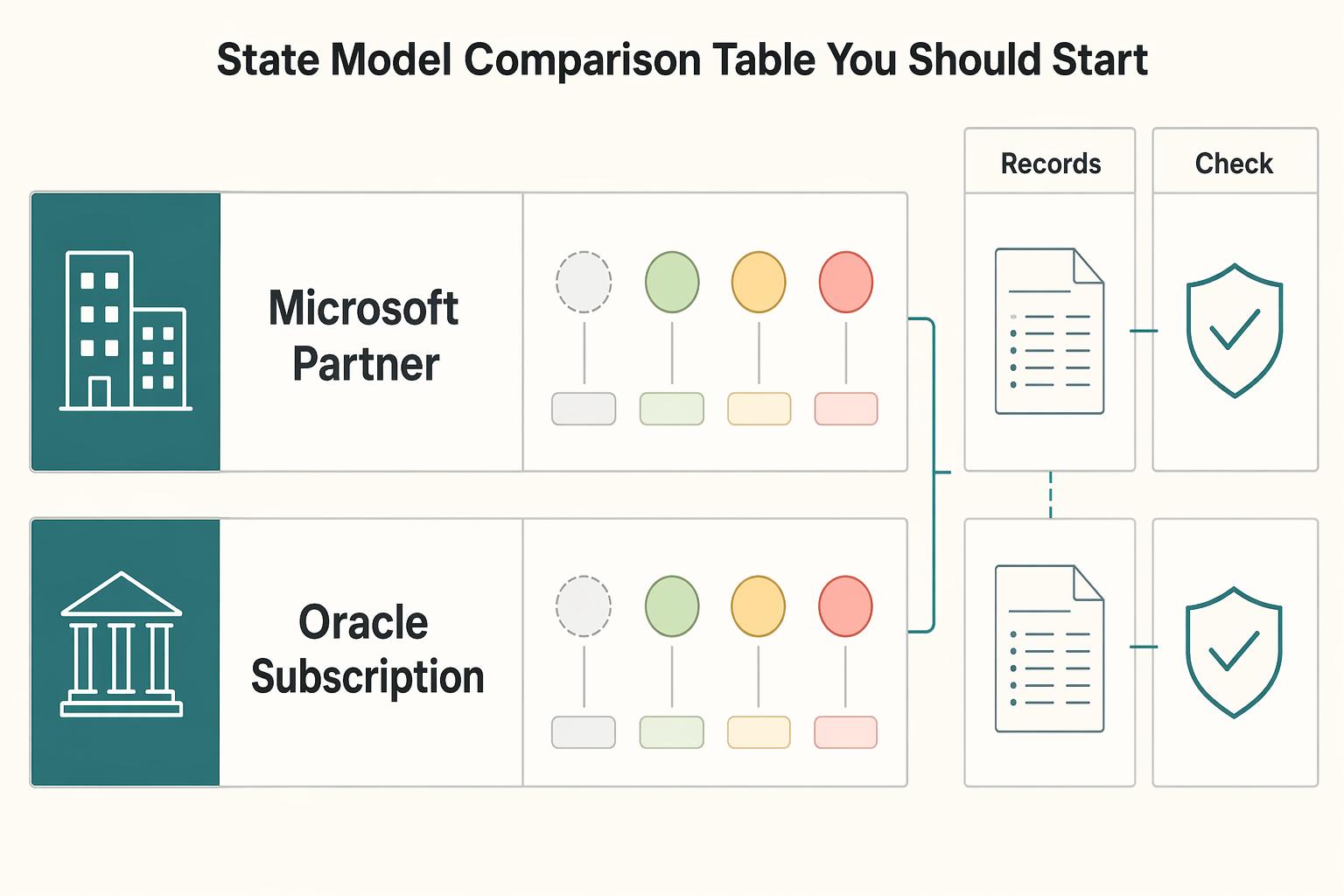
What Is a Subscription Lifecycle? How Platforms Manage Trial Active Paused and Churned States
A subscription lifecycle describes how a subscription moves through setup, trial, service, payment recovery and exit. Each state should tell finance, billing ops and product what changes in charges, access, edits and reconciliation. Business labels such as paused or churned need a mapping to the actual provider behavior.