
Quick Answer
Start with strict classification and control discipline: non-profit membership billing recurring donations member tiers works best when dues and gifts are separated at intake, renewal rules are written as enforceable paths, and finance can trace each event from ledger to settlement to bank activity. Use Topic 958 and ASU 2018-08 distinctions to avoid blended reporting, keep an exception queue with named owners, and add tier or cadence complexity only after close quality is consistently clean.
Why nonprofit membership billing breaks at scale#
Billing usually breaks before volume looks dangerous. The real problem is that membership programs often grow faster than their controls, so tiers, recurring donations, and membership dues start following different rules depending on who last touched the record. What you want is simpler than most billing documentation suggests: charges, renewals, and exceptions should be traceable and handled consistently, with ownership finance can explain without guesswork.
Step 1. Billing is a finance operation, not a checkout feature. Payment systems can be strong at the transaction layer, but nonprofit teams at scale usually need controls beyond payment collection. At small scale, teams can live with informal handoffs between ops, finance, and product. At scale, that turns into operational risk. Put the control points into written policies with named owners so it is clear who approves tier changes, who handles failed renewals, and who resolves exceptions. A useful checkpoint: if you ask three people how a changed renewal should be handled, you should get one answer.
Step 2. Separate recurring donations from membership dues from the start. Recurring donations can create more predictable repeat revenue, but they still need active management because failed payments are normal. Dues behave differently, especially when membership levels and monthly-versus-annual pricing options are involved. If your team pushes both through one operating path, reporting gets noisy fast and follow-up work drifts. The key control happens at intake: every transaction should be labeled as donation or dues before it enters the system, and that label should survive renewals and reversals.
Step 3. Build the evidence pack before exceptions start piling up. Close quality depends on having billing evidence assembled in one place, not rebuilt later from inbox threads. For membership billing, that means keeping transaction history, current status, and exception activity together. When evidence is fragmented across payments, fundraising, and finance tools, close work stops being reconciliation and starts becoming reconstruction.
That is the throughline for the rest of this guide. If your finance team cannot already trace a sample renewal through billing and recovery, do not add more billing cadence options or more benefit-based tiers yet. Simplify first, then expand.
If you want a deeper dive, read How to Use Webflow Memberships to Create a Paid Community.
Related: Subscription Billing for eCommerce DTC Brands Adding Recurring Revenue to Physical Products.
Gather prerequisites before you configure anything#
Do not start in the billing tool yet. Start with four written prerequisites, each with one owner and one pass/fail readiness test, so decisions stay traceable instead of turning into transaction-by-transaction exceptions.
| Prerequisite | Owner | Readiness test |
|---|---|---|
| Membership policy | Product drafts; ops reviews; finance approves | Ops, finance, and product can answer the same entitlement and dues questions from the same file |
| Cadence and change rules | Finance defines billing frequencies; product documents proration handling; ops owns exception paths | One approved path and one rejected path exist for an upgrade, a downgrade, and a failed renewal |
| Pre-launch packet | Finance coordinates; ops and product provide inputs | One sample renewal is traceable from member event to ledger entry to settlement status without inbox reconstruction |
| Conditional governance check | Ops gathers governing documents; finance records the conclusion; product waits for sign-off | Payment-status assumptions are documented as verified, not assumed |
Step 1. Write the membership policy. Owner: product drafts, ops reviews, finance approves. Document whether you run one level or member tiers, whether participation is required or elective, what each tier includes, and when upgrades or downgrades take effect. Membership programs exchange fees for added engagement, so this policy should reflect program goals, not just checkout setup. Readiness test: ops, finance, and product can answer the same entitlement and dues questions from the same file.
Step 2. Lock cadence and change rules. Owner: finance defines allowed billing frequencies, product documents proration handling, ops owns exception paths. Keep launch options narrow, and define how mid-cycle changes, credits, and manual overrides are handled before go-live. If any path depends on case-by-case judgment, treat it as incomplete. Readiness test: you can show one approved path and one rejected path for an upgrade, a downgrade, and a failed renewal.
Step 3. Assemble the pre-launch packet. Owner: finance coordinates, ops and product provide inputs. Build one packet with an event map, ledger mapping, settlement-state map, reconciliation responsibilities, and access controls, then run a traceable dry run. One practical model is to use named artifacts and ownership checkpoints like a Supplemental Information Checklist (Section 1305) and a coordinator role (Section 1410). Readiness test: one sample renewal is traceable from member event to ledger entry to settlement status without inbox reconstruction. For adjacent billing controls, see Recurring Billing for Marketplaces: How to Charge Buyers and Pay Sellers on the Same Cycle.
Step 4. Add a conditional governance check for association-governed programs. Owner: ops gathers governing documents, finance records the conclusion, product waits for sign-off. If your program may be affected by association governance or jurisdiction-specific obligations, verify current requirements before implementation and record the verification date and responsible owner in the packet. Readiness test: payment-status assumptions are documented as verified, not assumed.
Related: Shopify Subscription Integration for Recurring Billing Without Migration Pain.
Choose a tier structure finance can actually operate#
Use the simplest tier structure you can run cleanly. Keep one tier unless entitlement differences are clear, auditable, and operationally distinct; if tiers renew, recover, and reconcile the same way, extra levels usually add admin load without better control.
A tier is ready only when policy, operations, and finance align in writing. Marketing language is not enough on its own.
Use a hard approval checklist#
Before approving a new tier, run three pass/fail tests:
| Test | Passes when | Fails when |
|---|---|---|
| Renewal handling | Each tier has one documented renewal path, one lapse outcome, and one reinstatement rule | Support must interpret whether access continues, pauses, or changes |
| Recovery burden | Failed-payment handling follows existing retry/access logic or a clearly owned exception path | The tier requires custom retries, manual credits, or case-by-case access decisions |
| Reconciliation traceability | Finance can trace a sample renewal, failed renewal, and tier change from member event to ledger mapping to settlement state | Close depends on side notes, inbox history, or staff memory |
Keep this evidence in the launch packet for every proposed tier.
If a benefit rule depends on an external legal or governing source, verify against the official record rather than an informational rendering. FederalRegister.gov states its XML rendition does not provide legal notice and legal research should be verified against an official edition, including the linked govinfo PDF when available.
Define every tier before setup#
Write tier definitions before configuring plans. Different activities can require different rules, so your documentation should be activity-specific and non-overlapping.
| Tier | Benefit boundary (member-visible) | Accounting path (finance-visible) | Change policy (ops-visible) |
|---|---|---|---|
| Standard member | One clearly defined access/benefit package | One dues code, one ledger mapping, one reporting label | One published effective-date rule for upgrades, downgrades, and cancellations |
| Supporter tier | Adds a specific benefit standard members do not receive | Separate code only if finance needs separate reporting, with one documented dues path | Changes follow the approved cycle unless a written proration rule exists |
| Premium or sponsor tier | High-touch or limited-access benefit with a clear service boundary | Distinct mapping only if finance can reconcile it consistently | Any manual exception requires named approval before billing or access changes |
The goal is boundary control. Terms like "priority access" or "special perks" are not strong definitions unless they map to a clear member state, billing path, and change rule.
Add owners and know when to merge#
Do not launch a tier without named owners for tier creation, tier-change approval, and exception review. If any owner cannot sign off, the tier is not ready.
Merge or redesign tiers when exception patterns repeat and month-end close friction rises, such as recurring upgrade disputes, frequent manual credits, or repeated reconciliation delays tied to one tier. For a related comparison point, see travel and hospitality membership billing.
This also pairs with Hybrid Billing Models for One Invoice and Clean Reconciliation.
Set billing cadence and pricing logic without creating accounting noise#
Set one primary cadence first, and make the rollout decision binary: launch one cadence now or defer additional options until close is consistently clean. That keeps product, ops, and finance on one operating rule instead of ad hoc interpretation.
Decide cadence with action outcomes#
Use explicit actions in your policy packet:
- Select primary cadence: activate the one cycle you can run end to end with clear invoice, settlement, and ledger traces.
- Defer secondary cadence: do not add another schedule until one full period closes without manual cleanup or exception guessing.
| Cadence option | Operational load | Recovery complexity | Reconciliation impact | Defer when |
|---|---|---|---|---|
| Monthly | Highest event volume | More failed-charge follow-up | Most invoice and settlement matching work | Close is noisy or failed renewals are still handled manually |
| Quarterly | Moderate event volume | Moderate retry/exception volume | Regular matching workload with fewer events than monthly | You cannot show a clean trace for the primary cadence |
| Annual | Lowest renewal volume | Fewer failures, but misses are higher impact | Fewest billing events, larger single events | Lapse/reinstatement handling is still unclear |
As a consistency checkpoint, use a common billing-data schema mindset, for example, FOCUS v1.3 language discipline: keep product code, invoice label, charge reference, settlement reference, and ledger mapping aligned across active cadences. Use this as a control aid, not a guarantee, and rely on your written policy for execution.
Separate dues and donations in pricing logic#
Do not blend benefit-linked membership dues and voluntary recurring donations into one indistinct charge.
- At the product level: create separate items.
- At the invoice level: show separate line items.
- At the ledger level: map each to distinct reporting buckets.
If a disclosure threshold applies, leave it unresolved until the current requirement is verified from legal or official sources.
Before go-live, require a written yes/no policy for each active cadence on:
- proration,
- upgrade/downgrade effective timing,
- period-boundary handling for invoice and settlement posting.
If any answer still depends on staff interpretation at close, defer new cadence options.
Run a pass/fail validation before expansion#
For each live cadence, require all four artifacts:
- Pass invoice check: one sample invoice with expected line items and amount.
- Pass settlement check: trace from invoice to processor event and settlement record.
- Pass failed-renewal check: one failed-charge example with expected member-status outcome.
- Pass ledger check: finance sign-off on expected ledger outcome for that same sequence.
If any cadence fails one check, freeze expansion and stabilize the primary cycle first. Related examples: Health and Wellness Platform Billing: How to Manage Memberships Trials and Insurance Integrations and Recurring Payment Links: How to Set Up Auto-Billing for Monthly Retainers.
Separate recurring donations from membership dues in the ledger#
Classify money at intake and keep that classification through close. If you accept both member payments and gifts, do not merge them into one generic stream and try to separate them later.
| Control | Implementation action | Owner | Audit check |
|---|---|---|---|
| Intake classification | Create one transaction object for dues and a separate transaction object for any donation, even in the same checkout | Product or billing ops | One mixed checkout produces two references and two reporting lines |
| Idempotent posting | Post ledger impact once per event key, link retries to the original event, and publish reports only after period lock | Engineering | Replay the same intake event and confirm one ledger impact |
| Linked adjustments | Record reversals or settlement changes as linked adjustments instead of editing the original record | Finance systems owner | Trace one source event through ledger entry, adjustment, payout, and bank movement |
| Close packet | Require unresolved timing items, an owner per exception, and documented disposition before sign-off | Finance | Close packet has no unexplained timing balances |
Classify money before it hits the ledger#
Recurring donations and memberships can both support predictable revenue, but they are different models. Recurring donations are giving; memberships are recurring payments tied to member benefits and often loyalty or advocacy outcomes. If you run both, reflect that distinction at intake.
Setup details should map cleanly to transaction type. If a member selects a Variable Product with a Membership Tier, for example, $10 monthly, $25 monthly, $40 monthly, or $120 yearly, create a dues transaction. If that same checkout includes an optional gift, create a separate donation transaction with its own reference and posting path.
Your checkpoint is simple: run one mixed checkout and confirm two objects, two references, and two reporting paths.
Make retries and reversals predictable#
Use a fixed event order: intake, ledger write, settlement update, then reporting publish. Keep the behavior consistent on retries and reversals.
- Use one stable unique event key for the original economic event.
- When the same event arrives again, link it to the original event rather than creating a second posting.
- Apply the same duplicate guard to reversal events.
- Hold period reporting until the ledger period is locked.
To preserve history quality, add linked adjustments when status changes instead of silently editing prior rows. You should be able to follow one source event to ledger impact, settlement activity, payout movement, and bank movement.
If you want another example of why linked adjustments matter, Travel and Hospitality Membership Billing: How Platforms Manage Annual Passes Credits and Refunds shows the same timing risk in a different membership model. For payout trace discipline, Recurring Billing for Marketplaces: How to Charge Buyers and Pay Sellers on the Same Cycle is also relevant.
Turn reconciliation into a close packet#
Reconciliation is a close packet requirement, not an informal monthly task. At minimum, list unresolved timing items, assign an owner to each exception, and document disposition before sign-off.
A useful red flag is any variance labeled "timing" without a linked unsettled charge, payout delay, or reversal item. If the variance cannot be tied to a specific item, hold sign-off until it can.
We covered this in detail in Choosing SEPA Payment Rails for Platform Compliance and Recurring Billing.
Build a renewal and recovery sequence that survives failure#
Renewal and recovery should follow a controlled policy, not ad hoc support improvisation. Every failed charge should follow one defined sequence so access decisions, support actions, and ledger treatment stay aligned.
| Control area | Policy status | Primary owner | Close rule |
|---|---|---|---|
| Renewal path | Confirm pre-renewal notice timing from written policy and contract -> renewal attempt -> confirm the grace window from written policy -> terminal outcome | Ops | Member reaches renewed, suspended, downgraded, canceled, or manual-review state with timestamped notice history |
| Retry governance | Confirm the retry sequence, stop conditions, and escalation trigger from payment-provider settings and written policy | Product for automation, Ops for execution | No retry continues after terminal state, cancellation, or duplicate-event detection |
| Access enforcement | Required versus elective membership outcomes written as if-then rules across product access, support actions, and billing status | Ops with Product | Access state matches billing state in test cases and live exception reviews |
| Settlement and ledger impact | Open dues balance, recovery posting, reversal handling, and unresolved-settlement treatment documented | Finance | Each exception closes with linked settlement evidence and ledger references |
Make the state machine explicit from first notice to final status. Before any recovery step, verify the basics that break renewal most often: valid credit or debit card on file, current member information, and any required access artifact in your program. That control pattern depends on basic terms being explicit: continued use can count as acceptance, a valid card is required, payment-instrument good-standing checks are authorized, and inaccurate member information can invalidate benefits.
After the renewal attempt, branch to one of three paths. If payment succeeds, keep or restore active status and clear open dues. If the failure is recoverable under your approved policy, move the member to a documented grace or past-due state and run only the verified retry sequence. If a stop condition is reached, move directly to terminal outcome and stop automated retries; reserve manual review for edge cases, including cancellations submitted less than 3 business days before billing, unresolved settlement, or conflicting account data.
Write access policy as enforceable if-then logic. If membership is required for use, terminal nonpayment removes gated benefits, blocks ad hoc support extensions unless an approved exception exists, and keeps dues unpaid until recovery or formal write-off. If membership is elective, terminal nonpayment downgrades the account to non-member status, preserves history, stops member-only benefits, and limits support to reactivation or billing help.
Run retry monitoring by cohort, tier, cadence, and payment-method type where available, then escalate when retries loop without a new renewal event, settlement stays unresolved into close, or manual correction volume rises. Ops closes member-status exceptions, finance closes settlement and ledger exceptions, and product closes automation defects; finance approves policy changes before product ships and ops communicates them. For another membership-focused operations example, see Health and Wellness Platform Billing: How to Manage Memberships Trials and Insurance Integrations.
Reconcile faster with a month-end reporting checklist#
Close faster by using one evidence path every month. Keep dues and donations separate from intake through sign-off, or you will spend close time fixing classification drift instead of reconciling.
| Close step | Action | Evidence source | Owner |
|---|---|---|---|
| Standard packet | Build one period packet with dues, donations, cash received, unsettled items, and reversals kept in separate buckets | Ledger export or close report with distinct dues and donation lines | Preparer |
| Reconcile to cleared activity | Match dues and donations to bank-cleared or settlement-cleared activity without merging them into one total | Bank statement, cleared settlement file, and transaction-level support | Reconciler |
| Exception queue | Queue any unmatched payment, duplicate posting, reversal classification conflict, or unsupported adjustment; keep dues/donations classification visible on each item | Exception log with source event, ledger reference, cleared-activity evidence, and assigned owner | Exception owner |
| Sign-off | Approve only when open items are assigned, adjustments are traceable, and dues vs donation classification agrees across reports | Signed close packet with linked adjustment support | Approver |
Do not close from a mutable dashboard alone. As a control habit, verify summary views against the controlling record you use for cleared activity and retain that artifact in the packet.
Make queue rules explicit. Add an item when cash clears without a ledger match, when the ledger posts without cleared activity, when a reversal changes the original dues/donation classification, or when an adjustment has no support. Required evidence per item: member or transaction reference, source event, ledger line, bank or settlement proof, and named owner. Confirm the aging policy from written finance policy and source records. Escalation trigger: when the item cannot be resolved with linked evidence.
Ready to close means all three are true at once: ledger totals tie to cleared activity, dues and donation labels still match intake intent, and every manual adjustment traces to source evidence. For a related workflow pattern, see Health and Wellness Platform Billing: How to Manage Memberships Trials and Insurance Integrations and Travel and Hospitality Membership Billing: How Platforms Manage Annual Passes Credits and Refunds.
Related reading: AI Billing Infrastructure for Startups Using Credits Tokens and Metered Usage.
Roll out in phases with measurable checkpoints#
Use a phased rollout instead of turning on every option at once, and expand only when each phase clears a defined checkpoint.
| Phase | What to complete before moving on | Checkpoint artifact |
|---|---|---|
| 1. Case for change | Confirm whether optimization is enough or a larger change is required; document process and organizational gaps found early | Written case-for-change decision |
| 2. Governance and scope | Name final approval authority and lock initial scope, including the integration inventory of tools that must connect | Approved scope + named final approver + integration list |
| 3. Build and test cycle | Run execution in short feedback loops; if feedback is taking weeks instead of days, treat that as a rollout risk and pause expansion | Review log showing fast feedback cadence and resolved blockers |
| 4. Launch readiness | Move forward only after prior phase artifacts are complete and owners are clear for handoff and support | Go-live checklist with owner sign-off |
If you want a timing baseline for planning checkpoints, one common nonprofit project model uses: discovery and planning (1-2 weeks), design (2-4 weeks), development (3-6 weeks), content and testing (2-3 weeks), and launch/training (1 week). Use these as planning ranges, not guarantees.
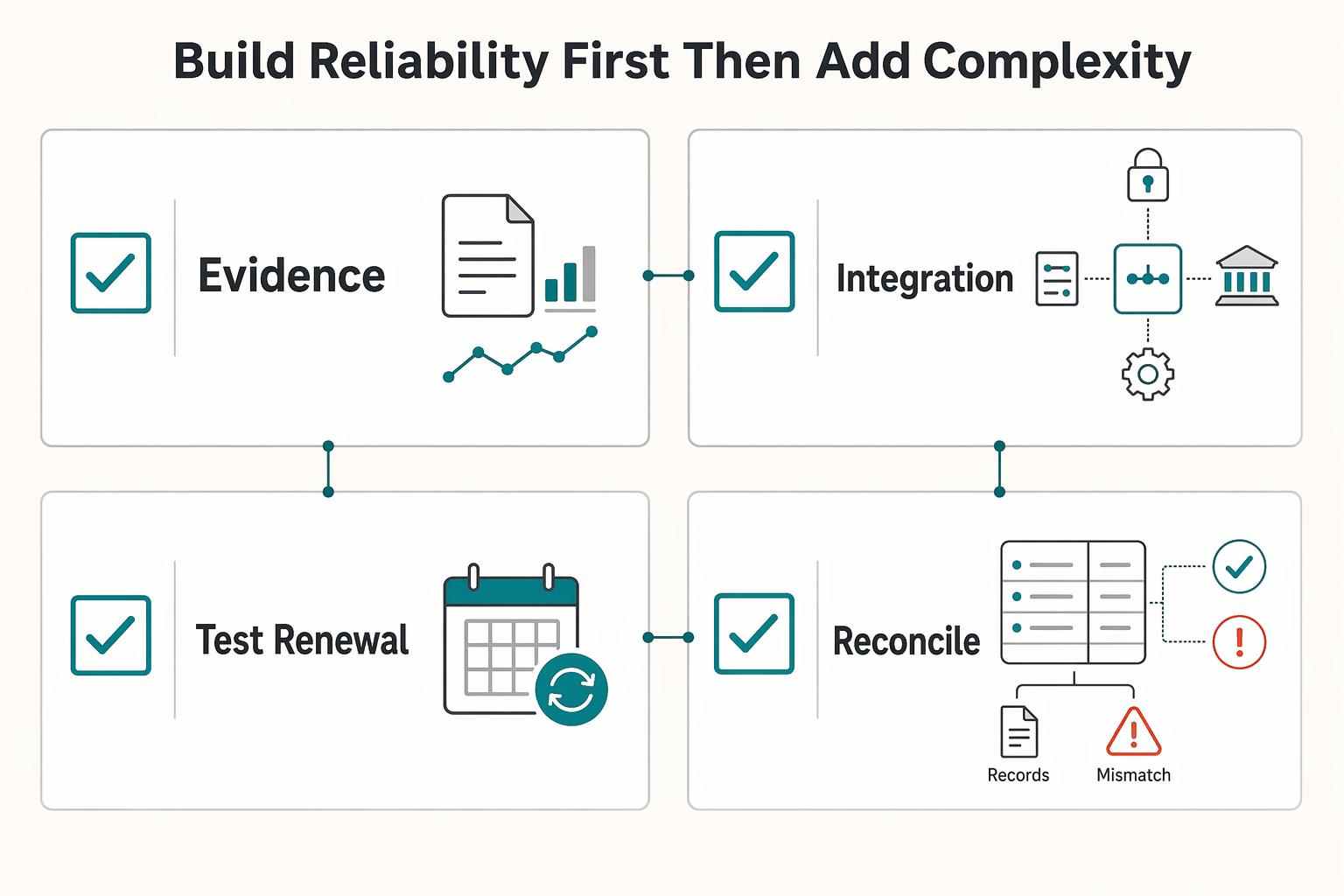
Build reliability first, then add complexity#
If your close process is fragile, do not add more tiers, cadences, or automation yet. Membership operations run continuously and often depend on personalized flows, role-based access, payment handling, and external integrations, so added complexity increases failure points. Start with the model your team can reconcile consistently, prove renewals and recovery work, then expand.
Step 1: Choose the membership model you can actually operate. Use one level or multiple tiers based on what your team can renew, recover, and reconcile without manual cleanup. If exceptions are already high, simplify first and document upgrade and downgrade rules before build. Poor level design can also reduce the membership traffic you need, so treat tier design as an operations decision, not just a pricing decision.
Step 2: Lock billing, access, and sync rules before configuration. Define when billing changes take effect, how role or tier access changes are applied, and how integration sync status is checked. Keep recurring donations and membership dues separated from intake through reporting so reconciliation stays clear. Because payment data handling carries compliance obligations, include that control surface in your pre-launch checklist.
Step 3: Treat renewal and failed-payment recovery as core controls. Write the full sequence: pre-renewal notice, charge attempt, grace handling, dunning stages, and final member-state outcome. Verify provider-specific retry behavior in your own system settings and documentation, for example, Stripe Smart Retries. Test at least one recoverable failure and one non-recoverable failure before launch so owners and remediation steps are explicit.
Step 4: Run a dry-run reconciliation packet before go-live. Rehearse billed dues, recurring donations, collected cash, unsettled items, and reversals by billing cycle. Investigate every variance before production.
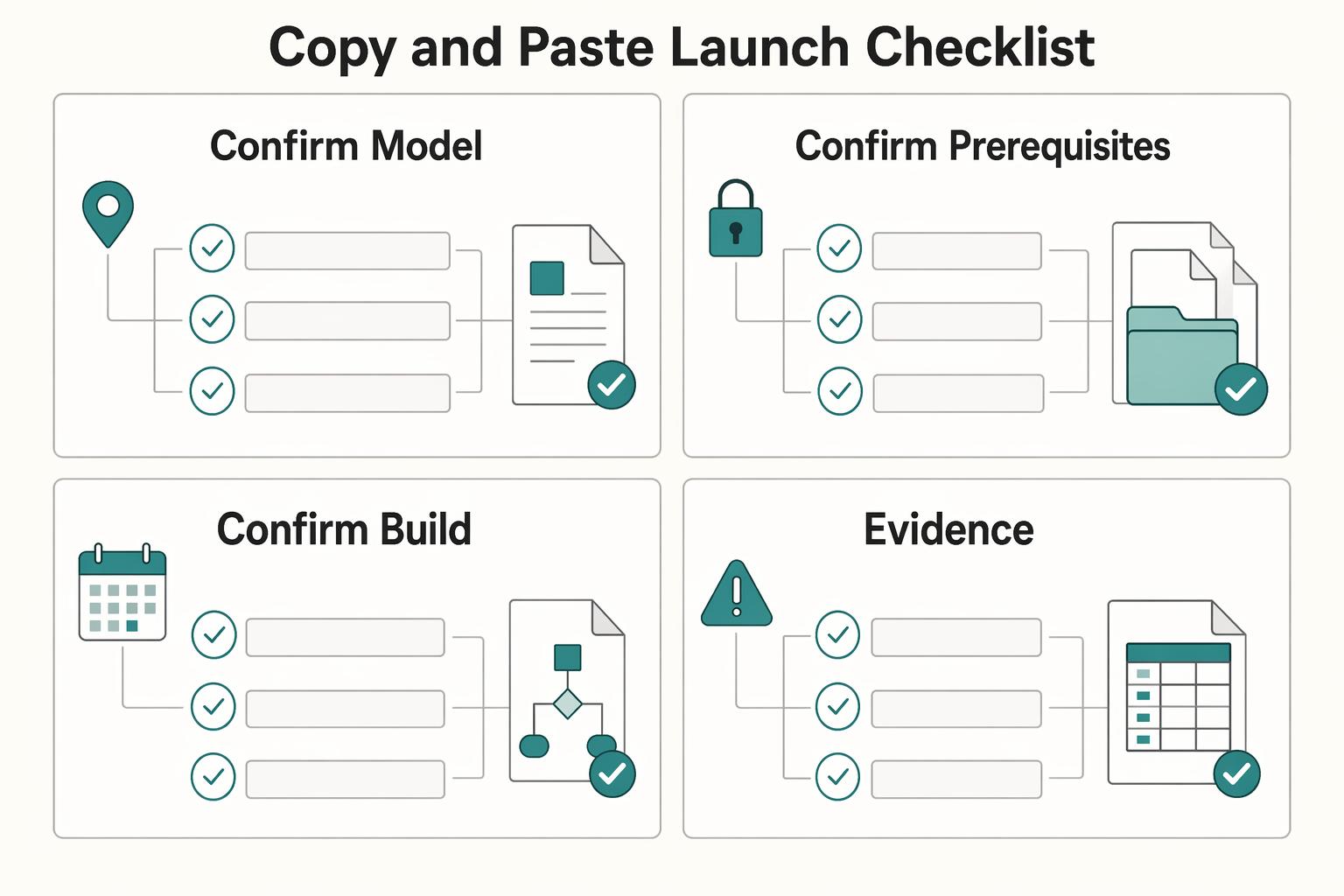
Copy/paste launch checklist
- Confirm the single-level vs tiered model and document upgrade/downgrade policy.
- Validate billing-change timing, access-change timing, and integration sync checks.
- Test renewal and failed-payment recovery end to end.
- Run a dry-run reconciliation packet and resolve all variances before go-live.
Need the full breakdown? Read Financial Metrics That Matter for Your Business. Also relevant: Subscription Billing Platforms for Plans, Add-Ons, Coupons, and Dunning.
Frequently Asked Questions
What is the operational difference between recurring donations and membership dues?
These are separate classes from the first intake screen, not a reporting cleanup later. Dues usually tie to membership status, while recurring donations are scheduled gifts and may also carry donor intent, including restricted funds that need separate tracking. If a gift is purpose-restricted, a practical control is to create a separate account for it so related expenses stay visible to finance, donors, and the board.
When should we use one membership level instead of multiple tiers?
Use one level when members receive essentially the same price, benefits, renewal treatment, and exception handling. Add tiers only when they create a real operational distinction that finance can reconcile and support can explain. Otherwise you are multiplying upgrade, downgrade, and close-period edge cases for little value. If your public site also needs gated access logic, How to Use Webflow Memberships to Create a Paid Community is a useful product-side comparison, but keep your ledger design stricter than your front-end packaging.
How do we choose between monthly, quarterly, and annual billing?
Pick the cadence your team can renew, recover, and close cleanly with the fewest manual fixes. Monthly billing can lower the commitment point but can create more failure, retry, and exception volume. Annual billing can reduce event count but can make mid-cycle changes and cancellations more sensitive. Your checkpoint is simple: one full cycle should trace from source event to ledger entry to settlement and bank activity without unexplained gaps.
What must be in the renewal and dunning process before launch?
You need a written sequence for notice, charge attempt, grace handling, payment-method update, cancellation path, and final member-state decision. Keep the retry detail verification-safe in your policy: the exact retry sequence, stop conditions, and escalation trigger should be verified from payment-provider settings, written policy, and source records before use. Also plan for real failure modes nonprofits already see, including duplicate-charge reports and address verification failures where the street address and postal code do not match, because those need review or remediation, not blind retries.
What self-service actions should members or donors have from day one?
At minimum, give people a clear way to update their payment method, cancel a recurring charge, and request proof of membership if your program uses it. Those paths matter because payment failures and support escalations can start with missing card updates or confusion about whether a recurring payment is still active. The control point is that each self-service change should leave a timestamped event you can trace back to the resulting charge, cancellation, or entitlement change.
Which reconciliation checkpoints matter most for finance sign-off?
Do not assume a universal legal checklist applies, but the practical bar is clear: finance should be able to trace every billed event to the ledger, the settlement or payout record, and the bank line, with a named owner for every exception. Keep dues and donations separate in reporting, and if a donation is restricted, keep it in its own account rather than blending it into general membership activity. If you want another example of why event traceability matters across charging and settlement, see Recurring Billing for Marketplaces: How to Charge Buyers and Pay Sellers on the Same Cycle.
How do upgrades, downgrades, and cancellations break reporting?
They can break reporting when membership status changes but the underlying recurring instruction does not, or when benefits switch on a different date than billing. Before release, test three things: whether the old schedule stops, which date controls entitlement changes, and how any credit, reversal, or catch-up charge lands in the ledger. For exceptions, keep a small evidence pack with the original plan, the change request, the resulting billing event, and the owner who approved the adjustment.
What is the biggest mistake teams make with non-profit membership billing recurring donations member tiers?
They add options faster than they add controls. More tiers, more cadences, and more recovery paths only help if classification stays intact, every event is traceable, and somebody owns the exceptions when reality does not match policy. If close quality starts slipping, reduce choice first and expand again only after the evidence says the process is stable.
Try a related tool
Researched and edited by the Gruv editorial team. Gruv builds cross-border billing, payouts, and finance-operations software for global businesses.
Sources
- ecfr.gov/current/title-2/subtitle-A/chapter-II/part-2...trusted
- eservices.calhr.ca.gov/enterprisehrpublic/mou/OfficialMOUtrusted
- federalregister.gov/documents/2025/11/28/2025-21456/medicare-pro...trusted
- federalregister.gov/documents/2024/01/31/2024-01427/us-citizensh...trusted
- hcpf.colorado.gov/sites/hcpf/files/Hewlett%20Packard%20MMIS%20...trusted
- hud.gov/sites/dfiles/Housing/documents/Email-Blast-2...trusted
- irs.gov/publications/p526trusted
- irs.gov/pub/irs-access/p2104_accessible.pdftrusted
Educational content only. Not legal, tax, or financial advice.
Related Posts
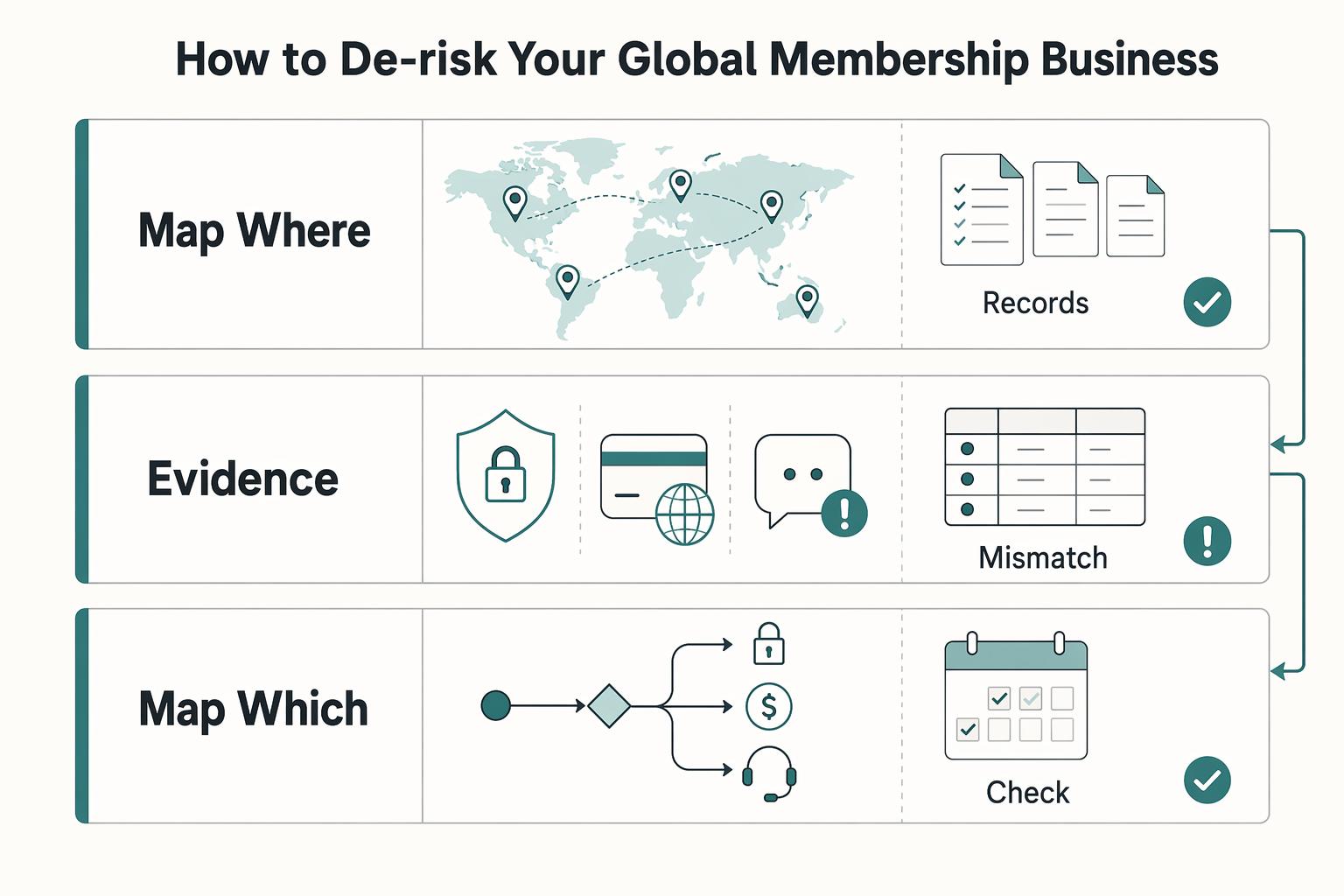
Webflow Memberships for Community: Compliance, Stack, and Monetization Guide
Your first compliance decision is not design, pricing, or even platform choice. It is deciding who carries tax, payment, and dispute liability across every path your members can take to buy.
Health and Wellness Platform Billing: How to Manage Memberships Trials and Insurance Integrations
A common rollout mistake is treating `membership billing`, `insurer billing`, and `employer-sponsored benefits` as one workflow. They are not. Membership billing is automatic, recurring billing after someone subscribes. Insurer billing runs through claims, with payment moving through payer channels. Employer-sponsored benefits are different again, because coverage or reimbursements are funded through employer-backed structures such as a group health plan or an individual coverage HRA (ICHRA).
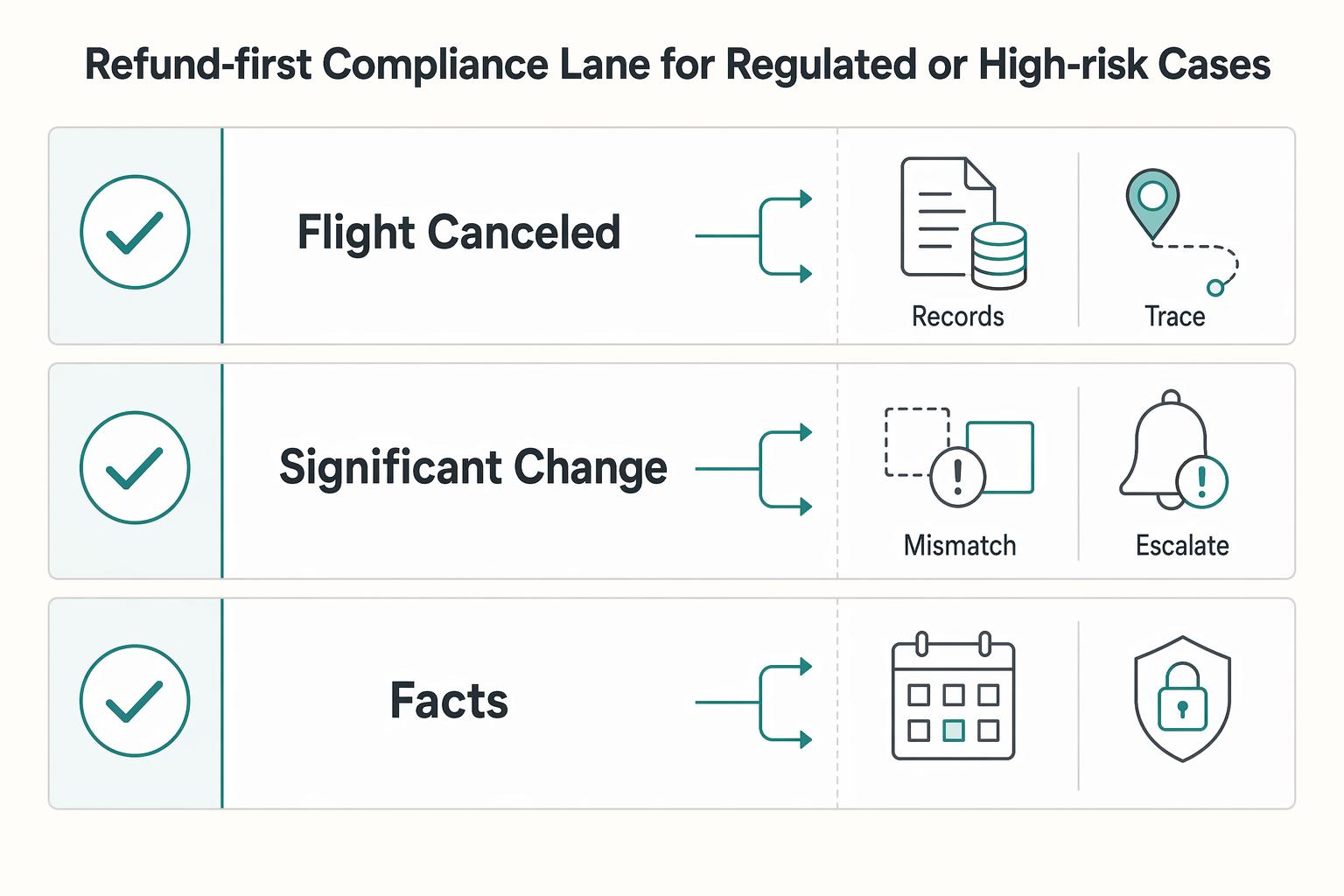
Travel and Hospitality Membership Billing for Annual Passes, Credits, and Refunds
If you run a pass or membership program, the hard part is not the charge. It is what happens after the sale. The pressure shows up later: when someone wants to cancel before renewal, asks for a refund, or accepts a credit that does not get redeemed cleanly. In travel and hospitality, those post-purchase events can make reconciliation unmanageable fast if support, finance, and billing are not working from the same record.