
Quick Answer
Run a narrow pilot first: one offer, one region, one cadence, then decide with evidence. For this topic, durable growth comes from renewal quality, not signup volume alone, so track MRR, subscription checkout rate, churn, retention, CAC, LTV:CAC, and ARPU together. Confirm that payment events, fulfillment actions, and finance reporting stay aligned on real transactions. If failed payments and support tickets climb at the same time, pause expansion and fix retries, customer notifications, and reconciliation before adding more traffic.
Why DTC teams are adding subscription billing to physical products now#
Direct-to-Consumer (DTC) teams are adding recurring billing for a simple reason. It can make revenue more predictable and planning less reactive. That upside is real, especially in ecommerce, where subscriptions are often associated with steadier revenue and stronger retention than one-time purchases alone.
Physical products expose weak billing design quickly. A SaaS-style setup that only focuses on charging cards on a schedule can miss what happens underneath each renewal. In a DTC business, a successful charge can affect inventory allocation, fulfillment timing, customer messaging, refunds, and finance reconciliation. If finance, ops, and engineering each treat that chain as someone else's problem, the subscription offer may grow while the system behind it gets harder to trust.
The first decision is mental, not technical. Recurring revenue does not come from adding a subscription checkbox at checkout. It comes from a setup that renews cleanly, handles exceptions, and stays explainable when something goes wrong. Platform fit matters here because tools that work for high-volume SaaS are not automatically a fit for prepaid or hybrid physical-product models. If your offer includes shipments, your billing choice has to match how orders actually get created, changed, paused, refunded, and reported.
Use one checkpoint before you scale anything. Trace a renewal end to end. Can your team show the payment event, the resulting order or shipment decision, any retry or refund, and the finance handoff without manual guesswork? If not, the problem is not demand. It is operational readiness. A common risk is a subscription front end that looks polished while the back office is left cleaning up duplicate charges, missed fulfillments, or reconciliation errors after the fact.
This article lays out a practical path to add recurring revenue without creating billing and fulfillment chaos. We will focus on the decisions that actually determine whether the model holds up: subscription type, billing architecture, rollout sequence, KPI guardrails, and exception control points.
This is for founders, product leaders, finance owners, and engineering leads who carry real accountability for ecommerce and embedded payments. If you own checkout behavior, payment events, order creation, exports to finance, or the support burden when renewals fail, this is for you. If you only want a generic tool list, this goes deeper than that, because with physical-product subscriptions, the details are the strategy. Related: Consumer Financial Services Subscription Billing: How Fintech Platforms Manage Recurring Revenue.
Build the right mental model before you pick a tool#
Treat this as a business model decision first, not a checkout feature decision. For DTC physical products, the model only works if your recurring offer stays reliable after signup.
Recurring revenue depends on customers continuing to renew, not just on acquisition volume. Subscriptions can work well in ecommerce because customers value convenience, personalization, and savings, while companies gain more predictable demand and revenue.
Before you compare vendors, align on a simple operating model:
- Subscription billing should match how the customer actually receives goods on a recurring basis.
- Recurring revenue is a retention outcome, so renewal quality matters as much as signup volume.
- Tool fit should be judged by whether finance and operations can explain what happened after each billing cycle.
Run one readiness check: trace a subscriber from signup to first renewal and confirm your team can clearly explain the customer record, payment outcome, fulfillment decision, and finance reporting handoff. If that chain is unclear, fix the model before adding more automation.
A common failure mode is a storefront that says "subscription" while the back office cannot confidently explain what happens after payment.
Choose your subscription model with a decision matrix#
Start with replenishment in most DTC physical-goods cases, then move only if your value proposition needs something else. This is usually the strongest fit when the product is consumable, reorder timing is predictable enough, and convenience is the core reason to subscribe.
Not every repeat purchase should become a subscription. Subscriptions tend to fit products that get used up or refreshed on a repeat cadence. Coffee, beauty supplies, and pet food are common fits; low-consumption durables are usually weaker fits. If product-fit is weak, recurring revenue gets forced and operational strain rises fast.
Read the model through margin, SKU stability, and operating load#
Use this matrix to choose based on what your team can deliver consistently, not what looks best at checkout.
| Model type | Expected subscriber retention pattern | ARPU upside from upsells / cross-sells | Failure risk | Team complexity |
|---|---|---|---|---|
| Replenishment | More stable when reorder need is clear and repeat use is obvious | Moderate, usually around refill-time add-ons | Cadence mismatch, stockouts, discount-led signups with weak fit | Low to moderate |
| Subscription box model | More variable if novelty, curation quality, or value clarity drops | Higher potential because each shipment creates cross-sell moments | Assortment misses, substitutions, fulfillment exceptions, support load | High |
| Service-bundled physical plan | Depends on whether the service layer keeps proving value each cycle | Moderate to high when add-ons are clear and relevant | Unclear offer design or inconsistent delivery can drive churn | Moderate to high |
Use two simple rules before you commit#
If fulfillment variability is high, avoid aggressive prepaid terms until churn behavior and exception handling are stable. Prepay can amplify stock issues, shipping delays, and support pressure when operations are still noisy.
If your growth thesis depends on average revenue per user, prioritize models with clear post-signup cross-sell moments over discount-heavy acquisition-only offers. If you cannot point to a natural expansion moment after the first order, ARPU expansion is unlikely to hold.
Subscriptions can be your core strategy or one part of a broader one. Early on, it is often safer to keep them as a disciplined component than to make them the whole business before operations are ready.
If you are implementing on Shopify, Shopify Subscription Integration: Adding Recurring Billing to Ecommerce Without Migration Pain covers the setup in more detail.
Want a quick next step for your billing workflow? Try the free invoice generator.
Design billing architecture that survives retries, refunds, and renewals#
Make the architecture decision explicit: keep billing in a commerce-native plugin, move it to a dedicated automated billing stack, or run a hybrid orchestration tied to embedded payments. For a small pilot, a plugin can be enough. As renewal, refund, and finance requirements grow, decide early where subscription state, payment state, and the finance source of truth should live.
A decoupled, API-centric design is often easier to adapt as billing logic changes because front end and back end can evolve independently. That is the core tradeoff in build versus partner: speed now versus control and flexibility later.
| Option | Integration depth | Webhooks quality | Idempotency support | Reconciliation effort | Migration risk |
|---|---|---|---|---|---|
| Commerce-native plugin | Usually strongest inside one storefront | Validate event coverage and replay behavior directly | Confirm how duplicate-event handling works | Can be light early, then heavier with exceptions | Can rise if critical billing state stays trapped in one app |
| Dedicated automated billing stack | Usually broader across commerce, payments, and finance systems | Validate completeness across renewal, refund, and cancellation events | Confirm explicit keys/rules for one-time processing | Often easier when billing outputs are consistent | Upfront integration work, with clearer long-term ownership if data is portable |
| Hybrid orchestration tied to embedded payments | Deep control across channels and payment flows | Depends on how cleanly payment events are routed and persisted | You define controls, so design quality matters more | Can improve over time with disciplined event ownership | Higher design effort, but can reduce future replatform friction |
Document one event chain before you scale#
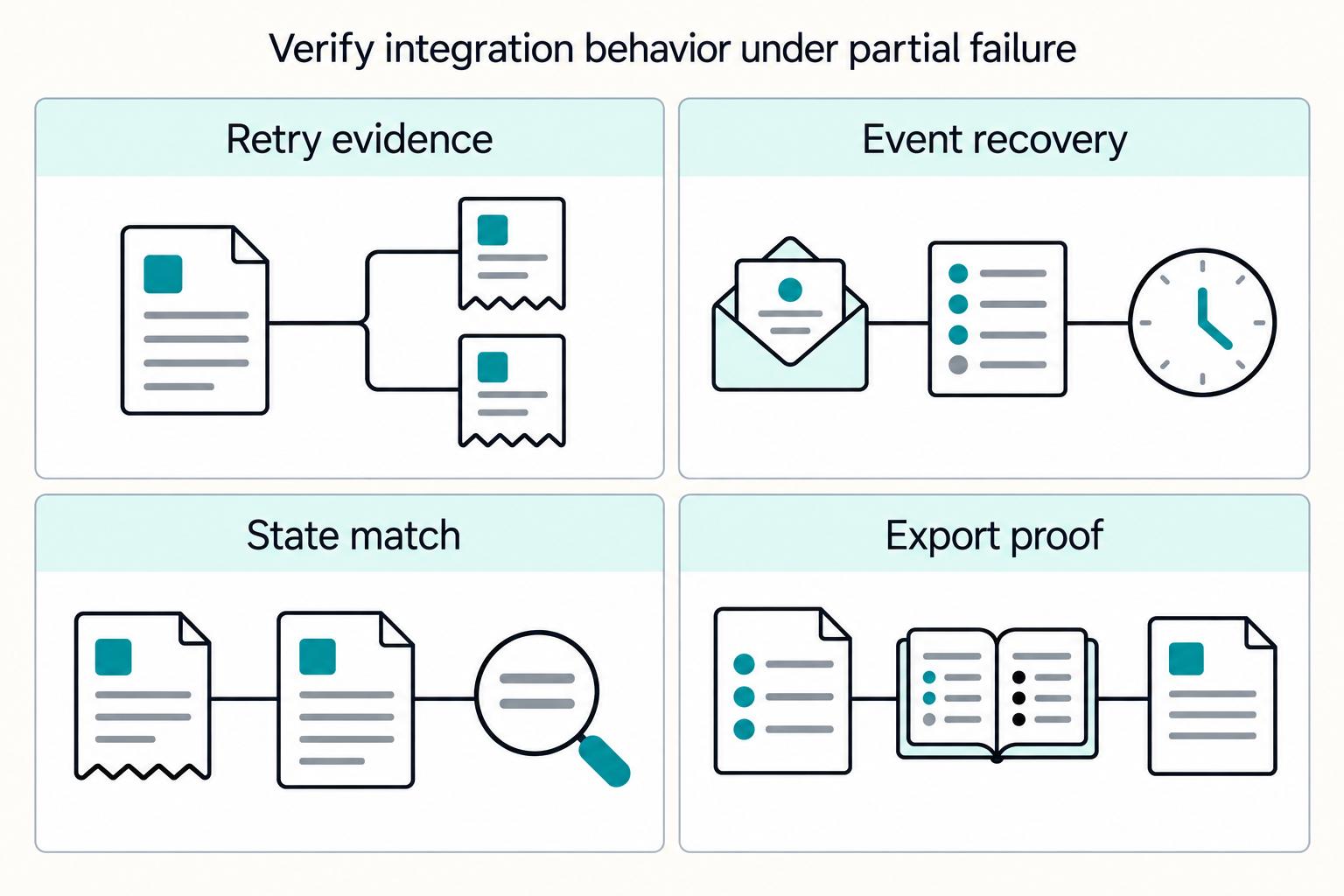
Pick one system-of-record flow and write it down so every team uses the same lifecycle. A common pattern is: payment event -> webhook intake -> idempotent write -> ledger posting -> finance export. Treat that as a design choice to validate in your stack, not a universal rule.
Stress-test the messy path, not just the happy path#
The broad case for decoupling and API-first integration is clear, but that does not answer the hard operator questions around idempotency or retry-storm outcomes. Test those risks directly in your environment with cases like failed renewal, successful retry, and partial refund, and confirm your records stay consistent across commerce, payments, and finance.
Sequence implementation in 90 days with explicit checkpoints#
After you choose the billing architecture, keep implementation narrow and step by step. In this 90-day window, prioritize trust from day one and use clear metrics to decide what to change before you scale.
| Phase | What to do | Checkpoint |
|---|---|---|
| Phase 1 pilot | Start with one offer, one region, and one renewal cadence; track monthly recurring revenue (MRR), subscription checkout rate, and first renewal outcomes | Your team can explain first-renewal performance clearly enough to choose the next fix |
| Phase 2 stabilize | Use pilot results to test and improve pricing, offers, and churn fixes with clear metrics; keep exception handling ownership clear so repeat issues are resolved consistently | Teams can review exceptions and outcomes without ad hoc interpretation |
| Phase 3 scale | Expand offers, channels, or regions only after renewal outcomes are stable and your operating model is predictable | Leadership agrees the current model is repeatable before adding complexity |
Phase 1 pilot#
Start with one offer, one region, and one renewal cadence so you can read outcomes clearly before adding variables.
Track:
- monthly recurring revenue (MRR)
- subscription checkout rate
- first renewal outcomes
Checkpoint: your team can explain first-renewal performance clearly enough to choose the next fix.
Phase 2 stabilize#
Use pilot results to test and improve pricing, offers, and churn fixes with clear metrics. Keep exception handling ownership clear so repeat issues are resolved consistently.
Checkpoint: teams can review exceptions and outcomes without ad hoc interpretation.
Phase 3 scale#
Expand offers, channels, or regions only after renewal outcomes are stable and your operating model is predictable. Use measured results, not rollout pressure, to decide when to widen scope.
Checkpoint: leadership agrees the current model is repeatable before adding complexity.
Set KPI guardrails that trigger decisions, not vanity reporting#
If your KPI review does not end with a clear continue, fix, or pause call, it is vanity reporting. For recurring physical-product offers, read the scorecard through a profit-first lens: are you keeping more money than you spend, or funding signups that fail to hold through renewal?
Track this minimum set: MRR, customer acquisition cost (CAC), LTV:CAC ratio, subscription checkout rate, subscriber churn, subscriber retention, and ARPU. Read them together by cohort, channel, and renewal stage, not as one blended program average.
| KPI | What it tells you | Decision use |
|---|---|---|
| MRR | Whether the base is growing or shrinking | Check if movement comes from new signups or subscribers staying longer |
| CAC | What you paid to acquire demand | Compare acquisition cost against downstream quality, not volume alone |
| LTV:CAC ratio | Whether acquisition is likely to justify spend | Hold expansion if the ratio worsens because value is weakening |
| Subscription checkout rate | Whether the offer and checkout flow convert | Prioritize offer/flow fixes before adding spend |
| Subscriber churn | Where the base is leaking | Inspect cancellation patterns, failed renewals, and support pressure |
| Subscriber retention | Whether performance holds over time | Compare durability across channels and offer types |
| ARPU | Revenue quality per subscriber | Confirm gains reflect healthier mix, not short-lived distortion |
Do not treat low CAC as a win on its own. A channel can look efficient early and still destroy economics if cohorts weaken after renewal.
Use a recurring product-finance checkpoint with three outcomes: continue, fix, or pause. Continue when KPI movement and incident load are both stable. Fix when slippage is isolated and diagnosable. Pause when KPI deterioration and operational noise rise together, especially around failed payments, fulfillment holds, refund spikes, or reconciliation breaks.
Keep one decision pack per review so teams act on causes, not headlines: cohort window, channel, offer, renewal stage, failed-payment count, cancellation patterns, refund volume, and support load. Also confirm finance and product are using the same cohort logic and revenue treatment before acting on trends.
Conditions in ecommerce can shift quickly, so keep your existing commerce flow running in parallel while you roll out subscriptions, then let measured outcomes determine how far to lean in.
Prevent the common failure modes competitors gloss over#
Most subscription billing breakdowns show up as operational problems before they show up as growth problems, so fix renewal flow quality before you scale spend. A 2026 subscription-commerce guide says failed payments can drive up to 40% of cancellations, and recovery programs can recapture 20-40% of involuntary churn. The same guide also reports higher monthly churn in physical subscriptions (5-7%) than digital (3-5%), which makes timing, fulfillment, and messaging discipline even more important.
Use your weekly KPI view to find causes, not just symptoms. If failed payments start rising, treat retry logic, dunning, and renewal communication as immediate priorities, even before headline revenue moves.
Use a real risk register#
Keep a short register with three required fields for each failure mode: owner, detection signal, and first mitigation path.
| Failure mode | Primary owner | Detection signal | First mitigation path |
|---|---|---|---|
| Billing timing mismatch | Product or engineering | Charges and shipment timing fall out of sync | Align renewal rules with fulfillment timing and fix event sequencing |
| Renewal surprise | Lifecycle marketing or CX | Cancellations/refunds tied to unexpected renewals | Improve pre-renewal reminders, charge visibility, and confirmation messages |
| Inventory backorder | Ops or supply chain | Renewals billed while fulfillment is delayed | Pause affected renewal promos, suppress unavailable SKUs, and realign charge timing |
| Stale retry logic | Payments or engineering | Repeated failed attempts with weak recovery | Refresh retry strategy, run dunning, and trigger payment-detail updates before cancellation |
| Broken customer messaging | CX or product | Billing/fulfillment events without matching notifications | Validate notification triggers and templates against live event logs |
Freeze expansion when two signals move together#
If payment failures rise and support tickets spike at the same time, freeze promo expansion and repair billing and notification flow first. Do not push more traffic into a renewal path you already know is failing.
Treat edge cases as core product behavior#
Handle edge cases as product rules, not cleanup work:
| Edge case | Rule to define |
|---|---|
| Refunds | Define how a renewal refund affects shipment and subscription status |
| Skipped shipments | Decide whether billing shifts with the skip or stays on the original cadence |
| Paused subscriptions | Define pause duration and exact reactivation trigger |
| Reactivation | Make next charge timing explicit and ensure account/payment state is valid before restart |
Clear churn-reduction operations can pay back materially: one industry roundup reports an average 16X ROI from churn-reduction strategies and highlights large recovered revenue from automated payment recovery systems. Related reading: The Best Tools for Managing Subscription Billing.
Add compliance and money-movement controls before scale#
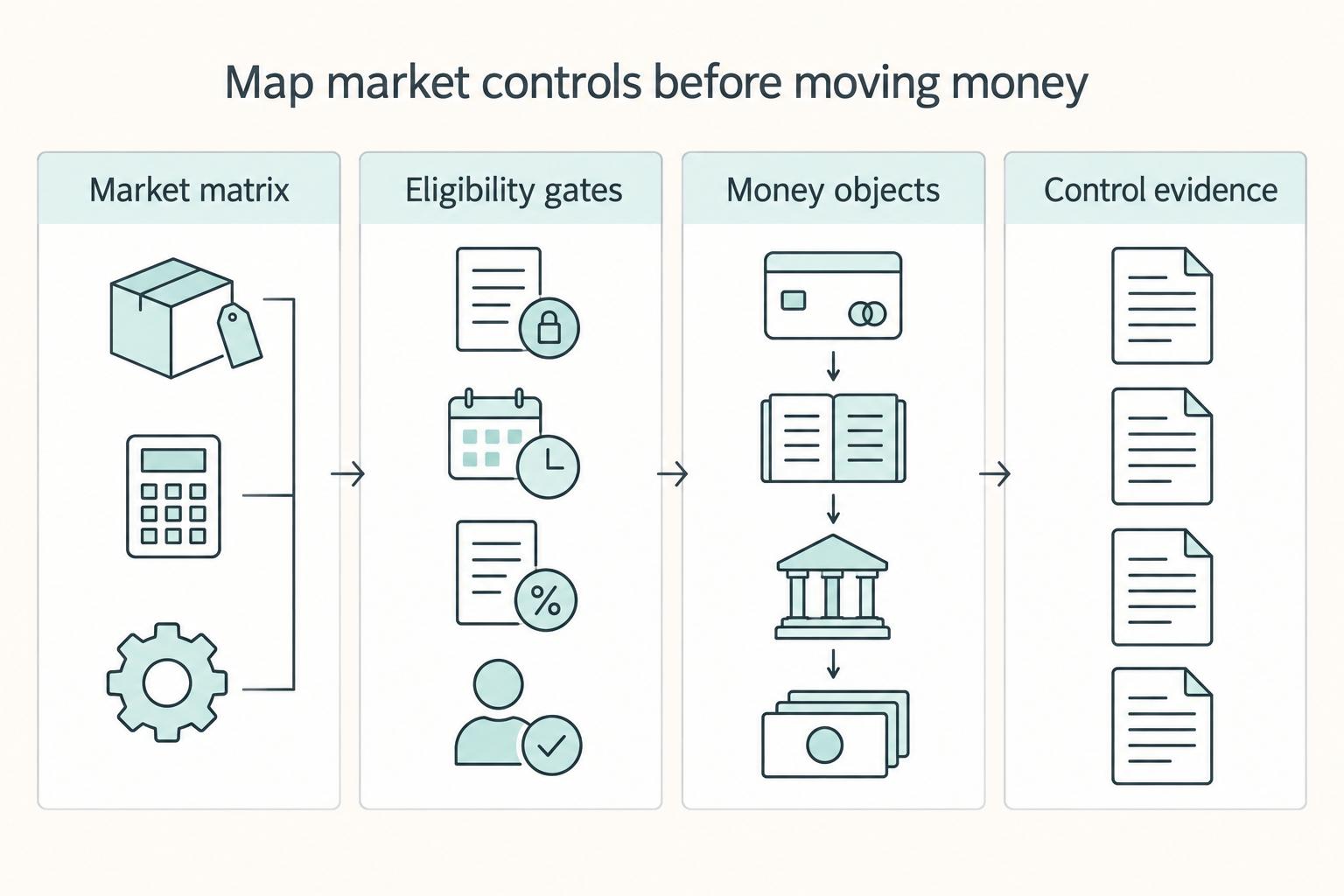
Before you scale, confirm your setup can move money in each target market both operationally and compliantly. Treat onboarding gates, payout eligibility, and tax or document requirements as launch blockers. Label them with clear qualifiers like "where supported," "when enabled," and "coverage varies by market/program," because platform fit is not one-size-fits-all.
Use one shared market support matrix across product, finance, and ops. For each country or program, track checks required where supported, payout conditions when enabled, tax or document dependencies, approver, and go-live status. Then test one recent transaction end to end (charge event to ledger entry to payout status) so ops can verify status history without pulling engineering logs.
For cross-border flows, define money-movement objects and events before volume arrives. If you use Virtual Accounts where supported, document their purpose in your flow, who monitors creation and funding status, and how exceptions route to ops. If you use payout batches when enabled, define release triggers, hold reasons, surfaced status events, and retained approval evidence so product, ops, and finance do not operate from different states.
Treat control evidence and cost controls as one workstream. Third-party subscription apps and external-gateway fees can vary by platform and plan, so use comparison figures as directional, not universal pricing. Keep traceable records for approvals, policy gates, and ledger evidence at each billing and payout step.
For platform details on plans, add-ons, coupons, and dunning, see Subscription Billing Platforms for Plans, Add-Ons, Coupons, and Dunning.
What to do next if you want recurring revenue without operational chaos#
Start narrow and make the system trustworthy before you scale volume.
Start with one simple offer#
Run one subscription model, one pilot cohort, and one review cadence your product, ops, finance, and engineering leads can actually maintain. A fixed monthly setup usually gives you fewer moving parts than adding yearly terms or variable billing at launch.
Use one concrete checkpoint: trace a real subscriber from checkout to first renewal, then verify the charge record, customer status, fulfillment action, and finance export match. Test one exception case too, such as a failed renewal or skipped shipment, so you can see where support and reconciliation work begins.
Make expansion decisions explicit#
Before adding complexity, document three short artifacts:
| Artifact | What to document |
|---|---|
| Decision matrix | Define the model, expected customer behavior, where expansion should come from, and which risks you accept |
| Architecture checklist | Confirm where billing events start, how customer state updates, where fulfillment is triggered, and who confirms finance visibility |
| Risk register | List key failure modes, the signal to monitor, owner, and mitigation |
This discipline matters because fragmented data creates drag: teams end up exporting CSVs, reconciling IDs, and patching records manually.
Hold the line on trust and reconciliation#
Recurring billing can make income more reliable and cash flow more predictable, but only if charges, customer communication, and internal records stay aligned. Trust building starts on day one, so renewal timing, amounts, and messaging should be clear before you increase volume.
Operator rule: if event traceability is weak or reconciliation still needs heroics, pause expansion and fix the foundation. Keep a pilot evidence pack with approval notes, customer notification copy, sample transaction IDs, exception-handling notes, and the finance output used to verify results.
For a step-by-step walkthrough, see Building Subscription Revenue on a Marketplace Without Billing Gaps.
Frequently Asked Questions
What metrics matter most first for DTC subscription billing?
Start with MRR, subscription checkout rate, first renewal success, subscriber churn, subscriber retention, ARPU, CAC, and LTV:CAC. The early decision rule is simple: if checkout conversion looks healthy but first renewal and retention are weak, you do not have durable recurring revenue yet. For physical subscriptions, one 2026 guide reports higher monthly churn than digital subscriptions (about 5-7% vs 3-5%), so watch renewal quality before you scale acquisition.
How is subscription billing for physical products different from SaaS?
SaaS often renews against a service entitlement. Physical goods add inventory availability, pick-pack-ship timing, address changes, skips, pauses, and refund or replacement handling, so billing and fulfillment have to stay in sync. In direct-to-consumer sales, the brand sells its own products directly to end customers, which means your team owns the whole chain from charge to shipment to support outcome.
What are the biggest risks when adding recurring revenue to eCommerce?
A common early failure is failed-payment churn, plus weak coordination between billing, fulfillment, and support when exceptions happen. If payment failures and support tickets rise together, treat that as an operating problem first, not a marketing problem. One 2026 guide says failed-payment recovery can recapture 20-40% of involuntary churn, so it is often worth fixing early.
What should teams implement before scaling subscription operations?
You want one event path that finance, ops, and engineering all trust: charge event -> webhook -> idempotent write -> ledger posting -> payout/reporting status. Then verify it with a real sample renewal, including one exception case such as a skipped shipment or refund, not just a happy-path success. Keep an evidence pack with approval notes, customer notification copies, and the transaction trace, because the failure mode is split truth across billing, commerce, and finance tools.
How should founders sequence a subscription rollout across product, finance, and engineering?
Launch one offer, one region, and one cadence first. Then measure first-renewal outcomes before adding more plans or channels. Product should define the customer promise and cancellation or pause rules, engineering should make events traceable and idempotent, and finance should sign off on ledger and payout visibility. If any one of those owners cannot explain what happens on a failed renewal, the rollout is too early.
What is still unknown from current market guides when choosing a platform path?
Some market guides show strong category momentum, but single-source benchmarks should stay directional, not treated as universal promises. They are weaker on the hard operator questions: event quality, reconciliation effort, money-movement coverage, and how exceptions are surfaced to ops. What matters most in practice is whether your chosen stack can support your actual renewal logic, customer states, and audit trail without manual patching.
Try a related tool
Researched and edited by the Gruv editorial team. Gruv builds cross-border billing, payouts, and finance-operations software for global businesses.
Sources
Includes 6 external sources outside the trusted-domain allowlist.
- dspace.mit.edu/bitstream/handle/1721.1/139478/marcus-jbmarc...trusted
- entrepreneurship.engineering.columbia.edu/bootcamptrusted
- autoship.cloud/tutorials/ecommerce-subscriptionexternal
- bettercommerce.io/blog/headless-architecture-composable-archit...external
- bigcommerce.com/articles/ecommerce/subscriptionexternal
- blueprint.store/reports/demystifying-ecommerce-retention-for...external
- digitalapplied.com/blog/subscription-commerce-2026-recurring-re...external
- ecommercefastlane.com/subscription-ecommerce-growth-2026external
Educational content only. Not legal, tax, or financial advice.
Related Posts
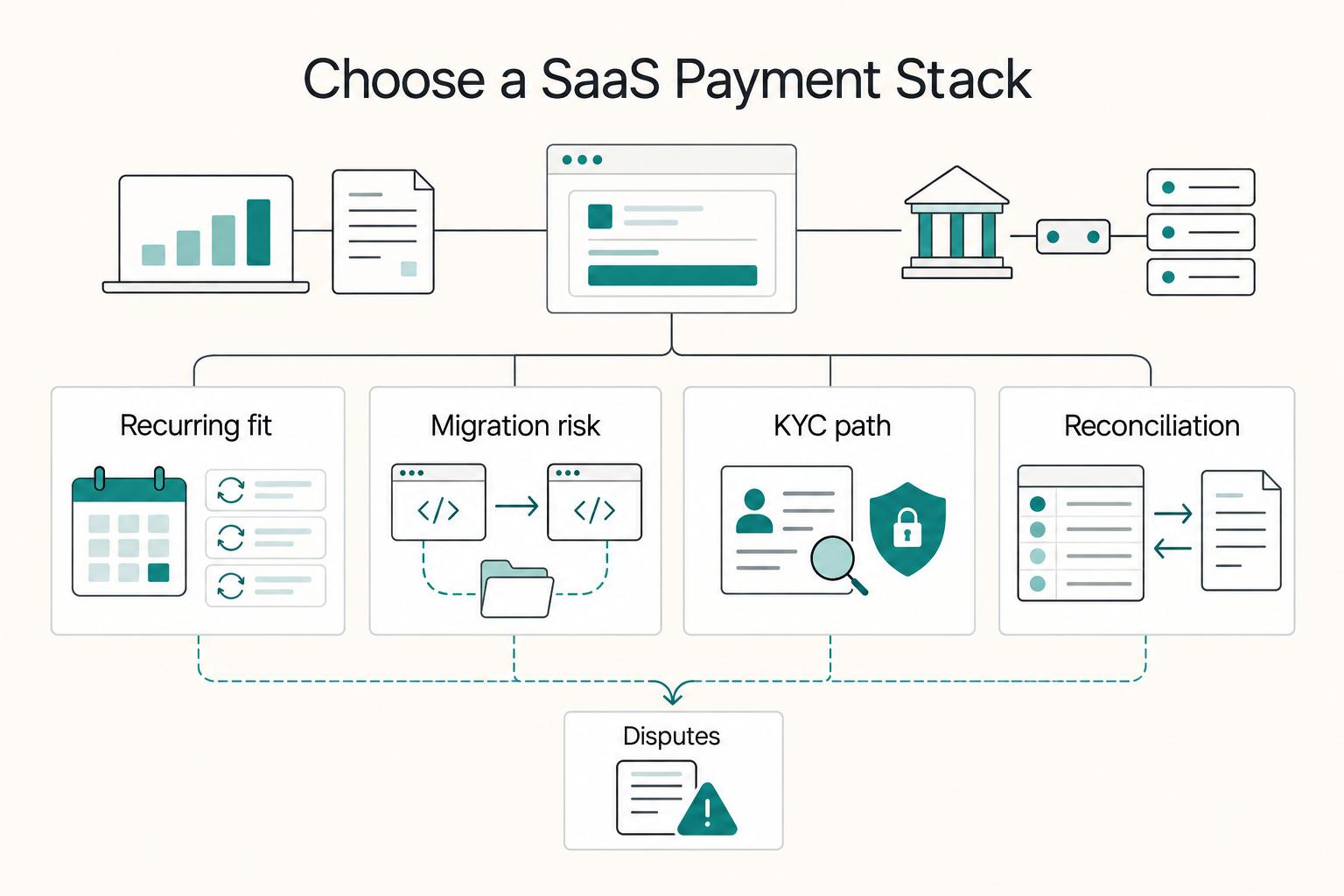
The Best Payment Gateways for SaaS Businesses
**Choose your gateway stack by cashflow risk first, then optimize for features and price.** If you want the best payment gateway for SaaS, start where money can stall, not where brand buzz is loudest. You are the CEO of a business-of-one, which means a payout delay or a payment hold is not an inconvenience. It is an operating event.
Choosing a Fintech Platform for Consumer Subscription Billing and Recurring Revenue
Choosing a consumer financial services subscription billing fintech platform is first an operations decision, not a feature-list exercise. Recurring revenue can improve forecasting, but it also creates a continuous billing and engagement cycle your team has to run cleanly.
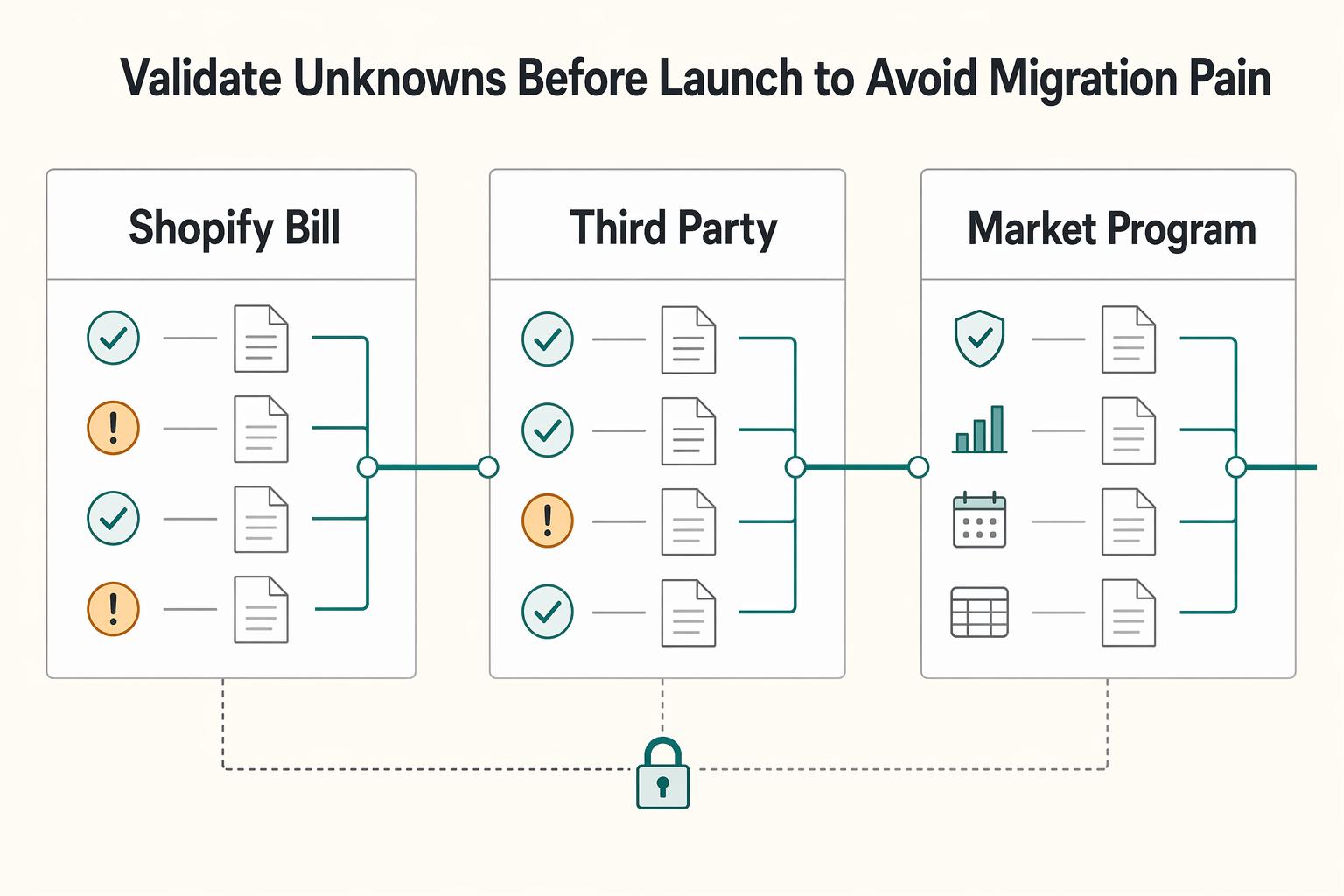
Shopify Subscription Integration for Recurring Billing Without Migration Pain
If you need recurring billing live in Shopify without creating cleanup later, separate the two billing layers before you write code. The first decision is architectural, not technical. Before anyone writes logic, maps revenue, or tells support and finance how this will work, you need to separate the two subscription surfaces Shopify exposes.