
Quick Answer
Choose a billing platform for your consumer fintech product after one end-to-end sandbox trace proves billing behavior and ownership boundaries. The strongest sequence here is to lock build-buy-hybrid direction first, then test plan changes, failed renewals, replay handling, and finance-facing outputs before procurement signoff. Keep any vendor in evaluation mode when cancellation responsibility, event recovery behavior, or compliance accountability is still ambiguous.
How to Evaluate a Fintech Platform for Consumer Subscription Billing#
Choosing billing infrastructure for a consumer fintech product starts with how your team will run it. Recurring revenue can improve forecasting, but it also creates a continuous billing and engagement cycle your team has to run cleanly.
This guide is for founders, product leaders, finance ops, and engineering owners in contractor, creator, marketplace, and embedded-payments businesses. Those models are not identical, so test platform claims against your own operating evidence before you commit.
- Protect recurring revenue with failure-path checks
Subscription revenue can improve forecast reliability, but the upkeep is continuous. Test what happens when a renewal fails, a plan changes mid-cycle, or finance has to explain a charge later.
- Match pricing architecture to real charging behavior
Usage-based billing charges customers based on actual usage, and a hybrid model combines flat-rate and usage-based pricing. If you use fixed fees, per-transaction fees, overages, or a mix, a simple demo is not enough. Ask the vendor to walk one real scenario end to end: product event, billing record, invoice, and payment-gateway handoff, including exceptions.
- Make integration and compliance core selection criteria
Production subscription operations often combine subscription management with payment-gateway integration, so API-first only matters if it fits your stack and operating model. The CFPB states that negative option subscription services must comply with federal consumer financial protection law, and U.S. federal banking agencies issued third-party risk-management guidance for banking organizations in 2023. Before procurement moves forward, define who owns cancellations, charge explanations, gateway dependencies, exception handling, and third-party risk review.
Test hybrid pricing, usage-based charges, and integration depth against the scenarios your team will actually run. If a vendor cannot show how it behaves under your billing rules, finance controls, and compliance obligations, you do not have a decision-ready answer.
Who this list helps and what good selection looks like#
This list is useful when billing complexity has outgrown manual workflows. If you expect a billing platform to absorb your compliance and reconciliation responsibility, pause and define ownership first.
- Teams moving out of spreadsheets or rigid legacy billing
This list fits teams adding usage-based billing or hybrid pricing when current tooling cannot represent real charge logic cleanly. A strong candidate should support fixed recurring fees and variable usage charges in the same catalog, because hybrid pricing depends on both recurring and usage-linked prices being configured together. The key test is whether the platform matches how you already sell, invoice, and explain charges.
- Teams with real multi-owner accountability
Selection quality improves when responsibilities are named before procurement. CFPB examination procedures treat compliance as day-to-day work and generally include Modules 1, 2, 3, and 5, including service-provider oversight. The important questions are who approves billing changes, who reconciles exceptions, and who owns vendor oversight under interagency third-party guidance final as of June 6, 2023.
- Teams that will verify integration behavior, not just API claims
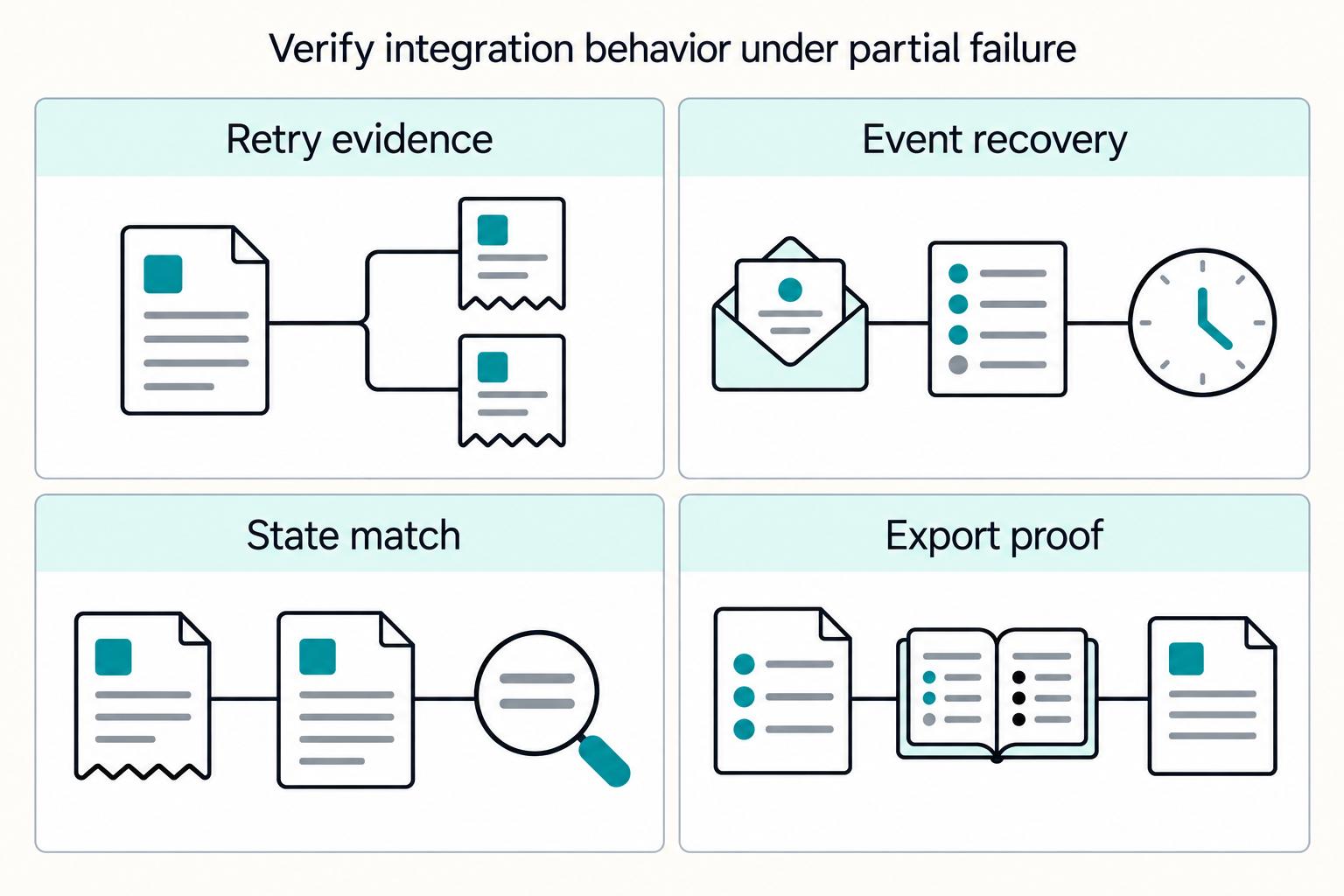
API-first integration is only credible if retries, event handling, and reconciliation still work under failure. Require proof of idempotent retry behavior, duplicate-prevention logic, and recovery of undelivered events within the selected provider’s documented retry window. Ask for evidence in a demo or sandbox: deduplication behavior, event logs, and how missed events are queried for reconciliation.
- Teams that can define failure tolerance before buying
If you cannot define which billing errors are tolerable, which trigger rollback, and how recurring revenue is checked after failures or mid-cycle plan changes, delay selection. A practical readiness check is whether your team can produce a minimum evidence pack now: approval trail, event history, reconciliation view, and charge explanation path. Good selection starts after internal controls are explicit. Related reading: Subscription Billing for SaaS Teams Handling Trials and Plan Changes.
Quick comparison of the current shortlist#
If your core need is a billing engine for fintech pricing complexity, the current evidence points most clearly to BillingPlatform. The other names here are better treated as adjacent capabilities or discovery inputs.
| Option | Best-for use case | Known strengths from available evidence | Known limits | Verification gaps | Evidence available vs unknown | Integration owner | Finance owner | Compliance owner |
|---|---|---|---|---|---|---|---|---|
| BillingPlatform | Teams needing fintech billing complexity with API-led integration | Markets subscription-plus-usage pricing and API-led embedded billing on its fintech product page; publishes customer testimonials. | Evidence here is still mostly vendor positioning plus customer/press quotes. | Confirm implementation effort, event behavior under failure, reconciliation outputs, and compliance boundary in your environment. | Available: fintech product page and customer testimonials. Unknown: production behavior, exact compliance boundary, total cost. | Engineering + product | Finance-led evaluation and signoff | Compliance/risk sets oversight boundary |
| Ethoca Smart Subscriptions | Consumer subscription visibility and management in banking channels | Positions Smart Subscriptions as consumer subscription management in digital banking channels, connecting issuers and merchants. | Not evidenced here as a merchant quote-to-cash billing engine. | Validate issuer/merchant handoff, data ownership, and how events map to your ledger and support flows. | Available: product page. Unknown: merchant billing logic, invoicing depth, close impact, exception handling. | Payments/banking integration lead | Finance assesses reporting, disputes, retention impact | Compliance reviews data-sharing and communication boundaries |
| Zone & Co | NetSuite teams evaluating subscription, usage, or milestone billing | ZoneBilling markets subscription, usage-based, hybrid, and milestone billing within NetSuite. | Product positioning does not establish fit for your specific billing and control requirements. | Re-validate shortlist claims with primary docs and product walkthroughs. | Available: ZoneBilling product page. Unknown: regulated-billing fit, implementation burden, behavior under failure. | Product/strategy for market scan | Finance converts discovery to scored requirements | Compliance after candidates become real |
| Alguna | Fintech teams evaluating usage metering and mixed-charge invoicing | Markets streaming usage metering, subscription-plus-usage models, and consolidated recurring, usage, and one-time invoice lines. | Vendor-described capabilities still need validation against your charge and exception scenarios. | Verify what is native vs custom, and how exceptions affect finance operations. | Available: fintech product page. Unknown: implementation fit, controls depth, edge-case reliability. | Engineering + RevOps | Finance for revenue-recognition and close impact | Compliance once regulated scope is defined |
| HubiFi | Teams focused on ASC 606 automation and subscription-to-cash reconciliation | Evidence emphasizes revenue recognition software, continuous reconciliations, and "Purpose built ASC 606 automation" with integrated order/subscription-to-cash reconciliations. | Not evidenced here as a full billing engine. | Confirm whether it handles billable event creation, invoicing, and customer-facing billing states, or primarily downstream accounting/reconciliation. | Available: accounting automation and reconciliation positioning. Unknown: catalog management, invoicing depth, payment-event orchestration, support tooling. | Data/ERP integration owner | Controller/revenue accounting lead | Compliance checks audit-trail sufficiency |
How to use this table without fooling yourself#
Use this as a scope filter first, not a winner table. BillingPlatform appears closest to full billing execution. Ethoca Smart Subscriptions appears focused on consumer subscription visibility in banking channels. Zone & Co and Alguna are useful discovery inputs. HubiFi appears strongest for accounting automation and reconciliations.
Set ownership before final demos: name a finance lead, integration owner, and compliance owner. Finance-led selection is common, and ownership often expands across payments, finance, and product as complexity grows.
Then ask each serious contender to map one charge end to end: configuration, customer charge, and ledger impact. If that flow stays unclear, keep the vendor in research mode instead of treating shortlist momentum as selection evidence.
If you're deciding between buying and building, read Why Platforms Regret Building Their Own Subscription Billing.
BillingPlatform best for pricing complexity and enterprise expansion#
If you need one candidate to test first for pricing complexity, BillingPlatform looks like the clearest fit in the available material. That is especially true for a hybrid subscription model plus usage-based billing and frequent pricing changes.
Where the fit looks strongest#
BillingPlatform’s fintech page describes mixed subscription and usage pricing, pricing experiments, and API-led embedded billing. Those capabilities make it a candidate for the recurring-fee-plus-usage scenario; validate the actual billing outputs and controls in your sandbox.
That lines up with teams managing mixed recurring fees and usage charges in one billing model. If your pricing is mostly flat and stable, this level of flexibility may be more than you need.
What the current evidence supports#
The product page describes REST APIs, webhooks, and SDKs for embedded billing. Validate their event flow and billing-state behavior, because those determine integration quality beyond a UI demo.
The same page publishes testimonials from J.P. Morgan Payments, GoCardless, InComm Payments, and Tipalti. Use these as references to explore, alongside your own sandbox evidence.
What to require before commitment#
Positioning is not proof of implementation in your environment. Before you commit, require a sandbox proof and finance reconciliation evidence for one end-to-end charge path.
Use this proof pack:
- One hybrid customer scenario: recurring fee, usage charge, mid-cycle pricing change, and failed-payment retry.
- Event behavior evidence under failure conditions.
- Finance traceability from billable event to invoice, payment state, and ledger-facing export.
- A written compliance boundary that separates vendor product support from your team's regulatory responsibility.
Decision rule: move forward only if BillingPlatform shows both fast pricing configuration and clean reconciliation on your data. If either stays unclear, keep it in evaluation mode.
Related: Streaming Media Subscription Billing: How OTT Platforms Handle Billing Trials and Churn.
Ethoca Smart Subscriptions best for consumer subscription visibility#
Ethoca Smart Subscriptions fits best when your main gap is consumer subscription visibility in banking channels, not end-to-end merchant billing operations.
Where the fit is real#
Smart Subscriptions is positioned for consumer subscription management in digital banking channels, through connections between issuers and merchants. That placement matters: evaluate its visibility and management role separately from your merchant billing engine.
The product page focuses on helping consumers view and manage subscriptions and on issuer and merchant engagement. Verify which controls are available for your integration and participating merchants.
Ask for current integration documentation and demonstrate one subscription-management action before you depend on it.
The differentiator and the limit#
The differentiator in this comparison is straightforward: Smart Subscriptions is positioned for issuer-linked subscription visibility, while broader billing platforms explicitly market merchant billing capabilities such as recurring and usage-based pricing.
Decision rule:
- Use Smart Subscriptions when the core problem is consumer-facing subscription visibility in a bank experience.
- Pair it with a broader billing platform when you need merchant-side recurring plus usage-based billing logic and end-to-end billing operations.
The cited public material does not support treating Smart Subscriptions as a full merchant billing core for invoicing, taxation, dunning, or revenue recognition.
What to verify before you depend on it#
Before procurement, verify operational boundaries in writing and in a live-flow test, especially because Ethoca describes subscription information being shared through issuer apps and back-office teams.
Validate:
- Data ownership boundary: who owns subscription status, merchant descriptors, cancellation state, and history at each handoff.
- Operational handoff: what appears in the consumer app versus issuer back office, and who handles incomplete, stale, or disputed data.
- Revenue control connection: how issuer-channel subscription insights feed your internal recurring-revenue controls and finance review.
Run one traced scenario end to end, such as cancel or pause: what the consumer sees, what the issuer sees, what the merchant receives, and what your team can audit later. If that chain is unclear, you have a visibility tool, not an operational control.
For implementation planning, see How to Integrate Your Subscription Billing Platform with Your CRM and Support Tools.
Zone & Co, Alguna, and HubiFi as shortlist inputs not final answers#
Use Zone & Co, Alguna, and HubiFi to widen your shortlist. Their product pages describe different jobs, so compare the capabilities you need before comparing implementation proposals.
Zone & Co#
ZoneBilling describes subscription, usage-based, hybrid, and milestone billing within NetSuite. If NetSuite is your finance system, test how its billing outputs fit your existing contracts and close process.
Treat hybrid support as unproven until you see a sandbox flow with fixed recurring charges, usage, and an adjustment or credit in one customer lifecycle, plus invoice output and reconciliation evidence.
Alguna#
Alguna’s fintech page describes metering streaming events such as API calls and transaction volumes, combining usage with subscriptions, and consolidating recurring, usage, and one-time invoice lines. Trace those charges through your own invoice and credit scenarios.
Require artifacts that trace usage events through invoice lines, credit handling, and dispute handling before you treat API-first depth as confirmed.
HubiFi#
HubiFi’s revenue-recognition product page describes ASC 606 automation and order/subscription-to-cash reconciliation. That makes it a candidate for the accounting layer; verify whether your billing engine remains a separate system.
For HubiFi, get a written boundary answer: billing engine, data layer around billing, or both. Then use the same proof pack for all three and keep unknowns explicit:
- API-first integration depth: auth model, sandbox access, event docs, retry behavior, idempotency evidence.
- Hybrid subscription model support: live configuration, sample invoices, exception handling, reconciliation outputs.
- Regulatory compliance scope: how authorized charges are controlled and how express consent for continuity billing is evidenced.
For a billing platform decision in this category, unknown is a valid status until the proof pack closes it.
Decide build, buy, or hybrid before you evaluate demos#
Decide the ownership model before vendor demos, because this choice often drives implementation risk. Build when billing logic is a real product differentiator and you can fund long-term ownership. Buy when speed to production matters more than custom behavior. Choose hybrid when core billing can be configurable, but your orchestration, controls, or embedded billing flows still need custom design.
| Path | Engineering lift | Finance ops burden | Compliance ownership | Migration risk | Expected time to production |
|---|---|---|---|---|---|
| Build | Highest: you own core billing implementation and change management | High: internal teams run finance workflows and reconciliation | Fully yours | Can be high if legacy data and pricing changes are not tightly managed | Longest relative path |
| Buy | Lowest relative lift: proven capability is already built | Moderate: finance still validates mappings, exceptions, and close outputs | Still yours; vendor use does not transfer accountability | Moderate; depends on model fit and migration planning | Fastest relative path |
| Hybrid | Medium to high: vendor core plus custom services and controls | Medium to high: split ownership adds handoffs | Operationally shared, but accountability remains with your organization | Coordination risk rises if boundaries are unclear | Middle path when boundaries are explicit |
1. Build#
Build makes sense when custom usage-based billing logic is part of your product edge. The tradeoff is maximum fit and control, with greater ongoing cost and effort.
Use an operator test early: can your team change a billing rule and trace it through rating, invoicing, and finance outputs without fragile cross-service work? If not, long-term ownership risk is already showing. Pricing complexity tends to grow. If you cannot sustain schema and workflow ownership over time, do not choose full build for feature control alone.
2. Buy#
Buy is often the better path when speed to value is the main constraint and deep customization is not required. You gain speed from proven capability, but you give up some customization and direct control.
Evaluate exception handling, not just happy-path demos: failed payments, credits, plan changes, exports, and reconciliation after corrections. For this kind of billing decision, keep the compliance baseline explicit: U.S. interagency third-party risk-management guidance applies to banking organizations; use it to plan bank-partner oversight alongside your own responsibilities. Size due diligence to the risk and criticality of the billing function.
3. Hybrid#
Hybrid is often the strongest middle path when you need configurable core billing plus custom orchestration around embedded billing and internal controls. It combines commercial speed with selective proprietary development.
Success depends on boundary clarity: define where billing logic runs, where invoice truth lives, and how control points are owned across systems. If those boundaries stay vague, coordination and reconciliation risk rises quickly.
Treat migration and operating evidence as first-class deliverables, including staged migration planning before launch.
Integration checkpoints that catch problems before launch#
Once you choose build, buy, or hybrid, launch risk shifts to integration behavior. Your stack has to retry, replay, and reconcile without duplicate financial objects, missed state changes, or opaque finance reporting.
| Checkpoint | What to prove | Timing or limit |
|---|---|---|
| Idempotent retries | The same idempotency key should not create a second object or apply the same update twice | PayPal warns that omitting PayPal-Request-Id can duplicate a request |
| Webhook handling | Acknowledge quickly, defer heavy processing, and verify ordering, deduplication, and recovery | Adyen retries failed deliveries and can keep them in its retry queue for up to 30 days |
| Undelivered event recovery | Confirm retry visibility and a finance-readable audit trail of received, skipped, replayed, and applied events | Stripe live-mode automatic retries run for up to three days; Dashboard resend is available for 15 days and CLI resend for 30 days |
| State-based reconciliation | Match settlement or capture and payout records to internal states and bank deposits | Use the provider's previous-day reconciliation file or payout reconciliation report |
| Pre-production checklist | Prove state mapping, failed-payment retry paths, webhook replay handling, and finance export fields | Include half-failure scenarios before go-live |
1. Prove idempotency before you trust any API-first integration#
Do not trust an API-first claim until retries are proven safe. Your checkpoint is not a single 200 response. It is proof that repeating the same create or update request with the same idempotency key does not create a second object or apply the same update twice.
Stripe supports idempotent retries to prevent duplicate operations, and PayPal warns that omitting PayPal-Request-Id can duplicate a request. Test the failure path directly: simulate a timeout, replay the request, and confirm the same operation is not applied twice.
Ask for evidence, not assurances: request logs with idempotency keys, produced object IDs, and before-and-after extracts showing no duplicate records for the same operation.
2. Treat webhook handling in embedded billing as an ordering and recovery problem#
Webhook handling is often where embedded billing risk shows up first. A webhook is an event-driven HTTP POST to your endpoint, so your controls need to cover acknowledgement, ordering, and recovery under failure.
Adyen's pattern is explicit: acknowledge quickly, defer heavy processing, and use timestamps for chronological processing. Timing matters in practice: Adyen retries failed deliveries and can keep them in its retry queue for up to 30 days. Stripe live-mode automatic retries run for up to three days. Dashboard resend is available for 15 days and CLI resend for 30 days; its Events API lists only the last 30 days.
Before launch, run an outage simulation and verify event deduplication, acknowledgement behavior, retry visibility, and a finance-readable audit trail of received, skipped, replayed, and applied events.
3. Reconcile against transaction states, not API success#
A successful API response is not reconciliation. The checkpoint is state-based matching across settlement or capture and payout records. Visa reconciliation data is transaction-level and includes accepted or rejected settlement status, which supports state-level checks.
Use a daily reconciliation step tied to the provider's previous-day reconciliation file or payout reconciliation report, then match it to your internal states and bank deposits. Do not treat processor success as financial truth. If payout groupings and bank deposits do not match, resolve variance categories before launch.
4. Force contract promises through a pre-production checklist#
Contract language is only a starting point. Before go-live, run a pre-production checklist that proves data-model fit and exception handling in real workflows.
Keep the checklist concrete: state mapping, failed-payment retry paths, webhook replay handling, and finance export fields. Include half-failure scenarios so you can see how exceptions surface when processing breaks mid-flow. Weak fit often shows up in broken migration samples or unmatched reconciliation files, not in demos.
Use this checklist in your sandbox to validate retries, event ordering, and reconciliation paths with the Gruv docs.
Compliance and risk controls that protect revenue#
Revenue protection here comes down to controls you can defend when a partner, auditor, or regulator asks who owned the decision, what happened, and how exceptions were handled.
| Control area | What to define | Proof point |
|---|---|---|
| Responsibility map | Who performs, approves, monitors, and is accountable for each control across planning, due diligence, contract negotiation, ongoing monitoring, and termination | Validate contract terms, product configuration, and escalation paths side by side |
| Policy gates | Pass, fail, or manual review outcomes for risk-based identity verification and beneficial ownership procedures where those requirements apply | Manual review queue needs aging, owner, and release criteria; overrides should record approver, timestamp, and reason |
| Audit pack | Approval logs, billing and payment event history, ledger traceability, and incident-response records | If CIP data is in scope, retention can extend for five years after account closure; where PCI DSS applies, test incident response at least annually |
1. Map responsibility before you trust the vendor boundary#
Do not accept "the vendor covers compliance" as a complete answer. U.S. interagency guidance says banks remain responsible for safe, compliant operations when using third parties. Use that lifecycle as a planning framework, and identify the obligations that apply to your product and any bank partner. Your first deliverable should be a control map showing who performs, approves, monitors, and is accountable for each control.
Make the map lifecycle-specific, not onboarding-only: planning, due diligence, contract negotiation, ongoing monitoring, and termination. If a vendor captures data, define who verifies it. If a vendor hosts card data, define who owns PCI DSS scope decisions, access monitoring, and incident escalation. If finance owns adjustments, define who can approve exceptions that change balances.
Validate the map against three artifacts side by side: contract terms, product configuration, and escalation paths. If those disagree, your control ownership is not production-ready.
2. Add policy gates before growth creates uncontrolled exceptions#
If your model requires KYC/AML-style controls, place those checks directly in the billing flow. Use written, risk-based identity verification gates, and treat legal-entity beneficial ownership procedures as a required written control where those requirements apply.
Use explicit outcomes at each gate: pass, fail, or manual review. Route manual review into a visible exception queue with aging, owner, and release criteria, and decide up front what pending-verification accounts can do: trial, invoice creation, fund collection, or payout.
Your checkpoint is operational proof: blocked accounts stay blocked, and overrides record approver, timestamp, and reason. If teams can bypass verification informally, the control is not real yet.
3. Build an audit pack from logs, not screenshots#
An audit-ready billing operation needs traceable evidence across approvals, events, and money movement. One dashboard export is usually not enough. Use multiple evidence types so a reviewer can follow the path from account approval through billing events to ledger impact.
Define the exact records you retain. That includes approval logs for account and plan changes, billing and payment event history, ledger traceability from invoice to settlement or payout, and incident-response records showing who was paged, when, and what changed.
If CIP data is in scope, retention can extend for years, including five years after account closure for specified customer identification information. In card environments where PCI DSS applies, monitoring access to network resources and cardholder data, and testing incident response at least annually, should be part of the operating model.
Run a practical test with one disputed subscriber. Reconstruct the full timeline quickly, including onboarding approval, verification status at billing, event sequence, ledger changes, and escalation path for suspected fraud or exposure. If you cannot do that reliably, the operation is not audit-ready.
90-day execution sequence after platform selection#
Treat the first 90 days as a proof window: freeze one MVP path, validate it under test, then widen exposure only when billing, reconciliation, and ownership are holding up.
| Phase | Focus | Required output |
|---|---|---|
| Days 1 to 30 | Lock the hybrid subscription model, usage-based billing rules, API-first integration boundaries, and ownership across product, finance, and engineering | Signed requirements and a test matrix for approved scenarios, including trials and renewals |
| Days 31 to 60 | Break the integration safely in sandbox, cover trial endings and annual renewals, and make idempotency a hard gate | Reconciliation tests that match payouts to underlying transaction batches |
| Days 61 to 90 | Roll out by risk tier with a canary-style release and rollback criteria set before launch | Expand only after exception review shows stable billing outputs and clean reconciliation |
| Exit criteria | Billing outputs are stable for approved scenarios, reconciliation cycles close cleanly, and ownership is documented | Requirements signoff, test results, reconciliation proof, rollback criteria, and named exception owners |
1. Days 1 to 30#
Start by locking the requirements that create downstream risk if they stay vague: your hybrid subscription model, usage-based billing rules, and API-first integration boundaries. Document your usage-event source of truth, rating timing, invoice timing, retry behavior, and who owns exceptions across product, finance, and engineering.
Freeze MVP scope in writing. For consumer recurring charges, make sure the flow covers clear material terms before billing details, express informed consent before charging, and a simple cancellation mechanism. Exit this phase with signed requirements and a test matrix for approved scenarios, including trials and renewals.
2. Days 31 to 60#
The goal in this phase is to break the integration safely before customers do. In sandbox, cover time-based scenarios such as trial endings and annual renewals. If test clocks are available, use them to simulate milestones.
Make idempotency a hard gate so retries do not duplicate effects. Design retry windows around the selected provider and endpoint’s documented idempotency-key retention; test what happens when a key expires. Run reconciliation tests that match payouts to underlying transaction batches, and treat instant payout reconciliation as your team's responsibility.
3. Days 61 to 90#
Roll out by risk tier with a canary-style release to a limited subset first, then expand only after exception review shows stable billing outputs and clean reconciliation. Set rollback criteria before launch. If stability degrades, reconciliation breaks, or outputs diverge from approved cases, revert to the prior revision.
4. Exit criteria#
Mark this phase complete only when billing outputs are stable for approved scenarios, reconciliation cycles close cleanly, and ownership is documented across product, finance, and engineering. Keep the evidence pack practical: requirements signoff, test results, reconciliation proof, rollback criteria, and named exception owners.
If you still cannot trace one subscriber from usage event to invoice to payout, with a clear fix approver, do not broaden rollout.
For a step-by-step walkthrough, see Subscription Billing for eCommerce DTC Brands Adding Recurring Revenue to Physical Products.
Conclusion#
Choose the platform you can verify under your real pricing, integration, and control conditions, not the one with the longest demo. Teams reduce operational risk when they prove critical flows early, document ownership clearly, and expand rollout only after live checks pass.
- Verified fit over feature volume
Start with the billing behavior you actually need, then test that exact path end to end. Subscription integration requires up-front decisions about how you charge customers and what checkout or payment flow you use, so score vendors on those scenarios first. If usage-based billing matters, test a real consumption case. If multiple pricing models matter, test a subscription plus variable-charge case and trace it through invoice and charge outcomes. Advance only vendors that can prove the workflow in sandbox from both API and finance or reconciliation views.
- Shared compliance ownership before go-live
Using a third party does not remove your responsibility. Third-party risk management is a full life cycle: planning, due diligence and selection, contract negotiation, ongoing monitoring, and termination. The Federal Reserve announcement for final interagency guidance was last updated June 12, 2023, and the OCC's May 2024 guide also states that engaging a third party does not remove a bank's responsibility to operate safely and soundly. Clearly define shared responsibilities, assign named owners for control areas, and include annual provider compliance monitoring (PCI Requirement 12.8.4).
- Phased rollout over big-bang migration
Move from selection to technical validation with controlled exposure, not full cutover. Canarying is a partial, time-limited deployment to validate with real traffic while minimizing risk, with fast rollback if issues appear. Use small, incremental, quality-gated release steps, and expand only after monitoring checks are stable.
Next step: score your shortlist against these checkpoints, remove candidates with material unknowns, and take only the top one or two into technical validation.
When your shortlist is down to final candidates, align product, finance, and engineering owners on coverage and control expectations via Gruv contact.
Frequently Asked Questions
What is a fintech subscription billing platform, and how is it different from consumer subscription management tools like Smart Subscriptions?
A fintech subscription billing platform is infrastructure for recurring billing and customer billing operations across channels. Smart Subscriptions, based on the available evidence, is a bank-embedded experience that helps consumers view and manage subscriptions in digital banking channels. In practice, one sits in your merchant billing stack, while the other is focused on consumer visibility and control.
When should a platform use a hybrid subscription model instead of flat recurring plans?
Use a hybrid subscription model when your pricing combines a subscription with other pricing structures. This is often the better fit when you need pricing experiments or multiple charge structures. If your offer is one stable recurring price with few exceptions, a flat recurring plan may be simpler to operate.
How do we evaluate vendors quickly without skipping critical regulatory compliance checks?
Move quickly on product fit, but still run the full third-party relationship life cycle: planning, due diligence and selection, contract negotiation, ongoing monitoring, and termination. The June 2023 interagency guidance applies to banking organizations. If you work with a bank partner, map its oversight requirements alongside your own obligations; using a vendor does not transfer your responsibilities. Require a written responsibility matrix showing what the vendor owns, what your team owns, and how monitoring evidence is maintained after go-live.
Which warning signs in demos suggest weak API-first integration for real production workloads?
A major red flag is vague or missing idempotency support on create and update requests, because retries can otherwise duplicate write actions. Another is weak webhook handling: if the vendor cannot clearly explain signature verification, event deduplication, and undelivered-event retry behavior, within the provider’s documented retry window, the integration is not ready for production workloads. Ask the vendor to replay a failed event and show how your endpoint avoids processing the same event multiple times.
What should we verify first to protect recurring revenue during migration?
Verify migration sequence first, not bulk import speed. A typical sequence is integration setup, then customer and payment processor migration, then subscription import. Your first checkpoint should be one end-to-end trace from migrated customer record to invoice event to charge attempt. If invoice acknowledgement fails, a charge attempt may not happen, so this is a direct recurring-revenue control point. For a deeper checklist, see How to Migrate Your Subscription Billing to a New Platform Without Losing Revenue.
How do we decide whether to build, buy, or hybridize billing logic for embedded billing use cases?
Build only when your differentiation depends on custom billing behavior and you can own integration, retries, reconciliation, and compliance oversight. Buy when speed and operational stability matter more than custom logic for straightforward recurring billing. Hybrid is often the practical middle ground: use a configurable billing core, keep custom orchestration around product control points, and document explicit ownership when third-party use can increase operational or compliance risk.
Try a related tool
Researched and edited by the Gruv editorial team. Gruv builds cross-border billing, payouts, and finance-operations software for global businesses.
Sources
- consumerfinance.gov/compliance/supervision-examinations/complian...trusted
- consumerfinance.gov/about-us/newsroom/cfpb-issues-guidance-to-ro...trusted
- docs.stripe.com/webhookstrusted
- docs.stripe.com/webhooks/process-undelivered-eventstrusted
- ecfr.gov/current/title-31/subtitle-B/chapter-X/part-1...trusted
- ecfr.gov/current/title-31/subtitle-B/chapter-X/part-1...trusted
- fdic.gov/news/financial-institution-letters/2023/fil2...trusted
- federalregister.gov/documents/2023/06/09/2023-12340/interagency-...trusted
Educational content only. Not legal, tax, or financial advice.
Related Posts
How to Build a Subscription Billing Engine for Your B2B Platform
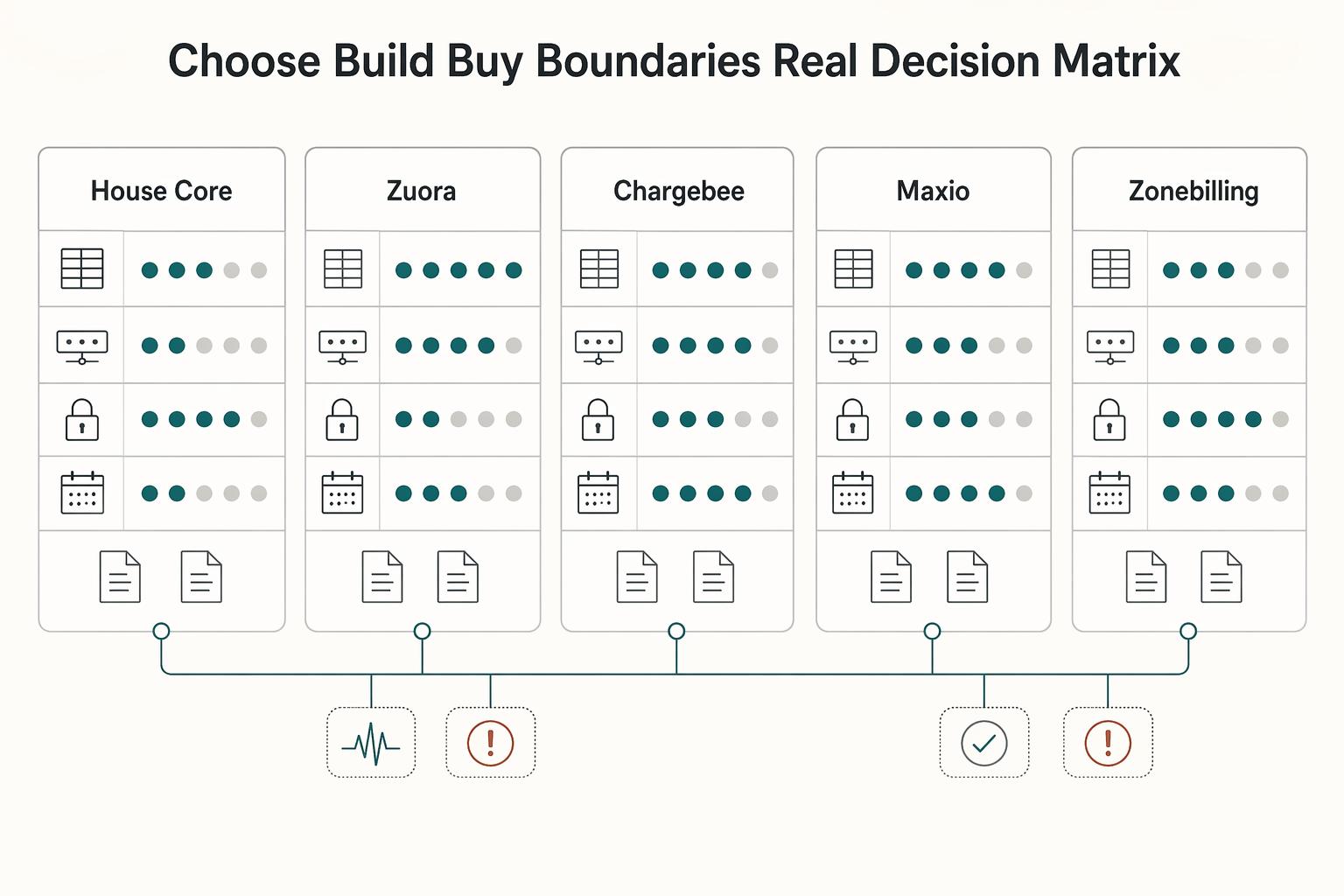
If you are designing a B2B subscription billing engine, get the close and reconciliation model right before you chase product flexibility. A durable sequence is to define recurring billing scope (plans, billing periods, usage, and trials), then map settlement and payout reconciliation to transaction-level settlement outputs, and finally tie that discipline into month-end close controls. The real test is simple: finance should be able to trace invoices, payments, and payouts from source events through settlement records into reconciled close outputs without ad hoc spreadsheet rescue.
How to Migrate Your Subscription Billing to a New Platform Without Losing Revenue
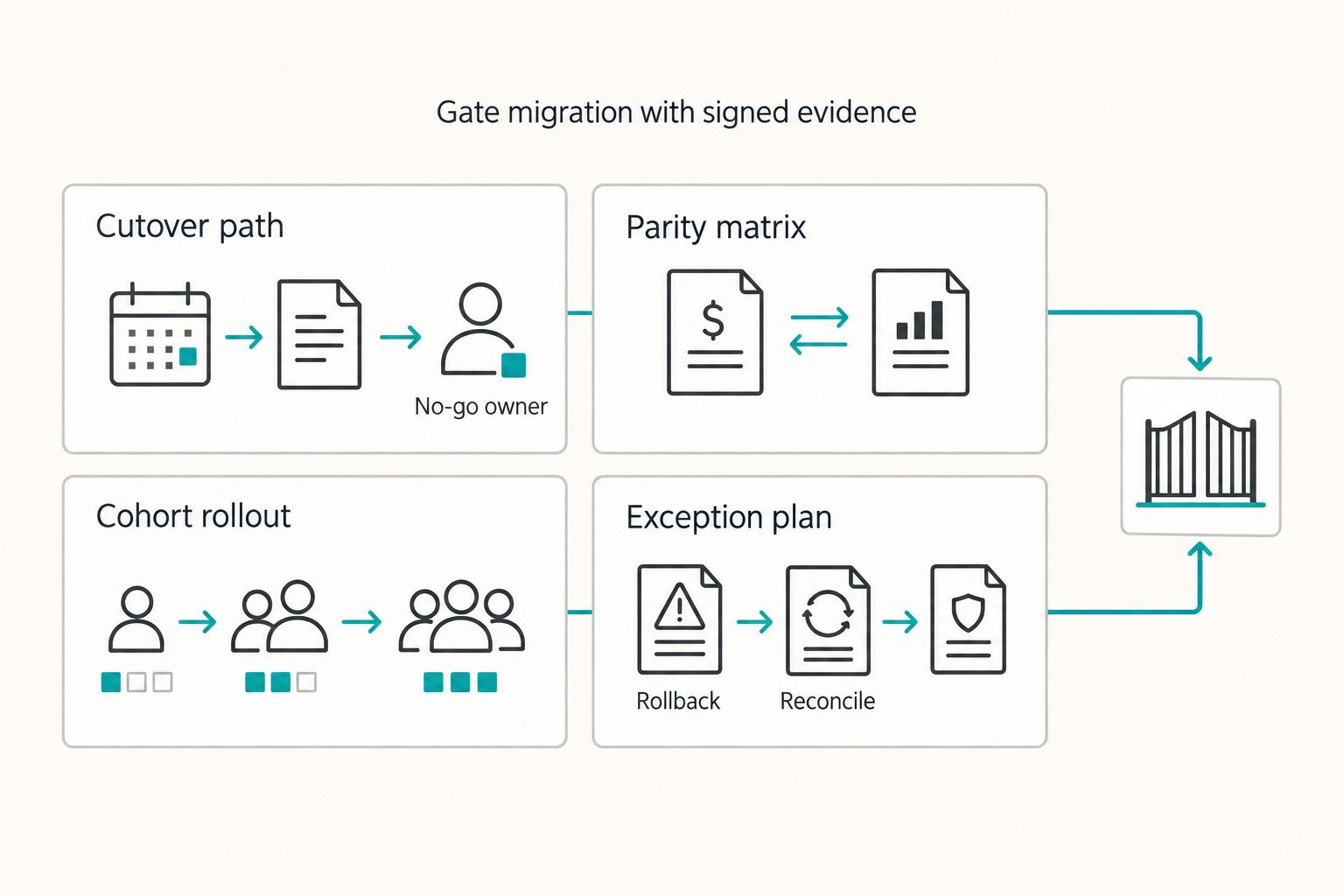
If you need to **migrate subscription billing platform without losing revenue**, treat it as a revenue operations change, not a simple software swap. Billing migrations sit close to renewals, revenue reporting, and payment credentials, so mistakes rarely stay technical. They can show up as duplicate records, inaccurate revenue reporting, failed renewals, or customer-facing downtime.
How OTT Platforms Handle Billing Trials and Churn in Streaming Subscriptions
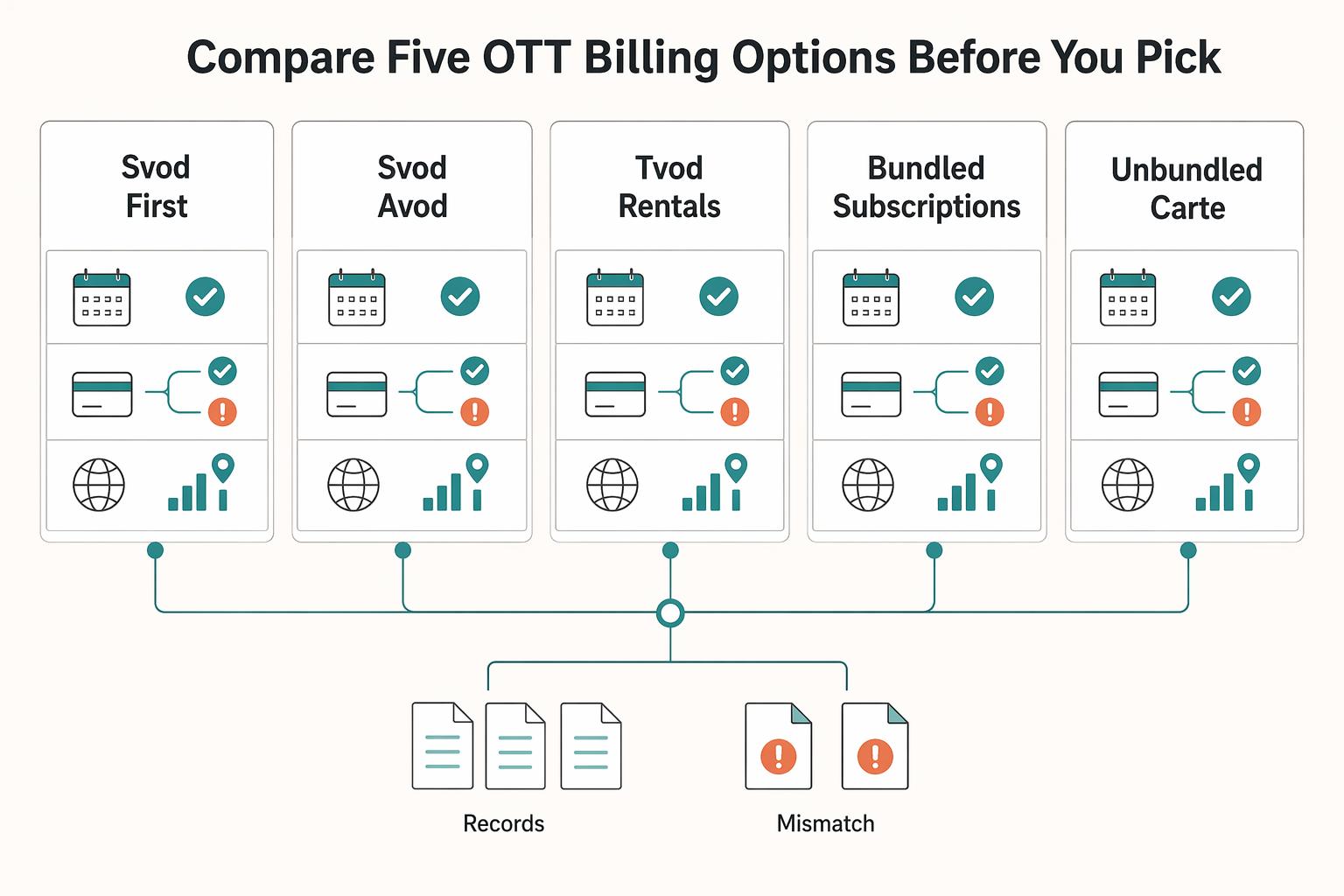
Start with the monetization model. Choose your monetization path before a product demo starts steering the decision. For a streaming offer, the real question is not which vendor can show subscriptions on a checkout page. It is whether your business is built around recurring access, ad-supported reach, one-off transactions, or a direct-to-consumer mix that may vary by market.