
Quick Answer
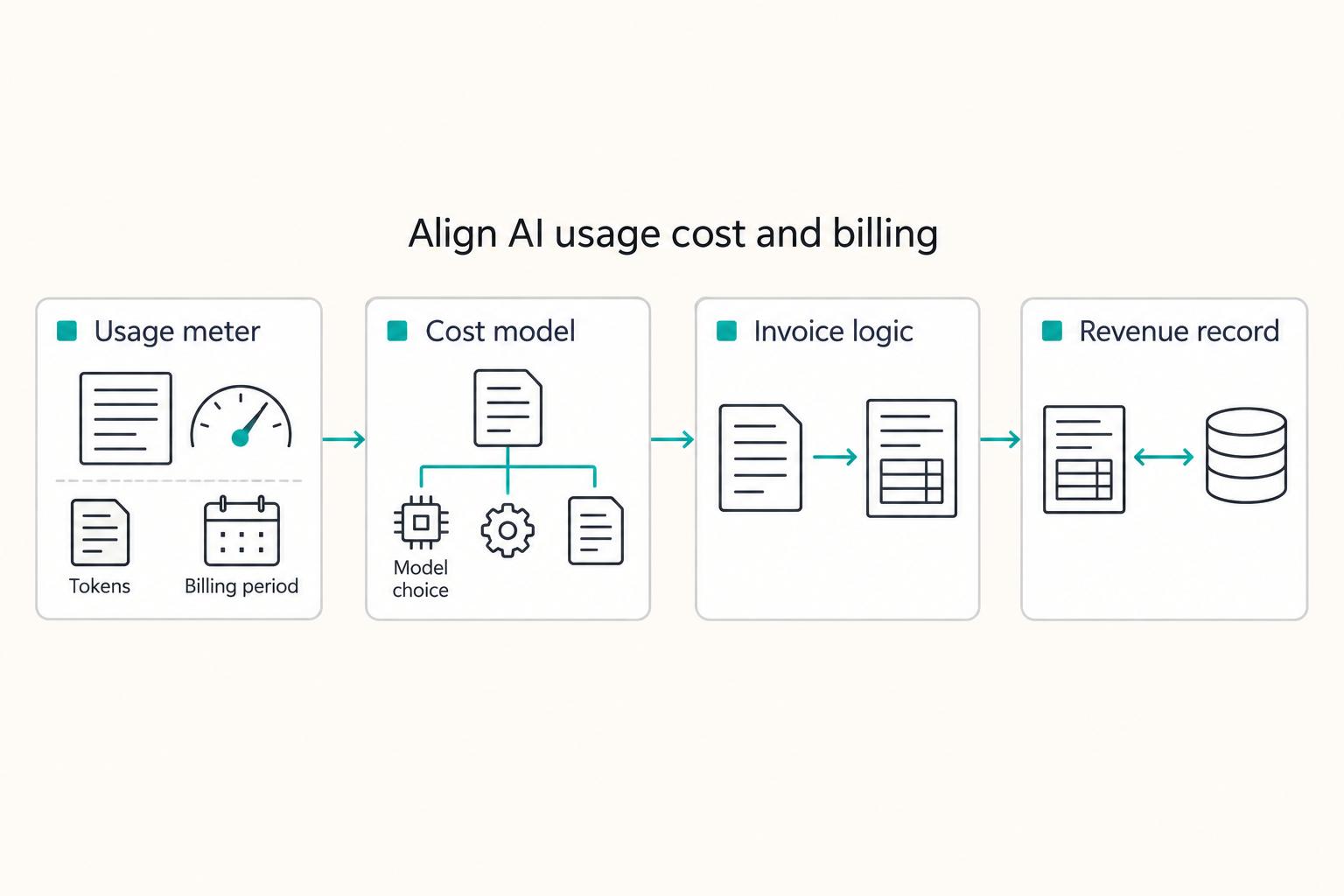
Separate measured tokens from commercial credits and earned revenue. Retain the logical event, price version, allowance application and invoice reference so replay does not charge twice. Enforce request-time quotas with reservations; asynchronous meter summaries and invoice-finalized grants are not real-time admission controls.
Tie AI usage, margin, and billing logic together#
For AI-native startups, billing often stops being a simple checkout problem once product usage starts driving cost. If your margin moves with API calls, model choice, or token volume, pricing, metering, and accounting need to agree from the start. Otherwise, you can end up with invoices that look fine on the surface but do not match actual consumption or revenue treatment.
Usage-based billing turns measured consumption into customer charges. Capture model, input, output and cache-related quantities separately because their rates can differ. The familiar four-characters-per-token estimate is only an English-language intuition; invoices should use actual provider usage and your published billable-unit rules, including how failed attempts and retries are treated.
Under IFRS 15, revenue follows satisfaction of contractual performance obligations, not the timing of an invoice or cash receipt. Usage charges can involve variable consideration; purchased credits create a delivery obligation, while promotional credits need a separate policy. Agree the service, allocation and recognition rules with finance before configuring the invoice.
Define the technical unit, the commercial unit and the accounting event separately. Specify what is measured, which usage earns a customer charge, how it consumes an allowance and when the service is delivered. Then trace one customer action through the raw event, priced usage, invoice, payment and revenue record; those are different milestones.
There is also an operational reality teams often miss. Meter events are not always instantly final. Stripe, for example, states that meter events are processed asynchronously, so assumptions about real-time completeness can create disputes, stale balances, or missing charges if your product shows usage before billing records settle. One failure mode is mixing tokens, credits, and invoice amounts into one field or one mental model. That makes reconciliation harder and hides where errors enter the chain.
Start with one billable unit and one complete lifecycle. Make the first implementation prove a paid credit purchase, usage consumption, a retry, a correction and a finalized invoice before adding more plans.
Want a quick next step? Try the free invoice generator.
Why AI-native startups outgrow subscription billing fast#
Flat pricing can work when usage is predictable or capped. If model mix and heavy-user consumption move cost materially, compare a capped flat plan, prepaid commit and base-plus-overage plan using the same customer cohorts before changing packaging.
The core issue is simple: AI infrastructure cost is variable with usage, and model mix changes per-customer economics even when the product surface looks the same. Stripe defines usage-based billing as charging by consumption and includes metrics like API calls.
| Model and standard token rate | Input per million tokens | Output per million tokens |
|---|---|---|
| Claude Opus 4.6 | $5.00 | $25.00 |
| Claude Haiku 4.5 | $1.00 | $5.00 |
| GPT-5 | $1.25 | $10.00 |
These are dated standard-rate examples checked on October 4, 2026, not a claim that a model is the best route for your task. Cached-input, cache-write, context-length, batch and service-tier treatment can change the invoice. Record the exact model, processing mode and current tariff with each cost estimate.
Compare contribution margin by workload and customer cohort. A heavy user can generate more revenue while consuming still more inference and support cost. Measure supplier cost alongside customer-billable usage, including retries you absorb, before deciding whether an allowance or overage rate needs to change.
Related: Usage-Based Billing Explained: How Consumption Pricing Works for B2B SaaS Platforms.
Define tokens credits and metered consumption before you ship#
Before you build invoice logic, separate your technical usage units from your commercial billing units so one customer action is traceable from usage to charge.
Use a clear dictionary instead of a catchall usage label:
| Term | Meaning |
|---|---|
| Token | Text-processing unit the model uses; token counts appear in API response metadata and can be used for billing traceability |
| Meter event | Customer action submitted for usage billing |
| Meter | Rule that aggregates meter events over a billing period and forms the basis of the bill |
| Usage record / dimension | Quantified usage unit tied to product, customer, dimension, and time |
| Credit / overage | Commercial layer that translates metered consumption into balance deduction or additional charges |
Before you launch, lock your event payload contract: event name, customer ID, numeric value, and timestamp behavior. If you use Stripe, recorded usage must be within the past 35 calendar days and not more than 5 minutes in the future. Make idempotency and deduplication explicit controls so retried events do not become duplicate billable usage.
Set ownership early so definitions stay consistent. Product owns customer-facing credit behavior, engineering owns event integrity and replay safety, and finance owns invoice mapping decisions. A practical readiness check is simple: if the team cannot explain one customer action from API call to credit deduction in one sentence, tighten the definitions before shipping.
You might also find this useful: Metered Billing Architecture: How to Track Units Aggregate Usage and Trigger Invoices in Real Time.
Set prepaid credits rules that finance and product can both defend#
Set prepaid-credit policy as a liability control first, then a UX decision. Advance consideration creates an obligation to deliver future goods or services, so define purchase, allocation, consumption, expiry, rollback, and exception handling before launch.
Use separate purchased and promotional Credit Grants with scope, effective dates and expiry. Stripe applies grants to eligible metered subscription lines at invoice finalization, not each request. Maintain your own request-time reservations for access controls and reconcile them to finalized grant transactions.
Decide credit scope explicitly and document it in product, billing, and support policy. If credits are pooled at account level, usage can be shared across workspaces; if isolated by workspace, attribution is tighter for profitability and dispute review. Neither model is universally better, so choose based on your support and finance workflows.
Stripe billing credits may pay for your own eligible products or services, but cannot act as general stored value, third-party payments, gift cards or wallet-linked funds. Build product rules that respect those restrictions.
Put correction paths in writing#
Use the correction object that matches both the billing state and the financial outcome. A meter correction, invoice reduction, credit restoration and cash refund are separate actions; do not assume one performs the others.
| Situation | Correction path |
|---|---|
| Incorrect meter event | Use the supported adjustment within its cancellation window; finalized invoices may need a separate correction. |
| Invoice amount must decrease | Issue an appropriate credit note; determine separately whether cash must be refunded. |
| Previously consumed billing credits should be restored | A Stripe credit note does not restore grants; issue a new grant where the policy calls for it. |
| Unused vs partly consumed grants | Void only an unapplied grant; expire remaining credits when appropriate. |
Avoid ad hoc balance edits. Use formal correction objects so reconciliation and audit history remain defensible.
Keep an evidence pack for every policy change#
Treat this as operating discipline. For each policy change, keep the product requirement, finance approval, engineering implementation note, and required audit fields. At minimum, capture grant ID, customer ID, applicability scope (billable items or prices), effective date, expiry date (if any), reason code, and the operator or service making the change.
That is the difference between a policy you can defend and one you have to reconstruct later.
Build the metering path from API calls to invoice and ledger journals#
Capture raw events, deduplicate logical usage, aggregate and rate once, apply the commercial allowance, then produce invoice and accounting outputs. Keep supplier cost separate from customer charges. If both your app and a vendor apply the same allowance, the customer can receive a double deduction.
Keep the sequence strict#
Start from the raw event, not the invoice. A Usage Event is a record of a specific instance of consumption, so capture who used what, when, and how much in a form you can preserve and replay. If you use Stripe-style metering, configure the meter first, then send meter events.
Keep a permanent logical usage-event ID with customer, quantity, event time and payload version. Transport retries should recover that same event; provider idempotency windows are not a permanent ledger. If an earlier response is uncertain, reconcile its event ID before resending. Corrections need a linked adjustment record rather than silently changing a previously billed event.
Rate usage under the price version effective for its service period, then apply prepaid or included allowances once. Keep consumption, invoiceable overage, cash receipt and recognized revenue distinct. For a simple hypothetical usage-only contract, a $1,000 cash prepayment initially leaves $1,000 to deliver; $300 of delivered service reduces that obligation to $700 and recognizes $300. A standing service fee or promotional credit needs its own allocation policy.
As a verification checkpoint, pick one invoice line and prove you can trace backward to the raw meter events and forward to the revenue recognition ledger output.
Design correction paths before you need them#
Define deterministic handling for duplicate, late, missing, and stale-retry events before go-live.
- Duplicate events: deduplicate the logical usage ID; return its recorded outcome on transport retry.
- Late events: obey event-ingestion and invoice-finalization windows separately. Stripe uses a 35-day past / five-minute future timestamp window; its selected cancellation API has a separate deadline. Airwallex’s documented one-hour period-end grace does not mean a finalized invoice can be changed by voiding an event.
- Missing events: reconstruct from durable supplier/job evidence, preserving the service period. If the invoice is finalized, reconcile through the supported invoice-correction path.
- Unknown/stale retries: inspect the original operation before replay; retain unconfirmed usage or cost reservations until it is reconciled.
Also plan for asynchronous lag in metering pipelines. Stripe processes meter events asynchronously, so previews and near-real-time usage views can temporarily lag.
Choose architecture by replay and reconciliation cost#
Use replay behavior and reconciliation effort as the primary decision rule.
| Architecture pattern | Latency | Replay behavior | Reconciliation effort | Suitability for usage-based billing at scale |
|---|---|---|---|---|
| Direct app to billing-meter API | Low when healthy, but exposed to provider API limits and async processing | Limited unless the app stores event IDs and idempotency keys | Medium to high when app logs and billing records diverge | Works for early volume or simpler products |
| Queue-backed event capture plus idempotent aggregator | Moderate | Strong, because raw events can be replayed before rating | Lower if raw events, aggregation outputs, and invoice references are preserved | Strong fit as volume or product complexity grows |
| Batch upload at interval or period end | High | Replay is possible, but corrections are coarse and delayed | High when customers expect near-real-time balances | Better for slower billing cycles than fast overage control |
Stripe documents 1,000 calls per second for the live Meter Event endpoint and 10,000 events per second through live API v2 streams, with higher capacity available by arrangement. Test the chosen endpoint, batching and account limit; event count and HTTP request count are different measures.
The operating rule is straightforward: preserve raw events, enforce idempotent aggregation, and treat invoice lines as the accounting hinge point.
This pairs well with our guide on Building Subscription Revenue on a Marketplace Without Billing Gaps.
Choose a hybrid pricing model that protects unit economics#
A hybrid plan can combine a recurring fee with included usage and postpaid overage. Price the base service and the variable consumption deliberately; do not impose a hybrid plan merely because the product uses AI. Test whether capped flat pricing or a prepaid commit better fits your customers.
Do not anchor pricing to your average account. Anchor it to the accounts most likely to compress margin. In AI products, token usage is a core cost driver, and model choice can materially change costs. API call counts alone can hide major differences between cached input, standard input, and output-heavy usage.
For a dated cost example, GPT-5 standard pricing checked on October 4, 2026 lists $1.25 input, $0.125 cached input and $10 output per million tokens. Ten million uncached input tokens, ten million cached input tokens and two million output tokens cost $12.50 + $1.25 + $20 = $33.75 before other services. Four million output tokens raise that subtotal to $53.75 with the same input. Count cached input as a subset of total input when the response reports it that way; do not charge it again at the uncached rate.
Pressure test low, medium, and heavy usage#
Before you finalize packaging, run three scenarios: low, medium, and heavy. For each, document API calls, MTok consumed, input/output mix, cached-input share (if relevant), and expected credit burn. Then map those assumptions to included credit consumption, postpaid overage, invoice lines, and expected gross margin.
Use one realistic heavy-user account as a manual check for a full month. Finance should be able to trace supplier-side token cost, product should be able to trace credit burn, and both teams should confirm whether the subscription still covers baseline value after spikes. Because bursty usage complicates forecasting, test steady heavy traffic and end-of-period bursts.
| Package structure | Included credits or commit | Overage treatment | Margin sensitivity trigger |
|---|---|---|---|
| Baseline subscription | Included credits sized for low, predictable usage | Postpaid overage once included credits are consumed | Low-usage customers regularly hit overage in normal use, indicating the base package is too thin |
| Hypothetical commit plan | $875 monthly commit with a defined included usage band | Usage-based, postpaid overage billed at period end | Medium-usage customers cross the band under ordinary behavior and margin compresses |
| Hypothetical higher commit | $1,125 monthly commit with a larger included credit pool | Postpaid overage after the included pool or threshold is exceeded | Heavy users drive revenue but weak gross margin because included usage subsidizes output-heavy or premium-model traffic |
These commit amounts are hypothetical package choices. Define their included units, rate version and overage rule before comparing margin. If a customer consumes an included pool worth $875, do not also subtract $875 from the already-reduced overage invoice. Test ordinary traffic and an output-heavy burst against supplier cost.
Add request-time and provider spend controls before volume scales#
Set spend controls at launch, because routing mistakes and retry loops can drain credits within a single billing period once premium models are widely available.
| Control | Effect and limit |
|---|---|
| OpenAI spend alert | Notifies; traffic continues. |
| OpenAI enforced organization/project limit | Stops affected traffic after tracked cap, subject to propagation delay. |
| Application account/job quota | Reserve before dispatch to constrain customer and concurrent-worker spend. |
| Cloud cost anomaly/budget alerts | Investigation signal; delayed cost data cannot replace request-time admission. |
OpenAI spend alerts notify without stopping traffic; current organization and project settings also offer enforced hard spend limits. Those limits can return 429 errors after tracked spend reaches the cap, with a small propagation overshoot. Keep a separate application quota for each customer and job: reserve expected cost atomically before dispatch, account for concurrent work and reconcile the reservation to actual usage before releasing it.
A practical launch set includes:
- low credit balance alerts at account and project level
- soft spend thresholds for warning and investigation
- application-level hard caps that pause new requests or jobs
- anomaly detection on API calls and spend signals, with a named escalation owner
Use cloud cost alerts for investigation alongside your request-time quota. AWS Cost Anomaly Detection uses delayed Cost Explorer data; Azure offers budget, credit and department quota alerts at eligible scopes. Neither is a per-customer reservation ledger or a guarantee that one expensive job stops at your product allowance.
Choose model routes using quality evaluations and cost per completed task. A cheaper model can be a poor choice if extra retries increase total cost or lower useful output quality. Keep the accepted route, maximum job cost and fallback policy versioned so changing a model does not silently change customer credit consumption.
Agent loops, retries and background workers need explicit cost and concurrency limits. Reserve against the account and job allowance before each call, bound retry count and token output, and stop dispatch when a hard budget error occurs. Keep unknown in-flight spend reserved until reconciled; immediate release after a timeout can let another worker spend the same allowance.
Keep the weekly checkpoint short and operational: prevented overspend incidents, triggered alerts, unresolved anomalies by owner, and premium-model exceptions. For each incident, keep a compact evidence pack with account or project, model used, spike window, API call volume, balance movement, retry pattern, and action taken. If you cannot explain a burst in that format, the control is not operational yet.
If you want a deeper dive, read A Guide to Usage-Based Pricing for SaaS.
Compare billing stack options before you commit#
Choose the stack that can absorb packaging changes without forcing a rewrite. If you expect frequent plan, credit, or overage experiments, prioritize systems where credits, rating logic, and finance-ready outputs are native.
| Platform | Credits and rating | Ingestion | Finance/export test |
|---|---|---|---|
| Stripe | Credit Grants for eligible metered subscription items; apply at invoice finalization. | Live meter endpoint 1,000 calls/sec; v2 streams 10,000 events/sec. | Test recognized-revenue configuration, credit corrections and event-to-invoice export lineage. |
| Orb | Pricing units, credit-ledger and usage-driven invoicing. | Default 10,000 events/minute; higher capacity by arrangement; 500-event default batch size. | Review recognition methodology and exports under your contract and close policy. |
| Solvimon | Meter/event, product/pricing, subscription and invoicing workflows. | Validate the contracted ingestion capacity with your workload. | Invoice-usage and unmatched-event reports are documented. Verify revenue-recognition configuration and report access in your plan. |
Compare each platform against the same workload: a purchased credit pool, a monthly base fee, a burst of usage, a duplicate event and a post-finalization correction. Native reports help, but finance still owns the contract policy and reconciliation. Choose from observed results and export access rather than a ranking inferred from marketing detail.
Before signing, run one proof with each vendor: trace a single billable event from ingestion to invoice artifact to revenue output. Ask for the exact export you would rely on during migration or audit, including usage event identifiers, timestamps, rated quantity, credit application, invoice line references, and any unmatched-event report. If a vendor can show invoices but not event history behind them, treat that as a red flag.
Check both the contract and data portability. Exportable events, price versions, credit transactions and accounting outputs help reconstruct historical charges; termination terms, retention windows and export permissions determine whether those records remain available during a migration.
For a step-by-step walkthrough, see Subscription Billing Platforms for Plans, Add-Ons, Coupons, and Dunning.
Conclusion#
Agree the billing lifecycle across product, engineering and finance: customer entitlements, measured usage, price versions, invoice state, payment and recognition. Each team should be able to explain where a change enters that chain.
That division matters because usage-based billing can break when any one team acts alone. Product can launch prepaid credits that look clean in the app but create messy exceptions if reversals and expiry were never mapped. Engineering can meter every API call but still leave finance blind if an invoice line cannot be traced back to raw usage. Finance can approve pricing that looks healthy on paper and still miss margin erosion if model mix or credit depletion rules changed underneath it.
Your practical finish line is simple: prove lineage before you scale. A good checkpoint is whether you can take one customer charge and walk it all the way through from raw usage to invoice line to revenue output. Orb's public revenue reporting language is useful here because it frames the exact control you want. You need lineage from a summary revenue entry to the invoice and then to raw product usage data, with recognized revenue calculated in an ASC606-oriented way. If your stack cannot show that chain, do not treat the billing design as done.
The next steps should stay concrete and owned:
- finalize unit definitions for tokens, credits, API calls, billable events, and overage
- approve the prepaid credits policy, including purchase, allocation, expiry, rollback, and refund treatment
- instrument API calls so finance and engineering can trace metered consumption into invoice artifacts and ledger-facing outputs
- test your hybrid pricing model against low, medium, and heavy usage cases before sales scales the wrong package
- stand up a regular spend-control review that checks alerts, anomalies, prevented overspend incidents, and unresolved owners
Keep tax and settlement configuration separate from the usage meter. Before opening a new market, verify the selected account’s settlement currency, payout schedule, bank eligibility and applicable tax treatment. An accurate usage invoice is not proof that cash has arrived or that the sale’s registration and tax obligations are resolved.
So keep policy gates explicit in your billing design. If you are entering a new market, confirm payout timing, bank and currency constraints, and tax registration requirements directly with the provider before launch. That extra step is often cheaper than fixing blocked payouts, manual revenue corrections, or tax exposure after customers are already live.
Frequently Asked Questions
What is the difference between tokens and credits in AI billing?
Tokens measure model processing. Credits represent your product’s commercial allowance, which may be purchased or promotional. Retain token quantities for supplier cost and version the mapping into customer credits; invoice-finalized credit applications can differ in timing from your request-time access balance.
Why can subscription billing fail for AI-native startups?
It can fail when your cost of goods moves with actual usage but your price does not. Usage-based billing is built to charge on consumption, and token demand can swing with experimentation, workload design, and prompt changes. If a flat plan is hiding a volatile cost base, margin can deteriorate before revenue dashboards show the problem.
What should an AI billing system meter in real time?
Measure actual input, output and applicable cache quantities plus the logical customer job. A request count alone can hide token-heavy work. Track supplier-billable attempts separately from customer-billable units, then reconcile provider usage to your event store and finalized invoice. Stripe meter aggregates are asynchronous, so they cannot serve as the sole request-time hard cap.
How does a hybrid pricing model reduce margin erosion risk?
Hybrid pricing can recover variable cost through overage once the included allowance is used, but only if the allowance and rate match real workload economics. In the worked GPT-5 example, doubling output from two to four million tokens increases supplier token cost from $33.75 to $53.75. Re-run that calculation whenever the model, cache behavior or customer price changes.
What are the most common causes of credit overspend?
Inspect output-heavy jobs, concurrency, retry loops and changes in the model-to-credit conversion. These are concrete failure modes to test, not a universal ranking of incident causes. Compare expected and actual job cost and retain unresolved usage as reserved until its outcome is known.
How do we control usage cost without hurting product quality?
Start by matching model choice to task value instead of sending every request to the most expensive option. Complex reasoning models can improve performance, but they also consume more tokens, so reserve them for work that justifies the spend and route routine tasks to lower-cost paths. Also review prompt design and provider pricing details like cached-input treatment before you cut features users actually value.
What is still unknown when comparing Stripe, Orb, and Solvimon from limited public detail?
The main unknowns are still anti-fraud controls, accounting behavior beyond the public materials in scope, and migration complexity. You should also verify the exact export artifacts you would rely on in an audit or platform change, especially usage-event history, invoice artifacts, and any unmatched-event reporting. If a vendor can show polished invoices but not the supporting event trail, treat that as a serious warning.
Try a related tool
Researched and edited by the Gruv editorial team. Gruv builds cross-border billing, payouts, and finance-operations software for global businesses.
Sources
Includes 5 external sources outside the trusted-domain allowlist.
- docs.stripe.com/billing/subscriptions/usage-based/recording-...trusted
- docs.stripe.com/billing/subscriptions/usage-based/billing-cr...trusted
- stripe.com/resources/more/hybrid-pricing-modelstrusted
- airwallex.com/docs/billing/usage-based-billing/usage-eventsexternal
- cfodive.com/news/one-in-four-firms-miss-ai-cost-projecti...external
- deloitte.com/us/en/insights/topics/emerging-technologies/...external
- developers.openai.com/api/docs/models/gpt-5external
- developers.openai.com/api/docs/guides/spend-limitsexternal
Educational content only. Not legal, tax, or financial advice.
Related Posts

SaaS Usage-Based Pricing for Predictable Cashflow and Fewer Disputes
If you are considering **saas usage-based pricing**, treat it as an operations and collections decision first. Pricing works best when the usage unit can be measured, shown on the invoice, and explained by someone outside your product team.

Usage-Based Billing for B2B SaaS Platforms That Teams Can Operate
Usage-based billing works best when customer value rises with measurable consumption rather than with a fixed license. It can improve pricing fit, but only if pricing logic, billing data, and finance controls are designed together from the start.
Metered Billing Architecture That Keeps Finance and Engineering Aligned
Real time often belongs in usage capture, not in issuing an invoice for every event. A common requirement is to record consumption as it happens, then turn that usage into charges on a defined billing cycle or another explicit trigger.