
Quick Answer
Yes. Track usage as events happen, but issue invoices on a defined billing cycle unless an approved off-cycle rule applies. Start with one signed trigger policy across product, finance, and ops, then enforce event contracts, duplicate suppression, and aggregation before rating. Use replay tests before go-live and require a trace from each invoice line back to source usage records. Keep real-time actions focused on visibility and control, not automatic per-event invoicing.
Metered billing architecture that finance can close and engineering can trust#
Real time often belongs in usage capture, not in issuing an invoice for every event. A common requirement is to record consumption as it happens, then turn that usage into charges on a defined billing cycle or another explicit trigger.
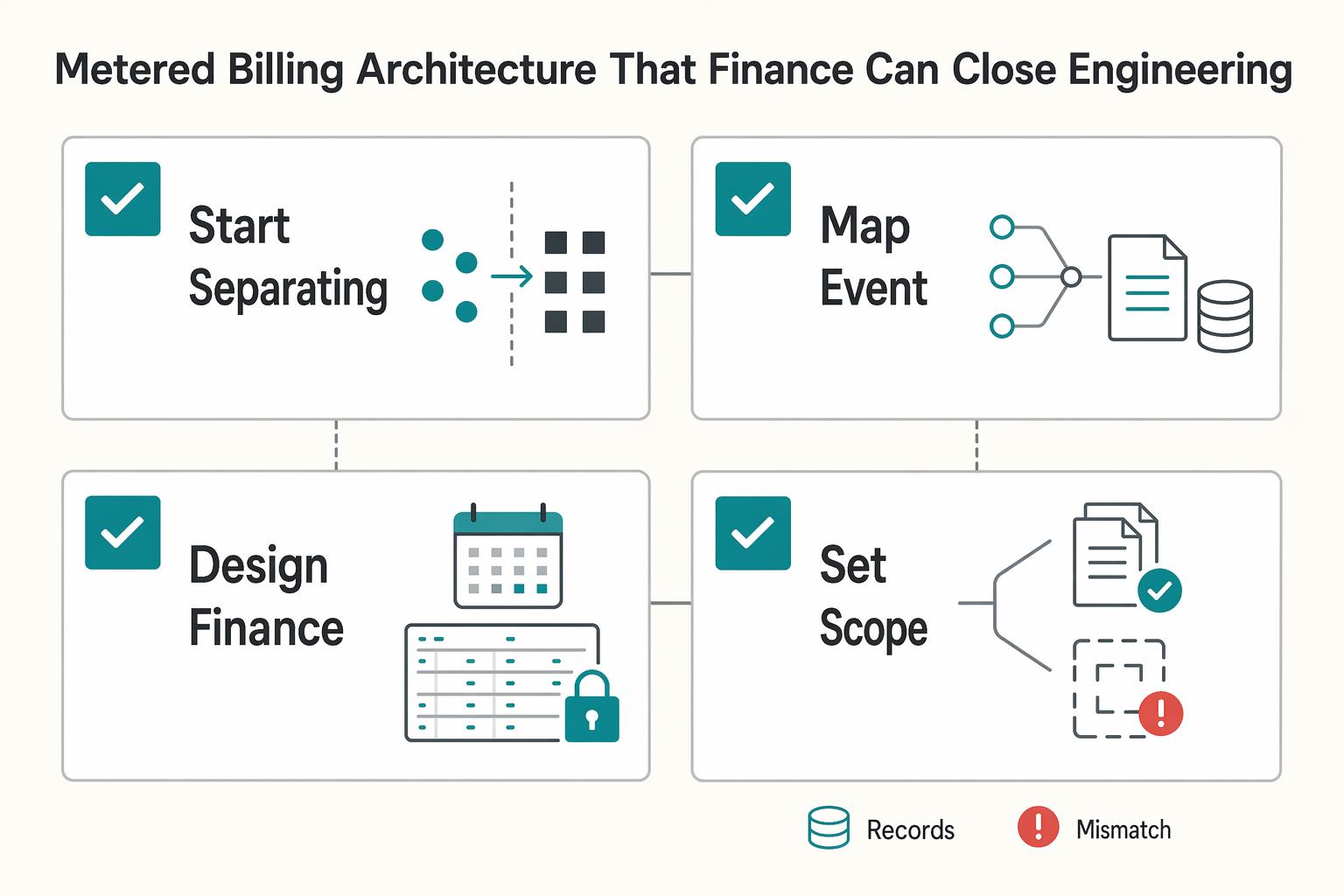
- Start by separating metering from invoicing.
Usage-based billing, or metered billing, means price is calculated from consumption of defined units. The first job is metering: tracking and recording usage events such as API calls, storage consumed, or transactions processed. The invoice comes later, after those events are aggregated and rated. If you collapse those stages too early, the design becomes brittle for both finance operations and engineering debugging. We recommend keeping that separation explicit so your team can debug usage and billing without guessing which layer broke.
- Map the event-to-invoice path before you talk about "real time."
The hard part is not just counting events. It is connecting API calls and event streams to accurate invoice lines across the full event-to-invoice pipeline. A durable pipeline usually has three stages: metering, aggregation, and rating or invoicing. That matters because a customer might generate 2.3 million API calls, store 480GB, or process 12,000 transactions in a period. Those volumes still need to become charges that both teams can trace. If you want your finance and engineering teams to trust the same number, keep that event-to-invoice chain visible.
Use a simple checkpoint here: can you trace a billed amount back through the aggregation result to the underlying usage records? If not, the system may still produce invoices, but billed amounts will be harder to validate when questions come up.
- Design for finance accuracy, not just engineering throughput.
Usage billing adds complexity that flat-rate billing does not, especially as volume grows. High-volume transaction handling matters, and accuracy does too. You need an aggregation layer that can summarize raw activity into billable totals, and a rating step that turns those totals into charges consistently for the same close.
The common failure mode is false confidence from totals that are "mostly right." Even small mismatches between captured usage and billed usage create reconciliation work across teams.
- Set the scope boundary now so the rest of the build stays sane.
This article focuses on a decision-oriented path for usage tracking, invoice triggers, real-time visibility, failure recovery, and audit evidence. Do not assume real time means per-event invoicing. In many cases, real-time actions can trigger operational workflows, while final invoicing still follows a defined cycle.
Lock that boundary early. If you need immediate customer visibility, use live usage capture and operational triggers. If you need invoice-grade accuracy, tie invoicing to a deliberate close point instead of every single event. Related: Billing Infrastructure for AI-Native Startups: Usage Credits Tokens and Metered Consumption.
Pick your invoice cadence before you design pipelines#
Choose your invoice cadence before you lock ingestion, aggregation, and rating logic. Start with fixed-cycle invoicing, then add off-cycle triggers only when your team has a clear policy for when and why they fire. We recommend starting with one default cadence your operators can explain before you widen trigger logic.
Step 1 Compare the three operating models before you pick one#
Cadence is an operating choice that changes how your event-to-invoice pipeline runs. You still have one automated pipeline, but trigger policy changes when aggregation and invoice-ready totals must be produced.
| Model | How it works | Best fit | Main upside | Main downside | What it means for the Aggregation layer |
|---|---|---|---|---|---|
| Billing cycle invoicing | Usage is captured continuously, then invoiced on a fixed cadence | Most SaaS products that expect a regular bill | Clear, regular invoice timing | Less flexibility for mid-cycle billing actions | Aggregate toward a scheduled close and keep traceability clean |
| Threshold or off-cycle invoicing | Usage is captured continuously and an invoice is triggered when a policy condition is met | Accounts or plans where earlier invoicing is required by policy | Lets teams invoice before cycle close when policy requires it | More policy and support complexity | Aggregation must support in-period trigger evaluation, not only end-of-cycle close |
| Hybrid model | One pipeline supports fixed-cycle invoicing plus selected off-cycle triggers | Mixed customer profiles or mixed plan types | Keeps one core system while allowing exceptions | More rules to define, test, and operate | Aggregation must reliably support both scheduled close and trigger evaluation |
Use one readiness check before launch: can you trace every billed amount from invoice line to aggregation result to underlying usage records, whether the invoice is scheduled or off-cycle?
Step 2 Start simple when usage is noisy and support load matters#
When usage is volatile and invoice questions are likely, start with fixed-cycle invoicing and real-time usage visibility, then add off-cycle triggers later if needed. This keeps invoicing predictable while still giving teams early operational signals before close.
Avoid bolting on trigger logic after you hard-code fixed-cadence assumptions in rating and invoice state handling. Trigger timing changes how the pipeline closes, retries, and corrects data. For late-arriving events after close, post adjustments instead of reopening closed invoices.
Step 3 Get one signed trigger policy before implementation#
Before build starts, have product, finance, and ops approve one trigger policy that defines default cadence, off-cycle eligibility, trigger conditions, late-data correction, and logging requirements. At minimum, answer these four questions:
| Policy area | What to approve |
|---|---|
| Default cadence | What closes an invoice by default: regular cycle only, or cycle plus trigger events? |
| Off-cycle eligibility | Which accounts, plans, or product lines can receive off-cycle invoices? |
| Late-data correction | How will late-arriving usage be corrected: adjustment line or another approved correction path? |
| Logging requirements | What evidence must be logged so teams can trace how each billed number was produced? |
Define billable units and event contracts before writing code#
After you choose invoice cadence, lock your billable-unit definitions before implementation. If unit definitions stay ambiguous, the aggregation layer stays ambiguous, and disputes get harder to resolve later.
Step 1 Define billable units in plain language and assign ownership#
Start with clear, fixed usage metrics that are easy to count and explain, such as API calls or GB transferred. In usage-based billing, this gives product, finance, and engineering a shared baseline before pipeline work begins.
For each metric you plan to charge on, write a short definition, state what is excluded, and assign one owner who approves changes. Keep the focus on the counting rule, not just the pricing label, so teams can reproduce the same totals from the same data.
Step 2 Define an event contract around traceability, not just ingestion#
Design the event contract so a billed amount can be traced back to a source record. Do not assume a single universal schema applies, so the practical goal is to define the fields your team needs to explain and defend a charge consistently. If your reviewer cannot follow that contract back to the source record, your billing explanation will not hold up under pressure.
Keep one short spec with valid and invalid records. The example below is an internal event contract, not a Stripe API payload; map its fields to any provider deliberately.
| Field | Example | Why it is retained |
|---|---|---|
| producer + source_event_id | api-gateway / req-123 | Stable deduplication key across retries |
| customer_id + metric | cust-17 / api_call | Assign usage to one customer and billable unit |
| quantity | 100 | Count accepted units rather than deliveries |
| occurred_at + received_at | 2026-06-14T10:00Z / 2026-06-14T10:01Z | Apply the effective price and inspect late arrival |
| source_reference | request-log-123 | Trace a disputed line to the producer record |
Require a unique producer and source-event ID pair. On a retry, look up that pair before counting; if the payload conflicts, quarantine it rather than silently replacing the accepted event. Validate timestamps and retain deduplication history through the billing correction window. Stripe meter events have an optional identifier with uniqueness enforced for at least 24 hours, and accept timestamps within the past 35 calendar days or five minutes in the future; those provider limits do not replace a longer internal replay policy.
Step 3 Set a readiness gate before production metering#
Treat production metering as a readiness milestone. Before launch, make the event contract, duplicate behavior, late-event policy and invoice replay executable in tests so an unfinished rule does not first surface in a customer dispute.
One practical risk check: if your team cannot consistently explain how a usage event becomes an invoice line, stop and tighten the contract first.
Build metering and aggregation in the right order#
Metering is most reliable when you run it in sequence: ingest valid meter events, suppress duplicates before counting, store accepted raw events, then aggregate for billing and alerts.
Step 1 Ingest usage events before you think about invoices#
Start by receiving meter events from the system that observes usage. A meter defines what event is tracked and how it is aggregated, so this step is about one decision: accept only events that match your contract, and quarantine the rest.
Use event acceptance rate as the first check. Track accepted versus rejected or quarantined events so ingestion issues are fixed before they affect totals.
In a Stripe-style flow, meter events provide the usage input and a meter aggregates it for billing. Stripe’s Basil change removes the legacy UsageRecords API in that API version; older integrations pinned to a pre-Basil version need a migration plan. Stripe’s meter-event API documents the event name, customer and value payload keys, optional identifier and timestamp.
Step 2 Dedupe before any counting happens#
Add duplicate suppression before aggregation. Retries are normal in distributed delivery, but duplicate counts should never become billable usage.
Watch duplicate suppression rate as an operational check. If that rate shifts suddenly after sender or retry changes, review the pipeline before trusting downstream totals.
Step 3 Persist accepted raw events, then aggregate with explicit rules#
Keep accepted raw events and aggregated totals queryable. Then aggregate each billable unit with an explicit method: Sum, Count, or Last.
Track lag to availability for real-time usage alerts. Real-time here means usage is visible quickly enough to act, while billing still closes on period totals. Low-latency architecture matters because monetization systems need to process high event volumes continuously with financial consistency.
In practice, raw events support traceability during investigations, and aggregated totals support efficient cycle-close reconciliation. Related reading: Real-Time Reporting Metrics Platform Finance Teams Can Actually Control.
Configure rating and invoice triggers without per-event billing chaos#
Keep trigger logic separate from event flow: alerts should warn, charge controls should manage exposure, and invoice triggers should decide when to bill.
Step 1 Separate trigger types before you connect actions#
| Trigger type | What should fire it | Action | Usage-billing example | Internal invoice example |
|---|---|---|---|---|
| Alert trigger | Usage nears a limit or projected exposure rises faster than expected | Notify ops or customer success (for example, in Slack) | Alert when projected June usage reaches 80% of an agreed allowance | Alert account team when usage is likely to exceed contract before cycle close |
| Charge trigger | Credit exposure crosses policy | Apply hold, require review, or create interim billing | Require review when reconciled unbilled usage crosses the approved exposure limit | Create interim charge or suspend new usage until risk is cleared |
| Invoice trigger | Billing cycle closes or approved off-cycle threshold is met | Finalize billable lines and issue invoice | Issue the June invoice after accepted counts and rated lines reconcile | Finalize cycle invoice from rated usage and approved off-cycle charges |
Keep the boundary strict: alert conditions should not create invoices, and invoice conditions should not silently place accounts on hold.
Step 2 Encode if-then rules around exposure, not raw event count#
Write policy as explicit rules: if usage nears limit, alert; if exposure crosses policy, hold or interim-bill; otherwise close on the normal cycle.
Step 3 Freeze plan-change rules inside the rating engine#
Store plan version, price version, and effective timestamp used for rating. For mid-cycle changes, rate each usage segment under the price effective when it occurred. Prorate any fixed fee only if the contract policy requires it. For grandfathered accounts, keep the older price table until its explicit end date.
The go/no-go check is replaying a mid-cycle plan change and confirming two correctly rated segments under your proration logic, rather than one opaque corrected total.
Worked example: replay a mid-cycle price change#
Hypothetical June cycle: API calls cost $0.02 each until 15 June 00:00 UTC and $0.03 afterward. Accepted event req-123 records 100 calls on 14 June; a delivery retry with the same producer and ID is ignored. Event req-124 records 50 calls on 16 June. Event req-125 records 25 calls performed on 14 June but received on 17 June, inside this example’s approved late-arrival window. Validate the source timestamp and assign price by occurred_at, not by arrival order. Version one has 125 units × $0.02 = $2.50; version two has 50 units × $0.03 = $1.50. The June invoice has two traceable usage lines totaling $4.00. If req-125 arrives after the June invoice is finalized, leave the closed invoice intact and issue a linked correction under the approved policy.
Step 4 Run replay tests over historical calls before go-live#
Replay historical API calls through the full rating path before launch, then compare output to expected invoices. Include edge cases you already see in production: deduped retries, late arrivals, plan changes, and policy-threshold crossings.
Keep evidence per replay set: raw events, aggregation snapshot, plan and fee-table versions, expected invoice lines, and a diff report. If totals only reconcile after manual spreadsheet adjustment, pause go-live.
For a step-by-step walkthrough, see Subscription Billing for Media Publishing with Metered Paywalls and Gifts.
Build an audit evidence pack for disputes and month-end close#
After replay tests pass, the next control is auditability: you should be able to trace any billed amount without rebuilding logic in a spreadsheet. For disputes and month-end close, keep one evidence pack that connects raw usage inputs, aggregation result, rating output, invoice lines, and the payment states recorded over time.
Step 1 Assemble one traceable record chain per disputed charge#
Start from the invoice or line-item ID and make every supporting record queryable from there. In practice, that usually means keeping:
| Record | What to keep |
|---|---|
| Raw event logs | Usage behind the charge |
| Aggregation snapshot | The snapshot used for that billing cycle |
| Rating output | The price version and effective timestamp applied |
| Final invoice lines | The invoice lines shown to the customer |
| State transitions | The sequence of states, not just latest status, especially pending, settled, errored, or chargeback |
The key check is reproducibility: walk from one invoice line back to source events, then forward to the rated amount, without manual correction. Store state transitions explicitly so you can show sequence, not just latest status, especially when payment outcomes move through pending, settled, errored, or chargeback.
Step 2 Tie money movement to explicit transaction states#
Use stored transaction states as your source of truth for reconciliation, because payment flows are asynchronous and non-atomic. Late webhooks, delayed settlement, and retries can all change timing without changing the underlying obligation.
To keep records trustworthy under those conditions, use operation-scoped idempotency keys and lock invoice-related records during state updates. Your checkpoint is simple: when a payment moves from pending to settled, downstream views update once, and only once, with no duplicate movement.
Step 3 Define dispute routing before go-live#
Decide ownership before the first live dispute so response paths are consistent under pressure. Route by problem type: evidence retrieval and customer updates on one path, and data or workflow defects on another.
Write the rule in plain language and test it with mock disputes. If the evidence chain reproduces the billed result, resolve through the standard decision path; if records conflict or edge cases are isolated for manual inspection, route to engineering while ops maintains customer communication.
Prevent the common failure modes and recover fast#
Treat reconciliation breaks as release blockers, not support cleanup. If totals do not tie, pause invoice finalization for that cycle, repair the underlying usage records, and rerun aggregation and rating before invoices move forward.
Step 1 Treat four failure classes as design inputs#
Plan for four classes from day one: duplicate events, out-of-order events, missing events, and backfill or re-rating drift. Any one of these can break the path from raw usage to invoice totals.
For real-time monetization, your architecture has to process, aggregate, and action events as they occur, while preserving consistency for financial calculations. A practical control is replaying a closed-cycle event set and confirming the same accepted counts, rated units, and invoice totals on each run.
Step 2 Freeze finalization when reconciliation does not tie#
Before an invoice leaves draft, reconcile raw accepted events, aggregated billable units, and rated quantities for the same customer and period. If one layer does not tie to the next, hold the invoice and repair at the source-event level first.
After repair, rerun aggregation and rating for the affected window and produce a delta audit report that shows what changed and why.
Step 3 Make post-bill corrections explicit#
Do not silently rewrite usage that has already been billed. Issue visible correcting lines and link them to traceable ledger journal entries so support, finance, and the customer can follow the before-and-after state.
Step 4 Define hard no-go criteria#
Do not launch or roll out major pricing changes if replay checks fail, dispute evidence is incomplete, or finance cannot reproduce totals from usage records and ledger data. Also stop if backfills can change historical totals without an approved delta report.
If settlement timing is part of your design, Real-Time Ledger vs Batch Settlement for Platform Volume Decisions goes deeper on the tradeoffs.
Conclusion and copy-paste launch checklist#
This checklist alone is not enough to validate launch-readiness claims. Use this checklist as an internal validation tool, not as proof that these controls are already in place.
- Choose your first production cadence.
Document one default cycle and any off-cycle trigger rules your teams intend to support. Verification: walk through sample accounts, including a mid-cycle plan change and a late usage event, and confirm product, finance, and ops expect the same invoice timing and charge treatment.
- Lock event contracts before you widen automation.
Define what counts as one accepted billable event across ingestion, idempotency handling, storage, and aggregation. Verification: replay identical source events and confirm counts, aggregates, and invoice amounts stay consistent before invoice finalization.
- Prove the money trail end to end.
Validate that your implementation can trace invoice lines back to usage records and reconcile invoice totals to finance exports. Red flag: the team cannot quickly produce auditable records for a disputed invoice line.
Use this in your launch review. We recommend treating each open box as a release decision, not just a documentation task:
- Billing cycle and off-cycle trigger rules are documented and approved by product, finance, and ops.
- Replay behavior for duplicates, late events, and replays is tested and outcomes are documented.
- Proration, plan-change, and rerating behavior is tested against expected outputs.
- Dispute evidence can be traced from invoice line to raw event records.
- Post-close corrections produce linked lines without silently rewriting a closed invoice.
- Invoice totals reconcile to ledger records and exported finance reports.
If any box is still open, keep the launch narrow and finish validation before adding more triggers or automation. We would keep your first release narrow until your team can answer every open item without hand-waving.
Frequently Asked Questions
Can you generate invoices in real time for every usage event?
You can design metered billing across the full flow from usage event ingestion to invoice generation, but that does not require invoicing each event. In a grounded usage-based flow, usage is metered as it happens, then aggregated, then rated and invoiced.
What should trigger an off-cycle invoice instead of waiting for the normal cycle?
Set a contract-backed rule, not a universal threshold. For example, a plan could permit an interim invoice after reconciled unbilled usage reaches $500 and an operator approves it. An 80% usage alert should only notify; it must not issue that invoice or place a hold by itself.
Which fields must be stored to defend invoice disputes confidently?
Store structured usage events and attribution metadata such as customer, feature, model, and environment where relevant. Keep enough records to trace a disputed invoice line through metering, aggregation, and rating or invoicing.
How do Webhooks and Idempotency prevent duplicate charges?
Assign each producer event a stable ID and deduplicate on producer plus source-event ID before aggregation. A retry with the same ID does not add units; a conflicting payload is quarantined. Keep this internal key through the correction window, since a provider’s shorter uniqueness window cannot prove long-term invoice replay.
What is the difference between Real-time usage alerts and real-time invoicing?
Real-time usage alerts are usage-stage signals, typically based on metered or aggregated usage. Real-time invoicing is the later billing stage where aggregated usage is rated into charges and turned into an invoice.
How do plan changes and proration affect the Rating engine mid-cycle?
Effective-date the price version and split usage at that boundary. In the hypothetical June replay, 125 calls at $0.02 plus 50 at $0.03 produce $4.00 in usage charges. Any fixed-fee proration or grandfathering is a separate contract rule to test before finalization.
Researched and edited by the Gruv editorial team. Gruv builds cross-border billing, payouts, and finance-operations software for global businesses.
Sources
Educational content only. Not legal, tax, or financial advice.
Related Posts

SaaS Usage-Based Pricing for Predictable Cashflow and Fewer Disputes
If you are considering **saas usage-based pricing**, treat it as an operations and collections decision first. Pricing works best when the usage unit can be measured, shown on the invoice, and explained by someone outside your product team.
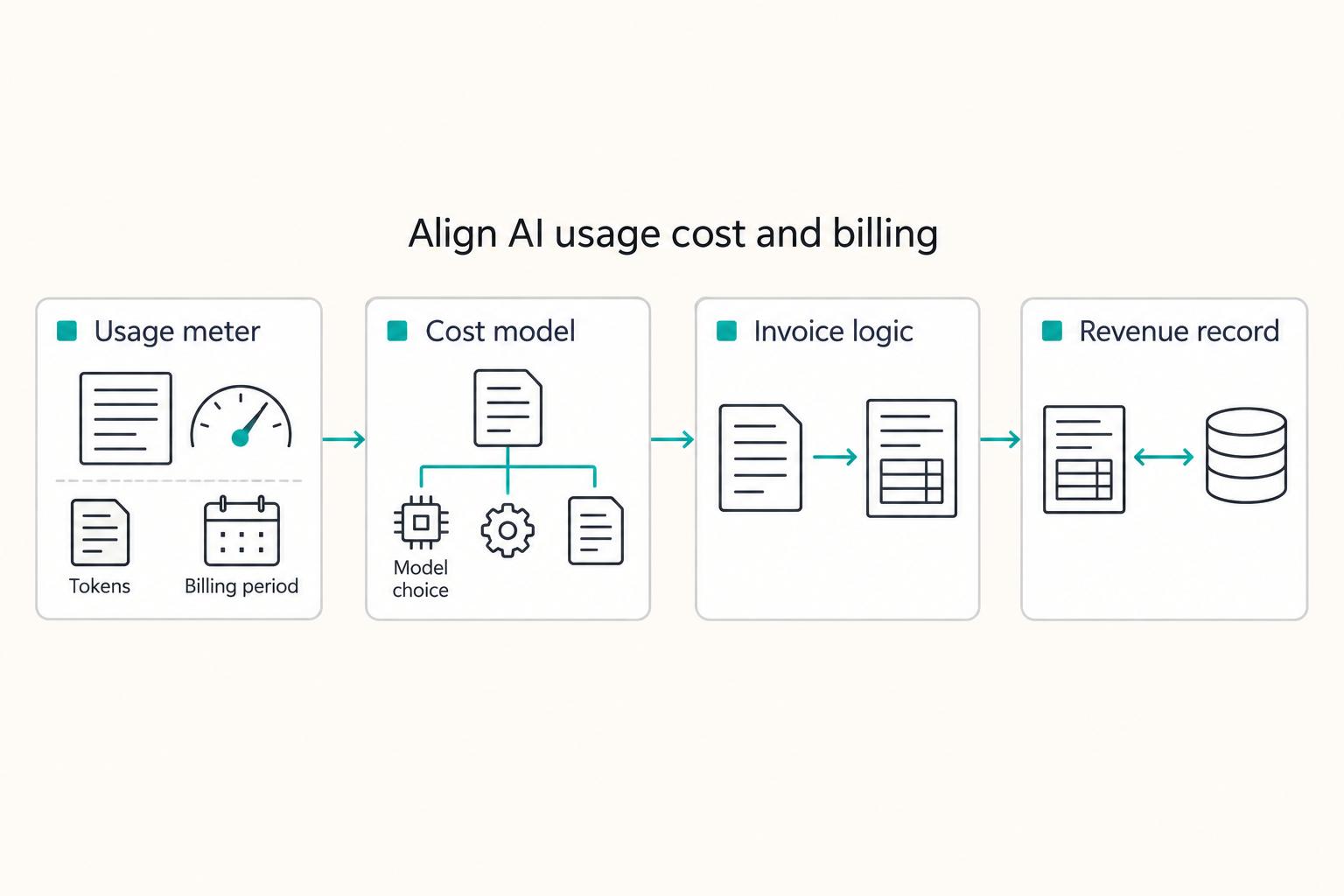
AI Billing Infrastructure for Startups Using Credits Tokens and Metered Usage
For AI-native startups, billing often stops being a simple checkout problem once product usage starts driving cost. If your margin moves with API calls, model choice, or token volume, pricing, metering, and accounting need to agree from the start. Otherwise, you can end up with invoices that look fine on the surface but do not match actual consumption or revenue treatment.

The Freelance Payment Penalty: A Modeled Audit of Platform Fees, FX Spreads, and Payout Delays
The money rarely disappears through a single, easy-to-spot fee. The real loss is stacked. A marketplace takes its commission, a processor adds a charge for international cards, a bank or payment company converts the currency at a spread, a platform holds the funds before release, and a wire sheds a little to intermediaries on the way in. Each layer looks defensible on its own, but the worker feels the combined result as a smaller deposit and a later payday.