
Quick Answer
Define the access contract first, then wire billing to that contract. Use a reader-state matrix (anonymous, registered, paid, lapsed, gifted, bundled), map each state to a clear access outcome, and enforce one event chain from authorization through invoice creation, payment confirmation, entitlement grant, and ledger posting. Test gift redemption, downgrade proration, failed renewal, and grace-period behavior in staging, and keep dispute evidence ready with invoice records, payment event IDs, and entitlement snapshots.
How Billing Supports Metered Paywalls and Gift Access#
Treat this as a contract and access problem first, not a pricing-page tweak. For teams working through subscription billing in media publishing with metered paywalls and bundles, the common challenge is getting product, finance, and engineering to agree on exactly when access starts, pauses, resumes, and ends. If your team cannot explain that in plain language before launch, you are not ready.
A metered paywall lets readers consume a limited number of free articles or visits over a set period before being asked to subscribe. It is often less intrusive than a hard paywall and can help turn first-time visitors into repeat readers. It also fits a basic business reality: digital content costs money to produce, and paywalls are one way publishers try to recover that cost while still allowing discovery.
Start with these inputs#
Before you configure anything, have these inputs in hand:
| Input | Details |
|---|---|
| Draft catalog of plans | Include any bundle or gift offer you want to support |
| Reader states | Anonymous, registered, paid, and lapsed |
| Named owners | Product, finance, and engineering owners who can approve access rules, billing events, and reconciliation outputs |
| Test environment | Show payment events, invoice creation, entitlement changes, and customer notifications |
Start by choosing the access model with your audience in mind. Zuora frames paywall choice as a critical decision for acquisition, growth, and revenue. It also points to audience understanding as the main factor in implementation. That matters because there is no universal free-article threshold you can copy. Even well-known publishers have adjusted their approach over time. Zuora cites The New York Times using a metered model since 2011 and tweaking it again in 2019, which is a useful reminder that meter settings are operating choices, not fixed truths.
From there, translate the model into billing and entitlement rules. Subscription billing can include recurring, usage-based, and contract-based charging, but in publishing the practical question is simpler: what billing state grants what content access? You need that answer for direct subscriptions, bundles, and any gift path you plan to offer. A useful checkpoint is a one-page matrix that shows the exact access outcome for each user state. If you cannot hand that matrix to support and finance without debate, your setup is still too fuzzy.
Then prove the edge cases before rollout. Do not depend on publisher benchmarks or vendor examples to tell you what will work in your catalog. Use scenario tests instead. Verify the meter boundary, confirm access is granted only after the payment state you trust, and keep an evidence pack for disputes with invoice records, payment event IDs, and entitlement snapshots. One failure mode to catch early is access drift, where a stale session or replayed event grants content the billing record does not support. Catch that in testing, not after readers find it for you.
Related: Publishing Subscription Models: Metered Paywalls vs Hard Paywalls vs Hybrid Access.
Want a quick next step on subscription billing for media publishing, metered paywalls, and bundles? Try the free invoice generator.
Pick the right access model before you configure billing#
Pick the access model before you touch billing configuration. This choice drives acquisition, conversion friction, support complexity, and how cleanly your entitlement rules can be enforced.
Paywall choice affects acquisition, growth, and revenue, and audience fit should lead the decision. Use one scoring table so product, finance, and engineering are weighing the same tradeoffs.
| Access model | Acquisition impact | Conversion friction | Support load | Expected effect on ARPU and LTV | Proof burden before choosing it |
|---|---|---|---|---|---|
| Metered paywall | Sampling can support discovery because access is limited, not fully blocked at first | Friction starts after free access is used | Usually tied to meter-state questions and entitlement edge cases | Set a test hypothesis; do not assume default lift | Show your audience returns enough for sampling to matter, and prove meter/enforcement behavior across reader states |
| Freemium paywall | Depends on whether free vs premium boundaries are clear to readers | Depends on how obvious and consistent those boundaries are | Usually tied to classification and access disputes | Set a test hypothesis; do not assume default lift | Show stable content classification rules and reliable enforcement in your CMS |
| Hard paywall | Can reduce new-reader access because content is blocked upfront | Highest at entry because there is no sampling path | Fewer ambiguous states, but failures are more severe | Set a test hypothesis; do not assume default lift | Require strong repeat direct traffic signals, clear high-value exclusives, and staged proof that full-block access logic works correctly |
| Soft paywall | Preserves reach with lighter gating | Lowest immediate friction | Lower entitlement conflict, higher ambiguity risk in prompts/offers | Set a test hypothesis; do not assume default lift | Show that lighter prompts still move readers into registration or paid pathways |
Use this as a decision rule, not universal truth: if growth depends on SEO and social discovery, start with metered; if your catalog has clearly separated premium tiers, test freemium first.
Before finalizing any model, verify CMS integration in staging. Poor paywall-CMS integration can leak revenue, so confirm access signals map correctly for anonymous, registered, and paid states before billing goes live.
Prepare your billing catalog and bundle architecture#
Before you configure checkout or entitlements, lock the catalog into explicit billing objects and rule sets. The Google News Initiative Reader Revenue Playbook, informed by insights from more than 50 publishers and including "4.6 Strengthening your technology stack," is a useful frame for this step.
Align on the catalog draft first#
Use one shared catalog draft across product, finance, and engineering. If the same offer has different names across teams, normalize the object list before implementation.
Step 1. Define product objects as billable contracts#
Treat each offer as its own billing object when renewal, invoicing, or access scope differs. Define separate objects for:
- Base subscription
- Print-and-digital bundle
- Multi-title bundle
- Partner bundle
- Household plan
- Team plan
For each object, document who pays, who gets access, what is included, and which event starts or ends entitlement.
Step 2. Set commercial rules per object before launch#
For every object, document:
- Renewal cadence
- Proration behavior for upgrades and downgrades
- Cancellation timing
- Grace period handling
Then run staging scenarios for upgrades, downgrades, mid-cycle cancellation, and failed renewal so invoice behavior, entitlement timing, and customer messaging stay aligned.
Step 3. Specify gift mechanics separately and document tax/invoice constraints early#
Keep gift subscription mechanics in a separate spec from standard subscription rules. Document purchaser vs recipient identity, redemption window, term start, and handling when the recipient already has an active plan.
Also document tax and invoicing constraints early, including VAT treatment by jurisdiction and required invoice artifacts for reconciliation.
If you want a deeper dive, read Media and Digital Publishing Subscription Billing: Paywalls Metering and Bundling for Platform Operators.
Design entitlement rules and meter logic that match the catalog#
Treat entitlement and metering as a written contract derived from your catalog, not as ad hoc paywall behavior. If access, meter state, and billing status do not resolve the same way every time, gifts, bundles, renewals, and lapses will create avoidable drift.
Step 1. Publish an entitlement matrix before you ship logic#
Define one matrix for your user states: anonymous, registered, paid, gifted, bundled, and lapsed. For each state, document the billing evidence you check, who owns access, what grants access, what revokes access, and how metering applies.
Keep ownership explicit when payer and reader differ. If multiple systems disagree, support and finance will not be able to explain outcomes consistently. Validate the matrix with cross-functional edge-case walkthroughs before implementation.
Step 2. Define meter behavior in unambiguous language#
Write policy that a developer cannot misread: what counts toward usage, what does not, when reset occurs, and how meter state persists across devices and identity transitions.
Document transition handling before storage and identity decisions are built. At minimum, cover anonymous-to-registered movement, paid-to-lapsed movement, and bundle or gift changes. Then run staging scenarios and confirm paywall decision, entitlement snapshot, and meter record agree.
Step 3. Add policy guards for support and abuse edge cases#
Document behavior for shared accounts, duplicate entitlements, and renewal or Grace period boundary races before launch. When bundle ownership and access ownership diverge, resolve entitlement from the active billing contract, not transient session state.
Also define the support evidence needed for disputed access decisions so teams can resolve issues quickly and consistently.
Implement the billing event sequence with audit trails#
Make the event flow explicit and provable: every access change should map to a billing state your support, finance, and engineering teams can all reconstruct.
Step 1. Sequence the events from checkout to access#
Define one canonical sequence and shared checkpoint names: authorization, invoice creation, payment confirmation, entitlement grant, ledger posting, and user notification. This does not need to be the only possible order, but it must be the order your system enforces.
| Flow point | Identifier |
|---|---|
| Checkout | Checkout ID |
| Invoice | Invoice ID |
| Payment event | Payment event ID |
| Entitlement grant | Entitlement grant ID |
| Ledger | Ledger reference |
Keep side effects tied to recorded state. For example, grant paid access only after payment confirmation is recorded against the invoice. Then write the entitlement grant with its timestamp and contract reference, post the finance event, and send the customer message from that same state.
For bundles, separate reader access from finance treatment. Zuora describes mapping transactions to performance obligations with user-defined rules and automatically expanding bundled transactions, so your ledger may need a more detailed split than the entitlement decision.
Your staging check is simple: one traceable chain from checkout ID to invoice ID, payment event ID, entitlement grant ID, and ledger reference.
Step 2. Make retries idempotent from edge to core#
Assume duplicate delivery is normal, and design so a replay cannot create duplicate side effects. The same billing event should not produce a second invoice, second entitlement grant, or second ledger post.
Carry a stable event reference through the full chain and check whether each side effect already exists before writing again. Do not stop duplicate protection at the webhook edge; partial successes can still duplicate records downstream on retry.
Validate this by replaying the same successful payment event in staging and confirming a single durable outcome per side effect according to policy.
Step 3. Define the failure path before renewals fail in production#
Document one renewal-failure branch up front: failed payment, dunning handling, temporary access policy during grace-period state, then recovery or revocation. You do not need to publish a complex cadence here, but you do need one consistent rule for when access stays on and what event turns it off.
When recovery succeeds, record the recovery payment event and entitlement continuation or reinstatement. When recovery does not happen, record revocation with a clear timestamp and contract reference.
For disputes and access questions, keep an evidence pack: invoice record, payment event IDs, entitlement snapshots before and after state changes, and the reconciliation export used by finance. That aligns with Zuora's audit-trail framing of tracking inputs from multiple sources for reporting accuracy and visibility.
For a step-by-step walkthrough, see Subscription Billing Platforms for Plans, Add-Ons, Coupons, and Dunning.
Set launch instrumentation and verification checkpoints#
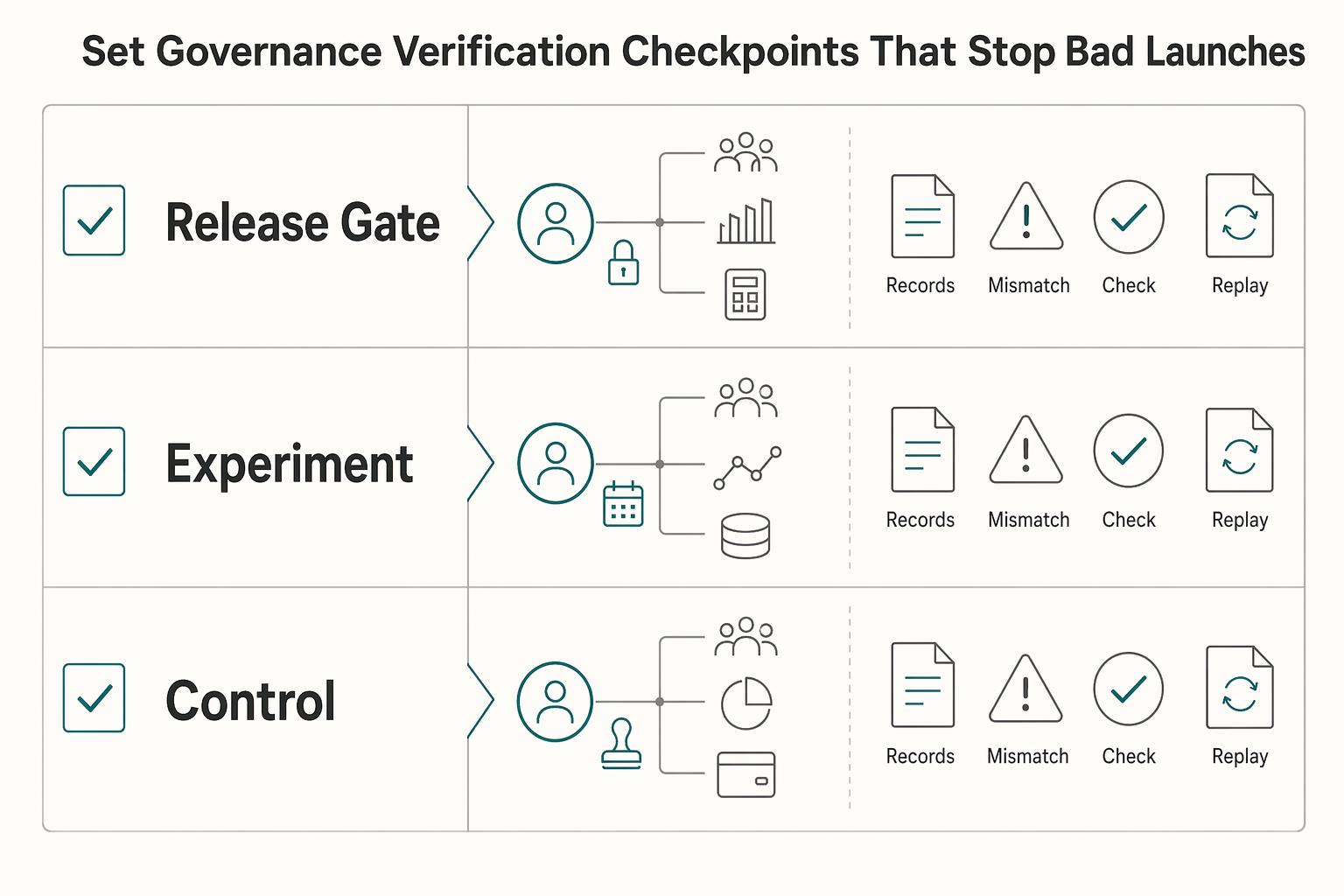
Use instrumentation as a launch gate, not a reporting afterthought. If product, finance, and engineering cannot trace the same path from billing event to entitlement outcome, hold rollout.
Step 1. Define a KPI tree that supports release decisions#
Build a small KPI tree tied to the decisions you expect to make early, then keep ownership clear.
- Track: meter-to-register conversion, register-to-paid conversion, failed renewal recovery, ARPU, LTV, and churn after bundle changes.
- Assign one owner and one primary event source per metric.
- Reconcile a daily sample from raw events through invoice, payment state, entitlement grant, and current access.
This is not about proving industry benchmarks. It is about spotting where the funnel breaks when you change meter rules, pricing, or bundle packaging.
Step 2. Gate rollout with explicit prelaunch checks#
Set explicit pass/fail checkpoints before full rollout.
- Entitlement accuracy tests
- VAT invoice validation
- Simulated Dunning outcomes
Define pass criteria for your own catalog, jurisdictions, and access policies. Test split-state failures on purpose, because invoices can be right while access is wrong, and access can remain active while Dunning has already advanced.
Step 3. Scenario-test high-risk flows and share one source of truth#
Run scenario tests for Gift subscription, Partner bundle, and downgrade flows before launch. Confirm who pays, who gets access, how proration appears, and when access changes, then make sure support views and entitlement logs show the same timing.
Publish source-of-truth dashboards for product, finance, and engineering that point to the same underlying identifiers. Include dashboard links, sample contract IDs, invoice references, entitlement snapshots, and expected outcomes so disputes can be resolved quickly.
Handle common failures without revenue leakage#
Treat failure recovery as an access-control decision tied to billing evidence, not a one-off support fix. Your objective is to restore only access that is still supported by the subscription record and current payment state, especially if your stack includes disjointed systems, manual workarounds, or legacy infrastructure where data inconsistencies are more likely.
| Scenario | Verify | Control point |
|---|---|---|
| Gift subscription mismatch | Billing and account records: order reference, account identity data, payment or invoice status, and current entitlement state | After identity records are corrected, re-check entitlements so access reflects the updated account state |
| Multi-title bundle or Household plan canceled or changed | What should be active against what is currently active, using catalog rules, billing status, and entitlement snapshot | Do not remove valid access or leave paid-only access active without support |
| Dunning too aggressive | Payment state and retry outcomes | Use a short Grace period that stays policy-bound; log entitlement changes and make them reversible when recovery fails |
Step 1. Resolve Gift subscription redemption mismatches with verified account data#
For a Gift subscription mismatch, start by verifying the billing and account records before you change access. Keep recovery tied to the same core records each time: order reference, account identity data, payment or invoice status, and current entitlement state.
After identity records are corrected in your normal workflow, re-check entitlements so access reflects the updated account state. The control point is consistency across your billing record, entitlement record, and customer-facing access.
Step 2. Reconcile bundle access changes before restoring entitlements#
When a Multi-title bundle or Household plan is canceled or changed, compare what should be active against what is currently active before you restore anything. In practice, use your catalog rules, billing status, and entitlement snapshot together so you do not remove valid access or leave paid-only access active without support.
This is where leakage often appears first in operations with fragmented tooling. A quick restore can solve the immediate ticket while creating long-tail entitlement debt.
Step 3. Use policy-bound grace for Dunning recovery, not open-ended exceptions#
If Dunning is too aggressive, a short Grace period can protect retention during temporary payment issues, but it should stay policy-bound. Tie grace handling to payment state and retry outcomes, and make sure entitlement changes are logged and reversible when recovery fails.
Avoid repeated manual exceptions as a normal path. If support keeps bypassing policy, fix the billing-to-entitlement handoff so recovery is consistent and auditable.
Roll out in phases with clear ownership#
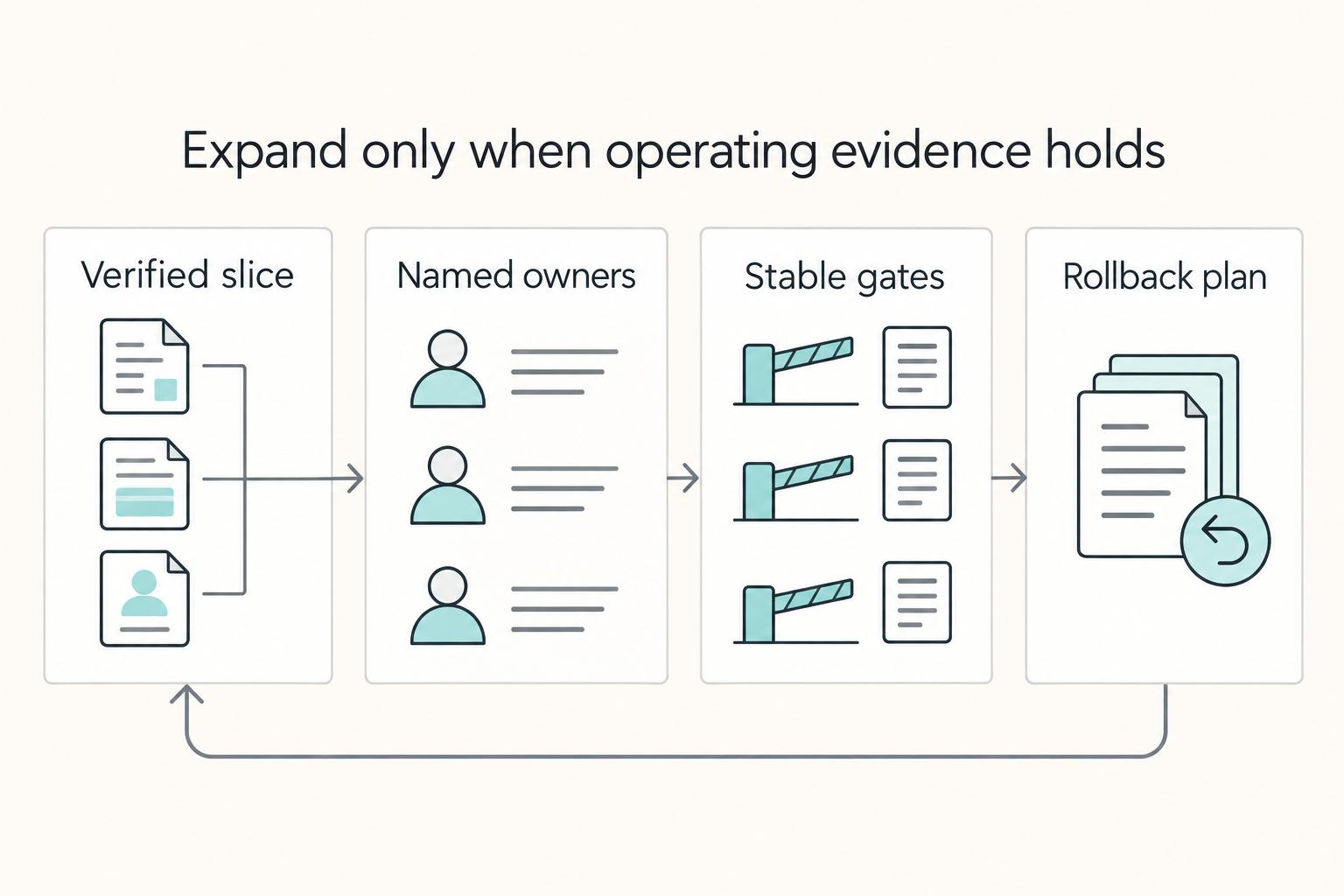
Roll this out as a controlled expansion, not a big-bang launch. Start with a narrow slice you can observe end to end, then expand only when the evidence shows the model is holding under real traffic.
Step 1. Start with one low-ambiguity slice you can verify end to end Pick an offer and audience slice where your access rules are straightforward to validate. Your checkpoint is simple: invoice state, payment events, and entitlement state agree for the same contract across web, app, and support views. If support is still fixing access by hand, hold expansion until those gaps are addressed. Recurring-billing transitions often expose disjointed systems, manual workarounds, and data inconsistencies first.
Step 2. Assign clear owners by decision area Do not leave policy calls to a committee. Define one accountable owner per decision area, including access policy, billing controls and reconciliation, and event processing plus observability. Keep teams on one scoreboard with shared stage KPIs and guardrails rather than separate success definitions. Document who approves grace exceptions, catalog edits, and paywall rule changes before launch day.
Step 3. Expand only when gate criteria stay stable Set progression rules in advance and use the same checks every phase. Require stable checkpoint results, support volume within your planned tolerance, and clean finance reconciliation before you broaden scope. Review evidence packs, not anecdotes: entitlement test outcomes, ticket patterns by failure mode, payment retry outcomes, and event-log completeness.
Step 4. Prepare rollback before changing pricing objects or paywall logic Version pricing objects and access rules so you can revert configuration cleanly if needed. Freeze nonessential catalog changes during each phase, and keep a pre-change snapshot of product IDs, entitlement mappings, and active contract counts. Treat it as a red flag if access is restored but renewal pricing or entitlements are no longer consistent for active accounts.
Conclusion#
Winning with paywalls is rarely about choosing the most fashionable access model. It comes from making one commercial decision and applying it consistently across the paywall and subscription operations. If those pieces do not match, friction usually shows up in the customer journey first.
Step 1. Finalize the model before you add complexity. A metered paywall or other paywall model can work in the right context, but each one creates different access and packaging rules. Your verification point is plain: the paywall, offer setup, and pricing page should describe the same offer in the same words. If you are still debating what counts toward the meter, do not launch bundles yet.
Step 2. Prove a clear path from payment to access. The most important operating standard is not clever pricing. It is whether your team can follow subscriber context and resolve issues without guesswork. A single customer view and centralized back office are useful here because they reduce barriers to purchase and support a more streamlined front-end experience. The failure mode is easy to spot: subscribers hit confusing handoffs between checkout and access.
Step 3. Expand only after core flows behave the way you wrote them. Reuters Institute material cited earlier supports the commercial case that payment for digital news is rising, but it also shows the ceiling is not universal. In that excerpt, 10% have paid in some digital form, with future willingness to pay at 14% overall and 19% among heavy news consumers. That is a reminder to keep the transaction flow smooth before adding more offer complexity. If core renewal or access messaging is still producing reader confusion, hold off on adding curated bundles or multi-offer promotions.
A final caution on benchmarking: one publisher example cited in the research projects $4.5 million in 2025 revenue entirely from subscriptions, with more than 14,000 paying subscribers at roughly 499 NZD per year. Treat that as evidence that subscriptions can work, not as a target you can copy into a board deck.
If you are close to launch, use this checklist before you scale:
- Paywall model and meter rules documented
- Offer and pricing language consistent across paywall and checkout
- Single customer view and back-office ownership defined
- Paywall flow reviewed for transaction friction
- KPI dashboard live for conversion, recovery, and churn signals
- Rollback criteria documented before pricing or paywall changes go live
If you can keep the paywall flow smooth, reduce barriers to purchase, and maintain clear operational visibility, bundles become more manageable growth tools instead of expensive exceptions.
Related reading: How to Calculate and Manage Churn for a Subscription Business.
Frequently Asked Questions
What is the practical difference between a Metered paywall and a Freemium paywall for billing and access control?
A Metered paywall lets readers consume a limited number of articles or visits in a set period before asking them to subscribe. In a freemium context, users typically encounter a paywall when they try to access full functionality. In practice, metered access is usage-limited over time, while freemium access is split between free and paid experiences. Exact billing, counter, and entitlement implementation rules are not defined at this level and remain your own design decision.
How should teams decide meter size when benchmarks differ across sources like Zuora and publisher case studies?
Do not copy a public number just because a large publisher uses it. The source guidance here supports the model, not a universal threshold, so your meter size should be a tested commercial choice tied to your own conversion funnel and audience mix. At minimum, document one reset window and exactly what actions count toward the meter. A validated benchmark meter size is not documented here.
How do bundles change entitlement design for Print-and-digital bundle, Partner bundle, and Team plan offers?
Contract-level entitlement rules for print-and-digital, partner, or team bundles are not established. Treat bundle entitlement design as a policy and contract-definition task you must document before launch. Your checkpoint is a contract-to-entitlement matrix that support can read without guessing.
What is the cleanest way to run a Gift subscription without creating identity conflicts?
Validated gift-subscription identity resolution mechanics are not established. Define and document how purchaser and recipient identities are handled from purchase through redemption, then test those flows before launch. A practical red flag is any flow that creates identity conflicts and later requires manual support correction.
Where do most implementations break first in Subscription billing for media publishers?
The source guidance does not identify one universal first break point. It does support a broader implementation reality: a paywall rollout is an organizational shift, not just a software purchase. Given that gap between paywall adoption and thriving digital revenue in the cited material, treat operating model and ownership clarity as core implementation work, not an afterthought.
How should Proration, Grace period, and Dunning work together during upgrades, renewals, and failed payments?
One validated rule set is not established, so this is a policy decision you must document precisely. Define triggers, state transitions, and customer-facing behavior for proration, grace period, and dunning in one place. Your verification point is simple: after an upgrade, renewal failure, or recovery payment, invoice state, payment event, and entitlement state should still agree for the same contract.
Try a related tool
Researched and edited by the Gruv editorial team. Gruv builds cross-border billing, payouts, and finance-operations software for global businesses.
Sources
Includes 2 external sources outside the trusted-domain allowlist.
- courses.cs.washington.edu/courses/cse143/25au/homework/dictionary.txttrusted
- etd.ohiolink.edu/acprod/odb_etd/ws/send_file/sendtrusted
- oag.maryland.gov/resources-info/Pages/security-breach-notices...trusted
- snap.berkeley.edu/project/12316474trusted
- sos.wa.gov/_assets/legacyproject/pressing-on.pdftrusted
- stripe.com/resources/more/how-to-create-a-subscription-...trusted
- aalpha.net/blog/how-to-monetize-ai-agentsexternal
- drupal.org/docs/contributed-modules/commerce-recurring-...external
Educational content only. Not legal, tax, or financial advice.
Related Posts
Media Subscription Billing Decisions for Paywalls, Metering, and Bundling
**A metered paywall is only a good business decision if your billing operations can support it.** For platform founders, the real question is not whether reader revenue sounds attractive. It is whether digital publishing subscription billing and paywall metering can survive the messy parts of launch: failed renewals, entitlement sync, invoicing, tax treatment, and local payment movement.
Choosing Publishing Subscription Paywall Models by Market Fit
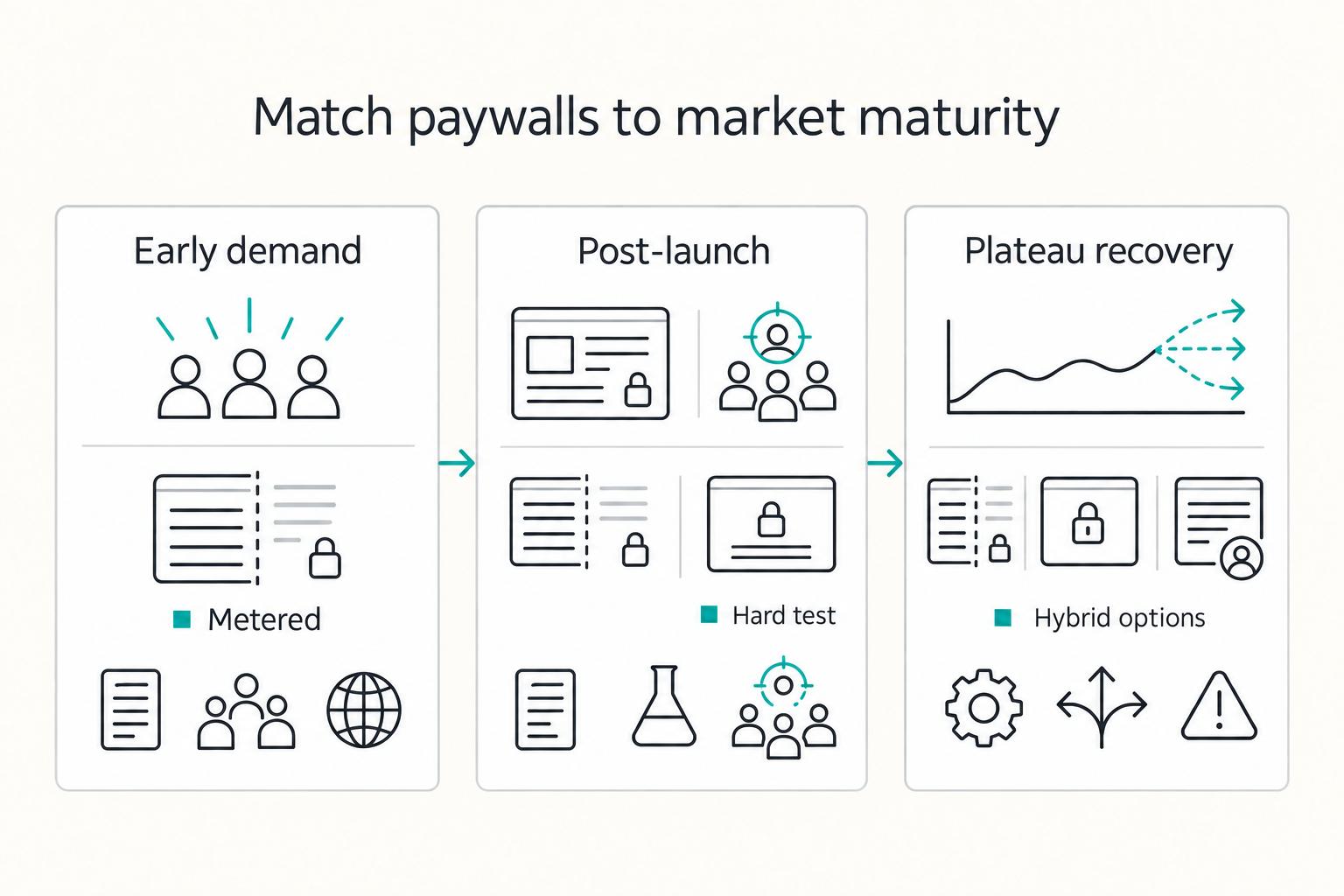
Treat paywall choice as a market-entry decision, not a pricing tweak. If you are deciding where to put product and GTM effort, the first question is not which model sounds strongest on paper. It is whether the target market shows enough reader demand, trust, and subscription maturity to support the access rules you plan to enforce.
How OTT Platforms Handle Billing Trials and Churn in Streaming Subscriptions
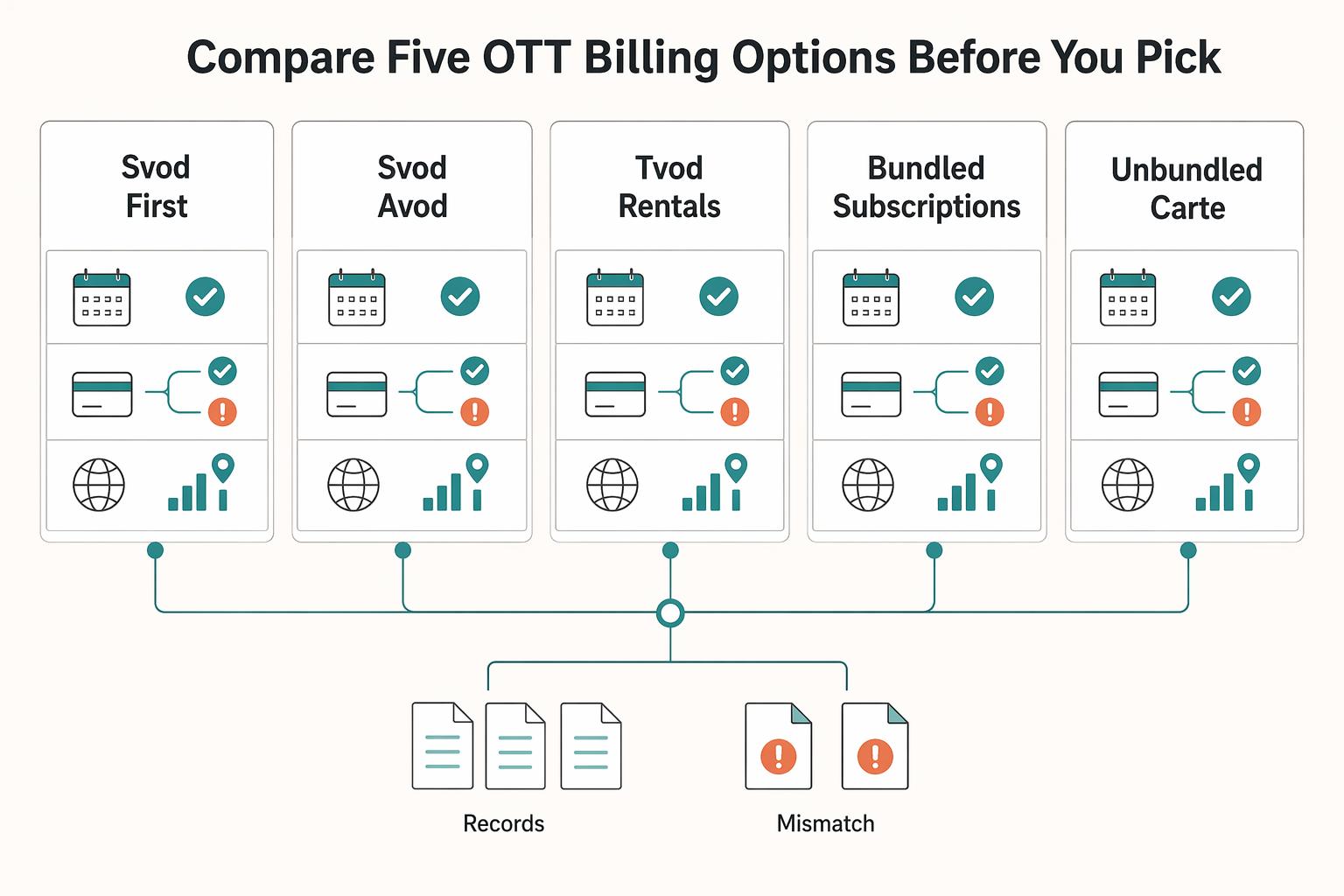
Start with the monetization model. Choose your monetization path before a product demo starts steering the decision. For a streaming offer, the real question is not which vendor can show subscriptions on a checkout page. It is whether your business is built around recurring access, ad-supported reach, one-off transactions, or a direct-to-consumer mix that may vary by market.