
Quick Answer
An ePayable replaces a mailed supplier check with virtual-card credentials tied to an approved B2B payment. Reuse, amount and expiry rules depend on the issuing program. Choose cards where acceptance and remittance work, eligible ACH where bank payments fit, and authorized checks as a constrained fallback. Resolve existing payment exposure before switching rails.
Why platform teams are replacing paper checks now#
Platform teams usually replace paper checks once payment speed, status visibility, and clean matching become operating requirements, not nice-to-haves. Checks still work in many workflows, but they can become a bottleneck as volume rises and control expectations tighten. If your team is still chasing check status by email, you are already paying the cost of that bottleneck.
A practical migration path is usually mixed, not absolute. If a supplier can accept card payments, ePayables (virtual cards assigned to specific vendors) are often worth evaluating. If card acceptance is not workable but bank transfer is, ACH is a widely used digital rail and its network volume continued to grow in 2025. If neither rail is workable, checks can stay as an explicit exception. We recommend defining those routing rules before your team starts promising a digital-first rollout.
Evidence quality also varies across market-adoption claims. Some search coverage cites large growth projections tied to unnamed or thinly described studies, so those numbers should not drive your decision. The more reliable test is operational fit: which rail gives you usable controls, clearer payment records, and less ambiguity when finance matches the payment back to the invoice.
Before you expand any rail, verify three basics in your current AP flow. Make sure:
- Suppliers can actually accept the target rail.
- Payment status events can be matched to the original payment intent.
- Remittance detail lands in a format finance can use without manual rework.
This matters because moving funds electronically without a coherent evidence trail can still leave reconciliation gaps. The strongest case for moving beyond checks is not just digitization, but cleaner proof of what happened, when it happened, and how it ties back to the underlying bill.
What an ePayable is and how the payment object actually works#
An ePayable, often called Virtual Payables, is a digital AP payment method that replaces mailed paper checks with supplier-specific virtual card credentials tied to a vendor payment.
The payment object contains card credentials and a provider reference tied to an approved payment intent. Single-use, amount limits, reuse, expiration and partial-capture behavior depend on the issuing program; some programs permit one card account to cover several invoices. Validate the actual lifecycle rather than assuming a single authorization consumes every virtual card.
On the AP side, the trigger is usually an approved payment file. The core sequence is straightforward:
- AP approves the bill and sends the payment file to the provider.
- The provider issues virtual card credentials for that payment.
- The supplier processes the virtual card through its acquiring/processing arrangement. Track authorization, capture and settlement separately, and connect the provider references and remittance to the approved AP record.
- Reconciliation data flows back to ERP so the bill can be matched to the outcome.
The real checkpoint is the return path, not just card issuance. Because reconciliation data is part of the flow, make sure you can tie each payment back to the invoice, supplier, and internal payment record. If you cannot trace that path quickly, your team will feel the gap at close and in supplier support queues.
If you want a deeper dive, read What Are ePay/ePayables? How Platforms Replace Paper Checks with Virtual Card Payments.
Where paper checks break your AP workflow at scale#
At scale, paper checks tend to break your AP workflow after approval because key steps happen outside one reliable status trail. Your AP system can show a payment as approved while check creation, printing, mailing, deposit timing, and exception handling remain scattered.
The status gap starts right after approval#
A check batch creates multiple handoffs, and any one of them can introduce partial or delayed status. That is usually where the clean AP record starts to drift from what the supplier actually experiences.
- Check creation and printing
AP approves the bill, generates the check, and sends it to print. Those post-approval handoffs can leave status fragmented before the supplier is actually paid.
- Mailing
Paper-check delivery includes preparation, mail handoff, deposit and bank processing. Track each stage and its evidence in the AP record rather than treating issue date as receipt or settlement.
- Deposit and funds availability
A mailed check adds delivery, deposit and bank-availability steps. Record those timestamps and obtain the receiving bank’s applicable funds-availability terms rather than assuming one universal hold period.
- Exceptions and fraud
Checks can be altered, intercepted or misdirected. Use approved payee details, controlled issuance and an investigation path for missing or unexpectedly cleared checks.
The business cost is follow-up work, not just slower delivery#
Manual follow-up grows when finance must reconstruct payment, ERP and bank activity from separate spreadsheets. Measure investigation time and unresolved items in your own close process before choosing a replacement rail.
A simple checkpoint: for every check batch you still run, confirm you can pull check number, issue date, mail handoff date, amount, payee, and deposit or return status from one operating view without cross-team backtracking.
Digital traces change the control surface#
Digital rails do not remove every exception, but they give you a more consistent evidence chain. Check-heavy workflows often force reconstruction after the fact.
If you are seeing repeated "did it go out?" inquiries, month-end matching drag, or rising exceptions, treat checks as a fallback rail rather than a default. A practical advantage of virtual payables and other digital rails is clearer control visibility. Your team can verify what happened without as much spreadsheet-based backtracking.
How virtual cards compare with ACH payments and paper checks#
If you need high-control, high-visibility B2B payments, virtual cards are often a practical starting point. Use ACH where supplier card acceptance is weak, and keep paper checks as a narrow fallback.
Side by side tradeoffs#
| Method | Speed to delivery | Acceptance friction | Traceability | Exception handling | Reconciliation burden | Cost notes |
|---|---|---|---|---|---|---|
| Virtual Cards | Credentials are issued digitally; settlement timing is program- and supplier-dependent | Can be medium to high for some suppliers due to upfront card-acceptance cost concerns | Strong when each payment has distinct card credentials | Payment-level controls help isolate issues, but supplier processing failures still need routing | Often lighter when payment data and remittance map cleanly into AP records | Program-specific; no universal cost advantage should be assumed |
| ACH Payments | Batch electronic rail; Same Day ACH can deliver within the same business day when eligibility and cutoff conditions are met | Can be lower where suppliers prefer non-card methods and bank details are already set up | Good bank-entry traceability, but less payment-level granularity than one-time card credentials | Timing and processing exceptions still require review | Moderate; typically cleaner than checks, less payment-specific than virtual-card controls | Commonly positioned as efficient, low-cost batched processing, but exact pricing varies by provider |
| Paper Checks | Typically slower operational flow than digital rails | Can still work with suppliers that take checks | Less end-to-end visibility than digital rails | Return handling exists for unpaid checks, but workflows are labor-heavy | Manual handling burden is often higher than digital rails | All-in cost varies by process and is not universally disclosed |
Choose the rail from supplier acceptance, bank-account eligibility, control needs and actual pricing. Aggregate industry usage does not establish whether a particular supplier can receive your payment.
Where the control surface is different#
The key difference is not just speed. Virtual cards use card credentials, including an expiration date and security code, and commercial programs can tie payments to a specific supplier, amount, and expiration date. ACH, by contrast, sends instructions through a nationwide batch network to a bank account.
That difference matters in practice. If you need one payment to one supplier for one approved amount, virtual cards usually map to that intent more directly. If supplier coverage and lower card friction matter more, ACH is often the better route.
For any rail, your AP record should show payment method, supplier identifier, approval reference, remittance reference, provider or bank reference, send time, and final disposition.
Speed and exception handling are separate decisions#
Same Day ACH has a current $1 million per-entry limit and depends on eligibility, banking days and the operator/provider submission windows. Nacha’s rule effective September 18, 2026 requires receiving banks to make non-Same Day credit entries available for withdrawal by 9 a.m. in the RDFI’s local time on the actual Settlement Date. That is a receiving-bank availability rule, not a promise that every newly submitted instruction arrives the next day.
Checks have return and investigation paths, but handling can be labor-intensive. Virtual cards instead depend on the supplier’s ability to process the credentials and remittance. Test both processing and reconciliation in your supplier cohort.
Cost and practical default#
Avoid blanket cost rankings. ACH is generally a low-cost batched rail. Some suppliers discourage card acceptance due to upfront costs while card networks argue broader economic value can outweigh those costs. Do not assume one universal fee hierarchy applies across virtual cards, ACH, and checks.
Operationally, a practical default is to use virtual cards where payment-specific control, visibility, and cleaner matching matter most, route acceptance-constrained suppliers to ACH, and keep checks only when neither digital rail is workable.
Related: Virtual Credit Cards for Platforms: How to Issue Single-Use Cards for Contractor and Vendor Payments.
Decision rules for choosing virtual cards, ACH, or check fallback#
Use a strict if-then routing rule. Choose Virtual Cards (ePayables) first when supplier card processing and traceability are both viable. Choose ACH Payments when card acceptance is the blocker but bank rails are available. Use Paper Checks only as a temporary exception with a defined exit path.
If card processing works, route to ePayables#
Use ePayables where the supplier can process your issuing program’s virtual-card credentials and you need payment-level controls. Verify amount, reuse, expiry and partial-capture rules; single-use is a program configuration, not a universal property of every virtual card.
A supplier saying it accepts cards does not prove it can process your virtual-card flow. Test secure credential delivery, authorization/capture and remittance posting with a controlled cohort before broad rollout.
If cards fail but bank rails work, route to ACH#
If card acceptance is the constraint and bank payments are available, use ACH Payments. Nacha positions ACH as broadly reachable across U.S. bank and credit union accounts, with FedACH and EPN as the two national operators.
Preserve one approved business-payment record when changing rails. Before creating a replacement ACH or check payment, determine the original card outcome and resolve any outstanding authorization/capture or other exposure through supported procedures. A timeout is not proof that the original payment failed.
If neither digital rail is viable, allow checks as a constrained fallback#
Allow paper checks only when an approved payment has no workable digital route. Assign an owner, reason and re-review date; incomplete internal approval blocks every rail, including checks.
Every check exception should include a clear owner, reason, and re-review trigger in your AP workflow so the fallback does not become a permanent shadow process.
Governance rule before expanding fallback paths#
Set this as an internal governance rule: require finance, operations, and engineering sign-off before expanding any fallback path that reduces matching quality or visibility. If a route increases unreconciled items, manual follow-up, or off-system tracking, pause expansion and fix those gaps first.
Turn those if-then rules into a build-ready rail matrix with policy gates, retries, and status handling: Read the docs.
Implementation sequence for launching ePayables without operational surprises#
Launch in stages. Baseline your current rail mix, define the target AP workflow, and run a controlled pilot before broad rollout. That sequence can surface matching, enrollment, and event-model gaps early, before they become month-end failures.
Your outbound AP feed can be multi-rail, not single-rail, and integrated payables can route the same feed to checks, ACH, wires, or cards. Start by baselining vendor payments by rail, supplier, exception rate, and remittance complexity. Then segment suppliers into card-capable, ACH-capable, and check-only temporary cohorts.
Sequence the rollout before you build around edge cases#
Do not build around outliers first. Define the target-state AP workflow in operational terms before building anything. For each payment, document who approved it, which rail was chosen, what remittance payload will travel with it, which status events you expect, and how failed or expired payments will be handled.
For virtual-card flows, treat the payment object as more than an amount. It includes generated card credentials, card number, expiration date, and security code, tied to a specific B2B payment intent. Then run a pilot cohort large enough to generate real exceptions and small enough for end-to-end finance review.
Build the four artifacts that prevent rollout drift#
| Artifact | What it should contain | Why it matters |
|---|---|---|
| Payment method matrix | Supplier segment, default rail, fallback rail, approval owner, remittance rules | Prevents ad hoc routing and check creep |
| Supplier Enrollment checklist | Card-acceptance confirmation, remittance contact, ACH bank-detail validation path, first-payment confirmation steps | Keeps enrollment as a core implementation control |
| Electronic Payment File schema | Required fields, rail mapping, validation rules, retry behavior, provider references | Prevents malformed files and downstream posting breaks |
| Exception-routing SOP | Owner and evidence requirements for failed, expired, duplicate, or rejected payments | Keeps exceptions inside AP operations |
If your provider accepts raw ACH files, validate the applicable file and batch record structure before submission; provider API payloads have their own contract. Define approved destination/account validation for first use and changed details. Prenotes, micro-entries or commercial validation each have limits and do not automatically prove account ownership.
Make the event model resilient before finance sees it#
Persist one durable business-action identity and the supported provider idempotency key before sending. Reuse that identity for transport retries of the same action; a genuinely new approved payment action gets a new linked identity. Keep internal duplicate protection beyond provider key retention and investigate uncertain outcomes before a replacement send.
Persist verified webhook events before acknowledgement and retain their event-time facts. Use the current resource to reconcile operational status when needed, without rewriting historical events as current facts. Deduplicate deliveries and financial effects separately, and expose references, timestamps and unresolved outcomes in the finance view.
Set hard launch gates and country caveat ownership#
Do not go live until you pass matching tests for successful, failed, expired, and duplicated payment attempts across Virtual Cards and ACH. For ACH, include an end-to-end bank validation run, such as a production connectivity penny test, and confirm final status appears in the finance view, not only in engineering logs.
Document support boundaries and ownership. Capability is not universal across countries, bank setups, or provider programs, and coverage can vary within a single provider's product set. For each capability, record where it is supported, the last verification date, and who is responsible for periodic re-validation before routing live volume. See Virtual Cards for Contractors and the Real Cost of Getting Issuance Wrong.
Controls, audit trail, and compliance checks you need before go live#
Before go-live, make sure each payment can be traced from initiation to final disposition in both your records and your finance view. For each B2B Payment, you should be able to show who initiated and approved it, which rail was used, the provider reference, and the final disposition used in your AP Workflow.
Make each payment event audit-ready#
Treat each payment as a sequence of control events, not just one send action. Keep evidence for creation, approval, rail selection, provider submission, and final status so finance does not depend on manual reconstruction.
| Event | Evidence to keep | Why it matters |
|---|---|---|
| Payment created | Internal payment ID, supplier ID, amount, invoice references, initiating user or service | Proves payment origin and scope |
| Payment approved | Approver identity, approval timestamp, policy result, exception note (if any) | Proves the control gate was applied |
| Payment executed | Rail used, provider reference, provider connection/account, affected system/component | Connects internal records to external execution |
| Payment finalized | Final status, status timestamp, settlement/return reference, finance-facing record update | Aligns operations with close and exception handling |
Operational audit records should identify the affected payment, supplier, system, actor, decision and timestamp. Keep sensitive credentials out of those records; an audit event name alone is insufficient for reconstruction.
Set the logging floor before launch#
Define logging as a lifecycle process, not just event capture: generation, transmission, storage, access, and disposal. Before go-live, assign ownership for each step, where logs are retained, who can access them, and how they are retired.
A practical minimum is to log the initiator, approver if different, rail, provider reference, internal payment ID, status before and after, timestamp, and final finance-visible disposition. Retries and out-of-order provider events should still produce one coherent payment history.
Protect card data in logs and screens#
Mask card numbers in AP screens, reports, support tickets and operational logs, and restrict any approved credential access to the secure issuing/payment channel.
Do not copy CVC into operational logs, support tickets or ERP records. PCI guidance prohibits ordinary merchants/service providers from retaining it after authorization; legitimate issuer/issuing-support needs are a distinct role-specific case, not an automatic virtual-card exception. Use only the approved secure credential channel for the program.
Define proof for ACH exceptions too#
Apply the same evidence standard to ACH exceptions. Define when AP initiates a Payment Trace Request through the ODFI to the RDFI to confirm whether a payment was not received, returned, or posted.
Validate any ACH Company Entry Description dependency against your provider’s current entry-type requirements. Across all rails, require an exception evidence pack and the supported resolution before marking an item cleared.
Need the full breakdown? Read How to Build a Spend Control Policy for Virtual Cards on Your Platform.
Supplier enrollment strategy that improves supplier acceptance#
Supplier acceptance usually improves when you enroll by segment, not by mandate. Prioritize suppliers more likely to accept digital rails, then expand. Avoid forcing universal migration up front, because payer rail choice is constrained by what suppliers are willing or able to accept.
Use segmentation across three factors together: payment preference, remittance needs, and readiness for Virtual Cards versus ACH Payments. That gives AP a routing plan that fits supplier operations instead of forcing a one-size-fits-all rollout.
| Supplier segment | What to verify first | Best first rail | Why |
|---|---|---|---|
| Card-ready, high remittance complexity | Supplier can process card payments and has a contact who can receive remittance details | Virtual Cards | Invoice-level remittance detail supports supplier reconciliation |
| Card-resistant, bank-rail ready | Supplier declines card but can receive ACH and provide bank details through your approved process | ACH Payments | Keeps payments digital when card acceptance is low |
| Digital enrollment incomplete | Approved payment, confirmed check eligibility and approved payee details; no unresolved prior attempt | Temporary check fallback only when authorized | Pending internal approval blocks every rail; incomplete digital setup alone does not authorize payment |
Set the enrollment order before outreach starts#
Supplier Enrollment works best when each step has an owner and a completion check. Use a sequence like this:
- Outreach script
Lead with the payment change, supplier benefit, and required action. Supplier education is a key acceptance lever, so explain what they will receive, how remittance is delivered, and where to get help.
- Data collection
Capture operational details, not just yes or no: payment contact, remittance email, preferred rail, virtual-card processing readiness, and secure-email status. Check provider scope limits during this step, since some programs require enrolled suppliers in the United States.
- Credential routing
Route payment credentials to the right recipient and channel. In virtual-card flows, details may be delivered by email, and card data may be masked when secure email is not enabled.
- First-payment confirmation
Enrollment is not complete at send time. Confirm the supplier received remittance, can identify the invoices paid, and successfully processed or posted the first payment.
Remove the avoidable friction#
Clear remittance detail supports supplier reconciliation and can reduce enrollment friction. For virtual-card payments, the remittance should identify the specific invoices being paid, not only the amount and payer name.
Define fallback ownership and timing before launch. Reroute only an approved payment whose original outcome is known and whose outstanding authorization, capture or funds exposure has been resolved. Escalate uncertain outcomes instead of sending another rail in parallel.
An initial refusal need not end supplier enrollment. Re-engage after fixing its specific cause, such as remittance confusion, processing capability or wrong recipient routing. Preserve approval and original-outcome checks before any new payment.
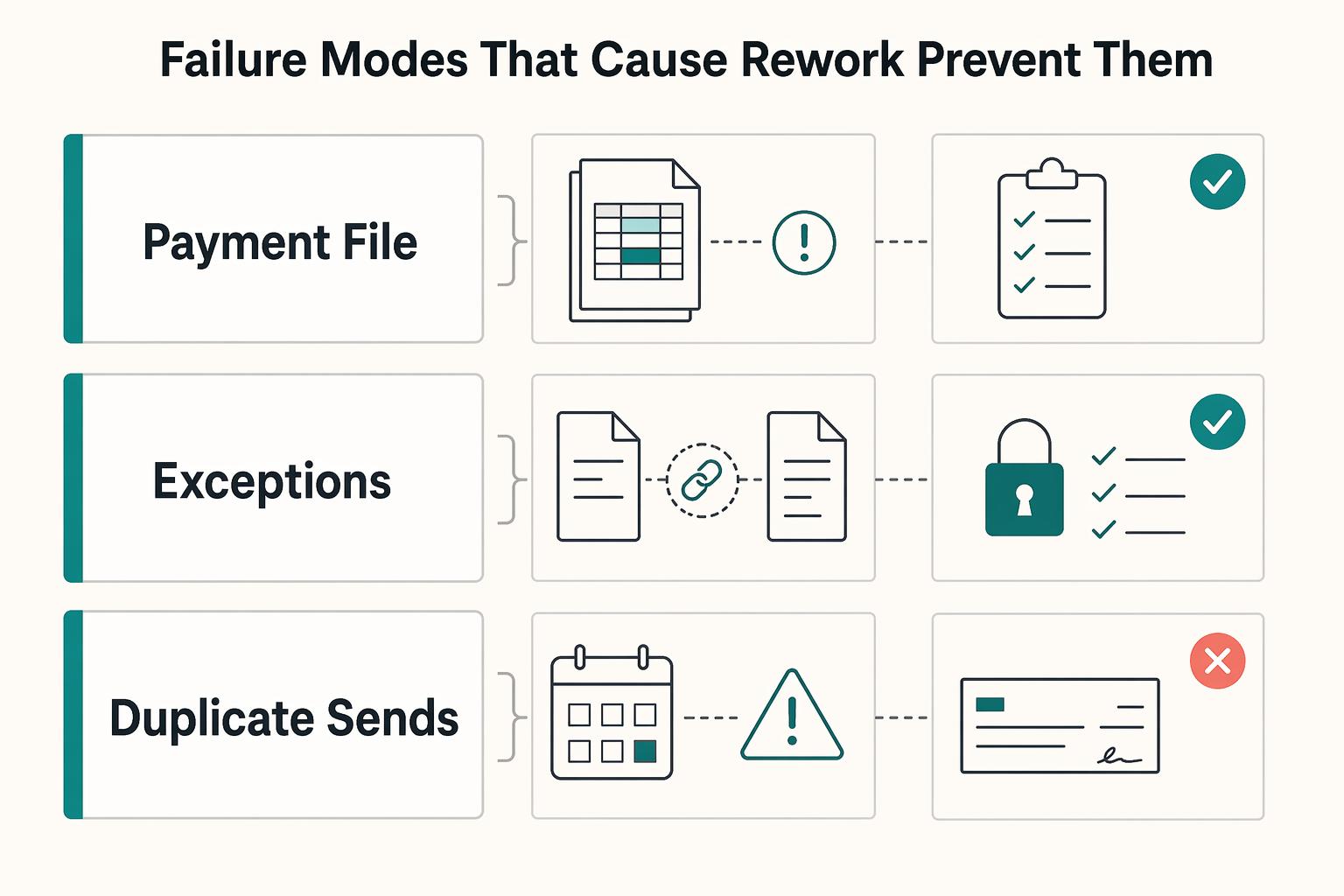
Failure modes that cause rework and how to prevent them#
A lot of cleanup work comes from execution drift, not just the initial enrollment decision. Prevent it by treating these four breaks as control points in your AP Workflow before they turn into support tickets.
| Failure mode | Preventive control | What to enforce |
|---|---|---|
| Payment-file schema or field errors | Schema validation before send | Validate payment files before submission so malformed fields are blocked early, especially for XML-based initiation files. |
| Mismatched supplier identifiers | Pre-send identity and destination checks | Match supplier, approved destination and changed bank details. Nacha’s WEB-debit validation rule applies to WEB debits at first use/change; it is not a universal supplier-credit ownership check. |
| Duplicate sends after retries | Idempotency keys | Persist durable financial-action identity; reuse supported provider key for the same transport retry and retain internal uniqueness beyond its expiry. |
| Unresolved payment exceptions | Supported outcome investigation and recovery | Resolve the original outcome and exposure before replacement. Use only operator/provider-supported eligible returns, reversals, refunds or cancellations; an internal rollback cannot undo executed money. |
Escalate rising check fallback, recurring disputes, unresolved credit returns and reconciliation gaps. If your program also originates ACH debits, monitor the applicable debit return rules separately; debit-network thresholds do not describe generic supplier ACH credits.
Metrics and reconciliation checkpoints for the first 90 days#
Your first 90 days should tell you whether the new rail mix is reducing work or just moving it around. Keep the metric set short, review it monthly, and treat reconciliation as a required control. Track four checkpoints:
- Method mix (count and value)
Track vendor payments by rail (for example, Virtual Cards, ACH Payments, and Paper Checks) by both count and dollar value. This makes migration visible and helps you separate real mix change from cosmetic volume shifts.
- Operational health in each reconciliation cycle
Monitor exception rate, time-to-resolution trend, and unreconciled-item count in each monthly reconciliation cycle. For ACH debits, include unauthorized and administrative return-rate monitoring as exception signals. At least monthly, compare records and ensure differences are investigated, resolved, and documented.
- Adoption quality, not just enrollment
Measure Supplier Acceptance by segment and repeat payment success after initial Supplier Enrollment. Treat enrollment as the start, not the finish: adoption quality shows up when payments process cleanly without repeated manual intervention.
- Monthly decision review
Run one monthly finance-ops-engineering review using the same evidence pack: rail mix, exception log, unreconciled-item aging, and enrollment cohort outcomes. For each segment, make an explicit call to expand, pause, or revert rail usage.
This pairs well with our guide on How Platforms Use Virtual Accounts to Reconcile Incoming Payments Per Client.
The fastest low-risk path to replace checks in B2B#
The fastest low-risk approach is selective replacement, not a blanket rail migration. Use ePayables where payment-level control and traceability solve a real AP problem, use ACH where supplier fit is better, and keep paper checks as a tightly governed fallback. We would rather see your team scale one clean routing rule than force every supplier onto the same rail.
Virtual Payables are strongest when each payment is tied to a unique virtual card account with supplier-specific amount and expiration controls. They also support cleaner posting when remittance detail and a unique payment identifier are carried in the transaction. If a supplier will not accept cards, ACH remains a core rail, including Same Day ACH for eligible payments up to $1 million.
What keeps this strategy low risk is execution discipline. Generic "go digital" plans can stall when method-selection rules are unclear, supplier enrollment starts too broad, or finance matching is treated as cleanup instead of a launch gate. We recommend treating finance matching as a launch requirement, not a post-launch cleanup exercise.
Use simple routing rules:
- card-capable supplier plus need for tighter control or cleaner audit trail: virtual card
- supplier declines cards but supports bank rails: ACH
- neither rail is available: temporary check with a named owner and sunset review
Run supplier enrollment in sequence, not all at once. Start with suppliers already able to process card payments, especially where remittance detail matters and check follow-up has been painful. Prove first-payment success and correct remittance application, then expand.
Before scaling, make matching a hard checkpoint. Confirm each payment record includes supplier ID, provider reference, remittance payload, timestamps, rail used, and final AP disposition. If your provider sends ERP finance files, test matching across success, failure, expiration, and duplicate-attempt scenarios.
Stop expansion if these signals appear:
- paper-check fallback rises after enrollment starts
- supplier disputes increase due to missing or unusable remittance data
- unreconciled items grow at month-end
- duplicate attempts appear from weak retry controls or bad supplier mapping
Next step: run a limited pilot with a controlled supplier cohort, apply card and ACH rules in production, and measure rail performance, exception load, and repeat-payment success after first enrollment. The goal is not "zero checks by a fixed date." It is reducing fraud exposure, manual follow-up, and close-process drag without creating a new supplier-acceptance bottleneck. We would rather see your team hold the rollout than widen it without clear evidence on exceptions and supplier fit. Before scaling beyond a pilot, confirm coverage, compliance gates, and operational ownership for your payout mix: Talk to Gruv.
Frequently Asked Questions
What is an e-payable virtual card in B2B payments?
An ePayable uses virtual-card credentials for an approved B2B supplier payment instead of mailing a check. Program-specific amount, expiry and reuse controls can improve payment-level traceability; not every virtual card is single-use or limited to exactly one authorization.
How does replacing paper checks with virtual cards work step by step?
After AP approval, issue the program’s virtual card and send credentials through the approved secure channel with remittance references. Track authorization, capture and settlement evidence. Webhooks are status signals whose content and state must be verified, not final proof merely because they arrived. Preserve durable action IDs and resolve unknown outcomes before a replacement payment.
When should we choose virtual cards over ACH payments?
Choose virtual cards when the supplier accepts your program and its controls fit the invoice. Use ACH for eligible accounts and supported supplier bank-payment routes. Same Day ACH currently permits eligible entries up to $1 million, subject to banking days and actual operator/provider windows; eligibility and timing must be checked for the specific payment.
When is it still reasonable to keep paper checks as a fallback?
Keep paper checks as a fallback only when suppliers cannot practically accept cards or ACH, or when a temporary enrollment gap would block a critical payment. Treat that fallback as explicit and controlled, not an open default. Checks are still used across firm sizes, but they remain the business payment method most often subject to fraud.
What are the first five implementation checkpoints for a platform team?
Start with a controlled sequence: baseline your payment mix, segment suppliers by card and ACH readiness, and define the payment and remittance data you need for reconciliation. Then add retry safety with idempotency keys. Before go-live, test webhook and internal status handling for success, failure, and retry scenarios so timeouts do not create duplicate payments.
How do we improve supplier acceptance without slowing down payments?
Start with suppliers ready to process the program and match remittance. For suppliers needing ACH, complete approved bank setup and payment authorization first. If a card attempt already exists, resolve its outcome and remaining exposure before changing rails.
What evidence should we keep for audit and reconciliation if rules vary by market/program?
Keep a per-payment evidence pack with initiator, rail, supplier, remittance, provider references, timestamps and verified AP disposition. Retain market/program enablement and validation records because capabilities and timing vary. Mask PAN in AP operational screens, logs and support records, and keep CVC out of those records. Ordinary merchants/service providers cannot retain CVC after authorization; legitimate issuer/issuing-support needs have separate role-specific treatment. Use only the issuing program’s approved secure credential channel, and never infer that virtual cards alone create an exception.
Researched and edited by the Gruv editorial team. Gruv builds cross-border billing, payouts, and finance-operations software for global businesses.
Sources
- csrc.nist.gov/pubs/sp/800/92/r1/ipdtrusted
- department.va.gov/financial-policy-documents/financial-documen...trusted
- federalreserve.gov/paymentsystems/frps-dfips-cy-2021.htmtrusted
- federalreserve.gov/paymentsystems/fedach_about.htmtrusted
- guides.gaoinnovations.gov/greenbook/2025/principle-16-perform-monitori...trusted
- helpwithmybank.gov/help-topics/bank-accounts/funds-availability...trusted
- ic3.gov/PSA/2025/PSA250127trusted
- public-inspection.federalregister.gov/2025-22272.pdftrusted
Educational content only. Not legal, tax, or financial advice.
Related Posts

The Freelance Payment Penalty: A Modeled Audit of Platform Fees, FX Spreads, and Payout Delays
The money rarely disappears through a single, easy-to-spot fee. The real loss is stacked. A marketplace takes its commission, a processor adds a charge for international cards, a bank or payment company converts the currency at a spread, a platform holds the funds before release, and a wire sheds a little to intermediaries on the way in. Each layer looks defensible on its own, but the worker feels the combined result as a smaller deposit and a later payday.

How to Respond to a Subpoena for Business Records
Move fast, but do not produce records on instinct. If you need to **respond to a subpoena for business records**, your immediate job is to control deadlines, preserve records, and make any later production defensible.
A US Expat's Guide to Investing in UCITS ETFs to Avoid PFIC Issues
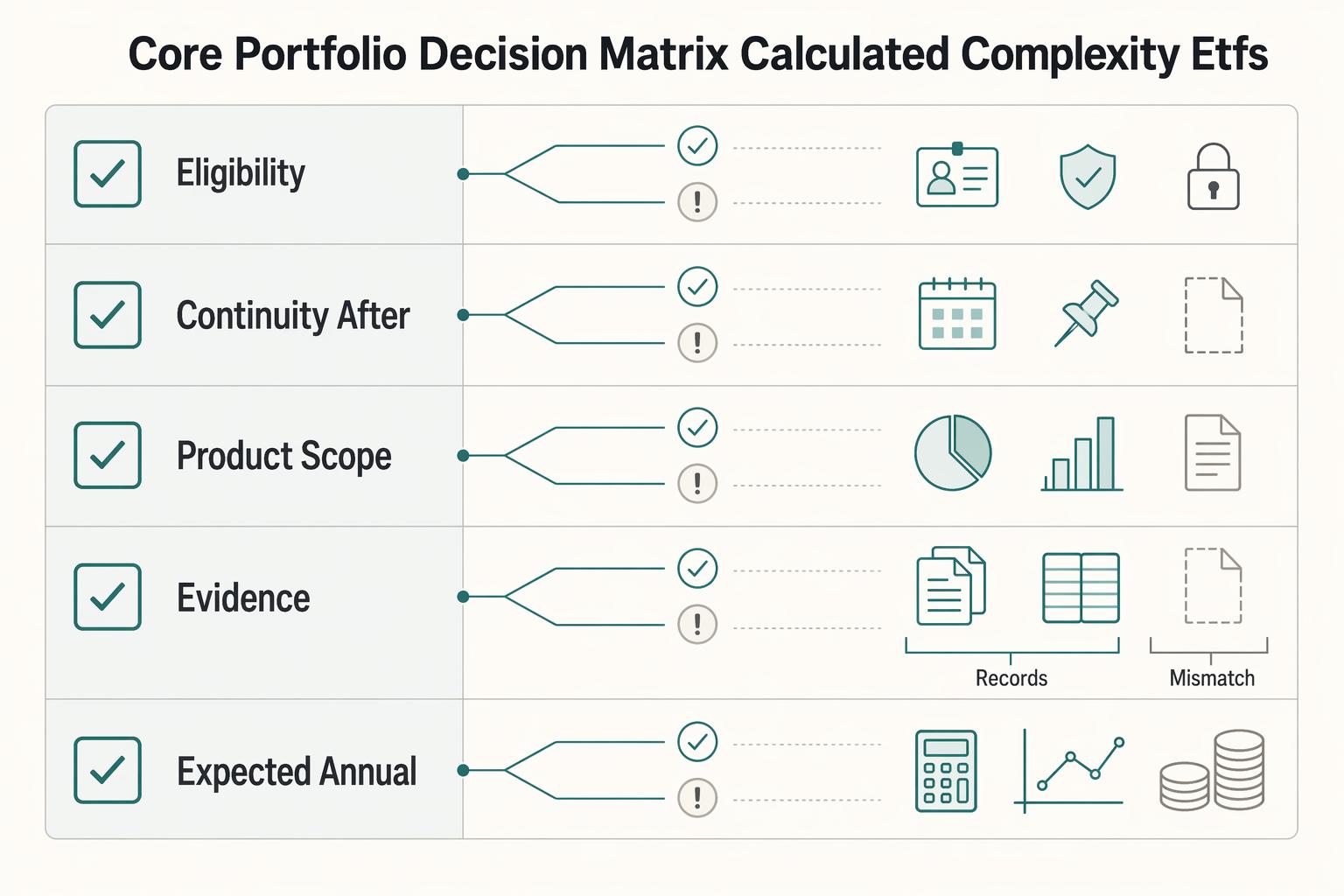
The real problem is a two-system conflict. U.S. tax treatment can punish the wrong fund choice, while local product-access constraints can block the funds you want to buy in the first place. For **us expat ucits etfs**, the practical question is not "Which product is best?" It is "What can I access, report, and keep doing every year without guessing?" Use this four-part filter before any trade: