
Quick Answer
Platforms should collect Form W-8BEN-E from foreign entities, not individuals, and hold payout until the form, payee type, and withholding position all align. They should validate core identity, Chapter 3 and Chapter 4 status, and any required U.S. TIN, FTIN, or GIIN, then reroute or escalate cases that point to W-8ECI, W-8IMY, W-8EXP, or Form 8233. Without valid documentation, the default baseline is generally 30% withholding from the gross amount paid.
What Platforms Need to Collect and Review#
Treat Form W-8BEN-E collection as a payout control, not a paperwork task. If you are the withholding agent, you generally must obtain valid documentation before payment. Without it, IRS guidance says you generally must withhold 30% from the gross amount paid to a foreign payee.
This guide gives compliance, finance, and risk teams a practical way to handle intake controls, validation checks, and escalation decisions for foreign business entities. The core routing rule is simple: Form W-8BEN-E is for foreign entities, while individuals generally use Form W-8BEN. If you run onboarding at scale, you need a route that tells your team what to collect, what to validate, and when to stop payout release. We recommend ending intake with one form path and one named owner.
Start by confirming who actually has control, custody, receipt, disposal, or payment of the income, because that party is treated as the withholding agent. Then confirm the payee is on the correct form and that the documentation is valid before payout release. the form is given to the payer or withholding agent, not filed with the IRS. Maintain your records and decision trail internally.
Scope: this guide focuses on foreign business entity form routing and operating controls in high-volume cross-border payouts. It does not replace legal or tax advice on entity-specific outcomes, and IRS FAQ guidance can support operations but is not legal authority.
Scope and prerequisites before you collect W-8BEN-E#
Set ownership and documentation rules before intake opens. If you cannot reliably tie each payment in your flow to valid tax documentation, you stay at the default 30% withholding baseline.
Assign accountable roles before go-live#
Name the withholding agent in policy and in the payout flow, not just in org charts. Under 26 CFR 1.1441-7, that is the person or entity with control, receipt, custody, disposal, or payment of the income, and that role carries withholding deposit obligations. As an internal control, define review responsibility and payout-stop authority before launch.
Build the minimum evidence stack around IRS form fields#
Capture the legal name of the organization that is the beneficial owner, country of incorporation or organization, Chapter 3 status, and Chapter 4 status where required. Include the tax ID fields you need downstream, especially U.S. TIN and FTIN handling, along with the treaty and beneficial-owner facts that can change withholding treatment. If you store these fields in one free-text bucket, you make downstream validation harder.
Set data controls before the first submission#
If you collect U.S. TIN or FTIN data, decide up front how those fields are displayed and access-controlled. IRS guidance allows truncation of payee identification numbers on statements, but that guidance does not by itself define your internal storage model, so treat masking and access design as explicit control decisions.
Define escalation ownership for unclear tax interpretation#
Define escalation ownership for questions that could change withholding treatment, and set that handoff before launch so unresolved files can be held until tax information is clarified. Track renewal dates, because a valid form generally expires on the last day of the third succeeding calendar year unless a change in circumstances makes it incorrect.
Route the payee to the right IRS form on day one#
Get routing right at intake, then hold payout until the form type and entity classification tell the same story. If you start your team on the wrong path, later checks are harder to unwind.
Map the payee by identity and claim#
Map the payee by who they are and what they are claiming, not by which PDF they uploaded. Use the table below, then end the step with one provisional form path and one clear reason code in the case record.
| Intake fact pattern | Initial route | Verify before acceptance |
|---|---|---|
| Foreign entity claiming beneficial owner status | Form W-8BEN-E | Not an individual, and facts support beneficial owner status |
| Foreign individual claiming beneficial owner status | Form W-8BEN | Natural person rather than an entity |
| Foreign person claims Effectively connected income (ECI) | Form W-8ECI | Claim is for U.S.-source income the payee says is effectively connected with a U.S. trade or business |
| Foreign intermediary or foreign flow-through entity | Manual review for Form W-8IMY path | Payee may be acting for others or passing income through to underlying payees |
| Specific exempt or reduced withholding organization category | Form W-8EXP | Category matches W-8EXP scenarios such as foreign government, international organization, or foreign central bank of issue |
| Nonresident alien individual claiming exemption on compensation for personal services | Form 8233 | Individual-only scenario tied to compensation for personal services |
Add branches for special categories early#
Add explicit branches for lower-volume, high-impact categories so they do not get forced into the standard entity flow.
Form W-8EXP is not a general special-entity form. It is for specific foreign organization categories claiming reduced or exempt withholding treatment. Form 8233 is for nonresident alien individuals claiming exemption on compensation for personal services, so it does not belong on an entity onboarding path.
Stop auto-approval when facts suggest intermediary behavior#
If the facts suggest intermediary behavior, stop auto-approval and route to manual review for W-8IMY confirmation. IRS describes intermediaries as agents for others, and W-8IMY is used by foreign intermediaries and foreign flow-through entities. If you see pass-through behavior, you should stop automation and move the file to manual review.
Use this trigger set: the payee says it receives funds for someone else, allocates payments onward, operates as a broker or nominee, or presents as a partnership, trust, or other pass-through arrangement. In those cases, collect the additional accompanying information needed to reliably associate payments to underlying payees.
For QI status, determine QI vs NQI from the intermediary's Form W-8IMY representations. For WP and WT labels, confirm the intermediary has the relevant withholding agreement with the IRS. Do not infer those statuses from sales communications or portal labels alone.
Check form type against entity classification before release#
Apply a do not proceed checkpoint before payout release. Your selected IRS form and your payee's entity classification should agree.
Practical examples:
- A company should not clear on Form W-8BEN.
- An individual should not clear on Form W-8BEN-E.
- A claimed beneficial owner that also acts for underlying account holders should not clear without intermediary review.
- A foreign entity claiming ECI should route through Form W-8ECI, not a standard entity form.
If your legal person type, beneficial-owner versus intermediary posture, and your selected IRS form conflict, hold the file and route it to exceptions.
Related: How to Fill Out Form W-8BEN-E for a Foreign Company.
Build the minimum W-8BEN-E intake packet#
Keep the packet as lean as possible, but complete enough to support the withholding and reporting decision. This packet is for entities, while individuals use Form W-8BEN. Collect the fields that change treatment first, then add only the identifiers and support needed to rely on the form. If you want fewer escalations later, collect only the fields that change treatment and make each one visible to the next reviewer.
Start with the fields that determine treatment#
Start with the core fields that determine treatment: beneficial owner name, country of incorporation or organization, Chapter 4 status, and whether a treaty claim is being made.
These fields drive review outcomes, not just form completeness. If any are missing, reviewers may need to infer withholding posture from free text or attachments. Before you move to identifier checks, confirm the names across your tax profile, the form, and the payout account are internally consistent. If they are not, hold for review.
Collect identifiers by type, not in one generic field#
Collect identifiers in separate fields, not one generic tax ID field. U.S. TIN, FTIN, and GIIN serve different purposes and are not universally required for every entity.
| Identifier | When used | Handling |
|---|---|---|
| U.S. TIN | Treaty claims | Collect in a separate field; treat missing U.S. or foreign TIN data as a blocker unless a valid exception is documented |
| FTIN | Line 9b and treaty claims | Support line 9b and the line 9c "FTIN not legally required" path so users do not enter placeholders |
| GIIN | When Chapter 4 status requires it | Capture in a dedicated field, validate the expected 19-character format, and apply GIIN verification against the IRS FFI list where required |
Build the UI to support line 9b, the line 9c "FTIN not legally required" path, and GIIN collection only when the selected Chapter 4 status requires it. For treaty claims, treat missing U.S. or foreign TIN data as a blocker unless a valid exception is documented.
Separate mandatory items from conditional items#
Separate mandatory items from conditional items in both policy and the intake UI so teams do not over-collect. Use the list below, and make sure every conditional item maps to a concrete trigger in the file.
| Item | Requirement | Trigger |
|---|---|---|
| Completed Form W-8BEN-E | Mandatory | All entity submissions |
| Core identity and Chapter 4 status fields completed | Mandatory | All entity submissions |
| U.S. TIN or FTIN | Conditional | Treaty claims, subject to exceptions |
| GIIN | Conditional | When the selected Chapter 4 status requires it |
| Attached line 9a or 9b details | Conditional | When GIIN or FTIN does not fit the form field |
Use the table above to drive both policy and UI logic. Over-collection can slow onboarding and weaken review quality. Build records that support internal validation, payout gating, and audit review, since the form is provided to the withholding agent or payer rather than sent to the IRS.
Validate tax identity fields before payout approval#
Run validation in two passes before release: deterministic field checks first, then cross-field consistency. If a required identifier or status is missing, do not infer intent from notes or emails.
Run deterministic checks before judgment#
Check presence and completeness for the fields that drive treatment on the form. That includes beneficial owner name, country of incorporation or organization, Part I Chapter 3 status with one box selected, and Chapter 4 status where required. If a treaty claim is being made, make sure it is explicitly stated.
Apply identifier checks by context, not as one universal rule. GIIN is conditional: some Chapter 4 cases can be accepted without a GIIN on line 9a, while other cases require obtaining and verifying GIIN against the IRS FFI list. Record the verification result in the file.
For tax ID fields, confirm entries are handled under your policy and placed in the correct fields. Treat line 9c, "FTIN not legally required," as a distinct exception path, not as a missing FTIN.
Compare fields that should agree#
A complete form can still be unreliable. Compare country of organization with the treaty claim, and route mismatches to review instead of auto-approval.
Also compare beneficial owner status, entity type, and the selected form path. Because the form documents foreign entity status for Chapter 3 and Chapter 4 purposes, conflicts across those declarations should stop approval until the form path is rechecked.
Apply one missing-identifier rule consistently#
Use one decision rule across cases. If an identifier is missing but optional in context, place the file in a documented exception state for review before payout. If the identifier is required for the status or claim, reject and request correction.
Incomplete documentation can create unknown-recipient risk, which is tied to withholding at the maximum applicable rate. The opposite error is rejecting every blank GIIN or FTIN field even when an allowed exception applies.
Log a clear, reviewable decision trail#
Once the field checks are done, make the file understandable to the next reviewer, auditor, or operator. Forms W-8 are retained records rather than routine IRS filings, so the file should show exactly how the decision was reached. If you want the next reviewer to agree with you, leave a record that shows exactly why you accepted or held the form.
Log each outcome with enough detail to explain the path taken, including the issue type, such as missing required GIIN, line 9c FTIN exception, treaty-country mismatch, or form-path inconsistency.
Before you approve payout, confirm the file contains the submitted form, relevant support or exception notes, GIIN verification results where applicable, and a final accept, reject, or hold decision.
For a step-by-step walkthrough, see How to Choose a Tax Preparer for Your Freelance Business.
Review treaty claims and FATCA status without overreaching#
After identity fields clear, ask whether the tax position is reliable enough for you to apply, not just store. Accept treaty and FATCA claims only when the form is complete, internally consistent, and supportable for withholding reliance.
Treat treaty claims as approval decisions#
A treaty claim is not self-proving because a box was checked. For treaty benefits, validity depends on core elements such as treaty-country residence, beneficial-owner status, LOB-related conditions, and the TIN condition for reduced withholding.
Check the claim path on the form. If the entity indicates it is a hybrid making a treaty claim, Part III must be completed. If the treaty country conflicts with the country of organization, or required TIN information for reduced withholding is missing, do not apply the treaty rate until the issue is resolved.
Verification point: your file should clearly show treaty country, beneficial-owner attestation, TIN status, and completion of required treaty-related sections without contradiction.
Review Chapter 3 and Chapter 4 together#
Read Chapter 3 and Chapter 4 declarations as one decision set. The form documents foreign entity status for both using separate classifications, so a clean Chapter 3 position can still fail if Chapter 4 status is incomplete or inconsistent.
Do not let one chapter drive the decision alone. If Chapter 4 status is unreliable, you do not have a stable basis for final withholding treatment. Chapter 4 can require 30% withholding in certain cases when qualifying status cannot be relied on.
Verification point: Chapter 3 entity type, Chapter 4 status, and the overall form path should tell one coherent story for the same entity.
Use provisional status only when withholding is unchanged#
Provisional acceptance is useful only when the open item does not change the withholding treatment you would apply now. In practice, that can mean accepting the form as foreign-entity documentation while holding treaty benefits pending correction of missing or unclear treaty items.
Do not apply treaty rates when unresolved issues could change withholding or when you have reason to know a claim may be ineligible. That includes contradictory Chapter 3 and Chapter 4 declarations, missing TIN information tied to a reduced treaty rate, incomplete Part III for a hybrid treaty claim, or doubtful treaty-country or beneficial-owner facts.
Separate internal validation from legal interpretation#
Know where operational review ends and legal interpretation begins. Your internal checks should cover completeness, consistency across country and status fields, required identifiers, and whether the form includes the parts required for the claim made.
Escalate questions that require legal interpretation, including LOB analysis, treaty-text interpretation, ambiguous beneficial-owner facts, or Chapter 3 and Chapter 4 conflicts that could materially change withholding. IRS treaty tables are useful, but not a complete guide, so if the form and treaty reference do not align cleanly, pause and route to tax counsel.
Verification point: each escalation packet should include the submitted form, validation notes, the specific conflict or open question, and the default treatment if the claim is not accepted.
Handle special entity cases that break simple routing#
Some entity types should break auto-approval by default because they can change who the payee is or which form belongs in the file. In these cases, a complete-looking submission can still support the wrong routing decision.
Flag disregarded entity submissions for enhanced review#
Flag disregarded entity submissions for enhanced review. For withholding, the IRS treats a payment to a disregarded entity as a payment to its owner, so confirm the owner and disregarded-entity details align. Part I captures the disregarded-entity name, and Part II is a key checkpoint when the disregarded entity has its own GIIN and receives a withholdable payment, or when branch facts apply.
Verification point: if Part I names a disregarded entity but owner identity is unclear, branch details are incomplete, or the GIIN cannot be tied to the named entity, hold for manual review.
Treat foreign partnerships and grantor trusts as non-standard#
Treat foreign partnerships and foreign grantor trusts as non-standard by default and check whether Form W-8IMY is required. IRS guidance describes Form W-8IMY as the form for foreign intermediaries and foreign flow-through entities. The form also includes explicit Part VIII paths for nonwithholding foreign partnerships and nonwithholding foreign grantor trusts.
If a foreign partnership or foreign grantor trust submits only Form W-8BEN-E, do not treat it as routine acceptance until manual review confirms the filing path.
Escalate Controlled foreign corporation references tied to Section 957(a)#
Escalate any Controlled foreign corporation reference tied to Section 957(a) when classification could affect withholding analysis. A CFC label is not self-proving. Section 957(a) relies on ownership thresholds of more than 50% of voting power or more than 50% of stock value. Record where the CFC or Section 957(a) representation appears and why it changes routing or withholding analysis.
Keep a short list of known complex cases#
Complex cases repeat, so write them down where operators will actually see them. Keep a short "known complex cases" list in ops tooling so similar files are handled consistently. Start with disregarded-entity owner mismatch, Part II branch or GIIN ambiguity, foreign partnership or foreign grantor trust on the wrong W-8 path, and CFC or Section 957(a) references.
| Complex case | Why it matters | Action |
|---|---|---|
| Disregarded-entity owner mismatch | For withholding, a payment to a disregarded entity is treated as a payment to its owner | Hold for manual review if owner identity is unclear, branch details are incomplete, or the GIIN cannot be tied to the named entity |
| Part II branch or GIIN ambiguity | Part II is a key checkpoint when the disregarded entity has its own GIIN and receives a withholdable payment, or when branch facts apply | Hold for manual review |
| Foreign partnership on the wrong W-8 path | Foreign partnerships are non-standard and may require Form W-8IMY | Do not treat a submission of only Form W-8BEN-E as routine acceptance until manual review confirms the filing path |
| Foreign grantor trust on the wrong W-8 path | Foreign grantor trusts are non-standard and may require Form W-8IMY | Do not treat a submission of only Form W-8BEN-E as routine acceptance until manual review confirms the filing path |
| CFC or Section 957(a) references | Classification could affect withholding analysis; Section 957(a) relies on ownership thresholds of more than 50% of voting power or more than 50% of stock value | Escalate and record where the representation appears and why it changes routing or withholding analysis |
Related: How to Handle Tax on a Foreign Life Insurance Policy.
Set escalation rules for ambiguous or high-risk files#
Use one rule across the team: if unresolved facts could change withholding, treaty treatment, or the correct IRS form path, escalate instead of approving on reviewer judgment.
That is not just a style choice. If a payment cannot be reliably associated with valid documentation, IRS presumption rules apply, and the withholding agent can face tax, interest, and penalty exposure. IRS guidance also treats withholding as a payment-time control, so post-payment cleanup is a weak fallback.
Use a short trigger list tied to withholding outcomes#
Do not escalate minor clerical issues. Escalate when the file supports more than one tax result and the submitted evidence does not resolve which one applies.
| Trigger | Why it changes treatment | Escalate when |
|---|---|---|
| Conflicting form signals | The form and facts point to different tax paths. | The reviewer cannot show, from submitted evidence, why beneficial-owner treatment is still correct or whether Form W-8IMY is required. |
| Unresolved ECI indicators | ECI points to a Form W-8ECI path, not routine Form W-8BEN-E treaty handling. | The payee claims ECI treatment or records indicate ECI, but no valid Form W-8ECI supports it. |
| Unclear treaty claims | Payors must not apply a treaty rate when the claim appears invalid; treaty-rate claims require a U.S. or foreign TIN. | Treaty country, TIN, entity facts, or limitation-on-benefits position is incomplete, inconsistent, or contradicted elsewhere in the file. |
| Intermediary ambiguity | Intermediary or flow-through facts can require Form W-8IMY routing. | The file references partnership, grantor trust, branch, or similar intermediary facts that are not clearly supported. |
Quick test: if the reviewer cannot state a one-sentence acceptance rationale tied to submitted evidence, escalate.
Apply a hard stop when evidence does not resolve the issue#
Apply a hard stop when the evidence does not resolve the issue. Your internal decision rule should be simple: if the case affects withholding and cannot be resolved from the form, validation results, and existing correspondence, escalate before payout approval.
Under the reason-to-know standard, unreliable documentation cannot be treated as valid just because a form exists. For Chapter 3, a reduced rate cannot be applied from presumed status where documentation is required. If key facts remain unknown at payment time, IRS withholding-agent guidance points to withholding sufficient to cover at least 30% of the amount later determined subject to withholding. Under that specific rule, it should not exceed 30% of the total amount paid.
Verification point: log the exact unresolved fact, not a vague label. Example: "Treaty rate claimed on Form W-8BEN-E, but no U.S. or foreign TIN provided."
Send escalations with a standard internal package#
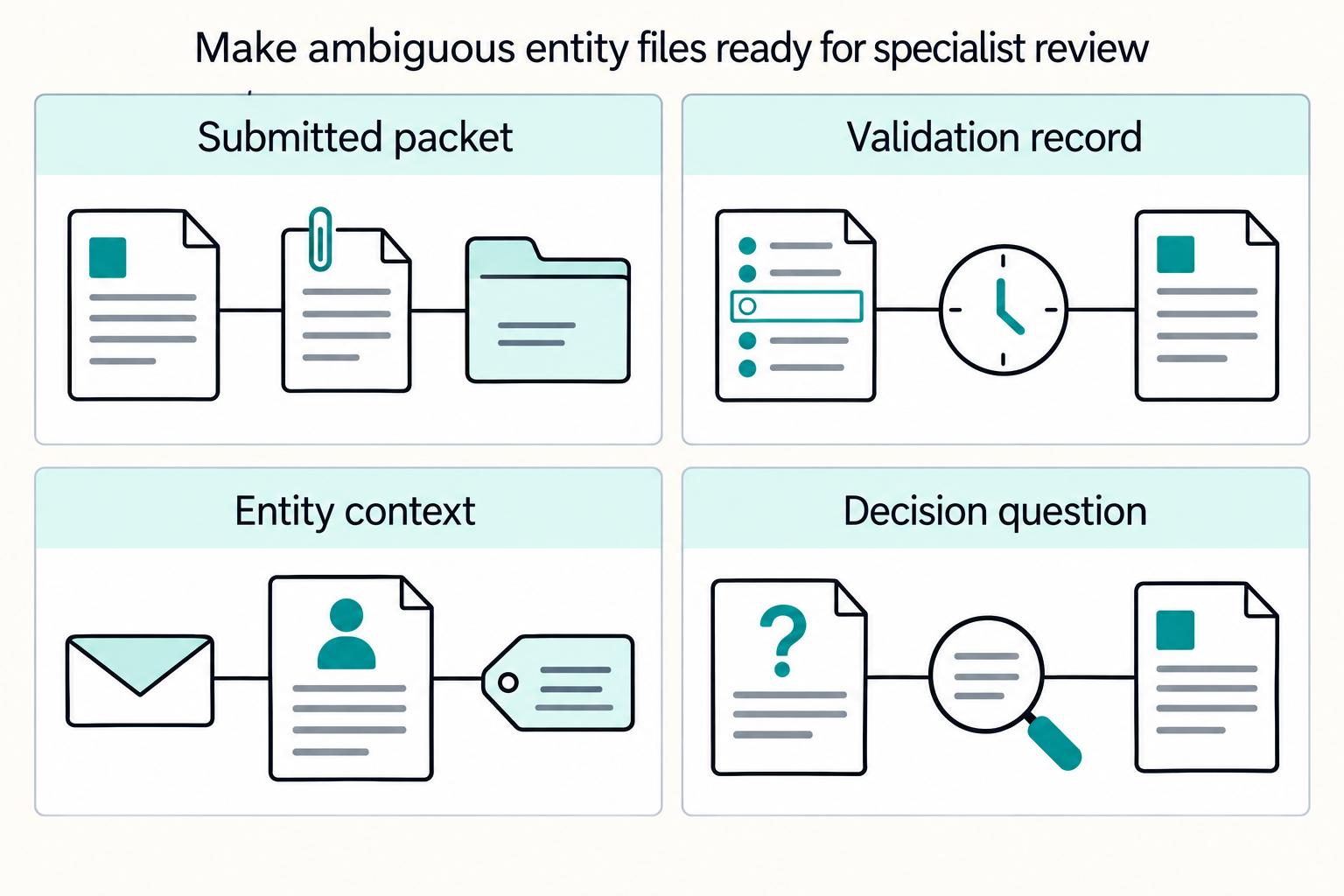
Send escalations with two things made explicit: what is in the file now, and what decision is needed. IRS does not prescribe a package format, so use a consistent internal one.
A practical package can include:
- submitted form and attachments
- validation log, including failed checks, notes, timestamps, and reason codes
- entity profile, including legal name, jurisdiction, payee type, and payout context
- prior correspondence or forms creating the conflict
- specific decision questions, not "please review"
Require a clear disposition before the file moves#
Require a clear disposition before the file can move. Close escalations into explicit outcomes: accept current form, request corrected form, apply presumption-rule treatment, or block payout pending new documentation.
Do not allow partial conclusions that leave operations to improvise. The disposition must state the next executable action for withholding and payout controls.
Connect tax form controls to payout operations and audit trail#
Tax-form status should control payout, not sit as a note in a case record. As an internal control, no payment should move unless the tax record is in a status your payout system can enforce and your team can reconstruct later.
Use one status path from intake to disbursement#
Use one internal status path from intake to disbursement, and make payout services read only that path. A practical sequence is submitted, under review, accepted, rejected, escalated, and cleared for disbursement.
IRS guidance does not prescribe those exact labels, but the withholding agent remains responsible when required withholding is missed. For form handling, Form W-8BEN-E is for entities, while individuals use Form W-8BEN. The final status should map to a clear payout decision. For accepted records, make the decision explicit: accepted form type, reviewer, timestamp, and no open escalation.
Bind status changes to payout controls#
Bind status changes to payout controls, not just case-management screens. Release funds only on a matching cleared-for-disbursement state for the specific payee submission and form version.
Design retries to be fault-tolerant. HTTP permits retries in some connection-failure scenarios, and Idempotency-Key exists to make non-idempotent requests safer, so one retry key should govern one approval or release action.
Keep sequence-quality audit records for every state change: date, time, user ID, event type, and success or failure. Protect audit data from unauthorized access, modification, and deletion so reviewers can trust the event history.
Make tax decisions and payout outcomes traceable in both directions#
Make tax decisions and payout outcomes traceable in both directions. Because the form is given to the withholding agent or payer and not sent by the payee to the IRS, your platform should keep a durable link between document decisions and payment results.
From a payout record, reviewers should be able to reach the form version, acceptance rationale, withholding outcome, and transaction posting record. From a tax record, they should be able to see whether payout was blocked, released, or paid under a specific withholding outcome.
Minimize personal data in events and dashboards#
Minimize personal data in events and dashboards while preserving the metadata needed for reconciliation. Collect and process only what is necessary, and limit exposure of full TIN values in routine operational views.
For working screens, keep masked identifiers plus the operational fields needed for exception handling, such as form type, submission ID, reviewer ID, and acceptance timestamp. Keep one boundary clear: truncation is not allowed on documents required to be filed with or furnished to the IRS.
If you want a deeper dive, read FATCA and W-8 Tax Compliance for Platforms: How to Avoid Withholding on Foreign Payouts.
Common failure modes and recovery steps#
Common failures usually come from routing and evidence gaps, not tax theory. Tighten controls where form type, intermediary status, payout release, and audit proof can drift apart.
Split individuals from entities before form collection#
Start with payee type before country, payout method, or uploaded document. Form W-8BEN is for individuals, and entities use Form W-8BEN-E.
If the payee is a natural person, route to Form W-8BEN. If the payee is a foreign entity, keep the entity path. When form type and payee type do not match, return the packet for rerouting before review. For the individual path, see W-8BEN Explained for Platforms: How to Collect and Validate This Form from Foreign Contractors.
Check for intermediary signals before approval#
Missed intermediary signals are a common routing failure. If those signals are not checked before approval, teams can accept Form W-8BEN-E when W-8IMY is the correct path.
Add a hard review check for QI/NQI, WP, and WT indicators. For WP, WT, and other intermediary or flow-through cases, require Form W-8IMY and the accompanying information needed to reliably associate the payment with the payee. If that supporting detail is missing, treat the documentation as incomplete and hold the case.
Block payout until validation is actually closed#
Do not release payout while tax documentation is still incomplete or unresolved. IRS requester instructions warn that missing valid documentation can lead to 30% chapter 3 or 4 exposure or 24% backup withholding exposure.
Gate release on one decision only: accepted status for the exact form version tied to that payment. Using reviewer sign-off as an internal control can help prevent release from submitted or under-review states. If accepted form type, reviewer, timestamp, or escalation status is missing, fail closed.
Centralize the proof needed to defend the decision#
Scattered evidence breaks auditability, so keep one audit-ready record per submission version, even if the underlying storage spans multiple systems.
At minimum, pull together the IRS form, validation outcomes, routing decision, reviewer notes, status history, and payout outcome for that version. If your team cannot quickly reconstruct why payment was blocked or released, treat the record design as a control gap and fix it.
Related reading: What UK Companies Should Enter in Foreign TIN on Form W-8BEN-E.
If your biggest risk is payout release before tax validation closes, map your accepted/escalated states directly into your disbursement controls with Gruv Payouts.
Conclusion and copy paste checklist#
Use one routing standard across teams: choose the correct form first, validate the fields that affect withholding, then move to your payout approval step. Keep controls strict where Chapter 3 or Chapter 4 treatment could change, and stay lean where missing data does not clearly affect withholding.
This form is only one route in the W-8 set, and it is for entities, not individuals. For reviews, anchor on the core fields first: Part I Identification of Beneficial Owner, Country of incorporation or organization, Chapter 3 Status (entity type), and Chapter 4 Status (FATCA status). If those do not align, treat it as a withholding decision issue, not just a form-completion issue.
Use this copy/paste checklist:
- Confirm payee form path (
W-8BEN-E/W-8BEN/W-8ECI/W-8IMY/W-8EXP/8233). - Validate required fields (beneficial owner, FATCA status, and
U.S. TIN/FTIN/GIINwhen required under IRS requester guidance). - Run consistency checks (entity type, treaty claim logic, Chapter 3 and Chapter 4 declarations together).
- Apply escalation triggers when ambiguity could change withholding and the reviewer cannot resolve it.
- If your policy requires it, hold payout until accepted or formally escalated.
- Store the final record with masked PII in operational views, reviewer notes, and an audit trail of the decision per your internal controls.
When your checklist is finalized, pressure-test your routing, escalation, and audit-trail design against your markets and program rules by talking with Gruv.
Frequently Asked Questions
Who should submit Form W-8BEN-E, and who should use Form W-8BEN instead?
Use Form W-8BEN-E for foreign entities and Form W-8BEN for individuals. If an individual submits the entity form, reroute the packet before review instead of validating the wrong form.
When should a platform route a payee to Form W-8ECI, Form W-8IMY, Form W-8EXP, or Form 8233?
Use Form W-8ECI when the foreign beneficial owner says the U.S.-source income is effectively connected with a U.S. trade or business. Use Form W-8IMY when the payee is acting as an intermediary, a foreign flow-through entity, or certain U.S. branch. Use Form W-8EXP for eligible foreign governments, international organizations, foreign central banks of issue, and certain exempt-type organizations. Form 8233 is for nonresident alien individuals claiming exemption on compensation for personal services, so it is not an entity route.
Do foreign entities send Form W-8BEN-E to the Internal Revenue Service (IRS)?
No. Form W-8BEN-E is provided to the withholding agent or payer, not to the IRS. Keep the records and decision trail internally.
Which Form W-8BEN-E fields are most critical for validation before payout approval?
Start with the fields that establish identity and routing, including the beneficial owner name and country of incorporation or organization. Then review Chapter 3 status, Chapter 4 status where required, and treaty-claim details. Check U.S. TIN, FTIN, and GIIN based on the entity's status and claim. Treat a missing FTIN separately from the line 9c "FTIN not legally required" path.
When does a treaty claim require escalation rather than routine acceptance?
There is no universal IRS escalation threshold in the cited materials. Escalate when the submission does not clearly support the claimed withholding treatment, including incomplete, inconsistent, or contradicted treaty country, beneficial-owner, TIN, or required treaty-section information. Do not apply the treaty rate until the issue is resolved.
How should platforms handle missing U.S. TIN, FTIN, or GIIN data without overblocking legitimate payees?
Do not auto-reject every missing identifier, and do not assume missing data is always acceptable. Decide whether the identifier is required for the payee's claimed status, because some Chapter 4 cases require GIIN collection and verification while some cases permit no GIIN or FTIN, including line 9c situations. Escalate or reject only when the missing data prevents a reliable withholding decision.
Try a related tool
Researched and edited by the Gruv editorial team. Gruv builds cross-border billing, payouts, and finance-operations software for global businesses.
Sources
Educational content only. Not legal, tax, or financial advice.
Related Posts

The Freelance Payment Penalty: A Modeled Audit of Platform Fees, FX Spreads, and Payout Delays
The money rarely disappears through a single, easy-to-spot fee. The real loss is stacked. A marketplace takes its commission, a processor adds a charge for international cards, a bank or payment company converts the currency at a spread, a platform holds the funds before release, and a wire sheds a little to intermediaries on the way in. Each layer looks defensible on its own, but the worker feels the combined result as a smaller deposit and a later payday.

How to Respond to a Subpoena for Business Records
Move fast, but do not produce records on instinct. If you need to **respond to a subpoena for business records**, your immediate job is to control deadlines, preserve records, and make any later production defensible.
A US Expat's Guide to Investing in UCITS ETFs to Avoid PFIC Issues
The real problem is a two-system conflict. U.S. tax treatment can punish the wrong fund choice, while local product-access constraints can block the funds you want to buy in the first place. For **us expat ucits etfs**, the practical question is not "Which product is best?" It is "What can I access, report, and keep doing every year without guessing?" Use this four-part filter before any trade: