
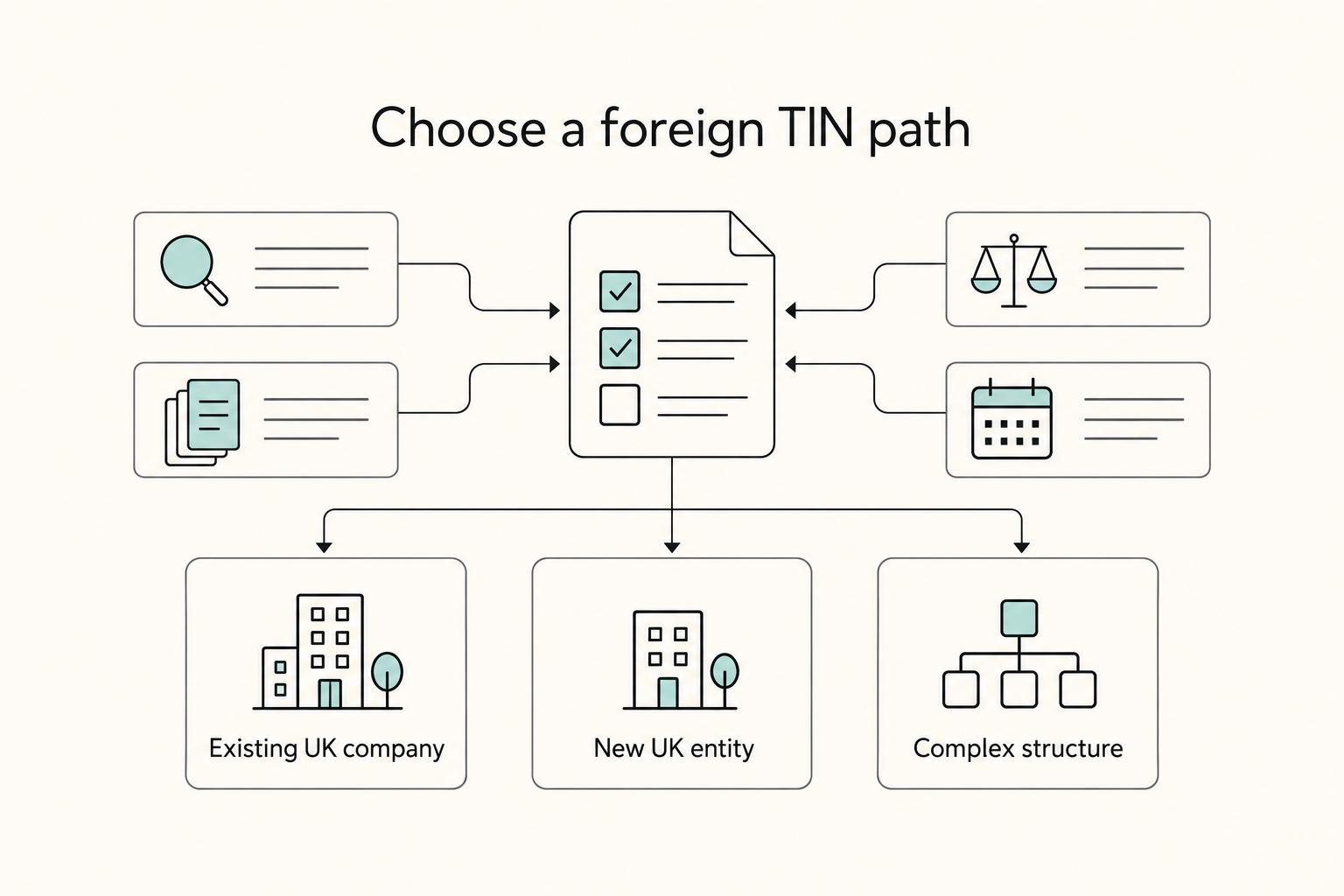
Quick Answer
For a UK tax-resident limited company, normally enter its 10-digit Corporation Tax UTR on line 9b. Match it to the company named on the form using HMRC correspondence; a director’s personal tax number is not the company’s identifier. A missing UTR does not by itself justify checking line 9c, “FTIN not legally required.”
What UK Companies Enter in the Foreign TIN Field#
For a UK tax-resident limited company, the Foreign TIN on Form W-8BEN-E is normally the company’s 10-digit Corporation Tax Unique Taxpayer Reference (UTR). Enter it on line 9b when completing that field, and match the HMRC document to the company named on the form.
That matters because the form is a certification, not a profile field. If your UK entity record says one thing, the payout account says another, and the form is completed from memory or copied from an earlier vendor, you can end up with a certification your team cannot support later. The practical goal is simple: reduce avoidable withholding issues and avoid unsupported statements before payouts start moving.
The practical distinction is between choosing the identifier and deciding whether the field is required. The company UTR answers the first question. The IRS line 9b instructions answer the second based on the account and payment facts; a UK incorporation address alone does not establish tax residence.
Find the company’s UTR on Corporation Tax correspondence or a previous Company Tax Return. HMRC’s UTR guidance also explains how to request a copy for a limited company. Check the legal name before copying the number; a director’s personal UTR or National Insurance number belongs to that individual.
The evidence standard should be light enough to use and strong enough to survive review. At minimum, keep the source instruction or payer request that drove the decision, the reviewer's name, a timestamp, and a copy of what was entered on the form. That small audit trail helps prevent a common failure mode: months later, a withholding agent asks why a field was completed a certain way, and the only answer is, "this is how we always do UK entities."
This guide focuses on UK tax-resident limited companies that can certify as the beneficial owner. Partnerships, disregarded entities, intermediaries and companies resident elsewhere need the form and residence analysis that fits their own facts.
Start by using the right form for the right entity#
Start by confirming that Form W-8BEN-E is the correct certificate before anyone enters a tax number. Use the IRS instruction headings "Who Must Provide Form W-8BEN-E" and "Do not use Form W-8BEN-E" as your first gate.
| Check | Question |
|---|---|
| Requested form | What exact form did the Withholding Agent request in writing? |
| W-8BEN-E eligibility | Does your file support that the payee can provide Form W-8BEN-E under the IRS eligibility section? |
| Beneficial owner status | Is the payee certifying as the Beneficial Owner, or does the file indicate an intermediary or Disregarded Entity question that needs tax review? |
| Change in circumstances | Has anything changed since the last form, based on the IRS topic "Change in circumstances"? |
Most avoidable foreign TIN errors start when teams reuse an old packet instead of checking the requested form again. If intake notes, contract documents, or payer communications reference Form W-8BEN, Form W-9, Form W-8ECI, Form W-8IMY, or Form W-8EXP, pause and verify the request rather than translating by habit.
Keep the control evidence light but usable: the payer request, a reviewer note citing the IRS heading used, and a timestamped decision on why W-8BEN-E was or was not used.
Do not copy forward conflicting form labels. If onboarding records and tax packets diverge, resolve that mismatch first to avoid preventable rework and delays before the certificate can be relied on.
Define the tax ID fields before anyone starts typing#
Before anyone enters Part I data, decide the field logic first. Treat Foreign TIN, U.S. TIN, GIIN, and Chapter 4 status as distinct fields that each need a documented completion decision for that entity.
Use the IRS Part I instructions for each field: line 8 is the U.S. EIN, line 9a is the GIIN where the selected status requires one, and line 9b is the identifier from the jurisdiction of tax residence. None of those numbers is a substitute for another.
Use the company UTR, not a director’s identifier#
The OECD’s UK TIN information identifies the UTR as a 10-digit tax-number equivalent issued to individuals and entities that must submit a tax return. For a UK tax-resident limited company with a Corporation Tax record, use that company’s UTR. Confirm the form names the same beneficial owner; do not borrow an identifier from another group company.
Decide requirement logic before data entry#
Use a strict sequence: determine certification logic first, then populate fields. Before certification, confirm consistency across records for:
- Legal name
- Country of organization
- Tax classification
If those core profile points do not match across onboarding records, the tax packet, and payer instructions, stop and resolve the mismatch before you enter any tax ID field.
Keep the evidence pack compact: payer request, reviewer note tied to the relevant W-8BEN-E instruction heading, source record for entity profile, and a timestamped rationale for each field outcome (completed, left blank, or escalated).
If you want a deeper dive, read A Guide to Obtaining a Foreign Tax Identification Number (FTIN).
Decide what to enter in Foreign TIN for a UK company#
Use the company’s Corporation Tax UTR for line 9b. Then check whether the IRS instructions require that field for this account or whether you are supplying it to support a treaty claim.
Line 9b requires an FTIN for the described account holder with a financial account at a U.S. office of a financial institution and associated U.S.-source income reportable on Form 1042-S, subject to the listed exceptions. Outside that account situation, the instructions allow an FTIN to support treaty benefits in place of a U.S. TIN where applicable. Read those conditions against the payment relationship, rather than treating every W-8BEN-E request as identical.
Separate an unavailable UTR from a legal exception#
Line 9c, “FTIN not legally required,” is for an account holder described in line 9b who is not legally required to obtain an FTIN from the jurisdiction of residence. Not having the number to hand, or waiting for HMRC to send it, does not establish that exception.
- Match the entity. Confirm the beneficial owner and UK tax residence before using the company’s HMRC record.
- Find the company UTR. Use Corporation Tax correspondence or the Company Tax Return, and retain the source with the draft.
- If the UTR is missing, recover it. Ask HMRC for a copy rather than substituting a director’s number or selecting line 9c because registration is pending.
- Check a genuine exception against line 9c. Record why there is no legal requirement to obtain an FTIN; a payer preference alone does not establish that fact.
| Scenario | Foreign TIN action | What to resolve |
|---|---|---|
| UK tax-resident limited company with its HMRC UTR | Enter the company’s 10-digit Corporation Tax UTR on line 9b | Match the HMRC record to the beneficial owner |
| New UK company waiting for its UTR, or an existing company unable to find it | Obtain or recover the company UTR; do not infer a line 9c exception | Check line 9b requirements and the payer’s handling while the identifier is obtained |
| Disregarded entity, intermediary or unclear beneficial owner | Determine the correct form and owner before entering an identifier | Resolve the structure and residence facts with the tax owner |
Record the basis, not just the number#
Keep a minimum evidence pack for each decision: source instruction used, reviewer name, timestamp, and what was entered on Form W-8BEN-E. If the field is left blank or an exception path is considered, state that explicitly and record why the file was held or escalated.
For example, a UK tax-resident limited company receives a W-8BEN-E request and finds its HMRC Corporation Tax letter. The preparer matches the company name, copies the 10-digit UTR to line 9b, and attaches the letter to the internal record. The UTR entry does not by itself choose a treaty rate, a Chapter 4 status or a GIIN.
Related: Foreign Tax Identification Number (FTIN): Do You Need One for W-8BEN?.
Handle U.S. TIN requests without over-collecting#
A UK company does not need an EIN solely because a payer requests Form W-8BEN-E. Check line 8 against the payment and entity facts. For treaty benefits, supplying an FTIN on line 9b can remove the need for a U.S. TIN for that claim; it does not remove a separate U.S. tax filing or identifier requirement.
Form W-8BEN-E is for foreign entities, and it is provided to the Withholding Agent. Anchor any U.S. TIN decision to that payer context and documented requirements, not to inherited onboarding habits. If the request is vague, stop and ask for the exact payer requirement.
Line 8 requires a U.S. TIN in specified situations, including a foreign partner required to file a U.S. return because of a U.S. trade or business, and a treaty claimant that has not provided an FTIN, subject to listed income exceptions. If an EIN is required and the company does not have one, use Form SS-4. A Form 8832 classification question needs separate review.
When a payer asks for an EIN, record whether the request follows an IRS requirement or the payer’s intake policy. A generic “tax ID needed” message may mean the company UTR, a U.S. EIN or another field; resolve that label before collecting a second identifier.
| Trigger | Required artifact | Owner | Internal review checkpoint |
|---|---|---|---|
| Withholding Agent asks for a U.S. TIN or EIN | Written payer request or onboarding requirement tied to this payee | Ops reviewer | Before certification |
| Treaty claim appears to depend on a U.S. identifier | Tax review note attached to the draft Form W-8BEN-E | Tax owner | Before certification |
| Form SS-4 or Form 8832 appears in the packet, or entity classification is unclear | Specialist instruction confirming why an EIN track is open | Tax or legal | Before certification |
| Request suggests the wrong form may have been used (for example, individual or ECI facts) | Re-papering decision and corrected form request | Ops plus tax | Before any payout release |
If you cannot point to payer instructions, a tax note, or corrected-form logic, do not collect an EIN just to keep the file moving. Hold certification and route it for review.
We covered this in detail in How to Fill Out Form W-8BEN-E for a Foreign Company.
Make treaty claims only when your evidence is ready#
Only claim treaty benefits in Part III Claim of Tax Treaty Benefits when the support is complete before certification. On Form W-8BEN-E, that claim can affect withholding outcomes with the withholding agent or payer, so an unsupported claim is a controllership risk.
Because the form is given to the payer and not sent directly to the IRS, your certification package should be review-ready at sign-off. Do not check the treaty claim first and backfill the rationale later.
For a treaty claim, record the company’s treaty residence, the income type and the applicable treaty article. Check the limitation-on-benefits test against the treaty itself. If Article 7 business profits is the chosen path, retain the facts supporting that position, including the relevant permanent-establishment analysis; the UTR alone does not establish entitlement.
Also confirm form routing before sign-off. If the position is that income is effectively connected with a U.S. trade or business, the IRS points to Form W-8ECI for that claim path.
| Claim path | Minimum evidence before certification | Required approver |
|---|---|---|
| Standard treaty claim in Part III Claim of Tax Treaty Benefits | Draft form plus reviewer note identifying treaty basis and payment type | Tax reviewer |
| Claim references Article 7 Business Profits | Tax or legal note confirming why Article 7 is being used for the payment stream | Tax, with legal when facts are complex |
| Claim relies on the Ownership and Base Erosion Test | Written analysis attached to the packet | Tax and legal sign-off before certification |
If the file has a checked treaty claim but no article-level support, hold certification and escalate. If treaty language is being used to compensate for uncertain form selection, pause and resolve form choice first.
Build an operator checklist for submission and retention#
Use one checklist that can prove three things later: what was certified, where it was submitted in your operating flow, and which payout record it governed. If any link is missing, the form may be complete but still weak in an audit or withholding dispute.
Give Form W-8BEN-E to the requesting withholding agent, payer or financial institution, rather than sending it to the IRS. Save the delivered version and receipt against the entity record so a later reviewer can identify the certificate the payer actually used.
Use a fixed order and do not skip unresolved fields#
The checklist should enforce sequence:
| Step | What to do |
|---|---|
| 1 | Collect entity data from onboarding records, including legal name, country, entity type, and the payout account the form supports. |
| 2 | Confirm the form path and route unresolved tax questions to tax or legal review before certification. |
| 3 | Validate tax identifiers against evidence already in the file. |
| 4 | Review any treaty position and confirm support notes are attached before certification. |
| 5 | Certify only after review is complete. |
| 6 | Archive the final packet and delivery or receipt evidence against the active payout record. |
Set a hard stop before certification. Compare legal name, country of organization, tax classification, and tax IDs across onboarding, the signed form, and the payout account record. If they do not align, stop and resolve first.
Assign owners and define revalidation triggers#
W-8BEN-E ownership roles are an internal control design decision. A practical split is preparer (assemble), reviewer (test against record and tax logic), and approver (clear exceptions). Revalidation is strongest when event-driven, such as legal name change, tax residency change, entity classification change, payout account change, payer re-papering request, or a corrected tax ID.
| Artifact | What it should prove | Link it to |
|---|---|---|
| Signed Form W-8BEN-E | The certified tax position relied on for payouts | Entity profile and active payout account |
| Decision note | Why key entries were made, including tax ID logic and treaty rationale (if used) | Review ticket or case record |
| Exception approval | Who approved a deviation and on what basis | Approver identity, date, and affected payouts |
| Change history and receipt evidence | When the form was delivered, updated, replaced, or superseded | Upload event, email acknowledgment, portal confirmation, or case ID |
Keep tax artifacts in controlled storage with access limited to the people handling the certificate. Record the submitted version, reviewer and related payee account so changes can be traced without exposing the full tax number in routine support views.
Once the entity and identifier decisions are settled, use the W-8 form generator to prepare a draft for review.
Spot red flags before they become withholding incidents#
Check for copied, mismatched or unsupported entries before submitting the certificate. These are concrete reasons to correct the packet while the payer can still receive a clean version.
Four red flags that justify an immediate pause#
| Red flag | Why it blocks use | Action |
|---|---|---|
| An entity sends Form W-8BEN instead of Form W-8BEN-E | Form W-8BEN-E is for entities, while individuals use Form W-8BEN. | Re-paper before any further payouts. |
| "FTIN not legally required" is checked with no documented basis | The file has no reviewer note or documented support for that selection. | Hold and escalate before the payer relies on the certification. |
| Part III is checked with no recorded rationale | The file does not include a short note supporting the claimed UK-US treaty position. | Stop and escalate for tax review before certification or use. |
| Core identifiers do not match across records | Legal name, country, or tax ID differs between onboarding, the signed form, and the active payout profile. | Reconcile before certification. |
Use the final pre-submission check to confirm the form is ready for the withholding agent or payer, not the IRS: does this exact signed Form W-8BEN-E match this exact entity and this exact payout record? If you cannot prove that linkage, pause and fix the file before payouts start.
Conclusion#
For a UK tax-resident limited company, start with its Corporation Tax UTR and match it to the beneficial owner. Decide line 9b, line 9c and any U.S. TIN requirement from the relevant IRS instructions, then review treaty claims separately.
That is the control point that matters most. The IRS requester instructions frame this around the Withholding Agent and Due Diligence Requirements for Reliance on Forms W-8, which is a reminder that someone is expected to rely on the certificate you submit. A clean-looking form is not enough if the file behind it is thin, copied forward, or inconsistent with verified entity facts.
The practical standard is simple. Your file should let another reviewer answer four questions without guessing: which entity is certifying, what identifier was entered, what instruction or fact pattern supported that entry, and who approved the decision.
If the UTR is missing, recover it through HMRC. If the number belongs to a director or a different group company, correct the entity match. Reserve line 9c for its stated legal exception, and keep any unresolved structure or residence question with the person responsible for that decision.
A usable packet connects the signed form, the company identifier source and any treaty analysis to the payer relationship. That gives the next reviewer enough information to update the certificate when the company’s facts change.
Frequently Asked Questions
What should a UK company enter as the Foreign TIN on Form W-8BEN-E?
For a UK tax-resident limited company, normally use its 10-digit Corporation Tax UTR on line 9b. Find it on HMRC company correspondence or a Company Tax Return, and match it to the beneficial owner named in Part I. Do not use a director’s personal tax identifier or another company’s UTR.
When can a company check "FTIN not legally required" on Form W-8BEN-E?
IRS line 9c applies to an account holder described in line 9b who is not legally required to obtain an FTIN from the jurisdiction of residence, including a jurisdiction that does not issue one. A missing or pending UTR is not enough. Record the legal basis before selecting the box.
Is a U.S. TIN always required for a UK entity filing Form W-8BEN-E?
No. For a treaty claim, an FTIN on line 9b can be used in place of a U.S. TIN where the IRS instructions permit it. Other line 8 requirements still apply, including the described U.S. partnership situation. Check the income and entity facts rather than treating the payer’s form request alone as an EIN requirement.
Where should Form W-8BEN-E be sent and who keeps the record?
Give the form to the withholding agent or payer. Do not send it to the IRS. As an internal control, keep your own copy of the signed certificate and submission record tied to the active payout file.
How is Form W-8BEN-E different from Form W-8BEN for compliance teams?
Form W-8BEN-E is for entities, while individuals must use Form W-8BEN. If the beneficial owner is a company and you collected the individual form, replace it with the correct certificate before further payouts. If the payee is acting as an intermediary, the form points to Form W-8IMY instead.
What evidence should we retain for treaty claims under the UK-US tax treaty?
Keep the signed certificate and the analysis supporting treaty residence, the income type and applicable article, and the chosen limitation-on-benefits test. Record any additional line 15 conditions used for the claim. The support should explain the actual payment relationship; a company UTR alone does not establish treaty entitlement.
What should payments ops do when payer instructions conflict with internal tax assumptions?
Do not force a certificate change based on assumptions alone. Capture the payer instruction, compare it to the verified Part I entity details and any Chapter 4 Status selection, and escalate to tax or legal review when they conflict.
Try a related tool
Researched and edited by the Gruv editorial team. Gruv builds cross-border billing, payouts, and finance-operations software for global businesses.
Sources
Includes 1 external source outside the trusted-domain allowlist.
Educational content only. Not legal, tax, or financial advice.
Related Posts
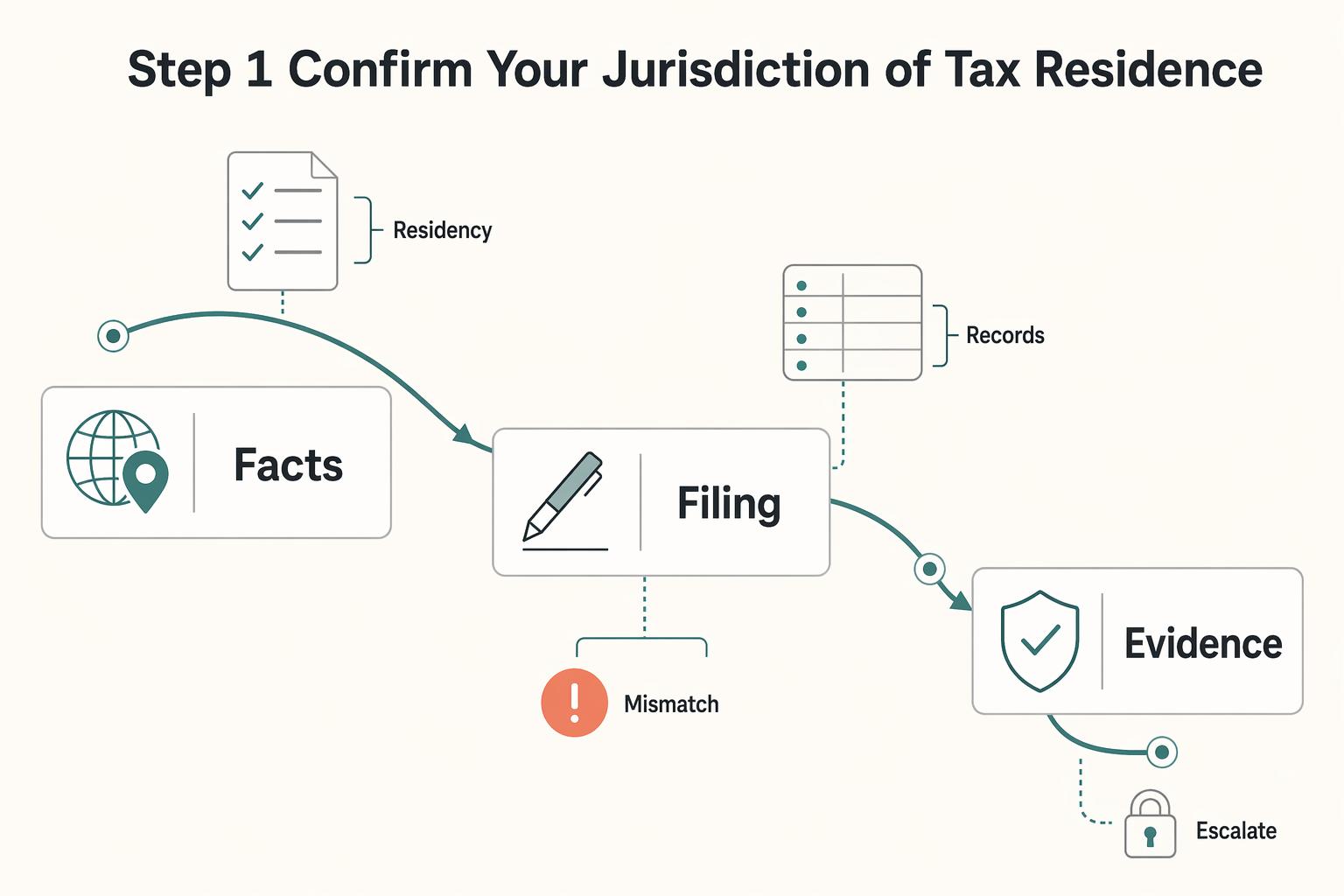
How to Get a Foreign TIN Without W-8BEN Filing Mistakes
Start by identifying the exact number the form asks for, then match that request to the right ID type. A common avoidable mistake is treating different tax IDs as interchangeable. If a field label conflicts with what you expected, follow the label first and resolve the mismatch before you submit anything.

Do You Need an FTIN on Form W-8BEN?
Treat FTIN on **Form W-8BEN** as an intake control, not a clerical field. One weak decision can affect withholding treatment and your ability to rely on payee documentation.
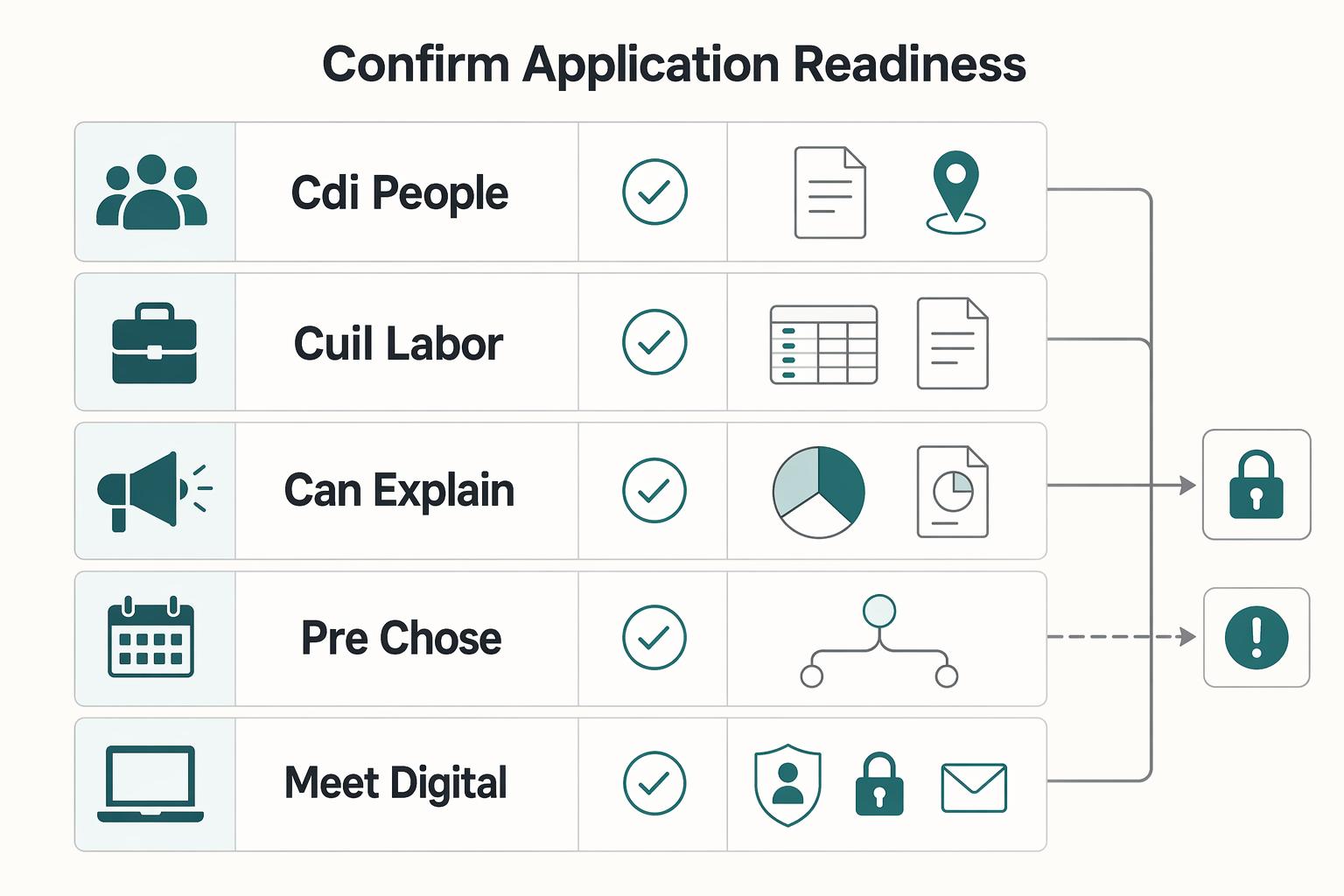
How to Get a Tax ID (CUIT/CUIL) in Argentina as a Foreigner
For independent work in Argentina, you generally need CUIT; for employment procedures, CUIL; and for banking or registrable-asset transactions without either identifier, CDI. Your immigration documents determine which application route to use. Tax residency and tax-regime registration are separate decisions, so plan those alongside the application.