
Quick Answer
Check your tax-residence authority’s portal or registration notice for an existing TIN before applying for another number. Confirm its process for your taxpayer category. On W-8BEN, foreign TIN belongs on line 6a when required; a U.S. ITIN is a separate identifier obtained through Form W-7.
You are here to get the right tax ID the first time#
Start by identifying the exact number the form asks for, then match that request to the right ID type. A common avoidable mistake is treating different tax IDs as interchangeable. If a field label conflicts with what you expected, follow the label first and resolve the mismatch before you submit anything.
TIN is the umbrella term used by the IRS to administer tax laws. It is required on returns, statements, and other tax documents, and it can be required on a withholding certificate for certain claims.
For U.S.-issued IDs, keep this straight:
SSN: issued by the Social Security Administration.- Other U.S. TINs: issued by the IRS.
- An ITIN requires a U.S. tax purpose and no SSN eligibility; apply with Form W-7 only when those conditions apply.
- ITIN applications can be filed by mail or in person.
Before you submit#
- Read the exact field label and confirm what type of taxpayer number it requests.
- If a U.S. number is required, check SSN eligibility first. If you are not eligible, use the ITIN path with
Form W-7and the return documents listed in that process, such asForm 1040orForm 1040-NR. - Save your first submission details and any rejection message so you can fix an ID-type mismatch first if it gets rejected.
Copy-paste checklist#
- I confirmed the exact field request before entering any number.
- I matched the request to the correct ID type instead of guessing.
- I verified whether a U.S. number was actually required.
- If a U.S. number was required, I checked SSN eligibility before starting ITIN steps.
- I saved the submission and any rejection text for a clean resubmission if needed.
Start with the ID match before you file anything#
Do the ID match first. TIN is an umbrella term, so by itself it does not tell you which subtype belongs in the field.
| Identifier | Issuer or meaning | Use |
|---|---|---|
| Foreign TIN / FTIN | Identifier issued by the jurisdiction of tax residence | Check existing tax records or the authority’s application process; use W-8BEN line 6a when required. |
| SSN | U.S. Social Security Administration | U.S. individual identifier where applicable. |
| ITIN | IRS individual tax number for a valid U.S. tax purpose when SSN-ineligible | Apply through Form W-7; it does not replace a foreign-issued TIN. |
| EIN | IRS identifier for businesses and certain other entities | Do not substitute an entity EIN for an individual’s foreign TIN. |
- Classify the field first.
Read the exact field label and payer instructions so you know whether it expects a U.S. taxpayer ID or another identifier.
- Follow the field instructions exactly.
Do not start a U.S. TIN application path unless the form explicitly requires a U.S. number.
- If it asks for a U.S. number, follow IRS subtype rules.
Use the IRS ITIN route only if you need a U.S. individual tax number for a valid federal tax purpose and are not eligible for an SSN. Form W-7 does not obtain a number from a foreign tax authority.
- Do not substitute unrelated ID types.
Do not enter ATIN or SSN unless the instructions explicitly make them applicable. ATIN is specific to pending U.S. adoptions, and an ITIN does not authorize legal work in the U.S.
IRS TIN Matching is a pre-filing service for payers or authorized agents on the IRS Payer Account File, not a self-serve tool for individual filers.
Stop and fix before submission if:
- You cannot tell what identifier type the field is asking for.
- You are starting
Form W-7without confirming that a U.S. number is actually required. - You are about to enter
SSNorATINas a placeholder.
Prepare your evidence pack before you contact any authority#
Prepare one evidence pack before you contact anyone. That way your records are ready if questions come up. Keep these record groups in one folder:
| Record | What to keep |
|---|---|
| Identity and foreign-status proof | Current identity and foreign-status proof |
| W-8BEN history | Latest and prior Form W-8BEN submissions, including any rejection text |
| Taxpayer profile | One-page profile with the exact name and ID formatting already used in counterparty and withholding-agent records |
| Usage log | Form on file, submission date, last status, and whether Form 1042-S may be relevant |
Use consistent file naming with date and form type so you can pull the exact version quickly if a payer asks for clarification.
For an ITIN application, follow the current W-7 document rules: original identity/foreign-status evidence or copies certified by the issuing agency, with a federal return unless a documented exception applies. Keep that package separate from your foreign TIN application.
Maintain a one-page usage log for each platform: form on file, submission date, last status, and whether Form 1042-S may be relevant for reporting U.S.-source income and withheld amounts. Review this log before each resubmission to keep profile data and form history aligned.
If your status is cross-border, recently changed, or inconsistent across payers, treat that as an escalation signal and pause before contacting authorities again.
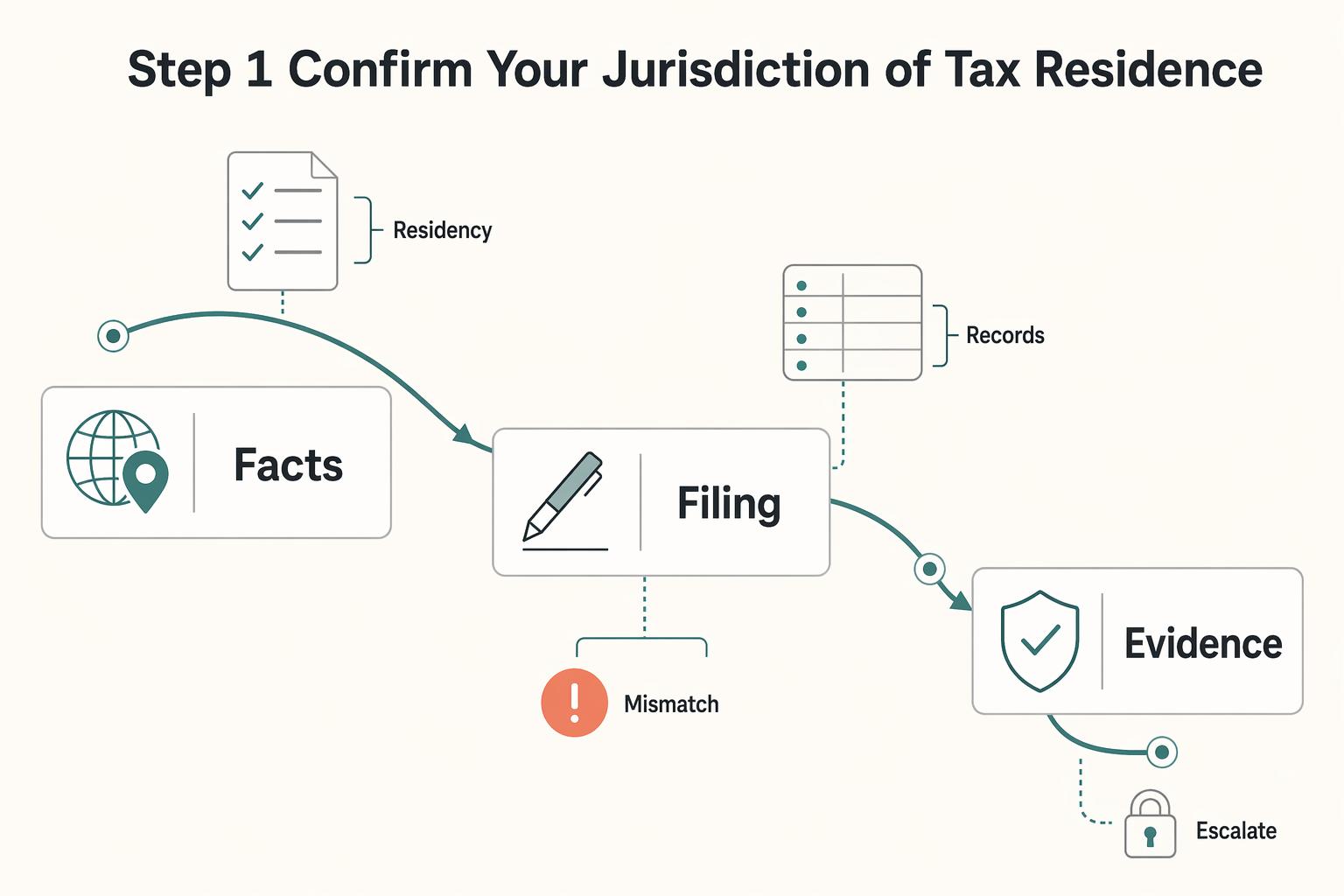
Step 1 confirm your jurisdiction of tax residence#
Establish the residence position relevant to the form before completing foreign-TIN fields. Multiple domestic-law residence claims can arise; do not simply choose the most convenient country. Get advice where residence or treaty rules conflict.
- Write your working residency position.
Record the country relevant to this form and the facts supporting it, including any competing residence claim requiring advice.
- Confirm through the official tax authority channel.
Check your tax-residence authority’s taxpayer portal, registration notice or official TIN guidance. First establish whether you already have a number; if not, follow the authority’s application process for your taxpayer category.
- Keep document types separate.
Keep residency certificates and taxpayer identifiers separate: a certificate supporting residence is not itself the number requested in an FTIN field.
- Apply the escalation rule before filing.
If your facts support more than one possible residence country, or your profile data conflicts with your evidence, escalate before submitting anything instead of guessing.
If your records mention more than one country, note why one is your active position for this cycle and save that note with the same evidence pack. Before moving on, verify that your jurisdiction note and draft filing fields point to the same country.
Step 2 identify the issuing authority and accepted document path#
Keep the tracks separate. For a foreign TIN or FTIN, start with your tax-residence country's tax authority. Use IRS Form W-7 only if you are applying for a U.S. ITIN.
- Confirm the issuing authority and process for your taxpayer category.
Contact the tax authority in your country of residence and ask for the official process to obtain or confirm your TIN. Ask which office or portal handles your category, since TIN structure and syntax are set by national authorities and can differ by individual category. If you get guidance by phone, write a dated internal note with the contact channel and what you were told. Checkpoint: You have the authority name, submission channel, and a written response or reference number.
- Align accepted documents with your Form W-8 profile fields.
Confirm what identity and status documents they accept, then match those details in your W-8 draft so names, country fields, and TIN formatting stay consistent. If you use an online TIN syntax check, treat it as format-only validation, not identity or existence confirmation. Checkpoint: Your W-8 draft matches authority-facing records exactly.
- Keep a review-ready evidence file.
Save screenshots, receipts, and correspondence as you submit or verify, including dates and reference numbers. This gives you a clear record if a withholding agent flags missing or incorrect TIN details. Checkpoint: You can show who issued the number, what number was provided, and what record supports it.
- Run a contrast check before using Form W-7.
Form W-7 applies for an IRS ITIN. Its instructions generally require a federal tax return with the application unless an exception applies. Keep that process separate from the foreign authority’s TIN process.
Step 3 complete W-8BEN fields so they pass review#
At this stage, consistency across Form W-8BEN, your account profile, and your tax records is the main review check. Field-level mismatches across screens can create avoidable follow-up.
If you are still finalizing your FTIN path, use this as a strict alignment pass before submission.
- Copy identity and residence fields exactly.
Use the same legal name format and tax-residence country shown in your account and tax records. Keep spelling, order, and abbreviations consistent. Checkpoint: Legal name and residence country match across your account profile and Form W-8BEN.
- Distinguish line 6a from line 6b.
Use line 6a for the foreign TIN where required by the W-8BEN instructions. Line 6b addresses not being legally required to obtain one; waiting for an application is not that exception. Review treaty-claim requirements separately.
- Reconcile every W-8 data entry point before submitting.
If your payer collects tax data in multiple screens or forms, update each one and run a final consistency check. Checkpoint: The same TIN or FTIN status and tax-residence country appear everywhere your payer stores tax details.
- Save the submitted version for later 1042-S reconciliation.
Keep the exact submitted W-8BEN and any submission confirmation from your payer. You may want that record later because Form 1042-S is used to report income and amounts withheld. Checkpoint: You can produce one record set with the submitted form and proof of submission.
Before submission, identify the rule requiring the FTIN or the precise exception relied on. A blank line or checked box must match your facts.
Step 4 handle missing FTIN cases without creating new risk#
Use one clear, supportable exception rationale in your Form W-8BEN package so the withholding agent can review it without conflicting signals.
If you are still working through the FTIN issue, treat this as an exception test, not a workaround. Start by checking the IRS list of jurisdictions that do not issue foreign TINs. Recheck it each filing cycle because the IRS indicates that list can be updated.
An avoidable failure mode is sending one explanation in the form and a different explanation in a support ticket. Keep one position across all records.
- Choose one exception basis and keep it consistent.
Check the IRS non-issuing-jurisdiction list and the form’s exception rules. Keep the applicable basis with your submission; do not describe a pending application as a legal exemption.
- State that basis directly for the withholding agent.
Include a short note with your Form W-8BEN package that names your tax-residence jurisdiction, your FTIN status, and why the number is missing. Keep it specific and factual so it matches the form. Checkpoint: A reviewer can match your note to your W-8BEN entries without interpretation.
- Keep documentation that supports what you submitted.
Save the exact explanation text you filed, the date you checked the IRS list, and any related platform correspondence in one place. Checkpoint: You can show one record set with your basis, submission, and response history.
- Escalate if the same explanation keeps getting rejected.
If a platform continues to reject the same rationale, stop rewriting variants and consider escalating to a tax professional before resubmitting. Checkpoint: Your next step after repeat rejection is escalation, not another wording change.
If the payer rejects the form, ask which requirement is unsatisfied and what evidence it needs. A missing FTIN does not by itself establish a universal withholding rate.
Step 5 submit, verify acceptance, and set a renewal trigger#
After submission, treat this as a control step: confirm acceptance, track what gets reported, and trigger updates when your facts change. Save the acceptance message with the same discipline as the form itself.
| Control | Action | Note |
|---|---|---|
| Acceptance archive | Save the accepted Form W-8BEN version and the acceptance message together | Be able to identify the accepted version, acceptance date, and storage location |
| W-8BEN reminder | Keep a reminder for your Form W-8BEN status | Generally valid through December 31 of the third calendar year after signing, unless circumstances change; some exceptions apply. |
| ITIN renewal | Track renewal separately when relevant | An ITIN expires on December 31 after 3 consecutive tax years of non-use on a federal return and may still be used on information returns when expired |
| Form 1042-S reconciliation | Compare each Form 1042-S against account tax settings and request correction if needed | Keep a short yearly reconciliation note |
| Residency-change review | Trigger a fresh tax-profile review after a move or split-year pattern | Log the change and, if it makes the form incorrect, notify the payer/agent/FFI within 30 days and provide a replacement form. |
- Confirm acceptance in writing and archive the exact accepted file.
Save the accepted Form W-8BEN version and the acceptance message together so you can quickly prove what was approved and when. Checkpoint: You can identify the accepted version, acceptance date, and storage location immediately.
- Set renewal reminders without mixing separate rule sets.
Set a W-8BEN review date from its validity rules and review sooner when facts change. Track ITIN renewal separately under W-7 guidance; the two dates serve different purposes.
- Reconcile account tax settings against each Form 1042-S issued.
Use Form 1042-S as a reporting check because it reports foreign-person income and amounts withheld. Compare the issued form against your account tax settings and request correction if they do not match. Checkpoint: Keep a short yearly reconciliation note with the form and your comparison record.
- Add a residency-change trigger for a fresh tax-profile review.
Log moves or changes to residence, identity or treaty claims, then review whether the form remains accurate. If a change makes information on your W-8BEN incorrect, notify the withholding agent, payer or account-holding FFI within 30 days and submit a new W-8BEN or other appropriate form. Preserve the replacement and the payer’s response together.
If you are still working through tax-profile details, this is where compliant files can break: after acceptance, when records are not updated as facts change.
Common mistakes and how to recover fast#
Fast recovery starts with one move: map the request to the correct ID type before you resubmit anything. Delays often come from mixing an ITIN path with an FTIN request in the same Form W-8 workflow.
IRS terminology is your anchor. TIN is the umbrella category, and ITIN is one TIN subtype. TIN requirements can apply on withholding certificates depending on what the beneficial owner is claiming. If your record mixes ID types, the withholding agent may treat the file as incomplete.
Another practical issue is partial updates: one record gets corrected, but another still carries the old ID label. Review every entry point before you send the next version.
- Label the requested ID type from the requester instructions first.
If the request is for FTIN details on Form W-8BEN, treat it as an FTIN path and keep that label consistent across your file. Checkpoint: Save the request text and add a one-line note: Requested ID type = FTIN or ITIN.
- Keep one form path tied to one number type.
Do not submit a record that signals FTIN in one place and ITIN in another. The requester instructions place responsibilities on the withholding agent to obtain Form W-8 documentation, so consistency matters. Checkpoint: Before resubmitting, verify these items match: ID type label and the number field on Form W-8BEN.
- If FTIN is not legally required, use one documented explanation.
The requester instructions include an FTIN not legally required case. If that applies, submit one clear explanation and keep it with the same form record. Failure mode: Changing the explanation between submissions without a change in facts.
- Escalate with evidence if rejection continues.
If you keep getting rejected after using one consistent ID mapping and explanation, escalate with your evidence set instead of repeatedly rewriting the same file. Checkpoint: Keep the rejection message(s), submitted Form W-8BEN version, and your ID-mapping note together.
Correct the number type and keep one coherent record for resubmission. The W-8 form generator can help prepare a draft, but the entries must reflect your actual status.
Know when to escalate to a tax professional#
Get professional review when the issue concerns residence, treaty eligibility or income classification rather than an obvious number-entry mistake.
- Pause when residency is split across countries.
Provide move dates, work locations and relevant residence records to an adviser when more than one jurisdiction may treat you as resident. Do not force the facts into a single-country answer merely to clear an intake screen.
- Escalate when structure choices could change your filing posture.
If your entity setup, contract model, or income characterization changed during the year, do not guess on treatment. If you are uncertain whether this affects your filing treatment, escalate for a written determination.
- Escalate after repeated rejection by a withholding agent.
Send a single escalation bundle with rejection messages, submitted forms and authority records. Ask the payer to name the unresolved field or requirement before submitting another version.
Keep tax records connected to the payment file#
The target is simple: keep visibility before funds move. You want one traceable path from the tax-profile request, to the accepted tax form, to the final Form 1042-S outcome.
- Step 1: Enable protected tax-data collection.
Use access-controlled document storage and share identifiers only through approved channels. Keep raw TINs out of ordinary chat and ticket notes. Record the document version and who reviewed it.
- Step 2: Tie reconciliation artifacts to payment events.
Start reconciliation when payments happen, not at year-end. Form 1042-S is used to report income and amounts withheld described in its instructions, so each payout should be linked to the tax-profile version active at that time, with a short reconciliation note when Form 1042-S is issued. If reported amounts or profile attributes do not match the payment trail, open a correction case immediately. Checkpoint: Every payment record points to the active tax-profile snapshot (for example, W-8/W-8BEN where applicable) and a matching reconciliation note.
- Step 3: Treat IRS updates as control triggers.
Check the current form instructions before updating intake templates. Keep a dated note of the version reviewed and the fields or exception rules that changed.
- Step 4: Apply policy gates before payout when tax data is incomplete.
Where the payer requires tax documentation, record unresolved gaps, an owner and the evidence needed to close them. This is a workflow design recommendation, not a claim that Gruv validates TINs or automates withholding.
Final takeaway and copy-paste checklist#
Use this as your final pre-submit gate: confirm the number type, keep records consistent, and escalate early when facts are mixed.
- Confirm the requested ID type before entering any number.
If you are using an ITIN, it is a 9-digit IRS number for federal tax purposes only and does not authorize legal U.S. work.
- Use one clear tax-residence position for this filing cycle.
Keep the form’s residence entries consistent with the documented position and resolve competing residence claims before certification.
- If Form W-8BEN is requested, keep records consistent and follow written instructions.
Use consistent identity and country details across your submission materials, and keep the submitted version and related confirmation records together.
- Do not guess on FTIN or country-specific details.
If requirements are unclear or instructions conflict, escalate for written guidance before resubmitting.
- Escalate early when uncertainty remains.
If residence or treaty facts remain unresolved, ask for written advice and provide one organized evidence pack.
Frequently Asked Questions
What is the difference between an FTIN, ITIN, and EIN?
An FTIN is issued by your jurisdiction of tax residence. An ITIN is an IRS individual number for a valid U.S. tax purpose when you cannot get an SSN. An EIN is an IRS business or entity identifier. They are not interchangeable.
Who issues a Foreign Taxpayer Identification Number?
The authority designated by your jurisdiction issues or confirms its tax identifiers. Check existing registration records before applying for a new number, then follow that authority’s instructions for individuals or businesses.
Can I submit Form W-8BEN without an FTIN?
Sometimes. Review line 6a requirements, the non-issuing-jurisdiction exception and line 6b’s legal-obligation test. A treaty claim may have separate identifier requirements; do not assume one exception satisfies every claim.
What should I do if my country does not issue TINs?
Check the IRS list and follow the W-8BEN instructions for your facts. Keep evidence of the jurisdiction and exception with the payer’s record; do not invent a placeholder number.
When do I need Form W-7 and an ITIN instead of an FTIN?
Apply through Form W-7 when you need an IRS individual number for a valid federal tax purpose and are not eligible for an SSN. It does not obtain a foreign-issued TIN. A return is generally required unless an exception applies.
Does receiving Form 1042-S mean I owe U.S. tax?
No. Form 1042-S reports specified income and withholding; receiving it does not itself determine your final tax liability. Reconcile it with the payer’s records and your applicable tax treatment.
Try a related tool
Researched and edited by the Gruv editorial team. Gruv builds cross-border billing, payouts, and finance-operations software for global businesses.
Sources
- irs.gov/instructions/iw8bentrusted
- irs.gov/instructions/iw7trusted
Educational content only. Not legal, tax, or financial advice.
Related Posts

The Freelance Payment Penalty: A Modeled Audit of Platform Fees, FX Spreads, and Payout Delays
The money rarely disappears through a single, easy-to-spot fee. The real loss is stacked. A marketplace takes its commission, a processor adds a charge for international cards, a bank or payment company converts the currency at a spread, a platform holds the funds before release, and a wire sheds a little to intermediaries on the way in. Each layer looks defensible on its own, but the worker feels the combined result as a smaller deposit and a later payday.

How to Respond to a Subpoena for Business Records
Move fast, but do not produce records on instinct. If you need to **respond to a subpoena for business records**, your immediate job is to control deadlines, preserve records, and make any later production defensible.
A US Expat's Guide to Investing in UCITS ETFs to Avoid PFIC Issues
The real problem is a two-system conflict. U.S. tax treatment can punish the wrong fund choice, while local product-access constraints can block the funds you want to buy in the first place. For **us expat ucits etfs**, the practical question is not "Which product is best?" It is "What can I access, report, and keep doing every year without guessing?" Use this four-part filter before any trade: