
Quick Answer
W-8BEN-E generally documents an eligible foreign entity that is the beneficial owner. Foreign individuals generally use W-8BEN; foreign partnerships generally use W-8IMY with supporting documentation. A disregarded entity generally provides its owner’s W-8BEN/W-8BEN-E, or W-9 for a U.S. owner. Hybrid treaty claims and other exceptions require the specific IRS instructions. Confirm the payment’s source and withholding treatment, complete applicable identity and status fields, and make only supported treaty claims. Complete line 15 only when the treaty benefit requires conditions not covered by line 14 or other certifications. When required, supply the article, paragraph, rate, income type and explanation of how you meet those conditions. Sign through an authorized representative and give the certificate to the payer or withholding agent, not the IRS. Keep delivery evidence and monitor changes.
Form W-8BEN-E: What It Is and Where to Send It#
Form W-8BEN-E documents foreign entity status for applicable withholding and reporting purposes and can support a treaty claim. It is provided to the withholding agent, payer or financial institution requesting it, not filed with the IRS. This guide focuses on client-payment onboarding, but neither U.S. payer geography nor an immediate withholding charge is a universal prerequisite for a valid request.
Step 1. Put it in your onboarding packet, not in a "tax later" pile. Keep the applicable certificate with your contract, vendor setup, invoice and bank instructions. Chapter 3 generally imposes 30% withholding on U.S.-source fixed or determinable annual or periodical income unless an exemption or reduced rate applies. Service income is generally sourced where the work is performed; a U.S. client alone does not make an overseas service fee U.S.-source. Missing or unreliable documentation can prevent the payer from applying appropriate treatment; backup withholding can also arise under separate rules.
Step 2. Send it before the first payment is paid or credited. Timing matters here. Send it during onboarding, before money moves, and send it to the actual payer or withholding agent. Before you send it, confirm your legal entity name matches your contract and invoice records.
| Workflow point | If you submit a complete form early | If you submit late or incomplete |
|---|---|---|
| Documentation status | Payer has Form W-8BEN-E before income is paid or credited | Payer may not be able to treat the payee as a documented foreign beneficial owner yet |
| Compliance risk signal to payer | Supports documented withholding classification | Missing documentation can trigger 30% Chapter 3 withholding on subject U.S.-source income; other rules can apply |
Step 3. Keep records and monitor for changes. A W-8BEN-E is generally valid from the signature date through the last day of the third succeeding calendar year, unless your circumstances change earlier. Retain the signed form, proof of delivery, such as an email or portal confirmation, and the exact version you sent. Bring in a tax advisor if the facts are not standard, especially around entity classification, treaty claims, or form selection.
Operator checklist
- Send it with onboarding, before income is paid or credited.
- Send it to the requesting withholding agent, payer or financial institution, not the IRS.
- Retain the signed form, proof of delivery, and related contract and invoice records.
- Escalate if ownership, entity type, treaty position, or other core facts are unclear or unusual.
If you want a deeper dive, read our guide to a defensible 2026 filing plan.
W-8BEN vs. W-8BEN-E: The One-Minute Decision#
Use a simple two-step screen: first confirm whether W-8BEN-E applies under current IRS eligibility checkpoints, then make sure your onboarding records tell the same story.
Ask one question first#
Who is being documented, and under what U.S. tax classification? Start with the beneficial owner or applicable account-holder status, not just the invoice name or requester’s country. The IRS instructions include both eligibility and exceptions for withholding and reporting contexts.
If payment is going to you personally, do not default to the entity form. Confirm the applicable form in current IRS instructions and your payer onboarding packet.
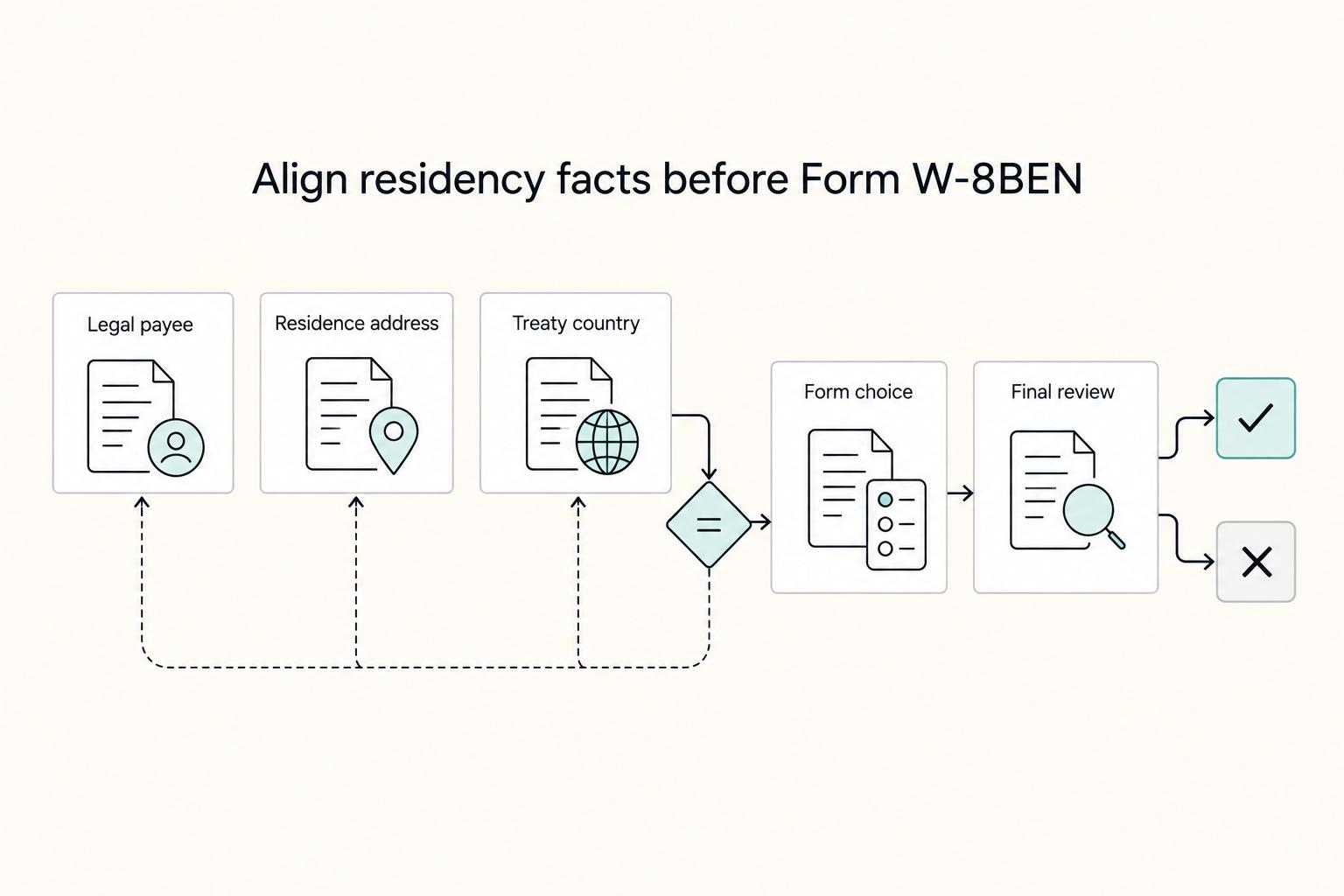
Run a mismatch check before you submit#
Before you choose the form, compare the named payee across:
- Your contract or SOW
- Your invoice
- Your payout profile or receiving account details
If those records do not point to the same legal identity, stop and resolve that first. Inaccurate legal identity details can cause processing delays or errors.
Quick comparison#
| Decision field | W-8BEN | W-8BEN-E |
|---|---|---|
| Typical beneficial owner | Foreign individual | Eligible foreign entity |
| Important exceptions | U.S. persons use W-9; certain U.S. personal-service treaty claims use Form 8233 | Foreign partnerships generally use W-8IMY; disregarded entities generally document the owner; hybrid treaty exceptions require review |
| Recipient | Requesting withholding agent, payer or financial institution, not the IRS | Requesting withholding agent, payer or financial institution, not the IRS |
| Pause trigger | Unclear tax status or payment treatment | Unclear entity classification, beneficial ownership or treaty eligibility |
Edge-case guardrail (single-owner/pass-through structures)#
W-8BEN-E generally documents an eligible foreign entity that is the beneficial owner. Foreign individuals generally use W-8BEN; foreign partnerships generally use W-8IMY with supporting documentation. A disregarded entity generally provides its owner’s W-8BEN/W-8BEN-E, or W-9 for a U.S. owner. Hybrid treaty claims and other exceptions require the specific IRS instructions. Confirm U.S. tax classification before signing; a separate legal entity or matching invoice name is not enough to select the form.
Fast self-check scenarios#
| Records status | Next step |
|---|---|
| Contract, invoice, and payout details all show you personally | Generally W-8BEN for a foreign individual; check special service-income exceptions |
| Contract, invoice, and payout details all show the same foreign entity | Check U.S. tax classification and beneficial ownership: eligible entity W-8BEN-E, partnership generally W-8IMY, disregarded entity generally owner documentation |
| Contract, invoice, and payout details show different names | Fix the records or get advisor confirmation before submitting either form |
Complete Form W-8BEN-E So the Payer Can Rely on It#
Your goal is simple: give the payer a W-8BEN-E they can rely on without follow-up. That means clean identity fields, the right Chapter 3 and Chapter 4 statuses, supportable treaty details when claimed, and an authorized signer.
Start with the current form and reconcile your records#
Start with the current IRS form and its instructions, then reconcile your records before entering fields. W-8BEN-E generally documents an eligible foreign entity that is the beneficial owner. Foreign individuals generally use W-8BEN; foreign partnerships generally use W-8IMY with supporting documentation. A disregarded entity generally provides its owner’s W-8BEN/W-8BEN-E, or W-9 for a U.S. owner. Hybrid treaty claims and other exceptions require the specific IRS instructions.
Give the applicable certificate to the payer or withholding agent before income is paid or credited, not to the IRS. Chapter 3 generally imposes 30% withholding on U.S.-source fixed or determinable annual or periodical income unless an exemption or reduced rate applies. Service income is generally sourced where the work is performed; a U.S. client alone does not make an overseas service fee U.S.-source. Confirm the relevant documentation and any separate backup or Chapter 4 withholding rules with the payer.
Use one consistent legal identity across your contract payee, invoice, payout profile, formation record, and tax registration record. If those do not match, fix that first.
Complete Part I with matching legal identity details#
Part I is where avoidable errors start, so treat it as a legal identity and classification check.
| Field | What to enter | How to validate before sending | Common issue to avoid |
|---|---|---|---|
| Legal identity details | Entity information that matches your official records | Match against contract, invoice, payout profile, and entity records | Mismatched names or records across documents |
| Chapter 3 Status (line 4) | One entity-type box only | Confirm it matches your actual legal or tax classification | Multiple boxes or a classification that conflicts with records |
| Chapter 4 Status (line 5) | FATCA status that applies to your entity | Confirm status and complete the related certification section as required | Picking a status you cannot support |
| U.S. TIN / foreign TIN / line 9c | Enter available TINs; use line 9c only if FTIN is not legally required | Validate against tax registration records | Missing or incorrect identification support when making a treaty claim |
Decision cues:
- A missing U.S. TIN does not automatically block treaty relief. IRS treaty guidance allows U.S. or foreign TIN support.
- If your entity classification is unclear, for example corporation vs partnership vs disregarded or hybrid treatment, stop and confirm before filing.
Use Part III only for supportable treaty claims#
Use Part III for a supported treaty claim, including the applicable residence and limitation-on-benefits certifications. Complete line 15 only when the treaty benefit requires conditions not covered by line 14 or other certifications. When required, supply the article, paragraph, rate, income type and explanation of how you meet those conditions.
For line 14a, enter the treaty-residence country. Check the actual treaty and IRS tax treaty tables for the applicable benefit. Complete line 15 only when the treaty benefit requires conditions not covered by line 14 or other certifications. When required, supply the article, paragraph, rate, income type and explanation of how you meet those conditions.
| Treaty claim state | What it looks like | Expected payment handling | Follow-up burden |
|---|---|---|---|
| Complete claim | Required residence, eligibility and tax-ID support are present; line 15 details supplied when additional conditions require them | Withholding agent may be able to apply reduced or exempt treatment if accepted | Lower |
| Incomplete claim | Required residence, eligibility, tax-ID support or applicable additional-condition details are missing | Withholding may default to standard rates until resolved | Higher |
If you cannot verify the article and rate from IRS tables, do not force a weak treaty claim.
Sign Part XXX only with an authorized signer#
Only sign Part XXX if the signer is authorized and the form is accurate. The certification is under penalties of perjury. The signer also agrees to provide a new form within 30 days if a change in circumstances makes the current form incorrect.
Run a final pre-send check#
Before you send it, run this quick check:
| Check | What to confirm |
|---|---|
| Identity alignment | Confirm legal name, country details, treaty residence if claimed, contract payee, invoice, and payout profile all align |
| Status selection | Re-check Chapter 3 and Chapter 4 selections against your actual entity status |
| TIN entries | Verify TIN entries and whether line 9c is being used correctly |
| Treaty claim | Confirm treaty residence, benefit eligibility and required tax-ID support; complete line 15 only if additional conditions require it |
| Signer authority | Confirm signer authority and readiness to reissue within 30 days after a relevant change |
| Escalation | Stop and escalate to a qualified tax advisor if you are unsure about entity classification, FATCA status, hybrid treatment, or treaty eligibility |
Before you send the form to a client, create a clean draft you can verify line by line with the W-8 Form Generator.
The Three Hidden Risks in Form W-8BEN-E (And How to Avoid Them)#
W-8BEN-E issues usually come from three operational misses: a classification mismatch, a weak treaty claim on line 14, or a form that enters the wrong client process and stalls.
Catch classification mismatches before review#
The first risk is a classification mismatch. If your Chapter 3 or Chapter 4 selections do not match your legal records, expect follow-up questions and delays.
Fix this before sending: reconcile the legal name, country of organization, Chapter 3 status, Chapter 4 status, and tax IDs across your entity records and onboarding details. If you use line 9c, use it only when an FTIN is not legally required to be obtained.
Do not pick a status first and make the rest of the form fit it. If your entity treatment is unclear, stop and get advisor review before submission.
Make treaty claims only when you can support them#
The second risk is an unsupported treaty claim, and it starts at line 14.
Before you send it, verify your treaty basis against IRS treaty materials. If your treaty does not contain a limitation on benefits article, handle line 14 accordingly instead of assuming it follows the same pattern as other treaties. If you cannot support the claim cleanly, remove it and escalate before resubmitting.
Send the form through the right client path#
The third risk is routing: the form reaches the wrong team and sits. You need a clear owner and intake path in the client process.
Ask one onboarding question early: who owns non-U.S. tax-form review, and what submission path should you use? If ownership is unclear or the form is bouncing between teams, pause and resolve routing before submission.
| Risk | Early warning sign | Pre-send check | Escalate when |
|---|---|---|---|
| FATCA or classification mismatch | Clarification request on entity tax status | Reconcile legal name, country of organization, Chapter 3 or 4 status, and line 9c use to records | Entity classification is unclear or records conflict |
| Weak treaty claim (line 14) | Follow-up asks for treaty basis or missing detail | Verify treaty basis for line 14 from IRS treaty materials | You cannot support the claim cleanly |
| Wrong delivery path | No clear owner, delayed confirmation, or internal forwarding | Confirm tax-form review owner and submission path | Client cannot confirm intake ownership |
| Withholding detail needs legal validation | Compliance flags partnership-interest transfer withholding | For certain section 1446(f) transfers, verify whether withholding applies, including the 10% amount-realized rule unless an exception applies | Section 1446(f) or related transfer issues appear |
Use these defaults:
- Match classification to records first. If unclear, stop and escalate.
- Use line 14 only when the treaty claim is fully supportable.
- Confirm the tax-form review owner and intake route before sending.
- If section 1446(f) or partnership-interest transfer issues appear, pause and get advisor review before submission.
Related: How to Fill Out Form W-8BEN for a Foreign Freelancer.
Beyond the Form: Integrating the W-8BEN-E into Your Onboarding System#
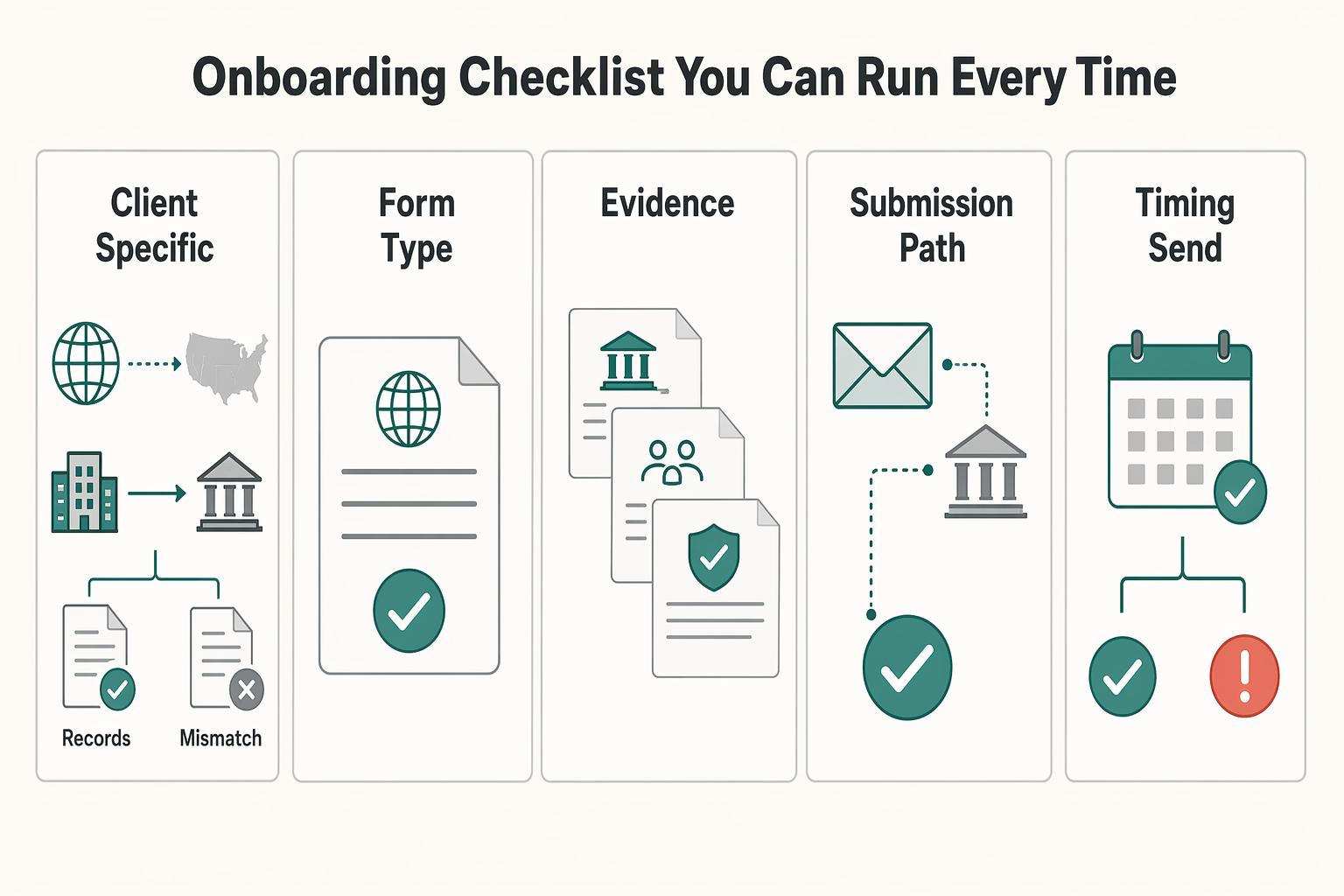
Treat W-8BEN-E as a repeatable onboarding control, not a one-time form. The goal is straightforward: send the entity certificate to the payer or withholding agent before the first payment, confirm receipt, and keep a clear update trail when facts change.
Onboarding checklist you can run every time#
| Step | Action |
|---|---|
| Client-specific packet | Send a client-specific packet. Separate withholding agents generally require separate forms. |
| Form type | W-8BEN-E generally documents an eligible foreign entity that is the beneficial owner. Foreign individuals generally use W-8BEN; foreign partnerships generally use W-8IMY with supporting documentation. A disregarded entity generally provides its owner’s W-8BEN/W-8BEN-E, or W-9 for a U.S. owner. Hybrid treaty claims and other exceptions require the specific IRS instructions. |
| Included documents | Include the signed W-8BEN-E and any client-requested onboarding documents. |
| Submission path | Send it through the payer or withholding-agent path the client names. Do not send it to the IRS. |
| Timing | Send it at onboarding start, or at the latest before the first payout is scheduled. |
| Receipt confirmation | Ask for written confirmation of receipt and who owns withholding or tax-form review. |
| Client record | Log the submission date, recipient, and confirmation status in your client record. |
| Follow-up | Follow up before payout if confirmation is missing. |
| Client-side role | What to send first | Why this handoff matters |
|---|---|---|
| Procurement / vendor onboarding | Core vendor packet + signed W-8BEN-E | Helps route documentation into the payer-side withholding workflow |
| Accounts payable | Approved W-8BEN-E + payment setup details | Payment timing and withholding timing are linked, so clear records matter before disbursement |
| Legal / tax reviewer | Signed W-8BEN-E + treaty-claim support, if a treaty claim is made | Supports classification and treaty-position review when claims or conflicts need validation |
Validity and renewal control#
Track validity in your client record and run two controls:
- Set a pre-expiry reminder.
- Assign a resend task to the client contact who confirmed receipt last time.
Keep prior versions and log replacement dates instead of overwriting history. As a baseline, the default validity period runs through the last day of the third succeeding calendar year unless a change in circumstances makes the form incorrect earlier. If facts change, notify the withholding agent within 30 days and update the form workflow.
Client hub mini-SOP (storage and retrieval)#
Good storage makes repeat requests easier. Use a consistent internal template, for example:
- Client legal name
- Your entity legal name
- Signed date
- Submission date
- Recipient name or email
- Classification summary
- Treaty-claim flag and article reference, if used
- Receipt confirmation status
- Validity rule in use
- Reminder date
- Current file version
Use clear versioning, such as dated filenames and a superseded note on older files. That makes it easier to retrieve the exact submitted version quickly for client re-requests or accountant review.
Escalate to a tax advisor now if#
- Your entity classification changed or form fit is now unclear.
- Your treaty position changed, including residency basis or the treaty article relied on.
- Client tax records conflict with your known facts.
- A change in circumstances affects Chapter 4 status, and you may need to notify the withholding agent within 30 days.
For a separate reporting workflow, see How to Fill Out FBAR (FinCEN Form 114) Step by Step.
Make Withholding Documentation a Repeatable Onboarding Process#
Use your withholding documentation as a repeatable onboarding process, not a last-minute response. That is how you reduce avoidable payment friction and cleanup work later. You cannot guarantee the outcome, but you can lower the risk of delays and messy finance back-and-forth.
Chapter 3 generally imposes 30% withholding on U.S.-source fixed or determinable annual or periodical income unless an exemption or reduced rate applies. Service income is generally sourced where the work is performed; a U.S. client alone does not make an overseas service fee U.S.-source. Tax and AP reviewers need the payment category, source, beneficial-owner classification and valid documentation to determine the correct treatment. Keep the certificate and supporting records consistent so payment handling and later reporting can be checked without reconstructing the onboarding history.
| Workflow point | Reactive process | Systemized process |
|---|---|---|
| Timing of submission | Send the form only after AP asks | Send the signed form with contract and vendor setup materials |
| Accuracy checks | Complete once and submit | Reconcile legal name, entity details, country, and tax IDs across form, contract, invoice, and vendor profile before sending |
| Renewal process | Wait for client reminders | Track your own renewal reminder based on the current verified rule |
| Document storage | Search email threads when asked | Store the signed PDF, related approval emails, and support notes in one place |
| AP follow-up | Respond after a hold appears | Confirm the correct reviewer, receipt, and any missing fields before the payment run |
With finance and procurement teams, trust comes from specific behaviors: matching entity details exactly, routing to the right reviewer, and producing the latest signed file quickly when asked. Those are the signals that you are easy to onboard and easy to pay.
- Send your current signed form to the correct client contact and get written receipt confirmation.
- Reconcile the form against your contract, invoice, and vendor record before the next payment run.
- Create a renewal reminder based on the current verified rule.
For a related example, see A UK Limited Company's Guide to Filling Out Form W-8BEN-E. If you want to confirm whether Gruv supports your market and compliance setup for cross-border payments, contact the team.
Frequently Asked Questions
Which form do I use: W-8BEN or W-8BEN-E?
W-8BEN-E generally documents an eligible foreign entity that is the beneficial owner. Foreign individuals generally use W-8BEN; foreign partnerships generally use W-8IMY with supporting documentation. A disregarded entity generally provides its owner’s W-8BEN/W-8BEN-E, or W-9 for a U.S. owner. Hybrid treaty claims and other exceptions require the specific IRS instructions. Action step: confirm U.S. tax classification and the applicable certificate first, then reconcile the documented owner’s identity with contract and invoice records. For a disregarded entity, document the owner as the instructions require rather than forcing every field to the invoice entity name.
What does Active NFFE mean on the form?
Active NFFE is a Chapter 4 status for a foreign entity that is not a financial institution. Part XXV requires less than 50% of the preceding calendar year’s gross income to be passive, and less than 50% of assets to produce or be held to produce passive income, calculated as a weighted average of quarterly passive-asset percentages. Check both tests and the passive-income definitions before certifying; an operating business label alone is insufficient.
Do I need a tax ID to claim treaty benefits?
Treaty claims generally require a U.S. or foreign tax ID, subject to the specific instructions and exceptions. Confirm the applicable requirement and treaty eligibility before signing Part III. Complete line 15 only when the treaty benefit requires conditions not covered by line 14 or other certifications. When required, supply the article, paragraph, rate, income type and explanation of how you meet those conditions. Line 9c concerns a limited foreign-tax-ID exception and does not itself establish treaty eligibility.
Where do I send the completed form?
Send the form to the requesting withholding agent, payer or financial institution, not directly to the IRS. In client onboarding, confirm the named tax-form reviewer and obtain receipt confirmation. Foreign-status or reporting documentation may be required even when no immediate withholding applies.
What happens if I send the wrong form or skip it?
A rejected certificate can prevent the payer from applying the claimed treatment. Chapter 3 generally imposes 30% withholding on U.S.-source fixed or determinable annual or periodical income unless an exemption or reduced rate applies. Service income is generally sourced where the work is performed; a U.S. client alone does not make an overseas service fee U.S.-source. Reconcile entity classification, legal name, form type and any treaty claim with the payer’s tax reviewer before resubmitting; determine the actual withholding consequence rather than assuming every payment loses 30%.
How long is the form valid?
As a baseline, it is generally valid through the last day of the third succeeding calendar year unless a change in circumstances makes the form incorrect earlier. Still, confirm current IRS instructions before filing and set reminders based on the rule you verified. Certain documented circumstances allow indefinite validity absent a change; confirm that exception with the withholding agent rather than assuming it applies.
When should you ask a tax advisor?
Escalate early when entity classification is unclear, treaty-claim support is uncertain, or client onboarding requirements conflict with your facts. Action step: consult an independent U.S. tax advisor before signing if you are unsure about W-8BEN vs W-8BEN-E, Active NFFE, or Part III boxes 14 and 15.
Try a related tool
Researched and edited by the Gruv editorial team. Gruv builds cross-border billing, payouts, and finance-operations software for global businesses.
Sources
Educational content only. Not legal, tax, or financial advice.
Related Posts

Digital Nomad Taxes in 2026 With a Defensible Filing Plan
With digital nomad taxes, the first move is not optimization. It is figuring out where you may be taxable, where filings may be required, and what proof supports that position.
How to Fill Out Form W-8BEN for a Foreign Freelancer
Form W-8BEN lets a non-U.S. individual document foreign status to a payer and, where eligible, claim treaty benefits. For a freelancer, the first decisions are who owns the income, where the services were performed, and whether this is the right certificate. A U.S. client does not by itself make your work U.S.-source income.

The Freelance Payment Penalty: A Modeled Audit of Platform Fees, FX Spreads, and Payout Delays
The money rarely disappears through a single, easy-to-spot fee. The real loss is stacked. A marketplace takes its commission, a processor adds a charge for international cards, a bank or payment company converts the currency at a spread, a platform holds the funds before release, and a wire sheds a little to intermediaries on the way in. Each layer looks defensible on its own, but the worker feels the combined result as a smaller deposit and a later payday.