
Quick Answer
Calculate depreciation by allocating the purchase price between land and building, depreciating only the building basis, and using the date the property was ready and available for rent as the placed-in-service date. For property used predominantly outside the United States, depreciation is determined under ADS, and you should track the current-year and cumulative amounts consistently because allowable depreciation still reduces basis even if you did not claim it.
Control of a foreign real estate investment starts at acquisition, not when you file a tax return. Your choices on basis, land versus building allocation, and placed-in-service support shape annual reporting and sale math. Handle the full lifecycle from purchase to operation to sale, and tax management becomes part of running the asset well instead of a filing-season scramble.
This playbook uses a three-stage approach to replace ambiguity with control, keeping the property well documented, easier to report, and easier to exit.
Stage 1: Document basis, land allocation, and the placed-in-service date#
You lock in much of the depreciation outcome at purchase, not just at filing. If basis, land/building allocation, or placed-in-service support is weak now, that weakness can carry into Schedule E, Form 4562, and your sale calculation. Allowable depreciation still reduces basis even if you did not claim it.
Step 1. Allocate the purchase price between land and building#
Start with a defensible basis file. Land is never depreciable, so you need a land versus building split you can support later. Avoid default splits or local rules of thumb you cannot document. For property used predominantly outside the United States, depreciation is determined under ADS. That makes the building basis decision foundational.
| Evidence source | Evidence quality | Keep in your file | Typical friction | Fallback path |
|---|---|---|---|---|
| Executed purchase contract with separate land/building values | Useful when allocation is explicit and deal-consistent | Signed contract, closing statement, short allocation memo | Many contracts do not break out values | Use local assessor ratio |
| Local property tax assessment with land/improvement values | Practical fallback | Assessment notice, translation if needed, ratio worksheet | Outdated cycles or category mismatch | Get an appraisal |
| Independent appraisal separating land and improvements | Additional support when assessments are weak or stale | Full report near purchase date, credentials if available, basis worksheet | Cost, time, format variability | Use documented comparable land analysis plus pro review |
| Documented comparable land analysis | Last-resort support | Comparable sources, screenshots, calculations, dated assumptions memo | High prep burden and easier to challenge | Escalate before filing |
Checkpoint: land value plus building value should tie to the basis you report, with math you can follow later without rebuilding it from memory.
Step 2. Capture records while facts are fresh#
Good basis work falls apart when records are scattered. Save the core documents immediately, while they are easy to collect and before memories blur. Use one property folder with: 01 Purchase, 02 Basis Allocation, 03 Placed in Service, 04 Capital Improvements, 05 Annual Tax.
Use consistent file names, such as 2026-05-14_Lisbon_ClosingStatement_FINAL.pdf. Keep signed finals as PDFs, keep a backup outside your primary cloud drive, and maintain a one-page index so you can retrieve key items quickly. Capture at minimum:
- Executed purchase contract and closing/transfer documents
- Land/building valuation support and allocation worksheet
- Dated support showing when the property was ready and available for rent
- Pre-rental invoices/receipts that affect basis or readiness
- Basis memo explaining assumptions and method
Retrieval test: if you cannot pull the contract, allocation support, and placed-in-service proof within five minutes, your file may not be audit-ready.
Step 3. Set the placed-in-service date with proof#
Use the date the property was ready and available for rent, not the first tenant move-in date. For Form 4562, you need the month and year placed in service, or converted to business use, so pick a date you can support with records.
| Support | What it shows |
|---|---|
| Dated listing records | Ready and available for rent |
| Manager onboarding documents | Ready and available for rent |
| Final required repair invoices | Readiness for rent |
| Communications confirming availability | Availability for rent |
Practical test: could a renter have moved in, and were you actually offering the property for rent? Useful support includes dated listing records, manager onboarding documents, final required repair invoices, or communications confirming availability. If major renovation was still ongoing, essentials were missing, or you were holding it for personal use, it was not yet in service. Watch two edge cases:
- Conversion from personal to rental use: do not default to purchase or move-out date without support for readiness and availability.
- Mixed personal/rental use: track personal-use days from day one. More than the greater of 14 days or 10% of fair-rental days can change treatment.
Escalate when facts are unclear. That includes mixed-use patterns, phased renovations without a clean readiness date, weak land/building support, or uncertainty about filing-year ADS classification in current Form 4562 instructions. If you want a deeper dive, read the digital nomad tax guide.
Stage 2: Repeat the same treatment and file Schedule E each year#
Once setup is right, the annual job is consistency: carry forward the same documented facts, apply the same treatment, and file Schedule E from records that tie out end to end.
Step 1. Confirm your opening facts#
At the start of each tax year, pull your prior-year return, depreciation tracker, and Stage 1 basis file. Confirm your opening inputs, such as building vs. land split, placed-in-service month and year, ownership percentage, and whether prior-year classification assumptions are unchanged.
Then run one carryforward check: this year's opening tracker balances should match last year's closing basis and accumulated depreciation. If they do not match, resolve that before you file.
Step 2. Apply the same method and post one clean annual entry#
If you previously determined a depreciation setup, keep that setup unless documented facts require a correction. Before posting the current-year amount, confirm whether anything changed, such as mixed-use periods, conversion periods, ownership changes, or periods when the property was not available for rent.
Post the annual depreciation in one tracker. Keep, at minimum: asset description, depreciable basis, method setup, placed-in-service date, current-year depreciation, and year-end cumulative depreciation. Your check is simple: prior cumulative amount plus current-year amount equals the new cumulative amount with no manual patching.
Step 3. Choose an FX workflow you can defend and keep consistent#
Do not assume a single required FX method applies for this context, so treat this as a documentation decision and flag uncertainty early.
| FX documentation checkpoint | Why it matters | What to keep |
|---|---|---|
| How local-currency amounts were converted to USD | Makes the calculation reviewable | Worksheet plus the rate records you used |
| Which recurring items followed the same treatment | Reduces income/expense mismatches | A short policy note for the tax year |
| Where exceptions were made | Explains one-off differences | Dated notes describing what changed and why |
Use a documented treatment for recurring items, and clearly note any exceptions for review before filing.
Step 4. Build your Schedule E filing pack before data entry#
Build the file before you touch the return. Use the 2025 Instructions for Schedule E (Form 1040) as your annual pre-file checklist. Review Other Schedules and Forms You May Have To File, Limitation on Losses, and Passive Activity Loss Rules, including Recordkeeping, before you enter numbers. Use this filing checklist:
| Filing item | Source documents | Mismatch risk |
|---|---|---|
| Gross rents | Lease ledger, manager statements, bank receipts | Income converted with one FX approach while expenses use another |
| Rental expenses | Invoices, receipts, manager statements, payment proof | Local books net fees or taxes against rent while the return separates gross income and deductions |
| Current-year depreciation | Annual depreciation tracker, prior-year return copy | The current-year amount no longer ties to original basis or prior cumulative depreciation |
| Personal-use and availability records (if relevant) | Calendars, platform exports, owner-stay logs | Manager reports show rental activity only and miss owner-use periods |
| Loss-limitation support | Prior-year return and carryforward schedules | Current-year losses are entered without validating limitation treatment |
Step 5. Escalate when the year is not routine#
Escalate to a tax pro if any of these apply: unclear classification, mixed-use periods, ownership changes, amended prior returns, or local records that conflict with your U.S. filing file. These are the years to document first and file second.
For background, see 183-Day Rule Explained: Stop the Tax Myths Before They Cost You. Before your next filing cycle, use the Tax Residency Tracker to keep country-by-country presence and compliance notes in one place.
Stage 3: The Strategic Disposition Plan (Maximizing Your Exit)#
Plan the sale before you list. Split the result into parts for planning, then verify year-specific rules before filing.
Step 1. Rebuild your sale worksheet from basis first#
Start with your adjusted-basis records, then layer in sale results. Use placeholders so you can verify current-year law before filing:
- Building basis at acquisition (per your records) = [A]
- Less cumulative depreciation (per your records) = [B]
- Adjusted building basis = [C]
- Add nondepreciable land basis and other nondepreciable amounts = [D]
- Total adjusted basis before sale adjustments = [E]
- Amount realized on sale, net of sale-related adjustments after verification = [F]
- Total gain or loss = [F] minus [E]
- Depreciation-related portion (if applicable under current law) = isolate after verification
- Remaining amount, if any = total gain minus the depreciation-related portion
- Apply current U.S. treatment = add rates or caps only after you verify rules for the filing year
Checkpoint: keep this worksheet tied to your closed records and verified final-year updates.
Step 2. Separate depreciation-related amount from the remaining amount#
Do this split first, then model tax impact. Treating the sale as one blended number can hide errors.
| Item | What triggers it | Tax character | Documentation needed | Planning action |
|---|---|---|---|---|
| Depreciation-related amount (if applicable) | May arise when prior depreciation affects basis and the sale result | Verify current U.S. treatment; do not assume a rate or cap from this section | Depreciation tracker, placed-in-service records, prior returns, basis file, sale worksheet | Estimate and reserve for this portion first |
| Remaining amount after that split | Amount left after adjusted-basis comparison and separation above | May be treated differently; verify current rules | Purchase/sale computations, ownership timeline, FX support, basis reconciliation | Model this second, not as a blended total |
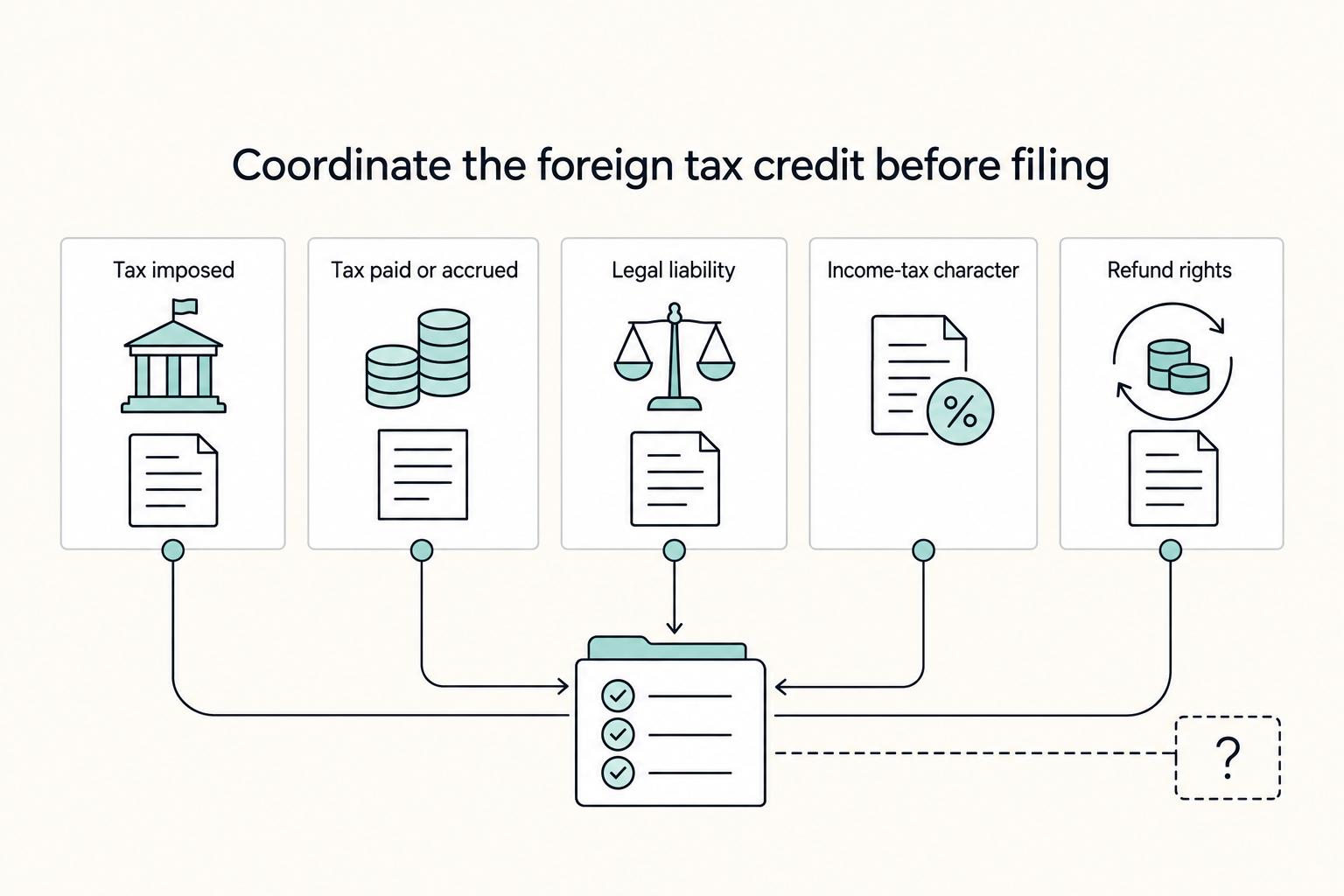
Step 3. Coordinate the Foreign Tax Credit before filing#
If the sale is taxed abroad, build your file around the FTC qualification tests before you draft Form 1116. IRS Topic 856 says the foreign tax must meet 4 tests: it must be imposed on you, paid or accrued by you, a legal and actual liability, and an income tax or tax in lieu of one. Use this coordination checklist:
| Requirement | What to collect |
|---|---|
| Tax imposed on you | Documentation showing the tax was imposed on you |
| Tax paid or accrued by you | Documentation showing tax paid or accrued |
| Legal and actual liability | Documentation showing a legal and actual foreign tax liability |
| Income tax or tax in lieu of one | Documentation showing the tax is an income tax or a tax in lieu of one |
| Refund rights or adjustments | Documentation of refund rights or adjustments, since taxes not legally owed (including refundable amounts) are noncreditable |
- Collect local sale-tax records
- Documentation showing the tax was imposed on you * Documentation showing tax paid or accrued * Documentation showing a legal and actual foreign tax liability * Documentation showing the tax is an income tax or a tax in lieu of one * Documentation of refund rights or adjustments, since taxes not legally owed (including refundable amounts) are noncreditable
- Map to U.S. reporting
- Determine the correct Form 1116 income category; prepare a separate Form 1116 for each category * Convert and report in U.S. dollars except where Part II specifies otherwise * Track foreign taxes paid or accrued in Form 1116 Part II * If tax was paid to only one foreign country or territory, use column A in Part I and line A in Part II
- Reconcile before you file
- Tie out local tax assessed versus local tax paid or accrued * Tie out refundable or adjustable amounts versus the amount you plan to claim * Tie out local-currency records to U.S.-dollar amounts reported on Form 1116
If this reconciliation does not tie, fix the file before filing.
Step 4. Escalate early when the exit is not routine#
Talk to a tax pro if any of these apply:
- mixed personal and rental use
- ownership-structure changes during the holding period
- partial dispositions or component-by-component disposals
- carryovers or prior-year limitation interactions
- local gain math that does not match your U.S. adjusted-basis computation
In these cases, clean records are necessary but not sufficient. Document first, model second, then file.
You might also find this useful: How to Report Foreign Rental Income on a U.S. Tax Return.
Conclusion: Turn Your Foreign Property into a Fully Optimized Asset#
Treat depreciation on foreign rental property as a lifecycle discipline, not a filing-season patch. The objective is simple: keep a defensible basis file, run the same Schedule E recordkeeping process each year, and document sale assumptions before you need them.
| Approach | Documentation quality | Filing predictability | Sale-readiness |
|---|---|---|---|
| Reactive filing | Scattered invoices, unclear land/building split, weak support for improvements versus repairs | Year-end guesswork and rework | Harder basis reconstruction and weaker exit math |
| Lifecycle-managed approach | Basis file, depreciation schedule, improvement log, and election support kept together | Repeatable annual process with easier tie-out to prior returns | Cumulative depreciation and adjusted basis already tracked |
What to do next (next filing cycle)#
- Confirm basis file integrity. Keep clear support for your land versus building allocation, since land is not depreciable, and make sure prior-year depreciation records are easy to retrieve.
- Verify your annual depreciation workflow. Keep Schedule E recordkeeping tied to your depreciation tracker, classify improvements as capitalized and depreciated when required, and make any safe-harbor election on a timely filed return when you use that position.
- Pre-plan sale treatment assumptions. Maintain a cumulative schedule of depreciation and capitalized improvements so your sale calculations start from records, not estimates.
Escalate early to a qualified cross-border tax professional if you have basis allocation uncertainty, complex multi-country tax questions, or sale planning that is no longer mechanical. For filing execution, use A Guide to Schedule E (Supplemental Income and Loss) for Foreign Rental Property.
For a step-by-step walkthrough, see How to Pay Foreign Property Taxes Without U.S. Tax Surprises. If you want a single operational system for cross-border invoices, payouts, and audit-ready records, review the Gruv docs.
Frequently Asked Questions
How do you separate land and building value for a foreign property?
Use a documented allocation between land and improvements and keep the support in your basis file. Good support can include the purchase contract, a local property tax assessment, an appraisal, or a comparable land analysis. If the split is unclear, fix it before filing.
What depreciation period applies to a foreign rental property?
For property used predominantly outside the United States, depreciation is determined under ADS. Verify the current recovery period for your property type and filing year before filing, and keep your tracker aligned from setup through annual reporting.
What exchange rate should you use for rental income, expenses, and taxes?
The article does not give one required FX method for this context, so use a documented approach you can defend and apply it consistently. For Form 1116, report amounts in U.S. dollars except where Part II specifies otherwise. Reconcile local-currency records to the U.S.-dollar amounts you report.
Can you use bonus depreciation or other accelerated write-offs?
Do not assume bonus depreciation or other accelerated treatment applies. Verify current-year eligibility before claiming anything outside your baseline depreciation approach.
Is depreciation on foreign rental property mandatory?
Keep your depreciation tracking current each year because allowable depreciation still reduces basis even if you did not claim it. If you skipped prior years, resolve that before filing so your annual reporting and sale calculations stay consistent.
Where do you report depreciation on your U.S. return?
Confirm the current-year form location and line reference before filing. Then tie the reported amount back to your depreciation schedule, prior-year file, and Schedule E reporting flow. Keep the placed-in-service month and year supported for Form 4562.
Can foreign tax paid on rent or a sale offset your U.S. tax automatically?
No. Foreign tax paid on rent or a sale does not offset U.S. tax automatically. IRS Topic 856 says the tax must pass 4 tests, and some taxes are still noncreditable, including taxes not legally owed or refundable amounts. If you file Form 1116, report by income category using a separate form for each category, and report in U.S. dollars except where Part II says otherwise.
What if you missed prior-year depreciation?
Do not just start with the current year. Rebuild the prior-year depreciation records first, then confirm the correction path before filing so your current-year and sale math stay consistent.
When should you bring in a tax professional?
Bring in a tax professional early if you have mixed personal and rental use, incomplete records, a cross-border sale, or ownership-structure changes. Those facts can complicate basis tracking, depreciation continuity, and Foreign Tax Credit handling.
Try a related tool
Researched and edited by the Gruv editorial team. Gruv builds cross-border billing, payouts, and finance-operations software for global businesses.
Sources
Educational content only. Not legal, tax, or financial advice.
Related Posts

Digital Nomad Taxes in 2026 With a Defensible Filing Plan
With digital nomad taxes, the first move is not optimization. It is figuring out where you may be taxable, where filings may be required, and what proof supports that position.

183-Day Rule Tax Myths That Trigger Residency Filing Mistakes
If you are a mobile freelancer or consultant, start here: the "183 day rule tax" idea is not a single universal test. It is a shortcut phrase people use for different residency rules that do not ask the same question. If you mix federal and non-federal residency logic, you can create filing risk even when your travel calendar looks clean.
Schedule E for Foreign Rental Property Without a Year-End Scramble
For Schedule E reporting on a foreign rental property, make three decisions in order: set up your system, run a monthly close, and verify compliance before filing. That order keeps your numbers, support, and filing positions aligned. It also cuts down the year-end scramble when bank activity, receipts, and conversion records all live in different places.