
Quick Answer
For a non-U.S. individual beneficial owner, complete W-8BEN Part I with your identity and applicable TINs: U.S. TIN on line 5, FTIN on line 6a. Use Part II only for a supported treaty claim, sign Part III, and send it to the payer rather than the IRS. Services performed outside the United States are generally foreign-source even when the client is American.
Form W-8BEN lets a non-U.S. individual document foreign status to a payer and, where eligible, claim treaty benefits. For a freelancer, the first decisions are who owns the income, where the services were performed, and whether this is the right certificate. A U.S. client does not by itself make your work U.S.-source income.
Use the IRS form alongside its instructions. The steps below cover the individual form, then show how to submit it and keep a usable client record.
Phase 1: Choose the form and gather your records#
For services, the IRS sourcing rule generally looks to where you performed the work. Services performed entirely outside the United States generally produce foreign-source income; work split between countries needs allocation. W-8BEN documents your status, but does not turn taxable U.S.-source income into exempt income. Missing documentation may trigger 30% foreign-person withholding or backup withholding under the applicable rules, rather than a universal 30% charge on every foreign freelancer invoice.
Step 1: Choose the right form first#
Use W-8BEN when you are a nonresident alien individual beneficial owner of the income. A sole proprietor is still an individual. U.S. citizens and resident aliens generally use W-9, even when living abroad. Foreign entity beneficial owners generally use W-8BEN-E; partnerships and intermediaries can require other certificates. For a disregarded entity, the owner generally supplies the certificate, unless the entity is making a qualifying hybrid-entity treaty claim.
| Decision signal | W-8BEN | W-8BEN-E |
|---|---|---|
| Who files | Foreign individual beneficial owner | Foreign entity beneficial owner, subject to entity classification |
| Typical use | You are the payee in your personal capacity | Your company or other legal entity is the payee |
| What changes the form | Individual owns the income, including through a disregarded entity in the ordinary case | Entity classification or a hybrid-entity treaty claim requires its own certificate |
| Common misclassification | Entity payee submits individual form | Individual assumes business activity alone means entity form |
| Key edge case | Disregarded entity context can be detailed | If a disregarded entity claims treaty benefits as a hybrid entity, use W-8BEN-E |
Step 2: Decide your tax ID path before entry#
On the individual form, line 5 is for a U.S. SSN or ITIN and line 6a is for your foreign tax identification number (FTIN). A treaty claim generally needs an appropriate U.S. or foreign TIN, subject to specified exceptions. Checking line 6b does not automatically replace a TIN required for a treaty claim.
| Situation | Action | Note |
|---|---|---|
| You have an SSN or a required ITIN | Enter it on line 5 | Use the IRS instructions to determine when a U.S. TIN is required |
| Using an FTIN for a qualifying treaty claim | Enter it on line 6a | It must be issued by your tax-residence jurisdiction |
| Covered financial account at a U.S. office of a financial institution | Review the line 6a FTIN requirement and its exceptions | This requirement is not identical to an ordinary client vendor intake |
| Not legally required to obtain an FTIN | Use line 6b only when its instructions apply | Not knowing your number or waiting for it is not the same as not being legally required to obtain one |
Step 3: Build your pre-fill checklist before Part II#
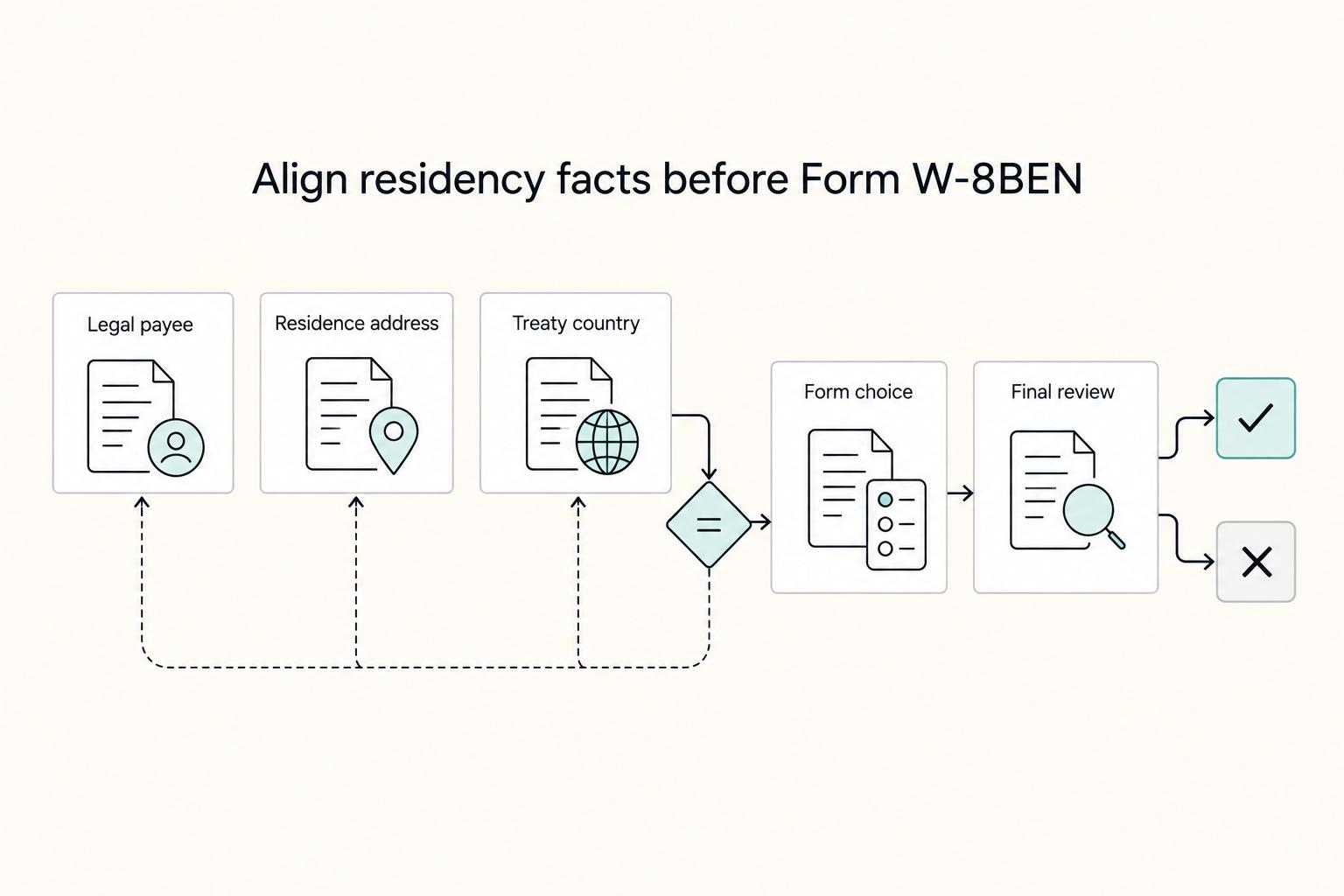
Do the prep first so Part II becomes a confirmation step, not a guessing exercise. Your residence address and treaty country should line up with your tax-residency position.
| Pre-fill item | Article requirement |
|---|---|
| Legal name | Full legal name of the beneficial owner/payee |
| Residence address | Permanent residence address in your tax-residency country |
| Residence address format | No P.O. box or mailing-only address; a descriptive address is permitted where street addresses are not used |
| Foreign TIN | Foreign TIN, or confirmation FTIN is not legally required |
| U.S. TIN | Only if required for your case |
| Date of birth | Use MM-DD-YYYY format where required |
| Treaty position | Treaty country and treaty-claim position you plan to use in Part II |
Step 4: Confirm treaty readiness before submission#
Treaty relief is conditional, not automatic. Before you submit anything, make sure your residency position, treaty basis, and TIN support all point the same way.
If you are claiming an exemption for personal services performed in the United States, use the applicable Form 8233 or W-4 route rather than this W-8BEN walkthrough. Effectively connected income generally calls for W-8ECI, with special rules for personal services. Resolve that classification before signing; a generic treaty statement cannot fix use of the wrong form.
Risk guardrail
If your residency status is ambiguous, your entity setup recently changed, or you are unsure which income category applies, do not submit until your classification is confirmed.
Related: How to Fill Out Form 1116 (Foreign Tax Credit).
Phase 2: Enter only facts you can support, then check for mismatches#
This is where avoidable errors happen. The safest approach is simple: enter only facts you can support, then check that those facts match the rest of your onboarding file.
Step 1: Fill the identity block, then run a mismatch check#
Complete Part I using your own tax identity. A trading name or platform nickname should not replace the beneficial owner’s name. Compare the result with the contract and payer record, explaining a legitimate trading-name difference rather than changing accurate tax information to match a nickname.
| W-8BEN line | What to enter | Practical check |
|---|---|---|
| 1 — Name | Your name as the individual beneficial owner | For a disregarded entity, use the owner’s information and identify the entity to the payer as instructed |
| 2 — Citizenship | Country of citizenship | For dual citizenship, apply the instructions; a U.S. citizen generally supplies W-9 |
| 3 — Permanent residence | Your tax-residence address, or normal residence if you have no tax residence | Treaty residence must satisfy the treaty; do not use a mailing-only address |
| 4 — Mailing address | Your mailing address if different from line 3 | A separate correspondence address does not establish treaty residence |
| 5 — U.S. TIN | SSN if you have one, or ITIN where applicable | Do not enter a foreign TIN here |
| 6a — Foreign TIN | Your tax-residence jurisdiction’s tax identification number when required | Check both treaty and covered-financial-account requirements |
| 6b — FTIN not legally required | Check only if the line’s exception applies to you | Not a shortcut for a lost or pending number |
| 7 — Reference numbers | Payer account or other reference information, if useful | Can identify a disregarded entity and its account without replacing your line 1 name |
| 8 — Date of birth | Use MM-DD-YYYY when required | Required in the covered U.S.-office financial-account circumstances described in the instructions |
Step 2: Only make a treaty claim you can defend from primary materials#
Part II is for an eligible treaty claim. On line 9, enter the treaty-residence country. On line 10, where required, give the article and paragraph, withholding rate, income type, and additional conditions that support the claim. Business-profits claims based on the absence of a U.S. permanent establishment require the representations described in the instructions. Use the actual treaty and applicable protocols, not another freelancer’s completed form.
A clean decision order helps:
- Confirm your source materials: work from current primary materials tied to your country and facts.
- Classify your income carefully: do not assume another country's wording, labels, or numbering apply.
- Write a plain-language statement tied to your facts: short, specific, and supportable.
For example, a non-U.S. designer who performs all services at home outside the United States may provide W-8BEN to document foreign status without claiming a treaty reduction in Part II. Keep the work-location facts with the contract. If the designer later performs part of the work in the United States, revisit sourcing, allocation, and the correct certificate before the next payment.
A line 10 claim must identify the actual treaty provision and conditions. A sentence saying only “I claim benefits under my country’s treaty” does not supply the required article, rate, income category, or supporting representations.
If a client requests W-9 or routes you into 1099-NEC onboarding, explain your documented foreign status and where the work was performed. The payer must determine its reporting obligations from those facts; W-8BEN is not a blanket promise that no U.S. reporting can apply. U.S.-source payments to foreign persons may instead require Form 1042-S, including certain payments exempt from withholding.
Step 3: Certify only after a final risk review#
Read every Part III certification before signing. Sign, print your name, date the form, and check the capacity-to-sign box as applicable. An authorized agent needs the supporting authority specified in the instructions. For electronic signatures, use the payer’s accepted process; typing a name alone is not sufficient. Then make these final checks:
- If you think any certified fact may have changed, pause and confirm with the payer what update process they require.
- Set a recurring compliance reminder plus an onboarding-time reminder for new clients.
- Escalate before signing if treaty eligibility is unclear, residency facts are uncertain, or your activities may involve U.S. trade-or-business exposure.
If U.S. trade-or-business facts are in play, do not guess. Income effectively connected with a U.S. trade or business can be taxable in the United States for nonresident aliens and foreign corporations.
Related: How to Fill Out Form W-8BEN-E for a Foreign Company.
Before you submit, run your details through this draft flow so your W-8 fields stay internally consistent and are easier for your client to review. W-8 Form Generator.
Phase 3: The Professional Workflow (After You Submit)#
Once the form is signed, the job becomes operational. You need to deliver it through the right channel, confirm the payer can use it, and keep records that let you resolve issues quickly. Send Form W-8BEN to the withholding agent or payer, not the IRS, and provide it before income is paid or credited when requested.
Step 1: Submit with a clear onboarding handoff#
Submit through the payer’s accepted secure channel before payment when requested. Tax identification numbers are sensitive, so confirm the recipient and avoid an unnecessarily broad email distribution. Use this handoff template:
- Subject:
Form W-8BEN for [Legal Name] - Purpose:
Attached is my completed Form W-8BEN for your vendor and tax records. - Confirmation request:
Please confirm receipt and let me know whether anything else is needed to complete onboarding. - Attachment/security note:
The signed form is attached [or uploaded via your portal]. If you need additional information or documentation to rely on it, please let me know.
Completion check: you should be able to identify who received it, which channel you used, and whether the payer confirmed it is usable in their process.
Step 2: Use the delivery channel the payer can process#
The right delivery method depends on the payer's policy, document sensitivity, setup effort, and whether you will have a clean audit trail later.
| Channel | Best fit | Client policy fit | Sensitivity level | Setup effort | Audit trail quality |
|---|---|---|---|---|---|
| Client/vendor portal | Formal intake workflow | Use when portal upload is required or preferred | Depends on portal access controls | Varies by client process | Can be strong if upload date/user are logged |
| Direct email to onboarding/AP/tax contact | Named contact and accepted email intake | Use when forms are handled by email | Depends on mailbox controls and forwarding practices | Varies by client process | Can be workable if you retain sent mail and replies |
| E-sign platform/request | Electronic certification flow | Use when electronic signatures are accepted and requested supporting information is provided | Depends on platform controls | Varies by client process | Can be strong when signer/date/history are captured |
Step 3: Keep a compact compliance pack per client#
Keep one client-level compliance file with clear version labels. It does not need to be elaborate, but it does need to let you reconstruct what was sent and when. A simple file should include:
- Signed W-8BEN version actually submitted
- Submission proof, such as portal confirmation, sent email, or e-sign history
- Client acknowledgment, even a brief "received" reply
- Any Part II treaty statement or support note you provided
- Any replacement form after a change in circumstances
- Any Form 1042-S received for that client
A simple naming pattern helps:
ClientName_W-8BEN_YYYY-MM-DD_submitted.pdfClientName_W-8BEN_YYYY-MM-DD_replaced.pdf
A practical test: months later, you can still show which version was in effect and when the client acknowledged it.
Step 4: Follow up, escalate, and schedule refresh points#
Do not assume silence means the form was accepted. If no acknowledgment arrives on your normal follow-up cadence, or on the payer's stated timeline, use a simple escalation path, then set two reminders:
| Trigger | Action | Timing or detail |
|---|---|---|
| No acknowledgment on your normal follow-up cadence or the payer's stated timeline | Initial check-in | Ask your original contact whether W-8BEN was accepted for onboarding |
| Ownership is unclear | Handoff | Request the accounting, AP, or tax onboarding contact |
| Issue is treaty eligibility, article wording, or fact mismatch | Compliance escalation | Escalate to the client's tax or compliance team |
| Form validity monitoring | Validity reminder | W-8BEN generally runs from signing through December 31 of the third succeeding calendar year, unless a change makes it incorrect; certain exceptions allow longer validity. Signed October 4, 2026, the ordinary expiry is December 31, 2029. |
| Certified information becomes incorrect | Change-in-circumstances reminder | Notify the payer within 30 days and submit a new W-8BEN or other appropriate form |
For a step-by-step walkthrough, see A UK Limited Company's Guide to Filling Out Form W-8BEN-E.
Keep the form usable after onboarding#
The value here is not in filling one form correctly once. It is in running a repeatable process that keeps your payee setup, treaty position where applicable, submission trail, and follow-up records aligned over time. When those pieces stay consistent, clients and tax teams can rely on your file with less back-and-forth. Use this closeout checklist:
- Confirm you used the individual W-8BEN rather than importing company-form line numbers.
- Check lines 5, 6a and 6b against your actual TIN requirements; support any Part II claim on lines 9 and 10.
- Explain trading-name or disregarded-entity differences without changing the beneficial owner’s accurate tax identity.
- Retain the signed version, submission proof, acknowledgment, treaty support where applicable, and replacement history.
- If you receive Form 1042-S, compare the recipient details, income code, gross income and withholding with your records; ask the issuer to correct genuine errors.
Then keep a simple routine:
- Renewal reminder: set a periodic reminder in your onboarding cycle to confirm the form on file is still current.
- Change review: recheck the form if your tax residence, legal name, entity status, or treaty eligibility changes.
- Client record confirmation: periodically confirm each payer still has the current signed version and log any
Form 1042-Sreceived.
Replace the certificate when a change makes it incorrect, and notify the payer within 30 days under the IRS change-in-circumstances rules. A new U.S. tax status, a different beneficial owner, or an unsupported treaty position can require a different form rather than a cosmetic edit. Keep both versions and their effective dates so the client can identify the certificate used for each payment.
Frequently Asked Questions
Which form should you use?
A nonresident alien individual beneficial owner generally uses W-8BEN; a foreign entity beneficial owner generally uses W-8BEN-E. U.S. persons generally use W-9. Disregarded entities, intermediaries and services performed in the United States require the more specific classification checks described above.
How do you claim treaty benefits?
For the individual W-8BEN, enter the treaty-residence country on Part II line 9. Complete line 10 where the claim requires an article and paragraph, rate, income type and additional representations. Confirm eligibility under the actual treaty. An exemption claim for personal services performed in the United States generally belongs on the applicable Form 8233 or W-4 route.
Do you need an ITIN or can you use your foreign tax ID?
Line 5 is for an SSN or ITIN; line 6a is for an FTIN. Treaty claims generally require a U.S. TIN or an appropriate FTIN, with specific exceptions. Some circumstances require a U.S. TIN regardless, while covered financial accounts have their own FTIN rules. Line 6b is a limited “not legally required” exception, not a general substitute for either number.
What happens if you do not submit a valid form?
Missing or invalid documentation can trigger foreign-person withholding at 30% or backup withholding under the applicable rules. That is not a universal rate on all freelance payments: service-income sourcing generally depends on where the work was performed. Ask the payer which payment, source classification and withholding rule it applied, and retain the notice and your submitted certificate.
Who should receive the form?
Submit it through your payer's required onboarding path. That may be a vendor portal, a finance workflow, or a named tax or AP contact, but it is not a one-size-fits-all destination. Keep proof of submission and acknowledgment, and escalate if the payer changes your record type or requests a different W-8 form without a clear reason.
When do you renew or replace it?
W-8BEN is generally valid from its signing date through December 31 of the third succeeding calendar year, unless a change makes the information incorrect; some exceptions permit longer validity. A form signed October 4, 2026 ordinarily lasts through December 31, 2029. Notify the payer within 30 days of a relevant change and provide a new W-8BEN or other appropriate certificate.
Try a related tool
Researched and edited by the Gruv editorial team. Gruv builds cross-border billing, payouts, and finance-operations software for global businesses.
Sources
Educational content only. Not legal, tax, or financial advice.
Related Posts

Digital Nomad Taxes in 2026 With a Defensible Filing Plan
With digital nomad taxes, the first move is not optimization. It is figuring out where you may be taxable, where filings may be required, and what proof supports that position.

The Freelance Payment Penalty: A Modeled Audit of Platform Fees, FX Spreads, and Payout Delays
The money rarely disappears through a single, easy-to-spot fee. The real loss is stacked. A marketplace takes its commission, a processor adds a charge for international cards, a bank or payment company converts the currency at a spread, a platform holds the funds before release, and a wire sheds a little to intermediaries on the way in. Each layer looks defensible on its own, but the worker feels the combined result as a smaller deposit and a later payday.

How to Respond to a Subpoena for Business Records
Move fast, but do not produce records on instinct. If you need to **respond to a subpoena for business records**, your immediate job is to control deadlines, preserve records, and make any later production defensible.