
Quick Answer
Tipalti offers AP workflows for supplier invoices and Mass Payments workflows for platform payees, including branded onboarding and self-billing. Choose by where your obligation originates and how it must be approved. Verify the contracted modules, country-method eligibility, required tax checks and reconciliation outputs before launch.
Evaluate Tipalti by operating fit, not feature lists#
For platform teams, understanding Tipalti payouts means deciding which workflow to buy and who will operate it. Ask whether its AP or Mass Payments product fits your approvals, reconciliation needs, payee experience, and launch countries. The product name alone does not establish that scope.
- Start with the decision, not the marketing story
Start with the source of the obligation. Supplier invoices may need purchase-order matching and finance approval; creator earnings may arrive as an approved amount from your platform ledger. Both need reliable payout and reconciliation controls, but they need different steps before release. Payroll also carries employee-specific requirements that a mass-payout integration alone does not establish.
-
A domestic batch and a cross-border batch can look similar in finance, but FX, bank identifiers, intermediaries and local requirements create different failure paths. Test those paths for your actual launch corridors.
-
Expect an AP-centric lens, not a generic payments overview
This article focuses on supplier and partner disbursements. Tipalti offers separate Accounts Payable and Mass Payments products. AP includes invoice processing and matching; Mass Payments includes branded payee onboarding, APIs and self-billing invoicing. Compare the contracted workflows rather than assuming that all Tipalti payouts start with an AP invoice.
- Read this if you run payout operations, skip it if you need freelancer onboarding help
This is for platform builders, finance owners, ops leads, and engineering teams managing supplier or partner disbursements. It is not a guide for an individual payee choosing a method. Before buying, validate the exact country, currency, method, payer entity and payee-type combinations in your initial cohort. Broad coverage language does not establish eligibility for each combination. For onboarding controls, see How Platforms Validate Bank Accounts Before Mass Payouts.
How to choose the right payout model for your platform#
Choose an AP workflow when supplier invoices, approvals and ERP records drive release. Choose a mass-payments workflow when your platform calculates partner or creator earnings and needs onboarding and disbursement at scale. Confirm employee payroll requirements separately.
| Criterion | What to confirm | Why it matters |
|---|---|---|
| Fit to operating context | Whether obligations originate in supplier invoices, self-billing or a platform ledger, and which product covers them | The approval and evidence requirements differ; verify employee payroll separately |
| Compliance gating depth | How KYC and AML checks gate payment release | Holds should be clear to operators, consistently enforced, and reviewable when exceptions happen |
| Tax compliance support | Tax forms, withholding and reporting applicable to each payee and payment type | Required data and exceptions need an approved hold or withholding policy |
| Rail coverage and reconciliation quality | Localized payment methods, multi-currency support, and ERP connectivity that supports reconciliation across entities and FX flows | If auditability and exception handling are your blocker, prioritize policy controls and traceability over broad coverage claims |
- Fit to operating context
Start with your operating flow. Tipalti AP can handle invoice processing and matching, while Mass Payments supports platform-oriented onboarding and self-billing. Identify which product and modules you are evaluating, then test the obligations your team must create, approve and settle.
- Compliance gating depth
Look at how KYC and AML checks gate payment release. The practical test is whether holds are clear to operators, consistently enforced, and reviewable when exceptions happen.
- Tax compliance support
Define the tax information required for each payee and payment type, including W-8 or W-9 handling where applicable. Confirm collection, validation, withholding and reporting responsibilities with your tax team. Missing required information should follow your approved hold or withholding policy; do not impose the same form on every payee.
- Rail coverage and reconciliation quality
Require localized payment methods, multi-currency support, and ERP connectivity that supports reconciliation across entities and FX flows. If auditability and exception handling are your blocker, prioritize policy controls and traceability over broad coverage claims.
What Tipalti payouts cover and what they do not#
Tipalti-style mass payouts are built for batch disbursements across countries, currencies, and payment methods, but they are not a universal replacement for every payment workflow.
- Mass payouts are the core use case
Mass payouts are designed to pay multiple recipients in a single batch, not one by one. In practice, this combines payee onboarding, tax compliance, and disbursement execution in one payout flow.
- Global scope adds capability and complexity
Global payouts involve funds moving between parties in different countries and/or currencies. That usually means payment processing plus compliance management, with rails such as international wire transfers and cross-border EFTs, but actual availability is still bounded by corridor, currency, and method.
- Separate AP, mass-payments and payroll scope
Do not infer product scope from the word payouts. Tipalti AP offers invoice processing, approvals and PO matching, and Mass Payments offers self-billing invoicing with configurable approvals. Confirm which modules are included and where your ERP or platform remains the record of the obligation. Neither capability establishes complete employee payroll coverage.
- Verify contract scope, not just marketing scope
Before you sign, confirm the exact country-method pairs you need, the currencies on those corridors, and which onboarding or tax-form checks can hold release. Cross-border payouts introduce rail, tax-form, and regulatory complexity that can create exceptions your domestic batch assumptions did not expose.
The three operating paths teams actually choose#
Most teams choose based on where payout control needs to live: finance operations, product experience, or both.
| Operating path | Best for | Key pros | Key cons | Implementation load | First 90-day risk |
|---|---|---|---|---|---|
| AP-centric payout platform | Finance-heavy organizations with supplier disbursements tied to ERP | Centralized compliance and approval controls, ERP-connected execution, less fragmented manual work | Vendor coupling, contract-scope constraints, less product-level flexibility | Medium to high (finance and ERP work first) | Finding late that needed country/currency/method combinations are out of scope |
| Marketplace-native payouts stack | Product-led teams building partner, creator, or affiliate payout UX | Tighter in-product experience, custom status visibility, faster UX iteration | More internal ownership for compliance operations, exception handling, and payout support | High | Launching front-end payout flows before operational ownership is clear |
| Hybrid model | Scaling teams with both supplier and non-salary partner payout flows | Keeps AP controls where they matter and adds flexibility for product-facing payout experiences | More integration points, harder reconciliation, split ownership across systems | High | Conflicting payout states across ERP, payout tooling, and product data |
- AP-centric payout platform
Choose this path when payment release depends on supplier invoice controls and ERP reconciliation. Tipalti AP can connect matching, approvals and execution; confirm that these are included in your implementation rather than assuming they are part of every mass-payments contract.
If your process depends on 3-way match, keep that requirement front and center: purchase order, invoice, and receiving report are compared before release to catch errors and fraud. In that AP context, control quality usually matters more than front-end payout polish.
- Marketplace-native payouts stack
Choose this path when payout experience is part of the product itself. It gives your team control of onboarding, in-app status design and partner communication. This can still use a vendor: Tipalti Mass Payments advertises branded onboarding and API integration, so test those options before treating custom UX as a reason to build every layer.
The tradeoff is operational ownership. Your team has to define who handles compliance checks, eligibility logic, and payout exceptions as you scale. That becomes more urgent if expansion is on a 12-24 month horizon, because gaps in ownership tend to surface fast.
- Hybrid model
Choose hybrid when you need AP discipline for supplier payments and more modular payout flows for partners or creators. It supports phased migration without forcing every payee type into one model immediately.
The cost is integration complexity. Before you build, define system-of-record ownership for supplier/payee data, approvals, release state, and reconciliation evidence so teams can resolve payout status conflicts quickly.
This pairs well with our guide on How Platforms Can Offer Instant Payouts as a Premium Feature Without Margin Surprises.
Which payout rails fit which disbursement scenarios#
Choose rails based on exception visibility for your core payout pattern, not headline fees. If one failed payment creates more support and reconciliation work than the fee savings, pick the rail that gives your team clearer status and traceability.
| Rail option | Best fit | What to verify |
|---|---|---|
| International wire transfer | When bank-to-bank interoperability across borders matters most | How payee banking details are validated at onboarding and how payment references flow back into your ERP or payout ledger after release |
| Local bank transfer methods in your provider's cross-border stack | Repeat, high-volume, non-salary disbursements | Contract-level eligibility before you design the workflow around a method |
| Alternative payment methods and online payout platforms | If you use alternatives beyond bank transfers | Whether pending, failed, and returned states are clear enough for both finance and support, including what payees see versus what your internal teams can reconcile |
- International wire transfer
Use wires when bank-to-bank interoperability across borders matters most. In this context, international wire transfers are one of the cross-border complexities global payout software is meant to handle, not the default for every payout pattern.
Before rollout, test validation and traceability. Use a bad account format, an incomplete instruction and a valid instruction in the vendor demonstration. Confirm which errors are caught before submission, what still depends on receiving-bank checks, and how provider references return to your ERP. Format validation alone does not prove account ownership or successful delivery.
- Local bank transfer methods in your provider's cross-border stack
For repeat, high-volume, non-salary disbursements, start by testing local bank transfer methods your provider actually supports for your program. That aligns with the mass-payout model: paying many recipients in a single batch across borders, currencies, and payment methods.
Validate contract-level eligibility before you design the workflow around a method. Tipalti states support for cross-border payments in multiple currencies and payment methods, but that does not guarantee every country-currency-method combination is live for your entities.
- Alternative payment methods and online payout platforms
If you use alternatives beyond bank transfers, evaluate them first on operational visibility, not just recipient-facing convenience. The key question is whether pending, failed, and returned states are clear enough for both finance and support to resolve issues quickly.
Ask to see the full status journey before rollout, including what payees see versus what your internal teams can reconcile. Global payout solutions are supposed to consolidate fragmented payment and compliance work, so avoid methods that recreate fragmentation through unclear statuses or weak audit evidence. Related: Intermediary Bank Explained: How Correspondent Banking Adds Fees to Your Payouts.
What to verify before signing any AP-centric payout contract#
Treat the contract as a controls document first. In an AP-centric payout deal, the core question is whether the platform gives you reliable checks, evidence, and reconciliation outputs, not just payout coverage or headline pricing.
| Check area | What to ask for | Why it matters |
|---|---|---|
| Control workflow and proof artifacts | How controls are applied across the process and what records your team receives for audit and reconciliation | AP internal controls are framed as checks and balances that reduce duplicate payments, fraud, compliance failures, and human error |
| Pre-release validation logic | What must align before funds are released and what evidence is retained when something does not align | If release criteria are vague, exception handling will be vague too |
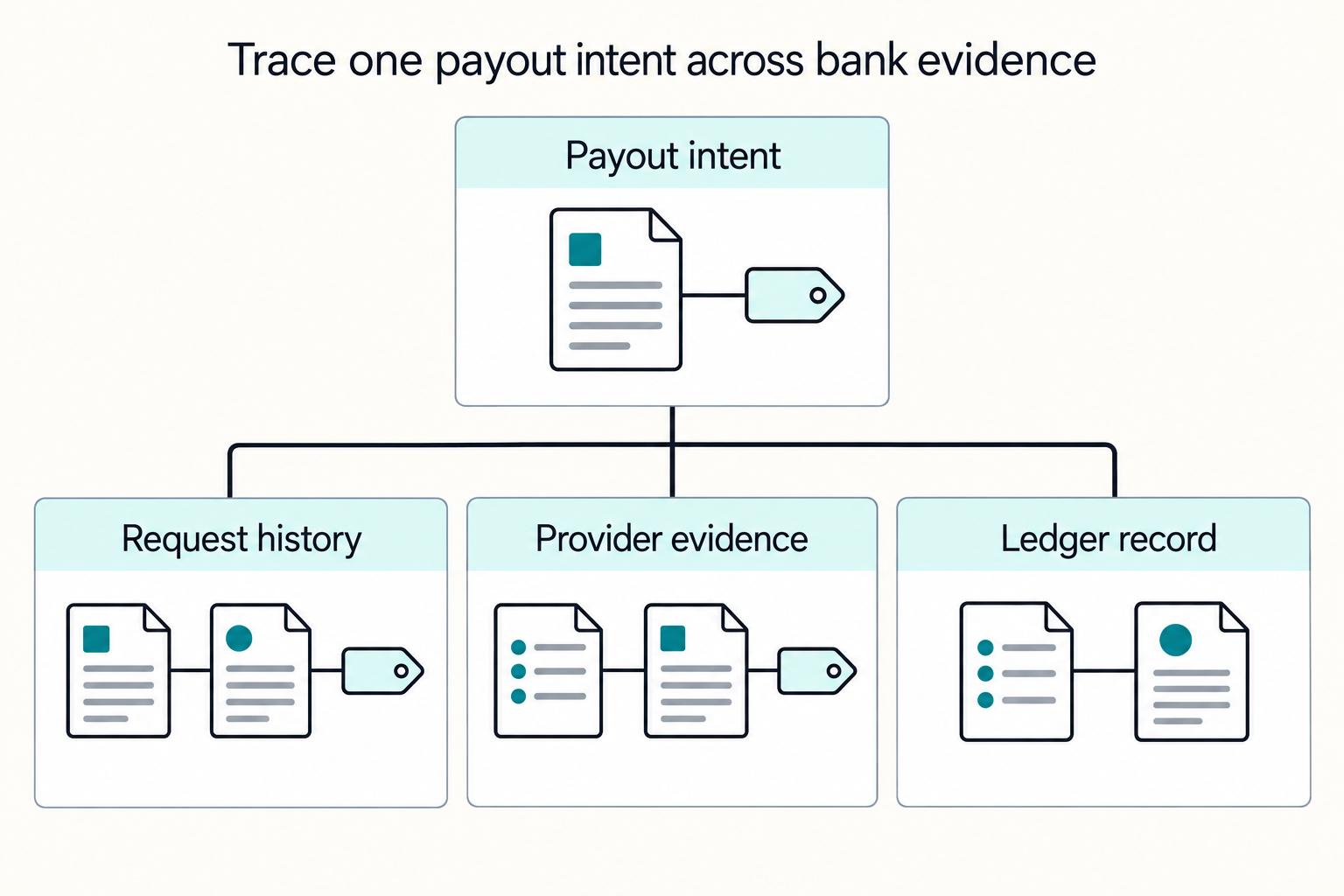
| Transaction-level history | Sample histories that show event timing, actor identity, and provider reference data | Your team should be able to follow one payout from initiation through exception and final outcome using exported artifacts |
| Automation and export readiness | Sample export files and field mapping before kickoff | If evidence and exports are only described verbally, treat scope as unverified |
- Build a due-diligence matrix around control workflow and proof artifacts
Start with control points, approval flow, and evidence outputs you can test before signature. Ask the vendor to map how controls are applied across the process and what records your team receives for audit and reconciliation. AP internal controls are framed as checks and balances that reduce duplicate payments, fraud, compliance failures, and human error, so your matrix should test those outcomes directly.
- Verify pre-release validation logic, not just UI labels
Require a clear explanation of what must align before release and what evidence is retained for exceptions. For PO-backed supplier invoices, test the configured two- or three-way matching rules and authorized tolerances. For platform-calculated earnings, test the approved ledger obligation instead; a receiving report is not the right evidence for every payout.
- Require transaction-level history your team can operate from
Ask for sample histories that show event timing, actor identity, and provider reference data your teams can trace across support, finance, and audit review. If you cannot follow one payout from initiation through exception and final outcome using exported artifacts, your reconciliation risk remains high.
- Confirm automation and export readiness before contract signature
Verify how much work stays manual in your actual flow and what exports your ERP receives. Ask for sample files, field mappings and a reconciliation demonstration before kickoff. Treat verbally described exports as unverified scope.
If a vendor answer cannot be tied to contract language, implementation specifications or sample artifacts, keep that requirement unresolved before launch.
Implementation sequence that avoids expensive rework#
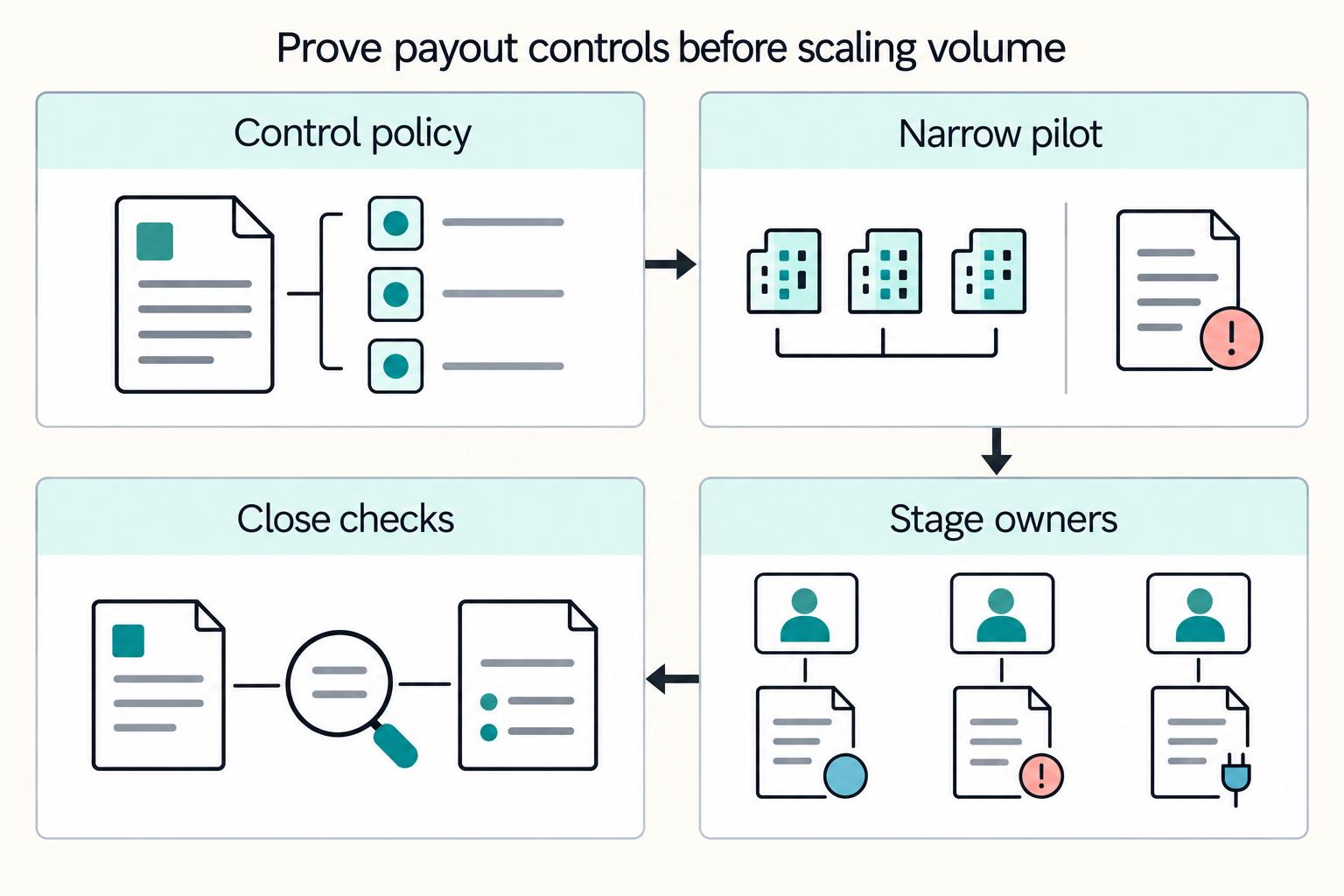
Implement in audit order: set control policy first, run a narrow pilot second, and scale only after finance, ops, and engineering can each prove their part works.
- Set control policy before building payout orchestration
Define release controls before integration work starts: evidence of the obligation, validated payee and payment data, authorized approval, and records of execution. Assign an owner and an exception path to each step. Changing those rules after orchestration is built can require both code and operating-process rework.
- Run a narrow pilot before expanding volume
Pilot with a small, inspectable cohort so you can verify real exception handling, not just the happy path. This matters because manual uploads may work early, but become time-consuming and error-prone as volume grows, while an API is meant to replace that drift. Treat pilot success as traceable outcomes across the workflow, not just successful submissions, especially if you plan to pay 100 or 10,000 suppliers through one process.
- Assign ownership by control stage
Successful payout API integration requires planning across developers, finance, and compliance teams. Keep ownership explicit by stage: who approves, who handles exceptions, and who maintains integration reliability. If those boundaries are unclear before launch, exceptions will stall between teams.
- Use close-cycle supervision as the scale gate
Expand only when controls are consistently clean at cycle close. Review duplicate prevention, unresolved returns, compliance holds and ledger differences. A submitted batch is not a completed close: finance must be able to explain its final outcomes and any remaining balances.
Common failure modes and the decision rules to contain them#
These failures usually come from scope, coverage, compliance readiness, and reconciliation drift rather than the happy path. Contain them early with clear rules before volume scales.
- Mis-scoped use case
Separate employee payroll requirements from supplier AP and partner earnings. Then decide whether the latter need invoice matching, self-billing or an approved platform-ledger obligation. A shared disbursement provider can support multiple workflows without making their approval and tax rules identical.
If one flow is trying to handle employees, suppliers, creators, and affiliates under the same policy, stop and split the requirements. Your approval policy should explicitly define which populations belong in the mass-payout lane.
- Coverage mismatch
Do not assume "global payouts" means every country-method combination is ready for your launch cohort. The grounded standard is support for localized payment methods and multiple currencies, so validate country, method, currency, and payee-type fit before contract signature.
Run that validation against your initial cohort before onboarding at scale. This avoids finding corridor gaps only after payees are already in motion.
- Tax bottlenecks
Complete the information and screening required for the specific payee, payer entity and payment program before release. Define which deficiencies cause a hold, who can resolve them and whether withholding applies. Run a pre-payout check each cycle rather than assuming the original onboarding state remains valid.
Do not wait for support tickets to surface missing compliance data. Keep an auditable record of who changed compliance details, when they changed, and the payee's eligibility at release time.
- Reconciliation drift
Keep payout status and ERP state aligned every day, or exceptions become audit risk. For cross-border disbursements, automated mass payout processing is most effective when integrated with ERP or accounting systems, so reconciliation must be an operating control, not a monthly cleanup task.
Use a daily exception report keyed first to provider reference, then payee, amount, currency, and final status, with operator audit logs attached. If a payout cannot be tied cleanly from source record to ERP entry to provider reference, keep it unresolved until the trail is complete.
For a step-by-step walkthrough, see How to Handle Unclaimed Payouts: Escheatment Rules and Dormant Funds Compliance for Platforms.
Conclusion#
-
Connect the obligation to its final outcome. Determine whether you need supplier AP, platform mass payments or both. Then test onboarding, approvals, release, returns and reconciliation as one workflow.
-
Confirm the launch combinations in writing. Use your actual payer entities, payee types, countries, currencies and methods, including an exception case. Global reach alone cannot answer those questions.
-
Prove the integration before expanding. Tipalti supports payment instructions through APIs or files. Pilot the chosen path with a narrow cohort and show finance how each obligation becomes an executed payment, a return or an unresolved balance.
-
Give exceptions a named owner. Missing tax data, rejected bank details and ambiguous payment statuses require someone who can investigate and record the outcome. Include those cases in the pilot acceptance criteria.
-
Choose based on the remaining gaps. Compare the contracted workflow against your invoice, recipient UX and reconciliation requirements. Expand only after the pilot passes. To discuss country and program support with Gruv, Talk to Gruv.
Frequently Asked Questions
What are Tipalti payouts in plain terms for a platform team?
Tipalti payouts combine payee onboarding and outbound payment processing with finance controls. Its AP product adds supplier invoice workflows; Mass Payments supports platform payees and self-billing. In either case, verify how your selected product connects the approved obligation to release, exceptions and reconciliation.
How are mass payouts different from payroll and standard accounts payable invoice payments?
Mass payments handle batches of payees whose earnings may originate in a platform ledger or self-billing process. Supplier AP can start with invoices and purchase orders; payroll needs employee-specific calculations and reporting. Tipalti offers AP and Mass Payments products, so choose the contracted workflow rather than assuming its payout layer excludes invoice processing.
Which payment rails are usually used for cross-border disbursements?
The available method mix depends on your implementation. Tipalti lists bank-transfer options such as international wire and local transfers, but you still need eligibility by country, currency, payer entity and payee type. Test the actual launch combinations and their return handling.
What compliance steps should be complete before any payout is released?
Complete the tax information, screening and payment-instruction checks required for the specific program. Tipalti describes instructions being validated before payer and payment-provider approvals, followed by release and success or failure notification. Confirm which checks cause holds and who resolves them. For US-reportable payments, assign form collection, withholding and 1099 or 1042-S responsibilities before queuing funds.
When should a team choose an AP-centric payout platform instead of building in-house?
Choose an AP workflow when supplier invoice approvals and ERP reconciliation are the main problem. If recipient UX is central, evaluate the Mass Payments portal and APIs too. Compare the gaps you would have to build and operate, including compliance, support and exceptions, before deciding to build in-house.
What data and status visibility should ops require to reduce payout support tickets?
Ops should be able to see whether a payee completed required tax forms, where the payment sits in the payment cycle, and whether release succeeded or failed. Tipalti states payers are notified of payment success or failure, but that alone is not enough for support. Ask for validation errors, approval-stage visibility, and an audit trail showing who changed payee or payout data and when, where available.
What must be verified with sales before rollout on fees, timing, and country-method eligibility?
Get a written eligibility matrix for your initial countries, currencies, payer entities and payee types. Confirm fees, FX pricing, funding requirements, cutoffs and expected timing by rail. Ask what each status proves, when a return can arrive and how it changes reconciliation; public coverage claims and generic success labels are not enough.
Try a related tool
Researched and edited by the Gruv editorial team. Gruv builds cross-border billing, payouts, and finance-operations software for global businesses.
Sources
Includes 5 external sources outside the trusted-domain allowlist.
Educational content only. Not legal, tax, or financial advice.
Related Posts
How Intermediary and Correspondent Banks Change Payout Outcomes
Intermediary and correspondent bank payout fees are often a settlement-path issue, not random noise. When your sending bank and receiving bank are not directly connected, other banks can enter the path, and each handoff can change what the beneficiary receives.

The Freelance Payment Penalty: A Modeled Audit of Platform Fees, FX Spreads, and Payout Delays
The money rarely disappears through a single, easy-to-spot fee. The real loss is stacked. A marketplace takes its commission, a processor adds a charge for international cards, a bank or payment company converts the currency at a spread, a platform holds the funds before release, and a wire sheds a little to intermediaries on the way in. Each layer looks defensible on its own, but the worker feels the combined result as a smaller deposit and a later payday.

How to Respond to a Subpoena for Business Records
Move fast, but do not produce records on instinct. If you need to **respond to a subpoena for business records**, your immediate job is to control deadlines, preserve records, and make any later production defensible.