
Quick Answer
Handle unclaimed payouts by separating normal payment delays from potential unclaimed-property cases, then tracking dormancy from a ledger-based start event, preserving outreach and approval evidence, and applying jurisdiction-specific rules. Automate scheduling, routing, and evidence capture only where inputs and rules are fixed. Escalate unclear triggers, treatment conflicts, and any change that could affect filing posture or legal interpretation.
What Platforms Need to Do When Payouts Go Unclaimed#
Unclaimed payouts are a real compliance duty, but controls should be proportionate to risk and evidence needs. For compliance, legal, finance, and risk owners, the practical goal is to decide what to automate now, what needs human review, and what should be escalated before an audit or state inquiry.
Step 1 Set a practical decision goal#
Use this guide to make operating decisions. By the end, you should be able to separate repeatable work from judgment calls: dormancy tracking for systems, case review for operations or finance, and legal escalation where state treatment is not uniform.
The legal baseline is straightforward. Unclaimed property is an outstanding liability beyond a specified period, and escheat is the transfer of that property to the state for safekeeping until the owner comes forward. State laws require annual reporting of outstanding liabilities and eventual transfer of reportable property, so your controls should be proportionate and defensible.
Step 2 Avoid solving the wrong problem#
Poor scoping creates avoidable risk. Teams may treat stale payouts as routine backlog for too long, or apply heavy controls to every delay when the issue is a normal payout exception.
That distinction matters because rules vary by jurisdiction. Dormancy periods are often described in a one-to-five-year range, but there is no single nationwide regime and no two states' unclaimed property laws are the same. If you assume one clock, one notice pattern, or one universal search standard, you can build the wrong process. Open-ended search expectations can also waste resources.
Before you automate anything, confirm three basics: which liabilities are in scope, which jurisdiction assumption you are using, and whether your records can support an annual reporting position.
Step 3 Build for evidence, not just throughput#
Audit readiness depends on evidence, not queue speed. Your process should show how a payout moved from outstanding liability to potential unclaimed-property treatment, who approved the decision, and which state-specific assumption was used.
The rest of this guide gives you a concrete sequence, decision checkpoints, and a monthly checklist your team can run. Expect clear boundaries between automated steps, manual review, and escalation for state-law ambiguity or policy conflicts. Where outcomes depend on jurisdiction, use this as operating guidance, not a substitute for jurisdiction-specific legal advice.
Define what counts as unclaimed payouts in your product#
A payout is not necessarily unclaimed just because it is late. Treat it as potentially unclaimed when a balance is tied to a clear outstanding-liability event plus a documented jurisdiction assumption under applicable U.S. Unclaimed Property Statutes. From that point, Escheatment should be handled as a compliance process, not optional cleanup.
Step 1 Draw a hard line between delay and dormancy risk#
Keep normal payout delay in an operations bucket and potential unclaimed property in a separate compliance bucket. Use a concrete start event from your ledger for each in-scope balance, not generic account inactivity or an old profile timestamp.
A useful control check is to sample aged items and confirm that each case has a traceable liability start event and a documented jurisdiction assumption.
Step 2 Classify balances by source and owner status#
Your classification should reflect how the balance arose and who the owner is in your records. Unclaimed status should be evidence-based, not inferred from age alone, so each case should map back to documented ledger facts and owner status.
For each category, keep a compact evidence set: source event, captured date, owner identifier, jurisdiction assumption, and any exclusion reason.
Step 3 Treat the trigger as a compliance handoff#
Once your policy-defined trigger is met for the relevant jurisdiction, treat the case as a compliance handoff, not routine ops follow-up. From that point on, notice, reporting posture, and potential remittance under applicable State Escheatment Laws should move through controlled handling.
Do not apply a single-state rule across all markets. NAUPA describes programs across all 50 states, the District of Columbia, and Puerto Rico, and no two state unclaimed property statutes are identical, even where core procedures are similar. If your policy borrows RUUPA-style concepts, document known unknowns early wherever a state's actual process may differ.
Gather the minimum data and documents before you change process#
Do not treat a process change as controlled until your records can explain each in-scope balance from start to finish. If you cannot reconstruct owner identification and location efforts and account actions from source records, fix data quality before rollout.
Step 1 Confirm the account record can explain the balance#
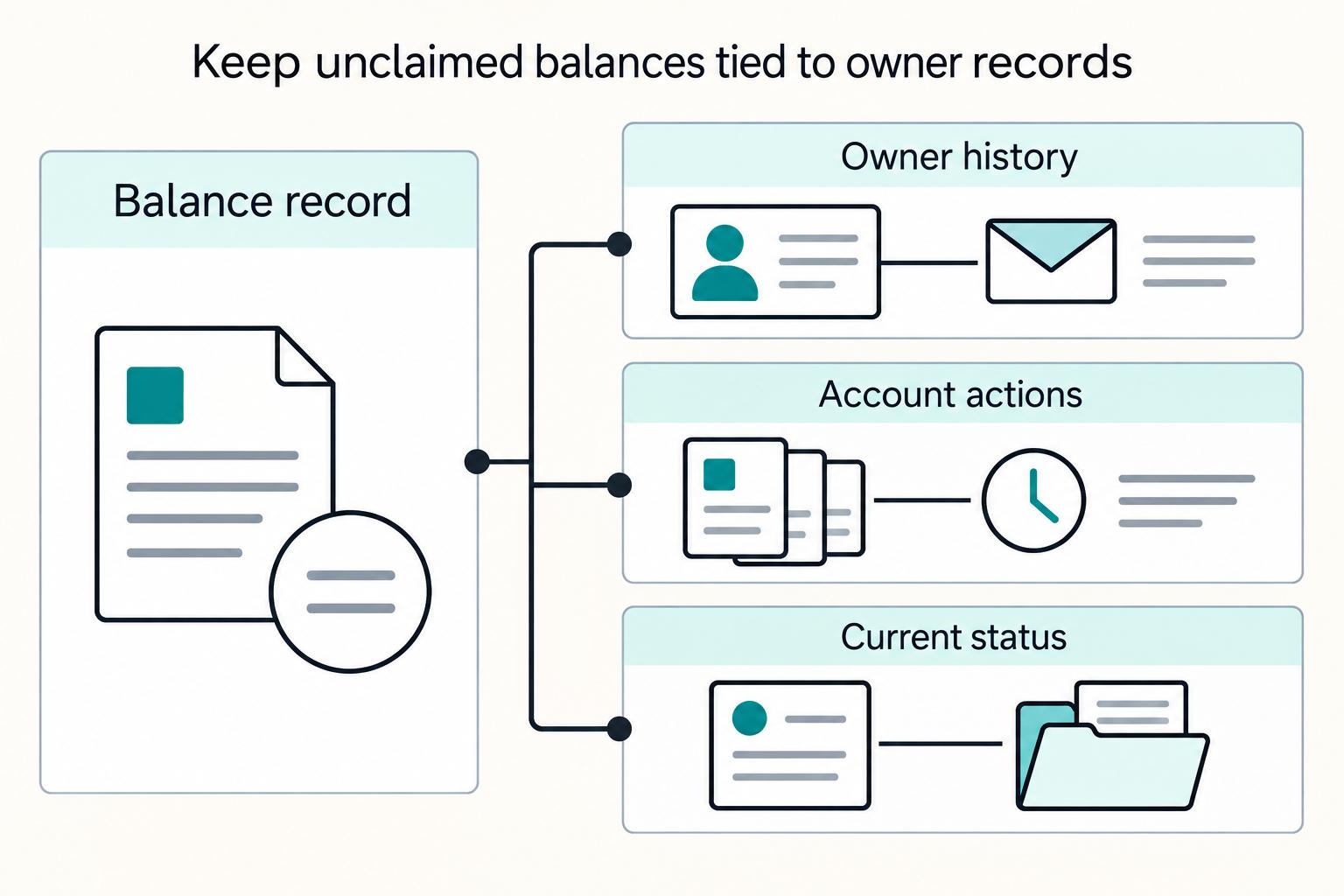
Start with the underlying account documentation, not surface dashboard fields. Confirm the record shows who the owner is, what actions were taken throughout the account life cycle, and what procedures were used to identify and locate owners tied to unclaimed balances.
Your control standard is simple: another reviewer should be able to trace a sampled balance from source event to current status without operator hand-holding. If they cannot, the record is not strong enough yet.
Step 2 Verify cross-system record lineage where it affects auditability#
Where related operational records exist, confirm they tie back to the same account and lifecycle actions. The point is not to force extra artifacts into every unclaimed-funds decision. It is to preserve one coherent evidence trail that management can review and rely on.
If owner and account-action records do not tie cleanly across systems, later review turns into manual reconstruction and weakens controlled handling.
Step 3 Assemble the baseline evidence pack before changing logic#
Before automation, assemble the core documentation that substantiates appointments and actions, the records used to identify and locate owners, and the procedures used to process work uniformly. That gives you a usable baseline for checks and balances.
Set one gate: if source records in that pack are incomplete or inconsistent, treat the change as not yet controlled and remediate the records before rollout.
Related: FATCA and W-8 Tax Compliance for Platforms: How to Avoid Withholding on Foreign Payouts.
Assign ownership before you automate anything#
Once your records can withstand review, ownership becomes the next control. Do not automate dormancy, notice, or remittance decisions until one named person can show who decided, who approved, and what evidence supports each step.
Step 1 Name one decision owner for each control point#
Assign explicit decision rights across the teams involved, often legal, compliance, finance, and ops. At minimum, name an owner for dormancy trigger logic, notice approval, remittance signoff, and exceptions. If no one owns a decision from start to finish, automation can turn a policy gap into repeated production behavior.
Treat this as a holder obligation, not a shared team chore. For each action, define a primary owner, an approver, and a backup. Use a simple checkpoint structure: activity, responsibility, and date. If any material step is missing one of those fields, the matrix is not ready.
A quick test helps here: pick one balance and ask, "Who can approve dormancy classification today?" If the answer is a team alias, shared inbox, or chat thread, ownership is still unclear.
Step 2 Separate document ownership from release ownership#
Define who drafts and maintains due-diligence notices or letters used in your process, who approves content, and who releases notices. A practical split is legal or compliance for template and trigger approval, ops for sending and evidence capture, and one filing-certification owner, often finance or compliance, to confirm filing completeness before remittance.
Do not stop at letter generation. The release owner should be accountable for the artifact trail: template version, recipient list, send date, channel, bounce or return signals, and notice identifier when used. That matters because response flows may depend on a control number. If a reply cannot be tied to the exact notice, your due-diligence record is weak.
Step 3 Set a standing law-change review cadence#
A standing monthly review can work for State Escheatment Laws and potential Multi-State Audits exposure. This is an internal control choice, not a claim that every jurisdiction requires monthly review.
Log the jurisdiction, source checked, effective date, impacted control, and release owner. Do not rely only on a statute-database view. Illinois notes that database updates can appear before they take effect. If you monitor 765 ILCS 1026, record the related Public Act and effective-date markers shown there, such as eff. 1-1-18; 100-863, eff. 8-14-18, before updating production rules.
Step 4 Appoint one escalation owner for policy conflicts and examiner contact#
Assign one escalation owner for cases where legal interpretation conflicts with operating policy. This person should be able to pause a release, open a tracked exception, and route to counsel when needed.
That same ownership should cover examiner interactions, including third-party examiners. If one person cannot quickly assemble the policy version, notice evidence, remittance support, and approval trail for a request, assign that owner before automating anything else.
Build a jurisdiction rule matrix your team can actually maintain#
Once ownership is clear, you need one place where legal rules and production behavior meet. Your matrix should be explicit and hard to misread. If a row does not point to a real statute and a real operating action, it is not ready to drive dormancy, notice, or remittance decisions.
Step 1 Build rows around jurisdiction, property type, and legal anchor#
Create one row for each jurisdiction and property-type combination you actually hold. Keep the core columns even when values are still pending legal review: Dormancy Period, notice timing, remittance cadence, exemptions, governing statute, and row owner. Do not guess missing values. Make unknowns visible before they become code or filing behavior.
Use concrete legal anchors. For Pennsylvania, tie the row to 72 P.S. 1301.1, et seq. For California, use Code of Civil Procedure Section 1500 et seq. Labels like "PA law" or "CA UPL" are too vague for reliable review.
Add a field for how the apparent owner is determined from holder records. If a row does not show which record establishes entitlement for that property type, it is too abstract to defend.
Step 2 Record assumption checks directly against each jurisdiction's statute#
Add an assumption check note to each row, and tie it to the jurisdiction's governing text. The useful test is simple: what did you assume, and where does the statute confirm or reject that assumption?
California shows why that matters. The relevant statute describes state custody rather than ownership, and notes that property received under the UPL should not permanently escheat. Section 1501.5 is cited on that point. If your matrix treats remittance as permanent forfeiture, your legal note and reunification logic are misaligned.
Pennsylvania raises a different risk signal. Holder obligations can apply to entities inside and outside the Commonwealth when property belongs to Pennsylvania residents. Capture that in row notes so jurisdiction mapping does not break when operations sit elsewhere.
Step 3 Add operational translation fields your team can execute#
The legal columns tell you what must be true. The operational fields tell your team what to do. Set jurisdiction-specific trigger rules, approval gates, and evidence artifacts explicitly as internal controls.
For each row, include Required trigger, Human approval point, and Evidence artifact generated.
Keep those fields testable and specific. "Notify user" is vague. "Release approved notice template and retain send log plus bounce or return status" is practical. "Review by finance" is weak. "Finance certifies filing completeness before submission" is auditable.
If you cannot trace one sample row from trigger input to named approver to stored evidence, the matrix may not be ready for audit response or consistent filings.
Step 4 Keep a versioned change log tied to production and filing impact#
Use a versioned change log, not just tracked edits. At minimum, record jurisdiction, statute cited, what changed, why, approver, row-change date, production-change date, and affected filing periods.
California's scope clarification is a good model of useful metadata: amendment date (June 23, 2025), hearing date (July 14, 2025), and whether property-type scope changed, for example digital financial assets. Even when the immediate impact is limited, that structure makes review decisions traceable.
Do not stop at "policy updated." Add explicit fields for production rule changed (yes/no) and filing posture changed (yes/no). Those fields let you explain why report populations, remittance decisions, or exception queues changed, especially under multi-jurisdiction examination.
Run dormancy and due diligence in a fixed sequence#
A fixed sequence can be a strong internal control. If the evidence is out of order or incomplete, treat the case as not filing-ready.
| Sequence step | Action | Required record |
|---|---|---|
| Detect inactivity | Anchor inactivity to ledger events and freeze one decision timestamp for Dormancy Period tracking. | Store the timestamp with the triggering event and the policy or rule version used at that time. |
| Trigger outreach | Run owner outreach in a defined order. | Keep attempt history, including the template or version used, send time, delivery outcome, and failed attempts. |
| Remittance prep | Route only unresolved cases forward. | Attach the frozen timestamp, applied rule reference, and outreach evidence. |
| Pre-file QA | Block submission when required fields or supporting artifacts are missing. | Keep the case in exception status until the record is complete or escalated. |
Use this as an operating rule for defensible case movement from inactivity detection through final review.
Step 1 Detect inactivity from ledger events and freeze the clock#
Anchor inactivity to ledger events, then freeze one decision timestamp for Dormancy Period tracking. Store that timestamp with the triggering event and the policy or rule version used at that time so later reviews can reconstruct the decision without guesswork.
Step 2 Trigger outreach in sequence and preserve proof#
Once the timestamp is fixed, run owner outreach in a defined order. If your program uses Due Diligence Letters, keep complete attempt history in the case record, including the template or version used, send time, delivery outcome, and failed attempts.
Step 3 Route only unresolved cases to remittance prep#
Only unresolved cases should move forward. Before handoff, require a complete packet with the frozen timestamp, applied rule reference, and outreach evidence attached so the case can be reviewed without manual reconstruction.
Step 4 Run a pre-file QA gate and fail closed#
Use a pre-file QA gate that blocks submission when your required fields or supporting artifacts are missing. If sequence evidence is incomplete, fail closed and keep the case in exception status until the record is complete or escalated.
Keep policy references current and versioned. Static snapshots can go stale, so your team should rely on maintained full-text sources with visible version history rather than detached one-off copies.
Related reading: Cross-Border Streaming Rights and Billing: How EU Portability Rules Affect Your Platform.
If you are operationalizing this sequence in product workflows, map the controls to statuses and webhook events in the Gruv docs.
Choose what to automate and what must stay in legal review#
Automate repeatable controls, and keep legal interpretation out of production logic until legal review is complete. The boundary is simple: deterministic workflow behavior belongs in systems, and ambiguous legal treatment belongs in review.
| Workflow item | Treatment | Condition |
|---|---|---|
| Scheduling | Automate | Use fixed inputs and versioned rules. |
| Task routing | Automate | Keep the same trigger event, rule version, notice template version, and required output fields for every run. |
| Evidence capture | Automate | Preserve case-level evidence, including the trigger event, rule version, send history, and manual overrides. |
| Report assembly | Automate | Use repeatability checks so the same sample population produces the same statuses, timestamps, notice versions, and outputs. |
| Ambiguous triggers | Manual review | Keep review manual when triggers are ambiguous. |
| Treatment conflicts | Manual review | Keep review manual when treatment conflicts. |
| New exception class | Manual review | Keep review manual when a new exception class is being introduced. |
| Policy change that could alter legal interpretation or filing posture | Legal review before release | Include the proposed rule text, affected scope, before-and-after samples, expected case impact, and approval record in the release packet. |
Step 1 Automate the controls that are deterministic#
Automate repeatable workflow controls such as scheduling, task routing, evidence capture, and report assembly when they run from fixed inputs and versioned rules. Keep the same trigger event, rule version, notice template version, and required output fields for every run.
Use a repeatability check: rerun the same sample population and confirm the same statuses, timestamps, notice versions, and outputs. If results change without a rule update or data correction, treat that as a control failure. Preserve case-level evidence, including the trigger event, rule version, send history, and manual overrides.
Step 2 Keep interpretation manual when scope or treatment is unclear#
Keep review manual when triggers are ambiguous, treatment conflicts, or a new exception class is being introduced. Do the same when external material is informative but not clearly in scope for your program.
For example, the July 2021 unclaimed-royalties report is explicitly scoped to the Mechanical Licensing Collective. In that context, recommendations are to be given substantial weight. That supports a governance checkpoint, not automatic reuse in platform policy without legal review.
Step 3 Require legal review when filing posture can change#
Use a hard if-then gate: if a policy change could alter legal interpretation or filing posture, require legal review before release. Include the proposed rule text, affected scope, before-and-after samples, expected case impact, and approval record in the release packet.
If that packet is incomplete, the decision is harder to defend later.
Step 4 Evaluate vendors for proof, not promises#
Evaluate automation vendors on whether they let you prove decisions later, not on broad claims that they "handle state rules."
- Rule transparency: visible logic, effective dates, and version history
- Audit trail depth: retained trigger event, decision timestamp, notices, reviewer actions, and export history
- Override controls: authorized overrides that preserve original outcomes, reasons, and approvers
- Export integrity: complete case and batch exports usable for later review
Also check source-handling discipline. eCFR content is authoritative but unofficial, so verify page currency before relying on it, for example "up to date as of 4/02/2026." Route content questions to the publishing agency. OFR staff do not answer document-content questions.
Standardize treatment across payout rails and account types#
Use one compliance record for each potentially unclaimed accrued balance, and log rail behavior as delivery evidence. Do not assume ACH, RTP, PayPal, Venmo, and card push methods can share identical legal treatment unless a more specific approved procedure says they can.
Step 1 Set one compliance record before rail-specific execution#
Create one ledger-level case with the trigger event, decision timestamp, owner identifier, payout method on file, and the notice and review artifacts for that balance. Before material adverse action, keep the baseline checkpoints in that case: written digital notice stating the factual basis and legal authority, a reasonable opportunity to respond with evidence, neutral decision-making, and any available appeal or review path. Rail systems should reference this case instead of creating separate compliance states.
Step 2 Separate rail events from compliance determinations#
Record ACH, RTP, wallet, and card outcomes as operational events, then map them back to the same case. That keeps retries, detail updates, and method switches visible without assuming they automatically change compliance status or legal timing. If compliance status changes, require a documented rule, corrected source event, or approved manual decision in the case history.
Step 3 Treat rail-specific edge cases as policy decisions until defined#
For debit card push flows, handle failed credits, stale recipient details, and replacement-card scenarios as policy exceptions unless your approved procedure already defines treatment. For each exception, capture the original payout instruction, processor response, whether funds returned to the ledger, owner outreach sent, and who approved the next action. Use Debit Card Push Payouts: How Platforms Deliver Funds Directly to Any Visa or Mastercard Debit Card for delivery mechanics, not legal conclusions.
If your payout flows cross borders, our guide to Cross-Border Compliance Checklist for Platform Payouts: Licenses Registrations and Reporting by Country can help you map the country-level rules that sit alongside dormant funds and escheatment obligations.
File, remit, and retain evidence for audit defense#
Treat filing as a controlled release, not a batch export. If the evidence pack, approval trail, or jurisdiction authority is incomplete, pause submission.
| Jurisdiction or material | How to use it | Why it matters |
|---|---|---|
| Illinois | Verify the section source note and the related Public Act before treating a rule as filing-ready authority. | The RUUPA page warns that recent laws may not yet be in the ILCS database and that statutory changes can appear before they take effect. |
| Florida | Anchor authority to codified Chapter 717. | Do not rely on internal policy text alone. |
| Minnesota HF 4120 | Keep it in monitoring, not production filing logic. | It is shown as introduction material for the 2025-2026 session, not codified statute text. |
Step 1 Freeze the filing release until legal authority is current#
Before generating a report, confirm that your jurisdiction map reflects effective law, not stale rules-table text, compiled statute text taken at face value, or introduced bill language.
Use Illinois as a release-gate model. The Revised Uniform Unclaimed Property Act page warns that recent laws may not yet be in the ILCS database and that statutory changes can appear before they take effect. If a section source note references a Public Act, verify that note and the related Public Act before treating the rule as filing-ready authority. Apply the same check in other states. In Florida, anchor authority to codified Chapter 717 rather than internal policy text alone.
Keep introduced bills in monitoring, not production filing logic. Minnesota HF 4120 is shown as introduction material for the 2025-2026 session, not codified statute text.
Step 2 Assemble one minimum evidence pack for each filing batch#
Build each batch so a reviewer can reproduce it from the case archive alone. At minimum, retain the triggered rule version, notice proof where applicable, owner-contact history, the remittance file submitted, and the approval trail that released the batch.
Make rule metadata specific enough to defend later: jurisdiction, property type, version date, and any manual exception approval tied to that batch. For owner evidence, keep contact attempts tied to the apparent-owner record used at filing time, since Illinois defines the apparent owner as the person whose name appears on holder records as owner.
Use this verification check: sample one filed item and confirm you can trace the dormancy trigger, notice evidence where applicable, unresolved status, remittance row, and approver identity without leaving the case archive.
Step 3 Structure records for Multi-State Audits, not internal convenience#
Organize records so you can produce them by jurisdiction, owner, property class, filing period, and submission history, not only by product line or processor.
Keep both operating and examination views available. Illinois examination activity can involve contracted agents and independent contractors, so assume evidence may be reviewed beyond your immediate team. On request, you should be able to produce the filed batch, supporting case records, and approval history without rebuilding data in ad hoc spreadsheets.
Waiting until an audit notice arrives can create rework, inconsistent totals, and disputes over which export is final.
Step 4 Limit access and retain only what review actually needs#
Retain enough detail to defend the filing, but do not expose full personal-profile data in every review export.
Link reviewer-facing evidence to source records, and restrict broad access to fields necessary for review. Illinois treats confidential information as including personal information under the Personal Information Protection Act, so retention and access controls should account for that risk. A practical model is a reviewer-facing evidence layer plus controlled access to full-PII source records, with documented approval for wider disclosure.
Set escalation rules before exceptions stack up#
Set escalation rules around one principle: if a case could lead to material adverse action, do not let it move on ad hoc judgment.
Step 1 Escalate any pre-action case that is missing legal clarity#
If the team cannot clearly identify the governing authority for a pending action, pause the case and escalate for legal review before operations proceeds. The escalation note should state the case facts, the authority you believe applies, and what action is currently blocked.
Step 2 Require a written digital notice before action#
Before any material adverse action, require a written digital notice that states the factual basis and legal authority. Treat missing or vague notice language as an escalation trigger, not a formatting issue.
Step 3 Enforce the full baseline process before release#
Use a release checklist that confirms all baseline process elements are present: notice, a real opportunity to respond with evidence, a neutral decision-maker, and appeal or judicial review rights as provided by law. If any element is missing, hold the action and escalate.
Step 4 Check whether a more specific procedure overrides the baseline#
Do not assume the baseline process always controls. If the governing text includes a qualifier like "Unless a more specific procedure is provided in this act," treat that as a mandatory interpretation check and escalate before final action.
Step 5 Add an internal stop-rule for exception overload#
When unresolved exceptions outpace team handling capacity, you can pause new rule changes and clear the pre-action backlog first. Treat this as an internal control choice, not a requirement established by the cited process excerpts.
Fix the common failure modes that trigger rework#
Once escalation rules are in place, the next job is reducing rework. Repeat defects often cluster in four areas: wrong Dormancy Period start logic, weak Due Diligence Letters evidence, drift between legal guidance and production settings, and payout-rail events that do not match compliance status.
Step 1 Correct the dormancy trigger before touching notices#
If the start date is wrong, everything downstream is unreliable. Re-run the affected population with corrected trigger logic, then document which records changed status, which batches were touched, and which cases must be pulled back from filing prep.
Verify with case samples against the trigger event defined in your policy. Do not rely on majority-state assumptions for this check. State Unclaimed Property statutes are not identical, and some states follow different processes in some areas.
Step 2 Backfill notice evidence, not just notice status#
"Letter sent" is not enough when evidence is missing or inconsistent. Backfill the actual notice package, delivery proof or channel log, template version, and the case timestamp that ties notice to the compliance decision.
Then route those cases through QA before they move forward. This helps catch mixed evidence standards that can appear when operations are scaled from partial guidance rather than complete jurisdiction-by-jurisdiction review.
Step 3 Reconcile legal guidance with live configuration#
Treat policy drift as a control failure, not a minor mismatch. Compare three items side by side: approved legal interpretation, current rule matrix, and deployed configuration driving case state.
In each review cycle, confirm the legal reference is current using visible "up to date as of" and "last amended" metadata where available. Use this as a currency checkpoint, not as an exhaustive 50-state rule set.
Step 4 Reconcile payout-rail events to compliance state before filing#
Before the next filing cycle, reconcile rail logs, return or failure events, and source-ledger status against each case's compliance state. Flag records where operations show funds movement but compliance still shows unresolved status, or the reverse.
When mismatches appear, hold the batch and rebuild the evidence pack before filing.
For a step-by-step walkthrough, see Gig Worker Tax Compliance at Scale: How Platforms Handle 1099s W-8s and DAC7 for 50000+ Contractors.
Conclusion and copy paste checklist#
Use this as your recurring operator checklist to show accountable, uniform handling of funds held for others, with records that can be reconstructed under review.
- Confirm jurisdiction matrix updates for State Escheat Laws and related unclaimed-funds rules.
Log what changed, or did not change, who reviewed it, and which internal rule version is now in force.
- Verify triggered cases have complete evidence and approvals.
For each triggered case, confirm the file includes owner-identification efforts, owner-contact history, and approval history. If evidence is incomplete, keep the case out of filing-ready status.
- Reconcile transaction events to ledger and compliance state.
Match transaction events to ledger status and compliance status so each case has one traceable record path.
- Review exceptions and document escalation decisions.
Escalate cases that change filing posture, span jurisdictions, or expose historical record gaps, and record any legal or counsel decision in the case file.
- Archive an audit-ready cycle pack.
Store the rule-matrix version used, affected population, contact-attempt evidence, approvals, and filing or remittance artifacts together so regulatory reviews can be answered from one coherent record set.
Before finalizing rollout across jurisdictions, confirm policy gates and market coverage with your team and contact Gruv.
Frequently Asked Questions
What is escheatment for platform payouts in practical terms?
escheatment is a workflow handoff rather than routine cleanup. An unresolved payout balance moves from normal operations into legal or compliance review under a documented jurisdiction assumption. The article does not present this as a universal legal trigger or definition.
When do dormant funds become reportable unclaimed property?
There is no universal timing rule in the article. Dormancy periods vary by jurisdiction, often within a one-to-five-year range, and no two states' unclaimed property laws are the same. Treat reportability as a jurisdiction-specific legal question, not a generic aged-funds rule.
Who should own unclaimed payouts compliance across legal, finance, and ops?
The article does not prescribe one required function as the owner. It says to assign explicit owners for dormancy trigger logic, notice approval, remittance signoff, exceptions, and escalation. If ownership is unclear, resolve it internally across legal, compliance, finance, and ops before automating.
How often should dormancy and jurisdiction rules be refreshed?
The article does not give a universal refresh cadence. It says a standing monthly law-change review can work as an internal control, but not that every jurisdiction requires monthly review. Keep changes logged with the jurisdiction, effective date, impacted control, and release owner.
Can one control approach cover ACH, RTP, PayPal, Venmo, and card push payouts?
No single blanket approach should be assumed across ACH, RTP, PayPal, Venmo, and card push payouts. The article recommends one compliance record for each potentially unclaimed accrued balance, while logging rail behavior as delivery evidence. Rail events should map back to the same case without assuming they automatically change legal treatment or timing.
What records prove due diligence was completed if an audit starts?
The article does not define a universal legal minimum evidence pack. It recommends retaining attempt history, notice template or version, send time, delivery outcome, failed attempts, owner-contact history, the triggered rule version, and the approval trail. Avoid relying on undated or scope-unclear evidence.
When should a platform consider a Voluntary Disclosure Agreement?
The article does not provide a rule for when a Voluntary Disclosure Agreement is appropriate. It treats questions that could change legal interpretation or filing posture as legal review issues. If a VDA is being considered, escalate to specialist counsel rather than relying on payout operations data alone.
Researched and edited by the Gruv editorial team. Gruv builds cross-border billing, payouts, and finance-operations software for global businesses.
Sources
- abnk.assembly.ca.gov/system/files/2025-07/sb-822-analysis.pdftrusted
- calbar.ca.gov/Portals/0/documents/ethics/Publications/Port...trusted
- copyright.gov/policy/unclaimed-royalties/unclaimed-royalti...trusted
- dol.gov/sites/dolgov/files/EBSA/about-ebsa/about-us/...trusted
- dol.gov/sites/dolgov/files/EBSA/about-ebsa/about-us/...trusted
- ecfr.gov/current/title-7/subtitle-B/chapter-XVII/part...trusted
- eregulations.ct.gov/eRegsPortal/Search/getDocumenttrusted
- fdic.gov/bank-examinations/section-2-operations-contr...trusted
Educational content only. Not legal, tax, or financial advice.
Related Posts

The Freelance Payment Penalty: A Modeled Audit of Platform Fees, FX Spreads, and Payout Delays
The money rarely disappears through a single, easy-to-spot fee. The real loss is stacked. A marketplace takes its commission, a processor adds a charge for international cards, a bank or payment company converts the currency at a spread, a platform holds the funds before release, and a wire sheds a little to intermediaries on the way in. Each layer looks defensible on its own, but the worker feels the combined result as a smaller deposit and a later payday.

How to Respond to a Subpoena for Business Records
Move fast, but do not produce records on instinct. If you need to **respond to a subpoena for business records**, your immediate job is to control deadlines, preserve records, and make any later production defensible.

A US Expat's Guide to Investing in UCITS ETFs to Avoid PFIC Issues
The real problem is a two-system conflict. U.S. tax treatment can punish the wrong fund choice, while local product-access constraints can block the funds you want to buy in the first place. For **us expat ucits etfs**, the practical question is not "Which product is best?" It is "What can I access, report, and keep doing every year without guessing?" Use this four-part filter before any trade: