
Quick Answer
EU portability rules mainly affect access continuity, not billing architecture. For paid online content services, subscribers can keep using the service while temporarily present in another Member State, with residence verification at contract conclusion and renewal using no more than two verification means. Platforms should separate entitlement decisions from tax, invoicing, payout, refund, and settlement changes unless a separate legal basis applies.
What EU portability means for your streaming platform#
The core risk is usually not reading the rule. It is getting legal, compliance, finance, risk, and product teams to agree on what the rule does and does not cover. At a streaming platform, portability questions often get mixed with access, eligibility, billing, and evidence decisions. Teams can each be partly right and still leave material gaps.
Regulation (EU) 2017/1128, adopted on 14 June 2017, sets a common EU approach to the cross-border portability of online content services. It supports subscriber use of lawfully provided services while they are temporarily present in another Member State. It is not a general right to cross-border access, so use that distinction as your first control gate before you change entitlement settings or related billing workflows:
- Is the service in scope for portability?
- Which Member State of residence is relevant?
- Is this a portability case, or a different cross-border access issue?
Where teams usually split the problem#
In practice, this often fragments in execution. Legal may own interpretation, while Finance, Payments Ops, and Engineering each own a different part of implementation. Keep one shared control structure: one rule interpretation, one reporting checklist, and one escalation map. If your team splits ownership early, you will spend more time reconciling exceptions than resolving them, so we recommend naming one operator owner for your control map.
A simple early check helps. Can every team point to the same legal source and the same internal policy note? If not, pause. The EUR-Lex consolidated text is useful for reading, but it states that it is a documentation tool with no legal effect. Build controls from the operative regulation text, your internal legal interpretation, and the product and billing events you actually rely on.
What this article will help you build#
The goal here is practical: an operating model that assigns decision ownership, defines a reporting checklist for exceptions and evidence, and sets an escalation path for scope questions that should not be settled ad hoc. We use this kind of map so your legal, billing, and support leads know where you expect a scope question to stop and escalate.
That operating model matters because portability decisions are easy to blur with billing or money-movement assumptions. Keeping those separate, and documenting who approves edge-case interpretations, is what reduces avoidable surprises.
Start with documented escalation, not improvised fixes#
Some boundaries are still case-sensitive, so the safest first move is to document how unclear cases get reviewed before anyone starts fixing access or billing manually. Commission materials explicitly raise edge questions, including time limitation and cross-border worker scenarios. The Regulation refers to temporary presence for a limited period and to actual and stable residence, but this wording does not give a fixed maximum duration.
When scope is unclear, escalate through documented legal review, especially for free-service scenarios, because free-service portability is optional and provider-dependent. The failure pattern to avoid is simple: access and billing actions happen first, and the legal interpretation gets written down later.
Define the legal baseline before touching billing logic#
Do not let billing logic move ahead of the legal baseline. For portability, use Regulation (EU) 2017/1128 of the European Parliament and of the Council, dated 14 June 2017, as the starting point, not product notes or support summaries.
Use the regulation terms precisely#
For portability, cross-border portability of online content services means a subscriber can keep accessing and using a service while temporarily present in another Member State. Treat that as continuity during temporary presence, not as a broader cross-border access right. Keep the scope line clear as well. The Regulation does not apply to taxation, so do not use it on its own to redesign VAT, invoicing, or payout handling.
"Online content service" is defined in the Regulation by reference to Articles 56 and 57 TFEU. "Digital content services" is not a defined term in that Regulation. If your team uses that label internally, map it to Directive (EU) 2019/770 of 20 May 2019. There, digital content is data supplied in digital form, and digital service includes services that let consumers create, process, store, or access digital data.
Keep the institutional trail straight#
Be precise about the legal source. This is a Regulation of the European Parliament and of the Council. For internal orientation, the European Parliament Legislative Train Schedule is useful because it tracks the file and records adoption by Parliament and Council in May and June 2017.
For controls, use a stricter checkpoint. Verify against the Official Journal text and record the citation OJ L 168, 30.6.2017, p. 1 (via EUR-Lex). In your evidence pack, include the act title and the exact definitions your policy depends on.
Treat summaries as orientation, not control evidence#
Secondary summaries can help people get started, but they should not anchor controls. LexisNexis and ACT are useful orientation sources, not primary control evidence. A common failure mode is building from summaries, then discovering conflicting repository labels or relying on consolidated text marked as documentation-only. Base approvals on the Official Journal legal text (available via EUR-Lex), your internal legal interpretation, and the specific definitions cited in policy.
| Source | Use | Control status |
|---|---|---|
| Official Journal text (via EUR-Lex) | Verify the legal text and citation OJ L 168, 30.6.2017, p. 1 | Primary control evidence |
| EUR-Lex consolidated text | Useful for reading | Documentation tool with no legal effect |
| European Parliament Legislative Train Schedule | Internal orientation on the file and adoption by Parliament and Council in May and June 2017 | Orientation only |
| LexisNexis | Useful orientation source | Not primary control evidence |
| ACT | Useful orientation source | Not primary control evidence |
Separate access portability from money movement obligations#
Keep portability and money movement on separate control tracks. Portability is about access continuity. Billing and payouts are separate money-movement decisions.
Under Regulation (EU) 2017/1128, the portability framework is about subscribers accessing and using an online content service when they are temporarily present in another Member State for a limited period. The Regulation also makes clear that portability is distinct from general cross-border access, which it does not cover.
For services provided against payment of money, the required action is on access. Article 4 deems provision, access, and use to occur solely in the subscriber's Member State of residence. That localisation rule addresses service rights, not payment-rail choices such as SWIFT versus local transfers or payout timing.
Use a strict decision rule. If a policy change affects only entitlement, access checks, or access continuity, do not automatically reopen payout-rail design. Change finance operations only when a separate legal or payments requirement supports it. If your change log touches only access logic, keep your finance workflow closed unless a separate payments trigger exists. We recommend writing that rule into the approval note so your billing and entitlement teams apply the same instruction.
Before you touch billing policy, keep these classifications explicit:
Paid subscription: portability access obligation applies.Without payment of money: provider opt-in, with residence verification as a condition.Ad-supportedorfreemiumlabels: treat classification as unresolved until Legal confirms where the model fits.
For auditability, record the same four items for each service variant: classification, whether portability is mandatory or optional, the residence-verification method used, and the rationale for any no-change decision on payout rails.
Map where portability can break your current subscription billing flow#
Once access rights and money movement are separated, map the handoffs end to end. On OTT paid subscriptions, problems can appear between billing, entitlement, and support.
For paid services, residence verification is a required checkpoint both at the conclusion and upon the renewal of a contract. That means your flow needs a legal checkpoint at signup and at renewal. Your access layer still has to support use during temporary presence in another Member State for a limited period, in the same manner as in the Member State of residence.
Signup and first entitlement#
At signup, a successful payment authorization is not enough by itself to grant portable access. First confirm that the service is in scope as an online content service. Then verify the subscriber's Member State of residence, meaning actual and stable residence, using not more than two verification means. After that, mark entitlement as portability-eligible. If your signup flow can activate service before residence evidence lands, add a hard stop and log who cleared it. We recommend treating that stop as a control your team can audit later, not as a payments retry.
One split outcome is billing success with missing or incomplete residence-verification evidence. The reverse is risky too. Entitlement is granted through a trial or early-activation path while charge collection fails, or the verification record never lands on the account. If IP address is one verification signal, keep it within privacy controls and log the purpose.
Renewal is a real control point#
Treat renewal as a separate compliance trigger, not just a recurring charge event. Do not assume the original residence evidence stays sufficient indefinitely because the subscriber remained active. Your renewal job needs a gate confirming that residence verification was completed, recorded, and tied to the active contract term. If your renewal batch skips that gate, you are treating billing success as a proxy for compliance. We recommend requiring the same evidence view at renewal that your team expected at signup. If you run renewals in batch, you should check your residence evidence before you post your next charge.
Two quiet breakages are worth watching closely. Billing renews while portability checks are skipped. Or product adds a travel-related surcharge tied to cross-border portability even though portability itself should not create additional subscriber charges.
Exception handling needs evidence, not goodwill#
Disputes can surface later, when access is denied, temporary presence is challenged, or support has already intervened manually. You do not need a new finance process for every case, but you do need a documented exception path with named approvers and logs that explain the decision.
Support should not override portability outcomes on its own. If residence is unclear, temporary presence is disputed, or service classification is unresolved, route the case to a named Compliance or Legal approver and link any billing action to that case. If you issue a refund or credit, keep records showing why access was denied, restored, or treated as an exception. If your support queue needs a fast answer, we recommend a standard note that tells reviewers what your team checked and what remains unresolved. If you need a fast answer, you can send your reviewer your exception note before your team changes access. This Regulation does not set a specific refund timeline.
| Stage | Data you need | Who should approve exceptions | Logs that prove the decision |
|---|---|---|---|
| Signup or contract conclusion | Service variant, paid subscription status, Member State of residence result, which verification means were used, count capped at two | Compliance or Legal if verification is incomplete or scope is unclear | Contract timestamp, verification outcome, means-used count, entitlement state change |
| Cross-border access event | Active subscription status, residence-verification status, indication that the user is temporarily present in another Member State | Compliance or Legal for disputed residence or repeated access denials | Access decision log, country or session signal used, reason code, reviewer if manually handled |
| Renewal | Renewal date, renewed contract reference, fresh verification checkpoint result | Compliance or Legal if renewal proceeded without valid evidence | Renewal job log, verification timestamp, subscription status, entitlement continuation record |
| Refund or dispute | Case ID, denied or restored access reason, subscription status, evidence attached to the case | Finance with Compliance or Legal signoff when the refund is tied to portability | Refund record, case notes, approval trail, linked access and billing events |
If you fix only one control first, fix the renewal gate. That is where billing, portability, and audit evidence can drift out of sync.
Related: Streaming Media Subscription Billing: How OTT Platforms Handle Billing Trials and Churn.
Decide service scope and eligibility without over-collecting data#
Get scope right before you apply billing or entitlement logic. The practical mistake here is collecting more data or building more logic before you decide whether the offer is even an in-scope portability case under Regulation (EU) 2017/1128.
Classify the service before you touch billing#
Run a short decision tree for every SKU or plan at signup and renewal, and rerun it when the product changes. "Digital" is too broad to support a portability decision. Digital content and digital services are wider categories, and not every digital offer is an online content service covered by portability rules.
| Decision point | If yes | If no | Billing and entitlement action |
|---|---|---|---|
| Is this an online service lawfully provided to subscribers in their Member State of residence? | Continue | Stop | Do not mark portability-eligible; do not apply portability billing logic |
| Is the subscriber tied to a Member State of residence based on actual and stable residence? | Continue | Stop | Hold portability entitlement until residence is verified |
| Is the offer clearly paid-for? | Continue | Escalate or exclude | Baseline paid coverage is clear; free content services fall outside that baseline in EU consumer guidance |
| Is the request about temporary presence in another Member State for a limited period? | Continue | Stop | Treat as a separate cross-border access question, not a portability one |
If your product team asks for permanent roaming behavior or broad foreign-market access, route that as cross-border access design, not portability.
Map the outcome to billing actions#
Once the service is classified, map the result to a small set of explicit account states: in-scope and verified, in-scope but pending verification, and out-of-scope or escalated. At contract conclusion and renewal, only in-scope and verified should enable portability-linked entitlement.
Keep the record narrow but auditable:
- service classification result
- paid or free status
- Member State of residence verification result
- verification means used for residence checks, capped at no more than two sources
- contract conclusion or renewal timestamp tied to that result
If evidence exceeds two verification sources, treat that as a control issue, not as stronger compliance.
Keep the evidence pack narrow#
More data does not mean better control. Collect only what supports the eligibility decision and later audit traceability. For this decision, that usually means the classification result, paid or free status, residence result, verification means used, and the contract or renewal timestamp already tied to the account state. Data minimization still applies, so evidence should be adequate, relevant, and limited to what is necessary for the portability decision.
Add a real stop-and-escalate branch#
Make the escalation path hard to bypass when the facts are not clean. Route the case to Legal or Compliance when:
- service classification is unclear, for example between online content services and broader digital content or service categories
- interpretation is unclear for the specific case
- residence becomes doubtful during the contract
When doubt arises, residence verification may be repeated, but it should happen through documented review, not a support-side override.
Related reading: Right-to-Disconnect Rules for Freelancers in Cross-Border Contracts.
Assign control ownership across Legal Finance Payments Ops and Engineering#
Once scope is set, name the owners before anyone changes billing code or support process. A practical split is by decision type. Legal interprets portability scope, the accountable business owner approves operating choices, Finance and Payments Ops evidence money-side execution where money-side behavior is affected, and Engineering evidences what the service actually allowed or blocked.
That split matters because portability is narrower than many teams assume. EU portability rules address access continuity for subscribers temporarily present in another Member State. They do not apply to taxation, and they are separate from broader cross-border access design. When ownership is vague, teams can start changing access, billing, or payout behavior without a clear legal record.
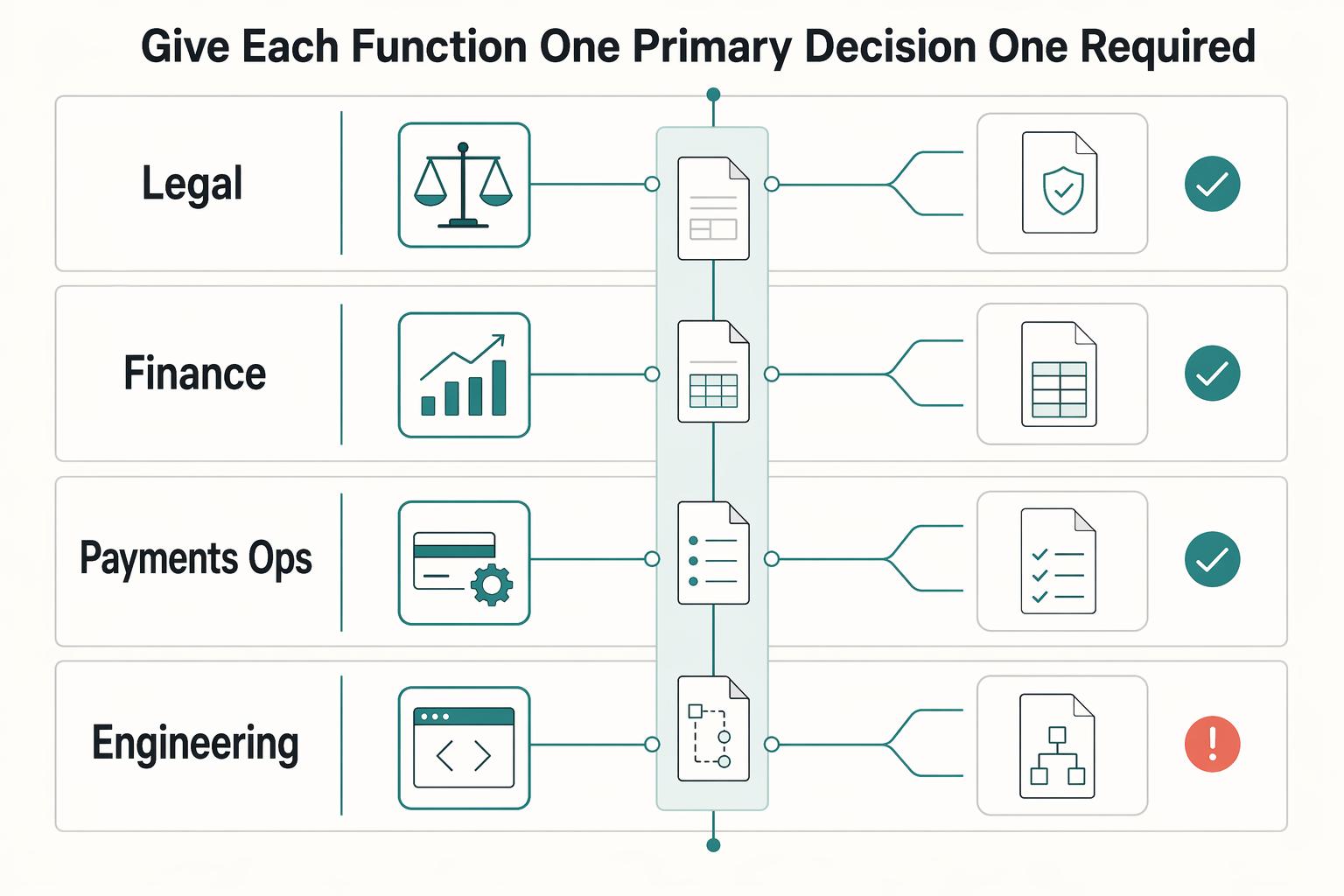
Give each function one primary decision and one required artifact#
Keep responsibilities explicit, named, and documented.
| Function | Primary ownership area | Required artifact | Required checkpoint | Common failure mode |
|---|---|---|---|---|
| Legal | Portability scope interpretation, residence-verification position, and whether a proposed change is actually tied to Regulation (EU) 2017/1128 | Policy memo | Memo confirms legal source text used for operative wording, plus known limits and out-of-scope items | Teams act from documentation summaries alone |
| Finance | Subscription billing controls, reconciliation design, and accounting treatment for charges, credits, refunds, and exceptions linked to approved portability decisions | Control checklist | Checklist maps billing events to decision states: in-scope and verified, pending verification, out-of-scope | Charges or refunds processed without trace to the eligibility decision |
| Payments Ops | Execution of payment exceptions and settlement handling under approved policy | Execution logs | Logs show who acted, when, against which approved case or policy version, and manual overrides | Manual fixes bypass the approval path and cannot be reconstructed |
| Engineering | Entitlement logic, event capture, and incident evidence of what access was granted or blocked | System events | Events capture verification result, entitlement change, and exception flags | Billing and service behavior cannot be reconciled |
Keep those artifacts narrow. Legal should not own settlement files, and Engineering should not author policy.
Make policy approvals hard to bypass#
The point of approvals is not bureaucracy. It is to prevent teams from shipping changes that look related but carry different risks.
| Change type | Required step | Limit |
|---|---|---|
| Access-only change | Legal signs interpretation, Engineering signs implementation readiness, accountable business owner approves release | Use for access-only changes |
| Billing-impact change | Finance approval is also required | Use when the change affects billing |
| Payout-impact change | Separate written Legal and Finance rationale is required | Do not assume an access rule justifies payout redesign |
| Unclear-scope change | Hold implementation and escalate for formal legal review | Use when scope is unclear |
This keeps "fix now" behavior from creating mismatched entitlement, billing, and override records.
Tie evidence together with one reference#
Use one shared policy version or case ID across all four artifacts. The Legal memo, Finance checklist, Payments Ops logs, and Engineering events should all reference the same version so complaints or audits can be reconstructed quickly.
Make that your minimum release gate. No policy-linked billing or payout change should ship without an updated Legal memo, Finance checklist, and Engineering event specification aligned to the decision states defined in the previous section.
Set decision rules for billing and payout scenarios#
Do not leave billing and payout outcomes to case-by-case judgment. Use one shared decision table so paid-subscription portability cases are handled the same way across Support, Finance, Payments Ops, and Engineering.
Use one scenario table across Support, Finance, and Payments Ops#
Common failures here are operational, not theoretical. Access gets granted while billing is paused without approval, failed verification still gets cross-border access, or a refund is issued without a traceable case decision. A single table closes a lot of those gaps.
| Scenario | If X | Then do Y for charges and access | Credit or refund action | Payout handling if money must move |
|---|---|---|---|---|
| Temporary travel | Subscriber is verified in the Member State of residence and is temporarily present in another Member State | Continue normal recurring billing. Preserve access parity with the home-country paid service. Do not add portability surcharges or travel fees. | No automatic credit. Credit only for actual service failure or duplicate charge under normal refund policy. | Usually no payout action. If a manual refund is approved, follow existing finance rail policy, not portability logic. |
| Long-stay ambiguity | Facts no longer clearly support temporary presence, or records conflict | Hold policy exceptions and escalate to Legal. Keep current subscription state unless approved policy says to suspend cross-border access pending review. | Do not issue courtesy credits to close tickets. Use temporary credits only when an approved remedy policy exists and the case ID is logged. | Do not change rails because residence is unclear. If a reversal is approved, attach case ID and route through normal treasury controls. |
| Failed portability check | Subscriber cannot be verified for residence using the allowed evidence approach | Keep home-market billing terms unless the customer cancels, but deny portability access when policy requires verification and the subscriber failed to present information. | Refund only if the subscription itself was mis-sold or incorrectly renewed. Do not refund only because cross-border access was denied after a failed check. | If a refund is approved, use the standard refund path. For euro accounts where policy supports local transfers, use SEPA Credit Transfer; otherwise use the approved SWIFT path. |
| Disputed access with active subscription | Subscriber claims they were entitled to access while traveling and billing stayed active | Open an exception case immediately. Preserve verification, entitlement, and renewal-timing logs before account-level actions. | If logs show eligible temporary travel and incorrect blocking, issue the defined service credit or refund. If logs support the block, keep charges unless a goodwill exception is approved. | Any manual payout or refund must reference the approved case. Use local transfers or SWIFT according to normal payout policy. |
Two controls matter most here: keep residence checks explicit, and preserve the event trail before touching money. If refunds are processed before Engineering confirms what was allowed or blocked, Finance cannot reconcile the case cleanly.
Treat long-stay cases as ambiguity, not as a hidden denial rule#
Long-stay edge cases should trigger review, not improvised denials. Portability is tied to temporary presence for a limited period, and there is no single EU-wide day-count threshold in this Regulation, so mixed facts should go through escalation instead of repeated goodwill credits or repeated manual restores.
There is a real tradeoff. Stronger verification and escalation improve auditability, but they also increase customer friction and manual workload. Tighten those triggers carefully so the control solves a real risk instead of creating avoidable disputes.
Use the deeming rule as your operational anchor. Portability use is treated as occurring in the subscriber's Member State of residence. Travel activity alone is not a reason to redesign payout rails, settlement geography, or tax handling under this Regulation.
Set payout rules only where an approved money event exists#
Payout-rail choice belongs to finance execution policy, not portability law. An access decision should not trigger payout-architecture changes on its own.
Define one clear handoff. When a portability case produces an approved money event, such as a manual refund or documented settlement correction, Payments Ops should follow the normal rail hierarchy. For euro payments inside SEPA, map local transfers to SEPA Credit Transfer first. When that route is unavailable under policy, use the approved SWIFT route and record the case ID in the payment record.
Make "no silent overrides" a hard rule#
Any exception to standard portability logic needs to be visible and traceable. Silent fixes destroy reconstructability.
At minimum, every override should record:
- case or policy version ID
- approver and function
- reason for departure from standard logic
- exact billing instruction, whether keep charge, reverse charge, or service credit
- exact payout instruction, including when no payout action was taken
If that evidence is missing, treat the case as unresolved rather than quietly fixed.
For a step-by-step walkthrough, see How to Integrate Your Subscription Billing Platform with Your CRM and Support Tools.
Build a monthly compliance reporting checklist#
Your monthly report should show that portability decisions were executed correctly, not just counted. Keep it short, and make every metric traceable to a case, a billing event, and the underlying verification evidence.
For paid-for services, subscribers temporarily present in another EU country should get the same content and functionality with no extra charges. Residence verification is required at contract conclusion and renewal, and portability access may be refused if required verification information is not provided. Anchor your checklist to those duties.
| Monthly output | What to count or review | Primary evidence source | What Finance or Risk should check |
|---|---|---|---|
| Portability exceptions | Cases outside the standard temporary-travel path, including failed verification, long-stay ambiguity, and disputed access | Case log, approval record, entitlement event log | Confirm reason code, approver, decision timestamp, and linked account ID |
| Unresolved cases | Portability cases still open at month end | Ticket queue, legal escalation register, support disposition codes | Identify aged cases affecting active subscriptions or upcoming renewals |
| Billing-impact patterns (internal control) | Manual refunds, reversals, or service credits tied to portability disputes | Billing ledger, refund ledger, processor records, case ID link | Verify each money event maps to an approved case rather than to missing evidence |
| Policy override log | Non-standard decisions such as access restore, billing hold, or manual credit | Override log, approver record, policy version ID | Detect overrides missing reason, approver, or billing instruction |
| Residence verification control check | Verification at contract conclusion and renewal | Verification records, evidence references, renewal event log | Confirm verification used no more than two allowed evidence sources and that data was not stored longer than necessary |
Treat reconciliation as the pass-or-fail test for your internal reporting quality. For subscription billing, every reported exception should tie to a concrete event such as signup, renewal, failed renewal, refund, or credit memo. If it cannot be matched to the affected charge or record, it is not reliable management reporting.
Run two control checks each month. First, confirm that each failed portability check includes the residence-verification outcome and the relevant contract-conclusion or renewal date. Second, confirm that personal-data use in verification has a documented retention basis so verification data is not kept longer than necessary.
Support tags alone are usually not enough. You need the full trail: billing outcome, access outcome after missing verification evidence, and any refund decision tied to the same case.
Add one legal checkpoint every month#
Use one monthly legal review checkpoint for open EU interpretation questions, even though the Regulation does not set a monthly cadence. Keep one list for unresolved scope questions, mixed facts around temporary presence for a limited period, and repeated disputes from a specific Member State. Route decisions through Legal instead of relying on ad hoc support or product workarounds.
Use that checkpoint to decide whether internal guidance still aligns with the Regulation, whether country-specific ambiguity needs external counsel, and whether new overrides should be paused. The Commission's 08 June 2022 report noted only a limited number of issues, but that is context, not a reason to stop documenting unresolved questions.
Define escalation triggers for specialist legal review#
Escalate whenever the decision turns on ambiguity rather than normal operations. That includes ambiguous legal terms, mixed service scope, repeated country disputes, regulator contact, or conflicting secondary summaries. The control goal is simple: stop support, billing, or product teams from improvising while access, renewals, refunds, or credits are still moving.
Regulation (EU) 2017/1128 of 14 June 2017 is the legal anchor, and the authentic versions are those published in the Official Journal of the European Union. The EUR-Lex consolidated text says it is a documentation tool with no legal effect. So cases that turn on "actual and stable residence" or a "limited period of time" should move out of routine operations.
| Escalation trigger | Why counsel should own it | Interim control while waiting | Evidence pack to attach |
|---|---|---|---|
| Unclear service classification | Paid subscriptions are in mandatory portability scope, while services provided without payment of money may choose to enable portability. Mixed or bundled offers need legal interpretation. | Keep current billing treatment unchanged and block policy releases that assume mandatory or non-mandatory portability. | Plan terms, pricing page snapshot, signup flow, sample invoice or charge, proposed policy change |
| Borderline residence or temporary-presence facts | The Regulation uses "actual and stable residence" and "limited period of time" without a fixed day-count threshold in these sources. | Avoid auto-denial, ad hoc manual credits, and unsupported access restores outside the override process. | Verification method used, contract conclusion or renewal date, country pair, subscriber statements, access decision log |
| Conflicting country interpretations or repeated disputes | National authorities enforce EU consumer protection laws at country level, so repeated country patterns are not routine support noise. | Route similar cases to one queue, pause local script changes, require Legal approval for exceptions. | Complaint log, dispute trend by country, reason codes, support transcripts, external complaint text |
| Regulator-facing inquiry | Once an authority or consumer body is involved, response language and record quality can become legal risk points. | Centralize response ownership and stop frontline promises on access, credits, or future billing. | Incoming inquiry, case chronology, account history, verification record, prior response drafts |
| Source-confidence gap | If secondary summaries conflict with each other or with Official Journal text, they are not enough for production decisions on their own. | Mark the issue unresolved and hold to the last approved interpretation until counsel confirms. | Conflicting summaries, relevant Regulation text, internal policy note under review |
What should trigger same-week review#
Use one internal rule: if the position cannot be defended from Official Journal text plus the case record, escalate. Prioritize same-week review for repeated disputes from one Member State, recurring reopen patterns, and any proposed portability-linked billing behavior change.
Keep tax questions on a separate path. This Regulation does not apply to taxation, so VAT or tax-evidence issues should go to the appropriate specialist instead of being absorbed into portability interpretation.
Set internal response targets#
No internal legal-escalation SLA deadline is defined here, so define your own severity-based response targets and document them. Apply the same framework each time: fastest for regulator-facing contacts, then live customer-impact cases, then policy interpretation issues without immediate customer impact.
While legal interpretation is pending, freeze non-standard billing behavior. Do not introduce ad hoc renewal stops, goodwill credits, or country-logic rewrites that cannot be reconciled to the contract date, verification record, and billing event.
Prevent the most common implementation failures#
A common implementation mistake is treating portability like a product toggle and letting billing, VAT, and payouts change by implication. Keep access logic, subscription billing, VAT reporting, and payout reconciliation as separate approval objects, and connect them only when you have a written legal or tax basis.
Do not let product changes quietly rewrite finance records#
Portability-related exceptions should not close as product fixes alone. If a case triggers a renewal stop, credit, refund, or manual rebill, Finance should confirm how that event is recorded and whether it is treated through OSS where applicable.
If you use an OSS scheme, all supplies under that scheme must be declared via the OSS return, and the OSS VAT return is additional to the regular VAT return. A common control break is resolving the customer ticket while invoice, credit, and return mapping no longer match the actual billing action.
Before you close the case, require a minimum evidence gate: billing event ID, approval owner, invoice or credit reference, and tax route used, including whether it was handled through OSS and, if so, the Member State of identification.
Do not build blanket controls on service labels you have not legally confirmed#
Do not apply one control rule across all service labels unless Legal has confirmed scope. The portability boundary between "online content services" and "digital content services" is not established, so internal taxonomy alone is not enough for broad billing-control changes.
If scope is unconfirmed, keep that service type tagged as unresolved, keep existing tax treatment unchanged, and block billing logic from assuming scope from labels alone. This matters most for mixed offers, where a scope assumption can quickly cascade into reconciliation and VAT reporting errors.
Do not change payouts without a documented reason outside portability assumptions#
Do not treat portability as a standalone reason to change payout rails, payout timing, or reconciliation treatment. That automatic link is not supported here.
If someone proposes a payout hold, new settlement path, or remittance change "because of EU portability," require a documented legal or tax basis first. Without it, keep payout behavior unchanged under the current rule set.
A quarterly control test is a practical internal governance choice, not a legal requirement. Each review should sample recent exceptions and confirm:
- written policy still matches current legal interpretation
- billing logs and approvals match what the customer actually received
- OSS treatment, invoices, and related records are consistent for in-scope items
- payout logic did not change without documented approval and a stated legal or tax basis
If any check fails, treat it as a control break.
Roll out in phases without overbuilding#
Start with a staged rollout, not full automation. The Commission reported only a limited number of issues since the portability regime took effect, so your first objective is consistent decisions and clean evidence, not a heavy rules engine.
| Phase | Main focus | Examples from article |
|---|---|---|
| Phase 1 | Define and operationalize the baseline for Regulation (EU) 2017/1128 | Set ownership and require each exception to capture case ID, owner, service type, paid versus free status, and whether the issue affected access only or also created a billing event |
| Phase 2 | Add explicit scenario rules across access and billing operations | Define handling for temporary travel, long-stay ambiguity, failed portability checks, and disputed access with active paid subscriptions, and build reporting from the same case evidence |
| Phase 3 | Automate only where incident data shows repeat risk | Use required evidence fields before closure, alerts on repeated access-versus-billing mismatches, and blocks on silent overrides; avoid automated rebilling changes based only on portability assumptions |
Phase 1. Define the baseline before adding tooling#
Begin by defining and operationalizing the baseline for Regulation (EU) 2017/1128 before adding tooling. For paid services, portability applies when subscribers are temporarily present in another Member State, with access to the same content and functionalities and no extra portability charge; free-service portability is optional for providers.
Teams need to apply "Member State of residence," meaning actual and stable residence, and "temporarily present," meaning limited time in another Member State, the same way every time or downstream controls will drift.
Set ownership early: Legal for scope interpretation, Finance for billing treatment, Operations or Support for exception intake, and Engineering for implementation of approved rules only. Require each exception to capture case ID, owner, service type, paid versus free status, and whether the issue affected access only or also created a billing event. Confirm that portability is not being treated as a tax rule change, because the Regulation does not apply to taxation.
Phase 2. Add explicit scenario rules across access and billing#
Once definitions are stable, add explicit scenario rules across access and billing operations. For temporary travel, long-stay ambiguity, failed portability checks, and disputed access with active paid subscriptions, define how existing charges, credits, or refunds are handled and who approves manual overrides.
Build reporting from the same case evidence: exception counts, unresolved scope questions, override logs, invoice or credit references, and entitlement-to-billing linkage. If a regulated payments entity in your group is in scope for DORA-related reporting, align incident fields to the harmonized model from 17 January 2025 instead of running a separate portability-only structure.
Phase 3. Automate only where incident data shows repeat risk#
Automate only where incident data shows repeat risk. Strong candidates are required evidence fields before closure, alerts on repeated access-versus-billing mismatches, and blocks on silent overrides. Weak early candidates are automated rebilling changes based only on portability assumptions.
The tradeoff is speed versus legal certainty. Automation can reduce missed steps, but it can also lock in a bad interpretation, especially where free-service portability is optional or service classification remains unsettled. If scope is still open, keep the control manual and keep the audit trail tight.
This pairs well with our guide on How to Build a Subscription Billing Engine for Your B2B Platform.
Conclusion#
The answer is not a longer legal memo. It is a tighter operating model for EU portability inside day-to-day billing and support work. The core rule is narrow: subscribers should be able to keep using their lawful home-country online content service while temporarily present in another EU Member State.
For billing and compliance teams, a key control is residence evidence. Under Regulation (EU) 2017/1128, applied since 1 April 2018, portability is tied to the subscriber's Member State of residence. Verification happens at contract conclusion and renewal using no more than two sources of information. Keep that evidence in the case record so credits, overrides, and access exceptions can be defended.
Keep scope disciplined. The Regulation distinguishes cross-border portability from broader cross-border access, and it treats use in another EU country as occurring solely in the subscriber's home EU country. That is why portability decisions should not automatically trigger tax, invoicing, or payout-routing changes without separate legal analysis.
Use proportionate checks with a clear failure rule. If residence cannot be verified from the required information, the provider does not have to make the service available in another EU country. Do not rely on contrary contract wording as a fallback, because contrary clauses are not enforceable.
Before shipping policy-linked billing changes, align Legal, Finance, and Payments Ops on:
- a scenario decision table
- escalation triggers
- a monthly evidence checklist covering failed residence checks, overrides, unresolved interpretation questions, and related credits or refunds
That alignment can turn portability from recurring incident risk into a manageable control. Before shipping policy-linked billing changes, have Legal, Finance, and Payments Ops validate coverage assumptions and control design with Gruv's team.
Frequently Asked Questions
What do EU portability rules require from billing and compliance teams versus product teams?
For paid services, providers must let subscribers access and use the service while they are temporarily present in another Member State. The Regulation sets that access outcome, but it does not assign responsibilities across billing, compliance, and product teams. Evidence-trail and dispute-handling workflows are internal operating choices.
Do portability obligations change tax, invoicing, or payout duties, or mostly access rights?
They mostly govern access rights. For portability purposes, provision, access, and use are deemed to occur solely in the subscriber's Member State of residence, and the Regulation does not apply to taxation. Portability alone should not be treated as a standalone basis for tax, invoicing, or payout-routing changes.
Do the rules apply only to paid subscriptions or also free and ad-supported services?
Paid subscriptions are the clearest mandatory case. Services provided without payment are optional for portability, and if a provider opts in it must verify the subscriber's Member State of residence. Free or ad-supported offers should not be treated as automatically identical to paid plans until Legal confirms the classification.
Which team should approve portability exceptions in a cross-border incident?
The Regulation does not assign a required internal approver. Approval is an operating-model choice for the organization. In practice, unclear residence, disputed temporary presence, or unresolved service classification should be routed to a named Compliance or Legal approver.
What should be included in a monthly portability compliance review?
The Regulation does not prescribe a fixed monthly template. A practical review checks portability exceptions, unresolved cases, billing-impact patterns, policy overrides, and residence-verification controls. It should confirm verification used no more than two allowed evidence sources, that personal data was not stored longer than necessary, and that each money event maps to an approved case.
When should a platform escalate to external legal counsel instead of handling internally?
EU portability law does not set a fixed external-escalation timeline. Escalate under internal risk policy when issues go beyond straightforward access-portability interpretation, such as unclear residence logic, repeated disputes about temporary presence, unclear service classification, regulator contact, or proposals to change tax, invoicing, or payout handling because of portability. While interpretation is pending, freeze non-standard billing behavior.
Researched and edited by the Gruv editorial team. Gruv builds cross-border billing, payouts, and finance-operations software for global businesses.
Sources
- digital-strategy.ec.europa.eu/en/news/commission-publishes-staff-working-d...trusted
- digital-strategy.ec.europa.eu/en/news/portability-online-content-services-...trusted
- eur-lex.europa.eu/eli/reg/2017/1128/2017-06-30/engtrusted
- eur-lex.europa.eu/eli/reg/2017/1128/oj/engtrusted
- europa.eu/youreurope/citizens/consumers/internet-telec...trusted
- europarl.europa.eu/legislative-traintrusted
- europarl.europa.eu/legislative-train/theme-connected-digital-si...trusted
- legislation.gov.uk/eudr/2019/770/body/data.xhttrusted
Educational content only. Not legal, tax, or financial advice.
Related Posts

The Freelance Payment Penalty: A Modeled Audit of Platform Fees, FX Spreads, and Payout Delays
The money rarely disappears through a single, easy-to-spot fee. The real loss is stacked. A marketplace takes its commission, a processor adds a charge for international cards, a bank or payment company converts the currency at a spread, a platform holds the funds before release, and a wire sheds a little to intermediaries on the way in. Each layer looks defensible on its own, but the worker feels the combined result as a smaller deposit and a later payday.

How to Respond to a Subpoena for Business Records
Move fast, but do not produce records on instinct. If you need to **respond to a subpoena for business records**, your immediate job is to control deadlines, preserve records, and make any later production defensible.

A US Expat's Guide to Investing in UCITS ETFs to Avoid PFIC Issues
The real problem is a two-system conflict. U.S. tax treatment can punish the wrong fund choice, while local product-access constraints can block the funds you want to buy in the first place. For **us expat ucits etfs**, the practical question is not "Which product is best?" It is "What can I access, report, and keep doing every year without guessing?" Use this four-part filter before any trade: