
Quick Answer
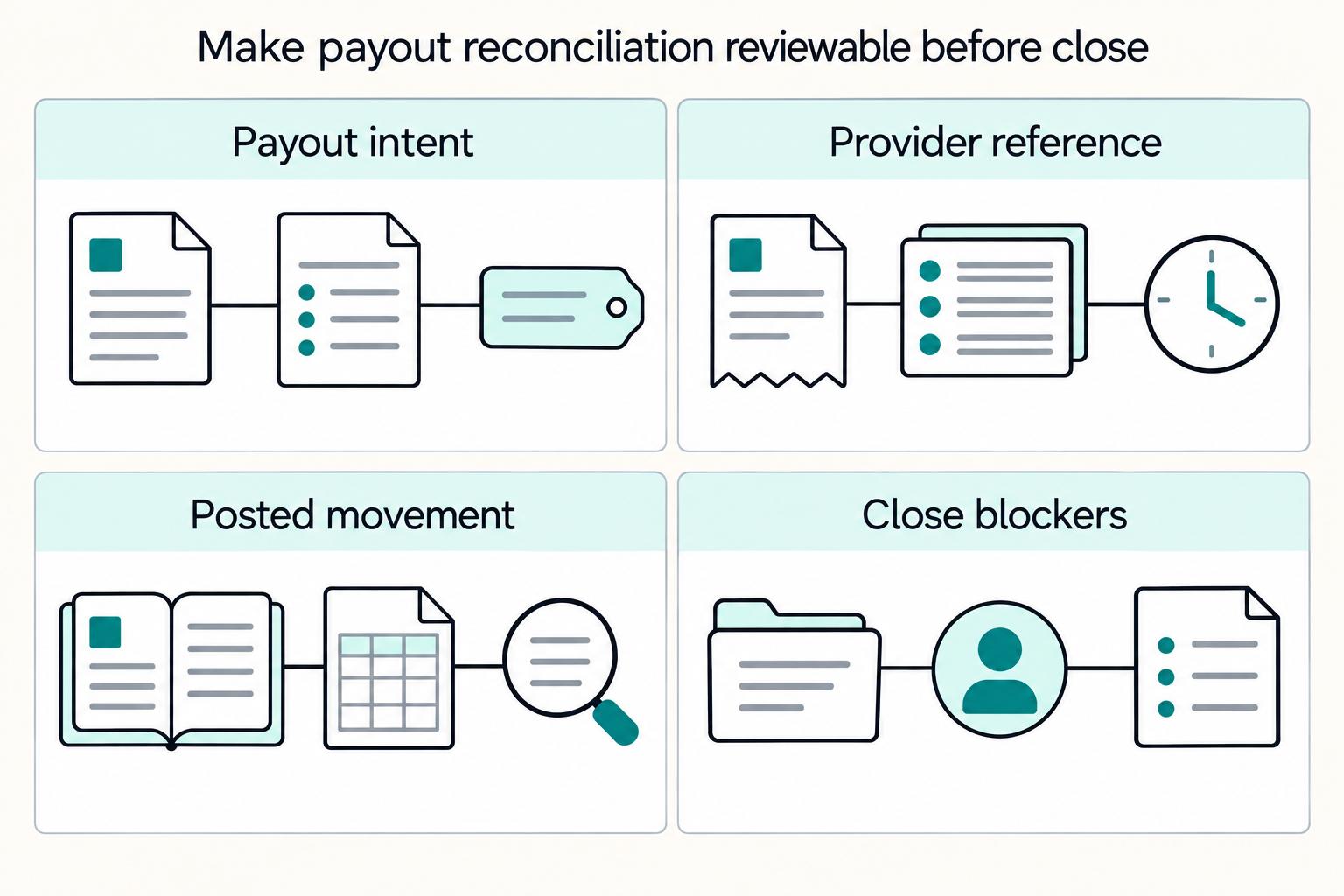
Scale contractor payouts without adding headcount by standardizing requests, blocking execution until required compliance and tax states are complete, reusing one idempotency key per payout intent, and treating webhooks as asynchronous facts. Finalize payouts only when the provider reference and matching journal posting agree, then run fixed-cadence reconciliation and exception queues owned across Finance, Ops, and Engineering.
What It Takes to Scale Contractor Payouts Without Adding Headcount#
Scaling contractor payouts without matching headcount is often a controls problem, not just a throughput problem. When ownership is fuzzy for retries, asynchronous webhook handling, KYC and KYB gates, and month-end reconciliation, rising volume turns routine payment noise into manual cleanup.
This guide is for platform founders, finance leads, and engineering owners who need a decision-ready path rather than a generic overview. The goal is practical: clear control gates, architecture choices, and failure and reconciliation procedures that still work as payout volume grows. It focuses on decisions Finance and AP can actually close with, not just what Engineering can ship.
Start with one constraint: public reliability benchmarks across providers are limited, so you should not assume every provider can support 100000 contractor payouts with the same reliability profile. Country and region support varies, capabilities are not globally uniform, and some features apply only where supported and enabled. So this guide stays anchored to ownership boundaries and verification checkpoints instead of broad vendor claims.
Before you start#
Use these as non-negotiables before you scale:
| Area | Rule | Detail |
|---|---|---|
| Retries | Treat retries as a controlled action | An idempotency key lets the server recognize retries of the same API request; Stripe allows keys up to 255 characters and notes they can be pruned after at least 24 hours |
| Webhooks | Treat webhook events as asynchronous facts | Do not mark a payout final until both the provider reference and matching journal posting are present |
| Compliance | Treat compliance as risk-based, not one-size-fits-all | Checks vary by jurisdiction, business model, corridor, payee, and program |
-
Treat retries as a controlled action. Idempotency is a core protection against duplicate payout operations. An idempotency key lets the server recognize retries of the same API request. As a concrete operating detail, Stripe allows keys up to 255 characters and notes they can be pruned after at least 24 hours. If your provider behaves similarly, design your retry window and internal dedupe record deliberately.
-
Treat webhook events as asynchronous facts. Provider notifications are useful for payment lifecycle updates, but they do not guarantee immediate or ordered delivery. Some event types also require synchronous response behavior. A checkpoint used throughout this guide: do not mark a payout final until both the provider reference and matching journal posting are present.
-
Treat compliance as risk-based, not one-size-fits-all. AML, KYC, and KYB controls vary by jurisdiction, business model, and program. The right question is not "do we have compliance?" but "which checks apply to this payout, in this corridor, for this payee, under this program?" Where evidence is market- or program-dependent, this guide calls it out directly.
This control-first framing is deliberate. Regulators have identified weak safeguarding practices at some payments firms, which reinforces a simple point: moving money safely is not the same as moving money quickly. Shared operating practices across Finance, Ops, and Engineering often matter more than exceptional handling after the fact.
The rest of this guide spells out ownership, state-advance checks, expected failure modes, and when to pause expansion if controls lag throughput. Where a recommendation depends on market support, provider behavior, or program configuration, it is qualified directly instead of presented as a universal rule.
If you need to sync contractor payouts back into Xero, see Xero + Global Payouts: How to Sync International Contractor Payments into Your Accounting System.
What success looks like at 100000 payouts#
At 100000 payouts, success is a control outcome, not a throughput headline. You should be able to trace every payout from the API request to provider status updates to the final journal posting without manual reconstruction across teams.
Step 1 Trace every payout end to end#
Define success as full lifecycle traceability for each payout: request ID, idempotency key, payee record, policy decision, provider reference, webhook status updates, and the matching journal entry. If any link is missing, you have volume with blind spots.
Use a simple checkpoint: sample recent payouts and confirm Finance can trace each one without engineering logs or inbox threads. If your provider offers a payout reconciliation report, use it to match bank-received payouts to underlying transactions. A failure mode to watch for is partial truth: the provider shows "paid" while the books are missing the final journal or AP export.
Step 2 Set operating outcomes for Finance and AP#
For Finance and Accounts Payable (AP), success means close is predictable, the exception queue stays manageable in normal operations, and every approval or hold leaves an auditable history.
This is not just operations hygiene. Internal control also has reporting and compliance implications. If AP cannot show who approved, who retried, what changed, and why a payout was released, scale turns into manual cleanup disguised as growth.
Step 3 Gate money movement with policy, then price uncertainty honestly#
Treat KYC, KYB-adjacent legal-entity checks, and AML as gating controls, not cleanup tasks. Money should move only after the required policy state is in place for that payee, corridor, and business type. For legal entities, beneficial ownership verification should be part of that evidence.
Be explicit about unknowns. Public examples in the material include claims like 10,000+ monthly payouts, but they are not independent proof of reliable 100000-payout execution across the same countries, rails, and risk profiles. Treat that gap as rollout risk and tighten verification before expansion.
For a broader look at scaling finance operations without adding team size, read Finance Automation and Accounts Payable Growth: How Platforms Scale AP Without Scaling Headcount.
Choose your architecture before you scale volume#
Pick the model your team can operate reliably. If you cannot own webhooks, reconciliation tooling, and policy gates, use provider-led execution with a thin internal control layer. If your product depends on custom routing, wallet logic, or embedded payout UX, keep orchestration in-house and standardize API, event, and journal contracts early. At higher payout counts, manual glue stops being temporary. Growth compounds inefficiency unless the operating model is already disciplined.
Step 1 Decide ownership before adding complexity#
This is an ownership decision, not a build-vs-buy slogan. Provider-led models can reduce onboarding and identity-verification build burden while still leaving some payout-flow control to the platform. In-house orchestration gives you more product control, but you also own more operational surface.
| Decision area | In-house orchestration on top of API + webhooks + internal records | Provider-led infrastructure or AP tooling |
|---|---|---|
| Best fit | Differentiation depends on custom routing, wallet behavior, or embedded payout UX | Faster operational maturity with less engineering ownership |
| Ownership burden | You own onboarding, event ingestion, retries, reporting, exception handling, and reconciliation depth | Provider or tooling absorbs more onboarding and operational surface; you keep internal controls |
| Webhook reliability | You must handle duplicate deliveries and delayed retries; retries can continue for up to 3 days | Less event plumbing to own directly, but you still need internal controls to verify status and books stay aligned |
| Idempotency behavior | You must enforce stable idempotency keys and retry rules; keys can be up to 255 characters | You rely more on provider semantics, so confirm same-key retries return the same result and understand retention behavior |
| Reconciliation | You build the match between payout intent, provider status, and booked movement | Easier start, but confirm export detail is enough for Finance and AP exception handling |
| Failure reason fidelity | You can preserve provider errors, policy blocks, and retry history to your own standard | Tooling may abstract failures into broad statuses, which can slow triage and migration |
| Lock-in and migration | More work up front, but cleaner exits if contracts and data models are yours | Faster launch, but closed PaaS can create dead ends or unexpected cost spirals |
| Rollback options | You can dual-write, shift traffic by corridor, and replay events when contracts are disciplined | Confirm you can export full history and cut over without losing traceability |
Step 2 Apply the recommendation rule honestly#
If your team cannot run retry-safe asynchronous integrations today, volume will not fix that gap. A webhook endpoint may receive the same event more than once, and delivery retries can run for days. Reliability depends on deduplication, retry handling, replay, and reconciliation design.
Use provider-led execution when those capabilities are not ready, and keep a thin internal layer for payout intent, policy decisions, provider references, and final journal postings. Move orchestration in-house when control is part of the product. Make the contracts boring and consistent: one payout request schema, one idempotency strategy, one event model, one posting path.
Step 3 Check lock-in and migration criteria before committing#
Confirm these four criteria in writing before you decide:
| Criterion | What to confirm |
|---|---|
| Data export depth | Bulk export of payout requests, provider references, status history, failure reasons, and timestamps |
| Idempotency behavior | Same-key retries return the same outcome, including failures, with clear key-retention behavior |
| Failure reason fidelity | Finance and Ops can see specific failure details, not only broad status labels |
| Rollback path | You can pause or shift corridors and migrate without breaking traceability to the books |
Run one failure-path simulation before rollout. Retry a payout, disrupt event delivery, and verify you can still trace request to provider reference to final journal without engineering log reconstruction. The real risk is false confidence: provider status shows paid, but internal posting or exception clarity is incomplete.
For a deeper treatment, see How to Lock In FX Rates for Contractor Payouts Using Forward Contracts.
If you are deciding between in-house orchestration and provider-led execution, use the Gruv docs to map API, webhook, and ledger ownership before implementation.
Prepare the prerequisites and ownership map#
Once you pick the architecture, lock ownership and record boundaries before you add more code. If Finance, Payments Ops, and Engineering do not share one map and one payout contract, failure handling gets inconsistent as volume grows.
Step 1 Publish one ownership map for failure paths#
Use one document, not scattered tickets. For an API failure, a delayed webhook, or a reconciliation break, the first owner and handoff should already be explicit.
| Trigger | Primary owner | Required handoff | Evidence to capture |
|---|---|---|---|
| API submission failure or timeout | Engineering | Payments Ops takes over only after request ID, idempotency key, and provider acceptance state are confirmed | internal request ID, idempotency key, provider response, payout intent reference |
| Delayed or missing webhook | Engineering for endpoint health, Payments Ops for aging items | If provider reference exists but final event is missing, Ops opens an exception and Engineering checks delivery and replay | event ID, delivery timestamps, replay result, current internal status |
| Reconciliation break | Finance | Engineering and Ops join when payout intent, provider status, and journal posting do not align | provider reference, journal reference, export batch ID, reason code |
Run one failure drill before go-live. A practical test is an accepted request with no immediate webhook, since events are asynchronous and retries can continue for up to three days.
Step 2 Define the payout data contract before coding#
Define the operator-critical states up front: payee identity state, policy status for KYC, KYB, and AML where applicable, tax profile readiness, and payout method readiness.
Keep tax fields explicit. Form W-9 is for providing a correct taxpayer identification number. Form W-8BEN is for foreign individuals. Form W-8BEN-E is for foreign entities. A single generic "tax form collected" flag creates manual cleanup later.
If your provider or sponsoring institution uses written, risk-based identity procedures, mirror that structure in your contract. Use 31 CFR 1020.220 and 31 CFR 1010.230 as anchors where relevant, and avoid hardcoding one universal beneficial-owner re-verification rule across all programs.
Step 3 Decide your record boundaries explicitly#
Decide and document which system is authoritative for payout intent, policy decisions, provider references, and final journal postings. Use wallet balances and Xero or AP exports according to that boundary, typically as operational views or reporting outputs rather than sole audit evidence.
That boundary keeps disputed payout-state resolution in operational records rather than report exports. Xero report extraction is useful for Finance reporting, but it should not be your only proof of request, approval, send, and posting status.
Step 4 Assemble the go-live evidence pack#
Before launch, compile the evidence pack your team will actually use during incidents:
- Policy matrix: which KYC, KYB, AML, and tax states allow, block, or hold execution
- Exception taxonomy: owner team and disposition path by exception class
- Month-end reconciliation checklist: payout intent, provider status, and booked movement checks
- Incident escalation contacts: Finance, Ops, Engineering, and provider paths
Validate it with one tabletop on an API failure and one missed-event case. The goal is fast, unambiguous first actions when provider status and internal records do not match.
For a step-by-step walkthrough, see Choosing Global Contractor Payment Rails in 2026 Without False Precision.
Step 1 standardize payout requests and policy gates#
Turn your ownership map and data contract into hard entry conditions: one normalized request shape for every channel, and a hard stop when required policy states are missing.
Normalize one request shape#
Map API calls, CSV imports, admin-panel payouts, and finance backfills into one internal schema before execution. At minimum, keep amount, currency, and an idempotency key in the same record, then add policy-specific fields, for example destination rail, beneficiary state, and business purpose.
This is not a claim that every provider uses one universal schema. It is an internal consistency control so retries, approvals, and reconciliation behave the same way everywhere. Since major payout APIs require amount and currency, those should never be optional in intake.
For idempotency, design for cross-provider limits. Stripe supports keys up to 255 characters, while Adyen documents a 64-character maximum. If you operate across providers, keep the internal key format at 64 characters or less. Persist it in your system of record even if a provider may prune keys after 24 hours. Verification checkpoint: retry the same request from two channels and confirm one payout intent, one provider submission, and one final journal path.
Block on incomplete compliance states#
Execution-time gates for KYC, KYB, and AML should be binary: if required state is missing, expired, pending review, or failed, do not submit the payout.
Parameterize these checks by location, business type, and capabilities instead of hardcoding one global rule. In U.S. programs, 31 CFR 1020.220 anchors customer identity procedures and 31 CFR 1010.230 covers beneficial-owner identification and verification for legal entities. In EU AML text, if due diligence cannot be completed, the transaction should not proceed.
| Gate | Check before submission | Block when | Store in system record |
|---|---|---|---|
| Request validation | amount, currency, idempotency key, and policy-required fields present | Any required field is blank or malformed | request ID, validation result, field version |
| Identity and AML | KYC, KYB, and AML status meets policy for that jurisdiction and account type | required verification missing, pending, or failed | policy version, rule result, reviewer or automated decision ID |
| Tax and VAT where relevant | required W-8BEN or W-9 on file; VAT number checked where policy requires it | tax form missing, VAT invalid, invoice requirement unmet | document reference, validation timestamp, source service result |
| Approval | required business approval obtained | approval absent or outside allowed threshold | approval ID, approver identity, timestamp |
Add tax and VAT gates before first payout eligibility#
Where your program requires tax documents, collect them before first payout eligibility instead of during failure cleanup. Form W-9 is used to provide the correct TIN for U.S. reporting, and Form W-8BEN is furnished by foreign beneficial owners when requested by the payer or withholding agent.
Use VAT checks where policy requires them, not as a blanket global rule. For EU validation, use VIES. For UK VAT numbers, use the HMRC check service. Verification checkpoint: for any payee record, an operator should be able to see tax-form status, validation date, and the exact service result used at approval time.
Write the decision trail into the ledger#
Store every approval and policy decision in a durable audit trail, not in chat, email, or mutable notes. Each record should show the policy version used, result returned, document that satisfied the gate, and who or what approved release.
This keeps audits and disputes operational as volume grows. You should be able to reconstruct the exact eligibility state at submission time from one place.
If your team still runs payouts from CSV files, see How Staffing Agencies Automate Contractor Disbursements with Batch Payouts via CSV.
Step 2 implement idempotent execution and webhook truth#
After policy gates, the main execution risk is duplicate or premature payout state changes. Use a strict sequence: submit once, treat webhooks as asynchronous facts, and post final journals only when provider and accounting records match.
Step 2.1 persist the payout intent before you call the provider#
Retry safety starts with order of operations: accept request via API -> assign idempotency key -> persist payout intent -> submit to provider -> ingest webhook events -> post final journals.
Do not treat the first provider response as money movement finality. Adyen documents multi-stage payout lifecycles and status updates through both API responses and webhooks, so an initial response may indicate submission acceptance or rejection rather than final credit.
Checkpoint: one accepted business request should map to one internal payout intent, one idempotency key, one current execution state, and zero or one provider submission record.
Step 2.2 reuse the same idempotency key for retries of the same intent#
For the same payout intent, always retry with the same idempotency key. Stripe states that repeated requests with the same key return the same stored result, including 500 responses.
So if the first attempt times out or returns an ambiguous server error, do not generate a new payout request. Retry with the same key, then reconcile with provider status plus webhooks.
Keep attempt evidence queryable: internal payout ID, idempotency key, normalized request fields or hash, provider reference when assigned, response code, and submission timestamp.
| Stage | Required evidence before moving on | Red flag |
|---|---|---|
| Request accepted | Internal payout intent persisted with idempotency key | Same business request creates multiple intents |
| Provider submission | One provider submission record tied to that intent | New key created during retry of same payout |
| Webhook ingestion | Provider event ID stored, deduplicated, and linked to intent | State changes applied twice from repeated deliveries |
| Final journal posting | Provider reference and final booked entry both present and consistent | Payout marked final with missing reference or missing journal |
Step 2.3 process webhooks as asynchronous facts, not arrival-order truth#
Webhook processing must be deduplicated and state-aware before any transition. Stripe retries undelivered events for up to three days, warns against processing the same event multiple times, and recommends returning success for already processed events so retries stop.
Before applying a state change, do three things:
- Check whether the provider event ID was already processed.
- Compare the event timestamp with the current payout state.
- Write the event reference and transition decision to an immutable trail in your books or an adjacent event store.
Do not trust arrival order. Out-of-order delivery can happen, so reconstruct sequence from payload timestamps and only allow forward transitions unless your investigation path explicitly allows reversal.
If a confirming event is missing, keep payout state non-final and query provider status or replay events. Waiting too long increases risk, especially when event retrieval windows are limited, for example last 30 days in Stripe's listed-events guidance.
Step 2.4 model Virtual Bank Accounts (VBAs) with explicit internal money states#
If your payout flow includes Virtual Bank Accounts (VBAs), define internal states such as credited, held, and returned, and map provider-specific statuses into them.
| State | Action | Key detail |
|---|---|---|
| Credited but unmatched | Hold in suspense | Attach provider reference and investigate remitter details, expected amount, and intended beneficiary before allocation |
| Held | Route to investigation | Use for compliance review, missing reference data, or account restrictions; do not auto-release |
| Returned | Reverse projected balance impact | Store the return or failure reason and route a decision on retry or an alternate refund path |
Where provider lifecycle data is available, keep status separation between submitted, provider-confirmed, and bank-credited states.
Step 2.5 finalize only when references and journals agree#
A payout is final only when both artifacts exist and agree: provider reference and posted journal with matching amount, currency, and beneficiary mapping.
If either side is missing or inconsistent, keep the payout non-final. This prevents false closure and gives reconciliation a complete proof set without manual reconstruction.
Step 3 build reconciliation that closes without heroics#
To keep close repeatable, reconcile on a fixed cadence and surface exceptions early so unresolved items do not pile up at period end.
Step 3.1 run a fixed-cadence three-way match#
Use one reconciliation table keyed by internal payout intent ID, then compare payout intent, provider status and reference, and posted journal movement. This is an operating pattern, not a vendor-mandated standard, and it gives Finance, Ops, and Engineering one shared fact set.
Run reconciliation on a defined schedule and include pre-close checks. This aligns with periodic AP-to-GL reconciliation practice and with the expectation that differences are investigated and corrected. For provider-side evidence, use Stripe reports based on the question you need to answer:
| Artifact | Best use | What to verify |
|---|---|---|
| Stripe Payout reconciliation report | Reconcile transactions included in each automatic payout as a settlement batch | Missing or extra transactions in a payout batch |
| Stripe Balance report | Review provider balance activity in a bank-statement style | Movement sequence and unexplained balance changes |
| Xero Aged Payables Detail | Review what was unpaid as of the report date | Outstanding bills, credit notes, expense claims, and overpayments |
| Xero Bank Reconciliation report pack | Compare actual bank balance with Xero | Missing, deleted, or duplicated transactions |
Checkpoint: matched rows should carry one payout intent ID, amount, currency, and provider reference when assigned.
Step 3.2 generate operator-ready exports for AP and Xero#
Do not hand raw provider CSVs to Accounts Payable as the working file. Export from your reconciliation table and attach provider or bank extracts as supporting evidence.
Include payout intent ID, provider reference, bill or invoice reference when relevant, amount, currency, current status, last status timestamp, internal reason code for unmatched items, and aging bucket. Keep the file aligned to report-date truth. Xero aged payables is as-of-date based and can show items that were unpaid at that date even if later paid.
Step 3.3 set manual-review triggers before close starts#
Manual review should be trigger-based, not ad hoc. Route rows for review when any of these occur:
- provider status remains pending or ambiguous beyond your documented expectation for that rail or corridor
- amount or currency mismatch between provider data and your books
- missing provider reference on a row treated as near-final
- duplicate external IDs, including after retries or replayed imports
For Stripe, document that some payout trace states may remain pending for up to 10 days after arrival date so teams do not escalate normal timing as defects.
Step 3.4 keep one close blocker list until every item has a disposition#
Maintain one close blocker list for unresolved exceptions with one owner per item, blocking reason, next evidence needed, and target disposition date. Keep this list focused on items that can delay AP signoff, Xero reconciliation, or close.
Remove an item only when it is resolved, written off under approved policy, or carried forward with documented impact. This control helps keep close from depending on heroics as volume grows.
For staffing teams building a more complete contractor payment workflow, read How to Build a Contractor Payment System for a Nursing or Allied Health Staffing Agency.
Step 4 design exception operations that do not add headcount#
Design exceptions by handling path, not by which team found the issue. Automate repeatable recovery, and reserve humans for policy decisions, high-risk investigations, and breaks that span webhooks, provider data, and your books.
Step 4.1 build the taxonomy before you tune queues#
Start with a compact taxonomy that reflects real failure modes:
| Exception class | Typical signal | Default owner | Default action | Verify first |
|---|---|---|---|---|
| Compliance hold (regulated bank context) | identity verification issue, suspicious-activity concern, or payee eligibility restriction | Compliance or Risk Ops | Escalate | hold reason, policy state, review notes, approval trail |
| Beneficiary error | invalid destination details, account holder name mismatch | Payments Ops | Automate correction request, then follow up if unresolved | beneficiary fields, provider error text, last known-good destination |
| Rail failure | provider-reported rejected, returned, unclaimed, or failed payout | Payments Ops | Automate only policy-approved retries for known repeatable failures | provider reference, rail status, retry eligibility |
| Webhook mismatch | duplicate, delayed, or out-of-order event | Engineering | Automate dedupe and replay-safe handling | event ID, delivery timing, internal state version |
| Reconciliation break | provider status and booked movement do not align | Finance Ops | Escalate | payout intent ID, amount, currency, provider reference, journal presence |
Treat webhook mismatch as its own class. Duplicate and out-of-order deliveries are expected in at-least-once systems, so event handling must be idempotent and replay-safe.
Step 4.2 automate the repeatable cases and stop there#
Automate deterministic cleanup, but do not automate policy judgment. Beneficiary-data failures should trigger a corrective workflow, pause unsafe retries on that destination, and reopen only after updated details pass your checks.
Keep compliance and risk exceptions manual. If you operate in a regulated bank context, suspicious-activity reporting duties can carry deadlines, for example 30 calendar days after initial detection and up to 60 when suspect identification is pending. Auto-release is not a safe default for those classes.
Checkpoint: every auto-recovered exception must end with one final journal disposition and no duplicate posting path after replay.
Step 4.3 give each class one owner, one SLA, one escalation path#
Prevent queue ping-pong by assigning each exception class to one accountable team, one SLA, and one escalation policy. One owner does not mean one team does all the work. It means one team owns the clock, status, and next action.
For high-severity cross-system failures, use a single incident lead so decisions stay coherent across Engineering, Finance Ops, and provider operations.
Step 4.4 run queues from facts, not inboxes#
Build operational queues from webhook processing state plus book state, not from inbox threads or dashboards. Each row should show what happened, what evidence is missing, who owns it, and what happens next.
At minimum, capture event ID, first-seen and last-seen timestamps, payout intent ID, provider reference, internal status, retry count, and reason code. Add dead-letter handling for failed processing paths so broken payloads do not disappear.
If events can be retried for hours or manually redelivered later, your queue must tolerate repeat deliveries without changing the financial outcome.
Related reading: How to Build a SaaS Marketplace That Manages Subscriptions and Contractor Payouts.
Step 5 handle cross-border tax and compliance artifacts early#
Treat tax and compliance artifacts as upfront eligibility data, not payout-failure cleanup. When required forms or profile data are missing at payout time, a predictable intake step turns into exception work across Ops, Finance, and Support.
Step 5.1 collect required tax forms before first payable status#
Collect required tax profile data at onboarding or before a payee becomes payout-ready. For US information-return reporting, Form W-9 is used so payers can obtain a correct taxpayer identification number. For non-US persons, Form W-8BEN is submitted when requested by the withholding agent or payer.
The operating rule is simple: when your payer or program may require the form, collect it before money movement is eligible. Do not let a contractor reach payout-ready status with missing required tax documentation and assume triage will catch it later.
Verification point: store document type, collection date, status, validator, and a document reference or version, not only a yes or no flag.
Step 5.2 define jurisdiction-aware outputs and keep the evidence#
Design outputs around the jurisdictions and reporting regimes you actually support, and keep proof of checks. If you support EU seller flows, DAC7 is one reason to build seller-information collection and verification early. For VAT checks, split EU and UK handling. VIES VAT number validation supports EU validation, and as of 01/01/2021 the prior VIES route for UK GB VAT numbers ended. UK checks should use HMRC's checker.
Keep evidence, not just values. HMRC's VAT checker can provide proof of when a UK VAT number was checked, so retain that timestamp and result. For EU checks, retain validation date, result, and country code.
Treat Form 1099 support as form- and tax-year specific. IRS materials referenced here show $600 and $2,000 after December 31, 2025 in one FAQ context, while Form 1099-MISC materials still list $600 categories. Avoid one universal threshold rule without form and year verification.
Step 5.3 mask sensitive fields in every ops surface#
Expose only the minimum data needed for the task. This aligns with data minimisation: personal data should be adequate, relevant, and limited to what is necessary for the processing purpose.
In practice, mask taxpayer IDs, account numbers, and full tax-document contents in queues, logs, and approval screens. Restrict full-value access to tightly permissioned investigation views. Keep support tickets and escalation notes free of sensitive identifiers unless there is a documented need.
FinCEN FBAR help explicitly warns against including sensitive information such as account numbers and taxpayer identification numbers in support tickets. Your operational logs should follow the same minimum-necessary standard.
Step 5.4 clarify what you support for US persons and what you do not#
Set clear boundaries for FEIE and FBAR support. FEIE depends on IRS conditions including foreign earned income, a foreign tax home, and residency or presence tests. FBAR is an annual filing on FinCEN Form 114 when aggregate foreign-account value exceeds $10,000, due April 15 with an automatic extension to October 15.
Your platform can support tracking, exports, and reminders. Unless you explicitly provide that service, do not imply the platform has determined FEIE eligibility or completed FBAR compliance for the user.
Roll out by corridor and risk tier instead of big bang#
Once tax and compliance artifacts are gated up front, scale corridor by corridor and risk tier by risk tier, not all at once. You can use lower-risk waves to prove controls, then expand to higher-risk or higher-friction corridors.
Step 1 rank corridors by operational friction and risk#
Do not give every corridor the same launch path. Group routes by exception load and risk level, then apply stronger controls where risk is higher and simplified controls where risk is lower.
Before moving any corridor from pilot to broader release, confirm that payout processing and reconciliation are clean for that corridor, not just in aggregate. Keep a wave record with enabled countries, risk tier, owner, known failure modes, and rollback owner.
Step 2 add MoR or VBAs only when they remove real work#
Use Merchant of Record (MoR) only where it clearly improves your operating model. The MoR is legally responsible for payment processing and related financial, legal, and compliance obligations, so this is a liability and control decision, not a default upgrade.
Use Virtual Bank Accounts (VBAs) where your team will actually use the added attribution for tracking and reconciliation. Virtual accounts are sub-ledger accounts linked to a physical account and can reduce manual process risk when your finance workflow is built to use them.
Step 3 gate each expansion wave with canary-style controls#
Release each new corridor in a small canary first, then expand only if results hold. A practical starting point is 5-10% of planned volume so you can detect issues early and roll back quickly.
Track technical and business signals together:
- error trend by corridor and payout state
- business-metric trend by corridor during the evaluation window
- reconciliation completion rate, with end-of-day reconciliation on credited payments where your program supports it
If compliance issues or unmatched transactions trend in the wrong direction, treat that as a review trigger and pause or roll back before continuing expansion.
Common mistakes and how to recover fast#
The fastest recoveries focus on four failure modes: duplicate execution, premature success states, tax-document gaps, and reporting-first priorities. When one appears, pause expansion, stop assuming status, and re-establish book truth before tuning anything else.
Step 1 freeze duplicate risk and rebuild idempotent retries#
If you cannot prove one payout intent maps to one stable idempotency key, stop automatic retries. In APIs that support idempotency, keys let the server recognize retries of the same request, and reusing the same key is documented to return the original result instead of executing again.
Recovery sequence:
- freeze retry workers for the affected payout type or corridor
- dedupe by external reference and provider reference
- reconcile suspect items against internal records before resubmitting
Verification target: one approved request, one provider-side operation, and one final journal trail per payout intent. Also check key retention windows. Stripe notes keys may be pruned after at least 24 hours, so keep your own dedupe record.
Step 2 require two facts before marking success#
A missing webhook is not success. Webhook delivery is asynchronous, and duplicate events are expected, so your state model must handle delayed and duplicate events.
Recovery means reopening payouts marked final from API response alone, then requiring two facts before final status: provider reference and matching internal journal posting. After that, replay ingestion from provider event logs or your dead-letter queue and confirm transitions stay monotonic.
Step 3 gate U.S. tax readiness before the next payout#
For U.S.-scoped contractor programs, treat tax-document readiness as a payout gate. Form W-9 provides the correct TIN. Form W-8BEN is used by foreign persons in U.S. withholding or reporting contexts. You may have to file Form 1099-NEC for independent contractors.
If a required form is missing, block future payouts until the profile is complete and backfill evidence on prior payouts. Also check missing or incorrect TIN cases. IRS guidance states 24% backup withholding can apply when required.
Step 4 fix payout state integrity before polishing Xero or AP outputs#
Fix state integrity before improving Xero mappings or AP exports. Exports are reporting artifacts and are most useful after policy gates, provider references, and journal postings are consistent.
Use a simple test: if Finance cannot trace an unmatched item from payout intent to provider status to journal entry, defer export polish. First restore clean exceptions and reconciliation, then tune downstream outputs.
Related: Invisible Payouts: How to Remove Payment Friction for Contractors Without Sacrificing Compliance.
Final checklist for the next 30 days#
If you only do seven things this month, do these. The goal is control quality at scale: every payout should be traceable, retry-safe, reconciled, and pausable when controls degrade.
-
Choose your architecture direction now and document the tradeoff. Decide whether you own API submission, webhooks, and the core books, or use a provider-led model that takes on more onboarding and compliance scope. Make the memo explicit on integration effort, liability boundary, and migration risk, since some setup choices are hard to unwind later.
-
Publish one ownership map across Finance, Ops, and Engineering. Put policy gates, payout execution, exceptions, and reconciliation on one page with named owners and escalation contacts. If an exception class has no owner, queue growth and manual chasing can become a hidden headcount cost.
-
Gate payout eligibility on completed KYC and other required compliance/tax checks. Do not mark payees eligible until required verification is complete, including beneficial-ownership or AML controls where your program requires them. For U.S. tax flows, collect
Form W-9for TIN capture; useForm W-8BENwhen requested by the payer or withholding agent for foreign beneficial owners. If you use Stripe 1099 capabilities, track the documented600 USD in chargesthreshold where payouts can be disabled when required tax info is still missing. -
Make payout execution idempotent and webhook handling duplicate-safe. Keep one stable idempotency key per payout intent across retries so repeated requests do not create duplicate actions. Treat webhooks as retrying, duplicate-prone delivery. Stripe documents retries for up to three days and recommends duplicate-protection logic for undelivered events.
-
Run regular reconciliation with AP and Xero outputs and an exception queue. Compare payout intent, provider status, and booked movement on a set cadence, then produce exports Finance can close from. In Xero, reconciliation is statement-line-to-transaction matching, and the bank transactions endpoint does not return every payment type, including payments applied to invoices, expense claims, or transfers. Do not treat one endpoint as full close evidence.
-
Roll out by corridor and risk tier, with pre-defined pause criteria. Start with lower-friction corridors and lower-risk profiles, then expand only after controls remain stable. Use a risk-based AML or CFT approach, and pause expansion if unmatched transactions, stale pending payouts, or compliance holds rise faster than throughput.
-
Confirm market and program constraints before increasing volume. Coverage varies by program and region, and self-serve cross-border payouts are not available in every country. In Stripe's cross-border program, countries outside listed regions are not self-serve supported, and each cross-border payout has a documented
0.25%fee. Maintain a corridor matrix with country, rail, fee, compliance prerequisites, and fallback path.
Before rollout, align Finance, Ops, and Engineering on market coverage and control gates by talking with Gruv.
Frequently Asked Questions
What breaks first when contractor payouts scale from 100 to 100000?
Payout state integrity often breaks first. Duplicate processing and duplicate or delayed webhook events can create conflicting statuses if you are not deduping and reconciling reliably. A key red flag is when teams cannot trace one payout intent through provider status and internal financial records without manual investigation.
How do you scale payouts without adding headcount in Finance Ops?
Automate repeatable controls and reserve people for true exceptions. Gate onboarding, verification, and tax-document requirements before execution, then use automatic payouts and structured reconciliation. If exception volume rises faster than payout volume, fix the gate or state logic instead of staffing around it.
Which controls are non-negotiable for high-volume contractor payouts?
The core controls are stable idempotency keys, webhook-safe state handling, tax and compliance intake before payout, and reconciliation based on system facts. For U.S. contractor flows, tax intake starts with Form W-9, and Form W-8BEN is used for foreign individuals in U.S. withholding contexts. Keep independent control review in place even with strong automation.
How do idempotency keys and retries prevent duplicate payouts?
Idempotency makes retries safer because the same payout intent keeps the same key across retries. That helps repeated requests return the original result instead of executing again. If retries create new keys, transient failures or concurrency can turn into duplicate payout actions.
What should be fully automated versus manually reviewed in payout operations?
Automate deterministic work such as request validation, policy gates, payout submission, webhook ingestion, reconciliation matching, and known recovery paths. Keep manual review for judgment-heavy or higher-risk cases, including AML or CFT escalations, identity or tax-document mismatches, and cross-system breaks. A simple rule is to automate decisions that can be made from structured evidence every time and queue the rest for humans.
How should Finance, Payments Ops, and Engineering split ownership?
There is no universal mandated split, but there should be a written one. One workable model is Finance owning policy and close readiness, Payments Ops owning exception handling and provider coordination, and Engineering owning API, idempotency, webhook, and state reliability. During webhook incidents, Engineering should lead replay and recovery while Finance and Ops work from reconciled exceptions.
When should a platform use provider-led payout infrastructure instead of building orchestration in-house?
Use provider-led infrastructure when verification complexity is hard to maintain internally and you want lower implementation effort. Build orchestration in-house when product differentiation depends on custom routing, wallet behavior, or embedded payout UX and you can test account creation, identity verification, and payouts together before go-live. As a readiness check, your recovery model should cover webhook replay and manual resend options for eligible events.
Researched and edited by the Gruv editorial team. Gruv builds cross-border billing, payouts, and finance-operations software for global businesses.
Sources
- bsaefiling.fincen.gov/docs/FinCENFBARHelp.pdftrusted
- csrc.nist.gov/projects/cybersecurity-framework/filterstrusted
- ecfr.gov/current/title-31/subtitle-B/chapter-X/part-1...trusted
- ecfr.gov/current/title-31/subtitle-B/chapter-X/part-1...trusted
- guides.gaoinnovations.gov/greenbook/2025/principle-10-design-control-a...trusted
- irs.gov/forms-pubs/about-form-w-9trusted
- irs.gov/forms-pubs/about-form-w-8-bentrusted
- ncua.gov/newsroom/press-release/2026/fincen-issues-ex...trusted
Educational content only. Not legal, tax, or financial advice.
Related Posts

The Freelance Payment Penalty: A Modeled Audit of Platform Fees, FX Spreads, and Payout Delays
The money rarely disappears through a single, easy-to-spot fee. The real loss is stacked. A marketplace takes its commission, a processor adds a charge for international cards, a bank or payment company converts the currency at a spread, a platform holds the funds before release, and a wire sheds a little to intermediaries on the way in. Each layer looks defensible on its own, but the worker feels the combined result as a smaller deposit and a later payday.

How to Respond to a Subpoena for Business Records
Move fast, but do not produce records on instinct. If you need to **respond to a subpoena for business records**, your immediate job is to control deadlines, preserve records, and make any later production defensible.

A US Expat's Guide to Investing in UCITS ETFs to Avoid PFIC Issues
The real problem is a two-system conflict. U.S. tax treatment can punish the wrong fund choice, while local product-access constraints can block the funds you want to buy in the first place. For **us expat ucits etfs**, the practical question is not "Which product is best?" It is "What can I access, report, and keep doing every year without guessing?" Use this four-part filter before any trade: