
Quick Answer
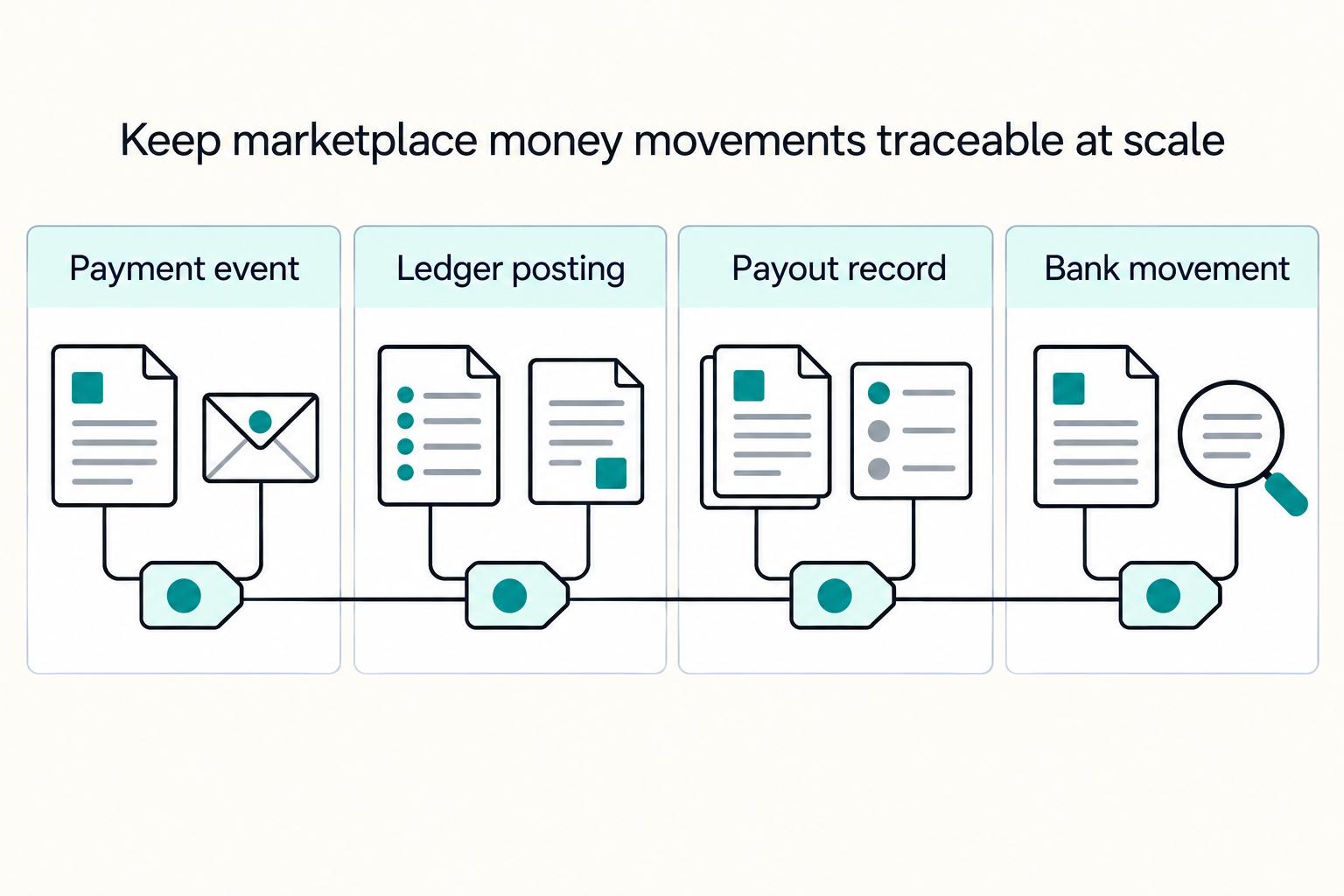
Start with staged execution: payment acceptance first, then multi-party allocation, then cross-border payouts. Keep one provider until route coverage, reliability, or economics clearly break your targets, and gate expansion with two checks: end-to-end transaction traceability and corridor-level coverage reality. Add idempotent requests, replay-safe webhook handling, and finance reconciliation sign-off before introducing orchestration.
What changes as marketplace payments scale#
Treat marketplace payments as an operating model decision, not a checkout widget decision. In a two-sided marketplace, customers pay the marketplace and the marketplace pays sellers. How well you scale depends on everything around that flow: monetization, merchant risk, payout operations, disputes, compliance, support, reporting, and fund recording.
Those choices shape your revenue model, risk exposure, and expansion pace at the same time. Payment, clearing, settlement, and recording all carry operational risk, so a stack that works at launch may need to change as volume, seller count, or country footprint grows.
Define the payment model before you add complexity#
Be explicit about who takes the fee, who owns disputes, when sellers get paid, and how merchant risk is handled. These are architecture decisions, not back-office cleanup.
Start with the money flow your product actually needs. For many teams, that means reliable payment acceptance first, then multi-party features once the economics and responsibilities are clear.
Add marketplace controls before gaps compound#
Seller onboarding is a core marketplace function, and it comes with real compliance complexity. Split payments also need explicit allocation instructions so funds can be recorded correctly across parties.
If onboarding rules, payout allocation, and ledger references stay vague, operations and finance lose traceability. You should be able to answer who owns each share of a charge, when platform fees apply, and what happened to a failed payout.
Scale in stages and use two checkpoints before you expand#
Scale in stages: payment acceptance, then multi-party commerce, then cross-border payouts. As the network expands, your infrastructure priorities should change with it. Use two checkpoints before you expand:
- Transaction traceability: one transaction should be traceable end to end across customer payment, platform fee, seller allocation, and payout status from a consistent record.
- Coverage reality: record the actually supported recipient country, account model, payout method, currency and fees for each corridor.
Start with the smallest scope that supports the required money flow safely. User-count bands in this guide are planning examples, not thresholds for deferring onboarding, allocation or payout controls that your actual launch already requires.
Related: How to Scale a Gig Platform From 100 to 10000 Contractors: The Payments Infrastructure Checklist.
Set the economic target before touching the payments stack#
Before you compare providers or add routing logic, define the economics of one good transaction. If you cannot clearly state who keeps the fee, who owns chargebacks, when sellers are paid, and where FX costs land, the stack is probably not the bottleneck yet.
Write the money model for one representative order#
Start by writing the money model for one representative order in your marketplace. Begin with take rate, the percentage of GMV the marketplace keeps. Then document payout timing policy, FX exposure, and dispute ownership.
For Stripe Connect, MoR designation and loss responsibility depend on charge configuration. Direct charges use the connected-account MoR; indirect charges with on_behalf_of also use that MoR, while indirect charges without it use platform MoR. Destination/separate-charge refunds and disputes debit platform balance even with on_behalf_of; recovery from a seller by transfer reversal is a separate action. Record both customer-facing responsibility and actual balance exposure.
Verification checkpoint: finance and product should be able to annotate one sample transaction with GMV, marketplace commission, payment fees, dispute cost owner, payout date, and whether a currency conversion fee applies.
Set a short operating scorecard before volume grows#
Track the few metrics that tell you whether scale is helping or hurting:
| Metric | What to track |
|---|---|
| Margin per transaction | After commission revenue, payment fees, platform fees, dispute fees, and conversion fees |
| Payout status and failed payout count | Status transitions and failed payout count |
| Reconciliation close time | Time to reconcile payment and payout settlement batches |
Do not treat take rate as margin. Once processor, dispute, and conversion fees are included, per-transaction economics can shift quickly.
Define minimum service-level objectives now#
Define minimum service-level objectives (SLOs) now so later architecture decisions have a clear pass/fail bar. At minimum, set targets for payment confirmation latency, payout status visibility, and availability.
For payout visibility, use webhook-driven status updates so support and finance can track transfer progress and status changes consistently. Teams often add providers for global coverage or reliability, but multi-provider setups also add implementation and operating complexity; make the expected coverage and reliability gains explicit before you expand orchestration.
Prepare the prerequisite evidence pack and owners#
Early payment delays often come from preventable gaps: generic onboarding assumptions, payout corridors that were never validated by country, and reconciliation that lives in a spreadsheet instead of an operating model. Lock the evidence pack and ownership before you build.
Build a pre-build packet for each launch market#
Build a pre-build packet for each launch market, not one global checklist. Required onboarding data varies by legal entity type and operating country or region, and onboarding requirements can change by capabilities, country, and business type. Include, at minimum:
- target market and entity types you expect to onboard
- required capabilities or program access by market
- expected payout corridors, including where each market will pay out
- whether you need multi-currency operations, and which currencies must be held and paid out
- market-specific compliance gates for seller onboarding and payout activation
Record actual supported holding/payout currencies, recipient countries, methods and account capabilities for the intended program. Coverage depends on platform location, configuration and corridor; a headline currency count does not establish your route.
Verification checkpoint: PM, finance, and ops should be able to review one target market and answer, without guessing, what seller data is required, which payout routes are planned, and which currencies are operational.
Assign owners by outcome, not just team name#
You need explicit accountability for seller onboarding, payout operations, and fraud screening, even if one person covers multiple areas today.
- Product: user-facing onboarding and payout-state decisions
- Engineering: event integrity, status propagation, and verification and payout evidence retention
- Finance or payments ops: payout scheduling, exception handling, and close support
This split matters because the platform may be directly responsible for verification-process handling, may manage payout accounts and schedules, and can apply platform-level fraud rules across connected-account payments. Verification checkpoint: each owner should have a written success measure and escalation path.
Define the reconciliation baseline before volume makes gaps expensive#
Your daily match should connect internal ledger entries to applicable provider references and actual route-specific movements or balances. Mark expected evidence not yet available as pending, with an owner and timing. A practical daily baseline includes:
- transaction- and fee-level data for the actual route
- payout linkage where the route groups transactions into payouts
- bank, provider-balance or supported manual movement evidence, reconciled with applicable amount/date/reference fields
Use reporting that supports both payout matching and transaction-level cost visibility so finance is not reconciling net deposits blindly. Then make sign-off explicit: who accepts daily matched status, who owns unmatched items, and when engineering is pulled in.
Related reading: How to Build a Trust and Safety Program for Your Contractor Marketplace.
Build the 100 to 1,000 user foundation without overbuilding#
At 100 to 1,000 users, restraint is often the right default. Prioritize one reliable processor path and clean traceability over feature breadth. If finance cannot trace a payment from request to ledger posting to payout status without spreadsheet stitching, the stack is already too complex.
Start with one core money path and instrument every state transition#
For many teams, that means one provider path, often Stripe or Tipalti, for current needs, without adding fallback routes or custom settlement logic too early.
Track, at minimum: request received, provider object created, payment authorized or failed, transfer or allocation created, payout submitted, payout status changed, and ledger posted. If you support split payments, log the parent payment ID plus each recipient allocation as separate ledger-linked events. Stripe supports separate charges and transfers to distribute one payment to multiple connected accounts, so retry safety matters immediately.
Checkpoint: someone outside engineering should be able to explain what happened to a payment and why it is in its current state from logs and reports.
Make event handling replay-safe before volume rises#
Use supported provider idempotency for the same request retry, with durable internal business-action identity. Stripe can prune keys after at least 24 hours; keep recovery/uniqueness beyond that window and resolve unknown original outcomes before a replacement operation.
Verify and durably persist event intake before acknowledgement. Deduplicate delivery separately from financial effects, then recover each side effect through its action intent and provider reference. An existing pending transfer or payout object does not prove completion; reconcile its actual outcome before closing or repeating work.
Add lightweight onboarding and fraud controls now#
Do this before abuse forces a rushed policy. Define required seller data, what enables charges, what enables payouts, and which checks block release of funds.
Collect required seller information and track actual capability/restriction states for the selected account model. Verification, risk and tax responsibilities depend on your role and program. Record why charges or payouts are enabled, pending or blocked instead of assuming one provider checklist meets every legal duty.
Make reconciliation traceable from day one#
With Stripe, automatic payouts help maintain transaction-to-payout association, and Stripe documents using the balance transaction endpoint with a payout parameter to list transactions in an automatic payout. With Tipalti, payment orders move through progressive statuses visible in Hub, APIs, IPNs, and FTP reports, and status history can be tracked via the Payment Details report.
Retain immutable internal action and financial-effect references, with applicable provider payment, transfer or payout IDs and status-change timestamps. A payout ID is not required on every ledger row. Finance should trace one transaction from the original request through available provider or manual evidence to the ledger and actual route-specific outcome without inventing a bank movement.
For a step-by-step walkthrough, see How to Build a Milestone-Based Payment System for a Project Marketplace.
Add 1,000 to 10,000 user controls when multi-party complexity appears#
At this stage, reliable scale usually comes from making multi-party money rules explicit before you add more providers. The job is to make one payment break cleanly into platform fees, seller allocations, holds, retries, and payout exceptions without ambiguity.
Turn multi-party commerce rules into data#
In Stripe Connect, the charge type determines how funds are split among parties, and one payment can fund multiple connected accounts, so allocation logic cannot stay implicit.
For each payment, record gross amount, platform fee rule, seller allocation rule, hold or reserve amount, release condition, refund owner, and dispute owner. If your platform takes a portion of the transaction, keep it as an explicit fee line item. Your ledger should represent both the parent charge and each downstream allocation.
Version those rules at payment time. If fee share or reserve behavior changes by category, country, or seller tier, refunds and payout reissues still need to reference the original rule set.
Verification point: for one order with two sellers, a platform fee, and a partial refund, finance should be able to recompute balances from stored rules and references.
Add explicit hold, reserve, and exception states#
If funds and fees must be booked to the correct balance accounts, your internal model cannot stop at "paid" and "payout sent."
Use operational states like pending allocation, held for onboarding, held for review, released for payout, payout failed, reversed, and refunded. If an account is not payout-eligible, keep funds in a held state with a reason code. If charge creation succeeds but seller allocation fails, do not treat the gross payment as payout-available.
Persist allocation intent and its financial-action key before the external operation. Reuse the supported key for the same transport retry and retain durable uniqueness beyond provider retention. Distinct adjustments need linked keys; do not suppress legitimate changes merely because a parent payment already exists.
Add PSP orchestration only when single-provider pain is clear#
Add payment service provider (PSP) orchestration only when single-provider performance is clearly hurting reliability, route coverage, or economics. Until then, keep one primary path and harden operations first.
Consider multiple providers only when measured coverage, resilience or economics justify the additional operating work. Provider count is not a maturity target; your team must first reconcile and recover the existing money path.
| Criterion | Keep single PSP | Add orchestration |
|---|---|---|
| Failure pattern | Outages are occasional and response is acceptable | Recurring route or provider failures materially disrupt payments or payouts |
| Geography and corridor coverage | Supported routes match your active markets | Important corridors, currencies, or payout methods are unsupported or constrained |
| Margin impact | Current pricing fits your take rate and support cost | Route-level economics materially change unit economics at meaningful volume |
| Operational readiness | Reconciliation and support are still stabilizing on one provider | Team can reconcile and triage across multiple provider event models |
If daily exceptions are not closing cleanly on one provider, orchestration can increase operational risk.
Treat cross-border payout failure handling as a first-class operation#
Build retries, dead-letter capture, machine-readable status reasons, and a human escalation path with evidence.
Keep failed/uncertain work in durable owned recovery records, with provider-native reasons, attempt identities and outcome evidence. A DLQ is one transport tool, not a permanent financial record. Verify the actual payout API’s response fields rather than borrowing acquiring/refusal fields.
Run corridor-specific triage. Transfer routes can vary by country, currency, counterparty, and priority, and some banks support only specific priorities or impose limits. For each failed payout, log corridor, currency, route or priority, provider payout or transfer ID, onboarding status, retry history, and failure reason.
Retry only under the actual API contract with original-outcome checks. Separate confirmed failures needing corrected beneficiary details or eligibility review from uncertain execution. Resolve original funds exposure before reroute or replacement; a transient-looking error does not prove no payout occurred.
Need the full breakdown? Read How to Build a Currency Reserve Strategy for Marketplace Platforms Operating in Volatile Markets.
Scale 10,000 to 100,000 users with global payout and resilience discipline#
At 10,000 to 100,000 users, the hard part is no longer checkout coverage alone, but market-by-market payout and compliance execution. If your next growth markets need different payout methods, currencies, or onboarding rules, protect reliability and traceability first.
Treat each market as a separate product surface#
In multi-currency operations, decide what you can send, how recipients are paid locally, what your provider supports, and what evidence is required before funds move.
Start from your platform context, not assumptions. With Stripe Connect, connected-account country availability depends on your platform business location, and cross-border payouts depend on specific Connect models and acquiring context. Payment-method support also varies by country, business type, account type, and charge type, so a single global checklist is not enough.
For each target market, keep a launch record with five required fields: supported recipient country, supported payout method, supported currency, required onboarding evidence, and payout timing behavior. Use product language like "where supported" and "coverage varies by market/program," because not all payout methods are available in all countries.
Do not copy onboarding rules from one market to the next. Verification requirements vary by country, capabilities, business structure, and risk level, so store what you collected, when it was verified, and which requirement triggered it.
Add corridor-specific policy gates before funds become payout-eligible#
Cross-border payouts are payments to recipients in another country, often in local currency, but failure risk sits in the corridor details. Before a payout becomes eligible, answer four questions:
| Gate | Question to answer |
|---|---|
| Country or program support | Is this country or program supported for this account model? |
| Payout method support | Is this payout method supported in the recipient country? |
| Onboarding evidence | Is required onboarding evidence complete for this market and capability set? |
| Schedule behavior | Is this payout aligned with the applicable schedule behavior for this country and industry? |
Do not promise one settlement timeline across markets. Payout scheduling varies by country and industry, and returned payouts should capture both provider-native return reasons and your normalized internal reason, since bank responses drive many return codes.
Verification point: for any failed payout, ops should be able to classify it as unsupported corridor, unsupported method, missing KYC evidence, schedule delay, or bank return in one pass.
Define resilience standards around user and finance impact#
Webhook lag, payout completion windows by corridor, and incident recovery time tell you more than aggregate success counts.
Webhook behavior is a control point at scale. Stripe retries webhook events for up to three days in live mode, but that retry policy is not your internal SLO target. Keep tighter alerting, replay-safe recovery, and a clear check that terminal payout state was recorded.
Use corridor-aware measures: time from initiation to terminal payout status by country and method, oldest unprocessed webhook age, share of payouts with complete internal and provider references, and recovery time after event-processing incidents. Those metrics map better to speed, transparency, access, and cost outcomes than global averages.
A success label alone can miss degradation. Trace the ledger entry, applicable provider/action references, received status evidence and any actual balance movement or bank return reason for the selected payout route. Record unavailable expected evidence as pending rather than assuming completion.
Build and maintain a market comparison table before launch#
Keep payout-program coverage separate from broad provider-footprint pages. Use one row per market with at least these columns:
| Column in your market table | What to capture | Why it matters |
|---|---|---|
| Payout method availability | Methods supported in that specific market or program | Method support is country-dependent |
| Payout completion window | Expected completion window by market and method | Timing behavior varies by country and industry |
| Return behavior | Provider-native return reason plus normalized internal reason | Bank-driven returns need consistent triage |
| Required onboarding evidence | Exact documents and checks required for that market or program | Verification scope varies by country, capability, and risk |
| Coverage note | Explicit "coverage varies by market/program" qualifier | Product availability is narrower than headline footprint claims |
If top markets require heterogeneous rails, prioritize traceability and operational control before headline fee optimization. The costliest failure here is launching markets you cannot verify, reconcile, or support when payouts fail.
If you want a deeper dive, read How to Scale Global Payout Infrastructure: Lessons from Growing 100 to 10000 Payments Per Month.
Choose the right provider shape for your stage#
Choose the provider shape that matches your money movement and close process, not the brand you know best. Once you have split payments, connected-account setup, and cross-border constraints, fit matters more than familiarity.
Map your dominant flow before you compare providers#
A domestic-heavy marketplace with one main currency needs a different setup than a multi-region vertical marketplace running frequent cross-border payouts.
| Provider shape | Usually worth evaluating first when | What to verify before you commit |
|---|---|---|
| Stripe Connect | You need platform and seller money movement in one product surface, including split-payment style flows | Connected-account country availability depends on your platform business location, and self-serve cross-border payouts only cover listed regions |
| Tipalti | Your main pain is mass payouts to many recipients across countries, currencies, and methods | Actual recipient corridors, account eligibility, currencies, methods, exception handling and reconciliation exports in the proposed payout product |
| Nuvei | Growth depends on localized checkout and broad alternative payment method coverage | The exact methods, countries, and settlement outputs in your contract, since Nuvei pages show differing payment-method totals |
If your core problem is multi-party platform commerce, Stripe Connect should usually be in the first evaluation set. If the harder problem is high-volume partner payouts, Tipalti should usually be in that first set.
Test each option against your reconciliation model#
Do this before you optimize for dashboard UX or acceptance claims. This is where bad selections usually happen.
For Stripe, payout reconciliation behavior is the key check: automatic payouts maintain transaction-to-payout association, while manual or instant payouts require your team to do the matching work. For Tipalti, validate how much ERP synchronization reduces close effort in your actual stack. For Nuvei, do not assume broad APM coverage implies equivalent reconciliation outputs for your finance workflow.
Verification point: finance should be able to reconcile one week of sample volume from provider event to internal ledger to bank payout or settlement line, without spreadsheet stitching.
Pick by scenario, then pressure-test the weak side#
Domestic-heavy marketplaces usually prioritize merchant experience, platform fee logic, and straightforward payout traceability. Multi-region vertical marketplaces with frequent cross-border payouts usually prioritize corridor support and payout operations.
Validate the exact current methods, countries and reconciliation outputs in the proposed product/contract. Broad provider-footprint totals do not establish corridor availability or operating fit.
Defer orchestration unless one provider fails your bar#
If one option covers target markets, supports your payout and reconciliation model, and has acceptable economics, keep the stack simple.
General orchestration can route across providers, but each product has an integration scope. Stripe’s current Orchestration private preview excludes Connect, non-card flows and disputes/settlement activity; third-party processors manage their routed refunds and settlement/disputes. It is not a drop-in Connect marketplace orchestration layer. Any separate marketplace orchestration design needs supported account/rail contracts, durable action recovery and independent reconciliation.
Before adding orchestration, translate your decision table into required payout statuses, retries, and webhook handling in the Gruv docs.
Design reconciliation so finance can close books at scale#
Reconciliation is not a reporting afterthought. It drives payout setup, identifier design, and whether finance can close without spreadsheet stitching as volume grows.
Choose one primary reconciliation model first#
Stripe documents two patterns: payout-batch reconciliation for automatic payouts and balance-based reconciliation for period-end accounting. It also states automatic payouts preserve transaction-to-payout association, while manual payout reconciliation is user-owned because Stripe cannot identify which transactions are included in each manual payout. If clean traceability across split flows is the priority, start from payout-batch logic and use manual payout timing only when your team is ready to own the matching work internally.
| Approach | When it applies | Article note |
|---|---|---|
| Payout-batch reconciliation | Automatic payouts | Automatic payouts preserve transaction-to-payout association |
| Balance-based reconciliation | Period-end accounting | Treat the PSP balance like a bank account and reconcile on a fixed cadence |
| Manual payout reconciliation | Manual payouts | User-owned because Stripe cannot identify which transactions are included in each manual payout |
Treat payment, accounting, payout and bank evidence as linked dimensions, not a mandatory universal chronology. Valid liabilities/accruals or executed cash effects must be recorded under accounting policy even when payout eligibility is held. Reconcile actual route-specific settlement and cash movement rather than inferring settlement from a status label.
Trace a sampled order to its applicable financial entries, provider/transfer/payout references and actual route-specific movement evidence. Several journals or a balance-based/manual match may be legitimate; not every payment maps to one bank batch.
Use stable, non-editable join keys across every money movement path#
Adyen notes reconciliation identifiers are exchanged in API requests, responses, and webhooks, so persist them at ingest and avoid overwriting them later.
For split paths, keep stable internal references plus provider references that connect payment, allocation, and payout activity. When statuses change, append state history instead of mutating original join data.
Set audit checkpoints for policy-gated events#
Determine onboarding, AML and sanctions duties from the actual entity, regulated role, jurisdiction and program. Retain decisions and legally required actions separately from internal release holds; bank-specific CIP is not a universal marketplace rule.
Your evidence should capture decision timestamp, decision inputs, result, and decision owner or system. For onboarding, tie verification results to the seller account record. For fraud screening, retain the rule or score version active at the time of approve, review, or block decisions.
Assign retention by actual record class and entity/program obligations, including applicable BSA, sanctions, tax and contractual rules. Do not apply a bank-specific five-year example as the complete rule for every marketplace.
Define exception queues and escalation rules before close starts slipping#
Queue unmatched items by age, amount, and risk sensitivity, then assign a clear owner and due date.
Document your own unmatched-item threshold and escalation trigger in close policy. If you breach that trigger across close cycles, consider pausing nonessential payment feature work until reconciliation debt is reduced.
We covered this in detail in Building a Two-Sided B2B Marketplace to Reach $100M GMV.
Prevent the common failure modes before they become outages#
Many payment outages are not mysterious. They usually come from a small set of controllable failures: retries that are not replay-safe, failure reasons nobody can route, and launch decisions that ignore reliability or compliance debt.
Make payout creation and async processing idempotent by default#
Use request idempotency so retries do not execute the same operation twice. Treat webhook delivery as duplicate-prone by storing processed event IDs so one repeated event cannot trigger a second payout, ledger post, or seller notification.
Replay the same request and event and verify no duplicate intended financial effect. Use the selected provider API’s duplicate controls as additional protection, while retaining internal uniqueness and recovery beyond its window.
Standardize cross-border payout failure handling before ticket volume scales#
Keep provider-native fields, for example resultCode, refusalReason, and refusalReasonCode, and map them to a smaller internal status set your ops team can route quickly. Store both the raw provider output and your mapped status on each payout record.
If a payout lands in an unknown state, escalate to a named owner with the original provider response instead of retrying indefinitely.
Gate new market launches on SLOs and verification readiness#
Define your own SLO/error-budget policy and measured release threshold. If reliability evidence breaches it, pause the affected expansion until recovery; an unexplained fixed four-week rule is not a universal requirement.
Add a compliance gate in parallel: required verification evidence must already be collectible and tracked, because missed provider deadlines can disable payouts.
Run payment-specific incident drills on an approved risk-based cadence#
Drill delayed events, target/provider timeouts, duplicate submissions and recovery from missing outcomes. Stripe live automatic delivery can retry up to three days; other APIs/modes have their own windows. Preserve recoverable financial history beyond delivery limits.
Where available, enable provider health alerts and verify finance can still trace final outcomes after recovery.
Fix the strategic mistakes competitors gloss over#
Model your own margin and loss exposure rather than copying a large marketplace’s scale story. Include seller fees, processor/FX costs, refunds, disputes, support and failed-payout recovery for representative good and bad transactions.
Define your own margin and risk model first#
If you cannot state your take rate, dispute ownership, payout timing, and who absorbs failed payout or refund costs, you do not yet have a scaling plan.
Verification point: for one representative order, your team should be able to show gross amount, platform fee, seller allocation, expected payout date, and loss owner if the payment is disputed or the payout fails. If your benchmark deck highlights Amazon or Alibaba volume but finance cannot model one bad transaction end to end, pause expansion.
Translate trend narratives into operator requirements#
NRF and Mirakl can signal where retail discussion is heading, including AI discoverability and agentic commerce, but they do not replace payout readiness. If your marketplace pays sellers, onboarding and KYC checks are a prerequisite for payout eligibility, and your split-payment design must define how one payment is allocated across parties.
Use one concrete checkpoint: can a newly approved seller complete onboarding, pass KYC, and receive the correct allocation from a single test order without spreadsheet fixes? A failure mode to watch for is launching seller acquisition campaigns before payout-eligibility evidence is collectible, so sellers can transact but not get paid.
Treat reconciliation as a product requirement#
Do not leave it as a back-office cleanup task. Stripe defines payment reconciliation as matching transaction records to accounting records and notes it helps identify irregularities and preserve record integrity. Growth is harder to sustain when finance cannot match ledger entries, provider references, and bank movements.
Sample recent successful, failed and returned transactions and join their payment/transfer/payout references to financial entries and actual movement evidence. Measure manual exceptions in your own operation instead of treating a cross-company benchmark as your control target.
Pair each growth milestone with controls and finance verification#
Example: if you launch a new seller segment, ship KYC evidence capture as the controls milestone and a daily exception report for unmatched payments and payouts as the finance-verification milestone.
If you keep one rule while scaling payment infrastructure, keep this one: no volume target ships alone.
Conclusion#
The path is often staged: keep the payment stack as simple as possible until the business model truly requires more, but put traceability, replay-safe retries, and reconciliation discipline in place early.
Reconfirm business assumptions before you change architecture#
Take rate is the share of GMV your marketplace keeps as revenue, so if take rate, dispute ownership, or payout timing policy changed, your current design may already be misaligned.
Set service-level objectives (SLOs) as real reliability targets for signals like payment confirmation, payout-status visibility, and incident response. If you cannot tell whether first-payout behavior is improving or degrading, you are scaling without a reliable control signal.
Lock controls early#
For seller onboarding, connected accounts must complete onboarding requirements before activation, and you need a clear decision on collecting required information up front or incrementally.
Assign actual independent identity/AML/sanctions obligations and provider verification responsibilities for your role and program. Preserve evidence and override authority; a provider capability flag does not replace the full applicable obligation.
Run one end-to-end check: onboarding to first successful payment to payout, without manual stitching. Keep idempotency consistent across retries for the same operation. If you use Stripe idempotent requests, keys can be up to 255 characters and may be pruned after at least 24 hours.
Get finance sign-off on the reconciliation model before the next growth jump#
Choose payout-batch, balance-based or controlled manual reconciliation for the actual route. Preserve allocation and journal lineage and reconcile actual settlement/cash evidence rather than assuming one bank deposit per order.
Make the provider decision explicitly, then use this copy/paste closeout checklist before each stage change:
- Unit economics and take-rate assumptions updated for current stage
- Service-level objectives (SLOs) defined and monitored for payments and payouts
- Seller onboarding, fraud screening, and payout policy gates documented
- Reconciliation model passes finance sign-off with clear exception handling
- Provider strategy decision made: single path or phased payment service provider (PSP) orchestration
Keep one provider where coverage, reliability and traceability fit. Add supported orchestration narrowly when actual markets/rails need it. For cross-provider fallback, resolve the original attempt and remaining exposure before a replacement send; provider keys do not prevent duplication across providers.
Next step: align product, engineering, and finance on one stage boundary, then ship the smallest change set that clears both growth and control checks.
If your next stage depends on cross-border payout reliability and reconciliation controls, talk to Gruv to validate market and program fit.
Frequently Asked Questions
What usually breaks first when a marketplace scales from 100 to 100,000 users?
There is no universal first failure, but a common break-point is operational scope creep across onboarding, underwriting, disputes, compliance, support, reporting, and payouts. Scale adds all of those capabilities, not just checkout, so failures often show up as duplicate handling when retries are not replay-safe. Stress-test one path end to end: a newly approved seller should complete onboarding, pass KYC, run a test order, and reach payout without manual repair.
When should we move from a single provider to payment service provider (PSP) orchestration?
Move when your operating model no longer fits one bundled path, not when volume simply grows. The practical trigger is shape: multiple processors, decoupled pay-ins and payouts, or funds segregation requirements. If one provider still covers your markets and preserves clean transaction-to-payout reconciliation, you may not need orchestration yet.
What are the minimum controls for compliant, scalable cross-border payouts?
Start with onboarding and KYC verification before payout enablement. Then confirm corridor coverage by region and program instead of assuming universal self-serve availability, and account for program-level fees where they apply. Define who owns legal and compliance obligations in your integration model, and keep corridor-level evidence so failed payouts can be explained quickly.
How do we prioritize speed versus control versus margin in payment infrastructure?
Prioritize controls that prevent duplicate money movement before fee optimization. In practice, idempotent requests and replay-safe webhook handling should come before fee-optimization projects. If your team cannot trace a transaction through to its payout outcome, optimize controls before basis points.
Which service-level objectives (SLOs) matter most for marketplace payments and payouts?
Start with SLOs tied to user outcomes, with availability and latency as core indicators. Availability and latency are defensible core indicators, but your targets should come from your own baseline rather than copied defaults. Track first-payout behavior separately from steady-state payouts, since initial payouts can follow a different timing window.
How should product and finance teams share ownership of the reconciliation model?
Product owns event and exception tooling; finance owns accounting/matching rules, close cadence and unresolved-item sign-off. Validate automatic payout association where available and maintain your own association for manual/balance-based routes. Include actual nonbank movement evidence when relevant.
Try a related tool
Researched and edited by the Gruv editorial team. Gruv builds cross-border billing, payouts, and finance-operations software for global businesses.
Sources
Educational content only. Not legal, tax, or financial advice.
Related Posts

The Freelance Payment Penalty: A Modeled Audit of Platform Fees, FX Spreads, and Payout Delays
The money rarely disappears through a single, easy-to-spot fee. The real loss is stacked. A marketplace takes its commission, a processor adds a charge for international cards, a bank or payment company converts the currency at a spread, a platform holds the funds before release, and a wire sheds a little to intermediaries on the way in. Each layer looks defensible on its own, but the worker feels the combined result as a smaller deposit and a later payday.

How to Respond to a Subpoena for Business Records
Move fast, but do not produce records on instinct. If you need to **respond to a subpoena for business records**, your immediate job is to control deadlines, preserve records, and make any later production defensible.
A US Expat's Guide to Investing in UCITS ETFs to Avoid PFIC Issues
The real problem is a two-system conflict. U.S. tax treatment can punish the wrong fund choice, while local product-access constraints can block the funds you want to buy in the first place. For **us expat ucits etfs**, the practical question is not "Which product is best?" It is "What can I access, report, and keep doing every year without guessing?" Use this four-part filter before any trade: