
Quick Answer
Start with clear milestone states, approval deadlines, and release controls before you add automations or flexible payout rules. A marketplace payment system is safer when every milestone change leaves an audit trail and the release path is explicit for both parties.
Why founders need an operations-first milestone design#
Start with operations, not feature copy. In a marketplace that uses milestone payments, the first real decision is where you can collect funds, hold prefunded milestones, and release payouts under clear approval and dispute rules.
When milestone funds are held or released against approval events, compare your design with Cornell Law's escrow overview and NIST's audit trail definition so approvals and releases stay traceable.
Start with the real product boundary#
A project marketplace that moves money between multiple parties is not a simple billing feature. You are designing a controlled payment flow where funds are held first and released through platform workflow, approval, and dispute handling.
Before you promise anything in product, confirm the actual provider constraints. Connected-account country coverage can depend on your platform’s business location. Cross-border payouts can be conditional, and payment-method availability can vary by country and account setup.
Treat expansion as a control problem#
Expansion is a speed-versus-control decision. Cross-border payment conditions vary by country and segment in speed, cost, access, and transparency. A launch plan that looks strong commercially can still fail operationally.
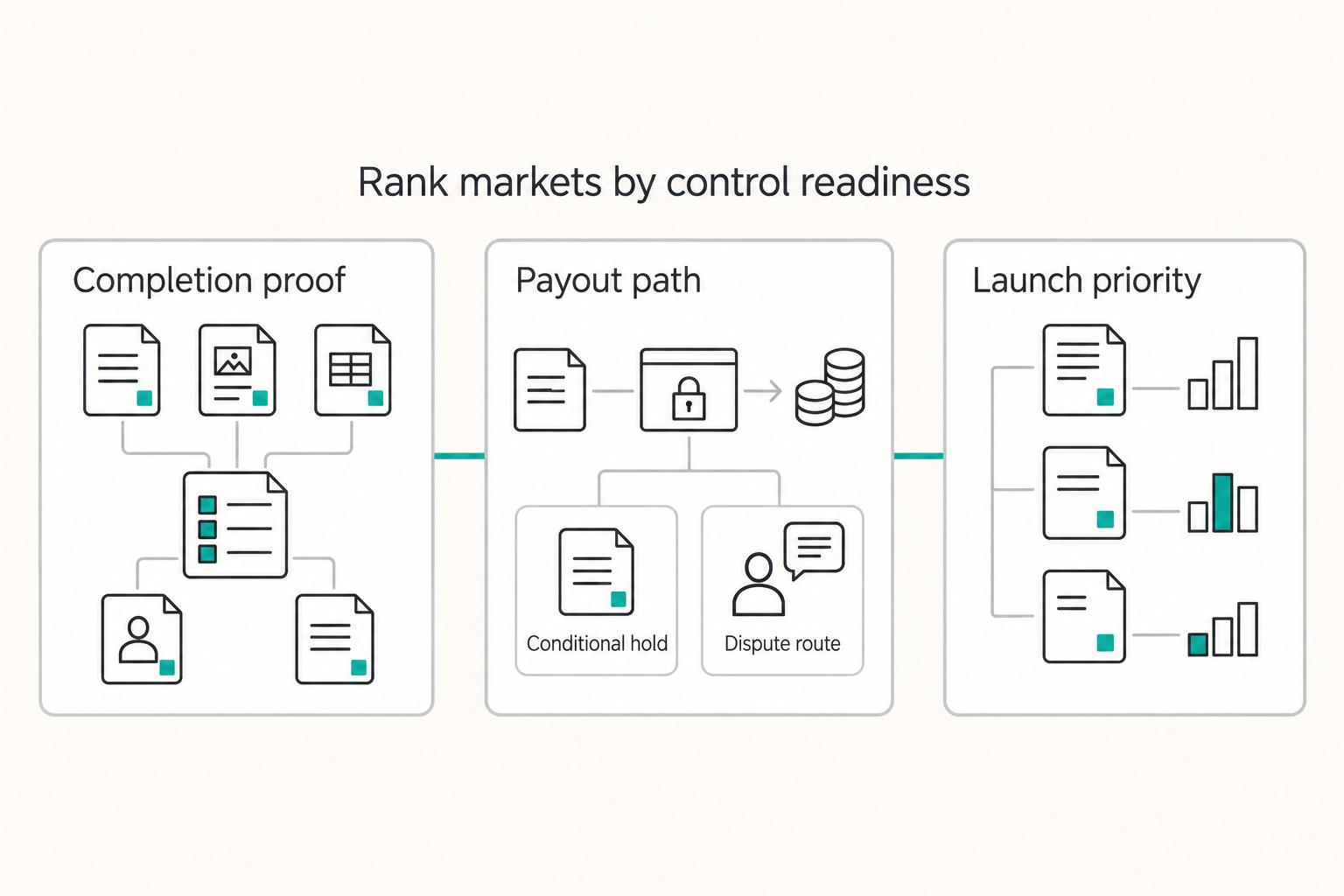
Prioritize launch markets by control readiness, not demand alone. If completion evidence is hard to verify or payout paths are conditional, move that market down the queue.
Also, do not assume one milestone pattern will fit every market. In existing marketplace flows, funds can stay held until client release or dispute resolution, and some flows auto-release after a stated buyer review window, such as 14 days in one fixed-price workflow. Treat that timing as platform-specific, not universal.
Define the decision this guide should produce#
This guide should leave your team with three working outputs:
- a preliminary go-or-no-go view for each target country and vertical, based on your own risk and operating capacity
- a launch order tied to control readiness
- a documented release-and-dispute design prepared for real disputes and audit review, subject to control testing and recordkeeping evidence
Before you commit budget, run one end-to-end sample case: prefunding, review, missed review, dispute, and payout exception. If you cannot clearly identify who can act, what evidence supports release or hold, and what record you would produce if challenged, the launch decision is still open.
Related: How to De-Risk a Fixed-Price Project with a Phased Payment Schedule.
Define the minimum viable milestone operating model#
Your minimum model should favor enforceable controls over flexibility. Define money states and action rights first so approvals, releases, and disputes follow clear rules instead of operator judgment.
Map the money into five enforceable states#
A practical minimum model can use five plain states: fund, hold, review, approve, release. In fixed-price milestone flows, funding happens upfront, and funds remain held until work is approved. Base approval on objective evidence. If you use a true escrow account, label it precisely. If you use a provider hold model, label that precisely too. For example, Stripe Connect manual payout timing is not an escrow service.
For every state, set an audit checkpoint: what changed, who triggered it, what evidence supports it, and what status is recorded in the ledger and milestone record.
Assign role-based approval and handoffs#
Permissions should attach to roles, not people. Buyer actions typically cover funding and review decisions. Provider actions cover deliverable submission and resubmission after requested changes. Platform ops actions should stay limited to defined exceptions such as stalled reviews, disputes, or payout holds.
Keep the review handoff menu explicit: approve, request changes, or no action. In live models, timing is provider-specific. For example, Upwork uses a 14-day review window and resets the review period after resubmission. PayPal delayed disbursement can auto-disburse after 28 days.
Make the milestone payment schedule testable#
A milestone payment schedule is most enforceable when acceptance criteria are explicit and testable. At minimum, define the deliverable description, amount, inspection timing, and required objective evidence for each milestone.
Treat subjective-only acceptance as a risk signal. If completion cannot be supported by verifiable data, your team will end up arbitrating opinion instead of applying a clear release rule.
Related reading: A Guide to the Statement of Work (SOW) for a SaaS Development Project.
Choose your first markets and verticals before writing product specs#
Do not start with TAM. Start with the first country-vertical pair where collection, review, release, and failure handling can work without guesswork.
Score markets with an operator table, not a strategy memo#
Build a comparison table before writing payout logic or onboarding screens. The question is simple: can you collect, hold, review, and release funds in this market without guessing on licensing, KYB, AML, or payout failures?
| Country + first vertical | Licensing posture | Collections reliability | Payout reliability | Dispute burden | Onboarding friction |
|---|---|---|---|---|---|
| India + services marketplace | High scrutiny. If your model resembles online payment aggregation, check RBI’s Payment Aggregator direction and whether your setup depends on an authorized operator | Do not treat collection as resolved until PA posture and partner model are confirmed | Medium until beneficiary data quality and failed payout handling are tested | Medium to high if milestone acceptance is subjective | High, because regulatory posture and partner structure need early confirmation |
| US + B2B professional services with legal-entity providers | Program-dependent. Confirm whether your partner program requires beneficial-owner procedures under 31 CFR 1010.230 | Can be easier to structure, but only after partner responsibility is clear | Medium. Rejected or failed payouts still need tracking and recovery rules | Can be lower if deliverables are document-based and acceptance is objective | Medium, because legal-entity KYB can require owner collection and verification |
| New market + custom creative work | Unknown until local legal and partner review is complete | Unknown until local collection path is confirmed | Unknown until payout rails and failure states are tested | Can be high, because disputes can turn on opinion | Highest, because both compliance and verification are weak at launch |
Keep the five columns even if you score with simple labels. If a cell cannot be filled with a defensible note and owner, treat that as a readiness failure for product specification.
Check the regulator signal before choosing the build path#
Do the regulator check before product design. In India, RBI has a formal “Master Direction on Regulation of Payment Aggregator (PA)” dated September 15, 2025. Earlier circulars required existing online non-bank PAs to apply under the Payment and Settlement Systems Act, 2007 by September 30, 2021, with net-worth references of ₹15 crore by March 31, 2021 and ₹25 crore by March 31, 2023 in that context.
This does not mean every marketplace model in India is automatically a PA. It does mean “Payment Aggregator” is an early design qualifier, not a cleanup item. RBI also publishes a list of authorized Payment System Operators (cited date: Mar 30, 2026). If you cannot clearly state whether your flow requires, depends on, or avoids that posture, delay the build decision.
Use the same posture in other markets. FATF is explicit that countries use different legal, administrative, and operational frameworks, even with a shared risk-based approach. Do not assume one global onboarding spec is portable.
Use a hard no-go rule when KYB or AML ownership is unclear#
If KYB or AML ownership is unclear, stop. Delay launch and run a compliance discovery sprint. That sprint should produce:
- a market memo covering licensing posture, regulator signal, and partner dependencies
- a KYB and beneficial-owner responsibility map showing what is collected and who verifies it
- an AML trigger list for onboarding, transaction review, and payout holds
- a payout-failure map translating provider states like “rejected” or “failed” into operations
In the US example, beneficial-owner procedures for legal-entity customers are a concrete requirement in at least some covered financial institutions under 31 CFR 1010.230. If that requirement sits in your onboarding path, it changes the documents, review steps, and release timing you need.
Rank launch order by operational confidence#
Launch first where verification is straightforward and dispute handling is manageable. In practice, that usually means one country, one vertical, and milestones that can be validated with objective evidence such as files, tickets, approvals, or similar records.
Treat payout reliability as a launch gate, not a post-launch fix. Stripe documents rejected payouts when bank details do not match bank records, and Adyen includes explicit “credited” and “failed” payout outcomes. “Payout available” alone is not readiness.
Also account for dispute liability routing. Visa guidance notes that dispute and settlement obligations can fall back to the payment facilitator or marketplace when sellers cannot repay cardholders. A subjective, high-ticket first vertical can therefore become a direct balance-sheet risk decision.
Launch where compliance ownership is clear, regulator signals are readable, payout failures are operationally mapped, and milestone completion can be verified without subjective debate.
Set escrow funding and release rules that match risk#
Set funding and release rules before launch, and make them explicit by category. Because platform mechanics differ, define funding and release behavior per platform and category instead of assuming one pattern applies everywhere.
Require prefunding by risk level#
Match the funding rule to dispute exposure and enforce it in workflow. Escrow.com requires full funding at transaction start for milestone transactions, and Upwork requires clients to fund each milestone or project upfront.
For categories with higher dispute exposure, keep funding and release rules explicit so release decisions focus on acceptance and review outcomes, not whether funds are available. If your workflow supports partial release, keep it narrow and explicit in contract terms and release logic. Use one machine-checkable gate: a milestone cannot move to review unless held funds satisfy its configured funding rule.
Choose one primary release mode per category#
Pick a primary release mode for each category, then document the exceptions.
| Release mode | Best fit | Trigger | Main upside | Main risk |
|---|---|---|---|---|
| Manual approval | High-dispute or high-ticket work | Reviewer accepts submitted work | Strong control and auditability | Slower approvals |
| Conditional auto-release | Lower-dispute work with clear review ownership | Submission is complete and no rejection is raised in the review window | Reduces stalled payouts | Weak criteria can allow poor submissions through |
| Time-based fallback release | Categories with frequent reviewer silence | Funds release when review or inspection period expires with no action | Prevents funds from sitting in limbo | Silence can hide unresolved quality concerns |
Upwork shows the manual path clearly: reviewers can accept and pay or request changes, and requesting changes blocks release until resubmission and re-review. Upwork also applies timed fallback after a 14-day review window if no action is taken. Escrow.com similarly releases on acceptance or at inspection expiry, with inspection periods set at 1-30 calendar days.
Tie release triggers to clear deliverables and review actions#
Release triggers should be written around clear deliverables and platform-defined review or inspection actions. Avoid soft language like "mostly done."
Each trigger should define what was delivered, who can approve, and what happens if no action is taken before expiry. Capture required evidence before the review timer starts. Keep audit fields for submission time, reviewer, and expiry time. Where transfer proof matters, retain receipts, tracking details, or similar records.
Document exception paths before production traffic#
Do not wait for live disputes to define the exception path. Before go-live, spell out missed milestones, partial acceptance, requested changes, and refund or reversal handling. Keep ownership, timers, and allowed actions explicit.
Upwork supports partial milestone release, so if you offer partial acceptance, state who can approve partial release and how remaining held funds are handled. Platform examples are specific on refund and dispute timing, and Upwork fixed-price dispute assistance is non-binding. One Upwork refund flow uses seven days for freelancer or agency response and five days for client response. Set and document your own internal windows instead of leaving them informal.
Design milestones that are auditable, not ambiguous#
If a milestone cannot be verified by someone other than the seller, it is not ready for release logic. Each line in the milestone payment schedule should function as a testable acceptance packet with a named verifier, required objective evidence, and a clear pass or fail decision.
Convert each milestone into an acceptance packet#
Do not describe a milestone as a sentence fragment. Define it through five fields:
| Field | What to define |
|---|---|
| Deliverable | The specific output expected at this stage |
| Verifier | The person or role allowed to accept or reject it |
| Evidence format | The records required before review starts |
| Deadline | Submission cutoff and review expiry |
| Pass/fail condition | The decision rule for approval |
The pass or fail condition is the control point. Acceptance criteria are the exit criteria, and pass or fail criteria are the rules that determine whether the item is accepted. Replace vague text like “phase 1 complete” with testable conditions tied to required records and clear approval rules.
Use one operational gate: the review timer starts only after the packet is complete. On platforms that use a 14-day review window, start it only when the required evidence is attached and the verifier is clearly assigned.
Require evidence by work type and keep the approval trail#
Evidence requirements should live inside each milestone, not in a separate SOP. Objective evidence for audit is record-based and verifiable, so submissions should point to actual records, not statements like “tested and working.”
Set evidence by category and enforce it in product. The goal is consistency: evidence links, test outputs (when relevant), and approval history captured together so operators can reconstruct what was agreed, what was delivered, who reviewed it, and when actions happened.
Keep role-based approval explicit: provider submits, buyer or designated reviewer accepts or requests changes, and ops overrides only through a documented exception path. If multiple roles can approve, define precedence before launch.
Add a cannot-claim-complete list#
Block ambiguous completion claims before they enter review. A short “cannot-claim-complete” list can reduce disputes tied to unclear submissions. Examples to block:
- “mostly done”
- “ready for feedback”
- “works as expected”
- “delivered all agreed items”
- “QA passed” without attached results or evidence links
When a blocked phrase appears, return the milestone to draft and require the missing packet fields.
Store the minimum record set for disputes and release decisions#
For every milestone, store the minimum record set: agreed milestone text, submission timestamp, evidence links, test/QA output (when relevant), reviewer identity, approval or rejection action, and request-changes history. Your audit trail should be chronological and detailed enough to reconstruct the sequence when funds are contested.
Keep the release chain strict: no evidence packet, no complete status, no review. No review outcome, no release.
Put compliance gates in front of money movement#
Treat compliance status as a release gate, not just onboarding admin. Payout should require both milestone approval and a clear KYC, KYB, or AML state at the moment money moves.
Define preconditions by money-movement stage#
Do not rely on one vague account approved flag. Split controls by action so operators can see exactly what is allowed and what is blocked.
| Lifecycle stage | Control to check | Operator rule |
|---|---|---|
| Onboarding | KYC/KYB collection and verification | Allow setup and draft contract creation only when your provider or program supports it |
| Funding | Payment capability and verification status | Block funding if verification is required before processing payments |
| Payout/release | Payout eligibility, KYC/KYB state, AML or fraud holds | Block release when required verification is pending or when payout status is paused or suspended |
| Enhanced review | Fraud flags, ownership gaps, other risk signals | Apply program-defined payout restrictions and route to manual or provider review |
Requirements are not uniform across providers or users. Stripe and Adyen both vary verification requirements by factors like location, entity type, and requested capabilities, so avoid hardcoding one universal document list.
Separate onboarding, transaction, and payout checks#
Use onboarding checks to collect and verify identity and business information, including beneficial ownership for legal entities where required. If your program has CIP obligations, that identity collection belongs before account opening in that program.
Use transaction checks at funding time, not only at signup. Status can change after onboarding, so funding and release logic should check live status, not stale status.
Then check again at payout. Incoming payments can remain available while payouts are paused, and paused or suspended payout states can block outgoing transfers even when milestones are approved.
Write operator rules for pending and held accounts#
Keep the operator rules short and enforceable:
- If KYC or KYB is pending, allow drafting only where your provider or program allows it, but block release until verification clears.
- If an AML hold or fraud suspension is active, apply the restrictions defined by your provider or program and route the case to investigation or provider-led review.
- If verification status changes after funding but before payout, stop release and require a fresh status check.
Store case-ready records, not just pass or fail flags. Keep provider status, missing requirements, reviewer action, and hold timestamps.
Make caveats explicit in product copy#
Say this plainly in UI and policy copy: verification coverage varies by market, legal-entity type, and program, and some functions may remain available while payout is blocked.
That avoids a common failure mode. Users often assume work approval means payout approval. In a milestone system, it does not.
Choose collection and payout rails by operational fit#
Do not choose rails on collection coverage alone. A launch corridor is ready only when collection and payout both work for the same country, currency, and account type.
Map checkout and Virtual Account funding to buyer behavior#
Use checkout-based collection when buyers need to pay online. Checkout is a low-code way to collect payments, supports one-off payments and subscriptions, and can accept more than 100 local payment methods.
Use a Virtual Account path when buyers are expected to fund by bank transfer, especially where providers position it for larger transfer-based collections. Where supported, virtual-account flows can also reduce manual reconciliation by automating matching and payment notifications.
Treat availability as a hard gate. Virtual-account funding is not universal across providers or markets, so confirm corridor support before you commit to implementation.
Separate collection readiness from payout readiness#
A working checkout flow does not prove payout readiness. Payment gateway integration and payout availability are separate checks. Validate payout constraints before launch:
- Stripe Connect settlement currencies vary by payout country.
- Multi-currency settlement is only supported in specific cases, and connected accounts must be in the same region as the platform.
- Stripe states connected accounts can hold and pay out in up to 18 supported currencies.
- In Adyen, the Local payout column is key for planning. In classic platforms, payout-method country must match account-holder country.
- If local payout is unavailable, payout can fall back to cross-border transfer.
For each launch corridor, record the collection rail, payout country, payout currency, local versus cross-border outcome, and merchant-role ownership. If any field is unresolved, the corridor is not launch ready.
Score payout rails on reliability, not just coverage#
Pick payout routes your team can operate and recover, not just routes with broad nominal coverage. Score each rail on:
- Return rates: use your own corridor-level failure and return patterns; no universal threshold is established in the sources.
- Reconciliation effort: prioritize rails that reduce manual matching.
- Provider visibility: confirm what payout-status, failure-reason, and external-account details you can access.
- Failure recovery speed: account for the fact that failed payouts can block further payouts to that external account until details are updated.
Also account for payout timing behavior. Some providers note an initial live payout window of 7-14 days after first successful payment.
Use Merchant of Record when responsibility is the real constraint#
Run Merchant of Record (MoR) analysis early when tax and transaction responsibility is the real blocker. The MoR is the entity with legal responsibility for the transaction, and in direct marketplace collection that assignment depends on configuration, such as Stripe Connect direct charges where the connected account is MoR.
A managed MoR model can reduce operational burden where indirect tax, fraud handling, disputes, and support are what hold up a product line. But treat scope as contract-verified. Stripe materials reference both "more than 80 countries" and "more than 75 countries" for tax-compliance coverage.
If you need custom funds movement and direct control, assess direct collection against MoR options. If legal and tax responsibility is the larger launch constraint, a MoR route may reduce moving parts.
Implement API and webhook behavior that survives retries#
Once the rail choice is set, state drift in your integration is still a major risk. Treat create, approve, release, and payout calls as retryable, and do not mark funds released until your ledger and provider records reconcile.
Use idempotency keys on every mutating payment action#
Assign one idempotency key per business action, not per HTTP attempt. Use one key for milestone creation, approval submission, release initiation, and payout initiation. If a request times out, retry with the same key.
Use each provider’s idempotency mechanism consistently: Idempotency-Key for retry-safe POST or PATCH behavior, PayPal-Request-Id for PayPal REST POST calls, and Adyen retries with the same idempotency header on timed-out POSTs. Keep key format portable across providers, including Adyen’s 64-character limit.
A practical pattern is a key tied to object and action, such as milestone_482_release_v1. Store it with:
- internal milestone ID
- action type
- actor from your approval record
- provider account or corridor
- final provider response reference
Teams get burned here when they skip correct idempotency on key operations.
Define webhook contracts that are duplicate-safe and replay-safe#
Assume duplicates and delays will happen. Stripe explicitly notes duplicate event delivery and recommends logging processed event IDs for deduplication. It also retries undelivered events for up to three days in live mode. Your release logic cannot rely on exactly-once delivery or one fixed retry window across providers.
Model state transitions by allowed milestone state, not by event arrival order. A payout-success event should move release_pending to released only when it matches the stored release attempt. A delayed failure event for an older attempt must not override a newer success.
For Adyen flows, acknowledge first and process asynchronously. If Adyen does not receive a response within 10 seconds, it marks delivery as failing and retries. Your endpoint should persist the raw event, return success, and hand off processing.
Reconcile ledger, provider reference, and milestone state before release#
Before marking funds released, require a three-way match:
- internal ledger entry for the release or payout attempt
- provider reference for that same attempt
- milestone still in the expected pre-release state
For Stripe, reconcile payout outcomes with related balance transaction records. For Adyen, preserve merchantReference for reconciliation and store the related PSP reference with it.
If any record is missing or mismatched, stop at release_pending_review instead of forcing released. Include the raw webhook payload, idempotency key, provider reference, and approval record in that review queue.
Build dispute handling before go-live#
A clean release flow is not enough if the dispute path is vague. Before launch, define a dispute ladder with clear decision authority, required artifacts, and timeout rules so milestones do not stall in limbo.
Define a platform-specific dispute ladder#
Use a staged ladder, not a single "raise dispute" button: evidence request, reviewer decision, partial release option, escalation, final resolution. In practice, party-to-party messaging often comes first, then formal escalation if the two sides cannot resolve it.
Keep authority rules platform-specific. On PayPal, escalating to a claim asks PayPal to investigate and decide the outcome. On Upwork fixed-price disputes, team decisions are described as recommendations and nonbinding. For each dispute state, define who can act, what they can submit, and what outcome they can trigger.
Require artifact-backed decisions#
Base decisions on artifacts, not opinions. For each disputed milestone, require an evidence packet tied to milestone terms, such as the submitted deliverable, service-delivery records, and timestamped status changes.
Use reason-specific evidence requests. Dispute categories can require different proof, and service disputes often depend on delivery documentation such as download records or email receipts. If the packet does not match the milestone's original pass-or-fail condition, pause and request the missing artifacts instead of forcing a ruling.
Add a partial release path before escalation#
Treat partial outcomes as a normal path, not an exception. PayPal supports partial refund outcomes, and Freelancer supports partial milestone releases, so your flow should allow partial release when completed work is separable and evidenced.
If the work is inseparable, move directly to reviewer decision or escalation. When partial release is used, record the deliverables covered, adjustment rationale, and remaining held amount.
Set SLAs and timeout behavior that end limbo#
Define explicit stage clocks before go-live so unresolved milestones do not sit open indefinitely. Set deadlines for evidence submission, reviewer response, escalation cutoff, and final resolution, and define what missed deadlines trigger in your system, such as auto-close, auto-release, or manual review.
Use external timelines as reference points, not universal rules. Upwork cites a 14-day client review window and a 5-day non-response release path in one dispute flow. PayPal notes that escalation often requires at least 7 days from payment date. Disputes auto-close after 20 days if not escalated, and claim decisions are usually 14 days but can take 30 days or longer. If dispute staffing or SLA ownership is still undefined, consider delaying expansion until that ownership is explicit.
Prepare tax and invoice artifacts for cross-border execution#
The same discipline you use for disputes should carry over to tax and payout records. Missing forms or weak payment trails can create reporting errors and slow execution.
Build a minimum document bundle per released milestone#
Create a baseline bundle per released milestone: invoice, payout confirmation, and supporting records such as the contract or order form, acceptance evidence, and release record. The release record can tie to the milestone schedule, approved amount, approver, and release timestamp, and the payout confirmation should include the provider reference showing funds moved.
Before closing the milestone, verify that payee name, amount, date, and proof of payment align across all records. If an invoice covers the full project but the release is partial, document that difference clearly in the release record.
Collect the right tax form before payout#
Collect the tax form before payout setup. Use Form W-9 for U.S. payees when you need a TIN for information return reporting, Form W-8BEN for foreign individuals, and Form W-8BEN-E for foreign entities. W-8 forms are furnished to the payer or withholding agent, not filed directly by the payee with the IRS.
If the form type is unclear, route to manual review before funds are released.
Map records to the correct reporting path#
Map each payout to the reporting path using the tax form, invoice trail, and payout evidence. Card and third-party network transactions are generally reported on Form 1099-K by the payment settlement entity and are not subject to reporting on Form 1099-NEC or 1099-MISC. Nonemployee compensation paid to nonresident aliens may require Form 1042-S treatment.
Keep ownership clear: ops validates record completeness, and finance or tax counsel owns tax classification decisions.
Separate user tax guidance from platform controls#
Keep FEIE and FBAR as user guidance, not payout release gates. FEIE is taxpayer-level guidance tied to services performed in a foreign country and eligibility tests. FBAR is user-level reporting context: U.S. persons may need FinCEN Form 114 when aggregate foreign financial accounts exceed $10,000 during the year, due April 15 with an automatic extension to October 15.
Protect records with explicit access controls. Mask payment card numbers in operations views by default, encrypt tax documents at rest and in transit, and restrict full-record access to staff with a legitimate business need.
Pilot in one corridor and instrument decision checkpoints#
Once your tax and payout records are stable, run a small, time-bound pilot before broad rollout. Keep the scope tight, define success metrics during build, and use explicit gates before expanding.
Constrain the pilot on purpose#
Start with a corridor you can monitor closely so the variables stay readable. Set limits in writing for duration and user volume. Keep your pilot process consistent across contracts so the results reflect market behavior, not a shifting process.
Instrument the operator KPIs during build#
Track dispute rate, payout failure outcomes, completion rate, and manual review load from day one. For each milestone, capture submit and acceptance time, approver, release time, payout status, and provider reference.
Measure disputes by charge date. Treat movement toward the 0.75% excessive-dispute benchmark as a warning signal. Log failed or returned payouts with return reasons, since returns commonly appear within 2-3 business days.
Set an expansion gate before the first user goes live#
Define expansion criteria before launch, then hold the gate until results meet your risk standard. At minimum, confirm reconciliation quality by matching bank payouts to transaction batches, and verify completion rate so users can finish the flows they start. Do not treat funded volume alone as success when disputes can surface up to 120 days after payment.
Feed pilot findings back into controls and milestone design#
Use pilot outcomes to tighten operating rules, not just reporting. If manual review volume stays high, narrow intake criteria for higher-risk cases. If acceptance slows because deliverables are vague, refine the milestone payment schedule so each release requires objective evidence, a named verifier, and a clear pass/fail condition.
Before expanding beyond your pilot corridor, align your release gates and retry logic with the implementation patterns in the Gruv docs.
Common mistakes that sink marketplace milestone launches#
Milestone launches can fail at the control layer even when demand is strong. A common pattern is that policy, money movement, and provider behavior drift apart. If you fix one thing first, make milestone rules enforceable in code and payout controls, not just in UX copy.
Turn milestone policy into hard release controls#
A common mistake is treating milestone policy as guidance instead of a hard gate. A release should fail unless three checks pass: funds are in the right account state, the acceptance packet includes objective evidence, and the approver role matches the contract risk or value.
In regulated setups, this is operational, not optional. In the RBI PA/PPI context, authorized entities are required to maintain an escrow account with a scheduled commercial bank, and RBI's PA framework also includes formal dispute-management expectations. Your controls need to hold up in complaint and exception scenarios, not only happy paths.
Run one direct test: attempt release with a missing artifact, expired approval, or wrong approver role. If payout creation still succeeds, you have policy copy, not policy enforcement.
Make your API integration replay-safe before live traffic#
The next common mistake is assuming retries are rare or harmless. If idempotency and replay-safe webhook handling are weak, duplicate release attempts and stale-state regressions are likely.
Provider behavior makes that explicit. Adyen supports idempotency keys with minimum 7-day validity. PayPal warns duplicate requests can occur when its request ID header is omitted. Stripe Connect requires webhook endpoints, and Stripe retries undelivered events for up to three days. Adyen's webhook retry queue can run for up to 30 days.
Use one release rule: do not mark funds as released until the ledger entry, provider reference, and milestone state reconcile. Then force failure-path tests, including duplicate approvals and out-of-order events.
Validate country payout behavior before expansion#
A common expansion error is validating collections but not payout exceptions. Country support is not binary enough for launch decisions.
PayPal documents 4 payout feature levels by country, and Adyen notes that unsupported local payout routes may settle via cross-border transfer. Stripe Connect also notes failed payouts can disable the affected external account until corrected.
Treat gateway readiness per market as a full-path test: success, failure, retry, and account recovery. If you cannot demonstrate that end-to-end path for a country, hold launch.
Front-load KYC and AML edge cases#
Another common failure mode is deferring KYC and AML design until after rollout. In practice, compliance gates directly control whether accounts can accept payments and receive payouts.
Stripe states KYC requirements must be fulfilled before connected accounts can accept payments and send payouts, and AML risk can surface in onboarding, payouts, and transaction logs. For legal entities in relevant regimes, beneficial-owner identification and verification procedures are part of required AML and CDD controls.
Design your evidence model upfront: entity details, beneficial-owner details where required, verification status, hold reason, and operator notes. Also plan for payout-stop scenarios. In Stripe Connect, payout pauses block both automatic and manual payouts, and in-flight payouts can remain pending for up to 10 days.
Use this launch checklist before committing expansion budget#
Do not approve expansion budget until one country, one vertical, and one release model pass payments and operations checks in real conditions. The goal is to prove that money movement, evidence review, and exception handling still work when users miss deadlines, dispute deliverables, or fail onboarding.
Pick the first corridor and vertical#
Start with operational feasibility, not TAM. Rank candidate markets by compliance clarity, payout reliability, and whether completion can be judged with objective evidence.
Corridor conditions are not uniform. Cross-border payments still face cost, speed, access, and transparency friction, and costs vary by route. If regulation or onboarding requirements are unclear, pause and resolve that before build. India is a clear example: the Reserve Bank of India’s Master Direction on Regulation of Payment Aggregator dated September 15, 2025 is a reminder to run compliance review first for India launches.
Checkpoint: produce a one-page go or no-go note per country-vertical pair covering collections, payouts, dispute burden, onboarding friction, and how payouts succeed, fail, retry, and reconcile.
Lock milestone rules before shipping UX#
Define milestone policy in writing before polishing UX. For each milestone, set required evidence, approval owner, silent-review behavior, and dispute or cancellation triggers.
Use manual release when acceptance depends on human judgment. Consider timed fallback release only when evidence is explicit and the review clock is clear. A 14-day review with auto-release is one known fixed-price pattern, but it is an example, not a default.
Checkpoint: every milestone has a verifier, deadline, evidence format, and pass or fail condition. If completion can only be described as “mostly done,” the rule is too vague to scale.
Validate retry safety and reconciliation controls#
Assume retries and delivery failures will happen. Use idempotency for milestone creation, approval, release, and payout calls so repeated requests do not duplicate money movement.
Test webhook recovery paths as implemented by your provider. For example, Stripe retries undelivered events for up to three days, and manual recovery only covers the last 30 days of events. Build handlers for replay and verify internal state from records, not event arrival alone.
Checkpoint: mark funds released only when your ledger entry, provider reference, and milestone status agree. Also treat posted payout status as non-final for recipient receipt. Return and reversal handling must exist before launch.
Verify compliance and tax artifacts#
Gate payouts behind onboarding and compliance readiness. In U.S. regulated contexts, CIP procedures are part of AML, and for covered institutions legal-entity flows require written beneficial ownership verification procedures. Practical policy: if required KYC or KYB checks are incomplete, block payout.
Keep a complete audit and tax trail: contract, invoice, acceptance evidence, release record, and payout proof. Use Form W-9 when a payee provides a correct TIN for IRS information returns, and Form W-8BEN when a foreign beneficial owner is asked to provide it to the payer or withholding agent.
Checkpoint: operations can pull one complete file showing payee, amount paid, proof of payment, and date incurred without engineering support.
Run a pilot and require explicit approval to expand#
Pilot one country-vertical pair before wider rollout. Keep contract values controlled, measure manual review load, and log disputes, payout exceptions, and reconciliation breaks.
Expand only through an explicit approval memo. Approve the next market when pilot results show stable acceptance timing, workable dispute handling, successful payout recovery, and clean reconciliation. If operations cannot explain delayed releases or failed payouts, do not fund the next rollout.
For a step-by-step walkthrough, see Collection Agencies for Small Businesses: Use a Payment Assurance System First.
If your expansion decision depends on market-by-market payout and compliance feasibility, use your checklist outputs to talk through coverage and rollout design with Gruv.
Frequently Asked Questions
What is a milestone payment system in a project marketplace, and how is it different from hourly billing?
A milestone payment system is a fixed-price contract split into stages, with pre-funded amounts released after approval. Hourly billing usually fits work where scope is still evolving, while fixed-price milestones fit work that is clearly defined upfront. If you cannot define clear acceptance checks for each stage, hourly is often the better fit.
When should a marketplace require full escrow funding versus partial prefunding?
There is no universal rule. This is a marketplace policy decision, not a global requirement. One major marketplace flow allows either full contract funding or only the first milestone, with a minimum first milestone of $5.00 USD. Use that as a design signal to set funding rules based on your own risk controls and operating model.
How do escrow, objective evidence, and role-based approvals work together in practice?
Escrow controls fund state, the evidence packet supports the completion claim, and approval permissions control who can release funds. Buyer-side actions can include accept, request changes, or pay early, while pending milestones can also move through request-release, cancel, or dispute paths. The practical rule is simple: if required artifacts are missing, acceptance checks fail, or the approver is out of policy, release should not proceed.
What are the highest-risk rollout failures when launching in multiple countries?
A high-risk mistake is assuming feature parity across countries. Some payment features are not available in certain regions, and connected-account requirements vary by location, business type, and requested capabilities. Launch plans should follow tested payout behavior in each market, including success, failure, retry, and recovery paths.
How should founders decide between manual release and auto-release for milestones?
Use manual release when acceptance requires human judgment and documented review. Auto-release works better when acceptance criteria are explicit and your timeout rule is clear to both sides. For example, one fixed-price flow uses a 14-day review window before automatic release, and some escrow flows release after an agreed inspection period passes without response.
What should be validated before enabling payouts in a new market?
Validate that the payout route and features you plan to use are actually available in that market. Then verify the required onboarding data for that account type, since payout readiness is market- and profile-specific. Before production rollout, run end-to-end tests for successful payout, failed payout, remediation, and operational traceability.
Which compliance gates are non-negotiable before funds can be released?
Connected accounts must meet KYC requirements before they can accept payments and send payouts, and some onboarding flows also require KYB procedures. Where U.S. MSB rules apply, AML programs must be written and risk-based, but you should not assume every marketplace is an MSB. In India, the Reserve Bank of India (Regulation of Payment Aggregators) Directions, 2025 dated September 15, 2025 are a direct signal to review country-specific payment requirements before launch.
Researched and edited by the Gruv editorial team. Gruv builds cross-border billing, payouts, and finance-operations software for global businesses.
Sources
- cisa.gov/audiences/small-and-medium-businesses/secure...trusted
- csrc.nist.gov/glossary/term/role_based_access_controltrusted
- csrc.nist.gov/glossary/term/audit_trailtrusted
- ecfr.gov/current/title-31/subtitle-B/chapter-X/part-1...trusted
- ecfr.gov/current/title-31/subtitle-B/chapter-X/part-1...trusted
- irs.gov/forms-pubs/about-form-w-9trusted
- irs.gov/businesses/small-businesses-self-employed/re...trusted
- law.cornell.edu/wex/escrowtrusted
Educational content only. Not legal, tax, or financial advice.
Related Posts

The Freelance Payment Penalty: A Modeled Audit of Platform Fees, FX Spreads, and Payout Delays
The money rarely disappears through a single, easy-to-spot fee. The real loss is stacked. A marketplace takes its commission, a processor adds a charge for international cards, a bank or payment company converts the currency at a spread, a platform holds the funds before release, and a wire sheds a little to intermediaries on the way in. Each layer looks defensible on its own, but the worker feels the combined result as a smaller deposit and a later payday.

How to Respond to a Subpoena for Business Records
Move fast, but do not produce records on instinct. If you need to **respond to a subpoena for business records**, your immediate job is to control deadlines, preserve records, and make any later production defensible.

A US Expat's Guide to Investing in UCITS ETFs to Avoid PFIC Issues
The real problem is a two-system conflict. U.S. tax treatment can punish the wrong fund choice, while local product-access constraints can block the funds you want to buy in the first place. For **us expat ucits etfs**, the practical question is not "Which product is best?" It is "What can I access, report, and keep doing every year without guessing?" Use this four-part filter before any trade: