
Quick Answer
A SaaS development SOW connects deliverables to acceptance tests and an agreed payment schedule. Define scope, exclusions, dependencies, approvers, review windows and change orders. Use invoice triggers that fit the billing model, and state what happens when delivery, approval or payment is delayed.
Your SaaS SOW should protect cash flow before code starts#
Before coding starts, agree what the client will receive, how it will be tested and when you can invoice. Those decisions protect delivery time and cash flow more directly than a broad promise to implement the platform.
A SaaS development SOW records a specific build or implementation engagement. It may sit under an MSA or form part of another signed agreement. State how it incorporates the other documents and which terms prevail if they conflict.
One common failure mode is simple. The client asks for "one more workflow tweak" during an agile sprint. If your scope only says "workflow setup," you either absorb the work or fight about it later.
If your SaaS SOW names the exact workflow, acceptance criteria, and change path, you can approve, reprice, or defer with less risk of dispute.
| Control point | Weak default | Safe default |
|---|---|---|
| Scope | Broad deliverable labels | Specific deliverables, assumptions, and out of scope list |
| Approval | Informal "looks good" signoff | Named approver, evidence standard, review window |
| Payment | One undefined approval gate for all invoices | Explicit milestone, advance or time-and-materials triggers |
Match payment triggers to the agreed billing model. Milestone invoices can depend on acceptance; deposits, retainers and time-and-materials invoices need their own triggers. Avoid leaving every payment dependent on an open-ended client approval.
- Lock scope in plain language. Define in scope, out of scope, and client dependencies.
- Lock acceptance early. Name who approves, what proof counts, and how long review can take.
- Define invoice triggers for the billing model, including due dates and disputed-amount handling.
- Lock change control. No approval, no build. Update scope, acceptance, and payment together.
- Lock cross-border assumptions. Confirm jurisdiction differences and procurement constraints before kickoff.
Give each contract document a clear role#
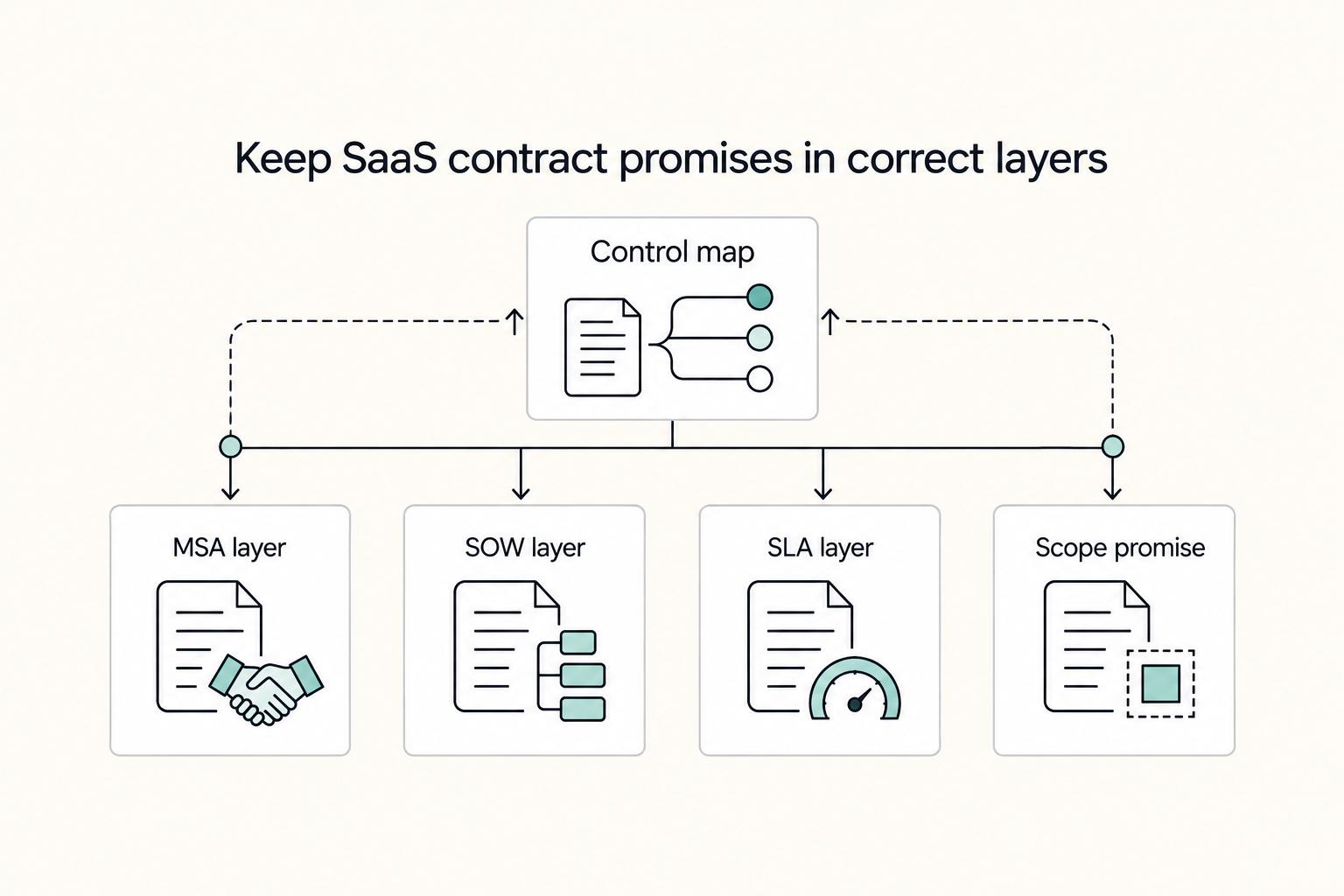
The MSA usually holds relationship terms, the SOW describes the project and an SLA defines service levels where relevant. Scope of work is commonly a section of the SOW rather than a fourth signed agreement. These are drafting conventions, not a guarantee of enforceability.
- Master Services Agreement (MSA): the overarching commercial and legal baseline for the relationship.
- Statement of Work (SOW): project responsibilities, deliverables, and timelines for a specific project engagement.
- Service Level Agreement (SLA): measurable ongoing service performance after go live.
- Scope of Work: the work-definition block inside the SOW that describes what work will be performed.
| Contract layer | Primary job | Put this here | Avoid duplicating |
|---|---|---|---|
| MSA | Relationship baseline | Overarching reusable commercial and legal terms | Project-specific task lists and deliverables |
| SOW | Project execution plan | Project responsibilities, deliverables, and timelines | Reusable relationship-level legal baseline |
| SLA | Live service performance | Measurable ongoing service standards | Implementation-phase project execution details |
| Scope section within SOW | Work definition block inside SOW | What work will be performed for the project | Relationship-wide legal terms |
Define scope and acceptance before drafting the schedule#
- Scope of Work: state what work will be performed for the project.
- Acceptance Criteria: define how project deliverables are accepted.
Also keep a common core structure in every SOW, even when project details change. If you want a reusable baseline, align your process with How to Write a Master Service Agreement (MSA) for Long-Term Client Engagements.
What should a SaaS development SOW include?#
Keep scope, acceptance, payment, ownership and client responsibilities in one readable project plan. A delivery lead should be able to tell whether a requested task is included without reconstructing the negotiations.
A strong statement of work for software development keeps the practical core in one place: requirements, deliverables, timelines, payment terms, and acceptance criteria. It should also align with related agreement documents so project terms and legal terms stay consistent. Keep project scope concrete so delivery, approvals, and invoicing can run without reopening definitions every sprint.
Use a minimum structure that prevents silent expansion#
| SOW block | What to define clearly | Why it protects both sides |
|---|---|---|
| Scope of Work | In-scope tasks, out-of-scope tasks, assumptions | Stops informal expansion and resets expectations early |
| Deliverables and milestones | Exact outputs, due sequence, handoff points | Gives clients visibility and gives freelancers a delivery map |
| Acceptance Criteria | Evidence needed, approver name, review window | Prevents subjective "looks done" disputes |
| Payment Terms | Billing model, invoice triggers, due dates and disputed-amount process | Keeps cash collection aligned with approved work |
| Execution ownership | Roles, responsibilities, escalation owner | Removes ambiguity when blockers appear |
| Dependencies and access | Client inputs, system access, integration dependencies | Protects timelines when external inputs slip |
| Risk and exit controls | Data handling, compliance, offboarding or transition steps | Plans operations beyond build completion |
Recurring SOW issues often come from blurred acceptance versus completion language. Use clear wording when you define acceptance evidence.
In an agile engagement, a client requests an extra integration after sprint planning. You check the out-of-scope list, issue a change note, update acceptance criteria, and adjust payment terms before work starts. That workflow protects trust and margin.
What belongs in the SOW vs the MSA?#
Put reusable legal and commercial rules in the MSA, and put project execution details in the SOW. Clear document boundaries make drafting and review easier across sales, delivery, and legal.
The MSA sets the long-term rules for the relationship. The SOW defines one project, including deliverables, timing, and project scope. In practice, one MSA can support multiple SOWs over time, letting you reuse baseline terms while tailoring each software development engagement.
Use a clear split for each clause#
| Clause type | Default home | What to write |
|---|---|---|
| Relationship-wide legal terms | MSA | Core commercial and legal baseline terms that should stay stable across projects |
| Project scope and delivery plan | SOW | Scope of Work, deliverables, milestones, acceptance criteria, and project timeline |
| Risk allocation | MSA first | Limitation of Liability and Indemnification, then reference how they apply in this SOW |
| Governing Law and Jurisdiction | MSA first | Baseline forum terms, plus explicit project exception language only when drafted in the signed contract set |
| Project-specific exception | SOW plus MSA cross reference | Exact exception and a clear statement of what baseline assumption changes |
At kickoff, a client asks for a new liability carve out inside the SOW. Route that request to the MSA track, keep execution items in the SOW, and record the approved exception clearly. You keep speed without blurring accountability.
How do you prevent scope creep without slowing delivery?#
Agree a written change process with named people who can approve scope, price and timing. FAR Part 43 illustrates authority and modification controls for U.S. federal procurement; it does not govern an ordinary private SaaS engagement. Use the modification rules in your actual signed contract.
Build a low friction change lane#
Use this as a starting point in your SaaS SOW, then adapt it to your contract and jurisdiction. Each request enters one lane: you assess impact, both sides approve, then delivery starts.
| Step | What you do in the SaaS SOW | Why it keeps speed |
|---|---|---|
| Trigger | Define what counts as a change, including new integrations, data migration asks, or extra training artifacts | Teams spot change early instead of discovering drift in sprint review |
| Impact statement | Record scope impact, timeline impact, dependency impact, and owner | Everyone sees tradeoffs before work starts |
| Pricing decision | Attach cost or effort change to the request before execution when feasible | Approval and budget move together |
| Signature step | Require written signoff from named client authority and your delivery owner | You block informal directives from people without modification authority |
| Release to build | Update the Scope of Work and related terms in one written revision | No approval, no build keeps delivery aligned with agreed scope |
In a sprint, a stakeholder asks for an extra integration in chat. You acknowledge it, log the request, send an impact note, and pause that work until both parties sign. Momentum stays intact because the team keeps moving on approved backlog items.
Prewrite dispute escalation#
Name escalation owners and agree the dispute path, including any negotiation, mediation, court or arbitration stages. A 15-day response window and 30-day executive meeting are possible negotiated terms, not legal defaults. Keep urgent-relief provisions and binding forum clauses consistent.
How should acceptance criteria and payment terms be linked?#
State the event that permits each invoice and the event that starts its due-date clock. Acceptance can trigger a milestone invoice, while an advance or monthly time-and-materials invoice follows a different agreed event. The client’s receipt of an invoice cannot be a prerequisite to your right to issue that same invoice.
In a SaaS SOW, treat approval and billing as one path:
- Acceptance criteria define how a deliverable passes review, who decides and what evidence is required.
- Payment terms specify the invoice trigger, due-date clock and treatment of advance, recurring or disputed amounts.
Build one approval to cash path#
| Milestone term | Illustrative agreed wording | Purpose |
|---|---|---|
| Deliverable | Import up to 10,000 client-supplied records into one named environment; ongoing cleansing excluded | Makes the scope testable |
| Acceptance evidence | Reconcile source and imported record counts and pass five agreed sample queries | Creates an objective pass/fail test |
| Review and cure | Named client approver has five business days to list failed tests; supplier gets ten business days to cure | Defines an illustrative review process, subject to agreement |
| Invoice trigger | Invoice the agreed milestone fee after acceptance; any advance invoice follows its own signed schedule | Separates billing events |
| Due-date clock | Payment due 30 days after receipt of a valid milestone invoice; disputes identify the affected amount | Makes the illustrative deadline calculable |
For software development in an agile model, keep this lightweight but strict. If you use deemed acceptance language, define the notice window and the consequence of no timely rejection, then confirm the approach under the MSA and jurisdiction.
If a client says the feature is almost there, request specific failures against the agreed tests within the review window. Record the defects and cure plan, and apply the agreed billing rule for disputed and undisputed amounts. Do not let vague feedback silently extend the payment deadline.
Add a non-payment response ladder#
Write a staged response into your SaaS SOW:
- Day of missed due date: send a concise payment reminder with milestone evidence attached.
- If still unpaid: issue a formal cure notice under contract terms.
- If breach continues after the cure window: escalate through Dispute Resolution steps.
- Final step: reserve Termination rights for non-payment if the contract permits.
Which legal clauses protect you when a SaaS project goes wrong?#
Protect yourself by allocating failure risk, forum rules, IP ownership, and data duties before the first incident. Once acceptance evidence and payment triggers are tight, the next job is keeping disputes inside the agreed scope when something goes wrong.
Lock risk allocation and dispute path#
Define termination triggers, notice and cure periods, accrued fees and any surviving duties. Specify which losses a liability cap covers and its exclusions. For indemnities, define the covered claims and defense process. Their operation depends on the signed terms and applicable law.
| Clause block | What to define now | Practical default for software development deals |
|---|---|---|
| Termination | Trigger events, cure window, survival terms | List material breach triggers and survival items such as payment, confidentiality, and IP |
| Limitation of Liability | Cap scope and excluded damage categories | Tie cap logic to contract economics and carve out only the risks you can carry |
| Indemnification | Covered claims, process, control of defense | Define notice timing, defense control, and cooperation duties |
| Governing Law and Jurisdiction | Applicable law and dispute venue | Set governing law and forum deliberately based on realistic enforcement needs |
| Arbitration | Seat, rules, enforceability plan | For cross-border contracts, confirm award-enforcement planning under the New York Convention framework |
Protect IP data and continuity#
Identify background tools, third-party components and project deliverables separately. Under U.S. copyright law, work-made-for-hire treatment has limited eligibility; commissioned contractor software does not automatically qualify. Use an appropriate signed assignment for rights intended to transfer, and state when the transfer takes effect and what remains licensed.
| Item | What to define |
|---|---|
| Work for Hire | Verify legal eligibility; contractor software does not automatically qualify under U.S. law |
| Assignment of Rights | Pair it with a signed Assignment of Rights for copyrightable outputs |
| NDA | Name protected information and confidentiality duties |
| Data Processing Agreement (DPA) | When acting as a processor under applicable data-protection law, agree the required processing terms and responsibilities |
| Force Majeure | Address extraordinary-event non-performance and clarify how obligations pause and resume |
Consider a simple scenario: an infrastructure outage blocks testing and both teams miss milestones. Your clause set should tell each side who must notify, what pauses, what resumes, and when either party can terminate cleanly.
How do cross-border rules change your safe defaults?#
Map the actual countries, contracting parties, data access and payment flow. Apply the rules that govern those activities rather than assuming every cross-border SaaS project has the same tax, privacy or verification duties.
Set country-specific defaults before signature#
Use a short cross-border matrix during deal review, then copy approved items into the Statement of Work (SOW) and Master Services Agreement (MSA).
| Control area | Default decision rule | Contract placement |
|---|---|---|
| Compliance and Jurisdiction | Confirm local compliance obligations, tax handling assumptions, and enforceability planning for each delivery country before signing | SOW assumptions section plus MSA governing-law and forum clauses |
| Data Security and DPA | Where GDPR Chapter V applies, establish an adequacy basis or appropriate safeguards and required assessments; a DPA alone is insufficient | MSA privacy schedule plus SOW data-flow appendix |
| UK transfer handling | For a UK restricted transfer, verify a current adequacy regulation, appropriate safeguard and assessment, or an applicable exception | DPA annex and legal checklist |
| Payment rails and timing | State provider and country-dependent payout behavior upfront. Some rails vary by industry and country, and holding windows can differ by country | SOW payment operations block and invoice terms |
| Verification checks | Document KYC evidence expectations by country and currency so onboarding delays do not block delivery | SOW dependencies and client obligations |
Track exceptions with audit-ready language#
Record each unresolved legal or operational question with an owner and the clause or data flow it affects. Resolve the relevant questions before authorizing that part of the work; keep negotiation notes out of the final signed SOW.
- Deviation owner: name the owner who confirms each deviation.
- Clause record: record the country, affected clause, and approved fallback.
- Payout log: log payout status changes and export reconciliation records on a fixed cadence.
- Record changed legal or provider requirements and assess whether the contract requires a scope or fee amendment.
- Signoff: require both parties to sign exception updates before related software development work starts.
If a new country rollout changes verification or data-access requirements mid-project, log the dependency, assess the work and obtain any required amendment before restarting the affected scope.
Keep the MSA stable and run every project through the same checklist#
Before signature, check that a delivery lead can identify the approved work and finance can identify each invoice trigger. After kickoff, use the same records to resolve changes and delayed approvals.
Frequently Asked Questions
What is a SOW for a SaaS project?
A Statement of Work (SOW) defines the implementation work for a specific Software as a Service (SaaS) engagement, including scope, timelines, and deliverables. It usually covers initial rollout and delivery work, while ongoing service performance lives in the SLA.
What should be in a SaaS SOW vs an MSA?
Put project-specific execution in the SaaS SOW: deliverables, milestones, acceptance workflow, and timelines. Keep reusable legal and commercial terms in the Master Services Agreement (MSA), including payment methods, intellectual property rights, confidentiality, and dispute procedures.
What are the minimum sections every SaaS SOW should include?
At minimum, spell out project scope boundaries, including what is included and excluded. Then define deliverables, milestones, Acceptance Criteria, roles and responsibilities, and Payment Schedules so both sides can execute without guesswork.
How do I prevent scope creep in a SaaS SOW?
Write scope boundaries in plain language, then use an explicit change-control step before new work begins. In iterative development, classify each request as in scope or out of scope, and update timeline, acceptance criteria, and payment schedule together.
How do I tie acceptance criteria to payment terms?
For milestone billing, pair each deliverable with objective acceptance tests, a named reviewer, a review window and the agreed invoice trigger. Record advance or time-and-materials billing separately, and define the treatment of disputed amounts.
Should Limitation of Liability and Indemnification sit in the SOW or MSA?
Handle both explicitly across the contract set. A common approach is to keep baseline language in the MSA, then reference or tailor it in the SOW when a project introduces specific risk conditions.
How do Governing Law and Jurisdiction affect cross-border SaaS projects?
They solve different decisions. Governing Law determines which legal system interprets your contract, while Jurisdiction determines which courts hear disputes. Because interpretation and enforcement can change across governing law and forum choices, choose both deliberately before signature and confirm local requirements with counsel.
Try a related tool
Researched and edited by the Gruv editorial team. Gruv builds cross-border billing, payouts, and finance-operations software for global businesses.
Sources
Includes 1 external source outside the trusted-domain allowlist.
- acquisition.gov/far/part-43trusted
- copyright.gov/circs/circ30.pdftrusted
- doi.gov/cloud/faq/procurementtrusted
- edpb.europa.eu/sme-data-protection-guide/international-data...trusted
- uncitral.un.org/en/texts/arbitration/conventions/foreign_arb...trusted
- ico.org.uk/for-organisations/uk-gdpr-guidance-and-resou...external
Educational content only. Not legal, tax, or financial advice.
Related Posts

Master Service Agreement for Freelancers in Long-Term Client Engagements
If you expect repeat work with the same client, set the contract architecture first: one reusable MSA for standing terms, then project documents for each engagement. The point is not just speed. It is making sure your baseline terms are set before they repeat across future projects. Treat each document as a separate layer:

The Freelance Payment Penalty: A Modeled Audit of Platform Fees, FX Spreads, and Payout Delays
The money rarely disappears through a single, easy-to-spot fee. The real loss is stacked. A marketplace takes its commission, a processor adds a charge for international cards, a bank or payment company converts the currency at a spread, a platform holds the funds before release, and a wire sheds a little to intermediaries on the way in. Each layer looks defensible on its own, but the worker feels the combined result as a smaller deposit and a later payday.

How to Respond to a Subpoena for Business Records
Move fast, but do not produce records on instinct. If you need to **respond to a subpoena for business records**, your immediate job is to control deadlines, preserve records, and make any later production defensible.