

Quick Answer
A fixed-price project can use phased payments. Agree the total fee, each phase amount, the billing trigger, and the due date. Save acceptance evidence for deliverable milestones, or the evidence required for a deposit or progress interval. Negotiate overdue pause and change rules before work starts.
Why phased payments matter in fixed-price client work#
Phased payments let you keep one fixed project price while tying payment timing to verified progress. That can help protect cash flow without giving up the budget certainty your client wants.
In fixed-price work, the tension is predictable. Clients want cost certainty, and you need payment to follow completed, reviewable work instead of waiting on one final signoff. A phased schedule helps by linking each financial commitment to a defined phase.
Keep the price fixed, not the commitment points#
A fixed price does not have to mean one bill at the very end. A cleaner structure is to keep the total price fixed and define payment triggers by phase in the contract.
It follows the same planning logic as phased delivery. Defined phases create decision points before new commitments are made. In client work, that means breaking the project into reviewable chunks and attaching payment to those chunks in writing.
Use phases as control points, not rigid templates#
Phases should help you make decisions, not force a one-size-fits-all template onto every project. You can adapt phase checklists to the work, but risk rises when variation starts weakening the original objective.
The risk is not just pricing. A weak phase structure can create trouble across the full project lifecycle. Your payment schedule should work as a delivery control, not just a billing preference.
Put the controls in documents#
The practical safeguard is a clear contract packet where scope, outputs, acceptance criteria, and payment triggers all map to the same phases. Planning is more reliable when it is reflected in approval documents instead of living in verbal assumptions.
Tie each invoice to its agreed contractual trigger and save the evidence. A deliverable milestone may require approval, while an agreed deposit or progress interval can have a different trigger. Related: How to Structure Payments for a Year-Long Retainer Project.
Start with the contract baseline before you discuss timing#
Set the baseline before you negotiate timing. If planned work, budget timing, and checkpoints are fuzzy, billing can turn into arguments about what was planned versus what actually happened.
Step 1. Define one time-phased baseline and keep it consistent. Use one baseline that aligns the project schedule with budget by time period. This gives you a clear reference point for planning, monitoring, and reporting progress and costs. Before you negotiate timing, confirm the schedule view and budget checkpoints describe the same plan.
Step 2. Align planned work with payment checkpoints before timing talks. Timing works best when the work planned for each phase matches the checkpoint used for payment review. If planned outputs are still shifting while billing phases are already set, you end up with one version for work and another for money. That mismatch is where payment friction starts.
At each checkpoint, compare planned work, actual effort, and the remaining budget. If a phase is consuming its margin early, resolve the scope or dependency issue before committing to the next phase.
Decide whether milestone or progress billing fits this project#
Pick the billing rhythm that matches how the work can be reviewed, not what you used last time. If outputs are discrete and reviewable, use Milestone Payment. If work proceeds continuously and review happens on a schedule, use Progress Payment.
| Decision point | Post-delivery only | Milestone Payment | Progress Payment |
|---|---|---|---|
| Best fit | A single final accepted output is realistic | Work can be split into defined events or accepted deliverables | Work proceeds continuously and is reviewed on a set cadence |
| Typical trigger | Final delivery and acceptance | Completion of a defined event or accepted deliverable | Periodic interval as work proceeds |
| Control lever to define | Final acceptance criteria | Milestone definitions and acceptance criteria | Review cadence and evidence of progress |
| Cash-flow timing | Mostly end-loaded | Distributed across milestones | Distributed across billing intervals |
| Dispute risk if terms are vague | Issues surface at final acceptance | Issues surface when milestone criteria are unclear | Issues surface when "progress" is not defined in observable terms |
| Common failure mode | Final invoice becomes a full-project debate | Milestones are vague or too large to test | Calendar invoices lack enough evidence of advancement |
Use the table as a working heuristic, not a legal ranking. Before you lock the schedule, test each payment trigger against your Scope of Work. Can you point to a named output, a defined event, or a clear review period? If not, the billing model is still underspecified and can create payment friction.
If requirements are likely to change week to week, pause before forcing a brittle fixed-price structure. In federal contracting, T&M is used only when scope or timing cannot be estimated accurately at award. It also carries weaker built-in incentives for cost control and labor efficiency. If volatility is real, either narrow the next fixed-price phase until it is truly reviewable, or use T&M for the uncertain portion.
Payment timing and acceptance are related but distinct. A contract can require a deposit, periodic progress billing, or payment after acceptance. Define which trigger applies to each amount; a generic approval-before-every-invoice rule would conflict with a deposit or agreed progress schedule.
Align scope, schedule, and payment terms before kickoff#
Use a contract packet that aligns scope, schedule, payment terms, document precedence, acceptance, and change or exit handling. These can be sections of one agreement rather than six separate documents.
| Document | Define | Purpose |
|---|---|---|
| SOW / scope | Outputs, exclusions, and who owns blockers by phase | Scope boundaries are explicit |
| Period of Performance | Start timing, delivery timing, review timing, and who approves | Schedule checkpoints are visible before kickoff |
| Payment terms | When money moves | Payment triggers are easier to verify and harder to dispute |
| Document precedence | Which document controls if the proposal, emails, and SOW conflict | Sets document control if terms conflict |
| Acceptance criteria | Observable terms for milestone approval | Payment is triggered by evidence instead of opinion |
| Change / early-stop handling | Process for scope changes or early stops | Payment logic is not rewritten under pressure |
Step 1. Prepare the SOW and scope so boundaries are explicit. Start with a clean Statement of Work and a clear scope section, whether it sits inside the SOW or in an appendix. For each phase, name outputs, exclusions, and ownership for blockers.
Keep scope and payment terms distinct but cross-referenced. Scope defines the included work; the payment schedule specifies each amount and the event that makes it billable.
State which signed document controls if the proposal, emails, and SOW conflict. Check the order together before signing rather than importing precedence language from an unrelated contract.
Step 2. Define acceptance criteria when payments depend on milestone approval. Write acceptance criteria in observable terms so payment is triggered by evidence instead of opinion. If an outside reviewer cannot tell whether a phase is complete from the written criteria, tighten them before attaching payment to that phase.
Confirm delivery and review timing. Record the project start, phase delivery dates, client dependencies, and review deadlines in the same schedule.
For each phase, define start timing, delivery timing, review timing, and who approves. If approval ownership is unclear at signing, payment delay risk is already built into the deal.
Define change and early-stop handling. Agree who can authorize scope changes, how revised fees and dates are recorded, and what happens if either party ends the project mid-phase.
Keep an explicit valuation and handoff rule for part-complete work. Store the contract packet in one shared version so the scope used for delivery is also the scope used for billing.
Step 1 define phases with objective acceptance criteria#
If a reviewer cannot clearly accept or reject a phase from documented evidence, that phase is not ready for a management decision. Treat each phase as a decision gate, not just a label on a timeline, and define it in writing with the same control fields:
- Deliverables
- Reviewer
- Due date or review window
- Decision criteria
- Proof of completion
- Allowed revisions
- Decision outcome and next-step authorization
Split broad phases into reviewable decisions. For example, a $3,000 website project could use the three milestones below. These amounts and review windows are negotiated examples, not standard rates; the invoices total the fixed fee.
| Phase | Deliverables | Reviewer | Due date or review window | Decision criteria | Proof of completion | Allowed revisions | Decision outcome and next-step authorization |
|---|---|---|---|---|---|---|---|
| Discovery ($600 of a $3,000 total) | Requirements summary and agreed sitemap | Client project lead | Five business days after submission | Includes the named pages and dependencies in the SOW | Dated summary and approval or contract-permitted acceptance record | One consolidated preference-revision round; remedy nonconforming agreed work as the contract requires | Invoice $600 on the agreed acceptance trigger; record the next-phase start condition |
| Build ($1,800) | Staging implementation of the agreed pages | Client project lead | Five business days after staging handoff | Named pages work on the agreed browsers; listed integrations pass the specified checks | Staging link, test record, and acceptance decision | Two preference-revision rounds within scope; agreed defects remain subject to the contract’s remedy terms | Invoice $1,800 under the accepted build milestone; record any payment gate before launch |
| Handoff ($600) | Production handoff and maintenance notes | Authorized client owner | Three business days after handoff | Agreed access, files, and instructions transferred | Handoff inventory and acceptance decision | One preference-revision round; supply missing agreed handoff items under the contract’s remedy terms | Invoice final $600 on the defined handoff trigger |
Add a sequencing rule so transitions between phases are controlled by documented decisions, with exceptions limited to cases that are clearly necessary and justified. Keep exceptions narrow, and document what is pending and what may proceed.
Tie every delivery and review window back to your core project approval documents so timing and control stay defined instead of ad hoc.
Step 2 tie each payment trigger to evidence and invoice timing#
For an acceptance-based milestone, save submission evidence, obtain the contract-defined acceptance decision, issue the invoice, and track its due date. If the agreement permits deemed acceptance, deposits, or periodic progress invoices, follow that specific trigger instead. Do not create a new approval requirement after signing.
| Record | Shows | Context |
|---|---|---|
| Signed acceptance note | Client approval | Typical contract evidence |
| Delivered files | Delivered work | Typical contract evidence |
| Client communications on review, approval, and revisions | Approval and revision record | Phase evidence packet |
| Activity or access logs and delivery timestamps | Access or delivery proof | When relevant |
| Signed contract, SOW, and approved changes | Contract terms and approved changes | Phase evidence packet |
| Bill, payment receipt, and accepted work records | Billing and accepted work record | Phase evidence packet |
List acceptable evidence next to each phase output. Typical contract evidence can include a signed acceptance note, delivered files, client approval communications, and delivery or access logs when relevant. The checkpoint is simple: a third party should be able to match the item, dated proof, and approver sign-off without interpretation.
Match the invoice to the agreed trigger and evidence. An acceptance-based phase needs its acceptance record; a deposit or progress interval needs the different evidence specified in its schedule.
Add this control in writing: no new phase starts while the prior bill is overdue, unless both sides sign a temporary exception. This is a negotiated contract rule, not a legal default. If you grant an exception, document what continues, when the overdue amount is cured, and whether dates shift.
Include a partial-acceptance clause for separable scope. Where your contract allows it, accepted items can then be billed at agreed amounts even if other items in the same phase remain in review or revision. That avoids all-or-nothing payment freezes.
For card payments, assume disputes are possible and keep a phase evidence packet organized by document type:
- signed contract, SOW, and approved changes
- bill, payment receipt, and accepted work records
- client communications on review, approval, and revisions
- activity or access logs and delivery timestamps when relevant
This packet helps both billing readiness and dispute response. Evidence requirements vary by dispute type, so keep records after payment is received.
Step 3 add protection clauses for delays, change requests, and exits#
Once payment triggers are defined, lock down the three places where things usually slip: delayed approvals, scope changes, and early exits. These clauses keep schedule and payment consequences explicit instead of being renegotiated mid-project.
| Issue | Control | What to state |
|---|---|---|
| Missed review window | Deemed acceptance or automatic timeline shift | What happens if the client does not review on time |
| Scope expansion | Change Order | What changed, price impact, date impact, effect on acceptance criteria or dependencies, and approval method in writing |
| Overdue invoice | Pause right, then stop-work right | Written notice and timeline updates if nonpayment continues |
| Early exit | Termination Agreement or termination section | How pay is handled for completed phase outputs, accepted work not yet billed, approved changes in progress, and part-complete work valuation and handoff evidence |
Add a default outcome for missed review windows. State what happens if the client does not review on time. Without a default outcome, review delays can push billing back without any clear contract consequence.
Use one negotiated rule in your Scope of Work or payment schedule:
- deemed acceptance after a missed review window, if there is no written rejection against the stated Acceptance Criteria and the term is enforceable under your governing law
- automatic timeline shift, where downstream dates move by the same delay period
Both are contract terms, not universal legal defaults. If enforceability is uncertain, treat deemed acceptance as uncertain and use a clear timeline-shift or escalation rule instead. For each submission, keep a clear record of the item name, submission date, acceptance checklist, approver, and review deadline.
Route scope expansion through a Change Order. Treat out-of-scope work as a pricing and documentation event, not an informal favor. Require a Change Order for additions to features, revisions, integrations, outputs, dependencies, or delay-driven rework.
Price and document a change before starting the added work. If a request merely corrects work that missed the existing acceptance criteria, handle it under the agreed revision obligation rather than charging it automatically as new scope.
At minimum, each Change Order should define:
- what changed from the original SOW
- price impact
- date impact
- effect on acceptance criteria or dependencies
- approval method in writing
If a request falls outside the signed SOW, a conservative default is to avoid starting it before written Change Order approval.
Tie overdue invoices to pause and stop-work rights. Define what happens after a bill becomes overdue, not just when payment is due. A practical structure is a pause right first, then a stop-work right if nonpayment continues, both tied to written notice.
Do not treat this as automatic in every jurisdiction. If you want these protections, include them in your Payment Terms and enforce them consistently when a prior bill is overdue.
Keep one notice packet per event: invoice, proof of sending, contract due date, reminder trail, and the pause or stop-work notice with timeline updates.
Price the exit before a dispute exists. Your Termination Agreement, or termination section, should state how pay is handled at exit for completed phase outputs, accepted work not yet billed, and approved changes already in progress.
For completed work, align payment to the agreed phase or milestone amount once acceptance is met. For part-complete work, define valuation and required handoff evidence up front, such as draft files, repository state, work logs, or handoff notes.
Final check: make sure termination language matches the SOW, payment schedule, and signed Change Orders so earned fees do not become negotiable because the documents conflict.
Step 4 set approval checkpoints that prevent silent payment stalls#
In fixed-price work, cost, scope, and timeline are set upfront in the contract. Keep your approval process tied to those same defined deliverables and agreed dates.
Tie checkpoints to the agreed deliverables. Set a review cadence that suits the project and record these fields for each phase:
- deliverable name
- measurable acceptance definition
- submission date
- where approval or rejection is recorded in writing
Keep decisions tied to measurable deliverables. Ask reviewers to respond against the agreed deliverable definition, not general satisfaction. Store approval, rejection, and revision notes with the submitted work so the contract record stays consistent.
Before invoicing, match the actual trigger to the contract. Save the acceptance decision, deposit condition, completed progress interval, or contract-permitted deemed-acceptance evidence that makes this amount billable.
If approval goes quiet, use the agreed escalation path. Apply deemed acceptance only when the contract permits it and the governing-law review supports the term; otherwise record the delay, escalate, and adjust downstream dates as agreed.
Set up your payment operations so cash flow stays visible#
Clear contract terms are not enough if billing operations are loose. Once approval or another billing trigger is documented, move into a defined process so earned revenue does not sit waiting on internal follow-up.
Step 1. Turn each contract trigger into an invoice task. Treat bill creation as an operational task tied to the agreed trigger, such as acceptance or a scheduled milestone, with a clear owner and timeline. Mirror the contract sequence in your process: trigger recorded, bill created, sent, due date tracked against Payment Terms.
Before sending, match the contractual trigger, amount, and due date to the invoice. Configure the actual due date or applicable days-until-due setting in your billing system; an overdue flag should reflect that date rather than the client’s delivery status.
Batching billing at week-end or month-end instead of using the agreed billing trigger can create lag between earned and billed revenue.
Step 2. Track every invoice in explicit states. Keep each phase payment in a visible status, not buried in email threads. At minimum, track draft, sent, awaiting payment, paid, and overdue when the due date passes.
Stripe invoices start as draft and normally become open when finalized; payment can then move them to paid. Keep sent and overdue as operating labels tied to delivery and due-date evidence, rather than assuming they are Stripe invoice API statuses.
Review sent-but-unpaid bills regularly against an accounts receivable aging view. Aging reports show what each customer owes and how long it has been outstanding as of the report date.
Step 3. Separate collection from payout in cross-border flows. In cross-border work, treat collection status and payout status as separate facts. In separate charges and transfers flows, payment collection can be decoupled from transfers, so a successful collection does not automatically mean payout is complete.
Track at least two fields: collected and paid out. That keeps visibility clear when transfer routing or payout timing is still pending.
For cross-border work, verify the actual collection and payout corridor and record currency, fees, and net receipt separately. A supported collection method does not establish that a later transfer route is supported.
Attach reconciliation and dispute evidence to each phase. Link the invoice to its agreed trigger and date, send date, amount, payment or bank evidence, and any short payment, fee deduction, or FX variance.
If you accept cards, build an evidence packet per phase before disputes happen. A Chargeback starts when a cardholder contests a payment, and response windows are usually short depending on the card network. Missing the deadline can automatically forfeit recovery.
Keep the packet practical: the applicable contract or SOW terms, billing-trigger evidence, dated delivery records where relevant, invoice, and relevant review messages. A deposit invoice can have different evidence from an accepted deliverable. Follow the processor’s actual dispute deadline.
Common failure patterns and how to recover fast#
When payment stalls keep repeating, weak contract controls are often part of the problem, not just slow collections. A Fixed-Price Contract does not adjust for your actual costs, so vague scope and soft approvals can create margin risk quickly.
Step 1. Rewrite vague scope before doing more work. If outputs are vague, fix them before the next phase starts. When feedback sounds like "not quite there" but no actual acceptance test was missed, tighten the Scope of Work and add measurable Acceptance Criteria for each phase output.
Use a pass-or-fail check tied to written evidence, such as delivered files, a demo recording, or repository handoff. If approval still cannot be decided from that evidence, your acceptance trigger is too weak.
Document genuine additions before starting them. Separate an added deliverable from a correction owed under the original acceptance criteria. Price actual additions and record their schedule impact through the agreed change process.
Handle new requests through a written Change Order, then document the effect on price, delivery schedule, or both before work resumes. After that, re-sequence the remaining milestone payments so billing still matches the revised plan.
Step 3. Enforce review timing when approvals slip. Late approvals can turn into late billing and late payment unless you reset the timeline in writing. When a review window is missed, send written notice, cite the approval-time clause, and propose an updated delivery schedule.
Keep the record explicit: submission date, named approver, and pending acceptance items. Do not treat silence as acceptance unless your agreement says so.
Renegotiate the remaining pricing model when scope stops being estimable. Agree a written amendment for T&M or a smaller fixed-price phase before restarting; one side cannot simply change the pricing model mid-project.
If you move to T&M, set reporting and approval expectations before restarting. If you stay fixed-price, reduce the next phase size and rebuild the acceptance tests first.
Copy-paste checklist for every fixed-price deal#
Use this before you send the proposal. If any item is missing, the deal may not be ready for a Fixed-Price Contract.
Step 1. Choose the model and write the payment trigger chain. Document the model and the trigger order in Payment Terms so billing follows project progress instead of assumptions. For many projects, phase-based billing can improve cash-flow visibility and align payments with progress, but it is not a universal fit.
Step 2. Lock the core documents before pricing. Finalize one shared packet before pricing and align it in writing: scope, deliverables, responsibilities, and milestones. Use a scoping meeting to align those items before estimating hours and cost, and make sure both sides are working from the same dated version.
Step 3. Turn risk controls on before kickoff. Document how out-of-scope requests will be handled, clarify overdue billing expectations, and make exit terms explicit. If requests expand beyond the original scope during negotiation, pause and rewrite the documents before you price.
Step 4. Confirm payment operations and evidence capture. Run invoicing and tracking as an operating practice, not a cleanup task: issue bills by phase and track status such as draft, sent, due, and paid. Keep a simple Cash Flow view and a phase-level record of scope versions, approvals, invoices, and approved changes.
Step 5. Add pricing-discipline follow-ups. Before sending the final deal, pressure-test margin and rate assumptions. If price keeps slipping in negotiation, review The Silent Profit Killer: How to Stop Margin Erosion in Your Freelance Business. Then check your billable-rate guidance before you lock the number.
Before sending the contract, turn your payment triggers into a ready-to-send billing flow with this free invoice generator.
The simplest way to get paid on time without heavy contracts#
Keep the fixed price, but make four items explicit in writing for each phase: trigger, approver, billing timing, and what happens when payment is overdue. That gives you practical control without turning the contract into a long legal document.
If you want fewer surprises, reuse one repeatable packet and one repeatable checklist.
Step 1. Write one clean commercial packet. Use the same small document set each time: contract, Statement of Work, and Phased Payment Schedule. The contract can stay plain if the SOW is specific about what is included, excluded, reviewed, and accepted for each Milestone Payment.
For each phase, define one objective trigger: what must exist before billing. If the trigger is not tied to a concrete artifact such as files, a handoff, or written approval, tighten it. Avoid "phase complete" language that depends on interpretation. Tie completion to evidence you can save.
Step 2. Confirm who can actually approve and change things. Make approval authority explicit before work starts. If someone other than the signer will review or approve, get written confirmation of that person's authority scope.
Separate delivery approval from authority to change scope or price. A client reviewer may be able to accept a deliverable but still need the signer’s approval for an additional fee.
Before any bill, verify:
- the agreed billing trigger occurred
- the required acceptance or other trigger evidence is saved
- the approver or written delegate has the required authority
- the invoice matches the phase label, amount, and payment terms
Step 3. Add one overdue rule and one change rule. Keep remedies short but explicit. State when payment is due after billing and what operationally happens if payment is late. Then make change control mandatory. If a request is outside scope, document the scope, price, and timeline decision in writing before work continues. This keeps boundaries clear and reduces the risk created by weak controls.
Track delivery and billing separately. Record the agreed billing trigger, invoiced amount, due date, payment, and reconciliation status. Track submission and acceptance where relevant; deposits and progress invoices need not start with accepted deliverables.
Keep each phase status linked to its evidence: submitted work, acceptance or other agreed trigger, invoice, payment confirmation, and reconciliation note. Reuse the fields across projects while preserving each client’s actual terms.
If you want fewer handoff gaps between approved milestones and actual disbursement, review how Gruv Payouts handles payout status tracking where supported.
Frequently Asked Questions
Can a fixed-price project use phased payments?
It can. The fixed-price label sets the overall pricing model, but the contract terms decide when payment happens. Keep each phase tied to a clearly named output and review point.
Who carries risk in a fixed-price contract when work takes longer than expected?
Under a firm fixed fee, the provider generally bears the extra effort needed to deliver the agreed scope. Approved changes, client delays, and other risks can be allocated differently by the contract. Check those terms before absorbing new work or claiming an additional fee.
What should trigger each milestone payment in writing?
Use artifacts already named in the contract: statement of work, schedule, period of performance, and review points. The trigger should be written so both sides can tell whether the phase is complete without an interpretation fight. Keep the approval trail and billing records aligned to that same structure.
Is milestone billing better than payment only after final delivery?
It depends on how clearly the work can be divided and reviewed. Milestone billing creates review points during delivery. Final-delivery billing is simpler structurally, but it concentrates approval and payment at the end.
How do I stop scope creep without damaging the client relationship?
Treat it as a contract-clarity issue, not a personal conflict. Undefined scope and outputs are a known project failure risk, so document new requests and decide on scope, timing, and price changes before proceeding. That keeps the relationship practical and predictable.
What should I do if the client delays approvals and payment?
Start by checking the contract documents and review points, then send a dated status note tied to what was delivered and what remains outstanding. If delays continue, escalate through the named decision path and reassess whether work should continue before unresolved items pile up. In phased structures, later stages can be delayed for long periods.
When should I switch from fixed price to Time and Materials?
Consider T&M when the remaining scope cannot be estimated or reviewed reliably. Agree the change in writing, including rates, a budget or cap, reporting, and approval rules; alternatively narrow the next fixed-price phase.
Try a related tool
Researched and edited by the Gruv editorial team. Gruv builds cross-border billing, payouts, and finance-operations software for global businesses.
Sources
Educational content only. Not legal, tax, or financial advice.
Related Posts

Stop Freelance Profit Margin Erosion Before It Hits Cashflow
Revenue can hold steady while the business underneath it gets weaker. What comes in matters, but what you keep after the work is delivered is the clearer signal of health.
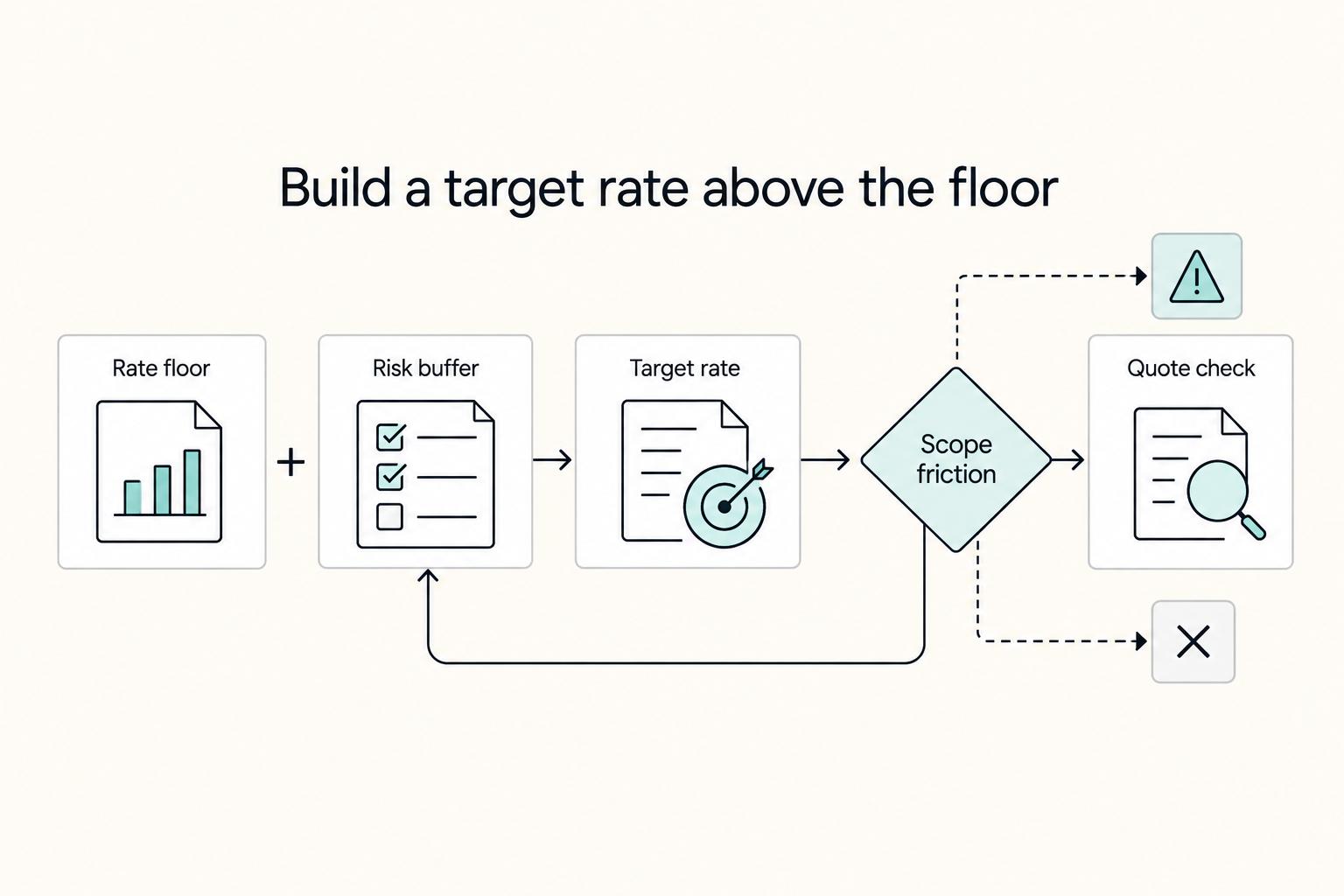
How to Calculate a Freelance Rate You Can Actually Get Paid On
A workable rate is not the neat number a calculator produces. It is the number that still works after you account for real billable capacity, non-client time, scope drift, and the gap between sending an invoice and receiving cleared cash. Start with hourly math even if you do not plan to bill hourly, then turn that number into a quote with clear `payment terms`.

The Freelance Payment Penalty: A Modeled Audit of Platform Fees, FX Spreads, and Payout Delays
The money rarely disappears through a single, easy-to-spot fee. The real loss is stacked. A marketplace takes its commission, a processor adds a charge for international cards, a bank or payment company converts the currency at a spread, a platform holds the funds before release, and a wire sheds a little to intermediaries on the way in. Each layer looks defensible on its own, but the worker feels the combined result as a smaller deposit and a later payday.