

Quick Answer
Define the GMV period and calculation, then work backwards from order value and buyer frequency. At an illustrative $5,000 per order, $100 million annual GMV requires 20,000 orders; a 5% fee gives $5 million gross fees before costs. Prove repeat fulfillment and funded payouts in one wedge before widening it.
Why most two-sided B2B platforms stall before meaningful GMV#
A $100 million GMV target needs a period and a transaction definition. This guide uses annual fulfilled order value after refunds, excluding sales tax and shipping. Your reporting may use another convention; state it and reconcile the differences before comparing marketplaces.
For an illustrative marketplace with a $5,000 average order value, $100 million a year requires 20,000 orders, or roughly 1,667 per month. At a 5% platform fee, that volume produces $5 million in gross fees before costs and any revenue-recognition adjustments. GMV is not platform revenue, profit or cash available for payouts.
Organize the work by decision owner. A go-to-market plan needs to be a concrete, time-bound blueprint, not a strategy document full of aspirations. If your team has a 12 to 24 month growth story but no 90 day operating plan, you are still in planning mode. Start with a simple owner map before you debate tactics:
- Product decides what transaction should happen first and what behavior counts as a successful match.
- Finance decides what counts as recognized platform revenue versus GMV and what exceptions are unacceptable.
- Operations decides where manual review is tolerable and where it will break the team.
- Engineering decides what must be observable before volume hides failures.
Use one practical checkpoint: if you cannot name one owner for each of those decisions, plus the pass or fail condition they are using, delay scale work. You do not have a growth problem yet. You have an accountability problem.
Work backwards from orders to active buyers. If each buyer completes four $5,000 orders per year, the illustration needs 5,000 active buyers. The next question is whether your chosen supplier cohort can fulfill those orders reliably and profitably.
Use the target to expose constraints rather than promise a path to scale. A higher order value can lower the required order count but increase credit exposure, fulfillment concentration and dispute cost.
The following checkpoints cover transaction responsibility, repeat buyer-supplier matching and reliable money movement. They support an expansion decision; they do not guarantee that the market can reach the target.
If you want a deeper dive, read Two-Sided Marketplace Dynamics: How Platform Supply and Demand Affect Payout Strategy.
What to prepare before you scale anything#
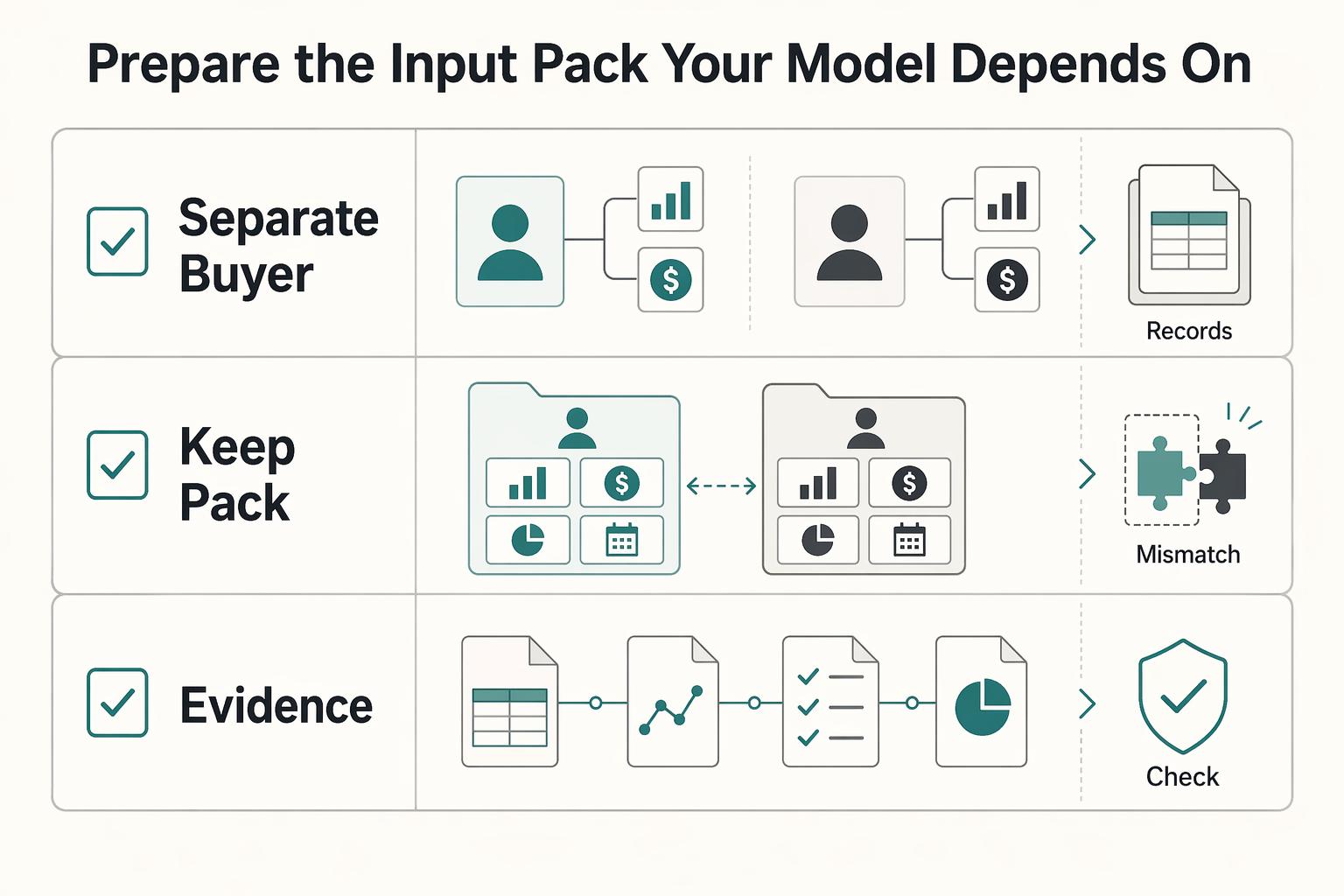
Before you spend on growth, lock the basic launch controls first: clear decision owners, a minimum evidence pack, and observability that explains each money movement without guesswork.
| Control | What to confirm | Scale implication |
|---|---|---|
| Define ownership before launch | One accountable owner per milestone; name who owns pricing and liquidity decisions, KYC/KYB/AML policy gates, and payout-risk exceptions | If ownership is unclear, decisions that were fast at low volume usually slow down as volume rises |
| Assemble the minimum evidence pack | Target segment, evidence of the current buyer-or-supplier bottleneck, reconciliation requirements and payout-failure escalation | Fund the side limiting successful transactions, and recheck when that constraint changes |
| Confirm integration readiness under retry and failure | Requests can be retried safely, webhooks are consumed reliably, and payment or payout status changes are visible in an audit trail | If a failed payout cannot be detected, routed, and resolved clearly, you are not ready to scale |
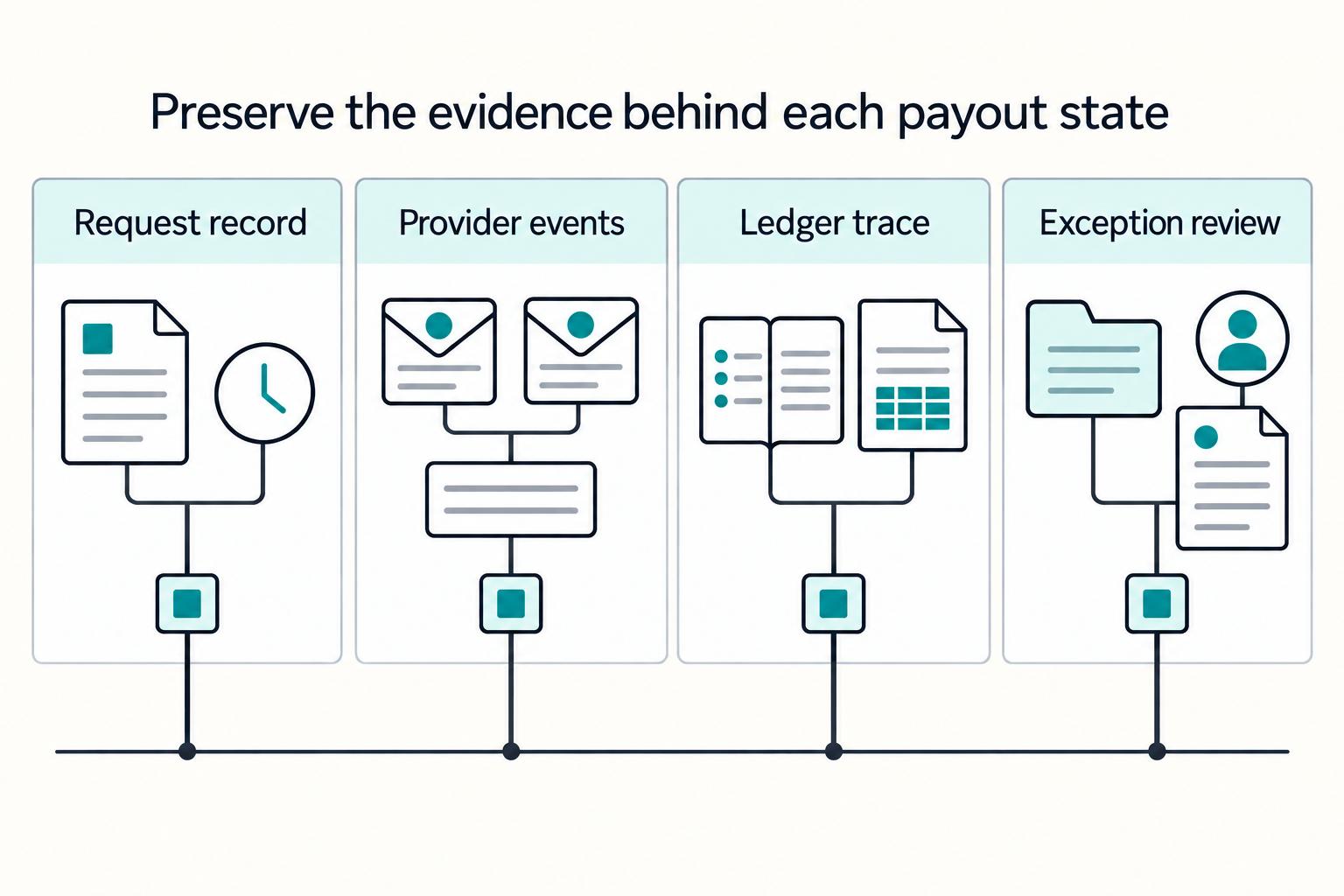
| Set one go/no-go checkpoint | Trace request -> provider reference -> ledger journals -> export | If you cannot trace that path, delay scale and fix observability first |
Your go-to-market plan should assign one accountable owner per milestone, not just revenue targets. Name who owns pricing and liquidity decisions, who owns KYC/KYB/AML policy gates, and who can approve payout-risk exceptions. If ownership is unclear, decisions that were fast at low volume usually slow down as volume rises.
Write down the target segment, observed matching bottleneck, reconciliation requirements and escalation for payout failures. Decide whether buyer demand or supplier capacity limits the next successful transaction before increasing spend.
Prove requests can be retried safely, webhooks are consumed reliably, and payment or payout status changes are visible in an audit trail. Replay the same request and verify that it does not trigger duplicate downstream actions. If a failed payout cannot be detected, routed, and resolved clearly, you are not ready to scale.
Make this rule explicit: if you cannot trace request -> provider reference -> ledger journals -> export, delay scale and fix observability first. This keeps finance trust intact and prevents growth from turning into a support problem.
Related: How to Calculate LTV for a Two-Sided Marketplace: Buyer LTV Seller LTV and Platform LTV.
Choose the transaction model before increasing growth spend#
Decide who owns the transaction before you increase demand spend. Product-market fit usually emerges gradually, which makes it easy to delay this call while volume still feels manageable. Make it early anyway, because this choice sets your finance workflow, support path, and compliance operating model.
Step 1. Name the transaction owner in writing#
Create a one-page responsibility matrix before you approve more growth spend. Keep it explicit: who accepts buyer payments, who controls settlement timing, who handles disputes and exceptions, who records platform fees, and who owns tax or reporting artifacts where they apply.
Then run one sample order end to end. Confirm that the same ownership logic appears in contracts, payment records, ledger journals, support handling, and payout release decisions.
Step 2. Compare models explicitly before you scale#
Use a short decision table that finance, ops, engineering, and legal can all sign off on:
| Decision point | What to lock in writing before expansion |
|---|---|
| Payment acceptance | Who is the transaction owner in provider terms and customer-facing records |
| Settlement control | Who decides timing, holds, and exception release |
| Dispute handling | Who owns intake, evidence, and resolution path |
| Margin structure | Separate GMV and fees; Finance determines gross or net recognized revenue from the actual accounting facts |
| Tax/reporting artifacts | Separate payer-held certifications from any legally required information-return filing and VAT records |
Compare platform-as-MoR, supplier-as-MoR and an eligible third-party MoR arrangement against the actual sale and payment configuration. MoR identifies transaction responsibility; it does not simply mean more payout control, and outsourcing does not remove every platform duty.
Step 3. Map artifact ownership before acquisition spend#
Assign the payer or withholding-agent role, applicable certifications, reporting obligations and VAT review to named owners. Collect only the data required for those roles; having foreign suppliers does not make their personal foreign-account reporting part of your intake.
Use one no-go checkpoint: do not expand acquisition until transaction ownership, artifact ownership, and dispute ownership are documented and verified on a sample order.
For a step-by-step walkthrough, see MoR vs. PayFac vs. Marketplace Model for Platform Teams.
Build liquidity in one wedge before expanding geographies#
Build density in one narrow wedge first, then expand. In a B2B marketplace, repeat useful matches in the same buyer and supplier cohorts are a stronger signal than broad but shallow coverage.
Step 1. Pick a wedge that can repeat#
Choose one buyer use case, one supplier profile, and one transaction pattern, then watch it across multiple cycles. The goal is to see demand move from push to pull over time, because product-market fit is usually gradual rather than instant. If every order still needs heavy persuasion, keep narrowing before you expand.
Step 2. Fix match quality before you widen scope#
If outcomes are inconsistent, improve onboarding, eligibility checks, and matching inside the current wedge before you add regions or categories. On a two-sided platform, signup growth can hide weak execution. More listings do not help if buyers still fail to find reliable fulfillment.
Step 3. Separate liquidity signals from growth noise#
Track wedge-level transaction quality, successful matches, and repeat behavior separately from top-line growth metrics. GMV and ARR matter, but they do not tell you on their own whether the market is becoming easier to use. If you cannot isolate wedge performance clearly, fix instrumentation first.
Step 4. Expand geographies only after operations stay steady#
Geography expansion should follow operating trust, not lead it. Add a new region only when your current operating model stays stable under normal variance without a rising manual burden. If expansion erodes reliability, collapse back to the strongest wedge and rebuild density before pushing wider.
Set up money movement rails that survive scale day#
Design controls for the funding and settlement paths you actually operate. The main test is whether a crash, duplicate event, return or uncertain provider result leaves one explainable obligation and a recoverable outcome.
| Rail area | Requirement | Validation |
|---|---|---|
| Order of operations | Use documented state transitions for each funding path; record cash on receipt even if allocation is unresolved | Trace sample orders end to end to confirm each handoff is recorded the same way |
| Virtual Accounts | Use selectively for repeat bank-transfer flows where supported | Validate that incoming funds can be mapped to the right buyer and transaction context without a growing manual exception queue |
| API and webhook replays | Persist verified events, track pending versus completed processing, and recover uncertain provider results | Replayed events should converge to one final business outcome, not conflicting states that require manual cleanup |
| Payout cycle close | Review cycle completeness, exception queue age, and reconciliation-ready evidence exports together | A high-level success view is not enough if unresolved exceptions or weak audit detail are still accumulating |
Record cash when received, using a clearing account if matching is unresolved. Keep earning obligations, funding availability and payout eligibility distinct. A platform-funded payout can precede buyer collection only with approved available funds and the agreed contractor or supplier terms.
Use Virtual Accounts selectively for repeat bank-transfer flows. Where supported, Virtual Accounts can simplify repeat inbound transfers, but only if matching is clean. Validate that incoming funds can be mapped to the right buyer and transaction context without building a growing manual exception queue.
Verify webhook signatures and persist accepted events before acknowledging them. Record pending and completed processing separately so a crash does not turn an unfinished event into a skipped duplicate. Commit local ledger effects atomically where possible. Persist outbound payout instructions with a stable unique ID and provider key; after a timeout, recover the original result before submitting again.
Close each payout cycle with three explicit checks. Review cycle completeness, exception queue age, and reconciliation-ready evidence exports together. A high-level success view is not enough if unresolved exceptions or weak audit detail are still accumulating.
For related reading, see Content Marketing for B2B SaaS That Holds Up Under Real Work.
Put compliance and tax gates in the transaction path#
Apply compliance checks required by your operating role and partners before payout, with clear policy decisions and ownership. Keep statutory requirements separate from additional platform controls.
Step 1. Gate payout eligibility with explicit compliance states. Tie payout eligibility to resolved account states, not order completion alone. If you use KYC, KYB, and AML controls, make payout release depend on those states being complete and traceable, with a clear decision source before a hold is lifted.
Keep legally prohibited transactions blocked. Other documentation failures need a named reviewer and approved treatment; missing tax certification may call for withholding rather than a universal payout ban. An internal override cannot remove a legal prohibition.
U.S. payees generally provide W-9, foreign individual beneficial owners generally W-8BEN, and foreign entities generally W-8BEN-E, with routing exceptions. Keep certifications with the payer. Determine information-return filing and VAT treatment separately; tax review must approve any lawful alternative handling.
Measure review throughput against the next promised payout date. If exceptions outgrow the team’s capacity, pause expansion while owners resolve the backlog; do not make suppliers finance a new corridor through unexplained holds.
Instrument the metrics that predict durable GMV#
Durable GMV tracking starts with one rule: use only metrics you can trace to real system events, not blended growth charts.
Use a scorecard with defined denominators: fulfilled orders divided by eligible buyer requests, repeat buyers within a stated cohort window, completed payouts divided by payouts due, disputed value divided by fulfilled order value, and the age of unreconciled balances. Assign each metric an owner and a response threshold.
Report GMV, platform fees and recurring subscription revenue separately. ARR is the annualized recurring revenue run rate under your chosen definition, not all annual revenue. Transaction fees do not automatically become ARR merely because they recur frequently.
Compare outside benchmarks only after checking their cohort, period and calculation. Set expansion targets from your own order economics, fulfillment capacity and available funding.
Keep the source, calculation, time window and owner for each metric. Some useful evidence comes from buyer research or support records, not only APIs and ledger postings; preserve its limitations instead of treating it as a financial event.
Common failure modes and how to recover without a full rebuild#
Start recovery at the point where the operating evidence shows a break. Some issues need a narrower wedge; others require a changed funding or compliance model rather than more acquisition spend.
| Issue | Evidence | Recovery move |
|---|---|---|
| Activity spread too thin | Activity is spread too thin across categories or corridors | Pause expansion and refocus on the cohorts that already transact reliably |
| Off-platform movement | Repeat partners are moving off-platform | Improve payout reliability and strengthen reporting and operational tooling they depend on |
| Review load rising | Holds and manual reviews increase | Tighten and clarify KYC, KYB, and AML decision rules; automate clearly low-risk approvals where possible; standardize exception evidence |
| Finance trust gap | Balance variance is not clearly explained | Reconcile from ledger journals, validate payout batches, and publish a weekly exception-close report |
Step 1. Collapse fragmented liquidity. If activity is spread too thin across categories or corridors, pause expansion and refocus on the cohorts that already transact reliably. Rebuild density there first, then re-expand in a controlled way.
Step 2. Make bypassing the platform less attractive. If repeat partners are moving off-platform, improve payout reliability and strengthen reporting and operational tooling they depend on. The goal is simple: staying on-platform should be easier and more useful than side-channel workflows.
Step 3. Tighten compliance decisions, not just staffing. When holds and manual reviews increase, tighten and clarify KYC, KYB, and AML decision rules. Automate clearly low-risk approvals where possible, and standardize exception evidence so reviews are consistent.
Step 4. Rebuild finance trust from ledger journals. If balance variance is not clearly explained, reconcile from ledger journals, validate payout batches, and publish a weekly exception-close report. Keep each exception tied to an owner and current status so finance and ops are working from the same facts.
You might also find this useful: Platform-to-Platform Payments: How to Build B2B Settlement Between Two Marketplace Operators.
Want a quick next step? Try the free invoice generator.
Your next 90 days and the checklist to execute#
For the next 90 days, run an execution plan before a growth plan: align decisions, assign owners, and require auditable evidence before you add channels. Keep the plan concrete, time-bound, aligned to business strategy, and explicit about milestone ownership.
Step 1. Align the non-negotiables#
Start by locking one answer to three decisions: your transaction model, your first liquidity wedge, and the compliance posture for that wedge. If product, finance, ops, and engineering would answer differently, pause expansion until you resolve the conflict.
Ship a short decision memo with named owners, decision dates, open risks, and explicit approvals. The checkpoint is consistency across teams and clear accountability for overrides, exceptions, and escalation paths.
Step 2. Build the minimum operating backbone#
After the model is fixed, implement the minimum backbone you need to trust a transaction end to end: idempotent APIs, reliable webhook handling, traceable ledger journals, and auditable payout batches. Your verification standard should be practical: trace a real transaction from request through provider reference, ledger posting, and payout/export output.
Use transaction records, failure exercises and approved operating decisions as evidence. A vendor demonstration does not establish that your integration can recover its own uncertain payouts.
Step 3. Gate expansion with operating checkpoints#
Expand only after your current wedge passes clear operating checks for payout reliability, compliance throughput, and reconciliation accuracy. Keep GMV and ARR reporting separated so metric ownership stays correct and remediation goes to the right team.
Use this checklist in your 90-day plan:
- Confirm MoR versus non-MoR responsibility split
- Confirm KYC/KYB/AML gating states and override ownership
- Confirm Virtual Accounts and payout rail availability by market or program
- Confirm W-8/W-9 and VAT validation capture points
- Confirm GMV versus ARR reporting separation and metric attribution
- Confirm incident recovery for failed payouts and unmatched ledger events
Frequently Asked Questions
What is a two-sided B2B marketplace strategy in practical terms?
It is the set of decisions that makes both sides get value at the same time: which buyer and seller cohort you start with, how you create repeat matches, and where your platform earns revenue through a take rate or subscription layer. In plain terms, you are not just selling software. You are making transactions happen reliably enough that both sides come back.
Which side should you scale first in a two-sided platform, and when should that change?
Build whichever side constrains a successful first transaction in the chosen wedge. That may be supplier coverage, or it may be credible buyer demand for existing suppliers. Shift effort when the observed bottleneck changes, rather than applying a universal supply-first rule.
What metrics matter more than user growth when targeting durable GMV?
Track eligible demand, supplier coverage, fulfilled order conversion, repeat buyers, contribution after variable costs and payout reliability in the same wedge. Define cohort windows and denominators so signup growth cannot hide failed fulfillment.
How is planning for $100M GMV different from planning for $100M ARR?
GMV measures transaction value under a stated convention; ARR measures an annualized recurring revenue run rate. In this article’s illustration, $100 million annual GMV at a 5% fee means $5 million gross fees before costs, not $100 million ARR.
What usually breaks first as a marketplace scales across regions?
The cold start problem can reappear in each new market. A wedge that works in one region can lose density when buyers and sellers are spread too thin, so conversion can drop before growth headlines show the damage.
When does disintermediation become a material risk, and what can you do early?
Watch whether repeat buyers and suppliers stop transacting after an introduction, and ask why. Better payment reliability, useful records and dispute support can make staying worthwhile. Account for fee level and the service actually delivered instead of assuming tooling alone prevents bypass.
What infrastructure must be in place before aggressive expansion?
At minimum, establish transaction responsibilities, funded payout obligations, durable event processing, recovery for uncertain provider results, applicable compliance review and reconciliation. Also measure fulfillment and repeat demand in the wedge; transaction visibility alone does not prove readiness.
Try a related tool
Researched and edited by the Gruv editorial team. Gruv builds cross-border billing, payouts, and finance-operations software for global businesses.
Sources
Educational content only. Not legal, tax, or financial advice.
Related Posts
How Supply and Demand Dynamics Should Set Your Marketplace Payout Strategy
In a two-sided marketplace, payout strategy is not back-office plumbing. It can shape whether sellers stay active, whether transactions complete reliably, and whether buyers can find supply that is ready to transact.
How to Calculate LTV in a Two-Sided Marketplace for Buyer, Seller, and Platform Decisions
In a two-sided marketplace, many teams look at buyer-side and seller-side value separately, then compare each view to the relevant Customer Acquisition Cost instead of forcing everything into one blended ratio. Treat Lifetime Value as an operating number, not a spreadsheet guess.

Platform-to-Platform Payments: How to Build B2B Settlement Between Two Marketplace Operators
If you need to stand up operator-to-operator settlement quickly, optimize for a controlled launch, not maximum speed on day one. This guide focuses on platform-to-platform B2B settlement for marketplace operators. It keeps the tradeoffs, control points, and recovery paths explicit for delayed, returned, or mismatched payments.