
Quick Answer
Run content marketing for b2b saas as a documented operating system with named ownership, pre-publish claim checks, and channel-specific distribution. Start with one bottom-of-funnel asset tied to one business outcome, then adapt it for Search, LinkedIn, and YouTube without copy-paste reuse. Track workflow reliability before judging pipeline impact, and use attribution for decision support rather than certainty. Expand formats only after your review and promotion steps stay consistent across multiple cycles.
You need a system not more content ideas#
If your publishing is inconsistent, nobody clearly owns decisions, and each post dies after one channel, you do not have an ideas problem. You have an operating problem. For a solo operator or lean team, your content gets more reliable when you document a few non-negotiable rules and review points.
That matters because easy-to-produce content often wins the weekly debate even when it does little to influence a purchase. Buyers also do not move through a neat funnel. They research in nonlinear ways across multiple stakeholders, so scattered posts and ad hoc opinions make it harder for sales, search, and social to reuse one clear message.
| Operating on ideas alone | Operating with a documented system |
|---|---|
| Planning trigger: "What should we post this week?" | Planning trigger: one buyer problem tied to one commercial goal, often starting with bottom-of-funnel content and working backward |
| Ownership model: draft starts when someone has time | Ownership model: clear owner and reviewer are defined before publish |
| Quality control: quality depends on who touched it last | Quality control: proof, examples, and message checks happen before anything goes live |
| Distribution follow through: article publishes, then promotion is optional | Distribution follow through: publish includes planned search, social, and sales use versions, each adapted for the channel |
| Performance review cadence: you look when traffic dips | Performance review cadence: early checks at 30 to 60 days, then commercial review against pipeline influence and deal velocity |
Your minimum governance layer can stay small. A lightweight checklist can include fields like owner, reviewer, approval step, publish trigger, and update trigger. The verification step that matters most is simple: before publish, confirm the core claim, the proof supporting it, and the intended audience action all match. When that check fails, the piece often turns into vague thought leadership or generic SEO copy that gets attention signals without useful buying intent.
Your second checkpoint is performance review. Vanity metrics can look healthy without showing any effect on trial, pipeline, or revenue. In the first 30 to 60 days, track Tier 1 attention signals like clicks and scroll depth so you can catch execution problems early. After that, review whether the topic is influencing real sales motion, not just traffic.
This guide gives you:
- a way to choose what to publish first based on buyer pain and commercial value
- a lean operating model you can run alone or with a small team
- repurposing rules so one strong asset becomes channel-specific outputs without copy-paste drift
- measurement checks that separate early engagement from pipeline impact
Picture one core message: your product cuts reporting time for finance teams. A system turns that into a search page answering a high-intent buying question, a LinkedIn post with a sharp point of view, and a sales one-pager using the same proof points. The wording shifts by channel, but the claim, evidence, and call to action stay aligned.
We covered this in detail in A Guide to Writing Case Studies for a B2B SaaS Audience.
What does content marketing for B2B SaaS actually mean?#
Content marketing for B2B SaaS means running a repeatable system that turns recurring buyer problems into assets that support pipeline, not just traffic. Your content should educate business decision-makers, build trust, and help people take action while multiple stakeholders research in parallel.
| Layer | What you decide | What you document and ship | Decision signal it is failing |
|---|---|---|---|
| Strategy | Which buyer problem to prioritize, which commercial goal it should support, and whether to start with bottom-of-funnel content | Core message, target audience, proof points, intended action | You can report output volume, but you cannot explain how the topic should influence trial, pipeline, or deal movement |
| Operations | Who owns drafting, SME input, review, and approval | Brief, review checkpoints, publish trigger, update trigger | Content ships with vague claims, weak proof, or inconsistent positioning |
| Distribution | Where buyers will discover and evaluate the message | Search version, LinkedIn version, sales-use version, repurposed formats | One asset is copy-pasted across channels and performance breaks for different reasons |
If you are operating solo, keep ownership simple: you set strategy, then enforce one non-negotiable pre-publish check that the claim, evidence, and audience action still match. Use founder voice when a piece needs product nuance or a clear market point of view. For standard explainers and educational pages, a normal editorial process is usually enough.
Do not force this into a neat funnel or a fixed buying-cycle timeline. B2B SaaS evaluation is non-linear, and content should support both demand creation and ongoing customer loyalty. Any current benchmark or timeline should be verified from analytics or source records before use.
Example: if your core message is "finance teams cut reporting time with our product," publish a search-focused explainer for a high-intent question, then a founder-led LinkedIn version with a sharper angle. Keep the proof consistent, adapt the format by channel, and avoid copy-paste reuse. For a deeper social workflow, read A Freelancer's Guide to LinkedIn Marketing.
The 10 minute decision framework to choose what to publish first#
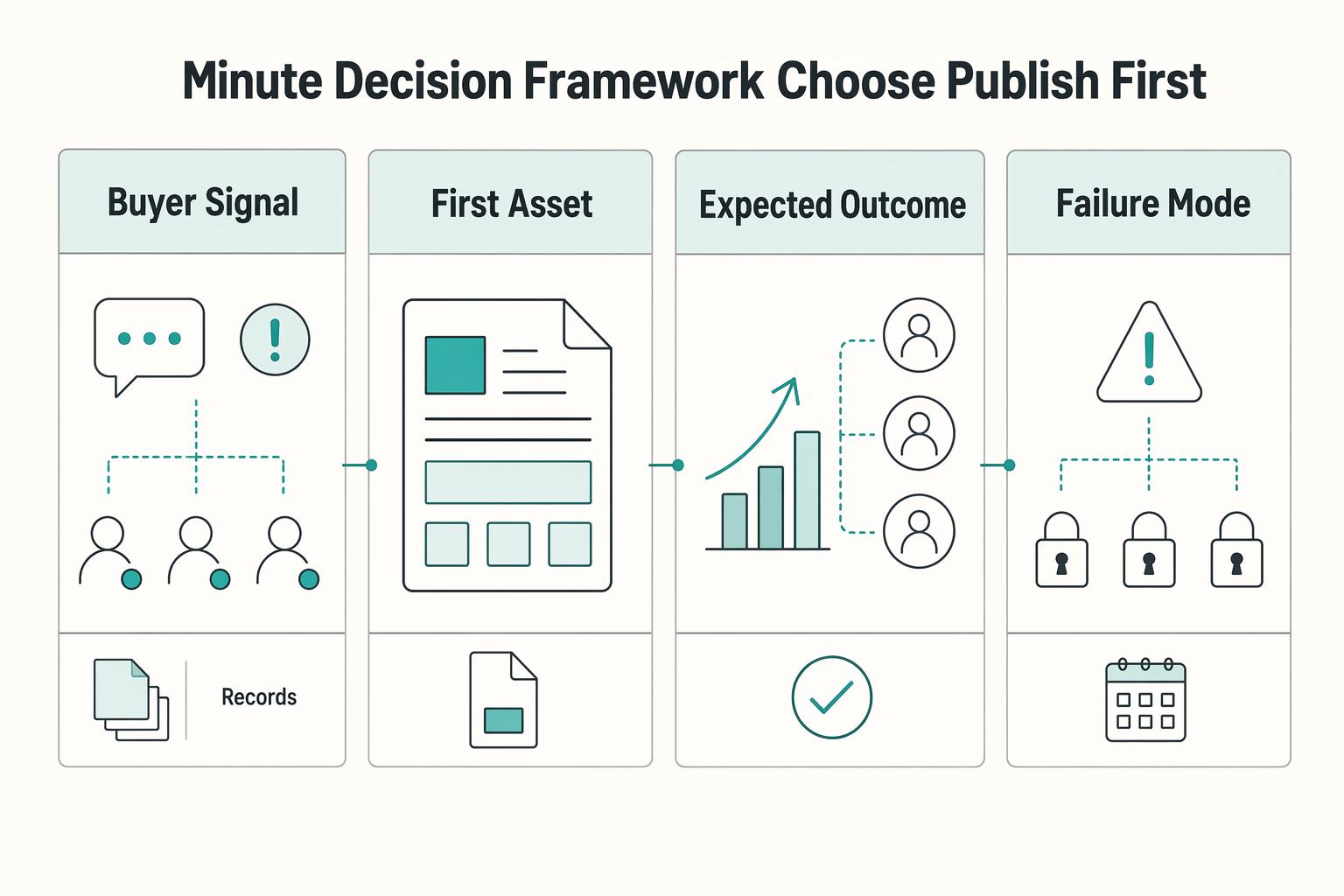
Use this sequence: pick one recurring buyer pain, map it to one business outcome, then choose your first channel based on intent and Time to First Result.
Start narrow, not broad. Write down one pain that keeps showing up in real buyer conversations, then tie it to one outcome: more qualified conversations, stronger pipeline influence, or faster deal movement. If you cannot name the outcome, you are still ideating.
Choose Google Search or LinkedIn as a practical first bet, not a universal winner:
| Decision cue | Google Search first | LinkedIn first |
|---|---|---|
| Buyer signal | Buyers are actively looking for an answer to a specific problem | Buyers need conviction, framing, or POV before they search deeply |
| First asset format | Search explainer or comparison page for one clear intent | Founder POV post focused on one real tradeoff or objection |
| Expected outcome | Capture existing demand and create an asset sales can reuse | Generate response, sharpen positioning, and create better follow-up language |
| Failure mode if mischosen | You publish generic informational content that is easy to replace with LLM summaries | You publish opinion without proof, product tie, or next step |
Let stage, ACV, and runway set expectations. Content-led work can compound, but timing varies, so align your first move with how quickly you need signal. Any ROI or break-even benchmark should be verified from analytics, finance, or source records before use.
Keep this step measured with a mini scorecard only:
- one outcome metric: qualified conversations or pipeline influence from the asset
- one execution metric: days from brief to publish
Do not add more metrics until this is stable.
Use one operational filter before anything enters the plan: every tactic must name an owner, the workflow step, and a review checkpoint. If you cannot say who does it, when it happens, and where it is reviewed, leave it out for now.
Example flow: keep one message, change the packaging, and define handoffs. Start with a search asset that answers a real question. Adapt that same message into a founder LinkedIn POV. Then add one proof asset, such as a short customer story or annotated process screenshot, that sales can send when interest turns into a serious conversation.
Related: The Best Project Management Tools for Small Agencies.
Should you run founder led content marketing or team led operations?#
Choose the model based on where your execution risk sits right now: speed of judgment, publishing reliability, and review quality. Run founder led when the founder can consistently drive strategic content. Run team led when you need a defined team workflow to publish without deadline drift. Use hybrid only when founder insight is dependable and editorial execution is already reliable.
This choice matters because having a strategy is not the same as running one effectively. One cited B2B SaaS summary reports that 96% of tech marketers say they have a content strategy, while 29% rate it as extremely or very effective. The gap is usually operational: either one person is overloaded, or ownership is unclear.
| Model | Choose it if | Decision owner | Common bottleneck pattern | Review dependency | What breaks first if misapplied |
|---|---|---|---|---|---|
| Founder led | You need fast judgment and a strong founder point of view, and the founder can show up consistently | Founder | Drafting starts late when founder time gets fragmented | High dependency on founder for claims, tone, and final call | Cadence breaks and posting becomes inconsistent |
| Team led | You need a repeatable publishing workflow with clear ownership and predictable handoffs | Content lead or marketing owner | Work progresses, but sharp insight can get diluted | Review should validate positioning and quality, not rebuild the draft | Output stays active but impact is unclear |
| Hybrid | You need founder authority in the message, but production must run through an operator or editor | One accountable owner per asset | Handoffs stall when insight capture is incomplete | Founder reviews substance; editor reviews structure and publish readiness | Everyone waits on everyone and publish dates slip |
Make the operating rule explicit#
Document a simple RACI for each asset before drafting starts. Assign one person Responsible for producing the draft, one person Accountable for publication, the founder or subject expert as Consulted on claims and positioning, and relevant stakeholders as Informed after approval.
| RACI role | Definition |
|---|---|
| Responsible | One person produces the draft |
| Accountable | One person is accountable for publication |
| Consulted | The founder or subject expert is consulted on claims and positioning |
| Informed | Relevant stakeholders are informed after approval |
Use fixed checkpoints so handoffs are visible: insight capture, outline sign-off, draft, review-ready draft, publish. If review starts with missing context, unclear claim support, or argument rewrites, the handoff failed upstream.
When hybrid works#
Use hybrid when two conditions are true: founder input is available on schedule, and editorial quality is consistently reliable. If founder availability is unstable, prefer team led. If editorial reliability is unstable, prefer founder led until review discipline is stable.
For your next cycle:
- pick one model for this cycle
- assign one accountable owner per asset
- define the reviewer and final approver
- set an escalation path for slips: who is notified, who can reduce scope, and who moves the publish date
For a step-by-step walkthrough, see A Guide to Account-Based Marketing (ABM) for SaaS.
Build a minimum viable publishing operating system#
Run publishing as a small, visible system: one sequence, clear owners, and only 1 to 2 active channels at a time. The goal is consistency you can sustain, not more output.
| Step | Entry criteria | Exit criteria | Accountable owner |
|---|---|---|---|
| Brief | Named ICP, one pain trigger, one business goal, chosen channel, source material linked | Brief is approved and scoped tightly enough to draft | Content lead or founder |
| Draft | Brief approved, evidence pack ready, subject expert input captured | Draft makes one clear argument; unsupported concrete claims are removed or generalized | Writer or operator |
| Review and publish | Draft complete, links, screenshots, and examples attached | Positioning approved, factual issues resolved, publish date confirmed | Final approver named in advance |
| Distribution and refresh | Canonical asset is live; derivative ideas mapped to active channels only | Channel-specific versions shipped; refresh owner and trigger logged | Distribution owner or content lead |
Keep scope tight before you scale. If you publish weekly, cap each cycle at one flagship asset, a few derivative assets, and one named owner for updates. The flagship should solve one buyer problem in depth, and each derivative should adapt the same insight to the channel instead of reprinting it.
Use a simple repurposing quality check before anything ships:
- Channel fit: does this version match the channel format and audience expectation?
- Claim consistency: are claims still aligned with the source asset?
- Duplicate-risk check: does this add original framing instead of thin copy-paste reuse?
If your team cannot answer core plan questions in about 60 seconds, the asset is likely still too vague to publish.
Tools are optional. Use a calendar, board, or docs only if they make handoffs and blockers obvious. Use AI for first drafts and variations, but keep strategy, claim standards, and final judgment human-owned.
Minimum viable checklist:
- workflow stages, owners, and approval point documented in one shared place
- one person assigned to publish each flagship asset
- one person assigned to refresh each flagship asset
- refresh trigger threshold pending analytics/source-record verification
For a fuller breakdown, read How to Build a 'Glocal' Marketing Strategy for Your SaaS Product.
How do you repurpose one flagship asset without diluting quality?#
Repurposing works when you keep one message, one proof standard, and one audience outcome consistent across every format. If those shift, your derivative pieces stop reinforcing the flagship and start weakening it.
| Brief element | What to define |
|---|---|
| Core message | The one point you want remembered |
| Defensible evidence | Which proof supports that point |
| Claim limits | What you will explicitly avoid overstating |
| Audience takeaway | What the buyer should do or understand next |
| Owner and reviewer | Who produces it, and who gives final sign-off |
Start from one substantial hub asset, then complete the brief above before you create channel versions. Use it as your quality anchor for every derivative.
| Channel | Change this | Keep this fixed | Main failure mode |
|---|---|---|---|
| Search | Restructure into a direct answer that matches buyer intent and can stand alone | Core claim, proof standard, and takeaway | Reads like a social post and does not fully answer the query |
| Reframe into one clear viewpoint plus one practical lesson for feed behavior | Core claim, evidence threshold, and target reader | Long-form copy pasted with no channel-native framing | |
| YouTube | Convert into a walkthrough with problem, decision path, and next action | Core message, proof, and audience outcome | Sounds like a verbatim article readout |
Before publishing, run a pass/fail gate:
- Is this useful on its own if someone never sees the flagship?
- Does it preserve the original claim without adding unsupported promises?
- Does it fit the channel format instead of fighting it?
- Is there a documented distribution plan with a named owner and publish step?
Use external examples for calibration, not imitation. A 20-page report can become a three-part blog series, and one idea can support a month or more of campaigns, but only if you adapt to your buyer intent, sales motion, and team capacity. The biggest waste pattern is still publish-once behavior: strong assets lose value when follow-through is not planned.
Related reading: The Best CRMs for a B2B SaaS Sales Team.
Measure what matters and control execution risk#
Use measurement as a control loop: first confirm your process ran as planned, then evaluate business outcomes on a slower timeline. If you reverse that order, you will overreact to noisy results.
That sequence matters in B2B SaaS because deals are rarely linear. Journeys can involve 6 to 10 stakeholders, often run 3 to 6 months, and may include 15 to 20 marketing and product interactions before close. When dashboards feel contradictory, the issue is often mixed signal types, not automatically weak content.
Separate execution signals from outcome signals#
Track fast operational signals separately from slower commercial signals so each report answers one question clearly.
| Signal type | What it includes | Review cadence | Named owner | Decision use |
|---|---|---|---|---|
| Leading execution signals | Execution reliability, claim-check completion, distribution completion | Every publish cycle, plus short weekly checks | Content owner or editor | Fix production, review, or distribution breakdowns before changing strategy |
| Attribution signals | Influenced opportunities, touch patterns, assisted conversions, path review | Regular reporting rhythm once enough deal data exists | Marketing lead with revenue ops support | Directional channel and budget decisions |
| Lagging business outcomes | Pipeline influence, ROI trend, ARR direction | Multi-cycle trend reviews, not single-asset reactions | Marketing lead with sales or finance input | Continue, narrow, or change investment by theme, audience, or channel |
Your exact cadence can vary by team size and sales cycle. The important rule is simple: diagnose execution first, then judge commercial effect.
Treat attribution as decision support, not proof#
Use attribution to improve your next decision, not to claim causal proof. It can connect spend and touches to revenue influence, but it does not prove one asset caused a deal by itself.
Relying on last-click or demo-booking-only views can hide meaningful deal influence. One grounded example tracked 50 closed deals and found an average of 18 touches before close across organic search, paid social, product trial, and sales calls. Treat that as pattern evidence.
Before finalizing reporting rules, verify what your current analytics, CRM, and automation stack supports. Platform attribution model names, defaults, and availability can change, so confirm in current vendor documentation first.
Put governance in the file, not in memory#
If you want to scale without quality drift, keep a lightweight risk checklist for each substantive asset:
| File item | What it records |
|---|---|
| Claim log | Each key claim tied to a source, customer example, screenshot, or internal data note |
| Review history | Who reviewed, when, and what changed |
| Assumptions | Target reader, buyer pain, channel choice, and expected next action |
| Uncertainty notes | What is validated now vs. what is still unknown |
That file should show the claim log, review history, assumptions, and uncertainty notes without anyone having to reconstruct decisions from memory.
When results are mixed, stay disciplined. Check distribution completion first, then inspect assumptions, then adjust the next cycle. If traffic rises while influenced pipeline stays flat, generic informational content can be one explanation, but treat it as a hypothesis to test, not a verdict.
A practical rule: if execution signals are inconsistent, improve reliability first. If execution stays clean across several cycles and outcomes still stall, change the topic, audience angle, offer, or channel.
This pairs well with our guide on Best Lead Generation Tools for B2B SaaS Operators.
Run your first 90 days as an operating test#
Run this as an operating test, not a scale sprint. In your first 90 days, prove your strategy, review flow, and distribution loop can hold up under real work before you add volume.
Meaningful results can take at least 3 months and often 6 to 12 months, so your first win is consistency. Build a documented strategy, publish against it, and review evidence without getting reactive.
| Phase | Objective | Non-negotiable deliverables | Go/no-go criteria before moving forward | Main execution risk to monitor |
|---|---|---|---|---|
| Days 1 to 30 | Build the baseline system | One simple one-page strategy naming primary audience, buying committee roles, core channels, cadence, and primary CTA path. One bottom-of-funnel asset with approved claims, source notes, named owner, and distribution checklist. | Go only if your team points to the same audience, CTA path, and review owner, and your asset can be reviewed without searching Slack or memory. | Reactive publishing from missing documentation, which leads to inconsistent messaging. |
| Days 31 to 60 | Tighten execution reliability | One repeatable sequence: brief, review, publish, distribute, refresh. Channel-specific repurposing rules so search and LinkedIn are adapted, not copy-pasted. | Go only if recent assets pass factual review, positioning review, publishing, and promotion without skipped steps. No-go if distribution is still slipping. | Approval bottlenecks and weak distribution discipline. |
| Days 61 to 90 | Scale one variable at a time | Add only one expansion, one new format or one new intent cluster, plus a simple view of execution signals and directional pipeline influence. | Go only if data capture is working, CTA path is still clear, and quality holds across the full workflow. No-go if you still cannot reliably track touchpoints into CRM. | Scaling output before measurement and messaging are stable. |
Use this decision rule when channel signals conflict: do not pivot early on reach alone. If LinkedIn engagement drops and search is flat, but sales reports better-fit conversations, verify intent match, CTA fit, and buying-committee engagement first. Reach can fall while pipeline quality improves.
Keep your weekly checklist action-first and owned:
- Strategy owner: update the one-page strategy and confirm audience, buying committee roles, channels, cadence, and CTA path; reviewer signs off before new briefs start.
- Content owner: brief the next bottom-of-funnel asset; product or founder reviewer approves claims, examples, and source notes before draft approval.
- Distribution owner: schedule promotion before publish; checkpoint that links, UTM naming, and post copy are ready before launch.
- Ops owner: verify analytics, CRM, and automation capture planned touchpoints; test one live CTA path end to end.
- Decision owner: review misses each week, such as skipped approvals, missed promotion, stale screenshots, or unclear CTA; if volatility spikes, verify the waiting window from analytics or source records before calling a trend.
If you want to turn this into a working planning document, use How to Create a Marketing Plan for Your Freelance Business. You might also find this useful: How to Build a Predictable Content Strategy for Your Agency.
Frequently Asked Questions
What is the minimum viable content setup for a B2B SaaS team of one?
Start with one audience, one commercial goal, one bottom-of-funnel asset, one distribution checklist, and one refresh date. Revenue-first prioritization starts with bottom-of-funnel pieces and works backward, which is typically more useful than publishing broad awareness content too early. Then make sure each asset has a named owner, approved claims, source notes, and a scheduled promotion step so you do not publish and forget distribution.
How do I choose between founder led and team led execution?
Use founder-led execution when your edge depends on original market perspective, product nuance, or thought leadership. Use team-led execution when consistency is the bigger constraint. Founder content can carry a stronger signal but may stall on approvals, while operator-owned production can ship more consistently but may drift if product truth is not reviewed. Then assign one decision owner, one approver, and one fallback reviewer so the queue does not freeze when the founder is busy.
What should I publish weekly versus monthly for B2B SaaS?
Pick the fastest cadence you can maintain after briefing, review, approval, publishing, and distribution are all accounted for, not just drafting. A missed review or skipped promotion step can hurt more than a slower schedule, and B2B buyers do not move in a neat linear funnel anyway. Review the last few cycles and see where work slipped. If the bottleneck is approvals or promotion, fix that before increasing volume.
How do I repurpose one flagship asset across SEO, LinkedIn, and YouTube without losing quality?
Rewrite for channel intent instead of copying the same piece three times. Search content typically needs problem and intent match, LinkedIn needs a sharp discussion angle, and YouTube usually needs a clearer narrative arc and stronger opening context. Then check that every version uses the same approved claim log, has its own call to action, and actually gets distributed, since underweighting promotion is a common mistake.
Which metrics should I track first to avoid vanity reporting?
Track execution signals first, then review pipeline influence and deal velocity through multi-touch attribution instead of traffic alone. Vanity metrics can look impressive while doing little for trials, pipeline, or closed deals, and many teams still struggle to connect content activity to ROI when leadership asks. Then confirm your analytics, CRM, and automation stack can capture the touch data you plan to review. If not, fix data collection before promising detailed attribution.
How do I build a simple workflow with clear ownership, approvals, and review checkpoints?
Write down the steps in order: brief, draft, factual review, positioning review, approval, publish, distribute, and refresh. Documented ownership can reduce missed approvals, keep evidence in the file instead of memory, and make it easier to diagnose why something underperformed. Then add one named owner and one approval timestamp to each step. If you need a simple planning structure, use How to Create a Marketing Plan for Your Freelance Business to turn this into an actual operating document.
How do I decide when to update, repurpose, or retire existing content?
Audit each asset against your current offer, buyer pain, approved claims, and observed buying fit, then make one decision only: update, repurpose, retire, or merge. Old examples, stale screenshots, weak positioning, or the wrong audience can create noise even when traffic still looks healthy. Without voice-of-customer input, teams risk improving content the market does not really want. Then verify whether the asset still supports pipeline influence, collect fresh customer language through interviews or a simple 0-10 recommendation question, and handle redirects carefully if you change URLs.
Try a related tool
Researched and edited by the Gruv editorial team. Gruv builds cross-border billing, payouts, and finance-operations software for global businesses.
Sources
Includes 5 external sources outside the trusted-domain allowlist.
- academia.edu/117041465/The_SMPTE_Chronicle_Vol_III_1990_2...trusted
- clame.nyu.edu/HomePages/E1FA4B/316850/b2b-saas_content_wri...trusted
- cob.unt.edu/_files/mktg/marketing_advisory_board_booklet...trusted
- actualtechmedia.com/blog/what-makes-b2b-saas-content-marketing-u...external
- alexberman.com/b2b-saas-marketing-planexternal
- averi.ai/blog/content-marketing-strategy-for-early-st...external
- bluetext.com/blog/the-content-atomization-playbook-one-id...external
- columnfivemedia.com/b2b-content-marketing-lead-genexternal
Educational content only. Not legal, tax, or financial advice.
Related Posts

LinkedIn for Freelancers Who Want a Predictable Client Pipeline
Treat LinkedIn as two jobs you run at the same time: a credibility check and a conversation engine. If you only chase attention, you can get noise. If you only send messages, prospects may click through to a thin profile and hesitate.

Build a Freelance Marketing Plan You Can Run Every Week
A usable **freelance marketing plan** starts with one business result, not a pile of activity. If a task cannot be tied to pipeline movement, client acquisition, or revenue, cut it before it takes up calendar space.

The Best Project Management Tools for Small Agencies
For a small agency, project management software passes or fails on one test: can the setup protect profit while delivery keeps moving. A clean board helps, but it does not tell you who is over capacity next week, what share of this week's time is billable, or which active project is drifting from target margin. Those are the answers that drive weekly decisions.