
Quick Answer
You can scale a platform finance team without hiring by automating repeat, policy-stable work while protecting audit trail quality, reconciliation speed, and reviewable controls. Start with high-friction tasks that are traceable end to end, define a shared scorecard and no-hire boundary, prepare evidence and ownership first, then pilot one narrow lane and expand only if cycle time, error rates, and audit evidence improve.
Scale finance throughput without adding headcount#
Scale finance throughput by automating repeat drag first, but only where you can still prove what happened. For platform teams, the goal is simple: more volume per operator, fewer month-end surprises, and no loss of the control evidence you need for a clean Audit Trail and solid Reconciliation.
Before you start#
This guide is for platform operators, not a generic back-office setup. It is aimed at teams running Embedded Payments, Marketplace Payments, or Cross-Border Payouts where finance, product, and engineering share ownership.
Get that ownership clear before you automate. Stanford's April 2026 enterprise AI playbook, based on 51 enterprise cases over 5 months, made a simple point: outcomes were driven by organizational readiness, not model choice. The same applies here. Unclear handoffs do not disappear under automation; they can move faster and get harder to unwind.
Target the highest-friction work first#
Start with repetitive work that follows known policy and burns operator time with limited judgment. Focus on high-volume handoffs and predictable follow-up where the process is already stable.
Do not start with edge cases your teams still debate. If finance, product, and engineering cannot agree on the normal-state flow, automation can harden confusion instead of removing it.
Protect Audit Trail quality and Reconciliation speed#
Treat Audit Trail quality and Reconciliation speed as hard constraints from day one. Every automated action should make it easy to confirm what triggered it, when it ran, which record it touched, and what changed.
Avoid spreading that across disconnected tools where context gets lost and latency creeps in. Fragmentation can make month-end reconstruction harder and slow issue resolution when records do not line up.
Define success like an operator would#
Define success in weekly operator terms: volume handled per operator, fewer issues first found at month end, and control evidence that is easy to retrieve. If throughput goes up but evidence quality drops, the system is not actually better.
Watch for an early red flag: teams arguing about transaction state because the underlying data is messy. Data readiness is a known blocker, and addressing it before automation can reduce the risk of multiplied errors later.
The point is to avoid the scaling trap where revenue rises, headcount rises with it, and margins still tighten. More output only counts if you can still trust the records.
For a step-by-step walkthrough, see IndieHacker Platform Guide: How to Add Revenue Share Payments Without a Finance Team.
Define the outcome and the no-hire boundary#
Use one decision lens across Accounts Payable (AP) and the matching work before you automate anything. If throughput, errors, close speed, and controls are tracked in separate places, you will optimize for speed while missing rising risk.
Set one scorecard#
Run one shared scorecard with a small set of agreed fields, for example throughput, error rate, close-cycle time, and control health. Keep AP and the month-end review on the same view so tradeoffs stay visible. If volume per operator goes up but unresolved exceptions rise or evidence quality drops, treat that as a regression.
Before any build, confirm a credible baseline for those fields from current records. If finance and engineering cannot align on counts, reporting window, or source record, treat that as an organizational-readiness gap.
Draw the no-hire boundary#
Set a working boundary in advance, not a universal rule: prioritize automation when failures are mostly repeat manual work under stable policy, and prioritize policy or process fixes, or hiring, when failures are mostly judgment-heavy exceptions. That keeps automation aimed at work you can actually control.
The opportunity is real, but only with the right control model. BCG reports AI-powered workflows can accelerate finance and procurement processes by 30% to 50% and cut low-value work time by 25% to 40%. It also stresses the need to balance autonomy with human oversight and embed controls from day one. For operators, that often means automating repeat AP touches and status follow-up before pushing automation into unresolved exception queues.
Set stop conditions before build#
Treat unresolved Ledger Journal mismatches and chronic Audit Trail gaps as warning signs, and define explicit pause criteria with finance and control owners before rollout rather than automating around broken records.
Use one pre-build checkpoint: sample AP items and matching breaks, then verify each can be traced from source event to Ledger Journal entry to final evidence without manual reconstruction. If teams still need side spreadsheets to explain what happened, stop and fix the record first.
If you want a deeper dive, read Finance Automation and Accounts Payable Growth: How Platforms Scale AP Without Scaling Headcount.
Prepare the evidence pack before you automate anything#
Build the evidence pack before anyone writes automation logic. If finance and engineering are not working from the same current-state records, you can end up building in isolation instead of from shared evidence.
Assemble the current-state pack#
Start with a small set of current-state operating records from your own process. Choose artifacts that show process flow, recurring failure points, and handoffs between finance and engineering. Treat these as operating records, not presentation artifacts.
Keep them in one shared context folder or a similar source-controlled location, not scattered across chat threads and local notes. File-based context helps preserve continuity. Chat-only work can reset and lose operational detail between sessions.
Use a simple verification check: a finance lead and an engineering lead should be able to review the same pack and describe the same process flow and failure points. If they cannot, your baseline is not ready.
Document non-bypass controls early#
Document the control obligations automation must respect before you talk about speed gains. Record the policy gates that apply in your environment and mark which ones cannot be bypassed.
For each control area, capture the owner, required evidence, and the path when evidence is missing. The RPA Program Playbook can help frame policy-oriented control areas such as security, credentialing, and privacy, but it is guidance, not a compliance substitute. Do not defer this to later mapping. That pattern can create fast flows that outrun review and approval expectations.
Define launch artifacts for traceability#
Before launch, define which records you will retain so a reviewer can reconstruct what happened without rebuilding it by hand. In your environment, that may include transaction records, system event logs, and status-history evidence.
Do not treat any artifact list as universally mandatory. Decide and document what is required for your process, then validate that choice before build.
Run one end-to-end sample check: can you show the triggering event, processing path, final status, and control-gate evidence from retained records alone? If not, the artifact plan is incomplete.
Record unknowns instead of hiding them#
Log unknowns explicitly, and if someone cites external benchmarks, mark those inputs as directional until internally validated.
Use a short unknowns log with three fields: claim, decision impact, and validation owner. This keeps assumptions separate from evidence and stops unvalidated benchmark language from becoming design truth. Related: How to Make the Case for AP Automation to Your CFO: A Platform Finance Team Playbook.
Map the money flow from intake to payout state#
Turn the evidence pack into one trackable money-flow map before you automate. You need a single path from the first request to the final payment outcome, with proof at each step. If that path is unclear, automation will only scale the confusion.
Draw the full path end to end#
Map the real sequence your team runs today, not the assumed one. In procure-to-pay, that end-to-end flow can include requisitioning, sourcing, purchase orders, receiving, invoicing, and payment.
Keep this as one connected workflow, not a set of disconnected tasks. If teams cannot trace the same transaction across ordered, received, and billed records, fix the map first.
Mark async breaks and assign first response ownership#
Mark every transition where updates may arrive later or from another system. These are common places for confusion when the flow is not clearly defined.
For each transition, assign one primary owner and a clear first-response expectation. If ownership is ambiguous, unresolved states will sit unresolved.
Add one proof check per state#
For each stage, use one checkpoint question: can you prove this state from retained records and audit trail evidence without manual reconstruction?
| Stage | Evidence to retain | Common risk | Verification check |
|---|---|---|---|
| Request created | Requisition or request record | Starting point is not clearly recorded | Can you show when it entered the flow? |
| Order and receipt recorded | Purchase order and receiving records | Ordered and received records do not align | Can you verify what was ordered versus received? |
| Invoice recorded | Invoice record linked to order/receipt | Billed record is not tied to prior steps | Can you verify what was billed versus ordered and received? |
| Final payment outcome | Payment record | Final state is unclear | Can you show the final payment status? |
Validate with one exception case#
Test the map on one real exception, not a happy path. Ask someone outside the original triage to reconstruct the outcome using only retained artifacts.
If they need chat history or memory to explain what happened, the map is incomplete. Add the missing step, owner, or record before build. For related reading, see Upskilling Platform Finance Teams for Payments Compliance and Automation.
Prioritize automation lanes by risk and payoff#
Use high repeat volume and low policy ambiguity in your own records as a local heuristic, and defer lanes where KYB or KYC exceptions are still judgment-heavy until criteria are explicit. Treat this as an internal operating choice, not a rule validated by the external excerpt.
Score each lane side by side using the same inputs: exception reasons, matching breaks, approval handoffs, payout status history, and webhook logs.
| Lane | Repeat volume | Policy ambiguity | Implementation effort | Control risk / blast radius | Webhook dependency | Default call |
|---|---|---|---|---|---|---|
| AP approvals | Score from your current approval and posting volume | Score from how often approvals need manual interpretation | Validate from your own delivery history | Validate from your own control design and incident history | Validate from your own architecture | Do not assume a default order; rank from your own evidence |
| Cross-Border Payouts orchestration | Score from payout and exception volume by corridor/provider | Score from your documented KYB/KYC and return-handling ambiguity | Validate from your own delivery history | Validate from your own control design and incident history | Validate from your own architecture | Do not assume a default order; rank from your own evidence |
| FX Quotes handling | Score from how often quotes are used and reworked | Score from how clear quote-use and exception rules are in your policy | Validate from your own delivery history | Validate from your own control design and incident history | Validate from your own architecture | Do not assume a default order; rank from your own evidence |
| Marketplace Payments settlement reconciliation | Score from settlement-match and break volume | Score from how consistent your matching logic is in practice | Validate from your own delivery history | Validate from your own control design and incident history | Validate from your own architecture | Do not assume a default order; rank from your own evidence |
Use one working gate before build: if a lane is not yet high-repeat and low-ambiguity in your own evidence, avoid automating the policy decision. You can still automate intake, routing, and status collection around it.
Do not assume a universal first-wave sequence; sequence lanes from your own exception and control evidence.
Do not anchor policy-critical automation decisions on unverified external summaries. If the source is access-gated or user-uploaded and you cannot verify it quickly, treat it as background context, not decision authority.
See Implementing a Purchase Order Process in Your ERP: A Platform Finance Team's Step-by-Step Guide.
If payout-status automation is in your first wave, pressure-test webhook ordering, idempotency, and failure paths against the Payouts module before you commit sprint capacity.
Design controls before scale#
Design controls before rollout, not after. If control decisions stay implicit, automation can shift work into harder exceptions and weaker audit evidence.
Make policy gates machine-checkable#
Turn policy intent into checks your product can evaluate from recorded fields. For each lane, define what must be true to proceed, who owns approval when a rule is not met, and where exceptions are routed. If a rule cannot be expressed as a clear pass or fail check plus a named escalation owner, keep that decision manual for now.
Use a quick readiness test: sample recent pass and fail cases and confirm the same outcomes can be reproduced from system data alone, not chat context or spreadsheet memory.
Lock the system-of-record path from request to ledger output#
Each automated action should be traceable from request to decision to ledger impact and downstream export artifacts. BAS shows why this matters. Records responsibilities were explicitly separated, with Unison PRISM handling contract records and Sunflower handling asset management. Apply the same discipline by naming the system of record for each artifact and avoiding shadow ownership across adjacent tools.
BAS also front-loaded design before rollout. It used the first 18 months for Global Design and Common Solutions ahead of phased go-lives (October 1, 2022, October 1, 2023, and October 1, 2024). The sequencing is the key takeaway: lock ownership and explainability before scale.
Decide reject, hold, and escalate outcomes before launch#
Define behavior for incomplete, inconsistent, or ambiguous inputs before go-live. For each known bad-input scenario, decide in advance whether the item is rejected, held, or escalated. Then validate that the workflow lands in the expected state with a clear reason code. That helps reduce silent acceptance and the later reconstruction work finance teams face when they need to explain outcomes.
Design the evidence pack up front#
Treat evidence design as part of product design. Decide what data is retained for review and which exports finance will use for close review. BAS treated records-management capability as a dedicated design checkpoint, with a Unison PRISM workshop scheduled for 6/26/2020. Use the same standard for your automation controls.
Use one rollout gate: if you cannot pull sample transactions and cleanly reconstruct the path from request through decision and ledger or matching artifacts, do not widen rollout. Manual processes are a known scaling limit, but high-volume automation without reliable evidence is harder to trust and operate.
We covered this in International Accounts Payable for Platforms: How to Manage Multi-Country Payables Without a Global Finance Team.
Build integration behavior for retries and async events#
Once policy gates are explicit, the next reliability risk is integration behavior under retries and async updates. Decide upfront how replayed requests are handled, which record finance reviews against, and how late or conflicting events are resolved.
Make retries safe by design#
Make retried actions safe by design. If your flow includes payout creation or inbound Webhooks, define one canonical outcome for the same request so a retry resolves to the same result instead of creating a second side effect.
A practical checkpoint is to persist enough execution context to explain the first result and route later replays back to that same outcome. If a retry can follow a different code path or bypass the original outcome lookup, duplicate risk remains.
Choose one canonical record for finance review#
Choose one canonical record for finance review and treat faster operational views as derived unless you can verify they stay complete and current. The hard part is not a dashboard that looks live. It is what Cockroach Labs frames as "real-time, always-correct reporting" under async event timing.
Keep the verification simple: sample transactions and confirm the canonical record alone can explain the current state without relying on transient views or team memory.
Plan for delayed, duplicate, and out-of-order events#
Where async callbacks or Payout Batches are in scope, define explicit handling for delayed, duplicate, and out-of-order updates. Do not rely on arrival order alone. Set allowed transitions, replay handling, hold paths, and escalation triggers when sequence conflicts appear.
The same integration can produce very different outcomes depending on process quality and readiness, not just technology choices.
Stress test failure paths before go-live#
Before go-live, use failure-path tests to stress replay and async behavior in your own integration. Re-run duplicate inputs, verify stale or superseded updates are handled by rule, and check parity between the canonical record and downstream operational views.
A practical release check is whether finance and engineering can replay known edge cases and reach the same final outcome consistently. The Stanford April 2026 report makes the same point: practical implementation discipline can determine whether similar deployments succeed or fail.
Need the full breakdown? Read Lean Accounting for Payment Platforms: How to Run Efficient Finance Ops Without a Big Team.
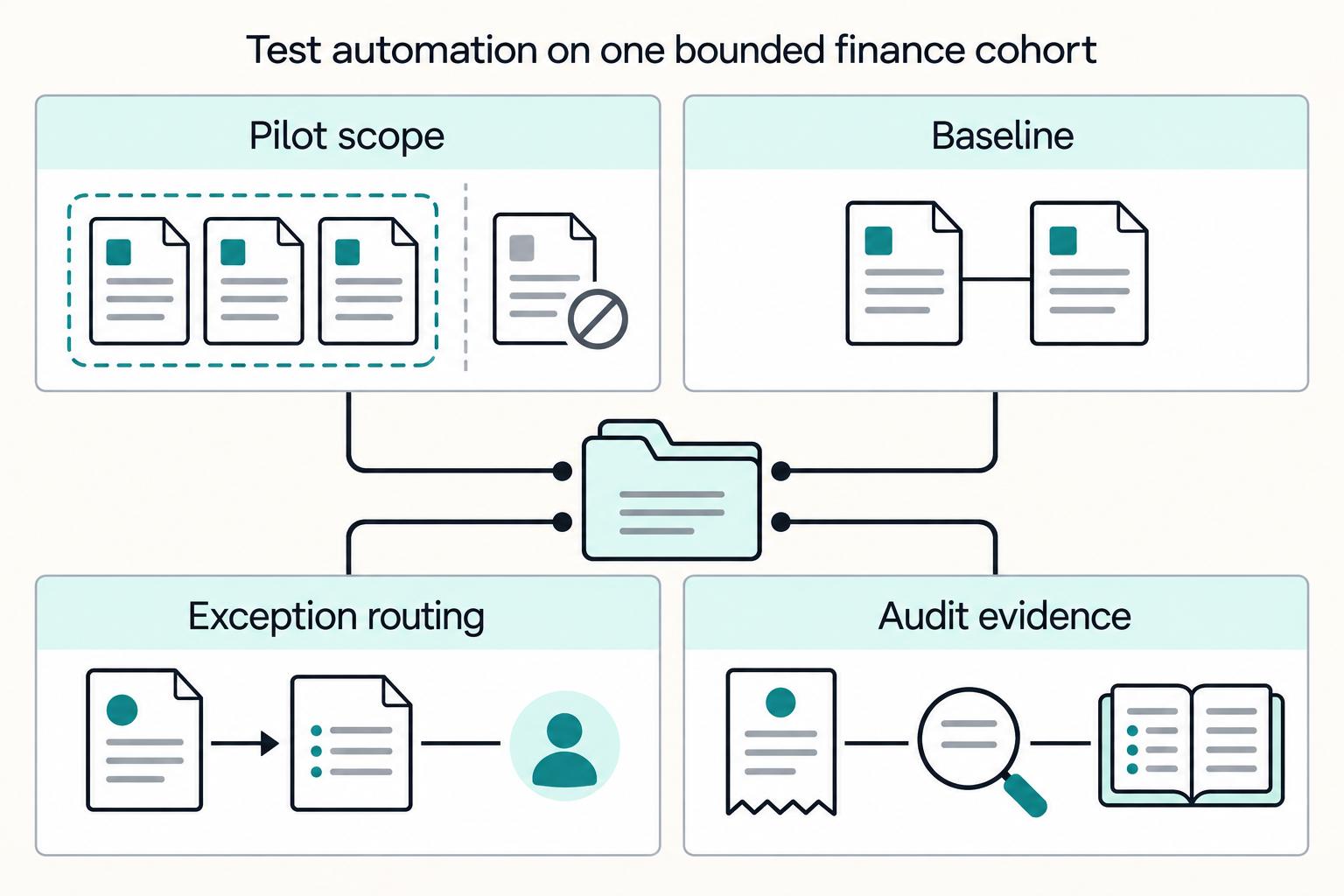
Run a controlled pilot with hard acceptance gates#
Run one narrow pilot first, then expand only when it proves operational performance and control quality. The goal is to reduce manual finance workload in the automated lane without weakening exception handling or audit evidence.
Choose one bounded cohort#
Pick one bounded cohort and keep everything else on the current path. A practical pilot is one process slice with similar patterns and stable rules.
Define why each item is in scope and why riskier items are out. If you mix very different process types in one pilot, it becomes harder to diagnose misses. Similar technology can produce very different pilot outcomes when process maturity and team readiness differ.
Set objective promotion gates#
Set promotion gates before launch, and make them objective. Use measurable KPIs and control checks such as:
| Gate | Pilot review note |
|---|---|
| Cycle time | Evaluate movement against your baseline |
| Error rate | Evaluate movement against your baseline |
| Exception-routing quality | For sampled pilot items, confirm exceptions are routed correctly |
| Audit-trail completeness | For sampled pilot items, confirm the records remain fully auditable |
Do not set targets after results are in. Evaluate movement against your baseline, and verify sampled items end to end, not just at dashboard level. For sampled pilot items, confirm exceptions are routed correctly and the records remain fully auditable.
Add a pause-and-fix rule#
Add a pause-and-fix rule before rollout expands. If KPI performance worsens or control evidence degrades, pause expansion and fix root causes first.
Treat rising human intervention as a warning signal, not proof of healthy oversight. The pilot should escalate exceptions while maintaining full audit trails. Expand only when the narrow cohort shows better cycle time and error rates, clearer exception handling, and intact audit evidence.
Expand safely with a clear operating model#
Once the pilot clears its gates, scale by tightening the operating model, not by automating everything at once. Expansion is safer when ownership is explicit, workflows are repeatable, and decisions remain reviewable.
Assign named owners before widening scope#
Assign named owners before widening scope. The exact org chart can vary, but known failure modes should map to a responsible team and a clear escalation path.
This is as much an organizational discipline issue as a tooling issue. Across enterprise cases, outcome differences were attributed to the organization rather than model choice.
Run a fixed governance loop#
Run a fixed governance loop: test, measure, adapt. Keep that loop measurable so process changes are judged on results and adjusted quickly.
Review known failure patterns each cycle and pause expansion if any of them appear:
- Automation added without redesigning workflows
- Brittle data access with no clean system of truth or permissions
- Leadership support that stays symbolic instead of operational
Expand in small increments#
Expand in small increments after stable governance cycles. If known failure patterns reappear or outcomes stop being easy to review, hold scope where it is and repair the operating model first.
Avoid the failure patterns competitors skip#
Many rollout failures are preventable. If a workflow only works in a controlled environment, it is not ready to scale. Fix process and ownership gaps before adding automation, or implementation can slow once it hits real systems, real data, and real constraints.
Validate in real operating conditions#
Validate in real operating conditions before widening scope. Use a small set of live workflows and confirm the chain from source event to decision to final outcome is traceable with minimal manual handoffs.
If teams still rely on side conversations to resolve exceptions, pause expansion. That is where integrations become brittle, trust erodes, and outcomes get less clear.
Move policy checks to the point of action#
Move policy checks to the point of action, not after the handoff. Late checks create dead time between user intent and the next step, and that is where implementation often slows or stalls.
Design the flow to reduce manual handoffs while keeping criteria and exceptions under clear control. Speed alone will not help if users and operators do not trust the process.
Ship exception routing before go-live#
Ship exception routing before go-live. You do not need a perfect first release, but each exception path should have clear ownership, first actions, and escalation routes so teams can follow through without extra handoffs.
Before widening scope, test recovery in a real workflow. If recovery still depends on ad hoc knowledge instead of a repeatable process, hold expansion and fix the operating model first.
Use this checklist to choose and execute the next step#
Make your next move falsifiable: choose a lane you can measure before launch, explain in review, and reverse without creating a bigger reconciliation problem.
- Baseline metrics are documented with clear goals and measurable KPIs.
Create a baseline pack that reflects current reality: process map, backlog notes, top exception reasons, and handoff points. If finance and engineering cannot agree on where work is stalling, map the value chain and run the 5 Whys on the worst bottleneck before automating it.
- Control requirements are mapped to your applicable compliance obligations.
Identify which checks cannot be bypassed, which approvals are required, and what evidence must exist in the audit trail. Do this at design time, not as downstream cleanup.
- Priority lane is selected with explicit tradeoffs and rollback criteria.
Pick one lane and state why it wins now. Name the tradeoff upfront: stability and control can reduce agility, and vice versa. Define rollback triggers before build starts.
- Integration design defines event-order handling and idempotent retry rules.
Write one shared rule set for late, out-of-order, and duplicate events, plus retried writes. Prove duplicate replays produce one durable business outcome.
- Pilot acceptance gates are defined and tied to traceable evidence.
Set objective gates for audit-trail completeness, exception handling, and parity. From a pilot sample, you should be able to show the request, checks, and resulting state without rebuilding history from side channels.
- Ownership is clear across finance, ops, and engineering before scale expansion.
Lock accountability before rollout broadens, then run a standing review cadence for the first 90 days. A 90-minute weekly leadership review on the top 1-3 issues is enough to catch drift early.
You might also find this useful: How to Identify Great Team Leaders in Your Platform Finance Operations. Once your checklist is complete, translate each control and integration gate into implementation tasks using the Gruv docs.
Frequently Asked Questions
Can you scale a finance team before hiring additional headcount?
Yes, sometimes, but not by skipping the basics. Confirm ownership, data readiness, and current-state records before you scale. If teams cannot agree on the process flow or source records, fix that first.
What should a platform automate first in AP and payouts?
There is no single first lane for every platform. Start with work your team can trace and review end to end, especially repeat tasks under stable policy. If the chain is unclear, narrow scope and stabilize the process first.
When does hiring beat automation for finance operations?
Hiring should come first when ownership and implementation bandwidth are the real constraint. If no one can own rollout and follow-through, more tooling can add coordination risk. Add accountable capacity first, then automate from a stronger base.
How much control design is enough before implementation starts?
You need enough control design to make tradeoffs explicit and outcomes reviewable before build starts. Define non-bypass controls, required evidence, and who owns exceptions. If those choices are still implicit, pause and define them first.
What are the biggest risks of automating finance ops too early?
The biggest risk is speeding up unresolved problems such as messy data, weak governance, audit-trail gaps, or unclear ownership. Early automation can hide failure points until they are harder to unwind. If stress behavior is unclear, do not widen rollout.
How do we prove automation did not weaken ICFR or SOX readiness?
Prove it with retained evidence, not intent. You should be able to reconstruct the path from request to decision to ledger or final state from the records alone. Sample pilot items should remain fully auditable, with control evidence easy to retrieve.
Researched and edited by the Gruv editorial team. Gruv builds cross-border billing, payouts, and finance-operations software for global businesses.
Sources
Includes 3 external sources outside the trusted-domain allowlist.
- congress.gov/113/crpt/srpt198/CRPT-113srpt198.pdftrusted
- digital.gov/s3/files/m-files/rpa-playbook.pdftrusted
- digitaleconomy.stanford.edu/app/uploads/2026/03/EnterpriseAIPlaybook_Per...trusted
- leginfo.legislature.ca.gov/faces/billCompareClient.xhtmltrusted
- sec.gov/Archives/edgar/data/18926/000001892625000024...trusted
- bcg.com/publications/2025/how-agentic-ai-is-transfor...external
- bcg.com/publications/2026/how-retail-banks-can-put-a...external
- cockroachlabs.com/blog/rethinking-global-reporting-platformexternal
Educational content only. Not legal, tax, or financial advice.
Related Posts

The Freelance Payment Penalty: A Modeled Audit of Platform Fees, FX Spreads, and Payout Delays
The money rarely disappears through a single, easy-to-spot fee. The real loss is stacked. A marketplace takes its commission, a processor adds a charge for international cards, a bank or payment company converts the currency at a spread, a platform holds the funds before release, and a wire sheds a little to intermediaries on the way in. Each layer looks defensible on its own, but the worker feels the combined result as a smaller deposit and a later payday.

How to Respond to a Subpoena for Business Records
Move fast, but do not produce records on instinct. If you need to **respond to a subpoena for business records**, your immediate job is to control deadlines, preserve records, and make any later production defensible.

A US Expat's Guide to Investing in UCITS ETFs to Avoid PFIC Issues
The real problem is a two-system conflict. U.S. tax treatment can punish the wrong fund choice, while local product-access constraints can block the funds you want to buy in the first place. For **us expat ucits etfs**, the practical question is not "Which product is best?" It is "What can I access, report, and keep doing every year without guessing?" Use this four-part filter before any trade: