
Quick Answer
Implement a PO process in ERP by designing controls first: require a purchase request or requisition, lock approval routing, make ERP the authoritative PO record, and connect invoice matching, receipt evidence, and AP controls before payment. Then scope phase one to traceable spend, assign decision rights, define a shared data contract, and roll out in waves with objective go or no-go gates.
Why Your ERP Should Own the Purchase Order Process#
Treat this as a control design problem first and an ERP configuration task second. You need a PO flow that gives finance and procurement reliable records while keeping engineering delivery practical, without leaving AP to reconstruct the trail later.
ERP should connect business processes and reduce duplicate data through one authoritative record, so your PO flow has to hold up across every handoff. A PO is the source document for a vendor order and usually follows an approved requisition. When intake, ownership, or approvals are fuzzy, approvals slow down and invoice handling becomes harder to defend.
Start with the operating question#
Before you configure anything, define what must be true for a vendor charge to move from request to payment without reconstruction later. Your process should answer these checks every time:
- Was there a valid purchase request or requisition before the PO?
- Who approved the PO, and is that approval action recorded?
- Does the vendor invoice map to the correct PO?
- Is AP processing invoices under written procedures with separation of duties?
If those answers are hard to produce, your baseline is not reliable yet.
Implementation stance for this guide#
Run this as cross-functional work from day one. ERP implementation guidance points to teams that span leadership, IT, and core business functions, so PO rollout decisions should be explicit across finance, procurement, AP, and engineering.
Sequence the work in the same order you may later need to defend it operationally: define request scope, lock approval rules, establish ERP as the authoritative record, then connect invoice handling and AP controls. Approval routing comes early for a reason. Rules-driven workflows route POs to identified approvers and record their actions, which is what makes the process reviewable later.
Scope for this section#
This guide covers PO intake, approval routing, invoice handling, and AP controls in and around ERP, plus the integration boundaries with payout and reporting surfaces where they affect PO integrity. It does not try to redesign every payout or reporting flow.
Use this boundary check before you automate anything else: if another system can change the meaning of a PO record, or AP has to rely on informal evidence to explain a payment, tighten the handoff and evidence trail first.
Set scope and success criteria before building#
In phase one, scope discipline should be explicit before build speed. Only include transactions you can trace from an internal purchase request or requisition to a PO, then to a vendor invoice and posted ledger-journal evidence. If that chain is not consistently available, leave that category out of the first rollout.
Define what is actually in scope#
Start with a spend-category matrix and force a yes or no decision on three controls for each category:
- Is a purchase request or requisition required?
- Is a PO number required before vendor billing?
- Are vendor invoice controls required against that PO record?
Approved requisitions can be converted to purchase orders, so requisition-to-PO is your first hard boundary. Include categories where you expect formal vendor commitments and invoice review. If receipt evidence is part of the control, include 3-way matching from the start. If receipt or service confirmation is routinely missing, treat that as a design problem now, not as cleanup for later.
Before build, validate this with real samples from each category. Check whether request, PO, invoice, and receipt records actually exist. Repeating gaps are design warnings, not just data hygiene issues.
Lock three measurable outcomes#
Pick three SMART outcomes and define each one the same way: metric definition, owner, baseline, and review date.
- Fewer manual AP steps, such as rekeying or manual invoice correction.
- Better first-pass 3-way match quality across PO, receipt, and invoice agreement.
- Better month-end close readiness, supported by posted and reviewable ledger journals.
Keep those definitions stable through rollout so you can compare results instead of shifting the goal line.
Write the do not build yet list#
A PO rollout gets weaker when exclusions stay implicit. Write down what is out of scope before build, which can include non-critical O2C changes when they are not required to protect PO integrity.
Keep exclusions in the same governance artifact as scope and change-control rules so additions are evaluated deliberately instead of slipping in through scope creep.
Related: What Is a Purchase Order (PO)? And When Should Platforms Use POs for Contractor Engagements.
Assign decision rights across finance engineering and procurement#
Lock decision rights before configuration. If you do not, approval logic can drift after go-live. Keep the split simple: finance and procurement can propose policy changes, but only a named admin group should edit approval routing in ERP.
Set the minimum ownership map#
Use a lean RACI-style matrix for phase-one decisions. In RACI, roles are Responsible, Accountable, Consulted, and Informed. Keep segregation of duties explicit: the person who creates a purchase request should not approve that same path, and receiving should remain separate from payment processing.
| Decision area | Accountable | Responsible | Consulted | Informed |
|---|---|---|---|---|
| Approval policy and levels by spend type or amount | Finance team | Procurement | Engineering, AP | Requesting department |
| ERP approval routing rule changes | Finance systems owner or ERP admin | Engineering or ERP admin | Procurement, AP | Finance team |
| Exception closure for invoice and receipt mismatches | AP lead | AP analyst | Procurement, receiving owner | Finance team |
For each row, document the owner name, exactly what they can change, and where the approval record is stored.
Restrict who can edit routing logic#
Separate change authority from change requests. Procurement and finance can request updates when policy changes, but designated administrators should make routing edits, including parallel versus sequential paths and approval levels over a particular amount.
That boundary matters in practice. If anyone with access can change a PO approval path at quarter-end, your control authority is too loose.
Define escalations before exceptions pile up#
Do not wait for the first backlog to decide how exceptions move. Define named escalation paths for these three cases:
| Case | Default action | Closure evidence |
|---|---|---|
| Blocked approvals | Configure workflow escalation where your ERP supports it | Approval history |
| Disputed vendor invoice data | AP checks mismatches against configured tolerance policy before escalation | Mismatch reason |
| Missing receipt record | If a 3-way match invoice is on hold for missing receipt, route it to the receiving owner for confirmation; if overbilled, route it for PO change-order review | Receipt or change-order reference |
Document the closure evidence for each case too: approval history, mismatch reason, and the receipt or change-order reference.
Define the PO data contract your systems must share#
A clean approval design still fails if your systems do not agree on what a PO record is. Define the data contract before integration work starts.
Start with the minimum fields that cannot be ambiguous#
Separate header fields from line fields, then make required values and validation explicit for each.
| Contract element | Required data | Validation focus | Authority (set explicitly) |
|---|---|---|---|
| PO header | PO number, vendor identity, payment terms, requested receipt date, linked purchase request ID | PO number uniqueness, vendor resolution to the right vendor record, payment terms present and valid | Usually ERP for vendor-facing PO terms |
| PO lines | line identifiers, item or service details, quantity, price, amount | line-level completeness and consistency before approval | Usually ERP for commercial line detail |
| Cross references | requisition ID, internal request ID, API request ID | no orphaned PO records without upstream traceability | Shared mapping table, single documented definition |
Use one approved PO as a trace test. You should be able to find its originating purchase request, vendor identity, line records, and mapped cross-system references without manual interpretation.
Document canonical IDs before you write integrations#
Do not let each system define identity differently. Document canonical IDs for PO, vendor, requisition, and lines, then map them across ERP entities, internal tables, and API payloads.
Keep the PO number visible in every downstream action that can create, amend, receive, invoice, or update that order. Where possible, use a unique order number as a duplicate-check key so AP and engineering can reconcile incidents from one shared identifier.
Make authority field-specific, not object-wide#
Avoid blanket statements like "one system owns the whole PO." In cross-system procurement flows, control is often split across related apps. Field-level ownership prevents disputes and reconciliation drift.
Make an explicit decision for each field in your environment. A common pattern is ERP authority for PO commercial terms and vendor details, with field-level exceptions documented for connected systems.
Add idempotent write rules for retries and webhook replays#
If a create or update path can retry, idempotency is not optional. Repeated requests with the same idempotency key should return the same result instead of creating another PO path.
At minimum, persist the idempotency key, request fingerprint, resulting PO number or error, and timestamp. Treat webhook consumers the same way. Stripe may resend undelivered events for up to three days, so handlers should ignore already processed events using stored event or request keys.
For a step-by-step walkthrough, see IndieHacker Platform Guide: How to Add Revenue Share Payments Without a Finance Team.
Map state transitions and handoffs end to end#
Once the data contract is fixed, map the flow as a set of owned state changes. If you cannot name what moves a record from purchase requisition to PO, receipt to invoice match, and invoice approval to payment, ownership is still unclear.
Model the full path from internal need signal through procuring, receipt, invoicing, and vendor payment, with requisition-to-PO treated as a formal handoff.
Build the state table first#
Use one state table that finance, procurement, AP, and engineering all approve. Key it by the same PO number and upstream purchase requisition ID defined in your contract.
| State | Main trigger source | Expected latency | Failure owner | Evidence to persist |
|---|---|---|---|---|
| Requested | API or manual entry of purchase requisition | Define in policy, immediate write or queued creation | Requesting team or procurement ops | Purchase requisition ID, requester, timestamp |
| Approved | Manual approval action or approval service callback | Business SLA with escalation for long waits | Approver chain owner | User or action log, approval decision, timestamp |
| PO issued | ERP action after approved requisition | Immediate after approval or queued ERP job | Procurement or ERP owner | PO number, request ID or job ID, confirmation timestamp |
| Received / product receipt recorded | Manual receipt entry, warehouse update, or webhook/event from receiving process | Event-driven near real time or manual SLA | Receiving owner or procurement ops | Product receipt (or GRN, where used) reference, receiver, quantity, timestamp |
| Invoiced / Vendor invoice captured | Manual AP entry, inbox capture, or supplier integration | Defined AP intake SLA | AP | Vendor invoice number, supplier record, capture timestamp |
| Matched / AP validated | ERP validation against PO and receipt | Immediate validation or batch cadence you set | AP | Match result, discrepancy or hold reason, validator, timestamp |
| Paid | Payment release and accounting post | Treasury or AP payment calendar | AP or treasury | Payment record ID, payment date, ledger journal reference |
For each row, make three things explicit: what event moved it, who owns failures there, and what evidence proves the move happened.
Make handoff rules explicit#
Each transition needs rules that match its trigger type. API triggers need request validation and idempotency handling. Webhooks are event-driven and near real time, so they need replay-safe processing. Manual actions need role controls, timestamped logs, and escalation rules for work that sits too long.
Approval ownership should be explicit too. The approver can be different from the submitter, and stale approvals should escalate to a named owner.
A practical check is to replay one completed PO end to end. You should be able to produce, in order, the purchase requisition, approval log, PO issue event, product receipt (or GRN, where used), vendor invoice, match result, payment record, and ledger journal reference.
Model negative paths before go-live#
Normal paths are not where most control failures happen. Map the negative paths before go-live:
| Scenario | Default handling | Key control |
|---|---|---|
| Partial receipt | Record product receipt evidence for the quantity received and keep the remaining quantity open | Product receipt evidence |
| Quantity mismatch | If billed quantity exceeds received quantity or falls outside tolerance, route it to hold or exception review before payment | Hold or exception review before payment |
| Price mismatch | Route price variance to AP exception handling with a documented reason and approver | Documented reason and approver |
| Duplicate invoice | For the same supplier and invoice number, enforce duplicate prevention across intake paths | Same supplier and invoice number |
| Stale approval | Escalate long-waiting approvals and preserve who submitted versus who approved | Submitter and approver history |
Build evidence for audit and root-cause analysis#
You need durable evidence for both audit and debugging. Persist machine-step evidence such as event ID, API request ID, and idempotency key, manual-step evidence such as user, action, and date or time, and posted-accounting evidence such as the ledger journal reference.
Keep this in a PO-keyed timeline you control, not only in vendor dashboards. Some idempotency keys may be removed after 24 hours, event retrieval can be time-bounded, and redelivery windows can also be limited, so duplicate-tolerant handlers plus durable internal evidence are both required.
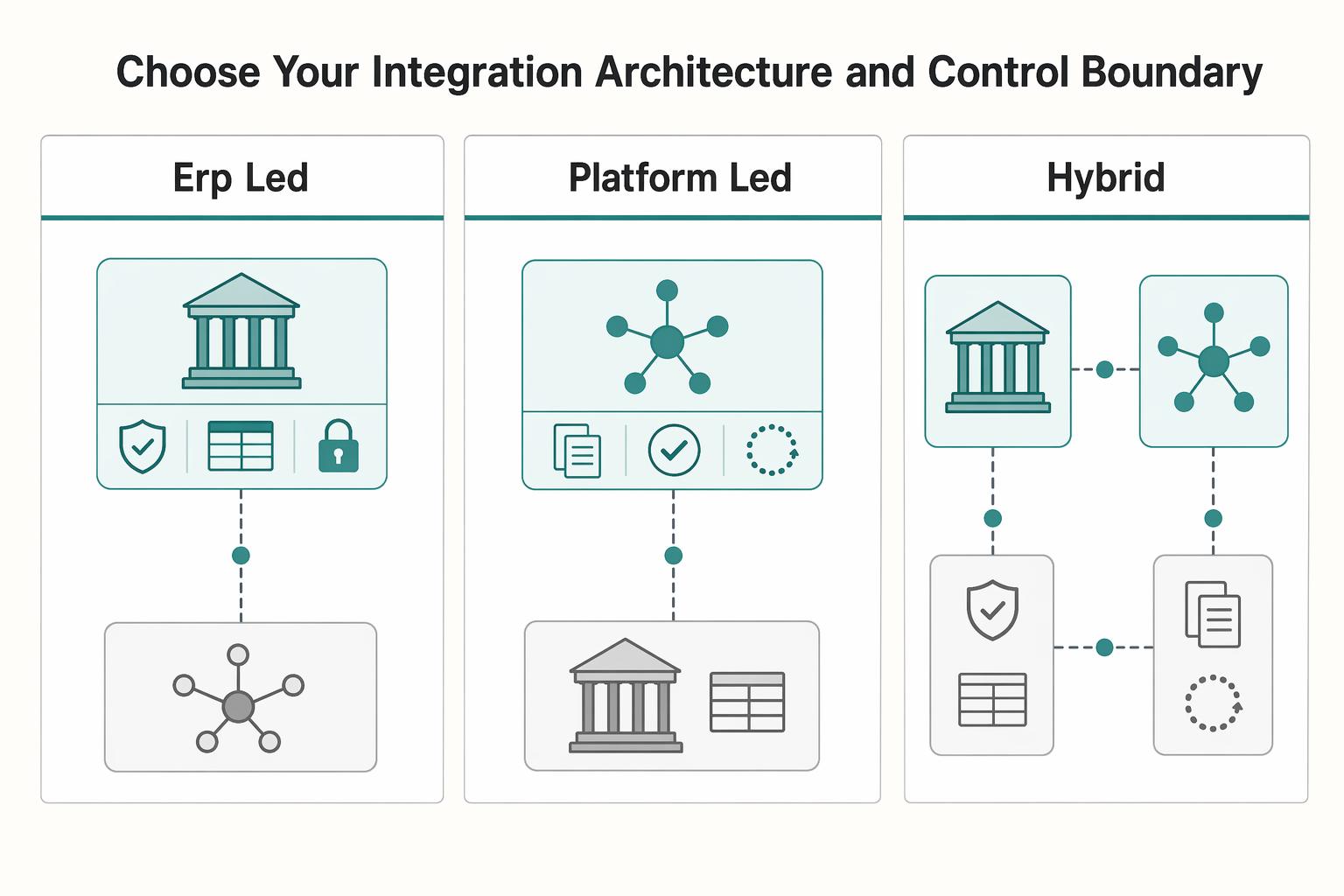
Choose your integration architecture and control boundary#
After the state table is set, decide where each transition is allowed to execute. Keep approval and posting authority in ERP when AP controls are already mature there. Move orchestration outward only when product-side timing or event volume is the real constraint, and make retries idempotent.
These are working patterns, not a canonical taxonomy. What matters is which system is authoritative for approval routing, PO creation, and accounting posts, and which system absorbs retries and failures.
| Pattern | Where authority sits | When it fits | Main upside | Main risk |
|---|---|---|---|---|
| ERP-led orchestration | ERP owns approval routing, PO issuance, and posting | ERP controls are already trusted and auditability is the priority | Control and audit trail stay centralized | Product flow can slow down if every step blocks on ERP responses |
| Platform-led orchestration | Product or integration layer coordinates steps and ERP is the downstream record | Throughput, responsiveness, or event-driven flow is the main need | Better fit for high-volume async flows | Reconciliation complexity rises if retries, duplicates, and replay handling are weak |
| Hybrid | ERP keeps final approval and posting, platform handles intake and async fan-out | You want ERP financial authority without blocking product flow on every round trip | Balance of ERP control with async throughput | Boundary confusion if mutation rights are not explicit |
Put financial authority where controls already exist#
Do not rebuild financial authority in product code if your ERP already handles it well. If ERP already has rule-based approvals and action history, keep approval authority there instead of recreating it elsewhere. Oracle Procurement supports rule-driven routing and records approver actions, which fits ERP-owned approval control.
When responsiveness and volume matter more, use asynchronous orchestration and keep ERP as the financial system of record for final outcomes. Dynamics guidance aligns with this split: synchronous is blocking request-response, while asynchronous fits high-volume flows where slight delay is acceptable.
Use this rule in practice:
- Put ERP in charge of steps that change approval status or accounting outcome.
- Use platform orchestration for intake, enrichment, and nonblocking fan-out, with replay-safe handling.
Contract API commands and webhook events separately#
Commands and events should not share one loose contract. Treat them differently.
For API commands, such as create PO or submit for approval, require a stable business key plus an idempotency key. Idempotency means retries do not create extra mutations. Stripe also documents deterministic replay for the same key, with keys up to 255 characters and pruning after at least 24 hours.
For webhook events, treat messages as notifications, not first-delivery guarantees. Persist event ID, type, timestamp, and PO reference before marking them processed. Replay-safe handlers are required because Stripe may retry undelivered events for up to three days, and manual recovery windows can be limited to the last 30 days.
Use two boundary checks in testing:
- Timeout a create-PO command, retry with the same idempotency key, and confirm only one PO is created.
- Send an unprocessable event and confirm it is dead-lettered with event ID, PO reference, and error reason.
Make dead-lettering explicit. If an event cannot be delivered or processed, move it to a separate destination for later handling. In SQS, maxReceiveCount controls when a message moves to a DLQ, so set it deliberately for your failure profile.
Define payout adjacency without sharing PO authority#
If the same platform also handles payout execution, such as payout batches or virtual-account flows, document that boundary explicitly. Keep any boundary decision explicit in your design docs.
A simple architecture check is enough here: verify payout retries do not unintentionally mutate PO approval or posting state, and PO retries use their own idempotent handling.
If you are locking API and webhook boundaries with idempotent retries, use this as an implementation checklist: Read the docs.
Build approval logic with policy gates and exception queues#
Once the control boundary is clear, make approval outcomes follow explicit policy in ERP rather than team habits. If AP relies on ERP approval history, keep approval routing in ERP and let integrations provide context inputs, not parallel approval paths.
1. Encode policy as gates, not only amount limits#
Amount-only routing can be too thin for real operations. Keep amount limits, then add the policy dimensions your team already uses so routing is rule-based instead of inbox triage.
In NetSuite, approval routing supports approvers and approval amount limits by authorizer level and department, with company-wide settings. In Dynamics 365, PO change management starts at Draft and moves through six approval statuses to Finalized. That is the right place for approval gates, escalation, and auto-approval rules.
A practical check is to run the same purchase request through two valid policy scenarios, such as different departments, and confirm the approver chain changes only where policy says it should.
2. Add AML and identity checks based on risk#
Use AML and identity controls where risk justifies them, not as a blanket step for every path. FATF treats a risk-based approach as foundational, with enhanced measures for higher-risk cases and simplified measures for lower-risk cases.
For onboarding, keep customer identity verification and legal-entity beneficial-owner diligence as distinct controls under the applicable rules. U.S. covered financial institutions are required to maintain written procedures to identify and verify beneficial owners of legal-entity customers, and U.S. bank CIP rules require risk-based identity verification.
The implementation point is sequencing. Define where required identity and diligence checks occur in your workflow based on applicable regulatory scope and risk.
3. Make exceptions explicit and assign ownership#
Exceptions should land in visible queues, not side-channel email. Give each queue an owner, aging visibility, and a defined escalation path so blocked POs can be triaged quickly.
| Exception queue | Typical trigger | Minimum record to capture |
|---|---|---|
| Missing documents | Incomplete onboarding or missing approval evidence | PO number, vendor, missing item, requester, last action time |
| Rejected approvals | Approver rejects or returns request | PO number, rejection reason, approver, requested changes, resubmission owner |
| Conflicting PO amendments | Line changes during or after approval flow | PO number, prior approved version, changed lines, current status, override reason |
In Dynamics 365, change management can be enabled for all vendors or specific vendors, and can be overridden per PO. Treat overrides as tracked exceptions.
4. Automate low-risk approvals first#
If cycle time is your bottleneck, start automation in low-risk, repeatable lanes. Dynamics 365 supports automatic approval rules and escalation for approvals that wait too long, which makes it a practical first lane for clean, stable categories.
Keep higher-risk or high-variance lanes in manual review until exception rates stabilize. If auto-approved POs repeatedly end in downstream AP holds or amendment conflicts, roll that category back, fix the policy inputs, and then automate it again.
Implement matching and reconciliation checkpoints#
After approvals, matching and reconciliation become core controls. Define match rules in ERP, require validation before payment, and make mismatches traceable to the final ledger entry.
1. Lock three-way matching criteria and tolerances#
Set three-way matching across the vendor invoice, PO, and receipt record (called product receipt in some systems), and apply it consistently at the line level.
At minimum, define which fields must match before an invoice can move forward:
- PO number
- vendor
- line item or service line
- quantity invoiced versus quantity received
- unit price and line amount
Make variance policy explicit. Matching discrepancies are checked against configured tolerances, so document the tolerance rules your team will use. Dynamics 365 guidance shows examples ranging from 0% default setup to 2% configured tolerance. Treat those as configuration examples, not universal thresholds.
2. Run checkpoints on a fixed cadence#
Do not leave matching and reconciliation to whoever notices an issue first. Use checkpoints that separate pre-payment control, exception operations, and period-close reconciliation.
| Checkpoint | What happens | Evidence to retain |
|---|---|---|
| Pre-payment AP validation | Validate invoice against PO and receipt data before payment release | PO number, invoice number, receipt ID, validation result, hold status |
| Exception review cadence | Review new and aging mismatches and unresolved holds, with clear ownership | owner, age, cause, next action, target resolution date |
| Close-period reconciliation | Reconcile AP transactional data and posted journals to ledger totals by period | subledger balance, journal reference, period, reconciliation result, unresolved difference note |
3. Block payment on mismatch by default#
If matching fails, block payment until the exception is resolved or formally released. Invoice holds exist for this control.
Route held invoices to a named owner or queue, and require an override note when a hold is released. Capture the reason, approver, and supporting document so the decision holds up at close and during audit.
4. Design outputs for reconciliation, not only payment release#
Matching outputs should help finance reconcile payables to the ledger, not just release invoices for payment. Reconcile payables periodically, including before and after posting to the general ledger, and review differences by period.
Keep join keys consistent across operations and accounting, especially:
- PO number
- invoice identifier
- receipt reference
- hold status
- ledger journal reference
When those keys stay consistent, finance can trace an exception to the exact transaction instead of rebuilding history in spreadsheets.
This pairs well with our guide on What Is a Requisition Order? How Platforms Use Internal Purchase Requests to Control Spend.
Roll out in phases with clear cutover gates#
Use phased rollout for PO controls when you need a gradual release in planned stages. Reserve big-bang cutover for genuinely small, simple changes. In a big-bang release, all users switch on one go-live date and the old system is retired at once.
Roll out in waves with clear objectives, and decide whether to run pilot rollouts before wider deployment. Before each expansion, make an explicit go or no-go call on business and technical readiness.
Keep cutover gates objective and written down:
| Gate metric | What to verify before expanding | Evidence to retain |
|---|---|---|
| Go/No-Go readiness assessment | Readiness questions are completed across business and technical categories, with a clear pass/fail outcome | completed checklist responses and category scores |
| AP cycle time (invoice receipt to payment transmission) | Cycle-time trend is stable or improving between waves | invoice receipt and payment transmission timestamps |
| Share of PO invoices with a mismatch | Mismatch share is not worsening between waves | invoice sample, PO number, receipt or GRN reference, mismatch reason |
| Share of PO invoices requiring correction | Correction share is stable or improving between waves | correction log, root cause, corrected field |
Set and document decision rules before go-live for each wave. Decide upfront whether to phase out the legacy system by a deadline or run legacy and new systems in parallel during transition.
Handle compliance and tax artifacts without polluting core flows#
Keep tax and compliance artifacts adjacent to PO operations, not embedded in core PO state transitions unless policy explicitly requires a stop.
| Area | Handling rule | Key details |
|---|---|---|
| Tax forms | Store form type, vendor or legal-entity ID, receipt date, and document link in a tax record tied to the vendor master, with PO reference available for traceability | W-9 goes to the requester, not the IRS; W-8BEN goes to the withholding agent or payer, not the IRS; use W-8BEN-E for foreign-entity status; retain W-9s for four years |
| VAT validation | Persist the country code, VAT number checked, timestamp, source, and raw response; retry asynchronously on a transient VIES outage | VIES is a search engine, not a database; accuracy is not guaranteed; use HMRC's checker for UK VAT numbers because GB validation in VIES ceased on 01/01/2021 |
| Annual reporting | Keep 1099 and FBAR logic in reporting evidence packs, not inline with PO approval routing | For FBAR, assemble evidence when aggregate foreign financial accounts exceed $10,000 during the year; track April 15 with automatic extension to October 15; check current IRS threshold guidance for 1099-NEC |
| Sensitive identifiers | Mask sensitive identifiers in day-to-day AP and procurement views and enforce least-privilege access | Log who viewed or replaced a form, when it changed, and which vendor record it was tied to |
- Separate collection from PO movement.
Store form type, vendor or legal-entity ID, receipt date, and document link in a tax record tied to the vendor master, with PO reference available for traceability. Keep the handling rule explicit: W-9 is given to the requester, not sent to the IRS, and W-8BEN is given to the withholding agent or payer, not sent to the IRS. Use W-8BEN-E to document foreign-entity status for chapter 3 and chapter 4 purposes. AP should be able to verify whether a form is on file without reopening the PO. If you collect W-9s, retain them for four years per IRS guidance.
- Treat VAT validation as evidence, not ground truth.
Persist the country code, VAT number checked, timestamp, source, and raw response. VIES is a search engine, not a database. The European Commission also notes that accuracy is not guaranteed and service can be temporarily unavailable. For UK VAT numbers, use HMRC's checker, since GB validation in VIES ceased on 01/01/2021. Avoid blocking invoice intake on a transient VIES outage. Retry asynchronously and only hold tax treatment when policy requires it.
- Keep annual reporting obligations downstream.
Keep 1099 and FBAR logic in reporting evidence packs, not inline with PO approval routing. For 1099-NEC, check current IRS threshold guidance against payment totals and vendor classification. For FBAR, assemble support evidence only when qualifying facts exist, such as aggregate foreign financial accounts exceeding $10,000 during the year. Track that evidence against the annual timeline: April 15 due date with automatic extension to October 15.
Mask sensitive identifiers in day-to-day AP and procurement views, and enforce least-privilege access so only required roles can see full values. Preserve auditability by logging who viewed or replaced a form, when it changed, and which vendor record it was tied to.
Run sanity checks before and after go-live#
A PO rollout is more reliable when retries, permissions, and reconciliations behave predictably in production, with clear ownership for failures.
1. Make pre-go-live a true go/no-go gate#
Pre-go-live should be a real decision point, not a calendar milestone. Use a formal checklist, complete planned test cycles, meet exit criteria, and require business sign-off before cutover. Your cutover plan should document dependencies, instructions, verification steps, roles, responsibilities, and support transition.
Minimum pre-go-live sanity checks:
- Duplicate event simulation (
Webhookreplay): replay the same event more than once and confirm one business outcome, since webhook endpoints can receive duplicate deliveries. - Retry safety (
Idempotency): force retry conditions and retry with the same idempotency key to confirm retries do not create duplicate operations. - Role-based permission tests: validate access by role, not by named user, so each role can do its operational work.
If you rely on provider-managed idempotency storage, confirm retention behavior. Stripe notes that idempotency keys can be removed after they are at least 24 hours old, so longer replay windows may require your own deduplication record.
2. Reconcile immediately after go-live and before close#
Do not assume ERP records and the ledger will stay aligned automatically. Run reconciliation checks early so differences are fixed in period.
Focus on two post-go-live checks:
- Subledger-to-GL reconciliation: verify that general ledger balances match assigned subledger balances, and run this before period close.
- AP aging-to-GL comparison: compare AP period-end balances with the AP trade balance in the general ledger to spot control drift.
3. Assign explicit operational owners#
Operational readiness needs clear roles and responsibilities and a transition plan to support teams. Define who monitors production, who handles failures, and who runs subledger-to-GL reconciliation before period close.
4. Run periodic control reviews to prevent drift#
Controls drift unless someone reviews them on purpose. Use both ongoing monitoring and separate periodic evaluations, and set the review schedule to your risk and change velocity so policy gates, routing rules, and evidence outputs stay aligned.
Related reading: Building a Monthly Payout Reconciliation Process for a 1000-Contractor Platform.
Conclusion#
Strong PO implementations depend on sequence and control boundaries, not on adding more tools. The real job is to make the procure-to-pay chain traceable end to end, from purchase request through approval, PO issuance, receipt, invoice verification, and payment.
P2P is a process first, not a technology choice. Teams create risk when they optimize screens, integrations, or automation before they define handoffs and ownership. If approvals, PO issuance, receipt, and payment decisions are split across teams without clear evidence and record authority, you have activity, not control.
Keep the control model explicit from the start:
- Make requisition workflow the first gate. Requisitions should move from Draft to Approved before downstream purchasing actions, with clear reviewer and approver roles.
- Require verification evidence before payment approval. Invoice approval should tie back to the PO and receipt record, or your ERP's equivalent.
- Use a traceability test on paid invoices. You should be able to trace each one backward to the payment record, invoice record, PO, receipt evidence, approval path, and the original purchase request with clear records.
Ownership must stay explicit across finance, procurement, AP, and supporting system teams. Procurement is cross-functional, so responsibilities for approval routing, exception closure, and source-of-truth records should be named, not implied.
The next step is practical: turn the earlier checklists into a first implementation plan, then validate it in a pilot before scaling. For larger or more complex rollouts, use phased execution in two or more steps, carry lessons forward, and reuse what worked in the pilot instead of redesigning each wave.
When you are ready to validate coverage, compliance gates, and rollout constraints for your ERP flow, talk with Gruv.
Frequently Asked Questions
What are the minimum steps to implement a PO process in ERP for a platform finance team?
Start with the smallest end-to-end chain that still gives you control: create the PO header, add PO lines, review totals, route approval, confirm with the vendor, record receipt, then process invoice and payment. That sequence works because receipt, invoice processing, and payment are separate operational stages in ERP workflows. If any stage lacks an owner or verification point, treat the rollout as incomplete.
Which PO fields are mandatory to support automation and clean reconciliation?
There is no universal mandatory field list across all ERP systems and configurations. In practice, you need a PO document identifier and line-level data that supports matching and reconciliation, including line number, item or category, quantity, unit, price, tax information, and matching information. If invoice lines cannot be traced back to specific PO lines without manual interpretation, your data contract is not ready.
Who should approve what across finance, procurement, department heads, and engineering?
Use approval workflows that define assigned approvers, automatic approvals where policy allows, and escalation rules for stalled items. The underlying systems support workflow-based routing, but they do not provide a universal cross-function approval matrix or fixed thresholds. Define ownership by role in your policy, then encode that policy into the workflow.
How does a three-way match work in practice with PO, vendor invoice, and GRN?
Three-way matching checks the invoice against both the PO and receipt evidence before payment. A core control is that billed quantity must be less than or equal to received quantity, with tolerances helping determine when holds are applied. If your ERP uses different terms than GRN, use its native receipt record as the same control point.
What should we automate first, and what should remain manual in phase one?
In phase one, prioritize automating controls that are directly system-enforced: PO identification, approval routing, retry-safe request handling, and match or tolerance checks that can trigger holds. Keep policy judgment and exception resolution manual until the core flow is stable. That gives you predictable control behavior before you add more complex automation.
What are the biggest failure modes in ERP PO integrations, and how do we prevent them?
Major failure modes include weak risk planning across implementation phases and duplicate side effects from retries without idempotent design. Prevent them by planning explicitly for install, migration, and training risks, and by validating retry behavior with idempotent request patterns. Also account for idempotency-key retention windows if your provider prunes keys after 24 hours.
What should we know before starting if timelines and benchmarks are unclear in most guidance?
Do not treat generic timeline benchmarks as decision-grade on their own. Choose your release strategy based on business objectives, risk appetite, budget, resources, implementation complexity, and time available. Use readiness gates tied to control outcomes, not calendar targets alone.
Researched and edited by the Gruv editorial team. Gruv builds cross-border billing, payouts, and finance-operations software for global businesses.
Sources
- csrc.nist.gov/glossary/term/least_privilegetrusted
- csrc.nist.gov/glossary/term/maskingtrusted
- docs.stripe.com/api/idempotent_requeststrusted
- docs.stripe.com/webhookstrusted
- ecfr.gov/current/title-45/subtitle-B/chapter-XVI/part...trusted
- ecfr.gov/current/title-31/subtitle-B/chapter-X/part-1...trusted
- europa.eu/youreurope/business/taxation/vat/check-vat-n...trusted
- guides.gaoinnovations.gov/greenbook/2025/principle-16-perform-monitori...trusted
Educational content only. Not legal, tax, or financial advice.
Related Posts

The Freelance Payment Penalty: A Modeled Audit of Platform Fees, FX Spreads, and Payout Delays
The money rarely disappears through a single, easy-to-spot fee. The real loss is stacked. A marketplace takes its commission, a processor adds a charge for international cards, a bank or payment company converts the currency at a spread, a platform holds the funds before release, and a wire sheds a little to intermediaries on the way in. Each layer looks defensible on its own, but the worker feels the combined result as a smaller deposit and a later payday.

How to Respond to a Subpoena for Business Records
Move fast, but do not produce records on instinct. If you need to **respond to a subpoena for business records**, your immediate job is to control deadlines, preserve records, and make any later production defensible.

A US Expat's Guide to Investing in UCITS ETFs to Avoid PFIC Issues
The real problem is a two-system conflict. U.S. tax treatment can punish the wrong fund choice, while local product-access constraints can block the funds you want to buy in the first place. For **us expat ucits etfs**, the practical question is not "Which product is best?" It is "What can I access, report, and keep doing every year without guessing?" Use this four-part filter before any trade: