
Quick Answer
Great platform finance operations leaders make money movement explainable end to end and can prove control under pressure. Look for clear ownership across initiation, settlement, matching, GL impact, and reporting, plus strong judgment on compliance gates, fluency with retries and event handling, and a 30/60/90 day plan backed by traceable records and measurable reduction in repeat failures.
What Strong Finance Operations Leaders Look Like#
To identify strong leaders in platform finance operations, look for control, not polish. The real signal is whether a leader can keep money movement explainable from the first API request through reconciliation, GL posting, and the final incident record when something goes wrong.
That context also matters in cross-border programs. The G20 launched its cross-border payments Roadmap in 2020, including explicit work on service levels and API harmonization, and most global targets run to end-2027. Official reporting also says end-user improvements are still limited globally. So the practical question is not who sounds strong. It is who can hold together speed, accountability, and evidence when the flow breaks.
Keep the core terms tight:
- API request: a request from one application to another for data or services.
- Reconciliation: matching transaction records to confirm payments align with accounting records and statements.
- Ledger (GL): the accounting record of a company's past transactions organized by account.
- Audit trail: the record that lets you reconstruct what happened, who touched it, and what actions were taken from start to result.
These basics are often where leadership gaps show first. A candidate may speak confidently about scale and urgency, then fail to explain how a missed status event becomes an unmatched item. They may also fail to explain how a manual override should appear in the record. If the evidence chain is unclear, the risk tends to surface later in month-end review, incident recovery, and payout exceptions.
Effective leaders here also need to make hard calls, not just keep the peace. Leadership guidance warns that being nice is not the same as being effective, and finance transformation can go sideways when teams share goals but no one owns the final decision. If a failure class has shared ownership but no final owner, treat it as an operating risk.
Use this guide as a practical evaluation sequence:
- Map ownership across initiation, settlement, matching, GL impact, and reporting.
- Score outcomes against operating reality, not presentation style.
- Test judgment under pressure with payout, compliance, and incident scenarios.
- Check technical fluency around API retries, event status handling, and traceability.
- Validate the first three months with evidence, because that transition window is high risk for new leaders.
Keep one rule in view: if a leader cannot name the control point, decision owner, and evidence artifact for a failure, treat it as a readiness gap for scaled finance operations. The leader you want can explain what should happen, what can fail, how to verify it, and when to stop the line instead of pushing money forward on hope.
What to prepare before you assess any leader#
Before you judge a leader, define the operation they would inherit. If the baseline is fuzzy, you will end up grading confidence instead of control.
1. Gather the live baseline#
Start with the numbers your team already uses to explain pain: open and aging items, unmatched transactions, failed payouts, settlement breaks, and recurring Service Level Agreement (SLA) misses. Keep the view current, not cleaned up for a quarterly review. Aging reports show current and past-due open items, and settlement breaks can push balances into a later settlement batch instead of resolving cleanly.
Use a simple check: can you trace a bank receipt to its transaction batch, and can you isolate failed automatic payouts as their own category? If not, a candidate can hide behind process language without proving they can reduce real failure classes.
2. Assemble the evidence pack#
Bring the artifacts that show how exceptions are handled today. If you use internal labels like exception queues, include those definitions, who investigates unmatched items, and the escalation path when analysis stalls. Unmatched transactions require analysis, so ownership cannot stay implied.
Include recent incident-record samples from real incidents. Each sample should let you reconstruct who accessed the system, what actions were taken, and in what order. If the record ends at "manually fixed," treat that as a pre-interview red flag.
3. Confirm the actual product scope#
Document which money-movement products are in scope now: virtual accounts, payout batches, and Merchant of Record (MoR) where enabled. Scope materially changes the leadership job. Virtual account structures support differentiated cash activity visibility, and payout batches introduce grouped timing and break risk.
| Product | Scope note |
|---|---|
| Virtual accounts | Support differentiated cash activity visibility |
| Payout batches | Introduce grouped timing and break risk |
| Merchant of Record (MoR) | The entity with legal responsibility for a transaction |
Be precise on MoR. The Merchant of Record is the entity with legal responsibility for a transaction, so do not leave it vague during assessment.
4. Align the evaluators#
Do not let one function judge alone. Different functions see different parts of the operating risk, and cross-functional accountability is the point.
Set criteria in advance: control quality, incident judgment, and evidence discipline. If one function cannot get clear traceability answers, pause and resolve that gap before moving to scenarios.
Step 1 map money movement and assign failure ownership#
Build one end-to-end ownership map first. If responsibility breaks at team boundaries, a leader can interview well while failures still fall between payment initiation, settlement, GL posting, and reporting.
1.1 Draw one path from initiation to reporting#
Use one map that follows money movement from initiation through tracking, failure handling, matching, posting, and compliance. Payment operations covers that full path, so your assessment artifact should too.
Ask for one row-based view showing who acts, who approves, and what evidence confirms completion at each stage. If a failed payout or unmatched item has no clearly named decision owner, resolve that gap before continuing the interview. Titles can vary, but decision ownership should not.
| Stage | Primary failure class to map | Evidence checkpoint (example) | Final owner to name |
|---|---|---|---|
| Payment initiation | Request accepted but not traceable downstream | Provider reference or originating request identifier (where available) | Owner for initiation controls |
| Event handling | Missing webhooks or unworked asynchronous status changes | Internal event ID tied to originating request where available | Owner for event intake |
| Match and break handling | Unmatched entries | Match record plus journal entry or exception record | Owner for break investigation |
| Payout execution | Failed payouts and retry decisions | Provider payout reference and status history | Owner for payout execution decisions |
| Batch settlement and reporting | Delayed payout batches or settlement visibility gaps | Settlement report reference and reporting output | Owner for settlement or reporting decisions |
1.2 Separate failure classes people usually blur together#
Do not keep "payment issue" as one bucket. Missing webhooks, unmatched items, failed payouts, and delayed payout batches are different failure classes with different evidence and different owners.
Webhook ownership needs its own row because status events are asynchronous. A payment can be initiated correctly and still fail operationally if the expected event is not processed.
Matching also needs explicit ownership. It is a comparison of record sets for accuracy, not a generic cleanup step. "Finance owns recon" is not enough unless someone is named to investigate unmatched items and decide whether to post, reverse, or escalate.
Treat settlement reporting as one input, not proof of payout health. Some provider reports support transaction tracking but still omit failure states. In PayPal payout settlement reporting, reference IDs support tracking, while declined payments do not appear. If you use that provider, also assign ownership for batch-state monitoring, including transitions like T1503 (processing hold) and T1105 (hold released on completion).
1.3 Assign named control owners for KYC, legal-entity due diligence, and AML#
Compliance gates need named day-to-day owners and clear escalation ownership. For identity checks, map responsibilities to CIP risk-based verification procedures. For legal entities, map what your team may call KYB to beneficial-owner identification and verification at account opening, subject to regulatory exclusions and exemptions. For AML, assign individuals responsible for coordinating and monitoring day-to-day compliance.
Use a practical check: who can stop a payout when identity data is incomplete, and who can approve an exception path? Shared execution can work, but this role still needs a clearly named final decision owner.
1.4 Add evidence checkpoints you can audit later#
Each row in the map should define the evidence expected after completion. Typical checkpoints can include provider reference, internal event ID, related journal entry, and final incident record. The exact fields can vary by provider, but each stage should leave durable proof for incident review.
Validate the chain on one recent incident: originating payment action, event record, GL impact, and final user or process actions in the record. Where available, request IDs can help tie event records back to originating API calls.
Watch for false completeness. "Settled" without the related journal entry, or "manually fixed" without a complete record, means the ownership map is incomplete.
If you want a deeper dive, read our guide to payment platform expansion as a strategic driver.
Step 2 define a leader scorecard tied to operating reality#
Score leaders on evidence-backed outcomes, not presentation style. A leader should pass because reconciliations close cleanly, settlements reach final posted outcomes, and payouts meet the agreed SLA.
2.1 Score outcome quality before management style#
Start with three outcome lines and require proof for each one. For reconciliations, score whether closure is timely, documented, and verifiable. For payouts and settlement handling, anchor reliability to your actual SLA commitments for performance, quality, and response or resolution handling.
| Scorecard area | What to score | Verification point | Common false positive |
|---|---|---|---|
| Reconciliation | Closure quality, not just closure count | Matched record set, explained variance, adjustment evidence, reviewer signoff | "All items cleared" but no explanation or adjustment trail |
| Settlements | Reliability of posted outcomes and break handling | Settlement report reference, related GL impact, final posted state | "Accepted for settlement" treated as final proof when downstream posting broke |
| Payouts | Reliability against SLA and recovery quality | Payout reference, status history, breach log, customer or internal resolution timing | Fast first attempt with weak retry controls or repeated manual rescue |
A closed period is more than a lower exception count. It is a periodic comparison of related records, variance explanation, and adjustments until records agree.
2.2 Add control metrics that expose hidden weakness#
Use control metrics that surface weakness before month-end does: exception trends, including aging where tracked, retry quality on API operations, and traceability completeness in the incident record. For retries, score duplicate safety, not just retry volume.
Use one failed payout or timeout case as a trace test: request ID, retry attempt, provider reference, and final record. If any link is missing, mark traceability incomplete. Also watch for two common misses: lower manual queue volume while exception aging gets worse, and "retry worked" without proof it could not execute twice.
If your provider uses idempotency keys, verify the retention window your team depends on. Some APIs document retention for at least 24 hours.
2.3 Include the finance readout executives will ask for#
Include the finance readout executives will ask for: statement impact from manual fixes and clear variance drivers in the income statement. Keep this tied to financial-statement discipline, including a complete set of financial statements at least annually with prior-year comparatives.
Ask for one month-end evidence pack: unresolved breaks, manual journals linked to incidents, and the variance list finance reviewed. If a leader cannot connect an ops incident to statement impact, that is a leadership gap.
2.4 Set pass or fail thresholds by maturity stage#
Set pass or fail thresholds by maturity stage so expectations match operating reality. Use a staged progression, Tier 1 to Tier 4, from ad hoc to risk-informed, repeatable, and adaptive outcomes.
A growth-stage team may pass on consistent monitoring and measurable improvement. As scope broadens, require stronger repeatability, clearer variance attribution, and more complete evidence. For stage design support, The Payment Operations Maturity Model: How to Benchmark Your Platform Finance Team is a useful companion.
Related: What Is an Income Statement? A Platform Finance Team's Guide to P&L for Payment Businesses
Step 3 test compliance and control judgment under pressure#
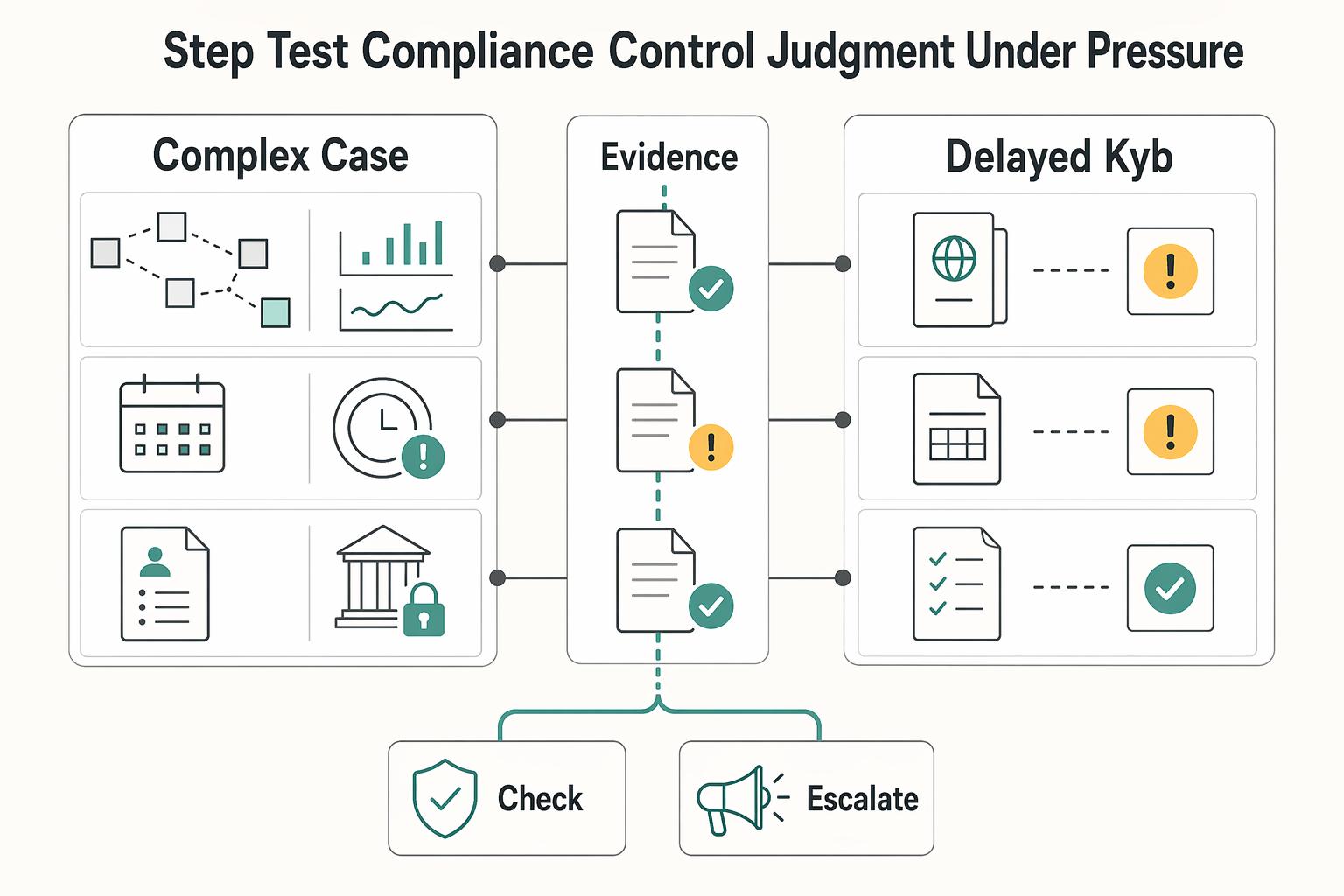
Force a real tradeoff. When payout urgency conflicts with missing compliance evidence, strong leaders protect policy-defined control gates, escalate through policy, and leave a defensible record.
| Pressure case | What a strong answer sounds like | Fail signal | Verification point |
|---|---|---|---|
| Urgent payout, incomplete identity data | Holds release until required identity-verification evidence is complete, or a policy-defined exception is approved and logged | "Pay now, finish checks later" | Missing-field list, hold reason, approver record, decision timestamp |
| Delayed KYB or VAT checks with business pressure | Distinguishes temporary check delay from an invalid result, then applies policy and escalation | Lets commercial teams override controls | Beneficial-owner check status, VIES result or outage note, escalation path |
| Missing tax documents before payout | Treats W-8 BEN or W-9 status as payout-readiness input where enabled, not end-of-year admin | "We'll fix tax forms later" | Form status, TIN status, withholding decision, reporting flag |
3.1 Present a payout case with incomplete identity data#
Use a case where payout is near cutoff but identity data is incomplete, then ask for the order of operations. In a US banking context, CIP requires minimum identifying information before account opening, with listed exceptions. So "release first, verify later" is a weak answer when your policy depends on those gates.
Look for two signals: they protect the gate under pressure, and they can name the exact pause point. They should specify what is missing, who is notified, what gets updated, and what evidence is required before release. A common miss is replacing policy with informal approval.
3.2 Push on delayed KYB and VAT checks#
Then shift the case to a legal-entity payee with launch pressure and pending checks. In covered-institution contexts, strong candidates should address beneficial-owner verification and explain how ongoing AML monitoring supports a pause-and-escalate posture when risk is unresolved.
If your flow includes EU VAT checks, ask how they handle VIES delay versus invalid status. That distinction matters. VIES is a search engine, and an invalid result means the VAT number is not registered in the relevant national database. Strong leaders do not blur that line to meet a deadline.
3.3 Ask how tax-document readiness changes payout decisions#
Tax-document judgment should be explicit in payout readiness where your product enables it. W-9 provides the correct TIN, and W-8 BEN may be required by the payer or withholding agent even without a reduced-rate claim. Missing or incorrect TIN data can create backup-withholding risk, including the current 24 percent rate.
Ask what changes operationally when forms are missing: block, withhold, or reroute based on policy, then tag the reporting impact. If they mention 1099, look for precise handling: 1099-NEC filing is due January 31 of the following tax year, and thresholds can change by form year and effective date.
3.4 Require a concrete audit-trail answer#
Do not accept "we documented it." Ask for the specific fields that would let you reconstruct the decision later:
| Record area | Fields to capture |
|---|---|
| Event details | what happened, when, where, and from which source event or system |
| Subject and hold reason | payee or entity identifier, missing document or failed check, and hold reason |
| Reviewer and decision | reviewer identity, exception decision, and decision time |
| Outcome | release, continued hold, or withholding treatment |
If they cannot name the pause point, policy approver path, and required evidence, they are not ready to lead under pressure.
Step 4 evaluate technical fluency with product and engineering#
After control-gate judgment, test whether the candidate can explain the mechanics that keep those gates reliable at scale. They do not need to write production code, but they should clearly connect API retries, webhooks, virtual account numbers, and posting decisions to matching outcomes.
4.1 Probe retry safety with an idempotency case#
Start with a timeout scenario: a payout create call times out, the team retries, and finance later sees a possible duplicate. A strong answer should begin with idempotency, retrying the same mutating request safely without executing it twice.
In Stripe's model, reusing the same idempotency key returns the same result, including 500 errors, and keys can be up to 255 characters long. The point is not vendor trivia. It is whether the candidate can describe the control path.
Verification point: they should explain the sequence in order. The request is sent, the key is attached, the response is ambiguous, and the same key is reused on retry. Then the result is checked against the original payout record before release or GL adjustment decisions.
A useful follow-up is key scope: what is reused for the same payout attempt versus what is new for a new payout instruction.
4.2 Test event handling through webhooks and virtual-account activity#
Next, test event triage. A webhook is an HTTP endpoint for provider events, and in Stripe's reconciliation guidance, a best practice is to retrieve payouts asynchronously when payout.paid or payout.reconciliation_completed is received.
For virtual accounts, ask how they handle an inbound credit without a clean customer match, then a later return. Stripe ties virtual account numbers to reconciliation automation in bank-transfer flows, and notes unreconciled customer-balance funds may be automatically returned after 75 days.
A strong answer should cover queueing, ownership, the evidence needed before posting, and how a return event reverses or adjusts earlier assumptions. A weak answer treats webhook status as self-validating truth.
4.3 Ask for an automation plan that protects ledger truth#
Look for selective automation, not blanket automation. Strong candidates can turn operations pain into implementable requirements for product and engineering, with clear controls for GL integrity and close quality. Ask for three concrete changes, such as:
- persisting idempotency key, provider reference, and internal event ID together for end-to-end traceability
- auto-ingesting webhook events into an exception queue, with explicit review before posting unmatched credits or returns
- triggering asynchronous payout retrieval from webhook events to reduce dependence on manual exports for matching
Verification point: they should be able to define evidence of impact, such as before-and-after exception counts, repeat-incident rate, and a sample incident record with event links.
If they can describe the pain but cannot translate it into data fields, event triggers, and review checkpoints, treat that as a potential scaling risk for platform operations. Related reading: How to Build a Subscription Billing Engine for Your B2B Platform.
Step 5 run scenario interviews on real incidents not hypotheticals#
Use structured, incident-based interviews so you can compare candidates on the same evidence. Higher interview structure improves comparison quality, and real past behavior is a stronger signal than polished hypotheticals.
5.1 Build one incident packet and reuse it for every candidate#
Use one standardized packet and one scoring rubric for every candidate. Keep the facts, prompts, and evaluation criteria consistent, then compare how each person sets priorities, handles controls, and asks for evidence before acting. A useful packet includes:
- a timestamped incident timeline
- payout or settlement references
- raw event IDs
- a GL snapshot before and after the break
- one or two customer-impact examples
- any compliance note, queue status, or onboarding record relevant to the case
- the reporting cutoff date if period-end is near
Verification point: strong candidates ask where the source of truth is before proposing action and separate customer impact from GL impact. Weak candidates jump to release or correction actions before confirming whether operations and accounting records have diverged.
| Scenario | What you give the candidate | What a strong answer does first | Red flag |
|---|---|---|---|
| Matching break | Unmatched settlement entries, one suspicious duplicate payout, close deadline approaching | Isolate the impacted population and verify posting state before adjustments | Treats provider status as final truth |
| Payout outage | Batch stuck or failing across multiple payout status stages | Stabilize customer impact, identify the failure stage, and control retries | Restarts broadly without controls |
| Compliance hold | Urgent payout request with incomplete identity or ownership data | Enforce hold, name the approval path, and define the evidence needed to clear release | Bypasses controls for speed |
5.2 Force a clear order of operations#
Use a clear sequence such as: stabilize customer impact, protect GL correctness, restore flow, then publish incident notes with traceability evidence. This is an operating choice, not a mandated rule, and it aligns with incident-response goals: reduce loss, mitigate weaknesses, restore service, and complete post-incident review.
Score whether they keep those stages distinct. If they cannot locate where the failure occurred in the payout flow or cannot explain why flow should resume, they are operating on assumptions.
Do not accept vague closeout notes. Require an evidence-backed record with incident ID, decision owner, affected accounts or batches, event references, customer communications, journal actions, and the reason normal processing resumed.
5.3 Score the tradeoffs, not just the answer#
Score decision tradeoffs explicitly, not just technical correctness:
- On speed versus control, strong answers protect financial truth first, then define narrow exceptions only when risk is bounded and traceable.
- On automation versus manual review, strong answers automate intake, grouping, and alerting, but keep human review for unmatched credits, returns, and compliance exceptions.
- On centralized triage versus domain ownership, strong answers use central coordination for priorities and communications while keeping release decisions with accountable domain owners.
If release authority is unclear, treat that as a control failure.
5.4 Include one compliance and reporting scenario with tax side effects#
Include at least one case that forces operations, compliance, and reporting judgment at the same time. For example: a period-end compliance hold across payouts and settlements where finance asks about current-period income statement, or P&L, effects and required records.
Keep compliance facts grounded: a CIP must support a reasonable belief that the institution knows the customer's true identity (31 CFR 1020.220). For legal entities, include beneficial-owner verification requirements (31 CFR 1010.230), while recognizing exclusions and exemptions exist.
Where relevant, add a tax-records wrinkle. FBAR can be triggered when aggregate foreign financial accounts exceed $10,000 at any point in the year, with due date April 15 and automatic extension to October 15. FEIE eligibility can depend on physical presence, including 330 full days in 12 consecutive months. The goal is not to make ops own tax filing, but to test whether leaders preserve the records needed for downstream compliance and reporting.
For a step-by-step walkthrough, see Real-Time Reporting Metrics Platform Finance Teams Can Actually Control.
Step 6 validate 30 60 90 day leadership proof#
After scenario interviews, require proof, not promises. Treat the first 90 days as a formal operating test. Day 30 should confirm baseline visibility, Day 60 should show targeted fixes by failure class, and Day 90 should show controls holding with fewer repeats and stronger records.
| Checkpoint | What the leader should prove | Evidence to inspect | Red flag |
|---|---|---|---|
| Day 30 | Baseline visibility across GL, matching, payout batches, and SLA breaches with agreed definitions | metric dictionary, source-of-truth map, sample reports, queue snapshots | many metrics, but no agreement on what counts as a break or breach |
| Day 60 | Process and system changes tied to API and webhook failure classes, with measurable exception reduction | before and after counts by failure class, change log, retry rules, backfill records | broad automation claims without a named control change |
| Day 90 | Durable control improvement shown by stronger record completeness and fewer repeat settlement incidents | repeat-incident trend, incident records, changed approvals, open risk register | activity completed, but repeat incidents or weak records remain |
6.1 Confirm the baseline on Day 30#
Start with shared metric definitions. If teams define match breaks, SLA misses, failed payout batches, or GL exceptions differently, the baseline is not usable. Require one written definition set, one owner per metric, and one named source of truth for each number.
Then check operating artifacts, not only dashboards. Where your provider supports them, use transaction-level settlement details reports for line-item matching and aggregate settlement details reports for batch-level payout checks. Ask the leader to trace one failed payout end to end: API request, provider reference, webhook state, posting state, and final exception-queue status.
Verification point: by Day 30, they should clearly name visibility gaps. "We cannot yet reliably link provider batch IDs to internal batch IDs" is acceptable. Claiming full visibility when gaps remain is not.
6.2 Ship targeted fixes on Day 60#
Day 60 should convert observed problems into narrow, testable changes. Do not reward ten parallel initiatives. Reward clear linkage between a named failure class, a control or handling change, and a measured exception result.
Typical focus areas are duplicate API requests, missing or late webhooks, weak retry handling, unclear queue ownership, and manual release paths that bypass controls. If duplicate side effects are live, idempotent requests should be part of the fix. If webhook delivery is unreliable, teams should account for provider retry windows. For Stripe specifically, live-mode retries can run up to 3 days, and teams can use missed-event querying or manual recovery when needed.
Watch for false attribution. Exception counts can fall because traffic falls, not because controls improved. Require before and after counts by failure class and the exact control change tied to each result.
6.3 Prove durable control on Day 90#
By Day 90, the standard is durability. You are no longer testing whether the leader can diagnose issues. You are testing whether operations now produce fewer and less damaging incidents, with records strong enough to reconstruct what happened and why decisions were made.
For record completeness, use a practical test: can another operator reconstruct timing, sequence, decision owner, affected accounts or batches, and why processing resumed from the record alone? If not, controls are still weak. For settlements, prioritize fewer repeat incident types, not just faster cleanup of recurring breaks.
Require an evidence pack at each checkpoint: before and after metrics, changed controls, and a risk register with unresolved items, owners, and response status. If you must choose, prefer the leader who can prove an attributable reduction in repeats and clearer records over one with a larger but less verifiable redesign story.
Turn your 30/60/90 evidence plan into concrete runbooks by aligning each checkpoint to payout statuses, webhook events, and audit-trail outputs in the Gruv docs.
Decide when to centralize split or add specialist leads#
Use your 30/60/90 evidence pack to make this call. Centralize when coordination failures drive incidents. Split when one leader cannot sustain both control depth and delivery pace. Add specialists when tax or MoR obligations become a separate operating burden.
| Leadership move | When to use | Evidence signal |
|---|---|---|
| Centralize incident leadership | When the same break crosses Reconciliation, Settlements, and Payouts | Teams needed fixed-order handoffs, and managers issued competing directions |
| Split ownership | When one seat is repeatedly trading off compliance depth against execution speed | Recurring SLA misses alongside weaker KYC/AML execution or gaps in legal-entity beneficial-owner diligence |
| Add specialist leadership | When tax-document collection, withholding or reporting operations, or Merchant of Record responsibilities are creating sustained rework or delay | Pressure points include W-9 TIN collection, W-8 BEN handling, and information-return workflows such as 1099-NEC and 1099-MISC thresholds |
| Controls lead first | If recovery is fast but the same failure classes keep returning | Repeat incidents point to controls ownership |
| Execution leadership first | If controls and records are strong but aged queues still grow | Growing backlog points to execution ownership |
| Split the roles | If both recurrence and backlog are persistent | If both are persistent, split the roles |
1. Centralize incident leadership when the same break crosses Reconciliation, Settlements, and Payouts#
Centralize incident command when one failure repeatedly requires sequenced work across multiple teams and creates conflicting instructions. The goal is unity of command for complex incidents, not a blanket preference for centralized org charts.
Run a practical check in recent incident records: did teams need fixed-order handoffs, and did managers issue competing directions? If yes, centralize that lane's leadership. Keep segregation of duties intact so incident command does not absorb every approval or release decision that needs independent control.
2. Split ownership when control depth and delivery speed are in conflict#
Split leadership when one seat is repeatedly trading off compliance depth against execution speed. This can show up as recurring SLA misses alongside weaker KYC/AML execution or gaps in legal-entity beneficial-owner diligence.
Use a risk-based lens. Review whether ownership checks, exception reviews, or approvals are aging while payout flow is being pushed forward. Validate with period-matched data: compliance exception aging, payout backlog, SLA misses, and approval records. A red flag can be restored throughput paired with unclear authority, weak records, or recurring manual overrides.
3. Add specialists when tax and MoR work becomes its own queue#
Add specialist leadership when tax-document collection, withholding or reporting operations, or Merchant of Record responsibilities are creating sustained rework or delay. Common pressure points include W-9 TIN collection, W-8 BEN handling, and information-return workflows such as 1099-NEC and 1099-MISC thresholds.
This is an operating-load decision, not an org-maturity signal. MoR scope includes payment processing responsibility plus indirect tax execution and KYC or AML obligations, so specialist ownership can be warranted when those duties form a persistent queue.
4. Choose the first added role by reading recurrence versus backlog#
Choose the first added role by the pattern in the evidence. If recovery is fast but the same failure classes keep returning, add a controls lead first and hold them accountable for corrective actions that reduce recurrence. If controls and records are strong but aged queues still grow, add execution leadership first to improve throughput across payouts and settlements.
Use a simple rule: repeat incidents point to controls ownership; growing backlog points to execution ownership. If both are persistent, split the roles.
Red flags that look strong in interviews but break operations#
The biggest hiring miss here is choosing someone who sounds senior but cannot lead at failure depth. These red flags show up quickly when you ask for mechanics, evidence, and tradeoffs instead of generic leadership language.
1. Probe for causal depth on Webhook failures#
If a candidate cannot explain the failure chain from an undelivered webhook to payout and matching impact, they are not ready for scaled payment operations. Ask what they would inspect after a missed payout.paid or payout.reconciliation_completed event. Strong answers include retry and backlog handling, duplicate-event protection, and awareness that Stripe can resend undelivered events for up to three days. Weak answers skip the transaction-to-payout linkage and default to "engineering will fix it."
2. Test whether they treat Audit Trail as an operating control#
Treat "audit trail is just reporting paperwork" as a serious warning. In operations, that record should support escalation, reconstruction of event order, and root-cause closure that helps prevent repeat incidents. Ask what must be in the incident record before closure. You want traceable records, clear decisions, timestamps, and the exact control or code change tied to the fix.
3. Force a speed versus compliance decision#
Promises of faster payouts without clear identity, AML, or beneficial-ownership gates are a red flag. In covered environments, identity verification is risk-based. Beneficial owners for legal-entity customers may need to be identified at account opening, so "clean it up later" is not a safe operating plan. Strong answers make the tradeoff explicit: for example, pause or segment flow, name an exception approver, and record the decision in the incident record.
4. Separate morale leadership from operating leadership#
Morale leadership is useful, but operations leadership must also manage SLA risk and recurrence. Ask for one example where team health improved while repeat failures or resolution times improved. If they only discuss communication and trust, without service metrics such as delivery or resolution time, they are describing people leadership without enough operational control.
Common hiring mistakes and how to recover fast#
Once red flags appear, fix the role first. Tighten scope, scoring, and decision rights so leadership is proven in live operations, not in another vague interview loop.
1. Narrow the role to one money-movement problem#
A practical fix for a broad finance hire is to assign one bounded settlements or payouts problem immediately. Set clear ownership and measurable checkpoints, for example, a documented owner map and a defined operational outcome, then review incident evidence, not status language. If ownership is still shared and no one is accountable for closure, the hiring mistake is still active.
2. Write one scorecard that finance and product both sign#
Use one shared scorecard across finance and product, or the leader can end up measured against two different jobs. Define outcomes in writing for operations, closure quality, and traceability completeness so both teams use the same KPI language.
Apply the same scoring standard across candidates and internal transfers. If teams cannot give the same definition of "resolved," the scorecard is not ready.
3. Publish escalation owners before the next incident#
Delayed escalation design creates governance risk, so publish decision rights before the next incident. Your escalation policy should name who is notified, who leads incident response, and who is authorized to make containment or release decisions when risk appears.
Go beyond a contact list by documenting handoffs and decision rules by severity, time, and scope. If everyone is informed but no one is authorized to decide, escalation is still broken.
4. Rerun the evaluation with structured evidence#
If you over-weighted culture fit, rerun the assessment with structured interviews tied to job-relevant competencies. Structured methods with consistent prompts and rating rules are more reliable and more defensible than unstructured interviews.
Use behavioral evidence from real incidents, then require a near-term proof plan with named deliverables. Retain interview notes for at least one year.
Conclusion#
Hire the leader who can keep GL truth, close discipline, and payout execution aligned under pressure, and prove outcomes with a defensible record. If you cannot verify those capabilities before the offer, you are still hiring on narrative.
- Confirm end-to-end ownership across your actual flow.
Require one written map of your actual flow, for example API requests, webhook events, settlement steps, GL records, and reporting, with one final decision owner for each failure class. Test it on a real incident and ask for the evidence chain, for example: provider reference, internal event ID, journal reference, and reporting impact. If webhooks are in scope, they should account for duplicate-event risk and retry safety, because some providers can deliver the same event more than once.
- Confirm the scorecard is operational.
Use a scorecard tied to execution: SLA attainment, exception aging, retry quality, and repeat-incident rate. Ask how each metric is measured, including breach logic. Prioritize trend quality over one clean month, and treat persistent repeat failures as a control gap even when dashboards look strong.
- Confirm compliance and tax judgment where enabled.
In regulated scopes, identity and ownership checks should be treated as control gates, not cleanup tasks after payout. Where applicable, the candidate should show clear decision rules for customer identification controls, for example CIP where required, beneficial-ownership checks, and AML controls, exception authority, pause conditions, and traceability evidence of who decided what. For relevant tax workflows in the applicable jurisdiction, confirm they can correctly place W-8BEN, W-9, and 1099-NEC dependencies within your operating process.
- Confirm a 30/60/90-day evidence plan.
Ask for named artifacts, metric deltas, and unresolved risks at each checkpoint. You want proof of control change, not activity reporting: baseline definitions, targeted control updates, and a before-and-after view of repeat incidents plus record completeness. Incident records should capture impact, actions taken, root cause, and follow-up actions.
Use this checklist before final selection. Choose the operator who can show ownership, evidence, and decision quality under pressure. If you want a second opinion on whether your ownership map and control gates are ready to scale, you can talk with Gruv.
Frequently Asked Questions
What traits most reliably identify a great platform finance operations leader?
The most reliable traits are clear accountability under pressure, explicit ownership, and evidence-based closure. Strong leaders can name who decides, who is notified, what control point applies, and what record proves the issue is resolved.
How do you evaluate finance ops leadership beyond interviews?
Evaluate beyond interviews by using structured interviews and a work sample based on a real incident or job scenario. The candidate should walk through the response sequence and specify the evidence you should see after closure.
Who should own reconciliation breaks versus settlement failures versus payout incidents?
There is no universal split, so ownership should follow your actual money-movement design and incident response plan. For each failure class, assign one final decision owner, one escalation path, and one closure checkpoint.
Which metrics best prove a leader can scale payment operations?
The best proof combines leading and lagging indicators. Use measures such as SLA attainment, exception aging, retry quality, traceability completeness, and repeat-incident rate to show both control quality and stable outcomes over time.
When should you restructure leadership instead of coaching the current team?
Restructure when accountability stays shared after repeated incidents or when decision rights remain unclear during escalations. Coaching makes more sense when ownership is already clear and the failures are narrow enough to fix with tighter scope and checkpoints.
What are the most common mistakes when hiring finance ops leaders, and how do you fix them quickly?
Common mistakes are relying on unstructured interviews, leaving escalation behavior undefined, allowing bias into the process, and letting hiring loops drag on. Fix them with a structured process, a job-relevant work sample, and one shared evaluation rubric across stakeholders.
Researched and edited by the Gruv editorial team. Gruv builds cross-border billing, payouts, and finance-operations software for global businesses.
Sources
- cisa.gov/sites/default/files/publications/Incident-Re...trusted
- csrc.nist.gov/glossary/term/audit_trailtrusted
- csrc.nist.gov/csrc/media/publications/shared/documents/itl...trusted
- department.va.gov/financial-policy-documents/financial-documen...trusted
- ecfr.gov/current/title-31/subtitle-B/chapter-X/part-1...trusted
- ecfr.gov/current/title-31/subtitle-B/chapter-X/part-1...trusted
- irs.gov/forms-pubs/about-form-w-8-bentrusted
- irs.gov/forms-pubs/about-form-w-9trusted
Educational content only. Not legal, tax, or financial advice.
Related Posts

The Freelance Payment Penalty: A Modeled Audit of Platform Fees, FX Spreads, and Payout Delays
The money rarely disappears through a single, easy-to-spot fee. The real loss is stacked. A marketplace takes its commission, a processor adds a charge for international cards, a bank or payment company converts the currency at a spread, a platform holds the funds before release, and a wire sheds a little to intermediaries on the way in. Each layer looks defensible on its own, but the worker feels the combined result as a smaller deposit and a later payday.
How to Respond to a Subpoena for Business Records
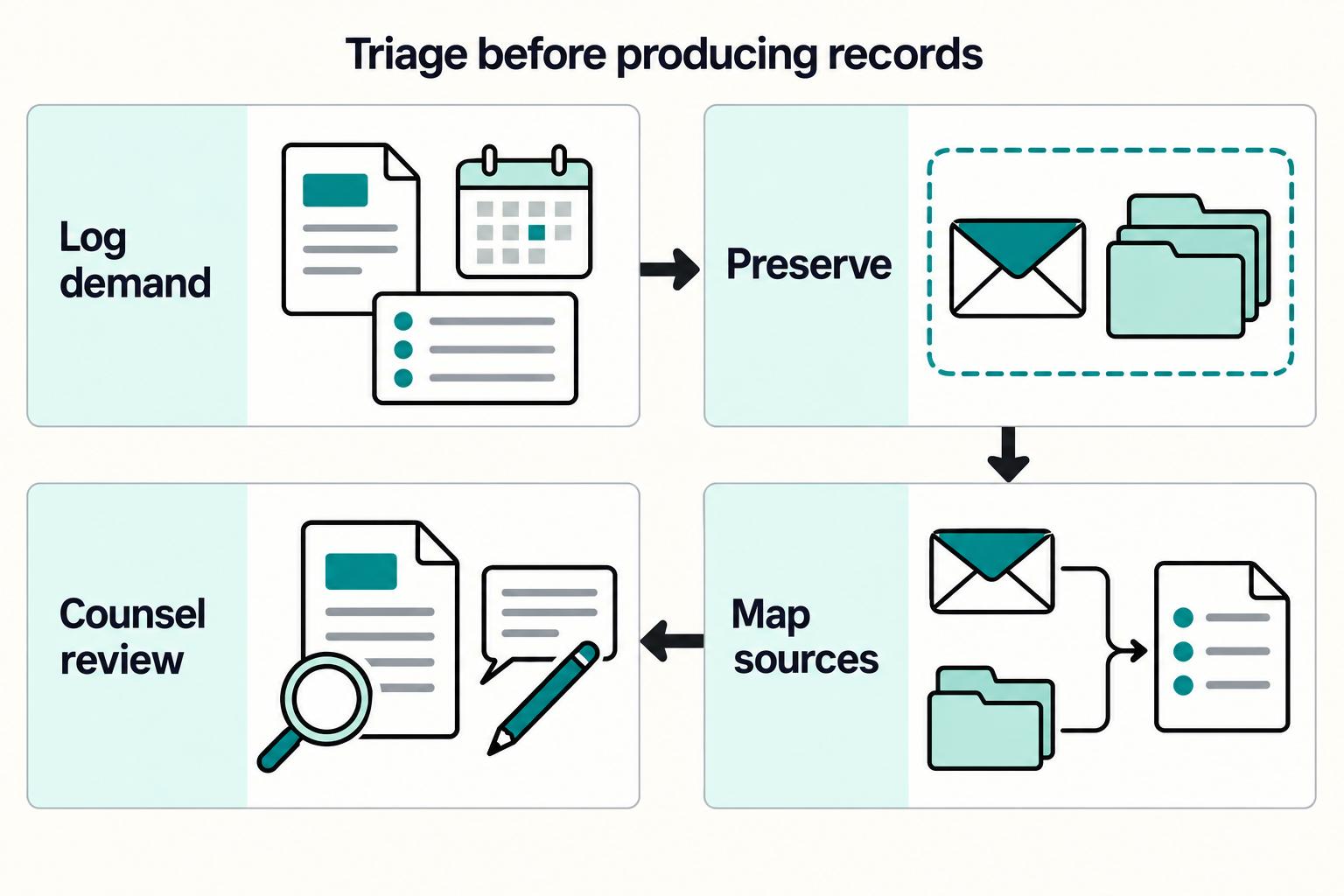
Move fast, but do not produce records on instinct. If you need to **respond to a subpoena for business records**, your immediate job is to control deadlines, preserve records, and make any later production defensible.
A US Expat's Guide to Investing in UCITS ETFs to Avoid PFIC Issues
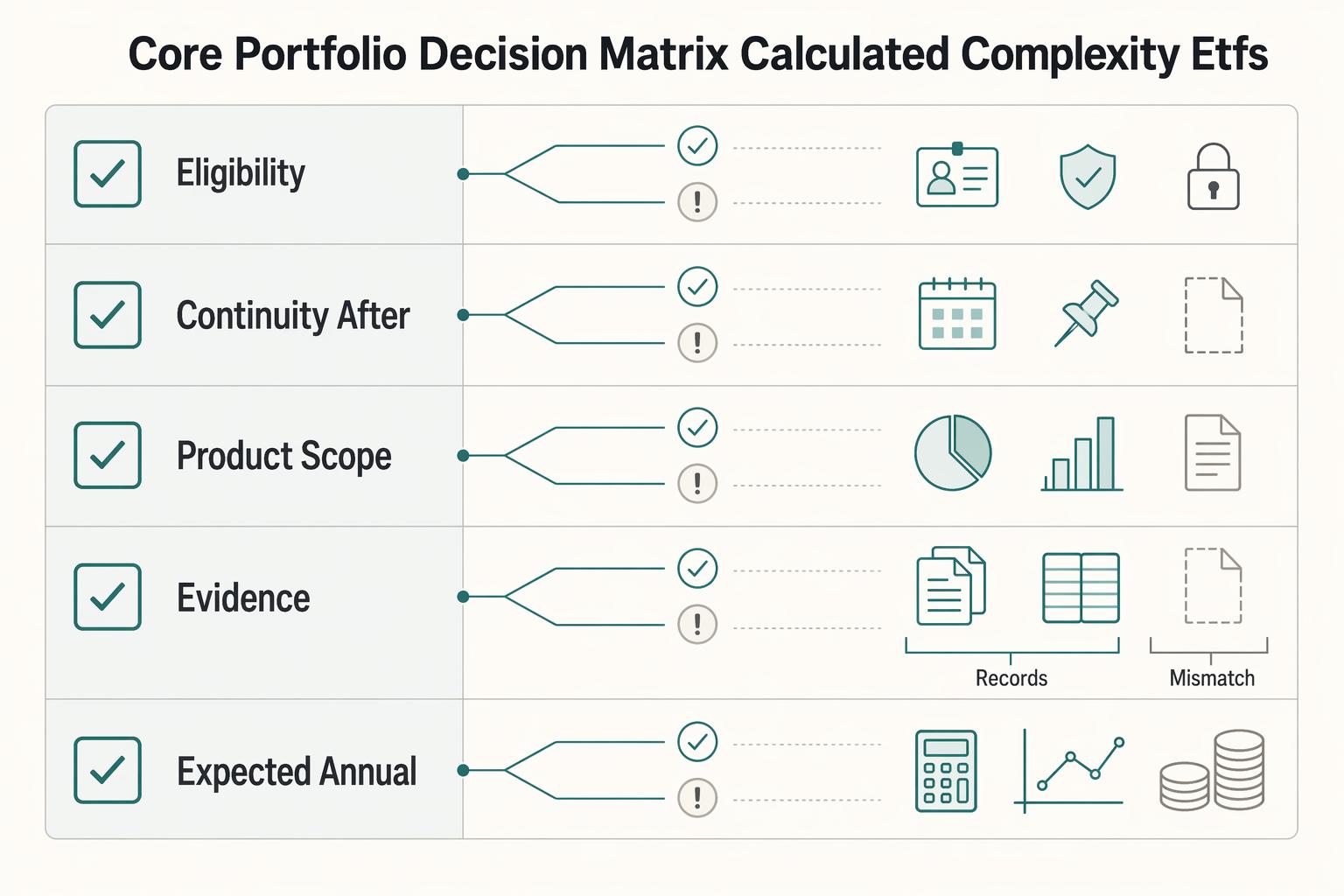
The real problem is a two-system conflict. U.S. tax treatment can punish the wrong fund choice, while local product-access constraints can block the funds you want to buy in the first place. For **us expat ucits etfs**, the practical question is not "Which product is best?" It is "What can I access, report, and keep doing every year without guessing?" Use this four-part filter before any trade: