
Quick Answer
A payment operations maturity model benchmarks a platform finance team by scoring real operating evidence across ledger integrity, reconciliation, settlement control, payout batch reliability, and exception handling. Start with one narrow scoped flow, build an evidence pack, trace the money path end to end, score checkpoints as met or not met, and reassess on a fixed cadence to prioritize the next improvement step.
How to use this maturity model#
Use maturity benchmarking as an evidence-based diagnostic, not a branding exercise. For a platform finance team, that means focusing on controls that show money is posted correctly, reconciled on time, settled with clear status, and paid out without batch surprises.
A payment operations maturity model helps you assess current capability and plan the next improvement step. In payment systems, that discipline matters because deployment errors or delayed patches can turn into financial loss, reputational damage, and regulatory scrutiny. The review should measure production behavior, not policy intent.
This guide is scoped across four practical domains: ledger integrity, reconciliation speed, settlement control, and payout batch reliability. It also treats the exception queue as the place where weak controls become visible. Treat stage labels as outputs, not starting points, and anchor each stage to observable behavior and supporting artifacts.
Run the assessment as an iterative process. Reassess on a fixed cadence, review operating data and trends, and compare results over time and, where useful, across teams or external peers. That keeps scores tied to evidence rather than opinion.
A core verification test applies from day one: can you trace a transaction from request to ledger posting to downstream export? If not, you do not yet have proof of maturity for that money path. Dashboards alone are not enough without artifacts for posting completeness, reconciliation breaks, settlement outcomes, and payout completion.
Before you start#
- Set a narrow scope
Pick one product line, region, or end-to-end flow so your scores stay specific.
- Assign evidence owners
Name who in finance, payments ops, and product will produce and validate each record.
- Define at least one checkpoint per domain
Use checkpoints your team can verify directly in records and workflows.
Common failure patterns emerge as handoffs, retries, and status transitions get more complex. Reconciliation drift may show up at asynchronous handoffs. Duplicate actions can appear around retries or webhooks. Settlement delays may get stuck in status transitions. Payout issues can surface when release appears successful but batch completion or exception ownership breaks down.
By the end of this guide, you should have a staged benchmark and clear priority rules for what to fix first, grounded in checkpoints, artifacts, and known failure modes.
Set the maturity model scope before you score anything#
Scope first, score second. Pick one unit of analysis and keep it narrow enough that a single assessment can show how that scope operates before you assign Crawl, Walk, or Run.
Pick one unit and freeze the boundary#
For this cycle, use one unit only: one capability, one domain, or one functional activity. Do not combine multiple units into one score.
Use a simple verification check: can one assessment rubric trace that same scope from input to outcome with clear evidence? If not, the scope is still too broad or too vague.
Keep this as a maturity assessment, not a full framework review#
State this explicitly in the document and in stakeholder discussions: this is a maturity assessment for a defined operating scope, not a review of the full framework.
That distinction keeps expectations clean. A maturity model is one component of a broader framework, and capabilities can sit at different maturity levels at the same time. Keep scoring outcome-driven for this scope instead of trying to force the highest stage everywhere.
Exclude what you cannot evidence and mark it "not scored"#
If you cannot evidence a domain, do not stage it. Put it on a visible not scored list in the rubric and name the missing artifact.
Use a simple operating rule: if you cannot show evidence for the checkpoint, leave it out of scoring for this round. That helps prevent over-engineering and under-investment driven by uncertain stage labels.
If you want a deeper dive, read Spend Analysis for Platform Finance Teams: How to Categorize and Benchmark Vendor Payments.
Prepare the evidence pack your benchmark depends on#
Once scope is fixed, assemble the records that will prove or disprove maturity. Here, evidence is what separates an operating control from design intent.
Gather the minimum operating records#
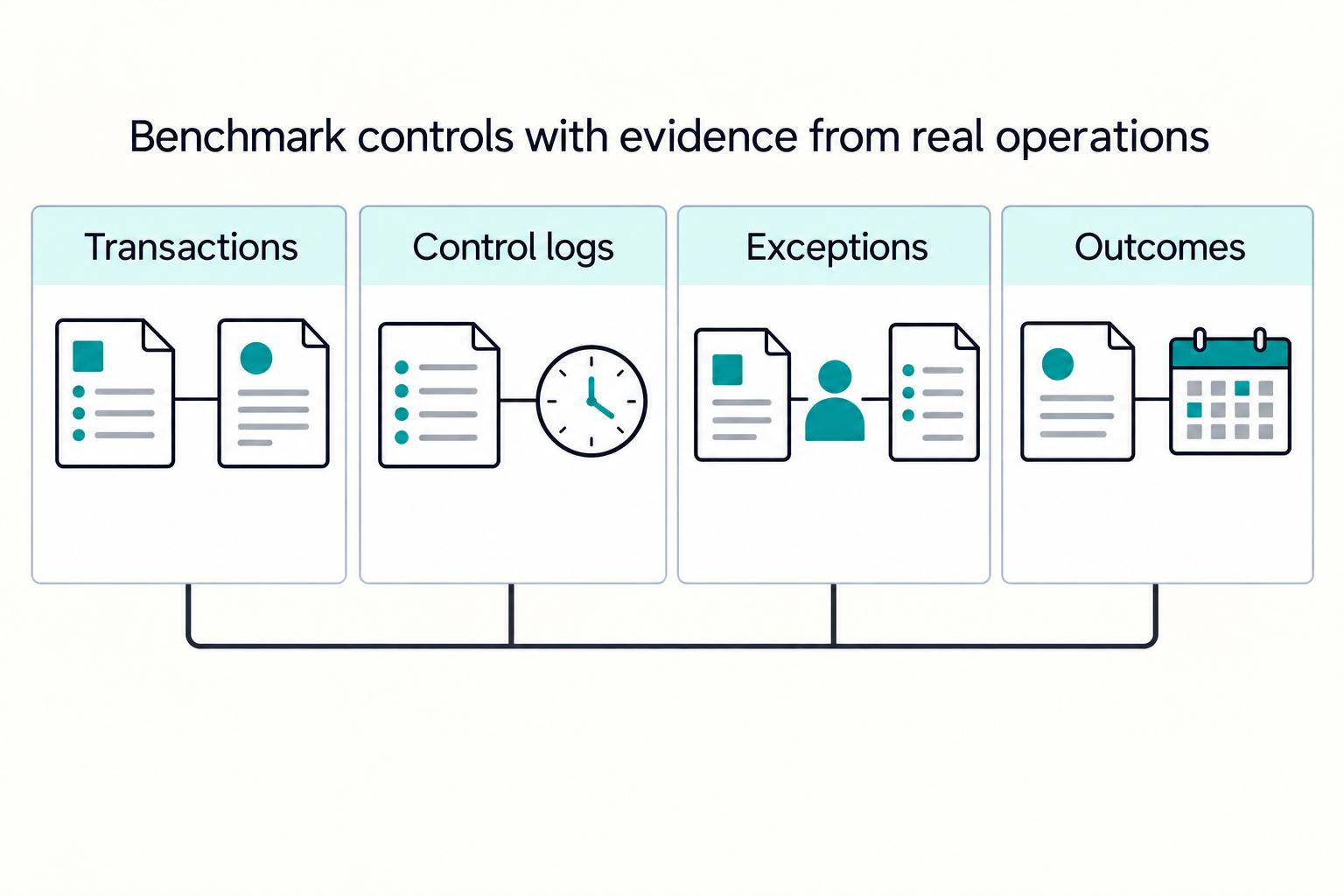
Start with one practical proof set for the scoped flow and period: transaction records, control-execution logs, exception records, and outcome/status outputs. Treat these as operating evidence, not externally mandated artifacts.
| Record type | What it helps verify |
|---|---|
| Transaction records | Trace one sampled item from initiation through processing to final reported output |
| Control-execution logs | Show whether a reviewer can tie a control to evidence that it ran |
| Exception records | Show where an issue appeared, who owned it, and what record shows final disposition |
| Outcome/status outputs | Confirm final status outputs for the scoped flow and period |
Before you score, confirm a reviewer can trace one sampled item from initiation through processing to final reported output without cross-team reinterpretation. If IDs, dates, or ownership do not line up, the pack is not ready.
Add control artifacts that show risk handling#
For each control you want to score, include the control description, evidence it ran, and any related findings, comments, or planned corrective actions. Keep financial-reporting controls and compliance-related evidence in one view so risk handling is evaluated together.
Use a findings register modeled on a Schedule of Findings and Responses so issue status and corrective actions stay traceable. If you include control mappings for your own obligations, do not treat the mapping itself as proof that the control operated.
Test traceability before accepting any control#
If a control cannot be tied to durable system evidence, mark it as design intent and keep it out of scoring for this round. Policy text or ticket templates can describe process, but they do not prove the control ran on the scoped flow.
Run one practical chain test from a recorded finding or exception: where it appeared, who owned it, what shows investigation, and what record shows final disposition. If that chain breaks, the control is weaker than the stage label suggests.
Publish one shared artifact list across finance, ops, and product#
Use one shared artifact list across finance, operations, and product owners so scoring debates stay about evidence quality, not vocabulary. Keep fields simple: artifact name, scope, period covered, source location, owner, supported control or checkpoint, and evidence status.
When relevant, include the linked finding reference and corrective-action status. Strong benchmarking depends on an evidence-based view. Weak evidence creates confident stage labels on top of unresolved breaks. If your team is also tightening vendor-payment visibility, the artifact discipline here should line up with your spend analysis approach.
Map the real money path and where failures actually occur#
If you cannot show the real money path from records, every later score is guesswork. Build the map from operating evidence, not process memory, and treat any unproven handoff as a risk gap until you can trace it.
Trace the actual order from evidence, not memory#
Start with one scoped flow and one sampled item or batch from your evidence pack, then document the order you can prove in records for the review period.
Use the node sequence your environment actually shows, and keep stage order only where your records support it.
For each node, capture three fields in plain language: what entered, what evidence shows completion, and what record or status moved work forward. If a step exists only in policy text or team habit, keep it as design intent, not operating evidence.
Mark every asynchronous handoff and status dependency#
Mark each point where completion depends on a separate message, file, export, or status update rather than the same record stream. For every handoff, record the sending artifact, receiving artifact, expected join key, and owner for mismatch detection.
Then run a weekly sample check: can source events be matched to receiving records without manual reconstruction? If not, flag that handoff as vulnerable to stale status and duplicate-action risk.
Add one weekly checkpoint to every node#
Use one checkpoint per node with evidence you can inspect weekly from system-of-record outputs. Keep the first version binary: verified or not verified.
For each node, define three things:
- the weekly checkpoint, such as whether the sample trace reaches the next state with a consistent ID, date, and owner
- the evidence, such as the primary system record plus the downstream status or output
- the failure sign, such as a state change that cannot be proven or ownership that stays unclear
If your review depends on a manually maintained summary before validation, the checkpoint is weaker than it appears.
Separate system latency from process latency before assigning blame#
Before you assign blame or stage maturity, split delays into two buckets: waiting for upstream status availability, and waiting for downstream handling after the item is practical.
Use existing timestamps to mark when the prior state was created, when the next usable status appeared, when the item entered an exception queue, if applicable, and when human or batch action resolved it. This keeps timing constraints separate from execution gaps.
That separation supports a more reliable operating view of performance assurance under latency pressure. If you cannot separate those latency types on the map, pause scoring and fix observability first.
Related: Accounts Payable KPIs: The 15 Metrics Every Payment Platform Finance Team Should Track.
Score maturity by domain with explicit stage criteria#
Now make scoring as mechanical as practical. Use evidence, not consensus, and if a checkpoint is not met in the review period, do not award it.
Use your money-path map to score the control areas that matter most in your operation, such as ledger integrity, reconciliation, settlement operations, payout batch execution, and exception queue governance.
Define one stage ladder before you score any domain#
Set one internal stage ladder first, then apply it consistently across all domains. You can borrow the progression discipline associated with CMMI and ISO/IEC 15504, but do not present this as certification.
| Stage | Observable operating behavior | Typical evidence sign |
|---|---|---|
| Stage 1 Ad hoc | Work is inconsistent and depends on individual intervention | Evidence is partial or reconstructed |
| Stage 2 Repeatable | Main-path steps usually run the same way | Source records support the sampled flow, but exception handling is uneven |
| Stage 3 Controlled | Ownership, review cadence, and evidence are defined for normal flow and failures | Checkpoints are verifiable from system-of-record outputs |
| Stage 4 Resilient | Failures are detected quickly and recovery is repeatable | Detection and remediation are visible in logs, alerts, and repeatable recovery records |
Score checkpoints as met or not met inside each domain#
Score checkpoints in binary form, met or not met, before assigning a stage. This helps keep review discussions tied to inspectable evidence rather than consensus alone.
| Domain | Checkpoint question |
|---|---|
| Ledger integrity | Can you trace a sampled payment event to the final journal entry and export without manual reconstruction? |
| Reconciliation | Can open breaks be tied to a cause, owner, and aging view from break logs? |
| Settlement operations | Can settlement status be matched to the source payment population with a stable join key and report date? |
| Payout batch execution | Can you show pre-release checks, released batch contents, and completion or failure status for the same batch? |
| Exception queue governance | Can you show queue aging, owner assignment, and closure evidence for operationally material exceptions? |
If a checkpoint depends on a manually maintained summary before validation, treat it as weak evidence and avoid using it alone to justify stage promotion.
Roll each domain up to a stage without averaging away risk#
Assign one stage per domain. Do not blend domains into a single average that can hide control debt. A domain with control-critical failures should be capped even if adjacent domains perform well.
Keep stage meanings stable across the review cycle. If evidence standards shift by domain or over time, benchmark integrity drops and trend lines become harder to trust.
Add a resilience modifier only where failure impact is immediate#
Use a resilience modifier as a second lens, not a replacement for stage scoring. Apply it where detection speed and recovery repeatability matter most, especially in settlement, payout batch, and exception queue operations.
The practical test is simple: did monitoring detect the issue early, and can the team show repeatable recovery steps? If detection is late or recovery is improvised, keep the core stage but mark the domain as fragile.
We covered this in detail in How to Build a Payment Compliance Training Program for Your Platform Operations Team.
Benchmark performance with internal cohorts before external claims#
Once you have domain scores, compare them carefully. Internal cohorts usually tell you more than outside labels, and external material is most useful as context for leadership, not as score conversion.
Group teams into like-for-like internal cohorts#
Compare teams only when they share the same volume profile and operating constraints. Freeze cohort rules for the review period and document eligibility criteria, such as volume band, markets served, settlement pattern, and any excluded flows.
Your quality check is reproducibility: a second reviewer should reach the same cohort grouping from your notes. If they cannot, treat the cohort definition as too broad before treating the gap as a maturity signal.
Use external narratives as context, not score conversion#
If leadership asks for market context, external benchmarks can frame discussion, but they do not validate your internal stage labels. Do not map your Stage 3 or Stage 4 directly to external maturity labels.
Keep benchmark use aligned to your stage, industry, and business model, and always report context with the numbers. Maintain a separate internal evidence pack so external framing cannot overwrite your operating reality.
Track trendlines in reconciliation and settlement#
Use repeated, time-boxed baseline assessments on a fixed cadence rather than relying on a one-time ranking so you can evaluate change over time.
Keep the comparison basis stable each cycle: same checkpoints, same cohort rules, same evidence standard. If the review basis shifts mid-cycle, trendlines lose decision value. For teams already reporting operational metrics, this should sit alongside your accounts payable KPIs, not replace them.
Give leadership market framing without overstating what is proven#
If executives want an external anchor, share it as context and state what remains unverified for your model: no validated external equivalence for your internal stages, and no validated external threshold here for reconciliation or settlement reliability.
Add an explicit unverified externally note wherever external comparisons appear. That prevents narrative shortcuts from turning into planning assumptions.
This pairs well with our guide on How to Build a Compliance Operations Team for a Scaling Payment Platform.
Prioritize the next quarter with hard decision rules#
Benchmarking matters only if it changes next quarter's plan. For this review cycle, use explicit gates so speed improvements do not outrun control quality. Prioritize ledger correctness, reconciliation, settlement visibility, and payout batch throughput based on current risk.
Protect ledger correctness before downstream speed#
Start with ledger correctness. Faster downstream work does not help if postings are wrong. Check journal exports against originating events and confirm posting completeness and traceability in weekly review. If a change removes the ability to reproduce how entries were created, adjusted, or reversed, hold it.
Reject speed gains that weaken auditability#
Reject changes that improve cycle time but weaken auditability. Foundational data issues are a known failure pattern, so do not approve "we can reconstruct it later" when evidence, logs, or traceability are reduced.
For cardholder or personal data changes, route through compliance. Require documented controls mapped to applicable obligations, with evidence finance or compliance can verify from exports, logs, or reports. If teams need clearer ownership on those controls, use the same model described in How to Build a Compliance Operations Team for a Scaling Payment Platform.
Treat rising exception queues as a stabilization signal#
When the exception queue keeps growing and closures lag, treat it as a signal to stabilize triage before expanding automation. In a fast-changing, high-risk environment, isolated execution increases risk instead of reducing it. Re-establish clear ownership for intake, aging, and escalation before adding new routing or matching logic.
Promote only changes with a measurable checkpoint and clear ownership#
Promote only changes with measurable checkpoints and explicit ownership. Defined KPI tracking is a stronger decision basis than usage-only tracking. One cited survey reports 41.9% using clearly defined KPIs, while 7.6% track adoption rates alone.
Require an approval pack with one measurable checkpoint, a clearly accountable owner, and one verification artifact, such as a journal export, reconciliation break log, settlement report, or exception aging snapshot. Defer work that cannot meet this bar.
If your next-quarter plan depends on tighter payout controls and clearer batch failure visibility, compare your checkpoints against Gruv Payouts before locking owners and timelines.
Execute improvements in a strict implementation sequence#
Many operating-model transformations deliver uneven performance, and capability-sequencing confusion is a known failure mode. Treat implementation order as part of the control: stabilize core execution first, tighten traceable control decisions next, standardize evidence artifacts, and only then broaden rollout.
| Step | Focus | Move forward when |
|---|---|---|
| Stabilize core execution first | Confirm outcomes are consistent and traceable through the full process path | Teams can reproduce outcomes from the same evidence and explain them end to end |
| Tighten traceable control decisions | Use standardized, traceable execution under regulatory and compliance pressure | Reviews use the same documented evidence set and do not depend on informal channels or ad hoc evidence |
| Standardize evidence artifacts before scaling changes | Standardize artifacts used for cost, performance, and control review | The benchmarking repository has up-to-date KPIs and best practices with stable definitions and clear period labels |
| Roll out narrowly and promote only after repeated proof | Expand in a narrow scope first so sequencing gaps stay visible | Repeated review cycles act as the internal promotion gate, using the same checkpoints each cycle |
Stabilize core execution first#
Start with the processes that generate the operating record. Before you optimize downstream work, confirm outcomes are consistent and traceable through the full process path.
Use a single go/no-go check before moving on: can teams reproduce outcomes from the same evidence and explain them end to end? If not, pause here.
Tighten traceable control decisions#
Once core execution is stable, tighten release and control decisions. The goal is standardized, traceable execution under regulatory and compliance pressure, not extra process for its own sake.
Use the same documented evidence set for each decision so reviews stay consistent over time. If decisions still depend on informal channels or ad hoc evidence, rollout is premature. Where control changes affect people as much as process, the training pattern in How to Build a Payment Compliance Training Program for Your Platform Operations Team is a practical reference.
Standardize evidence artifacts before scaling changes#
Before scaling, standardize the artifacts used for cost, performance, and control review. An evidence-based perspective depends on shared, consistent artifacts, not local variants.
Maintain a benchmarking repository of up-to-date KPIs and best practices with stable definitions and clear period labels so teams can compare outcomes across the operating model.
Roll out narrowly and promote only after repeated proof#
Expand in a narrow scope first, then scale only after repeated proof. This keeps sequencing gaps visible before they are masked by aggregate reporting.
Use repeated review cycles as your internal promotion gate before broader release. Keep the same checkpoints each cycle: process traceability, consistent evidence artifacts, and clear control decisions.
Assign ownership and escalation paths before scale exposes gaps#
Scale exposes vague ownership lines. As volume grows, ambiguity in ownership or escalation can become a control risk, so set explicit owners and escalation paths before operational issues become recurring.
Assign one accountable owner to each domain#
Assign one accountable owner per maturity domain and record it in the same assessment artifact you use for scoring. The goal is clear accountability and a traceable evidence set for each rating, not a specific org-chart pattern.
In the worksheet, use the comments and goals fields to document the basis for each rating and the current-state to future-state gap, and capture ownership notes with that evidence. If a statement does not apply to the scoped flow, mark it as opt-out rather than forcing a false assignment. Verify this step by checking that each scored domain has documented accountability.
Define escalation triggers from risk patterns, not chat volume#
Define escalation triggers from observable risk patterns. You do not need perfect thresholds on day one, but you do need rules that clearly move an issue from queue handling to cross-functional response.
Use patterns you can prove from existing artifacts, such as recurring delays, repeated exceptions, or unresolved issues across review cycles. If resolution knowledge sits with only a few people, treat that as concentration risk and escalate accordingly.
Run a control review with evidence and unresolved-risk visibility#
Run control reviews on a consistent cadence and keep compliance expectations in scope when process changes affect controls. Anchor each review in artifacts: scorecard results, open gaps, unresolved edge cases, and recorded remediation ownership.
The output should be auditable: who owns remediation, what changed, and whether processes remain standardized and traceable. If that record is unclear, scale will expose the gap quickly.
Related reading: Finance Operations Priorities for Payment Platform CFOs.
Recover from common maturity benchmarking mistakes#
Even with a sound method, a few repeat mistakes can distort the result. False confidence usually comes from scoring labels instead of operating evidence, so do not award maturity for what is documented, borrowed, or recently patched unless production evidence supports it.
Require evidence before you assign a stage#
Treat policy-only claims as design intent, not operating maturity. Assign stages only when production outputs and reconciliation records show the control working in real operations.
Use a traceable checkpoint for one real flow and confirm the same outcome appears across your operational records. If documentation looks clean but logs still show unresolved breaks or manual correction patterns, hold the stage.
Recalibrate external labels to your own constraints#
Use external benchmark labels as reference vocabulary, not as direct stage assignments. Because frameworks can overlap and conflict, copy-paste labels create comparability risk unless you recalibrate them to your own control obligations and operating constraints.
For each imported label, define the internal outcome it should represent and the checkpoint that proves it in your environment. Score the behavior and evidence, not the label itself.
Verify that fixes hold across later cycles#
Do not treat a shipped fix as a maturity gain on release alone. Count the gain only when the same failure pattern does not recur in later cycles and KPI movement supports the improvement.
Review recurring evidence, including incident, failure, completion, and remediation records. If the root cause was a deployment error or delayed patch, prioritize remediation by impact versus effort and rescore only after stability is sustained.
Conclusion and copy paste quarterly checklist#
Use the same evidence-led review each cycle, and do not let stage labels outrun what your operating records can prove. If a domain is not evidenced, mark it not scored.
- Confirm scope and domains for this cycle.
Define one unit of analysis, one product line, one region, or one end-to-end money path, then lock the control domains you will assess, for example ledger, reconciliation, settlement, payout batches, and exception handling. Keep a short included and excluded list before evidence collection so results stay comparable.
- Gather the evidence pack before scoring.
Collect the relevant process artifacts for the same review window. Treat anything that exists only in policy notes or meeting memory as design intent, not proven operating control.
- Assess checkpoints first, then use stage labels.
Make checkpoint-level met or not met decisions before summarizing maturity. This keeps labels tied to observable behavior instead of label debate.
- Prioritize fixes by control sequence, not preference.
Sequence improvements through the control path rather than by who asks first, so you do not accelerate weak controls. If exceptions rise faster than closures, stabilize triage before adding new automation.
- Assign accountability and escalation for each selected improvement.
For every item, set one accountable owner, a backup, the evidence source that will confirm improvement, and a clear escalation trigger tied to operating events.
- Re-run on a consistent cadence and compare trendlines.
Keep your review cadence consistent, for example quarterly, and compare like-for-like checkpoints over time. When a process changes mid-cycle, split before-and-after evidence rather than blending it.
- Use external frameworks as context, and decide from your own evidence.
If your operations are in FCA scope, keep PSRs 2017 and EMRs in your review pack and record which FCA Approach Document version you used. Version control matters. November 2024 (version 6) added risk-based payments guidance in Chapter 8, and March 2026 (version 7) updated strong customer authentication exemption guidance in Chapter 20. Use the tracked-marked version and re-check Annex 5, The Payment Process (page 287), against your current evidence set.
Keep this standard across cycles: decisions come from verified operating records, not polished dashboards or borrowed labels. When your quarterly maturity checklist is finalized, use contact Gruv to validate market coverage, compliance gating, and rollout constraints for your target payment flows.
Frequently Asked Questions
What is a payment operations maturity model for a platform finance team?
It is an internal benchmarking method for checking whether operating controls are working in practice, not just documented. It measures observable behavior against defined checkpoints and operating evidence. The goal is repeatable proof, not a label.
How is this different from a generic Finance Operations Maturity Framework?
This model is narrower and focuses on the operating path you need to trust day to day. A generic finance framework can cover a broader set of finance activities. It also helps avoid confusion with FinOps, which the guide describes as a separate framework focused on technology value and financial accountability through cross-functional collaboration.
What should we benchmark first if we can only do one pass this quarter?
Start with one high-impact workflow you can trace end to end. Use clear checkpoints, target deadlines, and baseline controls so you can verify what is happening in real operations. One pass is most useful when it creates comparable evidence you can reuse in later reviews.
What are practical maturity stages for ledger, reconciliation, settlement, and payouts?
Use a four-stage internal ladder and keep the meaning stable across domains. In the guide, stages are tied to observable behavior, moving from ad hoc to repeatable, controlled, and resilient. Use them as internal operating labels, not as a universal standard.
Who should own maturity improvements across finance, payments ops, and product?
There is no single universal ownership split. Assign one accountable owner per domain or checkpoint and record that ownership in the same assessment artifact used for scoring. Pair that owner with explicit partner teams because improvements often span finance, operations, product, and engineering.
How often should we reassess maturity after major process or system changes?
There is no fixed universal cadence in this guide. Reassess on a consistent cycle and after meaningful changes once you have enough production evidence to compare before and after behavior. Release-day results alone are not a reliable maturity signal.
What evidence shows maturity is actually improving and not just better reporting?
Use repeated operating evidence across later cycles, not just cleaner dashboards or faster headline metrics. Strong proof is that the same failure pattern does not recur and the underlying records show consistent control performance over time. A single speed metric can still hide inefficiency.
Researched and edited by the Gruv editorial team. Gruv builds cross-border billing, payouts, and finance-operations software for global businesses.
Sources
Includes 1 external source outside the trusted-domain allowlist.
- bis.org/cpmi/publ/d101a.pdftrusted
- dodcio.defense.gov/Portals/0/Documents/CMMC/AssessmentGuideL2.pdftrusted
- fcc.gov/sites/default/files/08-05-2025-AIWG-Final-re...trusted
- oag.ri.gov/reports-financial/FinStmt_FindingsMC_RI_2024...trusted
- sec.gov/files/ctf-written-input-daniel-bruno-corvelo...trusted
- sec.gov/Archives/edgar/data/1769628/0001193125250442...trusted
- treasurer.ca.gov/cdiac/debtpubs/financing-guide.pdftrusted
- assets.kpmg.com/content/dam/kpmg/nl/pdf/2025/sectoren/bankin...external
Educational content only. Not legal, tax, or financial advice.
Related Posts

The Freelance Payment Penalty: A Modeled Audit of Platform Fees, FX Spreads, and Payout Delays
The money rarely disappears through a single, easy-to-spot fee. The real loss is stacked. A marketplace takes its commission, a processor adds a charge for international cards, a bank or payment company converts the currency at a spread, a platform holds the funds before release, and a wire sheds a little to intermediaries on the way in. Each layer looks defensible on its own, but the worker feels the combined result as a smaller deposit and a later payday.

How to Respond to a Subpoena for Business Records
Move fast, but do not produce records on instinct. If you need to **respond to a subpoena for business records**, your immediate job is to control deadlines, preserve records, and make any later production defensible.

A US Expat's Guide to Investing in UCITS ETFs to Avoid PFIC Issues
The real problem is a two-system conflict. U.S. tax treatment can punish the wrong fund choice, while local product-access constraints can block the funds you want to buy in the first place. For **us expat ucits etfs**, the practical question is not "Which product is best?" It is "What can I access, report, and keep doing every year without guessing?" Use this four-part filter before any trade: