
Quick Answer
Approve a permitted funds flow first, then demonstrate payment execution, recoverable status tracking and reconciliation. Compare total operating cost and liquidity commitments alongside revenue. A live pilot must already satisfy its necessary legal and funds controls.
Finance operations priorities that actually change expansion outcomes#
When a payment platform expands, the finance question that shapes execution is often not broad strategy alone. It is country-level operability. Can your team move funds, verify counterparties, manage exceptions, tie activity back to the ledger, and handle tax and reporting work without building a fragile manual operation?
A country can have strong demand and still require more working capital, exception staff or reconciliation capacity than the launch budget allows. Finance needs those costs in the same decision as revenue and growth funding.
This article is for that decision. It helps you prioritize countries and verticals by operational readiness, not top-line TAM alone. Demand still matters. Readiness helps determine whether demand can be served reliably.
The scope is deliberate: founders and operators choosing markets before committing product build and go-to-market resources. If you are already live, the same logic still applies, but the leverage is higher earlier in market selection.
Map the actual entity, service and funds flow before applying local rules. A platform paying its own suppliers, a software provider and a regulated institution holding customer funds can have different obligations in the same country. Provider coverage does not resolve that perimeter.
Before you approve a market, verify four things with clear owners and current evidence:
- whether your provider or banking partner can support payout origination for the target country and currency
- what customer due diligence and beneficial-owner data must be collected and refreshed
- how taxes are reported and remitted for that location and sales profile
- whether payout events can be matched to ledger records without unresolved manual work
Treat cross-border execution assumptions as risks to validate. The Financial Stability Board continues to point to persistent cross-border challenges around cost, speed, access, and transparency.
Keep one caveat in view throughout: coverage varies by market and by program. A provider may support receiving funds in a country but not sending payouts from it. Onboarding options may differ in how they handle changing requirements. Tax reporting and remittance timing also vary by location and sales profile. So the real question is not, "Can we launch this market?" It is, "Can we launch this specific market, with this product and provider setup, with controls we can operate cleanly?"
Related: Choosing Embedded Finance for Freelance Platforms With an Operations-First Scorecard.
Define the priority stack before picking any market#
Set the stack before you score countries. The key distinction is execution versus strategy. Finance Operations is the execution layer in the CFO office: money movement, matching, and controls. Strategic Finance covers FP&A and capital allocation decisions about where to invest. If you blur the two, a market can look good in planning and still fail in live operations.
Treat legal requirements and operational reporting as baseline requirements, not differentiators. They are part of operability. In the U.S. MSB context, the AML program is a baseline control and must stay commensurate with the risks of the business's location, size, and service profile. What often separates a workable expansion is not whether baseline controls exist, but whether the market can support move, track, and match in live operations.
Use Move, Track, Match early#
Use Move, Track, Match as an early readiness test. It is a vendor-authored mental model, not a formal standard, but it maps well to real operator checks:
- Move: can your provider and banking setup support the payout type, country, and currency required by this product?
- Track: can reporting show lifecycle status across payment states?
- Match: can provider transaction records be tied to accounting records so ledger entries reflect transaction truth?
Before you approve a market, ask for concrete proof: one confirmed payout route, one lifecycle report sample with visible status progression, and one provider-to-ledger transaction pair. If move is available but track and match still depend on manual spreadsheet stitching, treat that as a material launch risk.
Why this beats generic vendor advice#
Use this model to connect market expansion to cash availability, losses and close quality. It is a working decision framework, not a regulatory standard or a substitute for the broader CFO forecast.
For a step-by-step walkthrough, see Choosing Creator Platform Monetization Models for Real-World Operations.
Score countries with a finance operations lens#
Once you have done the initial move, track, and match check, turn it into a country scorecard. Prioritize operational readiness before revenue upside. If a market looks commercially strong but operationally weak, treat it as a pilot only after each control gap has a named owner and a launch gate.
For each market, identify who originates the payment, whose money is held, which currency is owed and which partner provides the regulated service. Those facts determine the relevant control and cost work.
Start with one table that combines execution and strategy#
Use one comparison table so Finance Operations and Strategic Finance are working from the same facts. Keep the columns consistent across markets, and do not pretend there is one universal weighting formula.
| Market | Activity-specific regulatory question | Operational evidence | Finance implication |
|---|---|---|---|
| U.S. | If the entity is an MSB, determine applicable registration, AML and state licensing duties; federal registration does not grant every permission. | Confirm originator/account/rail support and item-level payment/return records. | Budget approved operating cash separately from customer funds and quantify exception costs. |
| EEA | Identify the PSP and activity in scope for PSD2 authentication and unauthorized-payment obligations, including applicable exemptions and exceptions. | Record authentication outcomes, liability ownership and refund-to-original-payment references. | Model the party bearing losses and liquidity needed for refunds. |
| UK | Determine payment/e-money safeguarding scope and any applicable APP reimbursement duties. | For covered firms, map relevant funds and reconciliation under the current FCA safeguarding regime. | Keep safeguarded funds separate from operating runway and model applicable fraud-loss exposure. |
| India | Where the activity is payment aggregation, apply the RBI 2025 direction to the actual PA category and entity; recipient geography alone is insufficient. | Document authorization/partner role, applicable escrow, reporting and exception ownership. | Cost the actual local operating model rather than inferring obligations from UPI volume. |
This table should answer two questions at the same time: how hard the market will be to operate, and whether that operating load is worth the capital and leadership attention.
Add evidence to every row, including unknowns#
A score without evidence quickly turns into confidence theater. Attach the same evidence pack to every market row:
| Evidence type | What to attach |
|---|---|
| Permission and role | The permitted entity/service role and the legal basis for the actual flow; keep permission separate from commercial availability. |
| Route and reporting | The actual originator and recipient route, supported payment references and a product-specific obligation-to-movement-to-bank reconciliation sample. |
| Recovery | Refund and return paths, recovery of unknown results, and the owner of each exception. |
| Unknowns | Named owners and closure evidence for implementation gaps; unresolved legal permission or funding ownership blocks a live pilot. |
A live pilot must already have a permitted flow and the necessary controls. Unresolved legal permission, funding ownership or recovery of money already sent cannot be risk-accepted away by calling the launch a pilot. A mock exercise can investigate those gaps without moving customer money.
Use the strategic lens to block weak expansion decisions#
Consider an illustrative launch with 2,000 monthly payouts. Route A costs $1 each and creates 40 exceptions at $20 of staff time each: total $2,800. Route B costs $1.40 each and creates 10 exceptions at $20: total $3,000. B costs $200 more operationally. Assume Route A requires no prefunding while B requires three days of prefunding on $100,000 of daily obligations. B then ties up $300,000 of additional operating liquidity. Decide whether its service benefit justifies both costs; customer funds subject to safeguarding cannot be treated as free runway. These are assumed figures, not provider benchmarks.
If a market requires heavy fraud support, strict refund timing, or local authorization and escrow work, the upside can compress quickly. When a country scores high on revenue potential but low on operational readiness, approve a pilot only after the open gaps have owners, dates, and clear no-go conditions.
This pairs well with our guide on How Embedded Finance is Changing the Competitive Market for Gig Platforms.
Choose verticals by exception risk, not only volume potential#
After you narrow the country list, choose verticals with the same discipline. Vertical selection is an operations decision first. The real question is how much exception work your team will need to approve, track, and match, not just how much volume you might win.
Start with payment behavior, not headline demand#
Compare your own cohort’s disputes, returns, investigation time and cash exposure using matched observation windows. Record the numerator and denominator for every rate; a percentage without its transaction population cannot justify choosing a vertical.
A dispute rate is an operating signal, not a complete liability calculation. Separate disputed value, losses after resolution, fees and staff effort. Apply network monitoring requirements to the actual merchant/program rather than importing an unsourced threshold into the expansion forecast.
See where vertical mix changes Invoice Approvals and Reconciliation#
Vertical mix changes finance workload directly across invoice matching, approval routing, payment origination, reconciliation, and reporting. Even at similar gross volume, cohorts with more payout variance or documentation friction can create heavier close pressure.
Do not assume one settlement pattern across cohorts. Payout availability can vary by industry and country of operation. That changes invoice approvals, timing expectations, and matching complexity.
Before GTM scale, run a simple evidence check:
- get one payout status progression sample for the target cohort in each launch country
- confirm one matched transaction from provider event to ledger entry
- review likely dispute reason codes and the evidence you can actually produce
- test whether connected-account verification requirements vary by location, business type, or requested capabilities
Verification requirements can also change over time, so documentation burden is ongoing, not just an onboarding task.
Protect Cost Control before scaling noisy verticals#
Price manual reconciliation directly: cases per month, minutes per case and loaded staff cost. Then add any delayed close, unrecovered loss or funding cost separately so the same expense is not counted twice.
If a vertical needs stricter policy checks, require deeper control work before broad rollout. Apply a risk-based approach, and where risk conditions are higher, require enhanced due diligence and documented controls. A practical gate is whether Finance can export a complete record for a disputed payment and related payout activity before Sales pushes scale.
Need the full breakdown? Read The Gig Economy in 2026: Payment Volume Trends Contractor Growth and Platform Consolidation.
Build a market entry readiness checklist your team can audit#
Do not let intent stand in for evidence. Your market-entry readiness checklist should work as a publish gate. If funds can move but status tracking and payout matching are still manual, treat the market as not publish-ready until those controls are in place.
Turn the checklist into gates#
Use a small set of required gates, and require evidence for each one before product, sales, or partnerships publish a market.
| Gate | What must be true before launch | Evidence to attach |
|---|---|---|
| Legal and regulatory controls | The launch path is permitted for the specific product and entity structure in that market | Written sign-off from legal/control owners; applicable authorization or registration status; control summary |
| Payout viability | The payout method is available for your country, industry, and use case, with known speed, cost, and reversibility tradeoffs | Provider confirmation, test payout path, failure handling notes, cash-flow assumption |
| Reporting and matching | Reports include the fields Finance needs for full ledger matching and are tested before go-live | Sample reports, one completed matched transaction, field mapping, export test |
| Escalation ownership | High-risk failures have named owners and response paths across teams | Escalation matrix with primary/secondary owner and handoff rules |
Market variance shows up most clearly in regulatory requirements. In the UK, payment and e-money firms need FCA authorization or registration for relevant services. In a U.S. money services business context, the AML program must be written and commensurate with risk. Take the practical lesson: one generic checklist will not be enough across jurisdictions.
Payout availability, reversibility and funding lead time vary by product, account and route. Establish each from the actual operating contract and pilot records. A merchant’s first settlement delay is different from the delivery time of a contractor payment funded from an available balance.
Require a launch document pack#
Require a document pack before approval so Finance, legal/control teams, and Support are working from the same controls.
- Policy mappings: local requirements and provider rules mapped to your internal controls and approvals.
- Matching logic: how provider events, payout references, and ledger entries connect.
- Exception playbooks: payout failures, reversals, policy holds, and duplicate event handling.
- Audit and export requirements: required reports, fields, and identifiers available on demand.
A simple checkpoint: Finance can export one complete payment story from provider event to ledger line, including the payout reference used in matching. If not, the market is not control-ready.
Verify the technical parts that break finance later#
For money movement and global payments, require explicit sign-off on three technical controls.
Bind each provider attempt to a durable business intent, account, environment, operation and unchanged parameters. Stripe may prune keys after at least 24 hours and caches the first executed result, including 500 errors. An expired key or repeated error does not resolve an unknown outcome; reconcile the attempt before replacement or switching routes.
Authenticate each delivery and commit durable receipt with discoverable work before acknowledgment. Receipt deduplication must preserve unfinished progress. Commit local financial effects and applied markers together, and give later returns and refunds separate identities so they are not suppressed by payment-level deduplication.
Require stable links among obligations, provider attempts, financial movements and bank records. Prove the actual product’s reporting join, especially where a manually initiated payout does not expose an underlying transaction batch. Record actual money movement even when an approval control failed; investigate the control failure separately.
Make publish or no-publish repeatable#
Use one internal checkpoint for every expansion path, with visible gate status and named owners across legal/control, finance ops, payments ops, and support. Roles and responsibilities need to be explicit. Shared queues without named ownership are not readiness.
A practical internal rule can be: do not launch when move is live but track and match are still manual. It helps prevent a costly false start, where revenue begins while visibility, ledger control, and support ownership lag. For teams still maturing these controls, The Payment Operations Maturity Model: How to Benchmark Your Platform Finance Team is a useful next check.
See also How to Build a Deterministic Ledger for a Payment Platform.
Turn your launch gates into implementation checks with the Gruv docs to validate status flows, retries, and reconciliation touchpoints.
Sequence expansion with a rollout matrix that prevents expensive rework#
Do not treat readiness as permission for full rollout. Scale in phases, with explicit exit evidence at each step. A rollout matrix helps you move from pilot to constrained scale to broad scale only when legal approval, exception handling, and matching stay reliable as volume grows.
Start with a small approved cohort of new obligations and preserve the same financial controls intended for scale. Pilot size changes the exposure; it does not change whether the flow is permitted or whether customer funds require protection.
| Phase | What you are proving | Minimum exit evidence |
|---|---|---|
| Pilot | The launch path is permissible, payment flow works, and exceptions are visible quickly enough to manage | Legal/control sign-off, named owners, active exception review, sample transactions matched from provider event to ledger |
| Constrained scale | Volume can increase without losing control visibility or matching discipline | Trend reporting for volume/value, exception reporting, unresolved case aging within your tolerance, matching on agreed cadence |
| Broad scale | Commercial acceleration will not outrun controls | Stable close process, repeatable escalation handling, no material blind spots in reporting, response performance within defined impact tolerance |
Gate by function, not enthusiasm#
For external rollout decisions, sequence legal approval first, then proven operational telemetry, then sales acceleration. This is a rollout sequence, not a build sequence. Telemetry work can start early, but external scaling should wait for an approved launch path, and demand expansion should wait for stable operational visibility.
This follows a risk-based approach: put resources where risk is highest. In practice, launch approval opens a pilot. It does not justify broad scale. Before sales accelerates, require telemetry that shows trend lines, volume and value over time, and exception reporting, not just aggregate dashboard totals.
Choose the operating model by exception behavior#
Start with centralized global ops when markets can run through shared matching and escalation paths. Shift toward market-specific ops pods when local operating differences create persistent exception-handling friction for the central team.
Use pods when the exception pattern is materially different and unresolved work can no longer be managed inside your normal review cycle. If the central model is still clearing exceptions and ledger work on time, extra local overhead is usually not justified yet.
Know when to pause#
Pause when unresolved exceptions rise, matching timing slips, or reporting visibility weakens. Exception handling guidance emphasizes active monitoring and response, and exceptions include disputes, notifications, questions, and information requests. Rising unresolved queues are a real control signal.
Set stop/go and escalation triggers before constrained scale, tied to your own impact tolerance. Define the trigger from your operating data, then document the evidence for either pausing or advancing.
Design controls around move, track, and match#
Controls need to cover the full chain, not just payment initiation. A market is not operationally ready if money can move but status is incomplete and matching still depends on manual stitching.
Move starts with retry-safe initiation#
For money movement, start with duplicate prevention. Use idempotent POST initiation for payments, payouts, and refunds so retries do not create a second financial effect. Stripe supports this with an idempotency key, caching results once execution begins.
Use the same intent during bounded supported retries. If an external result is uncertain, retrieve authoritative evidence before a new instruction. Preserve any later return as a distinct movement and reopen the remaining obligation under the approved recovery policy.
Track means status visibility finance can use#
Keep customer collection, merchant settlement and third-party payout states separate. A provider status records progress under that product’s contract; it does not automatically prove recipient cash receipt. Use authoritative objects and bank/recipient evidence where available, with unknown outcomes visible to operations.
So your status view cannot stop at "request accepted." It should show provider-exposed states such as paid, failed, or pending in a shared review surface for finance and payments. Stripe's payout reconciliation reporting includes a failed-payouts section, which is the level of failure visibility you want.
Match means deterministic links into the ledger#
Match provider references and financial movement records to the ledger, then reconcile bank cash separately. A settlement report can connect a merchant bank payout to its underlying collection batch; that does not establish the funding or receipt of an unrelated contractor obligation.
| Chain | Control to require | What to verify before launch |
|---|---|---|
| Move | Durable intent and bounded provider-specific replay | Unknown attempts are resolved before replacement; no duplicate obligation is paid. |
| Track | Authenticated recoverable event processing | Unfinished work can resume; current projections do not erase later financial movements. |
| Match | Obligation, movement and bank references | Books and cash reconcile, including outstanding items, returns and distinct fees. |
Country and program variance is not a footnote#
For each country and program, document originator eligibility, recipient coverage, supported currencies, funding method, cutoffs, reporting scope and recovery permissions. A provider’s receiving-country list does not prove payout origination or every feature is available there.
Do not assume one control design applies unchanged everywhere. Gate each market on the same test: can you move funds safely, track status well enough to manage exceptions, and match provider events to ledger truth without manual interpretation?
Pick KPIs that signal launch readiness, not vanity growth#
Launch readiness should be judged by whether controls, execution, and finance discipline hold under live volume, not by GMV alone. If growth looks strong but policy checks, exception visibility, or close discipline are still unclear, you are measuring demand, not readiness.
Use three KPI groups so each launch question has a clear answer.
| KPI group | What to measure | Why it matters before scale | Accountable owner |
|---|---|---|---|
| Control KPIs | Policy pass rates, review completion rates, percent of matches completed and documented on time | Control activities are implemented through policies and procedures, so readiness should show those procedures are operating | Named control owner, whether finance, risk, or policy |
| Execution KPIs | Payment and payout success rates, failure and return rates, time to resolve processing exceptions, rail-specific reliability | Processing reliability only helps if continuity and integrity hold in production | Named operations owner |
| Finance KPIs | Matching break rate, aged unmatched items, unit processing cost trends, annual close cycle-time health | Matching supports financial accuracy, completeness, and validity, and finance must see whether expansion adds hidden cost or close friction | Finance leadership, with CFO visibility or co-ownership on strategic outcomes |
For ACH debit origination, Nacha’s unauthorized return threshold is 0.5%, with a defined sixty-day or two-calendar-month calculation. It applies to unauthorized debit entries, not contractor credit payouts. Track credit returns separately under the selected bank and provider contract.
Make ownership explicit, but avoid rigid org assumptions. In many models, CFOs are asked to own or co-own broader outcomes, while reconciliation quality and processing reliability are assigned to designated finance and operations teams. What matters is one accountable team per KPI, one escalation path, and one documented source of truth.
Treat KPI design as an evidence problem, not a dashboard problem. Each metric should have a short definition sheet: calculation logic, lookback window, source report or ledger table, owner, and threshold where one exists. For ledger matching in particular, documented support behind the metric is part of the control.
A common risk is complete commercial reporting with partial operating reporting. If you can see approvals and revenue by market but cannot reliably see failed payouts, unresolved returns, or month-end unmatched volume, your launch governance is still missing critical instrumentation.
A maturity-model lens helps here: is each KPI ad hoc, defined, consistently monitored, or decision-ready? If the current state is still spreadsheet-dependent or person-dependent, consider raising the required state before expanding into additional markets. For a deeper benchmark, The Payment Operations Maturity Model: How to Benchmark Your Platform Finance Team is a useful companion.
Avoid the failure modes that break expansion#
Expansion can break when finance strategy gets detached from operating reality. FP&A and capital allocation are more reliable decision tools when the same plan also prices in KYC readiness, payout exception handling, and reconciliation effort.
Cost optimization and forecast accuracy matter only when the launch budget includes exception labor, losses, prefunding and control work. Review those inputs with the same owners who can change the operating design.
For covered U.S. MSB activity, 31 CFR 1022.210 requires a risk-based AML program. Apply provider onboarding requirements to the actual capabilities and their deadlines; do not infer that every verification field blocks every operation from the start.
A posted status does not necessarily prove recipient receipt. Keep an outstanding-money view with the provider attempt, bank movement and available receipt evidence. Do not treat all provider products as having the same return window.
The last failure mode is applying generic thought leadership without adapting it to your control model. Use external frameworks to frame the questions, then translate them into your own move, track, and match controls, owners, and exception paths.
Set ownership and escalation paths before scale#
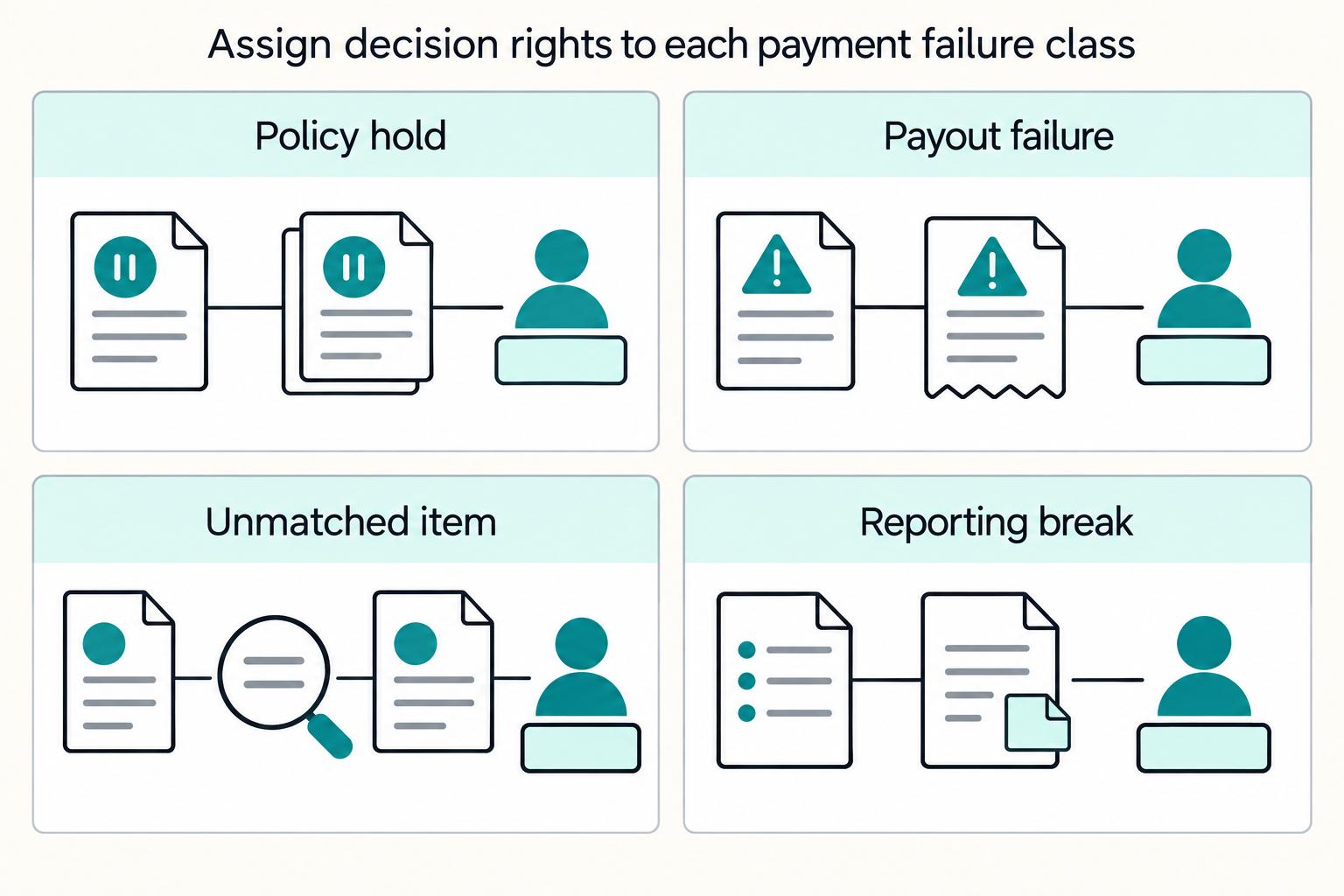
If ownership is unclear, ordinary exceptions can turn into accumulated risk as volume grows. Before you add markets or scale volume, assign each failure class a named primary owner, a backup owner, and an escalation path that ends with a decision-maker, not a shared queue.
This can break down when payments ops, accounting, and risk teams each see only one slice of the same issue. Governance guidance is consistent on the core point: define decision rights, responsibilities, and accountability so day-to-day decisions can be made quickly. In practice, policy holds, payout failures, unmatched transactions, and reporting breaks should not sit in a general inbox.
Start with failure classes, not job titles#
Assign ownership to the team that can resolve root cause, then name who can override, pause, or accept residual risk. The org chart will vary, but decision rights and accountability should stay explicit.
| Failure class | Owner basis |
|---|---|
| Policy holds | the team that can make release decisions under your control framework |
| Payout failures | the team that can act on payout execution and return paths |
| Unmatched transactions | the team responsible for ledger integrity and cash-position resolution |
| Reporting breaks | the team responsible for reporting integrity, with finance validation for close and control impact |
A common failure mode is assigning ownership by hierarchy instead of operational control. CFOs can own exposure and escalation standards for material issues without owning every queue. That matters even more as CFO scope expands into broader enterprise ownership and co-ownership.
Make escalation depend on risk and liability#
Escalation rules should reflect where liability actually sits. For connected-account disputes, response ownership and chargeback debit responsibility depend on charge type and negative balance configuration. Your escalation map should make that configuration explicit so disputes route to the right accountable owner.
Pressure-test the model on recent incidents with four checks: who triaged, who could take action, who approved the customer-facing outcome, and where the evidence is recorded. If those answers are not clear from ticketing, reporting, and ledger records, ownership is still incomplete.
A breakdown to watch for: payments ops closes a provider ticket, finance still carries an unmatched balance, and the risk team never sees the market pattern. That is how unresolved risk can age unnoticed.
Review Metrics, Analytics, and Reporting on a standing cadence#
Treat reporting as an active control loop, not a retrospective. Set a recurring market-level review cadence. The exact frequency matters less than reviewing often enough to change decisions before close quality or support performance degrades.
At minimum, include dispute volume, dispute rate, and dispute outcomes where card payments are relevant. Pair that with market-level payout failure patterns, unresolved unmatched items, and reporting defects that require manual correction. If reporting is repeatedly late or materially adjusted, escalate it as an operating risk.
Keep each review tied to named owners and open actions by market.
We covered this in detail in Choosing Toptal, Andela, or Arc for Marketplace Payment Operations.
Execute a practical first 90-day plan#
Treat the first 90 days as a control build, not a growth sprint. Baseline readiness first, pilot second, and scale only after matching and reporting hold under real volume. Use this timeline as an operating template, not a universal regulatory sequence. If a market can move funds but still depends on manual status tracking or payout matching, keep it constrained.
| Window | Primary focus | Checkpoint or guardrail |
|---|---|---|
| Days 1 to 30 | Baseline operational readiness by market and vertical; document what changes by location, payment method, and transaction profile | Use a signed checklist with named owners for policy holds, payout failures, unmatched transactions, and reporting breaks |
| Days 31 to 60 | Run pilot markets through the rollout matrix; verify retry safety for payment creation with idempotent requests; test webhook-failure handling | Prove finite replay safety, durable authenticated intake and recovery of unknown results before adding new obligations. |
| Days 61 to 90 | Harden matching and reporting loops before any broader scale decision | Confirm the actual product-specific join between each obligation, money movement and bank entry. Use available settlement references for merchant payouts and obligation references for third-party payouts; do not invent an underlying collection batch for a manual payout. Keep scale constrained if unmatched movements still roll into close. |
Days 1 to 30#
Baseline operational readiness by market and vertical, not just by country on a roadmap. Use a risk-based approach, and document what changes by location, payment method, and transaction profile. In the U.S., MSB AML programs must be commensurate with risk based on location, size, and the nature and volume of activity, so this phase should prove your scoring is specific, not generic.
Your checkpoint is a signed checklist with named owners for policy holds, payout failures, unmatched transactions, and reporting breaks. Include policy mappings, payout-method assumptions, matching logic, webhook dependency notes, and escalation paths for each failure class. A market is not ready just because a provider supports it if exception handling and ledger evidence are still undefined.
Days 31 to 60#
Run approved pilot markets through the rollout gates. Test delayed events and crashes with mocks or permitted non-money environments; prove that unfinished work resumes without duplicate postings. In the live cohort, reconcile existing attempts instead of replaying paid batches.
Measure actual report freshness and the time to resolve missing records. A report being available is different from it being complete enough for the relevant close and cash-reconciliation task.
Days 61 to 90#
Harden matching and reporting before scale. For UK firms in the payment/e-money safeguarding perimeter, use the Supplementary Regime in force from 7 May 2026, including applicable CASS 15, CASS 10A and SUP duties. It is distinct from investment client-money CASS 7. Map relevant-funds reconciliation and reporting to the firm’s actual scope.
Scale only the markets that pass every control gate. If unmatched payouts still roll into close, or accounting still depends on provider dashboard exports, keep the market in constrained scale and fix the control gap first.
The takeaway for CFOs deciding where to expand next#
Expand where you can run the required controls, money movement, and ledger matching reliably now, not where demand looks biggest on paper. For a payment platform, expansion is a finance operations decision first and a growth decision second.
External cross-border targets can frame the long-term problem, but they do not establish your route’s present delivery, cost or reconciliation performance. Use current operating evidence for the launch decision.
That matters most when safeguarding or ledger-control duties apply. In UK payments or e-money contexts, firms must safeguard relevant funds, and the FCA has flagged that some firms create unacceptable consumer and market-integrity risk. In U.S. banking deposit-flow contexts, federal agencies have communicated supervisory expectations for deposit reconciliation practices. Those points directly shape the launch evidence your team needs.
If you want help pressure-testing coverage, controls, and rollout constraints for your target launch path, talk to Gruv.
Frequently Asked Questions
What are the top finance operations priorities for payment platform CFOs?
Start with cost optimization, forecast quality, and growth funding without weakening controls. For payment platforms, those priorities only matter if they show up in ledger quality, exception ownership, and market-level launch gates.
How should CFOs prioritize expansion across markets without slowing growth?
Prioritize markets where the entity/service role is permitted and funding, status and accounting controls can operate. Use a constrained live pilot only after those foundations are met; investigate unresolved legal or funds-control questions in a non-money exercise.
Which KPIs matter most before entering a new country?
Use three KPI groups: control KPIs, execution KPIs, and finance KPIs. Track policy adherence, payout outcomes and return behavior, unmatched-transaction aging, reporting freshness, close-cycle impact, and corridor economics where cross-border cost or speed drives the model. Avoid assuming one threshold fits every market, but if ACH debits are in scope, treat Nacha's 0.5% unauthorized return-rate threshold as a hard risk signal.
How do you balance compliance requirements with reconciliation speed?
Keep accurate, timely records and reconcile actual financial movements even when a control fails. For UK payment/e-money firms in scope, current safeguarding requirements use applicable CASS 15 and related rules; do not substitute investment client-money CASS 7 for that perimeter.
What does move, track, and match mean in day-to-day finance operations?
It is a practical operating model, not a formal regulatory definition. Move means funds flow operationally. Track means payout and exception status is visible across systems. Match means provider records, internal records, and ledger entries tie out consistently. If money moves but tracking and matching still rely on manual workarounds, the market is not operationally ready.
When should a platform pause expansion and fix operations first?
Pause new expansion when exceptions exceed capacity, unknown attempts lack recovery owners, or unmatched items threaten cash and close accuracy. Continue resolving existing obligations and recording financial facts while the new-flow rollout is paused.
Try a related tool
Researched and edited by the Gruv editorial team. Gruv builds cross-border billing, payouts, and finance-operations software for global businesses.
Sources
Includes 3 external sources outside the trusted-domain allowlist.
- docs.stripe.com/api/idempotent_requeststrusted
- docs.stripe.com/webhookstrusted
- ecfr.gov/current/title-31/subtitle-B/chapter-X/part-1...trusted
- eur-lex.europa.eu/legal-content/EN/ALLtrusted
- fincen.gov/resources/money-services-business-msb-regist...trusted
- fatf-gafi.org/en/publications/Fatfrecommendations/Fatf-rec...external
- fca.org.uk/firms/emi-payment-institutions-safeguarding-...external
- nacha.org/rules/ach-network-risk-and-enforcement-topicsexternal
Educational content only. Not legal, tax, or financial advice.
Related Posts
The Payment Operations Maturity Model: How to Benchmark Your Platform Finance Team
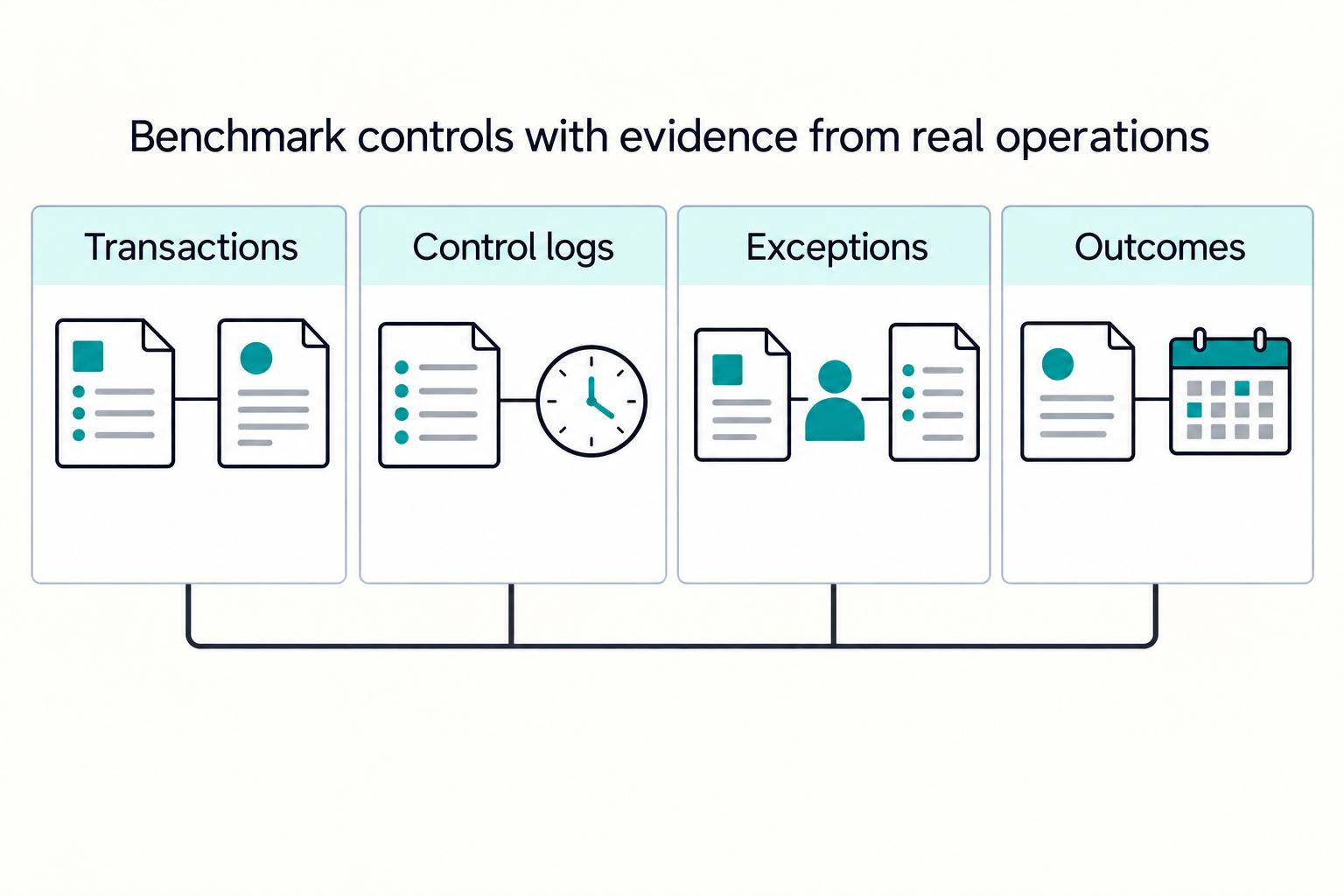
Use maturity benchmarking as an evidence-based diagnostic, not a branding exercise. For a platform finance team, that means focusing on controls that show money is posted correctly, reconciled on time, settled with clear status, and paid out without batch surprises.
Why CFOs Modernize Financial Operations in Payment Platforms
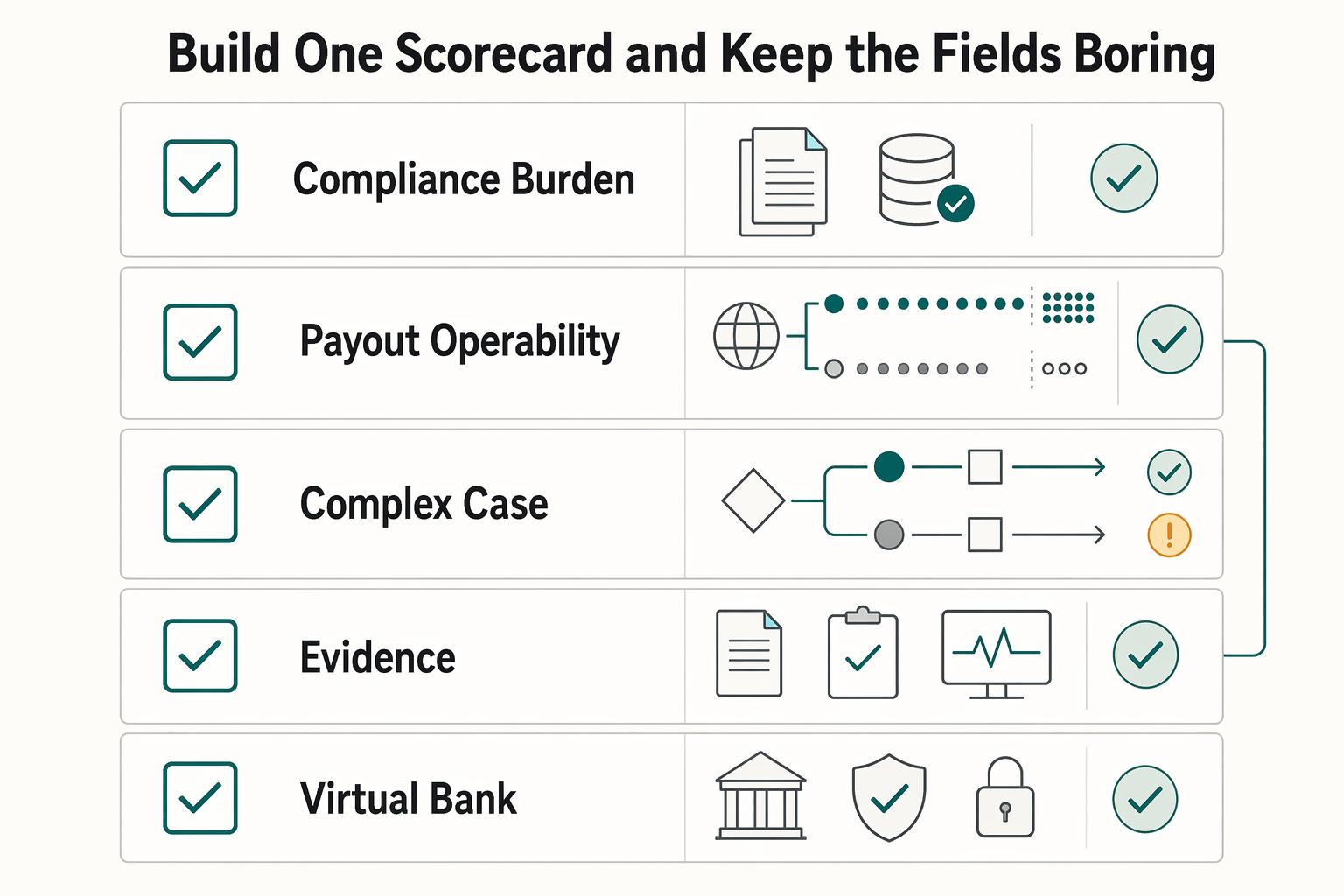
For a platform CFO, modernization is not a finance rebrand or a software shopping exercise. It is a decision discipline for a payment platform: which markets are worth entering, which constraints are real, what to launch first, and when to pause until the facts improve.
How Modern CFOs Make Payment Platform Expansion a Strategic Driver
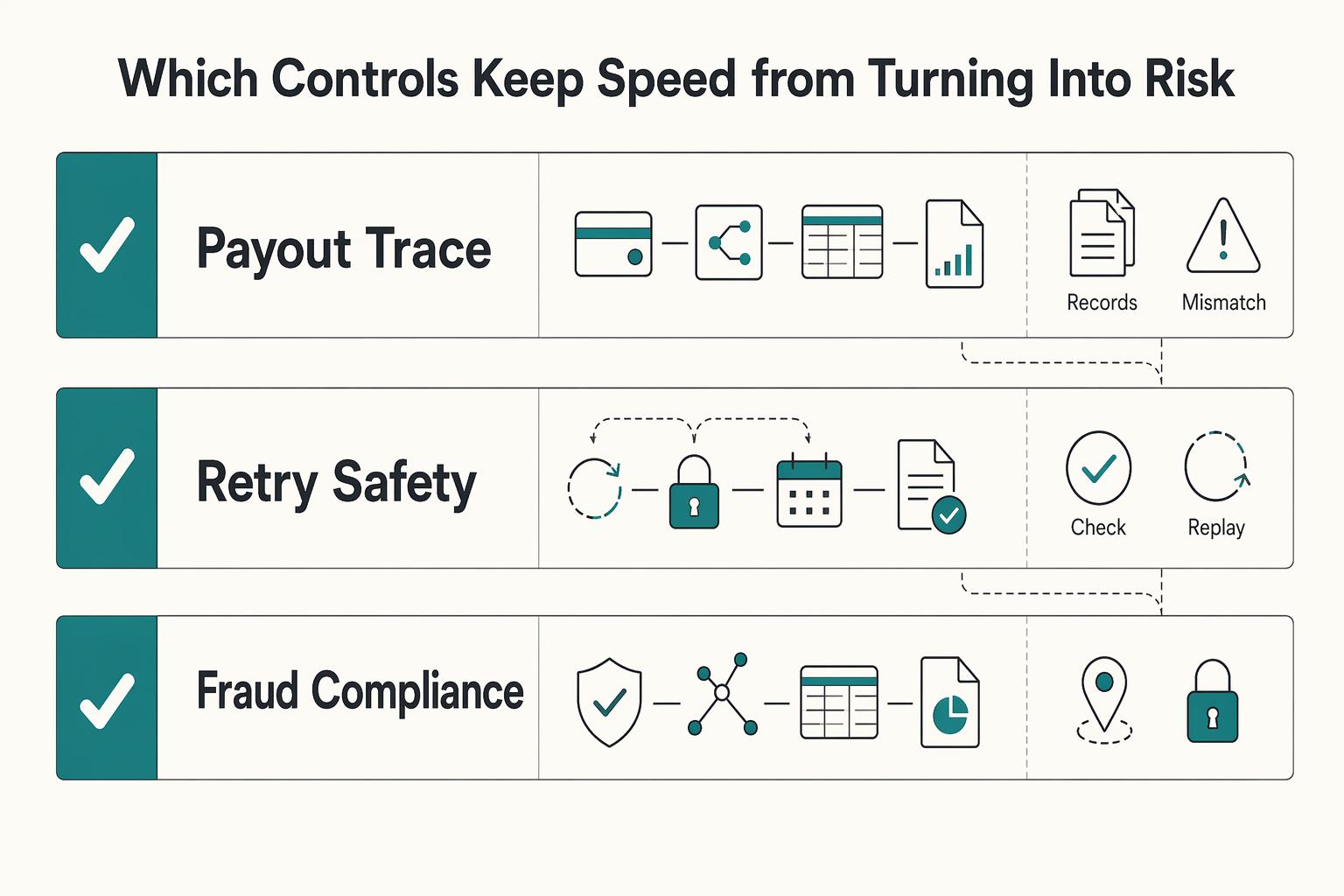
A payment platform should choose its next market based on operational readiness, not volume forecasts alone. The real question is whether you can run that market safely and clearly without creating finance debt that later shows up as payment, reconciliation, or compliance failures. If you cannot explain that operating path cleanly, your forecast should not carry the decision.