
Quick Answer
Keep SAP Business One as the finance backbone when your hardest issues are in payment orchestration rather than core close and control. For SAP Business One ERP mid-market planning, set clear boundaries across CRM, order capture, and ERP, then validate one full path from provider reference to posted outcome before scaling. If close still depends on spreadsheet stitching or conflicting status interpretations, fix the integration model first and delay new custom extensions.
For SAP Business One decisions in payment-heavy environments, start by getting clear on scope#
For SAP Business One decisions in payment-heavy environments, start by getting clear on scope. SAP Business One is positioned as an ERP for small and midsize businesses, with modules across accounting and financials, purchasing, inventory, sales, customer relationships, reporting, and analytics.
That gives you a workable architectural baseline. SAP describes Business One as a single system with instant access to real-time information and standard interfaces to internal and external data sources. In practice, that supports a straightforward pattern: use the ERP as the core operational and financial record, and integrate surrounding systems around it.
The main risk is boundary confusion. SAP training material frames integration as a way to remove problems caused by disconnected systems and processes, but that does not mean every payment function needs to sit inside ERP logic. A practical pattern is to keep the boundaries connected and observable, with ERP holding the record and external services handling execution.
This guide stays focused on that implementation reality. The checkpoints below help you decide where Business One is enough today, where integration design can save rework later, and where extension choices can create avoidable debt.
A second decision runs alongside the first: whether and when to prepare for cloud ERP. A hard trigger for moving from Business One is not defined here, so treat timing as a planning decision based on your finance model, integration load, and governance needs rather than generic growth claims.
Keep this baseline practical: if Business One cannot show clean handoffs from payment event to ledger posting, treat that as a finance-system constraint, not a preference.
Set the baseline before architecture debates#
Name system ownership before you debate tools. Use your ERP as the operational and finance record, and use payment or payout platforms as execution rails that reconcile back into ERP.
That baseline keeps operations and finance connected in one system instead of drifting into disconnected tools. It also helps manage rework risk in SAP environments, where connected systems are often tightly linked and not easy to pause or replace once change is underway. Document the boundaries across your stack:
CRM: relationship history, account context, pipeline stateE-commerceorPOS: order capture and checkout interactionERP: finance records and posting used for reconciliation and close
Then test the model with one real transaction path across those systems. If your team still relies on ad hoc spreadsheet stitching to connect execution records with ERP posting, treat that as a boundary warning and fix the design before you go deeper.
Make that first transaction path concrete enough that finance and engineering can both inspect it. Start with the customer or order reference, follow it through an external system reference, then verify the ERP-side posting and the report or reconciliation output finance will actually use. If any handoff depends on someone "knowing where to look," you do not have a stable baseline yet. You have a person-dependent workaround.
For a step-by-step walkthrough, see SAP Integration for Payment Platforms: How to Connect Your Payout Infrastructure to SAP ERP.
What mid-market teams must prove in the first 90 days#
In the first 90 days, the core question is whether the ERP backbone can support core finance operations in normal use. If month-end close still slips under routine operating pressure, readiness is not yet proven.
Early rollout validation should focus on core finance capabilities: accounting, payables, receivables, cash management, and financial close.
Prove the finance model under real operating conditions#
A demo is not enough. Run a close rehearsal on a narrow but real slice of activity under normal operating conditions.
Focus on whether finance outputs are consistent and explainable without recurring manual workarounds. If teams still need offline adjustments to explain balances, treat that as a design gap before broader rollout.
A practical test is to run a mixed sample of normal transactions through the intended process and have finance close that slice without special support. If the close only works with ad hoc intervention, the model is not ready.
The issue is not whether data exists somewhere. The issue is whether operating teams can rely on the designed process under routine pressure.
Map payment states to clear finance outcomes#
A single validated method for mapping payment-rail states into ERP statuses and month-end outputs is not established. Treat this as a local design checkpoint, and make sure finance and engineering use the same interpretation before you scale.
If the same external state is interpreted differently across workflows, close risk can stay in the design and should be resolved before volume increases.
Choose an integration pattern before custom code spreads#
One universally correct integration pattern for every case, whether direct ERP writes or an abstraction layer, is not established. Make the tradeoff explicit early based on your current scope and expected change.
Do not let this decision emerge implicitly through one-off integrations. Fragmented mappings make finance outcomes harder to keep consistent.
Make every release operationally reviewable#
A mandatory per-release evidence-pack standard is not established. Use a lightweight, repeatable review packet your team can assemble quickly, such as:
| Item | Covers | Question answered |
|---|---|---|
| Event logs | Changed transaction paths | Which transaction paths changed? |
| Reconciliation output | Provider records to ERP outcomes | Which records were expected to post, and which did not? |
| Exception aging visibility | Stuck items | Which exceptions are new versus pre-existing? |
| Rollback notes | Posting or mapping changes | What exactly reverts, and what still needs manual cleanup? |
If that packet is hard to assemble, observability and ownership may still be too weak for a payment-heavy ERP rollout. Keep it short enough to use, but specific enough to answer first-line operational questions after a release.
Which transaction paths changed? Which records were expected to post? Which ones did not? Which exceptions are new versus pre-existing? If a rollback is possible, what exactly reverts, and what still needs manual cleanup? A reviewable release is not one with more logs. It is one where the evidence is organized around how finance and operations diagnose risk.
Related: The Role of an 'Investment Banker' in a Mid-Market M&A Deal.
Use SAP Business One for core operations and keep payment logic modular#
Use Business One as the system of record for core operations, and keep payment execution logic in modular services. SAP presents it as an ERP that covers accounting and financials, purchasing, inventory, sales, customer relationships, reporting, and analytics, which makes it a practical fit for operational record keeping. Keeping payment orchestration separate can help you avoid tying finance records to every provider-side state change.
Put finalized business impact into ERP#
Post finalized business outcomes into ERP, not every intermediate payment event. Use Business One for the accounting impact you need to reconcile and report, while modular payment services hold transient states until they are ready for posting.
The practical test is simple: can a provider reference map cleanly to one canonical transaction record and one intended ERP posting outcome? If not, the model is still too loose.
That approach also gives you a cleaner failure boundary. If an external service receives duplicate callbacks or delayed updates, you can resolve them in the execution layer before they become duplicate ERP impact. If you post every intermediate signal directly into ERP, cleanup usually becomes harder and more dependent on manual finance review.
Use SAP HANA for reporting that follows finalized outcomes#
Keep reporting aligned to finalized transaction and reconciliation outcomes. SAP explicitly lists SAP HANA integration as a Business One capability, so reporting can stay tied to posted finance truth.
Leave unresolved gateway-event detail in a separate operational layer instead of mixing it into ERP-facing reporting. That keeps finance reporting stable while operational teams still have the detail they need.
In practice, this means agreeing on which reports are allowed to follow execution-stage signals and which must follow booked outcomes only. If finance users are reading dashboards that blend unsettled external events with posted ERP data, you create avoidable arguments during close. Separate the operational investigation view from the finance truth view from the start.
Normalize e-commerce and POS before posting#
If you run e-commerce and POS channels, normalize order signals into one canonical transaction model before you post into ERP. That keeps finance interpretation consistent across channels instead of letting each source define its own posting behavior.
If teams still need channel-specific mapping workarounds to explain differences, normalize first and scale second. A simple way to test this is to compare one order from each channel and ask whether they produce the same internal transaction shape before ERP posting logic runs.
If the answer is no, then ERP is being asked to absorb channel variance that belongs earlier in the flow. That usually shows up later as channel-specific exceptions, fragile mappings, or close questions that only one specialist can answer.
Extend through SAP Business Technology Platform before hardcoding#
If you expect frequent process change, favor controlled extensions first and treat hardcoded ERP customizations as the exception. SAP positions SAP Business Technology Platform to integrate, automate, and extend finance processes, which supports a more modular extension path.
Keep the extension scope explicit from the start. Business One pricing is quote-dependent, and vague requirements can turn into scope and budget surprises at go-live.
Be especially cautious when a requested customization is really standing in for an ownership or process decision that has not been made yet. Hardcoding an exception path into ERP can feel decisive in the moment, but it often freezes a temporary policy choice into the core system. If the rule is likely to change, keep the changeable logic outside the posting core.
If you want a deeper dive, read How to Create a Speaker One-Sheet for Your Freelance Business.
Map the integration ownership model before writing code#
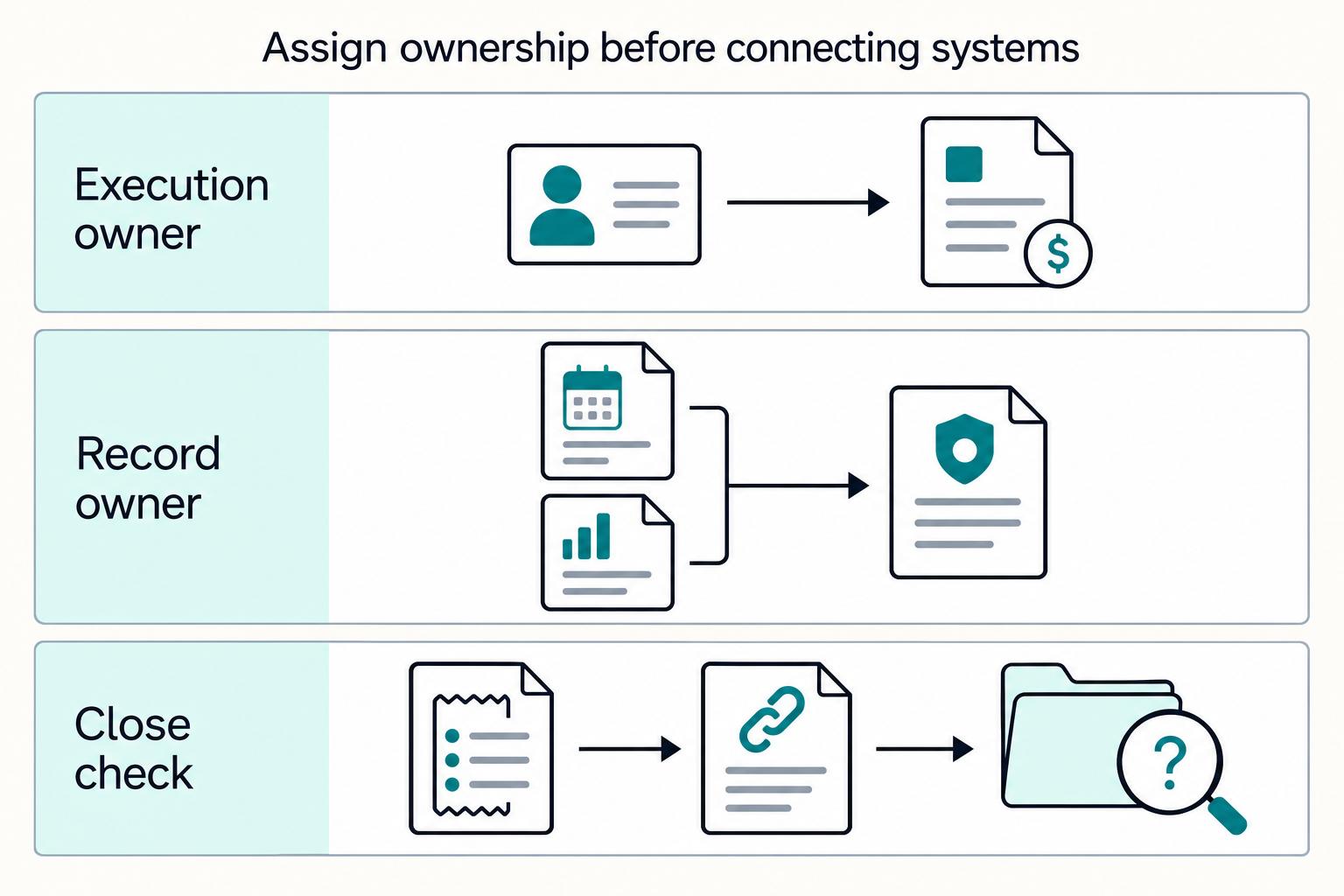
Map ownership before you build connectors. If a lifecycle step has no clear owner, retries and close activities can turn that ambiguity into rework, reconciliation friction, and arguments over which data is correct.
This is core implementation work, not admin overhead. Business One implementation guidance stresses disciplined planning and clear ownership, and its requirements/gap-fit step is positioned to prevent late surprises and scope drift. Treat this as part of pre-implementation planning, which one guide estimates at 10 to 15 percent of the overall budget, instead of pushing it into post-go-live cleanup.
Assign one owner per lifecycle step#
Make ownership explicit: who executes, who records the final finance impact, and what must be true before posting or close. Use the matrix below as a planning template, then finalize each row during requirements and gap-fit analysis.
| Lifecycle step | Primary execution owner | Final system of record | Pre-posting or close check |
|---|---|---|---|
| Invoice creation | Named process owner | Single system of record documented in the implementation plan | Canonical customer and transaction reference is defined |
| Payment confirmation | Named integration owner | System ownership for event status vs finalized finance outcome is documented | Provider reference maps to one canonical transaction |
| FX conversion | Named treasury/integration owner | System ownership for booked finance impact is documented | Converted amount, source currency, and rate source are captured |
| Payout release | Named payout operations owner | System ownership for instruction and release state is documented | Batch or transfer reference exists for settlement tie-out |
| Refund | Named payments owner with finance approval | System ownership for execution state and final finance impact is documented | Refund links to the original payment and intended accounting treatment |
| Reconciliation | Finance and integration team | Reporting and settlement truth is documented in one system | Unmatched items are queued with owner and aging status |
If a new engineer or finance lead cannot quickly answer "who decides, who records, who fixes" for each row, ownership is still incomplete.
The point of the table is not documentation for its own sake. It is to force decisions before incidents force them for you. During a failed settlement or replay event, teams do not need a broad process map. They need to know who is allowed to correct the execution state, who approves finance impact, and who owns the queue if records do not match.
Set system-of-record ownership by object#
Define ownership object by object, not by whichever system sits closest to the workflow. Shortcuts can speed delivery, but unmanaged workarounds become technical debt.
A practical pattern is to assign one system as truth for each object, then document what data is replicated for finance reporting versus transient execution detail. That keeps finalized business impact governed while avoiding overlapping ownership.
When this is not explicit, systems start competing to be truth for the same object. A customer-facing tool may hold one status, an integration service another, and ERP a third. Then the team spends close week debating which one is "real." Avoid that by naming the owner of each object before interface design is finalized.
Put idempotency and replay rules in writing#
Write retry behavior down for every interface. Do not assume native Business One idempotency and replay controls for payment interfaces. At minimum, define:
- the idempotency key shape for each action type, rather than reusing one pattern for invoices, refunds, and payouts
- retry behavior that returns the first accepted result instead of creating new financial impact
- a clear separation between transport retries and business rejections
- replay tests that prove duplicate messages do not create duplicate ERP posting outcomes
Also define what evidence proves those controls work. For example, if a duplicate message is replayed, you should be able to show the original accepted transaction, the duplicate attempt, and the unchanged ERP outcome. Without that proof, teams can mistake a quiet failure for safe duplicate handling.
Use verification checkpoints, not only logs#
Track interface failures directly through your observability setup. Focus on mapping failures, unmatched references, delayed events, and cross-system completion gaps that can block close.
Then review those outcomes on a weekly or bi-weekly cadence with a sponsor, a primary user champion, and department leads. If exceptions age across multiple cycles without a named owner, treat that as a sign that ownership was never settled clearly enough.
The checkpoint review should end with decisions, not just status updates. Which exceptions can be cleared through retry? Which need mapping fixes? Which reveal a process gap between operations and finance? A useful review is one that changes backlog priority, clarifies owners, and shortens the path from issue detection to finance-safe resolution.
You might also find this useful: ERP Integration for Payment Platforms: How to Connect NetSuite, SAP, and Microsoft Dynamics 365 to Your Payout System.
Decide when to stay on Business One and when to move to Cloud ERP#
Start with this rule: stay on SAP Business One when most complexity sits in external execution and integration workflows. Plan a move to SAP S/4HANA Cloud Public Edition when core finance, reporting, and control needs are outgrowing the current ERP model.
Business One is positioned as a unified base for finance, inventory, purchasing, and sales. Cloud ERP is a different operating model, delivered over the internet and positioned for larger, more complex operations with real-time data and automation capabilities. The important question is where the bottleneck actually sits.
| Decision area | Stay on SAP Business One when | Plan SAP S/4HANA Cloud Public Edition when |
|---|---|---|
| Multi-entity complexity | Complexity is still manageable in your current operating model. | Scale and entity complexity are consistently stressing core ERP outcomes. |
| Localization demands | Country and reporting needs are being handled without recurring structural strain. | Expansion and localization needs are repeatedly exposing limits in core ERP handling. |
| Integration volume | Integrations are mainly connecting execution systems while ERP remains the final finance record. | Integration growth is increasingly compensating for gaps in core finance/control capability. |
| Governance requirements | Governance controls are reliable with current processes and ownership. | Governance expectations now require broader automation or tighter control than the current setup supports. |
Use the source of complexity as the trigger#
Do not treat integration sprawl by itself as proof that you need a new ERP. More interconnected systems can create operational complexity and integration challenges. Move only when the pressure is clearly inside core ERP responsibilities.
If the current model no longer supports increasing complexity, global expansion, or advanced reporting needs, that is a real migration signal.
A practical way to separate the two is to classify each recurring pain point. If the issue is mainly in external execution workflows or integration handling, that points to the integration and execution layer. If the issue is close structure, reporting control, or the ability to support the finance model you now need, that points to ERP fit.
Tie decisions to business evidence, not vendor messaging#
Do not anchor this choice to SAP GROW or SAP Business Suite page narratives. Anchor it to operating evidence from engineering and finance. At minimum, document whether migration readiness is real across the known checkpoints: planning, data readiness, process simplification, and employee preparation. Treat cost of ownership as a separate, explicit decision input.
The discipline here is simple: convert broad concerns into evidence. Which close steps still depend on manual workarounds? Which reporting outputs are not trusted without offline repair? Which integrations exist only to compensate for an ERP control gap rather than to connect a legitimate external execution system? Those answers are more useful than general statements about scalability.
Keep transition options and unknowns explicit#
A full replacement is not the only option. A two-tier model can run on-prem ERP and cloud ERP in parallel. Cloud ERP also changes cost and operations, typically to annual or monthly subscription with vendor-managed maintenance and upgrades.
Before approval, log unresolved items as open decisions:
- Side-by-side TCO: confirm with your vendor and finance team.
- Migration timeline certainty: verify with your implementation partner.
- Full feature parity: confirm with the relevant authority before committing.
That keeps the stay-versus-move decision grounded in business triggers instead of assumptions. It also keeps the team honest about what is still unknown.
A migration plan is weaker when unresolved items are treated as implied yeses. Call them open decisions, assign owners, and require evidence before they turn into budget or timeline commitments.
We covered this in detail in our guide to the financial metrics that matter.
If your decision table points to modular payment orchestration, review Gruv Payouts to see how compliance-gated batches, status tracking, and idempotent retries can map cleanly back to ERP reconciliation.
Sequence implementation to reduce migration rework#
Implementation order matters. A practical sequence is to prioritize what is hardest to unwind later: first transaction traceability, then control and reconciliation discipline, then migration-facing abstractions. That sequence is practical because migration work usually exposes gaps in data quality, financial structures, system configuration, and team alignment.
| Step | Focus | Why it matters |
|---|---|---|
| Transaction traceability | Trace each in-scope transaction across operational systems, internal transaction records, and ERP posting outcomes | Get the transaction foundation stable before you layer on more complexity |
| Control and reconciliation discipline | Policy gates, exception handling, and finance checkpoints | Treat reconciliation and exception visibility as release criteria |
| Migration-facing abstractions | Localize ERP-specific mappings and posting rules behind a narrow boundary | Can help reduce rewrite scope if that move becomes necessary |
Start with transaction traceability before advanced payout behavior#
Get the transaction foundation stable before you layer on more complexity. You should be able to trace each in-scope transaction across operational systems, internal transaction records, and ERP posting outcomes, then tie that back to what finance uses for close.
Keep your current state explicit while you do this. SAP market management emphasizes maintaining status-quo information and evolving planning across current state, next state, and future vision. In practice, that means ownership of each transaction state should be clear before you add more branches.
Traceability work should produce a reusable path for investigation, not just a one-time project diagram. For any selected transaction, the team should be able to pull the source record, confirm the internal record, and verify the ERP-side outcome without inventing a new query every time.
Add controls where finance and engineering must meet#
Once traceability is stable, add policy gates, exception handling, and finance checkpoints. This addresses a common migration risk: implementation is often IT-led while finance owns the data that must reconcile.
Define what can post automatically, what needs review, and what evidence is retained for non-standard transactions. Treat reconciliation and exception visibility as release criteria, not just technical success criteria.
This is also where you decide how unresolved items age. Exceptions should not disappear into a generic support queue. Give each exception type a route, a reviewer, and a clear handoff back into normal processing once the issue is resolved.
Add migration-aware abstractions at the ERP boundary#
After the foundation and controls are stable, localize ERP-specific mappings and posting rules behind a narrow boundary. A recognized migration path is from SAP Business One to a higher-scale SAP environment such as SAP S/4HANA, and this boundary can help reduce rewrite scope if that move becomes necessary.
Do not treat this as a zero-rewrite promise. The goal is to contain change, not to pretend that future migration is only a configuration flip.
A good test here is whether a workflow change can be absorbed without touching multiple ERP-specific interfaces. If every change request still requires edits across upstream processing, ERP mappings, and reporting logic at once, the boundary is not narrow enough yet.
Use SAP planning artifacts as inputs, not your definition of done#
Use SAP methodologies, checklists, and best-practice planning artifacts to shape scope and readiness. But keep acceptance criteria owned by engineering and finance, with completion defined by operational evidence: traceability, reconciliation completeness, exception handling, and close readiness.
That distinction matters because planning artifacts can tell you what to review, but they do not prove your operating model works. Your definition of done should still be based on whether the team can run the process, explain the outputs, and recover from normal failure modes without rebuilding truth outside the system.
Need the full breakdown? Read Build a One-Page Business Continuity Plan for a Natural Disaster.
Handle country and program variance without blocking delivery#
When markets diverge, keep market policy outside hardcoded ERP logic so regional changes do not force a core redesign. Treat market-specific eligibility, documentation, and exception rules as market-level policy, while keeping finance posting behavior stable.
Before each market go-live, use a release gate that answers four questions:
- which controls are enabled for that market and program
- which exceptions trigger a hold versus a warning
- who owns escalation when a case cannot proceed automatically
- what evidence proves the controls were tested
Keep that evidence pack concrete: sample transactions with sensitive data redacted, the expected decision outcome, the actual message or status returned, and the final ERP posting result or hold state. That gives you enough detail to replay failures without exposing sensitive records across systems.
For verification, require artifacts that show both message transport health and decision history. SAP examples such as Message Monitoring Overview and enhancements to the Application Logs App are useful models: one checkpoint for message flow, another for logged decision trails.
Also watch for brittle integrations early. SAP documentation calls out a Deprecated Communication Scenario and Changing Message Numbers in Data Integration. If market rules depend on fixed message values or tightly coupled interfaces, regional updates can break routing, retries, or exception handling.
One practical safeguard is to test a market-specific flow with both a clean pass and a controlled exception path before go-live. You are not looking only for the happy-path posting result. You are checking whether the hold behavior, escalation owner, and final ERP treatment remain clear when a rule blocks automatic processing.
Red flags that signal architecture debt early#
Architecture debt can show up before obvious feature gaps. You see it when interfaces are brittle, automation depends on custom fixes, and switching options get narrower over time. If more than one of the signals below is already present, pause edge-case patching and harden the integration layer first.
| Signal | What it looks like | Implication |
|---|---|---|
| ERP interface | Not consistently open, stable, and well documented | Downstream automation inherits that fragility |
| Integration reliability | Depends on one-off fixes | Reliability depends on patchwork instead of repeatable system behavior |
| Cross-system workflows | Still hard to run end to end | ERP is still acting more like a wall than a bridge |
| Efficiency gains | Reducing strategic flexibility | A change can create debt if it depends on brittle integrations or makes switching cost-prohibitive |
Watch how these signals combine. A brittle interface alone is a maintenance issue. A brittle interface plus patchwork integrations plus hard-to-run cross-system workflows is an operating-model problem that tends to surface when teams need to scale or change direction. At that point, more patches can make future remediation larger, not smaller.
Conclusion#
Use SAP Business One for core operational control, and treat payment and payout orchestration as a separate architecture decision.
Business One is positioned as an SMB ERP that unifies core functions such as finance, sales, inventory, and procurement. When that model is working, you should see centralized control and reporting that help teams make decisions quickly.
Make the stay-versus-move call with explicit checkpoints, not broad scalability claims. Test whether teams can rely on dashboards and reporting for sales performance, inventory levels, and financial health without rebuilding truth in side spreadsheets. Also verify the compliance baseline you need, including the tax-compliance and data-security areas.
Treat these as warning signs: tasks still are not optimized, or teams still are not operating from centralized integrated software. If those issues persist, fix ownership boundaries, reporting discipline, and integration design before you expand scope.
Before the next implementation phase, run one joint engineering-finance architecture review and complete the two decision tables discussed earlier:
- Ownership and system-of-record table: for each major object or event, define what lives in ERP versus outside it, with field mappings, reporting outputs, and one end-to-end trace to the books
- Stay-vs-move table: list current control gaps, manual workarounds, reporting limits, and compliance questions, then classify each as payment integration, operating model, or core ERP fit
Related reading: Comparables Analysis for Business Valuation in a One-Person Business. Before you lock the next phase sequence, align engineering and finance owners on scope and coverage assumptions with Gruv contact.
Frequently Asked Questions
Is SAP Business One suitable for mid-market companies with complex payments?
One comparison excerpt positions SAP Business One for companies with 10 to 500 employees and describes it as an ERP for integrated core functions. That does not confirm complex payment orchestration is handled out of the box. If payment complexity is central, validate those workflows directly before committing.
What ERP capabilities does SAP Business One cover out of the box for finance and operations?
The excerpts describe SAP Business One as a single application that integrates core business functions. Listed core areas include CRM, sales and distribution, purchasing, and inventory, and ERP is distinguished from accounting-only software. That supports treating it as a finance-and-operations ERP foundation.
Can SAP Business One support multi-entity or multi-currency reporting without heavy customization?
SAP Business One supports multi-currency, plus multi-language and international compliance. Multi-entity consolidation behavior has not been validated here. If multi-entity close is critical, require direct product evidence before you commit.
How should teams integrate payments and payouts without creating long-term platform debt?
Validated implementation guidance for payment and payout architecture requires separate evaluation. SAP Business One supports ERP as a unified source of truth for core processes, but payment-specific design choices need separate validation.
When should a team move from SAP Business One to SAP Cloud ERP?
What is clear is broad positioning: SAP Business One is framed as more cost-effective and easier to implement, while SAP S/4HANA is framed for more complex global enterprise needs, pointing to 1,000+ employees. There are no hard migration triggers to rely on.
How do Workday and NetSuite comparisons change the SAP decision for payment-heavy businesses?
This guide does not support a credible Workday or NetSuite judgment, so no comparison conclusion can be made here. For additional context, see Workday vs NetSuite vs SAP: Choosing the Right ERP for a Payment-Heavy Business.
Try a related tool
Researched and edited by the Gruv editorial team. Gruv builds cross-border billing, payouts, and finance-operations software for global businesses.
Sources
Includes 6 external sources outside the trusted-domain allowlist.
- eecg.toronto.edu/~jacobsen/courses/ece1770/reader06/Patterns-...trusted
- uscis.gov/sites/default/files/document/data/h-1b-2016-...trusted
- 2isolutionsus.com/blog/grow-with-sap-for-mid-market-companies-...external
- b1-solutions.com/10-benefits-of-implementing-sap-business-one...external
- clientsfirst-us.com/blog/sap-business-one-implementation-guideexternal
- cogentnext.com/blog/sap-insights/navigating-digital-transfo...external
- erpsoftwareblog.com/cloud/2025/08/fueling-global-expansion-how-m...external
- fairfaxsolution.com/sap-business-one-faqsexternal
Educational content only. Not legal, tax, or financial advice.
Related Posts

The Freelance Payment Penalty: A Modeled Audit of Platform Fees, FX Spreads, and Payout Delays
The money rarely disappears through a single, easy-to-spot fee. The real loss is stacked. A marketplace takes its commission, a processor adds a charge for international cards, a bank or payment company converts the currency at a spread, a platform holds the funds before release, and a wire sheds a little to intermediaries on the way in. Each layer looks defensible on its own, but the worker feels the combined result as a smaller deposit and a later payday.

How to Respond to a Subpoena for Business Records
Move fast, but do not produce records on instinct. If you need to **respond to a subpoena for business records**, your immediate job is to control deadlines, preserve records, and make any later production defensible.

A US Expat's Guide to Investing in UCITS ETFs to Avoid PFIC Issues
The real problem is a two-system conflict. U.S. tax treatment can punish the wrong fund choice, while local product-access constraints can block the funds you want to buy in the first place. For **us expat ucits etfs**, the practical question is not "Which product is best?" It is "What can I access, report, and keep doing every year without guessing?" Use this four-part filter before any trade: