
Quick Answer
Shortlist by operating requirements, then test the money path. Workday offers finance with workforce context; NetSuite connects finance and operational records; SAP provides distinct deployment editions. Choose from demonstrated posting, correction and reconciliation behavior, required modules and total implementation cost.
Choose ERP by payout integration debt#
For a payment-heavy business, the practical ERP choice usually depends less on the longest feature list and more on how much long-term integration debt it avoids across payout infrastructure.
This comparison looks at Workday, NetSuite, and SAP S/4HANA through the lens that matters most in practice: architecture risk, sequencing, and operational control. If you lead engineering decisions, the real question is which option lets you ship now without creating brittle dependencies between finance, product, and payouts later.
Public positioning is still useful as a starting point:
- Workday publishes financial-management capabilities as well as HCM.
- NetSuite connects finance with orders, inventory, projects and other operational records; OneWorld adds multi-entity management.
- SAP offers distinct public-cloud, private-cloud and on-premises S/4HANA editions.
But those comparisons also have limits you should treat explicitly:
- Use the vendors’ current product documentation to define licensed scope.
- Request the same payment, rejection and reconciliation demonstration from every candidate.
- Obtain implementation scope and costs for your data, entities and interfaces; public customer counts do not establish your payout fit.
Confirm the selected edition, release schedule and sandbox process before signing. Include regression checks for payment mappings and close reports after each vendor upgrade; cloud hosting alone does not determine the amount of integration work.
The goal here is simple: move faster now without backing your teams into reconciliation and payout dependencies that are painful to unwind later.
This pairs well with our guide on NetSuite for Payment Platforms: Module Order, Automation, and Integration Strategy.
At a Glance Comparison for Payment-Heavy Teams#
Use operating requirements to build the shortlist: Workday combines financial management with workforce context; NetSuite connects financial and operational records; SAP offers distinct cloud and on-premises editions. Test the same payout and correction case in each, with the required modules and integrations priced.
This table distinguishes published product scope from the payout-specific evidence your team must obtain. It does not rank implementation effort or predict the first stable close.
| Product | Published scope | Deployment | Payment demonstration to require | Close and implementation evidence |
|---|---|---|---|---|
| Workday Financial Management | Accounting, consolidation, close, procure-to-pay and revenue; can connect workforce context | Cloud finance platform | Settlement payment integrations, acknowledgments and accounting entries; test your provider and exception paths | Normal and rejected payments linked to payable, posting and bank evidence; scope required modules |
| NetSuite / OneWorld | Connected financial and operational records; OneWorld supports multi-entity and currency consolidation | SaaS | Test the licensed payment integration, operational source record and correction handling | Subsidiary/currency mapping, clearing accounts, bank reconciliation and upgrade tests |
| SAP S/4HANA (specify edition) | Enterprise process coverage depends on selected scope and edition | Public cloud, private cloud or on-premises offerings | Show the chosen edition and interfaces handling your payable, bank result and correction | Edition-specific configuration, migration and release responsibilities; reconcile the same scenario |
Check HR lifecycle changes, GL journal synchronization and access governance when those interfaces are in scope. A worker departure, a repeated journal or a stale permission can create a payment or close issue even when the connector itself reports success.
Treat vendor demos as insufficient unless they show one end-to-end trace using your own business object. That trace should cover the originating event, ERP posting output, exception handling, close-period review, corrected-record resync, and approval or override controls. If they cannot show how HR changes, GL sync issues, or access-role changes are handled without manual repair, count that as integration debt.
Use a second filter that matches operational reality: HRIS connectivity, accounting depth, regional scope, security, and ease of implementation. This keeps you from choosing a system that is technically powerful but misaligned with how you actually run the business.
Keep each candidate whose licensed scope meets your critical processes. A workforce-heavy model may favor unified HR and finance; an order- or inventory-heavy model may favor tightly connected operational records. Use the same rejected-payment and close scenario to compare the integration burden.
What Each ERP Is Actually Optimized to Run#
Use one filter first: pick the ERP whose core business objects match what drives your finance outcomes. In practice, Workday is people-and-finance centered, NetSuite is transaction-and-operations centered, and SAP is enterprise-breadth centered.
| ERP | Core center | Best fit when | Requirements to test early |
|---|---|---|---|
| Workday | People plus finance | Finance behavior is closely tied to workforce and payroll context | Operational transaction integrations and mandatory deployment constraints |
| NetSuite | Money, transactions, and daily operations | Transaction operations drive finance outcomes, including order-to-cash, procure-to-pay, inventory, fulfillment, and supply chain | Regional HR/payroll interfaces where required |
| SAP | Enterprise breadth and process depth | Large enterprises need broad coverage across supply chain, manufacturing, finance, and HR | Edition-specific complexity and support effort relative to the processes you need |
That fit check matters more than feature volume, because teams can end up with technically strong systems that do not match how they actually operate. Once you have that directional fit, pressure-test the money path rather than the marketing story.
Workday is centered on people plus finance#
Workday offers financial management alongside HCM. Its finance product covers accounting, consolidation, close, procure-to-pay and revenue; workforce integration is one reason to shortlist it, rather than a limit on its transaction capabilities.
For payment teams, the fit is strongest when finance behavior is closely tied to workforce and payroll context. Validate that with an end-to-end walkthrough from a worker or payroll change to the resulting finance impact, including how corrections are handled.
If order, fulfillment or inventory records drive your money path, test those integrations explicitly instead of rejecting Workday by category. Its cloud delivery is a selection constraint where an on-premises ERP is mandatory.
NetSuite is centered on transactions and day-to-day operations#
NetSuite is built around managing money, transactions, and daily operations in one place. Its cited core scope includes order-to-cash, procure-to-pay, inventory, fulfillment, and supply chain.
For payment-heavy models, that can keep operational and accounting records closer together inside the same workflows. You should still test that assumption with real order and purchasing flows in demos rather than assuming integration effort will always be lower.
If workforce and payroll events dominate your accounting, compare the required HR/payroll integrations and regional coverage. Do not reject NetSuite solely because another vendor emphasizes HCM; test the actual handoff and correction costs.
SAP is centered on enterprise breadth and process depth#
SAP is the option most clearly framed for large enterprises that need broad coverage across supply chain, manufacturing, finance, and HR. That breadth matters most when payment-adjacent finance work is tightly coupled to wider enterprise process layers.
SAP distinguishes Cloud Public Edition, Cloud Private Edition and the on-premises S/4HANA offering. Specify the edition and contract scope before comparing configuration freedom, upgrade responsibility and implementation effort; one deployment label cannot stand in for all three.
Misfit warning: if you do not need enterprise-wide process depth, SAP can add overhead without improving your core payment outcome.
Keep candidates that meet your critical requirements. Workforce context, operational transaction records and enterprise process breadth help prioritize demonstrations; none is an automatic category exclusion.
Need the full breakdown? Read Accounting for a Payment Infrastructure Business: How to Structure Finance Ops.
Where Payment Integration Debt Actually Shows Up#
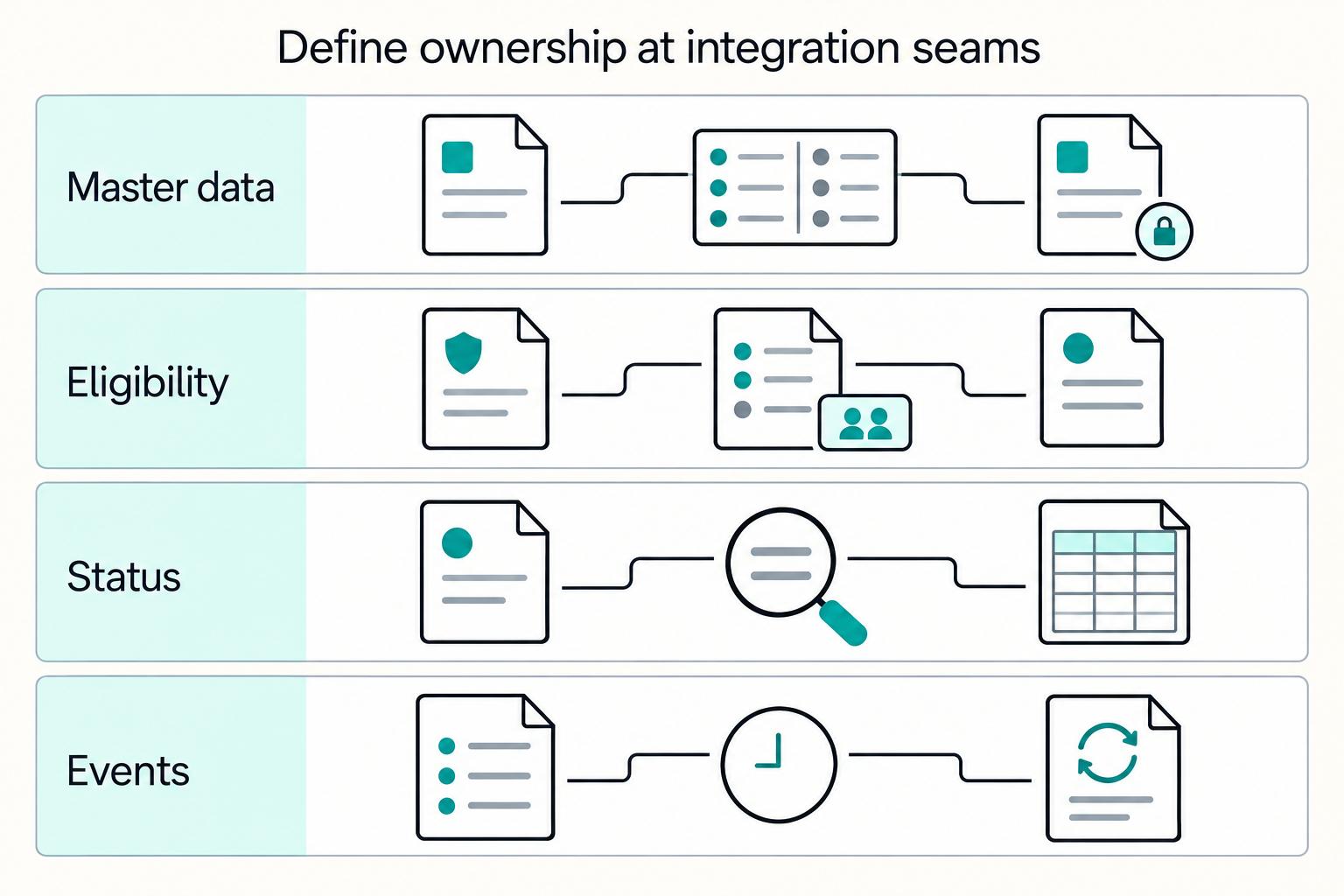
Integration debt usually shows up where business meaning crosses system boundaries, not at the connector itself. Common seams include ERP master data, payout eligibility logic outside or beside the ERP, and status propagation into Payout Infrastructure and Reconciliation Workflows.
| Seam | How debt shows up | Control to require |
|---|---|---|
| Master data | Legal entity, subsidiary, currency, customer or worker IDs, payout destination, hold status, and tax attributes exist in multiple systems with different update paths | Build a field-mapping sheet and source-of-truth table for payment-critical objects; if two systems can update the same attribute, make one read-only for that field |
| Eligibility logic | Policy is split across product rules, ERP statuses, and manual finance exceptions, with undefined precedence | Define exception classes and a state table for eligible, ineligible, on hold, released, paid, reversed, and under review; name which system can set each state and what event follows |
| Status propagation | Product and finance operate on different clocks and status chains, so one side can show paid while the other still shows pending or unreconciled | Use live observability and require one explainable event chain across operational and finance handoffs |
| Event design | Events lack stable business identifiers, clear transition names, or enough context to explain retries and replay during reconciliation | Keep an event catalog with object, transition, source system, effective time, and idempotency key; test replay and late-arrival paths against Reconciliation Workflows |
If you cannot trace an invoice and related operational and finance events as linked objects and events, you still carry architecture risk. That is the real delivery question in this ERP decision. The issue is not only whether it integrates, but where object ownership drifts once money starts moving.
Master data is where mismatches start quietly#
Master data debt starts when fields look shared but are not owned the same way across teams. Legal entity, subsidiary, currency, customer or worker IDs, payout destination, hold status, and tax attributes can exist in multiple systems with different update paths. Records can look consistent inside one application and still fail to reconcile end to end when payouts or settlements are reviewed.
The practical checkpoint is ownership clarity, not vendor claims. In the comparison context, NetSuite's OneWorld module is explicitly tied to multi-country and multi-currency operations, which raises the importance of subsidiary and currency mapping. For any ERP choice, build a field-mapping sheet and source-of-truth table for payment-critical objects. If two systems can update the same payout-relevant attribute, treat that as a risk until one system is read-only for that field.
Eligibility logic breaks when status lives in two places#
Payout eligibility debt appears when policy is split across product rules, ERP statuses, and manual finance exceptions. One system may show an invoice approved, another may show collection cleared, and another may still hold payout. Those states can all be valid. The risk starts when precedence is undefined.
That is why claims of automatic compliance handling should be treated as a warning signal, not a shortcut. Define exception classes and maintain a clear state table for eligible, ineligible, on hold, released, paid, reversed, and under review. For each state, name which system can set it and what event should follow each change.
When precedence is unclear, mismatch risk rises. Product can show funds ready while finance still treats the receivable as unresolved, or finance can clear while payout remains blocked. That becomes manual reconciliation work and close-period noise.
Status propagation is where visibility gets lost#
Status drift usually shows up when teams operate on different clocks and different status chains. Product may track authorization or collection completion, while finance waits for settlement and posting readiness. If propagation is partial, delayed, or mapping-heavy, one side can show "paid" while the other still shows "pending" or "unreconciled."
Link object and event records across ERP, the payout provider and your operational system. For example, a payable ID should lead to each transfer attempt, the provider result, the bank debit and the clearing-account entry. A separate process-observability tool can help, but is optional; it does not replace the accounting records.
Use live observability as the checkpoint, not just daily sync success. You should be able to track recovery rates and compliance exceptions live, and quickly explain why payout status and finance status differ.
Weak event design turns retries into accounting risk#
Unclear event contracts can make retries and replay behavior hard to explain during reconciliation. The risk is higher when events lack stable business identifiers, clear transition names, and enough context to show what changed.
Downstream retry behavior is easier to reason about when upstream event quality is explicit. Keep an event catalog that defines object, transition, source system, effective time, and idempotency key. Then test replay and late-arrival paths against Reconciliation Workflows to confirm one explainable outcome.
Choose the ERP that minimizes seams you need to invent, then require an object-and-event trace before implementation. If ownership and replay safety are not explicit for payment-critical states, integration debt is already forming.
If you want a deeper dive, read ERP Integration for Payment Platforms: How to Connect NetSuite SAP and Dynamics to Your Payout System.
Integration Sequence That Avoids Rebuilds#
Start with ownership boundaries before connectors. If ownership is unclear, integration work usually gets rebuilt later.
For a payment-heavy rollout, a practical sequence is to define ownership boundaries for critical records, implement one critical flow, close the loop in Reconciliation Workflows, and only then expand into broader automation.
Lock ownership before any serious build#
Begin with a written implementation plan that covers methodology, timeline, technical requirements, costs, and stakeholder involvement. In the same phase, complete process mapping and migration readiness, since migration issues, legacy incompatibility, and internal resistance are common implementation risks.
At this stage, make ownership explicit for payment-relevant records and states. If two systems can update the same payment-critical field, treat that as a risk until ownership is resolved. The checkpoint is simple: engineering, finance, and operations should be able to review one plan and one process map and agree on where each critical state lives.
Stabilize one money path end to end#
Scope phase one to a single critical path, such as Order-to-Cash through final ERP posting, with one explainable chain from business event to posting.
Choose the critical path from your operating model. If payroll is the first money path, include its mandatory worker and payroll integrations in phase one; defer only adjacent work that is not needed for an accurate payment or close. Finance should be able to trace real transactions and exceptions without ad hoc reconstruction.
| Phase | Finish now | Defer for later | Verification checkpoint |
|---|---|---|---|
| 1. Boundary design | Written plan, process mapping, migration readiness, ownership table | Low-leverage customizations and noncritical sync or UI work | Stakeholder agreement on payment-critical ownership and posting states |
| 2. Critical flow events | One end-to-end flow, for example Order-to-Cash to ERP posting, with traceable handoffs | Planning and secondary integrations that are not dependencies of the first flow | Teams can explain traced transactions end to end |
| 3. Closed-loop reconciliation | Reconciliation Workflows, exception ownership, review path | Advanced auto-release logic and cross-domain automation | Reconciliation pass-rate trend, exception aging visibility, lower close friction |
| 4. Expansion | Additional flows and selected automation | Any change that rewrites core posting logic before stability | New releases do not reopen posting or reconciliation issues at month-end |
Close reconciliation before you chase automation#
After the first flow is live, prioritize reconciliation reliability over new scope. Matched and unmatched states, exception ownership, and a usable review path should be stable before you add more automation.
Track three signals in each phase: reconciliation pass-rate trend, exception aging visibility, and month-end close friction. If close still depends on manual bridges, pause expansion and fix the evidence trail first.
Keep a real defer list#
Document what you are intentionally postponing: low-leverage custom workflows, broad bidirectional sync, custom dashboards, and nonessential approval layers. That is risk control, not delay.
Every custom layer expands the mappings and correction paths your team owns. For any edition, record the vendor release process and the sandbox tests needed for payment interfaces and close reports. Defer low-value customization while keeping essential exception recovery in scope.
Decision rule: do not expand beyond the first critical flow until month-end results are explainable from system records rather than manual reconstruction.
We covered this in detail in SAP Integration for Payment Platforms: How to Connect Your Payout Infrastructure to SAP ERP.
Non-Obvious Tradeoffs Teams Miss in ERP Comparisons#
If payout reliability and reconciliation latency are major constraints, prioritize operational fit over UI preference. A polished demo can still hide translation layers between business events and ERP postings.
Separate the implementation work from hosting responsibility. SaaS can reduce infrastructure administration while leaving configuration, migration, controls and integration maintenance with your team. Compare those responsibilities in the selected contract.
Deployment speed versus ownership load#
Cloud hosting can reduce internal infrastructure work. It does not guarantee faster delivery: data migration, configuration and payment integrations may still dominate the schedule. Check the vendor release cadence and available testing window.
On-premises deployment usually places more infrastructure and upgrade responsibility with the customer. Whether that lengthens delivery depends on the actual environment and scope. Compare it with the specific SAP cloud edition, rather than one generic cloud alternative.
| Decision area | Cloud Deployment | On-Premise Deployment |
|---|---|---|
| Early implementation pace | Depends on migration, configuration and interfaces | Depends on migration, configuration and interfaces |
| Infrastructure burden | Lower internal burden | Higher internal burden |
| Change ownership | More vendor/platform managed | More customer-managed |
| Operational fit for your processes | Must be validated in selection | Must be validated in selection |
| Long-term operating load | Lower infrastructure effort, but integration maintenance remains | Heavier operational ownership overall |
Labels are not enough when payout logic gets granular#
High-level product labels can help you shortlist options, but they do not prove operational fit. You still need to test whether payout-critical workflows align with native ERP processes or require stitching across modules and mappings.
A practical checkpoint is to map one real flow from business event to payout approval to final posting before selection. Ask vendors or partners to show process alignment, implementation scope, required integrations, and post-launch support coverage for that exact flow. If the response stays at screen-demo level, treat that as a risk signal.
Operational fit, implementation scope, and support coverage after launch are stronger selection signals than raw capability alone.
Adjacent suites create quiet integration debt#
The hidden cost is often the number of neighboring systems in the money path, not the ERP alone. Every direct integration adds authentication logic, rate-limit handling, breaking-change exposure, and data normalization work. Over time, this can fragment your codebase into provider-specific branches.
When ownership boundaries are unclear across systems, reconciliation gets harder. Teams can end up reconstructing meaning across tools instead of reading one explainable posting trail.
A sharper decision rule#
When options look close, ignore cosmetic differences first and choose the path with fewer translation layers from business event to ERP posting. If you cannot produce a short evidence pack with process alignment, implementation scope, and named post-launch support coverage, defer the decision until you can.
A practical tie-breaker is which option makes your first stable close easiest to explain from system records. Related reading: Choosing ERP Sync Patterns for Payment Platforms.
Hidden Costs and Failure Modes Before Go-Live#
Before go-live, the key test is simple: Accounting and Finance should be able to explain each posting, exception, and correction path from system records, with clear ownership and an audit trail.
Broad ERP comparisons usually cover implementation effort, customization cost, and licensing. A hidden cost is pre-launch coordination across teams: process alignment, implementation scope, and support ownership often surface late in testing. That risk applies across ERP options, even when feature breadth looks strong.
Costs that arrive late and hit hardest#
Budget for rework and cross-team coordination as well as missing features. Use the gaps found in your demonstration and migration pilot to estimate effort, rather than assuming one category is always the largest cost.
| Hidden cost area | What to verify before go-live | What usually goes wrong if you skip it |
|---|---|---|
| Cross-team coordination load | A named owner for each handoff across product, engineering, finance ops, and Accounting and Finance | UAT reveals assumptions about who owns approval rules, exports, or exception review |
| Exception-handling buildout | A written exception taxonomy with examples, routing, and finance treatment | Happy-path posting works, but failed, reversed, or duplicate cases lack a clear action path |
| Ambiguous ownership in finance review | Agreed audit trails, user permissions, and the records finance will use for sign-off | Reconciliation review becomes manual and disputed because teams do not trust the same source record |
A practical pre-go-live check is to run one normal transaction case and one broken case end to end. Validate the exact record sequence finance will use, not a verbal walkthrough. If the team cannot show the originating transaction, the ERP posting, the exception state, and who can approve or correct it, readiness is incomplete.
Failure modes worth treating as likely#
Include these failure scenarios in testing:
- Change management barriers that leave teams unclear on new workflows and ownership
- Data migration challenges that undermine confidence in finance review before launch
- Fragile custom mappings that work for current cases but fail on new exception variants
- Delayed reconciliation visibility, where data exists but not in a form finance can review quickly
Each issue can look minor on its own, but together they drive manual investigation, duplicate reviews, and close-period confusion. The risk is not only technical correctness. It is post-launch support strain from process alignment gaps, implementation scope drift, and unclear ownership.
Pre-go-live stop checks#
If any of the following remains unresolved, treat go-live as a stop decision or reduce scope into a phased rollout:
- Exception classes are still being discovered ad hoc, with no agreed finance treatment
- Correction paths are unclear when a workflow succeeds in one step and fails in another
- Finance has no agreed evidence trail for review, including which records are the source of truth
- User permissions for approval, correction, and export are not settled
- Real-time dashboards or equivalent visibility do not let operations and finance see the same state
Do not approve launch based on successful posting alone. Approve it when finance can trace, review, and challenge the posting from an audit trail without engineering reconstructing the story. If that is not true yet, narrow the first release and ship in phases.
For a step-by-step walkthrough, see Intacct vs. NetSuite for Payment Platforms: Which ERP Handles Multi-Currency and High-Volume AP Better.
Scenario-Based Recommendations by Business Shape#
Start with operational requirements: unified workforce and finance, transaction and multi-subsidiary operations, or complex enterprise processes. These are shortlist prompts; the demonstrated payment and close workflow should decide whether the fit is real.
| Business shape | Bias toward | Why that fit is plausible from the sources | First thing to verify | When to avoid |
|---|---|---|---|---|
| Workforce-heavy, people and finance tightly coupled | Workday | Workday is positioned around enterprise HR plus finance, with HCM and financial planning in cloud deployment | Run a live walkthrough showing how finance events trace to worker, org, and approval records | Avoid if your hardest problem is transaction-level operations depth and the demo stays at people-and-finance abstractions |
| Transaction-heavy growth company with multi-subsidiary needs | NetSuite | NetSuite is positioned for mid-market growth companies and global multi-subsidiary ERP in the cloud | Validate entity structure, posting paths for key transaction flows, and finance exception review | Avoid if your requirements are closer to deep global enterprise process complexity than growth-stage operational breadth |
| Large enterprise with very complex global operations | SAP S/4HANA | SAP S/4HANA is positioned as a flagship ERP for large enterprises and very complex global operations, with cloud and on-premises options | Confirm deployment model, ownership model, and implementation discipline before scoping integrations | Avoid if your organization is relatively small or cannot absorb timeline, cost, and complexity overhead |
Workday when workforce structure drives the accounting story#
Choose Workday first when workforce data sits at the center of how finance runs. This usually means HR, approvals, org structure, and finance processes are tightly linked, and you want those records close together instead of heavily bridged.
Test one normal posting case and one broken case, then review the source record, approval trail and correction path. If essential transaction detail depends on customization, price and scope that work before selection. Obtain a timeline based on your entities, migration and interfaces.
NetSuite when transaction operations dominate#
Bias toward NetSuite when your operating model is driven by transaction flow and multi-subsidiary growth. If finance friction starts with transaction flow and cross-entity operations, this is usually the more plausible shortlist direction.
Use your real subsidiary structure, approval checkpoints, exceptions and month-end review path. OneWorld supports multi-entity financial and operational management, but that does not determine your implementation time or guarantee payout-provider coverage. Test and price the missing interfaces.
SAP S/4HANA when enterprise complexity is the actual requirement#
Bias toward SAP S/4HANA when you truly run very complex global operations. In that scenario, module depth and deployment flexibility, including cloud and on-premises, can outweigh fastest-time-to-rollout considerations.
Require a scope-specific evidence pack covering the chosen edition, implementation ownership, technical handoffs and exception review. Price the modules, migration and interfaces you need, including support and release testing.
A practical rule across this decision is to choose the platform that matches the business you actually run, then require end-to-end proof for your hardest finance exception before committing. If proof depends mainly on future customization instead of current traceability, keep evaluating options. Related: SAP Business One for Mid-Market Companies: ERP Capabilities and Payment Integration.
Decision Checklist You Can Use This Week#
Once Workday, NetSuite, and SAP S/4HANA are on your shortlist, stop scoring features and start gathering evidence. As an internal policy choice, treat selection as premature until you can name payout-status ownership and trace reconciliation from source event to finance review.
That standard is practical, not theoretical. ERP selection mistakes are expensive, and early research inputs are often vendor-shaped. Treat this as a validation exercise, not a demo exercise.
Use a four-part gate before you advance any vendor#
Use this as a binary meeting checklist for engineering and finance.
| Checkpoint | What you need to confirm | Verification detail | Recommended stop rule |
|---|---|---|---|
| Operating model fit | Cost, implementation overhead, and operational fit match the business you actually run | Map your dominant operating shape on one page, then test it against how revenue, payouts, and close work today | If the shape does not match your real operating model, pause |
| Payout Orchestration ownership | A named source of truth for payout status and status changes into finance | In the system context diagram, mark where payout status is created, updated, and consumed | If payout ownership is unclear, pause selection |
| Reconciliation Workflows design | End-to-end traceability from business event to posting, exception handling, correction, and close review | Walk one normal case and one broken case end to end with finance present | If reconciliation is not traceable end to end, do not proceed |
| Implementation sequencing sign-off | Agreement on first flow, deferred items, and readiness criteria for the next phase | Require explicit sign-off on the first critical flow and success checkpoints | If sequencing depends on broad future customization before core posting works, pause |
Require an evidence pack, not just a demo#
Before moving any vendor from shortlist to selection, require four artifacts. If a vendor cannot support these credibly, treat that as a selection signal.
System context diagram: ERP, payout platform, data entry points, posting destinations, and ownership at each handoff.Event/state model: the states and transitions finance and reconciliation rely on, not just an integration sketch.Exception taxonomy: a shared, reviewable classification for reconciliation and close issues.Close-process walkthrough with finance: one broken payout-related case from detection through correction and review evidence.
Keep one page of unknowns open until contract and design are aligned#
Maintain a single-page unknowns list across three buckets:
Deployment constraints: model, environment assumptions, and compliance or certification checkpoints, for example certification level, certification path, and expiration dateIntegration limits: where middleware, custom development, batch handling, or non-standard mapping is requiredSupport boundaries: who owns defects, mapping issues, finance-facing corrections, and post-go-live investigation across ERP and payout systems
Also validate pricing beyond subscription headlines. Public comparison tables are directional, not contract-ready.
Ask who manages infrastructure, releases and regression testing in each proposed edition. Keep unanswered items open with an owner and due date.
Choose the finalist that can produce this evidence pack with the fewest unresolved ownership gaps. If ownership, traceability, or sequencing is still unclear, keep evaluating.
Before you commit to a platform, pressure-test your payout ownership, exception paths, and reconciliation checkpoints against a concrete implementation model with Gruv Payouts.
Governance Model for Build and Post-Launch Stability#
For this ERP decision, post-launch stability usually comes from explicit governance: clear ownership, written checkpoints, and traceability for critical defects.
| Governance area | Define before cutover | Stop signal |
|---|---|---|
| Ownership | Who approves and who implements changes that affect ERP posting logic, with process alignment and scope control explicit | Ownership is unclear at handoff points |
| Post-launch checkpoints | Written checkpoints for process alignment, implementation scope, and support coverage after launch | Controls are being decided during an incident or support coverage is an afterthought |
| Traceability and escalation | An audit-ready chain from request through posting and correction, plus escalation ownership for payout-blocking or close-period defects | The team cannot walk a normal case and an exception case end to end |
You can make a sound platform choice and still struggle after launch if these controls are left implicit. Governance keeps a workable implementation from drifting into recurring support work.
Ownership that survives go live#
Define ownership across the relevant business and technical functions for changes that affect ERP posting logic, and document who approves and who implements. Keep process alignment and scope control explicit so changes are reviewed by the right functions before release. If ownership is unclear at handoff points, treat that as a stop signal.
Post-launch checkpoints that matter#
Set post-launch controls before cutover, with written checkpoints for process alignment, implementation scope, and support coverage after launch. The exact targets can vary by business, but they should be written and reviewable, not decided during an incident. Include support coverage after launch as part of the governance model, not as an afterthought.
Traceability and escalation ownership#
Require an audit-ready chain from request through posting and correction, and make sure the team can walk a normal case and an exception case end to end. Define escalation ownership for payout-blocking or close-period defects so decisions are coordinated when issues cross functions.
For SAP S/4HANA, deployment options across cloud and on-premises can shift operational control and change ownership, and large-enterprise complexity can increase coordination demands. That makes governance design a build-time requirement, not a post-launch cleanup task.
Conclusion#
Choose the ERP that best fits your operating model and minimizes long-term integration debt, not the one that wins a feature grid. In practice, that means clear source-of-truth boundaries, traceable reconciliation, and a disciplined rollout sequence.
Workday’s financial-management scope includes transaction finance and can connect workforce records. NetSuite brings operational and financial records together, including multi-entity needs through OneWorld. SAP’s coverage and change responsibilities depend on the selected edition. These are starting points for testing the actual money path.
A common failure mode is treating Workday and NetSuite as direct substitutes before proving fit on your actual operating path. If your pain is operational event handling and posting detail, test operational data granularity first. If your pain is finance and workforce coordination with shared records, test that model first. For SAP, use the same discipline and validate payout-specific unknowns directly with the vendor and implementation partner before locking the architecture.
Before committing, run one operator-level walkthrough with engineering and finance together and cover:
- source event to status change to ERP posting
- correction and exception ownership
- reconciliation evidence and reporting output
- multi-entity and international reporting behavior, if in scope
If your team cannot clearly explain ownership, exception handling, and reconciliation traceability end to end, you are not ready to choose. Run this checklist, document unknowns, and validate them with vendors before implementation starts.
When you are ready to translate this decision into an integration plan, use the Gruv docs to map APIs, webhooks, and traceable status flows.
Frequently Asked Questions
Which ERP is best for a payment-heavy business with complex payouts?
Build the shortlist from your requirements, then compare the same payout and close scenario. Workday provides financial management with workforce context; NetSuite connects operational and financial records; SAP offers different deployment editions. Complex payouts still require demonstrated interfaces, correction paths and bank reconciliation.
Is Workday or NetSuite easier to integrate for Payout Orchestration and reconciliation?
It's not established that either platform is universally easier for payout-specific integration. A more reliable comparison is operating model fit: Workday Financial Management is described as a unified people-and-money platform, while NetSuite is described as fundamentally financial and operational. Treat a clear walkthrough of payout events, retries, corrections, and reconciliation export as a required proof point.
When should a team choose SAP S/4HANA over NetSuite or Workday?
Consider SAP when its process coverage or selected deployment edition meets your requirements. Distinguish Public Edition, Private Edition and on-premises S/4HANA in the proposal. Verify the required payment interfaces, configuration and release responsibilities for that edition.
What is the fastest integration sequence to reduce rework in the first six months?
Define ownership first, implement one critical money path, reconcile it through close and then expand. Include required dependencies of that first flow. Validate both a normal case and an exception from source event through posting and correction before relying on a delivery timetable.
Which platform usually creates the highest long-term integration debt, and why?
Integration debt depends on unresolved record ownership and workflow gaps. Compare master data, payable and transfer states, ERP posting, corrections and release testing for the same scenario. Price the missing work instead of ranking platforms by category.
How should we compare options if public pricing and implementation benchmarks are unclear?
Request a like-for-like scope covering licensed modules, migration, payment interfaces, exception support and upgrades. Get a timeline and cost proposal for your entities and data, with assumptions and responsibilities stated. A public comparison does not replace that scoped offer.
Researched and edited by the Gruv editorial team. Gruv builds cross-border billing, payouts, and finance-operations software for global businesses.
Sources
Includes 5 external sources outside the trusted-domain allowlist.
- doc.workday.com/admin-guide/en-us/financial-management/settl...external
- help.sap.com/docs/SAP_S4HANA_CLOUD_PE/b89b8b9026e1456bb2a...external
- netsuite.com/portal/assets/public-pdf/ds-netsuite-oneworl...external
- netsuite.com/portal/resource/articles/accounting/accounti...external
- workday.com/en-gb/products/financial-management/overview...external
Educational content only. Not legal, tax, or financial advice.
Related Posts

The Freelance Payment Penalty: A Modeled Audit of Platform Fees, FX Spreads, and Payout Delays
The money rarely disappears through a single, easy-to-spot fee. The real loss is stacked. A marketplace takes its commission, a processor adds a charge for international cards, a bank or payment company converts the currency at a spread, a platform holds the funds before release, and a wire sheds a little to intermediaries on the way in. Each layer looks defensible on its own, but the worker feels the combined result as a smaller deposit and a later payday.

How to Respond to a Subpoena for Business Records
Move fast, but do not produce records on instinct. If you need to **respond to a subpoena for business records**, your immediate job is to control deadlines, preserve records, and make any later production defensible.

A US Expat's Guide to Investing in UCITS ETFs to Avoid PFIC Issues
The real problem is a two-system conflict. U.S. tax treatment can punish the wrong fund choice, while local product-access constraints can block the funds you want to buy in the first place. For **us expat ucits etfs**, the practical question is not "Which product is best?" It is "What can I access, report, and keep doing every year without guessing?" Use this four-part filter before any trade: