
Quick Answer
Choose the supported lane that meets each object’s latency and recovery target: API calls for controlled reads and writes, webhooks for timely change signals, and batch imports for scheduled posting or bulk work. Require signature verification, durable operation keys, serialized or version-checked updates and row-level outcomes. Prove that replay and unknown-outcome recovery cannot create duplicate ledger effects.
How to choose an ERP sync pattern#
For a payment platform, this is a pattern-choice decision, not a generic back-office integration project. The job is to pick the sync model that can keep payout infrastructure, billing-record state, and payment lifecycle updates reliable.
This guide stays practical. It helps you choose between flat file integration, an Application Programming Interface (API), and webhook sync using decision rules instead of preference or vendor marketing.
In plain terms, an API is a defined interface for system-to-system interaction. A webhook is an HTTP endpoint that receives event notifications. Flat-file integration is batch-oriented data movement, and ERP platforms still support it for bulk loading. These patterns are often not interchangeable in payment operations.
Microsoft Dynamics 365 Finance and Operations guidance is a useful framing point. Processing mode often determines integration pattern choice, and synchronous integration is a blocking request-response model. Payment and payout workflows can mix blocking and delayed steps, so forcing one pattern everywhere can create operational friction.
Before you commit to a connector, verify the integration surface in your exact ERP and deployment. Similar labels can hide very different capabilities:
- Confirm an API channel for the records that matter. NetSuite documents a REST integration channel, and Workday documents SOAP API access.
- Confirm event handling or inbound webhook mechanics where needed. Acumatica documents inbound submission to a URL defined by a webhook.
- Confirm whether file-based bulk movement is part of the intended path. Oracle ERP integration services explicitly support bulk import and flat-file loading.
Do not assume similar behavior across ERPs. SAP documentation includes SOAP-based asynchronous services. Workday materials describe both real-time and batch modes. Odoo's external RPC documentation signals interface change over time, including scheduled XML-RPC/JSON-RPC removal in Odoo 22 (fall 2028) and Online 21.1 (winter 2027).
The scope here is intentionally narrow: payment and payout operations, not every ERP integration use case. Examples reference SAP, NetSuite, Microsoft Dynamics, Odoo, Acumatica, and Workday, while recognizing their integration behaviors differ.
If you want a deeper dive, read Acumatica for Payment Platforms: How to Integrate This Cloud ERP with Your Payout Infrastructure.
Flat file vs API vs webhook at a glance#
If you need fresher document status and quicker payment or payout exception awareness, do not treat flat file integration as the default. In payment platforms, file-based sync focuses on document/file exchange, APIs on request/response reads and writes, and webhooks on pushed change signals.
| Criteria | Flat file integration / Batch sync | Application Programming Interface (API) | Webhook / Event-driven sync |
|---|---|---|---|
| Sync latency | Usually tied to scheduled file drops or batch windows; suited to periodic transfer. | Request/response: you send a call and wait for a response. | Push-based account events; suited to real-time or near-real-time change notification. |
| Failure visibility | Can be delayed until import validation, rejection, or reconciliation. | Usually immediate at call level because each request returns a response. | Asynchronous; you need visibility into both delivery attempts and your handler outcomes. |
| Replay and idempotency complexity | Replay behavior depends on import design; duplicate prevention must be explicit. | Lower for writes when idempotency keys are supported; Stripe supports safe retries with idempotency. | Retries are expected, so consumers need duplicate-safe handling. |
| Reconciliation burden | Can increase when payment-state updates arrive only on batch cadence. | Depends on call cadence; reads are explicit but not continuous. | Improves freshness, but periodic reconciliation is still prudent. |
| Change-management overhead | File formats, mappings, and import rules need explicit change control. | Endpoint and field contract changes need version and release discipline. | Event schema and consumer logic changes need version and rollout discipline. |
Handling Payment received event | Visibility usually follows the batch cadence. | Usable with polling or explicit post-payment status fetches. | Strong fit; Stripe documents webhook notifications when PaymentIntent status changes. |
| Status freshness | Batch cadence can delay status visibility. | Freshness depends on when calls are made. | Event-driven signals can provide earlier change awareness; follow with API fetches when needed. |
| Payout exception turnaround | Can wait for the next file cycle. | Depends on how frequently current payout state is checked. | Stripe payout state changes can be monitored via webhook events. |
Where each pattern fits in payment operations#
Batch sync is still valid, but only when the lag is acceptable. Microsoft explicitly distinguishes file-based options such as recurring integrations API versus data management package API, so treat "we use files" as a design choice, not a default. Before you accept files for payment data, confirm import acknowledgements, rejection reporting, and reprocessing steps.
API-led sync is the control-first middle path. HTTP is request then response, so you decide when to read current state, when to write updates, and how to handle the result. That control is useful in payment operations, but you still own retry timing and duplicate protection. If idempotency is available, use it from the start.
Webhook-led sync is the freshness-first path. Stripe positions webhooks for real-time asynchronous payment events, which maps well to payment-received and payout-state monitoring. The core risk is recovery. Processing can fail while events keep arriving, so you need clear retry and replay handling plus a way to confirm final state.
The operator checks that change the decision#
Two checks usually settle the decision faster than an architecture debate. Check failure reporting for file paths, and check delivery visibility plus replay behavior for webhook paths:
- For file-based paths, verify import acknowledgements, rejection reporting, and partial-load visibility. Large-file capacity, for example
500 MB, is not enough without reliable failure reporting. - For webhook paths, verify delivery history and replay behavior. Stripe retries delivery for up to three days in live mode, but you still need deduplication and reconciliation.
Choose visibility targets from the actual rail and ERP import schedule. A daily file cycle adds detection lag if a return or rejection arrives after cutoff; payout-return timing varies by rail and case.
If stale status or late payout exceptions create business risk, start with webhook-triggered updates plus API confirmation. Keep flat files for periodic document/file exchange or lower-risk posting flows.
What each integration pattern really means in payment operations#
Start with the trigger, not the transport. If stale status or late payout exceptions create risk, use webhook signals first, confirm with API reads, and keep flat file integration for scheduled posting, bulk updates, and backfill.
| Pattern | What happens in practice | What teams actually monitor | Main operational catch |
|---|---|---|---|
| Flat file integration | Your Enterprise Resource Planning (ERP) and payout platform exchange CSV or similar files on a recurring Batch sync, usually in scheduled windows. One import can add or update many records at once. | File arrival, import acknowledgement, row rejects, partial-load results, next-cycle record updates | Failures after cutoff may not be visible until the next file cycle |
| API-led sync | Your service calls an Application Programming Interface (API) to push updates or pull current state when needed. Reads and writes are explicit, request by request. | Response codes, retry counts, idempotency keys, object fetches for current billing or payout state | You own retry timing and duplicate prevention, especially after connection errors |
| Webhook-led sync | The provider sends an HTTPS callback with an event object when state changes, then you fetch the resource by API for the latest details. | Delivery attempts, handler outcomes, event IDs, follow-up fetch results for billing and payout objects | Events are asynchronous, so replay handling and deduplication are required |
In file-based flows, the artifact is usually document exchange, not a live state-change signal. That can work for scheduled payout posting, but only if you can reliably see row-level rejects and partial-load outcomes.
API-led sync is the control-first option. When a write fails because of a connection error, retrying with the same idempotency key helps avoid creating a second object. For payment posting and payout updates, that only works if retry logging and key retention are operationally clear.
Providers can notify on invoice, payment and payout transitions. Use a current API read to confirm a status projection, with serialized or version-checked updates. Ledger postings need the distinct transaction and reversal history, rather than only the latest status; the detailed recovery sequence below keeps those purposes separate.
For a step-by-step walkthrough, see ACH API Integration to Programmatically Initiate and Track Transfers in Your Platform.
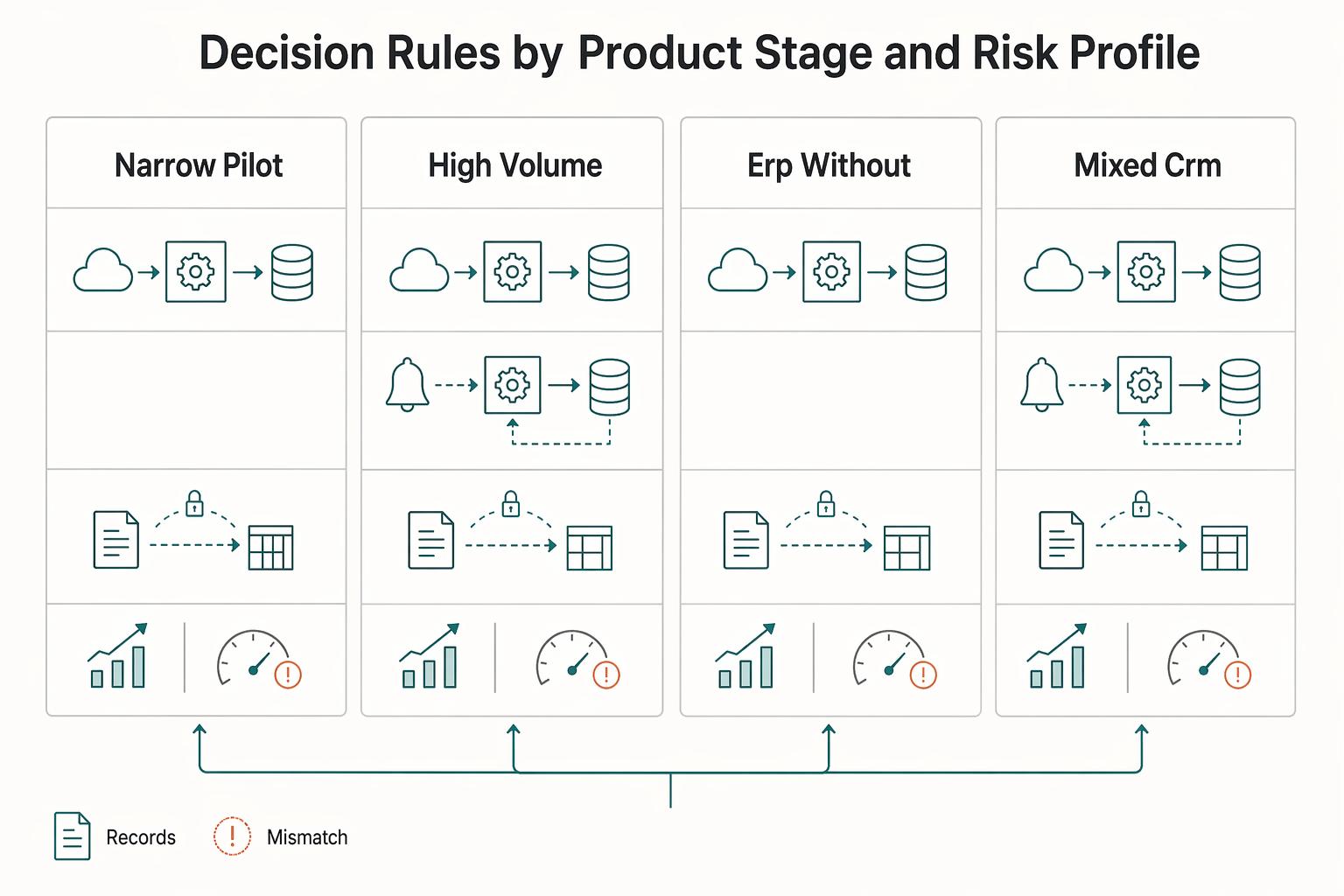
Decision rules by product stage and risk profile#
Choose the first lane from the ERP’s supported interface and each object’s latency target. API-led sync is useful when controlled reads and writes are supported; events add timely detection, while a supported batch import can remain the primary accounting posting lane when its lag and recovery meet requirements.
| Stage or scenario | Primary pattern to favor | Where batch/file still fits | What to verify first | Main failure mode |
|---|---|---|---|---|
| Narrow pilot, low event volume | Narrow supported API or scheduled batch lane meeting object requirements | Daily posting, backfill, limited reconciliation export | Idempotent writes and retry logging | Selected lane lacks row/request outcome evidence or duplicate-safe recovery |
| High-volume payouts, tight operational windows | Webhook-led event handling plus API fetch | Fallback exports, bulk reconciliation, audit snapshots | Delivery monitoring, replay handling, provider retry behavior | Exception handling lags until the next file cycle |
| ERP without reliable events | API polling with a modification-time/timestamp filter | Lower-frequency reference-data sync | Watermark tracking, overlap windows, duplicate suppression | Missed changes at polling boundaries or duplicate processing in overlap |
| Mixed CRM and finance sync | Split by object: event-led for payment state, scheduled sync for customer/reference data | Customer master updates, periodic enrichment | Explicit field/status ownership by system | Conflicting updates from unclear ownership |
For pilot-stage builds, keep your design simple and observable: synchronous API calls for critical writes, one constrained batch flow for accounting needs, and consistent idempotency keys on retries where supported.
For payout-heavy or marketplace flows, make event handling primary. Webhooks are the push signal, API retrieval confirms current object state, and batch remains a fallback or bulk lane. That matters when providers retry delivery, for example when non-2xx responses trigger repeated webhook attempts, and when bulk payout APIs have their own control constraints such as dedupe windows on batch identifiers.
When events are weak or unavailable in the ERP, polling is the practical bridge. Use incremental timestamp windows, persist a high-water mark, and prove that replaying an overlapping window does not create duplicate financial impact.
For architecture reviews, compare by money-state criticality, not by one universal pattern. Marketplace disbursements often need faster event reaction. B2B invoice settlement may use more scheduled posting in some flows, and mixed CRM or finance integrations often need split cadence by object type. The rule is simple: prefer the freshest available path for payment, payout, and record status, and reserve batch for bulk movement that can tolerate lag.
Hidden tradeoffs competitors gloss over#
The real cost is ongoing ownership after go-live, not the first connector. Use freshness where payment or payout state needs it, and decide up front how much manual operations each pattern can tolerate.
Where the cost actually hides#
Custom ERP integration work is not always one-and-done. SAP integration can require adapter development with SAP Cloud Integration SDK tooling, and Dynamics guidance includes custom-service patterns. That can leave your team owning service behavior, mapping changes, retries, and release compatibility.
| Approach | Where effort accumulates | Grounded example |
|---|---|---|
| Custom ERP integration | Service behavior, mapping changes, retries, and release compatibility stay with your team | SAP integration can require adapter development with SAP Cloud Integration SDK tooling; Dynamics guidance includes custom-service patterns |
| Flat file integration | Format ambiguity builds up across quoting, delimiters, null handling, date formats, or trailing columns | RFC 4180 notes CSV has historically had no formal specification |
| Webhook effort | Delivery-state monitoring, retry visibility, and alerting continue after implementation | Providers expose delivery states, and redelivery can continue after non-2xx responses |
Flat file integration can look cheap until format ambiguity accumulates. RFC 4180 explicitly notes CSV has historically had no formal specification. Teams can disagree on quoting, delimiters, null handling, date formats, or trailing columns while both claim they send "the same file." If files stay in scope, define column order, header version, timezone, decimal formatting, and empty-value rules, then reject invalid files before posting logic.
Webhook effort often shows up in operations, not just implementation. Webhooks reduce constant polling, but you inherit delivery-state monitoring, retry visibility, and alerting. Providers expose delivery states, and redelivery can continue after non-2xx responses, so unresolved delivery issues can surface later as reconciliation exceptions.
Control versus freshness#
API pull gives stronger control over read timing and state checks. In a synchronous pattern, the caller waits for the response, so you can fetch the current object, verify state, and then write the ERP update.
Webhooks improve awareness of asynchronous changes, but they are not an ordered ledger. Expect duplicates and out-of-order delivery. Confirm current status for projections through the API, serialize or version-check writes, and preserve distinct transaction history for financial postings as described in the reliability baseline.
API-led paths have constraints too. Dynamics documents service protection limits, and NetSuite shares account-level concurrency across web services and RESTlets. Confirm timeout and recovery behavior for the exact method; a client timeout does not prove the server abandoned the operation.
Reconciliation is where stale data becomes visible#
Stale billing-record state or delayed payment updates can show up as reconciliation exceptions, even when funds eventually settle. One common issue is two valid but out-of-sync system views of the same money movement.
Keep a compact evidence pack for each disputed item: provider object ID, event ID when available, delivery status, ERP document number, and timestamp of last successful sync or import. That gives teams a fast way to separate delayed delivery, duplicate processing, and mapping defects.
Decision checkpoint#
Use this as a checkpoint, not a universal threshold sheet. Set limits before build for lag, manual operations, and incident tolerance, then use the table to test whether the chosen pattern still fits.
| Pattern | Acceptable lag | Acceptable manual ops | Acceptable incident frequency |
|---|---|---|---|
| Flat file integration | End-of-day or scheduled-window lag is acceptable | Regular review of import errors and mapping changes is acceptable | Low-severity issues can wait until the next file cycle |
| API pull or API polling | Short scheduled lag or on-demand reads are acceptable | Teams can handle retry, timeout, and throttling follow-up during business hours | Intermittent read/write failures are acceptable if retries and logs are reliable |
| Webhook-led plus API fetch | Near-real-time updates are preferred for payment, payout, or exception handling | Manual work should be exception-only, with delivery monitoring in place | Short incidents are acceptable only if replay and duplicate suppression are proven |
If your acceptable lag is measured in minutes and manual-ops tolerance is near zero, favor webhook signal plus API confirmation from day one. If scheduled updates and human review are acceptable, API pull or a bounded file lane can be simpler to operate.
Failure modes that create platform debt#
Platform debt often comes from weak recovery design, not the connector itself. The recurring failures are predictable: duplicate financial actions, missed event handling, and imports that partially succeed and break reconciliation.
Duplicate processing is usually an idempotency failure#
Use provider idempotency for supported API writes, but preserve a durable business-operation key in your own store as well. Stripe accepts keys up to 255 characters and may prune them after 24 hours. A timeout is an unknown outcome: investigate with the original object/reference before retrying beyond the supported deduplication window or creating a new key. Provider retention is not permanent protection against a second financial action.
For webhook handling, duplicate delivery is expected and must be handled explicitly. Stripe says endpoints can receive the same event more than once and recommends logging processed event IDs to prevent reprocessing. A practical test is to replay the same event ID and confirm there is no second ERP posting, no second status transition, and no second downstream journal effect.
Replay collisions are the next failure mode. Stripe can automatically resend undelivered events for up to three days, while manual recovery returns events from only the last 30 days. If manual backfill runs while automatic retries are active, dedupe must hold across both paths. Already-processed events should still return success so retries stop.
Silent delivery gaps create stale finance truth#
A webhook is an HTTP callback, not proof that finance state is current. Use the detailed reliability sequence: verified durable receipt, duplicate suppression, serialized or version-checked processing, a current-state read for projections, and separate transaction history for postings.
Retry windows expose ownership gaps. PayPal documents up to 25 retries over 3 days for non-2xx responses, then marks delivery as failed. If failed deliveries are unowned, your ERP state and payout infrastructure state drift until reconciliation catches it.
The architecture red flag is no replay path and no dead-letter process. DLQs hold messages that could not be delivered or processed, and Azure Service Bus does not auto-clean them. If that queue can grow without an owner, unresolved money-state changes accumulate.
Batch sync fails in partial, messy ways#
Batch sync and file imports can fail in partial outcomes, not all-or-nothing runs. NetSuite documents cases where an after-submit script fails while the record is still created. SAP batch logs also separate processed transactions from incorrect ones. In practice, some records land, some fail, and teams lose trust in whether the run applied what it should.
For each batch, retain run ID, source-row business keys, counts, row outcomes and created ERP document numbers. Distinguish confirmed rejects from unknown outcomes. Reconcile unknown rows against ERP records before resubmission; a failed response can still accompany a created record. Replay only confirmed unapplied rows through the same duplicate-prevention controls.
Ownership failures are architecture failures#
Debt grows fastest when ERP and payments teams assume the other side owns recovery and final-state decisions. Make ownership explicit for schema, replay controls, and the authoritative billing lifecycle model.
| Area | Who should be explicit owner | Red flag |
|---|---|---|
| Event definition and required fields | One source of truth for event schema and validation | Different teams map the same status differently |
| Retry and replay decisions | Payments-side owner for delivery and dedupe controls | Manual backfills happen without duplicate checks |
| Final finance state for Invoice lifecycle | Named owner of authoritative state model | No agreed answer to which status wins during mismatch |
If your architecture review ends with no replay strategy, no DLQ handling, or no authoritative lifecycle model, stop and resolve that before go-live. Those controls determine whether a transient incident stays contained or becomes long-lived platform debt.
Reliability baseline for API and webhook sync#
Set this baseline before go-live: idempotent write calls, verified webhook signatures, and retries with bounded backoff. If one is missing, sync is not finance-safe under failure conditions.
The controls you should treat as mandatory#
| Control | What to require | Why it matters | Red flag if missing |
|---|---|---|---|
| Idempotent API writes | Provider-supported idempotency plus durable local business keys; reconcile unknown outcomes before retries beyond provider retention | Safe retries should not create duplicate charges, postings, or status updates | Timeout handling depends on manual inspection |
| Webhook authenticity checks | Verify the provider signature before trusting the event | A webhook is only an HTTPS POST unless you confirm sender authenticity and payload integrity | Your handler accepts events before verification |
| Retry policy with a cap | Bound attempts and total retry duration, use backoff with jitter, and route exhausted or unsafe retries to investigation | Retries are required, but unbounded retries can amplify incidents and queue growth | Infinite retry loops or no explicit attempt cap |
On writes, the key detail is provider-specific idempotency behavior:
- Stripe supports idempotent retry semantics and allows keys up to 255 characters.
- PayPal uses the
PayPal-Request-Idheader on supported REST POST calls. - Adyen allows idempotency keys up to 64 characters with a documented validity period of 7–14 days. Check company-account scope and regional endpoints; keys do not deduplicate across separate regions.
Do not assume every endpoint or provider handles retries the same way. Verify the exact API method before you build retry logic around it.
On incoming events, signature verification is mandatory. Stripe requires signature verification to confirm the event was not sent or modified by a third party, and PayPal is explicit that without verification you cannot validate the sender. Verification confirms authenticity, not exactly-once processing, so you still need dedupe keyed on event ID or a business key.
The event order that keeps finance state honest#
For a Payment received event, use this as the default order. It keeps the event as a trigger, not the final source of truth:
- Verify the webhook signature and durably record the event before acknowledgement.
- Deduplicate the event and route work through the object’s serialized or version-checked processing path.
- Fetch current state for status projection; retain required transaction history separately for postings.
- Apply the ERP change with a durable business key and capture its result; investigate unknown outcomes before replay.
An API fetch can supply the current state for a status projection, but it does not serialize concurrent workers or replace transaction history. Serialize updates per object or apply a checked version/cursor so an older fetch cannot overwrite a newer state. For journals, retain the distinct business transaction and reversal records needed by the accounting model; do not derive every posting from a final status snapshot. Use an atomic posting key or equivalent ERP-side uniqueness control and reconcile any unknown write before replay.
Observability and replay proof#
Require evidence, not just logs, for event-driven sync. At minimum, keep:
| Evidence to keep | What it should show |
|---|---|
| Per-event trace ID | Ingress through API fetch to ERP mutation (W3C Trace Context) |
| Retry counter and final disposition | processed, duplicate, failed verification, fetch failed |
| Reconciliation output | Payouts matched to settled transaction batches, preferably tied to event IDs or trace IDs |
Your go-live checkpoint is replay safety. Reprocess a known historical sample from the last 30 days where available, including already handled events, and verify no second ledger effect, no second closure, and no duplicate payout linkage. Stripe's undelivered-event guidance also requires duplicate protection and notes chronological catch-up via ending_before with auto-pagination. If replay safety fails, the retry design is not production-ready.
You might also find this useful: Webhook Payment Automation for Platforms: Production-Safe Vendor Criteria.
When ERP has no webhooks use polling and batch sync deliberately#
When your ERP cannot emit events, use incremental API polling for payment-critical changes and reserve batch sync for data that can tolerate slower freshness.
Where the API supports change tracking, use its documented cursor or timestamp filter. Verify lookback limits, page/result caps, deleted-record handling and the recovery route when an outage exceeds the window. A timestamp overlap alone does not prove that every changed object was returned.
| Sync target | Pattern | Guardrail to store | Main failure mode |
|---|---|---|---|
| Status, payment postings, payout updates | Frequent incremental polling (for example, hourly where supported) | Watermark plus processed-record keys | Boundary misses and duplicate reads |
| Less time-sensitive datasets | Lower-frequency batch sync | Last completed batch marker | Slow scans and stale attributes |
| High-volume changes across many resources | Transition toward webhook delivery | Event IDs and delivery status | Polling lag, request pressure, and rate-limit risk |
Persist a watermark only after every page in the bounded window has been durably captured. Use a stable tie-breaker or provider cursor for records sharing a timestamp, and select an overlap that covers the source’s clock and indexing behavior. Prove result completeness under caps; if needed, split bounded windows or use a supported export. Deduplicate overlapping reads and handle deletions explicitly.
If polling lag or request limits become unacceptable, assess whether the source actually supports usable events. Where it does not, optimize supported deltas and reconciliation or choose an appropriate scheduled import; events are an option only when available.
Related reading: Flat-Rate vs Tiered vs Per-Seat Pricing: A Decision Framework for SaaS Platforms.
ERP-specific constraints that affect pattern choice#
Pattern choice should be driven by four checks first: event support, API throttling or governance, file export stability, and API auth model. Those checks help you decide where flat file integration is acceptable and where an event-capable lane is safer for payment-critical state.
| ERP | Validate first | Architecture bias | Procurement checklist |
|---|---|---|---|
| SAP | Confirm whether your tenant will use SAP Event Mesh with queue, topic subscription, and webhook subscription setup. Verify S/4HANA Cloud communication arrangements and generated OAuth configuration. | Strong event option when Event Mesh is available and configured. Scheduled file exports can fit planned finance data, but are weaker for low-lag operational state. | Confirm whether Event Mesh and Integration Suite components are licensed and enabled, what approvals are required for queue or webhook setup, what tenant configuration steps are required, and who owns connector changes after go-live. |
| NetSuite | Check account governance because web services and RESTlet traffic share the same limit. Confirm OAuth 2.0 for new integrations, and note that as of 2027.1 no new TBA integrations can be created for SOAP web services, REST web services, and RESTlets. | API-led sync works when request budgets are explicit. High-frequency polling and broad full-sync jobs can become failure patterns under shared governance limits. | Set a governance budget for this integration, confirm the auth path and any TBA migration work, define required approvals, and assign connector maintenance ownership. |
| Microsoft Dynamics | Validate Business Events availability and your Finance and Operations version. Service protection API limits apply on version 10.0.19 and later; recurring integrations support document and file exchange. | Strong fit for mixed design: events for operational changes, file exchange for lower-freshness documents. | Confirm environment version, event configuration scope, any throttling review, required setup approvals, and whether ERP or integration engineering owns Business Events and recurring integration mappings. |
| Odoo | Verify whether your edition and workflow support automated actions that send to external webhooks. Account for XML-RPC/JSON-RPC removal timelines: Odoo 22 (fall 2028) and Online 21.1 (winter 2027). Check external API access eligibility for the actual pricing plan; hosted Custom-plan restrictions may apply. | Event path is possible, but roadmap risk matters if your design depends on older RPC endpoints. Batch or file lanes can fit slower sync where contracts are stable. | Confirm edition, modules, and customizations in scope, document endpoint transition planning before published deprecation windows, and assign ownership for custom adapters. |
| Acumatica | Check OAuth 2.0 or OIDC setup for REST API, SOAP API, or OData access without sharing user credentials. Validate whether webhook processing is needed for external formats that do not fit standard APIs. | API-first can be a clean baseline. Webhook processing matters when external message format drives integration design. | Confirm auth registration steps, whether nonstandard format mapping is in scope, required tenant setup and testing steps, and who owns custom API or webhook adapters. |
| Workday | Validate whether EIB or a real-time path fits the use case. Public docs position EIB for guided inbound and outbound integrations and Workday Orchestrate for real-time integrations and batch processing. | Batch or file lanes are reasonable for scheduled handoffs; real-time lanes matter when operational latency has direct cost. | Confirm which integration product your tenant can use, required approvals for tooling access, and long-term ownership for EIB or Orchestrate artifacts. |
Use a tenant proof test before architecture lock-in: trigger one finance object change, confirm delivery through the target pattern, and confirm the production auth path. This exposes constraint risk early, especially governance pressure in NetSuite, queue and auth setup friction in SAP, and lane-selection risk in mixed-capability ERPs such as Dynamics and Workday.
The practical rule is straightforward. If stale payment, payout, or billing-record state causes manual finance escalation, prioritize the ERP's event-capable lane and keep files for backfill, audit, or non-critical reference data. If scheduled freshness is acceptable and the file contract is stable, batch can remain a valid long-lived lane.
Related: Workday ERP for Payment Platforms: Finance and Payroll Module Integration Guide.
Implementation sequence that reduces rework#
Define canonical payment objects and field ownership first, then implement the narrowest supported lane that meets latency and recovery requirements. Add event triggers where they improve detection and use batch for scheduled posting, backfill or audit when appropriate.
Phase 1 starts with object ownership, not transport#
Before you build connectors, lock the canonical objects moving between ERP and the payment platform, for example billing records, payouts, and settlement status. Define field ownership up front so each field has one source of truth.
The Canonical Data Model matters because it reduces repeated pairwise mapping as you add systems. For each object, map ownership for identity, amount, currency, status, timestamps, and external references before any transform is implemented.
| Phase | Primary deliverable | Verify before moving on | Common rework trigger |
|---|---|---|---|
| 1. Canonical model | Definitions for billing records, payouts, settlement status, plus field ownership matrix | Each field has one source of truth and one external reference key | Same field mapped differently across file, API, and event lanes |
| 2. Selected supported lane | Critical reads and writes using the chosen API or scheduled import; add events where supported and useful | Request/row outcomes, duplicate protection, authenticity and replay safety demonstrated | An unsupported or unnecessarily broad second lane is introduced before recovery works |
| 3. Controlled batch lane | Scheduled posting, backfill and audit where required | Row outcomes and reconciliation complete; all writers share operation keys and ownership | Overlapping file/API writers create duplicate or conflicting effects |
If you cannot show one canonical status map for billing and settlement status, connector-shape decisions are likely premature. Teams often end up debating transport before ownership is settled.
Phase 2 should be narrow, reliable, and event-aware#
Implement the narrow supported lane selected for the pilot objects. If it uses APIs, verify request and write recovery; if it uses batch imports, verify row-level outcomes and safe replay. Keep scope small enough that ownership and auditability are clear.
Apply stable business keys and provider-supported idempotency to the selected writer. Add authenticated event intake only where available and useful, routing it through the same ownership and duplicate-prevention controls.
Test replay, unknown outcomes and reconciliation before widening scope. For a Stripe event lane, manual catch-up can overlap automatic retries, so duplicate protection must span both paths. For batch, reconcile unknown rows before any resubmission.
Phase 3 keeps batch in its lane#
Batch sync can remain the primary posting lane for a scheduled ERP workflow if its lag, row-level outcomes and recovery controls meet requirements. When API or event processing becomes the primary lane for the same objects, route batch catch-up through the same business keys and posting rules.
Retire overlapping paths that independently mutate the same finance state. Keep reconciliation exports read-oriented where practical, and govern any batch writer with the same field ownership and duplicate-prevention rules as other writers.
Go live only after four gates are real#
Use a short, strict go-live checklist. These gates should be visible to both engineering and finance ops:
- Replay test passed, including duplicate prevention during manual reprocessing
- Reconciliation report signed off, with transaction-level settlement evidence where available
- Incident runbook approved, with clear steps for delivery failures, retry spikes, and manual backfill
- Rollback path validated to a known-good deployment or connector revision
Keep one authoritative mutation path per object, even when several transports feed it. The selected batch, API or event lane must meet the agreed freshness and recovery requirements.
Decision checklist before production rollout#
Do not go live until four items are written and assigned: pattern fit, control ownership, fallback behavior, and ERP governance assumptions. If any of these is still informal, rollout risk is not controlled.
| Checklist area | What must be documented | Verification checkpoint | Red flag before go-live |
|---|---|---|---|
| Pattern fit | Why flat file integration, Application Programming Interface (API), or webhook is used for billing, payout, and settlement updates | Latency target and failure impact documented per object | Pattern chosen only because a connector already existed |
| Control surfaces | Idempotency design, retry owner, reconciliation owner across ERP and payout infrastructure | Duplicate delivery and repeated API submission tested without duplicate financial effects | Reconciliation ownership is assumed by both teams and owned by neither |
| Fallback behavior | Event-outage recovery plan with supported incremental polling plus controlled batch sync backfill | Catch-up from a known watermark and post-backfill reconciliation completed | Batch turns into a second uncontrolled live state path |
| Governance constraints | ERP limits, auth model, version assumptions, connector ownership | Assumptions log reviewed by engineering and finance ops | Unknown API limits, undocumented preview dependency, unstable export assumptions |
Confirm pattern fit against real targets#
Choose the pattern against your acceptable lag and incident risk, not implementation convenience. Flat file integration can still fit bulk movement, API gives direct request-response control, and webhook supports asynchronous event updates, but the decision should be tied to object-level timing and failure impact.
Document the exact method’s governance, pagination and result caps. NetSuite shares account concurrency across web services and RESTlets; a generic object-limit figure is not a complete budget for every API.
Confirm who owns retries and money-state correctness#
Assign owners explicitly for API retries, event replay, and payout reconciliation. For Stripe manual payouts, reconciliation responsibility sits with the integrator, so this should be named ownership, not a shared assumption.
Match the retry plan to provider retention. Stripe permits keys up to 255 characters and may remove them after at least 24 hours; reuse after pruning can create a new request. Retain your own durable operation key, keep the original parameters and reference, and reconcile an unknown outcome before any submission outside the provider’s protection window.
Confirm fallback behavior before the first outage#
Define fallback before incidents happen. If events fail, document the ERP-supported incremental polling mechanism, for example delta-link or similar cursor patterns where available, and when to switch from replay to controlled batch sync backfill.
Keep recovery windows explicit in ops planning. Stripe retries failed webhook deliveries for up to 3 days in live mode, and manual undelivered-event processing via Events API is limited to the last 30 days.
Confirm ERP-specific governance assumptions#
Document tenant-specific constraints per ERP, then sign them off. Examples that belong in the log include SAP Event Mesh webhook push capability, Business Central webhook change notifications, Dataverse retry strategy for API protection limits, Odoo webhook automation notes plus version-specific RPC deprecation timeline context, Acumatica webhook ingestion and OAuth 2.0 choices, and Workday API version lifecycle handling for preview changes.
Maintain a signed assumptions log for the ERP products, editions and tenant features actually in scope. Demonstrate those interfaces rather than requiring proof for every ERP named as an example.
Before you lock your production plan, compare your retry, reconciliation, and ownership model against Gruv's integration surfaces in the developer docs.
Conclusion#
The right integration pattern is an operations and risk decision first, and a coding preference second. Teams that optimize only for initial build speed often create avoidable issues later, including duplicate processing, stale state, and hard recovery work when finance and ERP records drift.
A practical path is to define decision rules, enforce reliability baselines, and sequence implementation to avoid early lock-in:
- Use supported flat-file imports for scheduled primary posting, backfill or bulk correction when their lag and recovery meet the object requirements.
- Use APIs for controlled, authoritative reads and writes.
- Use webhooks for event detection where faster state awareness changes operations, then confirm with an authoritative API read before final updates.
Treat reliability as a release gate, not a nice-to-have. Safe retries require idempotent requests, and webhook handling needs retry logic, duplicate suppression, and a dead-letter path for repeatedly failing messages. Your test should be explicit: replay events and retry writes, then verify you do not create duplicate financial effects.
Recovery ownership is critical. Stripe retries webhook delivery for up to three days in live mode and documents manual processing of undelivered events, so your team needs clear ownership for catch-up, replay, and reconciliation.
Before you lock choices, verify what your target ERP supports today. NetSuite recommends REST web services with OAuth 2.0 for new integrations while also supporting CSV import for bulk transfer. Workday publishes both SOAP and REST directories. Acumatica documents inbound webhook submission from external applications. Those differences should drive your design and migration path.
If you want the next layer of implementation detail, pair this with Gruv's ERP Integration Architecture for Payment Platforms: Webhooks APIs and Event-Driven Sync Patterns. Then review the ERP-specific Acumatica and Workday guides before you finalize interface choices.
If you want a practical architecture review for your ERP pattern choice and rollout risks, talk to Gruv.
Frequently Asked Questions
When should a payment platform choose `Flat file integration` over `Application Programming Interface (API)` or `Webhook` sync?
Choose flat file integration when your ERP supports batch imports and your primary need is scheduled, high-volume loads. Oracle FBDI is a concrete example of this model for importing voluminous external data into ERP tables. If you need more frequent or near-real-time visibility into changing states, use API or webhook patterns instead.
What is the practical difference between API sync and `Event-driven sync` for `Invoice` and payout state?
An API supports explicit reads and writes; polling is one way to use it for synchronization. A webhook pushes an event notification. Many teams use that event to trigger an API confirmation read, with serialized or version-checked updates and separate transaction history for ledger postings.
What should we do if our ERP does not support `Webhook` events?
First confirm what the source supports. If it offers change tracking, capture every page in a bounded window, handle result caps and deletions, and advance the watermark only after durable capture. Use a supported cursor or stable tie-breaker and tested overlap; plan recovery beyond the lookback window. Otherwise use a supported scheduled import or another documented read path that meets your latency and reconciliation requirements.
Why do ERP integrations stall even after a successful initial launch?
Because the initial launch usually proves only the happy path. Batch jobs can fail and require manual investigation; Dynamics recurring integration jobs are explicitly batch-mode and failed runs must be investigated.
How do we prevent duplicate processing when retrying API calls or replaying events?
Use supported provider idempotency with unchanged parameters and a stable operation key; keep a durable local record beyond provider retention. For example, Stripe may prune keys after 24 hours, while Adyen states a 7–14-day validity period and does not deduplicate across separate regional endpoints. Deduplicate events and financial business effects, and reconcile unknown writes before reissuing them.
What is a realistic migration path from `Batch sync` to near-real-time event handling?
A practical path is to keep batch sync for flows that can tolerate lag, then add incremental API sync for higher-priority state updates, and finally add webhook handling where near-real-time response matters most. Keep recovery procedures provider-specific, because delivery and replay windows differ: Stripe retries webhook delivery for up to 3 days in live mode, and event-list recovery is limited to the last 30 days.
Try a related tool
Researched and edited by the Gruv editorial team. Gruv builds cross-border billing, payouts, and finance-operations software for global businesses.
Sources
Includes 5 external sources outside the trusted-domain allowlist.
- developer.paypal.com/api/rest/webhookstrusted
- docs.stripe.com/webhooks/handling-payment-eventstrusted
- docs.stripe.com/api/idempotent_requeststrusted
- community-content.workday.com/en-us/public/products/platform-and-product-e...external
- developer.mozilla.org/en-US/docs/Glossary/APIexternal
- developer.mozilla.org/en-US/docs/Web/HTTPexternal
- docs.adyen.com/development-resources/api-idempotencyexternal
- docs.oracle.com/en/cloud/saas/netsuite/ns-online-help/chapte...external
Educational content only. Not legal, tax, or financial advice.
Related Posts

The Freelance Payment Penalty: A Modeled Audit of Platform Fees, FX Spreads, and Payout Delays
The money rarely disappears through a single, easy-to-spot fee. The real loss is stacked. A marketplace takes its commission, a processor adds a charge for international cards, a bank or payment company converts the currency at a spread, a platform holds the funds before release, and a wire sheds a little to intermediaries on the way in. Each layer looks defensible on its own, but the worker feels the combined result as a smaller deposit and a later payday.

How to Respond to a Subpoena for Business Records
Move fast, but do not produce records on instinct. If you need to **respond to a subpoena for business records**, your immediate job is to control deadlines, preserve records, and make any later production defensible.

A US Expat's Guide to Investing in UCITS ETFs to Avoid PFIC Issues
The real problem is a two-system conflict. U.S. tax treatment can punish the wrong fund choice, while local product-access constraints can block the funds you want to buy in the first place. For **us expat ucits etfs**, the practical question is not "Which product is best?" It is "What can I access, report, and keep doing every year without guessing?" Use this four-part filter before any trade: