
Quick Answer
Choose the model your team can price, invoice, and operate with minimal exceptions. In this SaaS pricing comparison, per-seat fits when value rises with user count, tiered fits when capability differences drive upgrades, and flat-rate fits when demand is relatively uniform. Validate with an evidence pack before rollout: segment mix, contract patterns, invoice exceptions, and discount requests. If growth requires constant overrides or manual fixes, the model is likely misaligned.
How to Choose Between Flat-Rate, Tiered, and Per-Seat Pricing#
The useful question is not which model looks smartest on a pricing page. It is which one your team can actually sell, bill, report on, and defend when growth targets and margin targets start pulling in different directions. For B2B SaaS, that usually means choosing based on how customers actually get value and how different segments buy, not on what a competitor happens to show.
That distinction matters because pricing fit affects real outcomes. Stripe notes that getting pricing right can improve retention, while poor fit can hurt conversion. So this comparison is less about theory than whether your pricing approach matches buyer behavior closely enough to support retention and conversion without creating billing friction.
A practical starting point is simple. Ask what grows when a customer becomes more successful with your product, then test whether your pricing approach makes that growth easy to price and explain. If value expands in different ways across customer segments, your pricing should flex with those differences rather than forcing every account into one pattern.
You also need to treat this as an operating decision, not just a go-to-market choice. Revenue wants a model buyers can understand quickly. Product needs clear package boundaries. Finance needs billing that does not depend on manual fixes every month. Platforms like Stripe Billing can support recurring billing, usage-based billing, and sales-negotiated contracts, but that flexibility does not rescue a model that is hard to invoice or explain.
One early red flag is copying the market without checking whether it matches your customer segments. The warning is straightforward: verify the model against your own account mix instead of assuming the market has already solved it for you.
Before you commit, pressure-test two things. First, look at your top accounts and ask what would trigger a larger invoice under your approach. Second, check the evidence pack behind the decision: customer segments, current contract patterns, invoice exceptions, discount requests, and where finance is already doing manual overrides. If your chosen model needs constant exceptions to close deals or produce clean invoices, it is probably the wrong one, even if it looks elegant on paper.
By the end of this guide, you should have a clear way to tie model choice to retention, conversion, and operating load so the decision holds up in both revenue reviews and finance reviews. For a step-by-step walkthrough, see Paddle vs. Stripe: A Comparison for SaaS Founders.
Flat-Rate vs Tiered vs Per-Seat at a glance#
The fastest way to choose is to match your value metric to how customer value actually changes. If value grows with team size, per-seat is often the clearest fit; if buyers mainly want predictability, flat-rate can fit; and tiered can work when segment and package differences are clear and operable. Packaging and billing units can coexist: a feature tier can charge per seat. Choose those two dimensions separately.
| Criteria | Flat-rate pricing | Tiered pricing | Per-seat pricing |
|---|---|---|---|
| Expansion path | Limited built-in expansion unless you upsell or reprice later | Expansion depends on customers moving to a higher package | Natural expansion as customer headcount grows |
| Price-to-value alignment | Best when customer need is relatively similar across accounts | Works when package depth maps cleanly to segment differences | Best when value scales with number of users |
| Forecastability | Usually high because price is fixed regardless of users or usage | Varies with plan mix | Usually strong when seat growth is steady and seat rules are clear |
| Discount pressure | Can increase when one price must fit very different accounts | Can increase if plan boundaries are hard to justify | Can increase around seat caps, minimums, or inactive seats |
| Implementation effort | Usually lowest if billing is truly one recurring charge | Depends on keeping packaging, pricing, and billing logic aligned | Depends on tracking seat changes and billing updates accurately |
| Best-fit customer shape | Narrow segmentation with similar buyer needs | Mixed SMB/mid-market/enterprise only when package boundaries are clear | Teams that expand by adding users |
| Finance burden in subscription billing | Usually lowest when exceptions are rare | Higher when plan exceptions and migrations increase | Higher than flat-rate when seat reconciliation is frequent |
| Common failure mode | Hides usage and cost-to-serve variance behind one price | Creates plan confusion | Misprices value when automation or outcomes drive value more than seat count |
| Avoid when | Account behavior varies widely but everyone pays one fixed amount | Buyers cannot clearly see why plans differ | Value is driven mainly by throughput or outcomes, not user count |
| Recommendation | Start simple only if unit economics are healthy and you can capture expansion later without a painful reprice | Use when package differences are real and defensible | Use when seats are the clearest value metric and customers accept seat-linked growth |
Run two quick checks before committing. First, ask what actually makes invoices grow in your best accounts: more users, deeper access, or neither. Second, test whether finance can run the model with minimal manual exceptions.
Examples can help, but they are still just examples: a fixed $99/month unlimited-user structure shows why flat-rate feels predictable, while $20 per user per month leading to $200 for ten users shows why per-seat is easy to explain. If your evidence pack already shows recurring exceptions, discount pressure, or contract workarounds, treat that as an early warning that model fit is off. Related reading: The Best Community Platforms for SaaS Businesses.
Stop mixing pricing strategy with pricing model#
Treat this as two decisions, not one: SaaS pricing strategy is how you set the price, and a pricing model is how you charge it.
| Decision layer | What question it answers | Examples |
|---|---|---|
| Pricing strategy | How should we set the price? | Value-based pricing, competitor-based pricing, cost-plus pricing |
| Pricing model | How should customers be charged? | Flat-rate pricing, tiered pricing, per-seat pricing |
| Other billing models | Which unit or combination should shape the bill? | Usage-based, hybrid or token pricing can stand alone or combine with feature packages |
The common mistake is using one strategy input, like competitor-based pricing, as if it also answers model design. It can help anchor price levels and expectations, but it does not decide whether charges should scale by seats, package depth, or a fixed subscription.
Use a quick check in your pricing doc: label each assumption as either strategy or model. If "match competitor" is being used to justify plan structure, seat logic, or upgrade paths, separate those decisions before you finalize packaging.
Usage-based and token pricing can be primary billing models. A hybrid can combine units, such as a base fee plus usage or per-seat charges. The three options compared here are common choices, not a required base for every product. Related: Pricing a SaaS MVP Project as a Freelance Developer.
How each model shapes expansion revenue and margin quality#
Expansion revenue and margin quality improve when your pricing model lets the bill move with customer value. If pricing stays rigid while customer behavior changes, revenue gets less predictable and operating friction rises.
This is not just packaging. It shapes how value is monetized over time, and the choice affects whether your growth path stays operationally clean or starts creating avoidable friction. Sage also notes that the right approach supports predictable revenue and long-term growth, while the wrong model or rigid billing setup can slow teams down.
| Model | Expansion signal you need to define | Margin-quality check | Guardrail if signal is weak |
|---|---|---|---|
| Per-seat pricing | What user growth should change the bill | Are usage, support load, and billed seats moving together? | Add a second charge component tied to actual consumption or feature access |
| Tiered pricing | What product value should trigger plan movement | Are customers getting higher delivery/support load without plan movement? | Tighten tier boundaries and upgrade triggers |
| Flat-rate pricing | What events should increase revenue over time | Are higher-demand accounts staying at the same price for long periods? | Add a hybrid component so growth has a pricing path |
Run a quick margin stress test before you keep or launch a model:
- If top accounts grow materially next quarter, does the bill change automatically or only through manual intervention?
- Which cost lines rise first when account demands rise?
- Where is friction already visible: finance, support, sales ops, or billing operations?
- Is variation in customer demand matched by variation in how you charge?
If your review shows demand changing faster than revenue under a single price, treat pure flat rate as a risk signal and consider a hybrid structure. Related context: International Expansion for SaaS With a Three-Stage Operating Framework.
Sales friction and packaging complexity in real buying cycles#
A pricing model can look solid in a margin review and still slow down real deals if the buying motion and packaging do not match how customers buy. In practice, flat-rate pricing can reduce early decision overhead, tiered pricing works when plan boundaries are clear, and per-seat pricing is easier when the buyer already plans by users or teams.
| Model | Typical buying motion | Where friction shows up | What you should verify |
|---|---|---|---|
| Flat-rate pricing | Quick path when scope is straightforward | Friction rises when buyers need procurement-fit terms, legal review, or non-standard scope | Check how often standard quotes close without exceptions |
| Tiered pricing | Buyer compares packages by capability | Friction rises when feature fences are unclear or packages are hard to compare | Review calls and proposals for repeated plan-clarity questions |
| Per-seat pricing | Buyer maps price to rollout by user count | Friction rises when seat scope and future growth assumptions are debated | Compare proposed seat counts with actual rollout plans |
For most B2B SaaS teams, Good-Better-Best packaging is still a practical public structure. It keeps options scannable for buyers and usable by sales. But each step up has to be obvious; if sales has to repeatedly reinterpret plan differences live, packaging is already adding cycle friction.
That is usually where list price should stop doing all the work. In enterprise cycles, adding higher tiers alone is not enough to convert larger buyers. Once deals involve formal procurement, legal review, multi-decision-maker approvals, multi-year terms, or complex integrations, sales-negotiated contracts should override a rigid public package structure.
Treat these red flags as operational signals:
- Too many tiers to compare cleanly.
- Unclear feature fences between plans.
- Seat minimums that do not match practical rollout scope and create early negotiation drag.
A practical checkpoint is your last 10 to 15 open or recently closed opportunities. If friction clusters around plan confusion, seat-count negotiation, or enterprise requirements your list pricing cannot absorb, simplify the public offer and route larger accounts to negotiated terms sooner.
Billing and finance operations decide whether your model survives#
A pricing model only survives if finance can run it cleanly end to end in recurring billing.
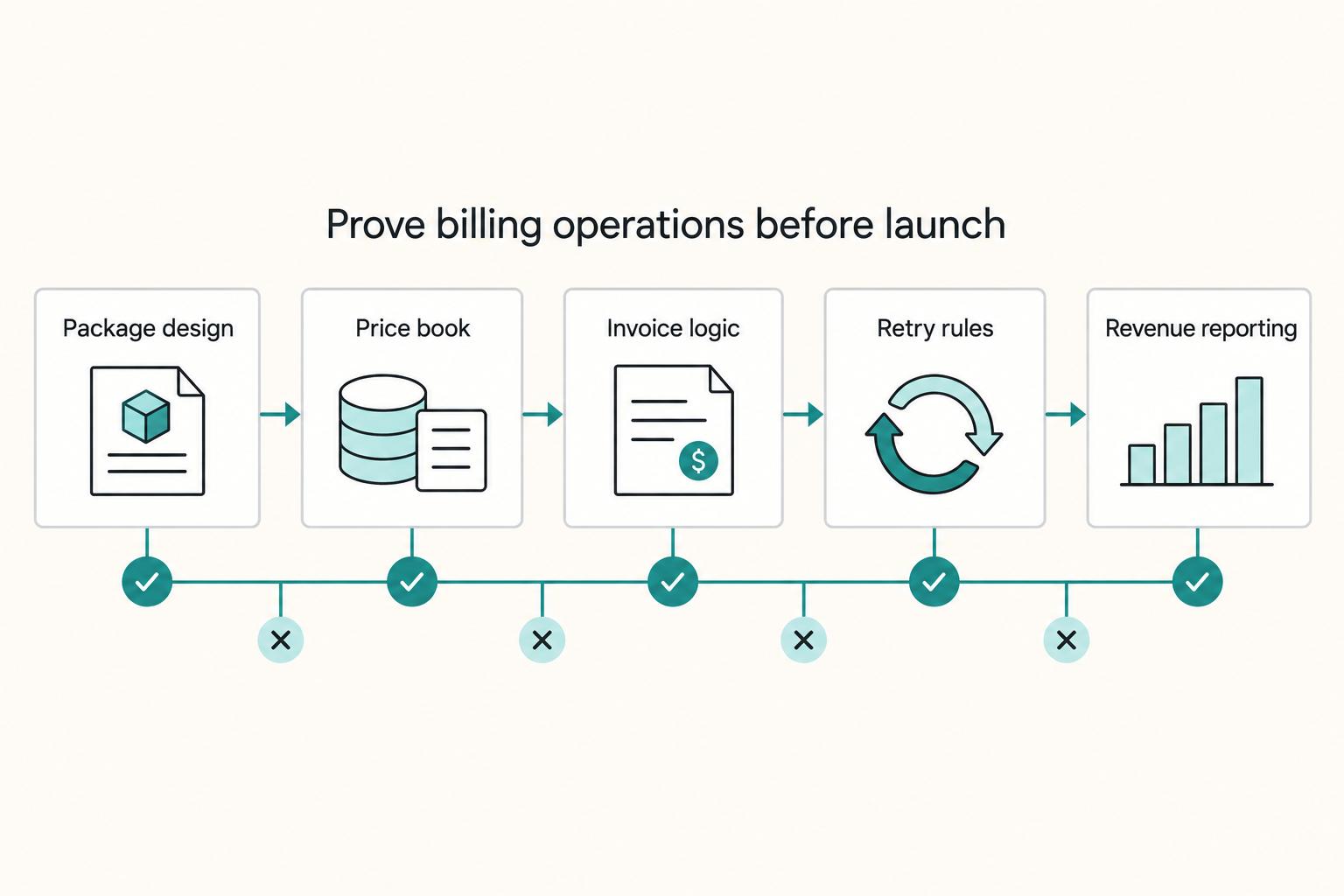
Follow this operating order, and do not skip steps: package design -> price book -> invoice logic -> dunning/retry rules -> revenue reporting. A quick stress test is whether an operator can take a signed order, map it to one approved price-book entry, and predict invoice lines without interpretation.
| Model | Implementation load | Where finance pressure usually appears | What to lock before launch |
|---|---|---|---|
| Flat-rate pricing | Lowest, until exceptions accumulate | Custom terms and one-off overrides can create reconciliation noise | Discount policy, exception approvals, renewal terms |
| Tiered pricing | Moderate, if package boundaries are clear | Misclassification risk when sales language and billing labels drift | Distinct tier identifiers and plain-English plan definitions |
| Per-seat pricing | Highest ongoing operational load | Mid-cycle seat changes and true-up handling can trigger invoice disputes | Seat source of truth, cut-off timing, approval workflow |
Include payment costs in scenario margins. Check your account country, contracted rates, payment-method mix, cross-border/FX charges, refunds and disputes against Stripe’s pricing. Billing, tax and other product charges may be separate from payment processing.
If your business also pays connected users, evaluate the actual Connect pricing arrangement separately. This is an additional marketplace/platform flow, not a fee every SaaS subscription incurs. Record who sets prices, which charges the platform pays and which the connected account pays.
Scenario-based decision rules for founders and revenue leaders#
Choose a pricing model as a testable hypothesis, not a permanent verdict. Start with company shape, run conservative/baseline/optimistic scenarios, and keep only the option that supports healthy expansion without breaking your MRR/ARR signal quality.
| Company shape | Candidate starting point | What to test in scenarios | Keep if... | Rework if... |
|---|---|---|---|---|
| Early single-product SaaS | Flat-rate or light tiers | Base, expansion, contraction, and reactivation behavior across conservative/baseline/optimistic cases | Expansion is visible without unstable assumptions | You need aggressive assumptions to make retention and expansion work |
| Multi-segment B2B SaaS | Tiered packaging hypothesis | Whether segment differences actually produce cleaner expansion paths in the model | Tier movement improves expansion without distorting reporting | Cohorts blur together and expansion is hard to attribute |
| Sales-led enterprise motion | Controlled set of commercial patterns | Whether negotiated terms still keep scenario tracking usable month to month | Finance and revenue teams can monitor outcomes weekly and update forecasts monthly | Exception volume makes outcomes hard to compare or trust |
| Product-led expansion | Per-seat or hybrid hypothesis | Whether adoption growth maps clearly to expansion in MRR/ARR streams | Expansion holds under conservative assumptions | Expansion depends on optimistic assumptions or weakens under baseline churn |
Use directional rules as a starting point, then prove them in your own numbers. If value appears to rise with more users, test a per-seat path; if value appears to rise with deeper capability needs across segments, test tiered packaging. Keep either only if retention and expansion stay credible across all three scenarios.
Use retention math to accept or reject the model#
Illustrative arithmetic: starting with $100,000 of recurring cohort revenue, 5% churn each month leaves $100,000 × 0.95^12, or about $54,036, after 12 monthly changes. If 2% expansion offsets churn on the same starting monthly balance, the net factor is 0.97, leaving about $69,384. This simplified example excludes new customers and is not a forecast.
| Metric | Practical check | Decision note |
|---|---|---|
| GRR | Starting cohort revenue minus churn and contraction, divided by starting revenue | Define the period; expansion and new customers are excluded |
| NRR | Starting cohort revenue plus expansion minus churn and contraction, divided by starting revenue | Define the period; new customers are excluded |
| LTV:CAC | Estimated customer lifetime gross profit divided by acquisition cost | State gross-margin, churn and attribution assumptions; avoid mixing periods |
Set decision targets from your business stage, cohorts, margins and cash constraints. NRR above 100% means cohort expansion exceeds losses over the stated period; it is not a universal launch requirement. Use LTV:CAC in that order, and test how uncertain lifetime and acquisition-cost assumptions change the result.
Keep operating complexity inside your actual capacity#
Set an operating constraint before rollout: do not add contract or pricing complexity your team cannot track consistently in weekly metrics and monthly model updates. A simpler commercial system you can run reliably is usually safer than a richer one you cannot measure cleanly.
Add usage-based or hybrid only when the current metric stops explaining value#
Introduce usage-based or hybrid pricing when your current structure stops reflecting expansion, contraction, or reactivation patterns in a believable way. Make the change in controlled lanes first, for example new deals or renewals, and compare results through weekly tracking plus monthly model updates before broad rollout. For a deeper design pass, read A Guide to Usage-Based Pricing for SaaS.
If you want a related pricing breakdown, read How to Price a UI/UX Audit for a SaaS Company.
Migration checkpoints when your current model stops fitting#
Switch pricing only when pricing friction is recurring and measurable, not when the model simply feels old. Before you migrate, make sure the benefits of switching clearly outweigh the price-related switching costs your customers will face.
| Migration step | What to define or review | Grounded detail |
|---|---|---|
| Segmentation hypothesis | Which segments are overpaying, underpaying, or hitting value ceilings | Start with diagnosis, not redesign |
| Package redesign | Define it around customer segmentation | Not generic tier templates |
| Contract transition plan | Who is grandfathered, who moves at renewal, and what incentives offset switching costs | Make sure the benefits of switching outweigh switching costs |
| Billing configuration | Price book entries, proration rules, invoice line labels, and renewal terms | Update before rollout |
| Customer communication | Internal sales/CSM brief, renewal notice, updated order form, then FAQ | Sequence customer communication |
| Operating owner | Document the owner for each step | So handoffs do not break execution |
| Pilot validation | Pilot outcomes, support ticket patterns, and renewal risk by segment | Use a pilot cohort on new deals or near-term renewals |
| Billing rehearsal | Run one mock renewal, one upgrade, and one mid-term change end-to-end in billing | Verify before scaling |
| Review cadence | Monthly review for variance and top actions; quarterly review for larger contract, workload, and guardrail decisions | Treat migration as a cadence, not a one-off project |
Start with diagnosis, not redesign. Write a segmentation hypothesis first: which segments are overpaying, underpaying, or hitting value ceilings under your current model. If discount pressure is growing, run competitor-pricing research with both primary and secondary sources so you separate positioning issues from packaging issues.
Use a practical migration checklist:
- define the package redesign around customer segmentation, not generic tier templates
- set a contract transition plan (who is grandfathered, who moves at renewal, and what incentives offset switching costs)
- update billing configuration (price book entries, proration rules, invoice line labels, and renewal terms)
- sequence customer communication (internal sales/CSM brief, renewal notice, updated order form, then FAQ)
- document the operating owner for each step so handoffs do not break execution
Before broad rollout, verify the change with a pilot cohort on new deals or near-term renewals and review three signals: pilot outcomes, support ticket patterns, and renewal risk by segment. Run at least one mock renewal, one upgrade, and one mid-term change end to end in billing before scaling.
Treat migration as a cadence, not a one-off project. Keep a monthly review for variance and top actions, and a quarterly review for larger contract, workload, and guardrail decisions so gains do not erode.
If the change touches international billing, pair this work with multi-currency pricing. If value growth is no longer captured by seats or tiers alone, evaluate usage-based pricing next.
Conclusion#
The right choice is the one that matches how customers buy and use your product, then holds up in real contracts and renewals. If you want the short verdict, use per-seat pricing when charging per user matches how adoption grows. Use tiered pricing when customers differ more by capability needs than by headcount. Treat flat-rate pricing as a simplicity-first option.
That matters because pricing models do more than set revenue mechanics. They shape whether prospects sign, whether existing customers upgrade, and whether deals stall in procurement. Pricing also filters the kind of customer you attract, so borrowing a competitor's structure without checking fit can create avoidable friction.
Before rollout, ask three blunt questions:
- Can the buyer predict the bill? Enterprise buyers tend to want predictable costs. If your pricing has variable elements, make sure the customer can still understand what will happen month to month.
- Does expansion follow the same unit you charge on? If adoption grows by adding teammates, per-seat can be a cleaner fit. If expansion happens through deeper capability adoption, tiers can map better.
- Will this reduce or add operational friction? If your pricing logic is hard to explain in contracts or billing, procurement and renewals can slow down.
You should also pressure-test failure modes before rollout. For each model, define what a bad outcome would look like for your buyers and your business, then validate with a pilot cohort. Review contract conversion, upgrade behavior, procurement friction, and whether customer mix shifts in ways you actually want.
Use the comparison table and decision rules from this guide to choose a SaaS pricing model you can defend in both growth and profitability reviews. The point is not to find a theoretically elegant answer. It is to align monetization with buyer behavior while keeping execution clear enough to run consistently.
If your rollout also involves global billing complexity, pressure-test this choice with your billing setup before launch, especially if you are considering a hybrid approach. If that is your next constraint, pair this decision with How to Handle Multi-Currency Pricing for Your SaaS Product.
Frequently Asked Questions
What is the practical difference between flat-rate pricing, tiered pricing, and per-seat pricing in SaaS?
In practice, these models differ by what they anchor price to: one base package, defined plan levels, or number of users. This guide does not establish one model as universally best, so the practical choice is the one that best matches customer value and segment needs.
Which model is usually best for a growing B2B SaaS company with mixed customer sizes?
There is no single model that is usually best in all cases. Stripe’s guidance is to keep SaaS pricing flexible across customer segments, so for mixed customer sizes the decision should focus on which structure keeps that flexibility while staying clear to operate and bill.
When should a company move from flat-rate pricing to tiered pricing?
Consider changing packaging when segment differences repeatedly cause discounting, unclear upgrades or rising cost to serve. Test the new offer on an appropriate cohort and honor existing contract terms; no universal switch threshold applies.
Is per-seat pricing better than tiered pricing for expansion revenue?
Per-seat pricing and feature tiers can coexist. Seats support expansion when additional users receive value; tier upgrades support expansion when customers need deeper capabilities. Test both against actual adoption and costs.
Can you combine per-seat pricing with usage-based pricing in a hybrid pricing model?
Yes. A hybrid pricing model is commonly defined as a base subscription plus usage fees. The key tradeoff is whether that combination improves value alignment or just adds complexity.
How do sales-negotiated contracts change the model decision for enterprise accounts?
They do not remove the need for a clear core model, but they do increase operational complexity. Stripe’s high-level guidance is that billing can span recurring, usage-based, and sales-negotiated contracts, so model decisions should account for that complexity without over-customizing by default.
Try a related tool
Researched and edited by the Gruv editorial team. Gruv builds cross-border billing, payouts, and finance-operations software for global businesses.
Sources
Educational content only. Not legal, tax, or financial advice.
Related Posts

How to Handle Multi-Currency Pricing for Your SaaS Product
Multi-currency SaaS pricing needs a clear customer price and a traceable path to cash. Separate the currency shown and charged from settlement and bank receipt before adding markets.

SaaS Usage-Based Pricing for Predictable Cashflow and Fewer Disputes
If you are considering **saas usage-based pricing**, treat it as an operations and collections decision first. Pricing works best when the usage unit can be measured, shown on the invoice, and explained by someone outside your product team.

How to Price a UI/UX Audit for a SaaS Company
If you need to price UI/UX audit work for a SaaS client, the job is not finding a magic market number. It is turning uncertain scope into a quote you can defend, a Statement of Work (SOW) the client can approve, and payment terms that do not leave you carrying the risk.