
Quick Answer
Finance ops for a payment infrastructure business should be structured as a live operating-control function, not just a month-end reporting task. Map every cash-affecting event from invoice through settlement and payout, name the authoritative systems of record, and build layered reconciliations with clear owners, approval boundaries, and exception paths. Tie revenue recognition and executive reporting to operational events and ledger lineage, and block close when unresolved breaks exceed policy.
How to Set Up Finance Ops for a Payment Infrastructure Business#
Treat payment infrastructure accounting as an operating-control problem first and a reporting problem second. Money movement can clear, settle, or trigger payout activity before month-end. That means finance operations need ledger integrity, reconciliation, settlement tracking, and payout controls, not just clean journal entries after the fact.
That distinction matters because payment activity is not just an accounting output. Supervisory and payment-system guidance frames settlement and related processing as operational activity with explicit risk-management expectations. The OCC defines merchant processing activity as settlement of card transactions for merchants. Payment standards also expect teams to identify plausible internal and external operational risks and mitigate them. If cash movement is live, your controls need to be live too.
Step 1. Start with the real operating surface#
Start before close. Clearing includes transmitting and reconciling payment orders before settlement, so several control points can pass before period-end reporting appears. Treat invoicing, provider events, ledger posting, settlement, and payout handling as one chain where applicable, not as separate tasks owned by different teams.
Use a simple rule: if an event can change cash position, payout status, or reporting output, it belongs in finance operations design. When those links stay implicit, exceptions are harder to explain during close, audit support, or incident recovery.
Step 2. Define the outcome you actually need#
The goal is reliable reporting that still holds up when operations break, not faster bookkeeping. The PCAOB defines internal control over financial reporting as a process that provides reasonable assurance about reliable reporting. Your income statement and P&L are only as trustworthy as the event trail beneath them.
Expect every material reported amount to trace to a recorded event, a matching reference, and a reviewed exception path when posting fails. The SEC framing is direct: an income statement covers period revenue and the related costs and expenses. If that output cannot be bridged to underlying payment events, the issue is a control design gap, not just a reporting gap.
Step 3. Check the foundations before redesign#
Before you change the process, verify three basics:
- Authoritative records are named. Define which source owns invoicing, which source owns the ledger, and where settlement and payout status are treated as final for operations.
- References can be matched. Confirm internal IDs, provider references, and posting records can be joined without guesswork.
- Exceptions have an owner. If settlement and ledger states diverge, or payout status changes after release, assign clear investigation and resolution ownership.
Practical checkpoint: trace a small sample of recent transactions from invoice or charge creation through settlement into reporting. If even one record cannot be explained end to end with evidence, do not assume scale will fix it.
Step 4. Design for failure, not only happy-path volume#
Build for known breaks from day one. Payment-system guidance emphasizes security, operational reliability, and scalable capacity. Your process should explicitly handle delayed settlement information, unmatched payment orders, and timing gaps between operational events and period reporting.
One common failure mode is treating exceptions as month-end cleanup. If settlement reaches one state but ledger or payout records show another, quarantine the flow and resolve it before close. This guide stays focused on practical finance-ops design: workflow order, clear verification points, and recovery actions that keep operations and reporting auditable.
We covered this in detail in Supply Chain Finance for Marketplaces: How Early Payment Programs Can Attract and Retain Sellers.
What changes when accounting moves from SaaS to payment infrastructure#
The main change is operational: once settlement or payouts can move cash before close, finance operations often need intraday controls, not just a month-end explanation.
Step 1. Treat cash movement as a live control surface#
Treat cash movement as a live control surface, not a period-end artifact. Month-end close finalizes the previous month's activity, but some payment rails run continuously. FedNow is designed for 24x7x365 processing, supports near-real-time transfer, and settlement is final once processed. Same Day ACH also expanded its submission window by an additional two hours every business day.
If your business can settle or release payouts intraday, you likely need to track settled-but-unposted items, posted-but-unsettled items, and payout statuses through settlement. Use a simple checkpoint: can you explain cash-affecting exceptions during the day without waiting for close reports? If not, treasury may see the movement first, the ledger may lag, and close turns into an exercise in proving timing differences.
Step 2. Tie revenue logic to operational events#
Revenue logic should follow operational events, not just invoices. ASC 606 still governs recognition, with a core principle focused on transfer of promised goods or services. For usage-based pricing, that means estimating variable consideration subject to a constraint. Payment companies also face judgment on how revenue and fees are presented, so ledger event rules need to be explicit.
For each product line, document three points: the event that creates billable usage, the event that updates the estimate, and the event that settles cash. This matters in hybrid models where invoicing, service delivery, and settlement can happen on different dates. If you key revenue off cash settlement because it is easier to source, reporting can misstate performance.
Step 3. Extend reconciliation beyond invoice matching#
Reconciliation often needs to go beyond invoice matching. In payment infrastructure, it can span invoicing, provider events, settlement batches, and payout outcomes. Provider reporting reflects that structure. Stripe payout reconciliation is organized around transactions in each payout settlement batch. Adyen settlement details can support reconciliation across multiple merchant accounts.
Run one end-to-end test for each flow: trace a transaction through the internal ID, provider reference, settlement batch ID, and resulting bank movement or payout record. If any leg depends on manual spreadsheet matching, treat it as a scale risk. Once money can move before close, many teams shift finance operations toward an operating-control discipline that supports reporting, not a reporting-only discipline.
If you want a deeper dive, read Lean Accounting for Payment Platforms: How to Run Efficient Finance Ops Without a Big Team.
What to prepare before you change finance operations#
Before you redesign workflows, lock down authority and evidence so control decisions stay consistent when records conflict.
Step 1. Name the system of record#
Name the authoritative system of record for invoicing, ledger, reconciliation, and treasury, and document it. If multiple tools can change balances or status, redesign work can create new timing breaks instead of removing old ones.
Run a one-day verification check: confirm records are updated daily, kept separate by day, and traceable so subsidiary detail balances to the general ledger. If you cannot isolate one day cleanly, pause downstream close changes.
Step 2. Collect current close artifacts first#
Collect the artifacts your close already depends on: the current close checklist, income statement mappings and P&L dimensions your team already uses, and exception logs for failed settlements. Keep the raw versions, even if they are messy.
For ICFR, management is responsible for maintaining evidential matter and documentation that supports its assessment. Preserve today's evidence trail first, then redesign it.
Step 3. Set policy boundaries before payout changes#
Set policy boundaries with finance and risk owners before you change payout logic. Make responsibility and delegated authority explicit for payment operations, payout approvals, and escalation rights.
For payment controls, a common baseline is to separate duties across access setup, payment initiation, and payment approval, and to document dollar limits for who can enter or approve instructions.
Step 4. Baseline metrics before rollout#
Baseline metrics before rollout so you can tell whether the redesign improved outcomes or just moved failures. Track reconciliation timing, settlement lag, and exception response time. If ACH is in scope, baseline unauthorized returns separately: Nacha sets a 0.5% unauthorized return-rate threshold measured over the preceding 60 days or two calendar months.
Related: Accounting Best Practices for Payment Platforms: A Controller's Guide to Scalable Finance Ops.
Map every event from invoice to payout#
Map the full path from invoice to payout as explicit event transitions, with IDs and ownership at every step, so reconciliation breaks show up before close.
Step 1. Build the normal event sequence first#
Start with your standard path and show which event triggers the next one.
A practical baseline is: invoice created in draft -> invoice finalized to open -> payment confirmed -> internal records updated -> settlements matched -> payout execution triggered. Keep this as your operating map, not a universal provider model.
Use provider lifecycle states exactly as they exist. Stripe invoices move from draft to open when finalized, then to paid when payment succeeds. If payment fails or is partial, the invoice remains open. Stripe PaymentIntent states can include succeeded, requires_capture, requires_action, or requires_payment_method.
Verification check: trace one completed recent transaction end to end and confirm you can tie invoice ID, payment object, internal record, settlement line, and payout record without ad hoc workarounds.
Step 2. Attach evidence fields to every event#
Every mapped event should carry the identifiers and ownership details you need to resolve conflicts quickly. A practical template includes:
| Field | Examples | Use |
|---|---|---|
| Internal reference ID | invoice ID, order ID, or internal transaction key | Internal matching |
| Provider reference | Stripe PaymentIntent ID or Adyen PSP reference | Provider matching |
| Merchant reference | Where supported | Cross-report tracking |
| Owner | Assigned for investigation and signoff | Conflict resolution |
| SLA | Timed review and escalation | Review timing |
| Recovery path | For unmatched or delayed events | Resolution path |
For asynchronous flows, record which webhook event changed status and when. If you use Adyen, keep both the merchant reference and the 16-character PSP reference for cross-report tracking. If you use Stripe, keep the invoice ID, PaymentIntent ID, and webhook event record linked in the same chain.
Step 3. Map the exception states that break close#
Model exception states explicitly. This is usually where close and payout logic diverge. Include at least:
| Exception state | Article detail | Timing/status note |
|---|---|---|
| Partial payment | Invoice can remain open after some cash activity | Cash activity may not close the invoice |
| Manual capture | Payment can be authorized but still requires_capture | Authorization can exist before capture |
| Capture timeout risk | Uncaptured PaymentIntents are canceled after 7 days by default | Default timeout applies if not captured |
| Settlement timing lag | Settlement availability can be later than booking date | Availability can trail booking date |
| Payout returns | Payouts are typically returned within 2-3 business days | Return timing is not immediate |
Operational rule: if customer-facing status changed but cash is not yet settlement-available, keep it out of payout triggers.
Step 4. Classify reconciliation ownership and close impact#
Classify each event by reconciliation owner and close impact so escalation is immediate.
| Event type | Source tool | Reconciliation owner | Close impact | Blocker severity |
|---|---|---|---|---|
Invoice finalized to open | Invoicing platform | Billing or accounting | Revenue and receivables can be misstated if status is wrong | Medium |
Payment confirmed or moved to requires_capture | Provider event feed or webhook | Payments ops with accounting review | Cash expectation and customer status may diverge | High |
Settlement booked or SentForSettle | Provider settlement reports | Finance ops or treasury | Timing differences can affect cash and clearing reconciliation | High |
| Payout executed | Payout platform or treasury records | Treasury or payments ops | External cash movement and transaction-to-payout reconciliation need to stay aligned | Critical |
| Payout returned | Provider payout reports | Treasury with operations follow-up | Returned funds require payout and reconciliation follow-up | Critical |
The goal is not a cleaner diagram. It is an event map that makes status, ownership, and reporting readiness clear for every transaction path.
This pairs well with our guide on Digital Platform Trends 2026: What Payment Infrastructure Shifts Mean for Marketplace Operators.
Define ownership and approval boundaries across teams#
Once events are mapped, make control authority explicit. Each material decision should have a defined owner, an approval path, and an escalation route so cash-impacting issues are not handled ad hoc.
Step 1. Assign a primary owner for each control point#
Split responsibilities so key controls are not owned end to end by the same function. Segregation of duties is meant to reduce error, misuse, and fraud risk, and payment control guidance separates initiator, approver, and reconciler roles. In many organizations, financial operations sits under controller oversight, with A/P, treasury, and A/R responsibilities kept distinct.
| Team | Primary decisions | Should not own alone |
|---|---|---|
| Accounting | Independent reconciliation review | Initiating or releasing payouts |
| Treasury | Cash release and bank movement | Customer credit-risk decisions |
| Receivables and credit | Customer credit-risk review | External payout release |
| Accounts payable / payments ops | Payment instruction preparation and initiation | Approval and reconciliation of the same payout action |
Two boundaries are especially useful in practice: receivables and credit should own customer-side credit-risk decisions, and payment instruction preparation should stay separate from treasury release authority.
Step 2. Separate initiation, approval, and reconciliation#
Do not let one person initiate, approve, and reconcile the same payout action. Dual control means more than one individual participates in payment initiation and release.
Document at least these handoffs:
- Initiation by an authorized payments or finance-operations role.
- Approval by a different authorized person.
- Reconciliation by a separate role after settlement or payout status is final.
For each exception action, keep clear evidence: the role or employee, approval time, transaction or provider reference, reason for action, and reconciliation outcome.
Step 3. Scale approvals to risk#
Use risk-based approvals instead of one blanket rule. Control rigor should match transaction risk and organizational complexity. In practice, routine and well-understood routes can use lighter approvals, while higher-risk changes should get additional review.
Keep the goal practical: put the strongest controls where cash loss, fraud exposure, or customer impact risk is highest.
Step 4. Publish escalation authority and information flow#
Publish who coordinates response, who has authority to act, and how information moves during incidents.
A simple matrix should cover common payment incidents and escalation paths so action does not stall when exceptions occur.
Build reconciliation controls and the evidence pack#
Once ownership is clear, set explicit pass-fail rules and treat unresolved breaks as a close gate, not rollover cleanup.
Step 1. Run linked reconciliations across three control views#
A practical pattern is three linked checks: was it paid, was it settled correctly, and did it land correctly in the books and payout records.
| Reconciliation layer | Required fields | Frequency | Pass/fail criteria | Downstream P&L risk |
|---|---|---|---|---|
| Invoice-to-payment | Invoice ID, customer ID, gross amount, currency, payment status, provider reference | Daily and again at close | Each posted invoice or payment event matches, or is in an approved exception state with owner and reason | Revenue, AR, fee completeness |
| Payment-to-settlements | Payment ID, provider reference, settlement batch or date, fees, refunds, chargebacks, net amount | Daily, and more often at high volume | Payment events tie to settlement records within documented timing lag and expected fee logic | Processing fees, chargeback expense, clearing balances |
| Settlement-to-ledger/payout | Settlement batch ID, payout ID, bank date, journal entry ID, balance transaction or equivalent, currency | Daily and before reporting signoff | Settled batches and payouts match ledger postings and bank-facing records within tolerance | Cash, liabilities, payout expense, classification errors |
Use source reports that match each layer. Adyen's Payment accounting report supports invoice reconciliation and fee and status matching. Its Settlement details report covers payments settled and paid out. Stripe's payout reconciliation report ties each payout batch to included transactions after settlement. Balance transactions are the recommended starting point for balance activity reporting, with a ledger-style record across charges, refunds, payouts, and other movements.
Validation should be direct: sample exceptions in each layer and confirm the same core identifiers in source reports, internal records, and journal output.
Step 2. Define tolerance and auto-resolution policy#
Define tolerance by flow type, not with one blanket rule. Auto-resolve only predictable items such as documented timing lag or minor fee rounding, and send higher-risk breaks to manual investigation.
Manual-review items typically include missing provider references, suspected duplicate payouts, incomplete partial captures, orphaned refunds, or unmatched bank credits. For auto-resolved items, keep the original amount, resolved amount, rule applied, timestamp, and internal and provider references used to clear it.
If retries are part of payment or payout handling, verify request identity before clearing suspected duplicates. Stripe idempotency is designed for safe retries without duplicate side effects.
Step 3. Assemble a close evidence pack#
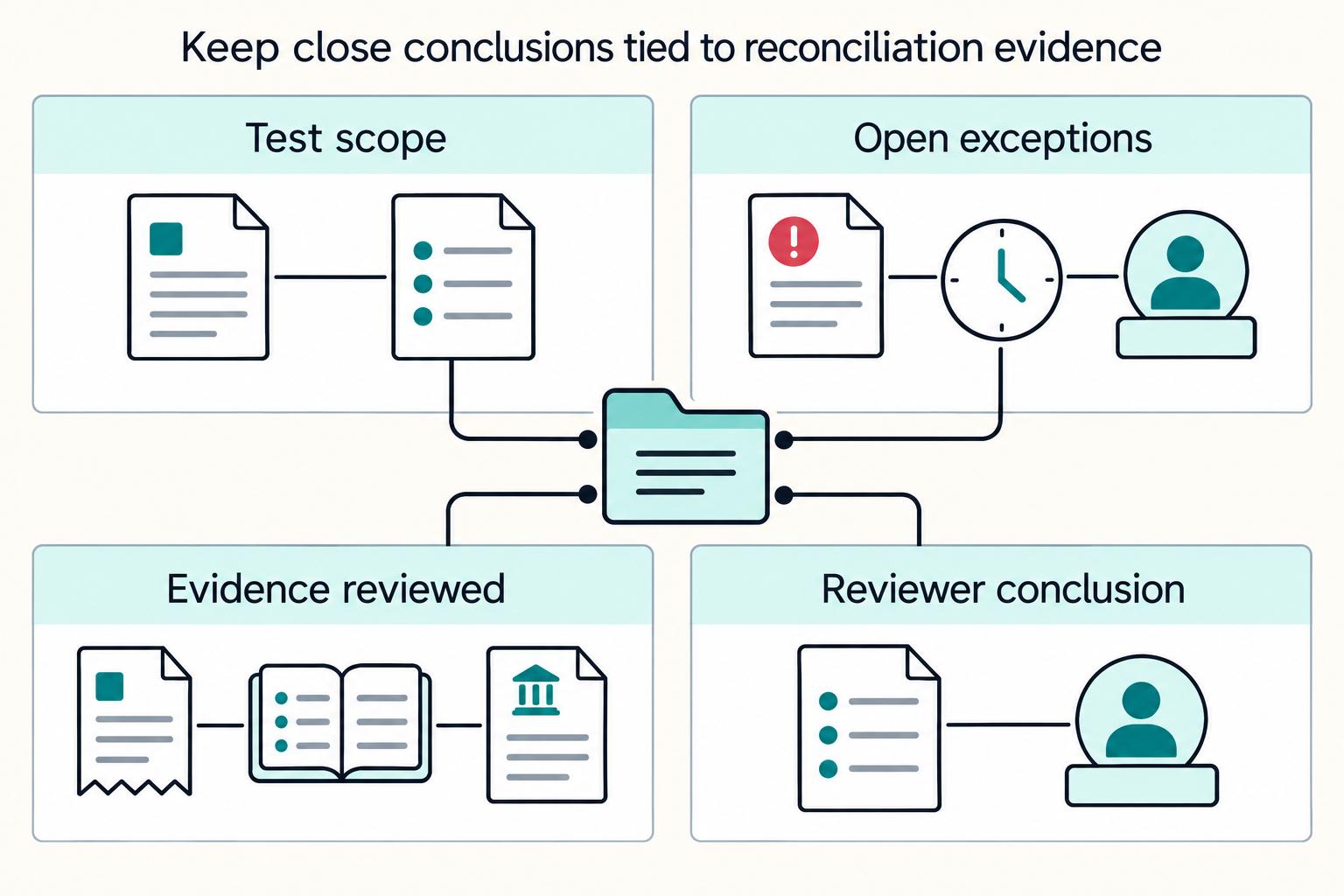
Build the pack so a reviewer can answer four questions quickly: what was tested, what failed, what evidence was reviewed, and what conclusion was reached. Include at minimum:
- Exception list at close cutoff, with owner, amount, account impact, and expected resolution date
- Aging buckets for open items
- Root-cause tags such as timing lag, mapping failure, duplicate event, fee variance, missing journal, or bank mismatch
- Documented reviewer notes for rejected items, including reviewer comments
This structure aligns with documentation expectations around procedures performed, evidence obtained, conclusions reached, and performer and reviewer accountability. Keep aging buckets tied to your actual flow timing, but force explicit review as items age so clearing balances do not become persistent reporting risk.
Step 4. Block finalization when unresolved breaks exceed policy#
Set the reporting gate before close begins: if unresolved exceptions exceed your documented internal threshold at cutoff, block finalization until they are cleared or formally escalated.
The threshold can be amount-based, count-based, or account-risk-based, but it should be documented in advance by control owners. If older buckets keep growing, or breaks cluster in cash, payout, or fee accounts, treat that as a control warning and resolve it before report release.
For a step-by-step walkthrough, see How to Build a Finance Tech Stack for a Payment Platform.
Set settlement and payout execution rules for scale#
Once reconciliation controls are in place, scale depends on timing and release discipline. Do not run one global settlement or payout clock across providers, rails, regions, and entities. Define timing by rail and jurisdiction, then enforce retries and release checks against that map.
Step 1. Define cutoffs by provider, rail, and entity#
Set settlement and payout timing at the provider, rail, and entity level, not at a single global close. Stripe notes payout availability varies by industry and country, and Stripe Connect also notes payout delay can be calculated in business days or calendar days depending on country.
Document, at minimum, provider, legal entity, country, currency, rail, release time, and whether timing uses business days or calendar days. For ACH, keep Same Day ACH as its own lane: same-day processing depends on meeting transmission deadlines, and FedACH includes windows such as 10:30 a.m. ET for 1:00 p.m. ET current-day settlement. Same Day ACH also excludes transactions above $1,000,000.
Verification point: confirm treasury calendars, provider settings, and bank timing agree for each entity and rail.
Step 2. Enforce idempotent retries with a stop rule#
Use idempotency keys on every payout creation retry so the same request can be retried safely without duplicate execution. This is the core safeguard when a request has to be retried.
Set an internal retry ceiling by failure class, then require manual takeover at that ceiling. Keep three fields on every attempt: idempotency key, attempt count, and last provider response. If the same payout instruction appears under a different key, treat it as duplicate risk and route it to investigation. Verification point: one business payout instruction should map to one idempotency-key lineage.
Step 3. Split transient and non-transient failures into separate queues#
Retry only transient failures. Route non-transient cases to manual correction instead of looping them through automation. A practical queue split is:
| Queue | Used for | Handling |
|---|---|---|
| Transient queue | Retry-eligible transient failures | Short automated retry window |
| Manual-correction queue | Destination or routing data issues | Edits before resubmission |
| Liquidity queue | Insufficient-funds cases | Treasury or finance review |
Keep returned payouts separate from initial creation failures. Return timing is variable: providers often report 2-3 business days, but it can be longer depending on provider and recipient country.
Step 4. Tie budget controls and cash checks to payout release#
Release decisions should check liquidity, not just payout status. Put cash-position and budget controls directly in front of payout release so volume growth does not outrun available funds by entity, currency, and rail.
Before you release payouts, require an entity-level cash check that covers the funding account, same-day obligations, and queued high-value payouts. If the entity cash view is stale, hold release and escalate rather than assuming later settlements will close the gap.
For a fuller breakdown, read Microsoft Dynamics 365 for Payment Platforms: Finance Module Setup and Payout Integration Guide.
If you are defining retry ceilings and manual takeover criteria, review how compliance-gated, idempotent payout operations are structured in Gruv Payouts.
Connect revenue recognition and reporting to operational events#
Once payout timing is controlled, the next failure point is reporting results your ledger cannot support. Treat ASC 606 as an event-mapping discipline, not a month-end spreadsheet exercise. If a revenue metric cannot be traced from source event to journal to management report, it should not be used in executive reporting until that lineage is fixed.
Step 1. Map each contract event to a performance obligation#
Map operations to the ASC 606 sequence: identify the contract, identify performance obligations, determine transaction price, allocate price, then recognize revenue when each obligation is satisfied. In practice, your product and billing events need accounting labels before they hit the ledger.
For sales- or usage-based elements, where that model applies, tie recognition to validated usage or sales events and related obligation satisfaction rather than invoice creation or cash receipt. Because usage can create variable consideration, define what is recognized now and what is constrained to reduce reversal risk. For project milestones, use milestones as an output-method progress signal where appropriate, but do not treat milestone billing alone as proof that revenue belongs on that date. For multi-element arrangements, separate promises first, then allocate price across obligations so one contract does not become one revenue trigger.
Verification point: sample one contract per model and trace contract language, obligation IDs, and event triggers to journal logic.
Step 2. Separate recognition timing from billing and cash settlement#
Recognize revenue based on transfer of promised goods or services and expected consideration, not cash timing alone. This is where mixed models can break down when implementation fees, milestone work, and later usage charges are blended without clear timing rules.
Document four event classes for each material stream: service transfer, revenue recognition, billing, and cash settlement. Without that split, reporting can start treating collections as performance and distort operating signals.
Keep presentation boundaries clear. If goods or services were transferred but billing rights are not unconditional, classify the balance as a contract asset. When rights become unconditional, present it as a receivable. If one bucket mixes receivables, contract assets, and contract liabilities without a clear bridge, your income statement view is probably hiding timing issues.
Step 3. Build a journal-to-report bridge that survives review#
Build the P&L from journaled facts, not disconnected reporting logic. At minimum, revenue journals should carry source event ID, contract ID, performance obligation ID, recognition date, and revenue-stream tag.
For contracts with multiple obligations, keep contract-level presentation for contract assets and liabilities while preserving obligation-level detail for internal traceability. A practical check is to pick one income statement revenue line and trace it back to supporting journals and then to underlying operational events without a manual remap. If that trace cannot be completed in one sitting, reporting is too detached from the ledger.
Step 4. Gate executive metrics by ledger lineage#
Set an internal gate: no executive revenue metric ships without ledger-event lineage. Metrics used for performance decisions should include source, calculation logic, and a tie-out to ledger-backed numbers.
Maintain a compact evidence log per reported metric: definition, source tables, journal population, tie-out schedule, and reviewer notes. Also reconcile opening and closing balances for receivables, contract assets, and contract liabilities to support revenue-reporting disclosures. A common failure mode is a late manual override that never reaches the ledger. If an override is unavoidable, log it, time-stamp it, assign an owner, and either book the correcting entry or remove the metric from reported outputs.
Add compliance gates and tax documentation without breaking throughput#
Use compliance gates only where risk changes so you can stop risky payouts without forcing manual review on every flow. In practice, that means gating onboarding, payout release, and material high-risk profile changes.
Step 1. Place checks where risk changes, not on every event#
Risk-based gating is the control pattern that scales for payment operations. Apply checks at onboarding, before payout release, and when a material risk attribute changes.
That aligns with U.S. expectations for ongoing, risk-based customer due diligence and risk-based OFAC control design across customer, transaction, product, and geographic risk. Treat routine low-risk repeats differently from events that change who is paid, where funds go, or whether reporting obligations may change.
Verification point: sample one first payout, one repeat low-risk payout, and one payout after a material profile change. Confirm the first and third hit the gate and the repeat low-risk case does not.
Step 2. Assign each gate to one owner and one queue#
Every gate needs a named owner and a queue, or blocked payouts can stall. For covered banks, AML programs must designate individual or individuals responsible for day-to-day compliance, and that ownership model is a practical operating baseline even outside that exact scope.
Route by failure type so the right team can act quickly:
- Onboarding failures to onboarding compliance or ops
- Payout-release hits to payments ops or sanctions review
- Tax identity failures to tax ops or accounting, with CPA escalation when filing or withholding is affected
If a transaction is rejected for sanctions reasons, capture reporting-ready case details, including a contact name and telephone number.
Step 3. Keep tax artifacts reviewable without slowing close#
Keep tax documentation in a reviewable, record-level pack so accounting and CPA reviewers can verify decisions without digging through inboxes. For reportable payment flows, maintain tax form status, TIN validation status, withholding status, information-return delivery status, and change history together.
Treat a missing TIN as an execution trigger, not a cleanup task: backup withholding must begin immediately on reportable payments when no TIN is provided. Also plan 1099-K operations from the January 31 recipient-copy deadline, and verify current IRS threshold guidance before hardcoding rules.
Set retention to evidence needs. Keep records as long as needed to prove income or deductions. Also account for longer windows where OFAC blocked-property records apply, including at least 10 years after unblocking.
Step 4. Include entity-level tax choices only when they change operations#
Include R&D tax-credit handling only when it changes operating design. The qualified small business payroll-tax research credit election is annual, with a maximum of $500,000 applied against payroll tax liability.
Use the same filter for other entity-level tax choices: include them only when they change payer entity, reportability, withholding responsibility, filing ownership, or close-critical workflows.
Common failure modes and how to recover#
Once gates and evidence packs are in place, recovery discipline is what keeps breaks from distorting cash, the ledger, or the income statement. Treat these as controlled incidents, not ad hoc cleanup.
Step 1. Quarantine settlements that have no matching ledger journal#
If a settlement posts without a matching ledger journal, stop that flow before payout or reporting. In some payment-and-settlement configurations, general-ledger posting is held until settlement is complete, so this mismatch can indicate event-mapping or posting-dependency issues, not just timing.
Quarantine the affected records, repair the settlement-to-journal mapping logic, and backfill the missing entry with an audit note that records what changed and why. Verification point: confirm settlement ID, amount, currency, provider reference, and journal ID reconcile.
Step 2. Enforce idempotency on payout retries and add a duplicate check before release#
Duplicate payout execution can start as a retry-control failure. Use idempotency keys on create or update calls so retries do not execute the same effect twice. Then add a pre-release duplicate check for the same beneficiary, amount, rail, and instruction window.
Do not rely on duplicate screening alone. Recovery should freeze the suspected duplicate set, confirm external payout status before reversal attempts, and preserve request IDs plus provider responses in the case record.
Step 3. Lock close on completed reconciliation layers#
Month-end surprises in the income statement can trace back to unfinished reconciliation. Do not move close from transaction recording to financial-statement production until required reconciliation layers are complete, because reconciliation must identify, explain, and correct differences.
Set a clear cutoff rule for unresolved items and document approved exceptions before final reporting. Verification point: require completion evidence for each layer before period release.
Step 4. Name one incident owner until every exception is closed#
When exceptions spread across accounting, payments ops, treasury, and product, resolution slows without a single owner. Assign one incident owner to hold the operational truth until closure, even when fixes are executed by different teams.
Keep one exception list, one status line, and one decision log. If multiple side threads carry conflicting numbers, control has already degraded.
You might also find this useful: What Is an Income Statement? A Platform Finance Team's Guide to P&L for Payment Businesses.
Conclusion and copy paste rollout checklist#
End-to-end traceability is the control that keeps finance ops reliable at scale. Every dollar should be explainable from invoicing to the ledger to reconciliation to payout execution, or reporting debates will outrun actual exception resolution.
- Anchor the rollout on one traceability promise.
Start by naming authoritative systems for invoicing, ledger, settlements, and payouts, even if parts are manual at first. For any sampled transaction, your team should be able to produce the internal reference ID, provider reference, current status, owner, and close impact without cross-team interpretation.
If ICFR applies, this is a control requirement, not just process hygiene: management responsibility and effectiveness assessment depend on maintained evidential documentation. Even when formal reporting does not yet apply, building that evidence trail early prevents post hoc reconstruction.
- Enforce hard checkpoints before scaling volume.
Keep the operating model simple, but make ownership, retry behavior, and close gates explicit. Reconciliation is a key internal control, so pass-fail rules should be timely, documented, and verifiable for each stage you run.
Do not assume settlement and payout timing is uniform. Settlement delay can vary by method, payout availability varies by industry and country, and initial payouts can be delayed with some providers after the first live payment. Use cutoff and retry rules that reflect those differences.
Use idempotency where supported so retries are recognized as the same operation. Also account for key-retention limits, and route unresolved cases to manual handling under your policy with documented evidence.
- Tie reporting judgments to operational events you control.
ASC 606 remains the accounting anchor, and its application in software or SaaS often involves significant judgment and estimation. Your design should let teams trace reporting outputs back to operational records and the ledger, rather than relying on month-end reasonableness alone.
Copy and paste this into your rollout doc, assign owners, and treat unchecked items as implementation gaps:
- Authoritative systems confirmed for ledger, invoicing, settlements, and payouts
- Event map completed with owners, SLAs, and exception paths
- Reconciliation controls live across the stages you operate, with documented pass-fail rules
- Settlement cutoffs and payout retry rules approved by finance and ops
-
ASC 606mapping tied to operational records and reporting outputs - Close evidence pack reviewed by accountable stakeholders (for example, accounting and treasury)
For go-live discipline, use one rule: do not finalize close when unresolved exceptions exceed your approved threshold or required evidence is missing. Simple, defensible controls with named owners beat complex automation no one can support. Related reading: Employer Cost by Country Benchmark for Finance and Ops Teams. When your rollout checklist is complete, map each control to implementation details and operational events in Gruv Docs.
Frequently Asked Questions
What is the practical difference between accounting for a `SaaS` company and a `payment infrastructure` business?
In SaaS, revenue is typically recognized as service is delivered over time. In a payment infrastructure business, you still handle revenue recognition, but you also need operating control across authorization, verification, settlement, and payout activity while funds move. Those monitoring and exception controls often run continuously, not just at close.
What minimum controls should exist before scaling `payout execution`?
Start with idempotency so retries do not execute the same payout effect twice. If you use Stripe, idempotency keys can be up to 255 characters and can be pruned after at least 24 hours, so retry logic should fit that window. Also separate transfer duties from bank-detail edit permissions and require stronger authentication when non-admin users can transfer funds.
How should teams structure `reconciliation` across invoices, `settlements`, and payouts?
Use layered reconciliation so each handoff is testable. Match incoming payments to invoice amounts, then reconcile payouts to settlement-batch transactions, then confirm payouts against bank deposits. Automatic payouts preserve transaction-to-payout linkage, while instant or manual payouts create more reconciliation work.
Which failure metrics should be monitored first in finance operations?
Start with payment success rate, network authorization rate, failure reasons, and failed payouts. Those signals show whether issues begin at acceptance, authorization, or payout release. Use them as first-line triage before expanding into secondary metrics.
How do you connect `ASC 606` requirements to event-driven ledger data?
Start at contract inception by identifying the promised goods or services that are performance obligations. Then map those obligations to operational records you control, such as finalized invoice line items or subscription items, so recognition logic has clear units. Also confirm principal versus agent treatment based on control before transfer because that affects how you apply the model.
When should a team centralize ownership in finance ops versus distribute it across product and operations?
There is no universal ownership model in this guidance. A practical baseline is to keep failed payouts in first-line finance-ops monitoring and assign clear reconciliation ownership for instant or manual payouts.
Researched and edited by the Gruv editorial team. Gruv builds cross-border billing, payouts, and finance-operations software for global businesses.
Sources
- ecfr.gov/current/title-17/chapter-II/part-229/subpart...trusted
- fdic.gov/risk-management-manual-examination-policies/...trusted
- fdic.gov/resources/supervision-and-examinations/exami...trusted
- federalregister.gov/documents/2007/06/27/E7-12299/commission-gui...trusted
- federalreserve.gov/paymentsystems/fedfunds_about.htmtrusted
- federalreserve.gov/frrs/regulations/appendix-cpss-iosco-princip...trusted
- guides.gaoinnovations.gov/greenbook/2025/principle-3-establish-structu...trusted
- irs.gov/instructions/i6765trusted
Educational content only. Not legal, tax, or financial advice.
Related Posts

The Freelance Payment Penalty: A Modeled Audit of Platform Fees, FX Spreads, and Payout Delays
The money rarely disappears through a single, easy-to-spot fee. The real loss is stacked. A marketplace takes its commission, a processor adds a charge for international cards, a bank or payment company converts the currency at a spread, a platform holds the funds before release, and a wire sheds a little to intermediaries on the way in. Each layer looks defensible on its own, but the worker feels the combined result as a smaller deposit and a later payday.

How to Respond to a Subpoena for Business Records
Move fast, but do not produce records on instinct. If you need to **respond to a subpoena for business records**, your immediate job is to control deadlines, preserve records, and make any later production defensible.

A US Expat's Guide to Investing in UCITS ETFs to Avoid PFIC Issues
The real problem is a two-system conflict. U.S. tax treatment can punish the wrong fund choice, while local product-access constraints can block the funds you want to buy in the first place. For **us expat ucits etfs**, the practical question is not "Which product is best?" It is "What can I access, report, and keep doing every year without guessing?" Use this four-part filter before any trade: