
Quick Answer
Marketplace early payment programs can attract and retain sellers when they accelerate payment on approved receivables without creating payout confusion or control failures. The key is choosing the right model first: Dynamic Discounting if you fund with your own cash, or payables finance if a financial institution funds early payment. Adoption depends on reliable approval gating, clear seller eligibility, accurate payout timing, and close-ready reconciliation.
Why Early Payment Programs Matter to Sellers#
Treat an Early Payment Program as both a funding decision and a payout-control decision. In a marketplace, it can shape seller experience, payout reliability, exception volume, and who carries cash and credit exposure when payment happens before standard terms.
Early payment is not one pattern. Under ICC-backed standard definitions , Supply Chain Finance is a financing and risk-mitigation approach used to improve working capital and liquidity across supply-chain transactions. Dynamic Discounting is usually led and funded by the paying company. The seller accepts a discount for faster payment, funded with that company's cash. Payables Finance follows the same lead-party pattern, but sellers access third-party finance against receivables in that company's supply chain. "Reverse factoring" is an accepted synonym.
Those definitions lead to different operating models. With Dynamic Discounting, pricing is typically set in the buyer-seller relationship, and internal liquidity matters more. In payables-finance structures, the finance provider relies primarily on the paying company's creditworthiness. This can support working-capital goals, but it adds external partner, approval, and reporting dependencies. If you are evaluating a supply chain finance marketplace early payment program that sellers will actually use, this is the first decision fork.
Funding also usually depends on approval state, not invoice creation alone. In supplier-finance operations, invoices are approved for payment and an approved invoice file is sent before funding proceeds. For marketplace teams, invoice state becomes the trigger for offer eligibility, payout release, and reconciliation.
Marketplace operators still carry platform-payment duties around onboarding, evolving compliance checks, pre-payout verification, suspicious-payout controls, and reporting. Providers in this category explicitly describe verifying sellers before payout and stopping suspicious payouts or flagging unusual activity. When approved receivables, seller verification, and payout release sit in separate logic paths, exception handling can increase.
Use a simple checkpoint in your design:
- One approved receivable state per early-payment event
- One verified payee record per payout
- One reconciliation artifact finance can close
This article stays practical. It covers how to choose between Dynamic Discounting and SCF, how to scope a first rollout, and where marketplace programs can break first, including approval gating, seller eligibility, payout execution, and reconciliation.
For a closer look at how supply chain finance compares with dynamic discounting on a platform, read Dynamic Discounting vs. Supply Chain Finance: Which Early Payment Strategy Works for Your Platform?.
Start with the right definitions and scope#
Standardize terms across product, finance, and partner teams first. SCF language is still used inconsistently in practice, which can create confusion in control design.
Under the ICC-backed standard definitions, Supply Chain Finance (SCF) is an umbrella, not a single funding model. Use these labels precisely:
- Dynamic Discounting: Buyer-funded early payment where the discount varies by how early the seller is paid. A bank or finance provider does not provide financing in this model.
- Payables Finance (Reverse Factoring): A buyer-led program where sellers access finance against receivables tied to payables the company has validated and committed to pay unconditionally and irrevocably.
- Factoring (Invoice Factoring): A receivables-purchase transaction between the seller and the finance provider; the paying company is not a party.
This is the first real operating fork. If early payment is funded by a finance provider within a buyer-led program, you are typically in payables finance. If payment acceleration is funded by the buyer's own funds, you are in dynamic discounting. For launch, keep the implementation narrow so eligibility, approval evidence, and reconciliation stay clean while you validate the model.
Related: What Is Reverse Factoring? How Supply Chain Finance Lets Platforms Pay Contractors Early at Low Cost.
Why marketplaces feel this pressure earlier than traditional buyers#
Marketplace sellers experience timing, holds and reserves as part of the product. Map each timing state before offering acceleration so the promised date reflects when cash is usable.
| Payout state | What the seller needs to know | Design check |
|---|---|---|
| Funds available | When the sale becomes eligible for release | Payment confirmation, reserve and dispute status are included |
| Payout initiated | When the provider accepts the instruction | Separate submission from recipient receipt |
| Bank posting | When funds become usable | Provider, rail and receiving-bank timing are reflected |
That makes early-payment design a product decision as much as a treasury decision. If you position payouts as dependable, sellers will judge the date funds are usable in their bank account, not the date your internal ledger marks funds as released.
Use one operating rule before broad rollout. Do not promise "early" or "fast" payouts until you can verify the full available-date calculation by seller cohort, payout rail, reserve status, payment-confirmation state, and bank posting window. If product shows one date but funds land later, support load can rise and seller trust can drop.
For a step-by-step walkthrough, see Recurring Billing for Marketplaces: How to Charge Buyers and Pay Sellers on the Same Cycle.
Choose the funding model before you design the product#
Choose the funding model before you design the offer UX. The same seller-facing promise can sit on very different funding, accounting, and dispute paths. Consider Dynamic Discounting when you can fund early payments with your own cash. Consider Payables Finance with a financial institution when internal liquidity is the bigger constraint.
Dynamic Discounting is led by the paying company and funded with its own funds. The payable is extinguished when early payment is made. Payables Finance follows the same lead-party model, but it is typically arranged with one or more finance providers. Funding is tied to payables already approved with an unconditional, irrevocable commitment to pay. In reverse-factoring terms, a financial institution pays supplier amounts the company owes, and the company pays the institution at the agreed timing.
The approval gate is the control point#
The approval state behind each funded item is the main control. In Payables Finance, weak or reversible approval data can create exceptions quickly.
Before rollout, confirm you can evidence, for each funded item: approval status, approved amount, original due date, and dispute status at trigger time.
| Model | Funding source and balance-sheet effect | Approval gate | Risk and disputes | Seller communication |
|---|---|---|---|---|
| Dynamic Discounting | Company uses its own cash; early payment extinguishes the payable at payment time. | Internal rules determine eligibility for early payment. | Funding exposure sits with the company; dispute handling follows your program terms. | Typically handled inside your own payout program. |
| Payables Finance / Reverse Factoring | External finance provider funds early payment; the buyer owes the resulting obligation under the agreed program terms. Accounting classification requires separate assessment. | Approved payables with an unconditional, irrevocable commitment to pay. | Post-funding allocation is contract-specific and must be explicit. | Ownership should be defined in contracts and product copy. |
| Invoice Factoring | Seller sells receivables; ownership transfers to the finance provider. | Driven by receivables sold by the seller, not an approved-payables program. | Factor typically manages debtor portfolio and collections. | Communication may shift toward the factor's servicing model. |
Under IFRS analysis, reverse-factoring liabilities may be presented within trade and other payables, within other financial liabilities, or separately, depending on nature and function. Supplier-finance disclosure guidance applies for annual reporting periods beginning on or after 1 January 2024.
Keep factoring distinct from buyer-led early payment programs#
Invoice Factoring can meet seller liquidity needs, but it is a different operating model from a company-led early payment program. It is usually seller-initiated, receivables are sold to the factor, and collections are typically handled by the factor.
Treat model choice as an operating-design decision, not just a funding-cost comparison. Ask who can reliably approve the payable or receivable state, who funds early payment, and who owns seller communication when disputes happen. If approval controls are weak, fix that before scaling either Dynamic Discounting or Payables Finance.
Design seller eligibility and offer rules that survive scale#
Base eligibility on approved receivables first, then layer cohort policy on top. Across early-payment structures, the common anchor is approval state. Sellers request acceleration on approved invoices, and payables-finance programs rely on invoices or payables the paying company has accepted and committed to pay.
A practical matrix can still segment each Marketplace Seller or Supplier by invoice status and program-defined cohort criteria. Treat extra filters as your program policy choices, not market-wide requirements.
Set hard boundaries before launch#
Define exclusions and participation behavior before you tune pricing:
- approved Accounts Receivable only
- excluded categories documented in your policy
- clear seller opt-in behavior
- clear non-acceptance behavior (invoice stays on normal maturity payment path)
For Dynamic Discounting, the acceptance window sits between invoice approval and due date, and seller participation is voluntary. That default-to-maturity path keeps outcomes clear when sellers do nothing.
Before showing an offer, preserve invoice ID, approval status, approved amount and original due date. After presentation, record the seller’s acceptance, decline or expiry outcome with the offer terms and timestamp.
Use cohort rules instead of one global offer#
Target offer mechanics by cohort instead of applying one global offer. Early-payment campaign setups can segment by payment terms, method, and currency, and can run as recurring standing criteria over an agreed period. If a cohort has frequent disputes or exceptions, tighten eligibility before widening discounts.
| Offer setup | Discount presentation | Acceptance window | Policy documentation to require | Missed-payout fallback to define |
|---|---|---|---|---|
| Dynamic Discounting standing offer | Time-based discount that changes with days paid early | After approval and before due date | Approved invoice record, due date, acceptance/non-acceptance record | Keep a defined route to normal maturity payment |
| Dynamic Discounting campaign offer | Terms shown only to targeted supplier cohorts | Campaign period, still limited to approved invoices before due date | Cohort criteria + approved invoice and acceptance records | Preserve standard payment path when acceleration is not completed |
| Payables Finance | Offer tied to approved payables with a company commitment to pay | Per program terms after payable approval | Evidence of approved payable and commitment to pay | Route through standard payable timing or exception handling in program terms |
Keep documentation standards explicit and operational so payment behavior matches the program terms.
For a broader operator view of how marketplaces balance incentives across buyers, sellers, and the platform, see Marketplace Economy 101 for Buyers, Sellers, and Operators.
Build the money and data path end to end#
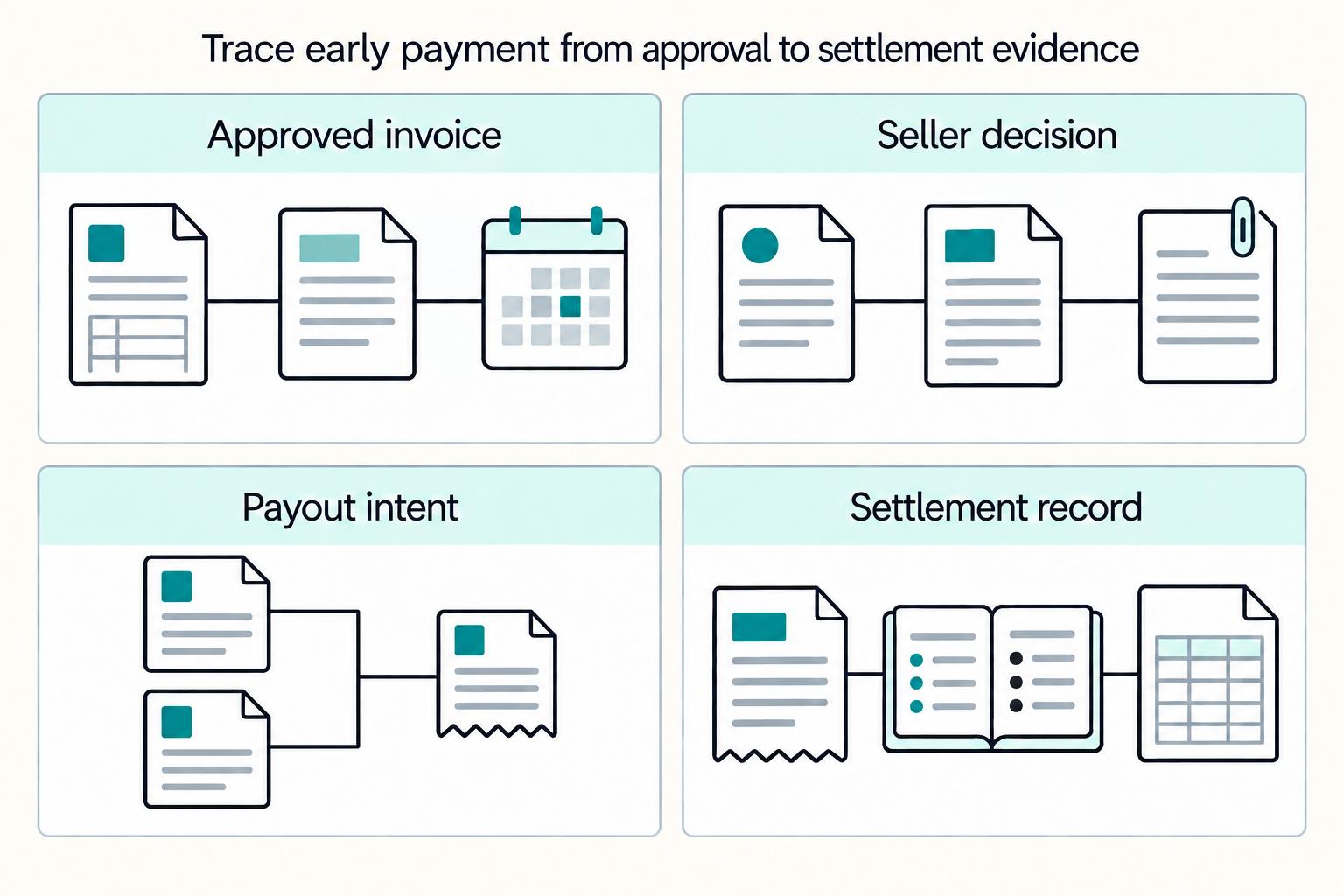
Build this as a controlled receivable-state process, not a loose payout flow. One approved invoice should create one payout intent. Each early-payment event should resolve to one ledger trail and one reconciliation artifact for the paying company and the Marketplace Seller.
The eligibility gate is approved Accounts Receivable. From there, keep the sequence explicit: invoice created, invoice approved, offer shown, seller accepts or declines, payout initiated, ledger posted, reconciliation closed. If the seller does nothing, keep the invoice on normal maturity and do not create a payout intent.
Anchor payout triggers to receivable states#
Approval is the hard checkpoint. At minimum, keep: invoice ID, approval timestamp, approved amount, due date, dispute status, seller decision, and payout-intent ID. That gives finance a complete explanation of why funds moved, or why they did not.
For Supply Chain Finance (SCF) programs led by the paying company, keep approval and submission of approved invoice details to the finance provider as a distinct state before maturity settlement. In some SCF implementations, payment instruction submission is step 1 of the account-to-account flow. The trigger is not just "seller accepted." It is "seller accepted an approved payable that is ready for funding under program terms."
Make retries safe before you need them#
Use one durable payout intent per early-payment action. After a timeout, retrieve the provider’s status before deciding whether to retry. Where supported, repeat the identical request with its original idempotency key. Do not fail over or create a replacement payment while the original result is unknown.
Store three linked IDs per early-payment action:
- internal payout-intent ID
- external payment-instruction or transfer ID
- ledger journal ID
Keep duplicate-detection records longer than the provider’s idempotency window. If an amount changes, first establish the original intent’s definitive status. Cancel an unexecuted intent where supported, or use a reviewed adjustment for a completed payment; a new amount must not silently create a second payout.
In SCF flows, end-to-end IDs that connect payment instructions to payments can improve reconciliation from approved receivable through funded payment to settlement evidence.
Separate automated actions from human review#
Automate low-ambiguity actions and route exceptions to review queues.
| Queue | Included actions |
|---|---|
| Automated | Create offer after approval, capture accept or decline, create payout intent, submit payment instruction, post standard ledger entries, auto-match known settlements |
| Manual exception handling | Payout reject, stale approval, amount mismatch, missing settlement record, dispute opened after approval |
| Blocked pending review | Changed banking details, changed approved amount, missing commitment in SCF, unresolved dispute flags |
Keep separation of duties intact. The person resolving an exception should not also release the corrected payout.
Verification checkpoint: every early-payment event maps to one traceable ledger trail and reconciliation artifact, such as a settlement record, statement match or provider confirmation. Set retention under the specific legal and contractual requirements that apply. If you cannot trace a funded invoice end to end, stabilize the flow before scaling.
Put compliance gates where risk actually appears#
Put compliance before eligibility. An invoice should not become early-payment eligible until the seller passes the checks required for that program and country. If you wait until payout release, ops can end up freezing, explaining, or unwinding a commercially approved invoice.
Gate before the offer is even possible#
Map due-diligence duties to the covered institution, customer and activity. For U.S. covered financial institutions, apply the CDD rule with FinCEN’s current exceptions and February2026 relief, rather than assuming fresh beneficial-owner collection at every new account. Have the compliance owner approve the eligibility gate for each program.
Use a simple gate rule where these controls apply: no KYC or KYB completion, no offer; no sanctions result, no payout intent. This matters even more when a third-party funder is involved. The platform, the paying company, and the Financial Institution can each assume someone else already checked the seller. Make ownership explicit in your product and data model.
Before an approved Accounts Receivable item can move to "offer shown," confirm the seller record includes:
- onboarding status and review outcome
- jurisdiction and program type
- sanctions screening result with timestamp
- beneficial ownership verification status where required
- who performed the check: your platform or the Financial Institution
If required eligibility evidence is missing, block the early-payment offer and route the case to its owner. A sanctions or legal hold can also prohibit normal maturity payment; missing evidence must not automatically trigger that fallback.
Write policy by country and by program#
One global policy is usually too loose. FATF is explicit that countries implement AML controls differently, so onboarding checks, payout restrictions, and monitoring expectations should be documented by seller region and by program structure.
For each Marketplace Seller region, specify what onboarding evidence is required, whether early payment is allowed, what triggers enhanced review, and whether monitoring differs by program. If one corridor uses a Financial Institution and another uses your treasury, document that too, because control ownership changes. Document country and program differences first, then encode only the allowed paths.
Make sanctions holds and reporting ownership explicit#
Sanctions control is more than name screening at onboarding. You need clear hold and release authority once invoices, payment instructions, or settlement flows are live. FFIEC OFAC guidance frames this as risk-based across products, customers, transactions, and geography.
The operational risk is unclear ownership at the moment of a hit. If a payment instruction exists and a sanctions alert appears, you need to know who is the holder, transferrer, or releaser. Under OFAC rules, blocked-property reports are due within 10 business days. Rejected transactions can also require reporting.
Set one written authority map tied to Supplier and payer records. Define who can place a hold, who can clear a false positive, who files blocked or rejected transaction reports, and who approves release. Keep evidence with the transaction: screening result, decision notes, case ID, report copy if filed, and linked invoice and payout-intent IDs. For OFAC-covered records, retain availability for examination for at least 10 years after the transaction. For blocked property, the recordkeeping period continues throughout the block and for at least10 years after unblocking.
If you cannot answer "who holds, who reports, who releases" for one blocked payment in under a minute, the control model is still too loose for scale.
Price it with unit economics instead of marketing claims#
Price early payment options on comparable unit economics, not headline funding claims. Use the same unit across models, such as one approved invoice or $100,000 of approved Accounts Receivable accelerated by a fixed number of days. Then compare seller cost, platform operating cost, and Working Capital impact.
For dynamic discounting, seller cost is the accepted discount tied to days accelerated. For provider-funded payables finance, include the contracted funding and operating charges. For a credit facility, include the actual rate, draw timing, commitment and other fees; a headline borrowing benchmark is not a term sheet.
What to compare in the model#
Model all three layers together:
- Seller cost: discount given up, receivables-based financing cost, or no direct seller fee if you absorb funding cost.
- Platform cost: onboarding, disputes, payout operations, reporting, and reconciliation.
- Cash impact: own cash use, revolving facility draw, or third-party liquidity.
A funding-rate-only comparison misses material cost. Treasury-funded programs use your cash and affect working-capital flexibility. Supplier-finance programs can also add disclosure and reporting burden around payment timing, confirmed obligations, and annual rollforwards. FASB made these disclosure expectations more explicit on September 29, 2022, and IASB issued Supplier Finance Arrangements amendments in May 2023. Finance-team reporting effort belongs in pricing.
| Option | Margin impact | Cash timing | Control burden | Reconciliation workload |
|---|---|---|---|---|
| Dynamic Discounting | Seller discount reduces seller proceeds; platform uses own cash | Early payment funded from company or platform treasury before original due date | Program governance over offer rules and payout timing | Link approved invoice, accepted discount, and payout |
| Line of Credit funding | Interest cost sits with platform when the line is drawn | Early payment funded by borrowed working capital; repayment follows facility terms | Treasury management and borrowing discipline | Reconcile invoice payouts to draws and repayments |
| Payables finance / Reverse Factoring | Economics depend on funder terms and structure | Third-party institution pays supplier early; the company repays on agreed timing | Partner oversight and disclosure readiness | Track confirmed obligations, settlements, and reporting support |
| External Invoice Factoring | Seller financing cost depends on receivables, debtor credit risk and the agreed recourse and pricing terms | Seller gets liquidity outside platform treasury cycle | Receivables are sold rather than collateralized, so control and collections design differs | Varies by operating model |
Benchmark honestly, not aspirationally#
Internal funding uses cash and shifts working-capital tradeoffs. A bank line shifts funding from treasury cash to borrowed working capital, with interest charged only when drawn. Payables finance can preserve platform Working Capital by using third-party liquidity, with higher dependence on partner terms and reporting readiness. Invoice factoring is structurally different because receivables are sold rather than collateralized, which can change control and collections design.
State the unknowns up front#
Keep these as explicit unknowns until validated:
- adoption sensitivity by seller cohort and discount level
- final pricing and eligibility terms from each Financial Institution
- corridor-level compliance cost by country and program structure
Verification checkpoint: for each option, trace one funded invoice from original due date to accelerated payment date, economic charge, settlement record, and ledger outcome. If that trace is slow or incomplete, the model is understating operating cost.
Launch in phases with explicit go or no-go checkpoints#
Once pricing is clear, the next risk is scale. If core operations are still fragile, growth can amplify failures. Start with a pilot, require evidence at each gate, and treat expansion as a control decision.
Pilot with a narrow seller cohort and one well-understood funding and payout path. Expand only after approval, settlement and reconciliation evidence shows that the intended operating model works.
Use phases to isolate failure modes#
One practical rollout pattern for a marketplace early payment program is:
| Phase | Scope | Focus |
|---|---|---|
| Phase 1: controlled pilot | Start with a narrow cohort and payout path | Verify funded Accounts Receivable events end to end |
| Phase 2: measured cohort expansion | Add additional cohorts only after pilot behavior is stable | Test eligibility and exception handling beyond the cleanest segment |
| Phase 3: broader rollout | Add countries, entities, or settlement paths where controls are holding | Operational and reconciliation complexity can increase |
If you expand too early, root causes can get harder to isolate across funding design, segment mix, and payout rails.
Define checkpoints before the first payout#
Set go or no-go gates before launch and assign an owner for each gate.
| Checkpoint | What to review | Healthy signal | Red flag |
|---|---|---|---|
| Adoption quality | Which eligible sellers accept and repeat | Usage comes from intended cohorts with low onboarding friction | One-time uptake followed by drop-off or confusion |
| Exception rate | Failed payouts, rejected instructions, duplicate attempts, dispute holds | Exceptions are categorized and trend down | Ops is repeatedly rescuing payouts manually |
| Reconciliation closure | Match funded invoice to payout, settlement record, and ledger | Finance closes with a complete trail and controlled exceptions | Unmatched items carry past close and accumulate manual work |
| Seller support volume | Ticket volume, reasons, and resolution time | Questions cluster in expected onboarding gaps and decline | Tickets expose unclear offers, timing confusion, or incorrect presentation |
Treat missed checkpoints as a pause signal for expansion while root causes are addressed.
Assign ownership where decisions actually sit#
These programs are multi-departmental in practice. Treasury may lead, but execution requires cross-functional buy-in, including functions such as Procurement and Accounts Payable.
In marketplace teams, one workable split is:
- Product: offer design, eligibility presentation, and acceptance UX.
- Finance: settlement controls, reconciliation policy, and close readiness evidence.
- Engineering: event reliability, retry behavior, and idempotency controls.
Idempotency matters because retries should not create duplicate payout operations.
Make expansion contingent on evidence, not optimism#
Before each phase gate, review operating evidence, not only summary slides: funded-invoice trails from approval to reconciliation, exception aging, support themes, and manual interventions.
Two issues to watch for are "mostly working" flows that hide manual fixes and underestimating supplier enablement effort, which is an ongoing day-to-day process that can require substantial resources. If checkpoint quality degrades, consider holding expansion, fixing the operating cause, and then retesting the gate.
If your pilot checklist is set, map payout states, retries, and batch exception handling to your rollout controls in Gruv Payouts.
Catch the failure modes competitors usually skip#
Phase gates only help if you can detect hidden breaks early. Treat approval state, payout execution, and post-funding disputes as separate control points, each with its own evidence trail.
Freeze the approval record before funding#
Funding in buyer-led SCF should run from approved payables, not from mutable invoice state. That makes an immutable approval record your first control.
Preserve a locked approval snapshot with timestamp, gross approved amount, invoice ID, approver and status version. Link it to the accepted offer, discount and fees, net amount funded or paid to the seller, and the obligation due at maturity. Reconcile those amounts explicitly rather than requiring the gross receivable to equal net seller proceeds.
Make retries safe and rejections visible#
Persist one intent identifier and reuse the original idempotency key when retrying an identical request within the provider’s supported window. Resolve unknown outcomes before resubmission or replacement, and use durable duplicate checks when the provider’s key protection expires.
Also treat rejected payment outcomes as a core operational state, not an inbox side case. Rejected-status reporting, such as pain.002 flows, should reconcile back to the original payment submission and ledger record. Without that linkage, close can turn into manual cleanup.
Use an exception queue with named owners and escalation SLAs, and require this evidence for each exception:
- original payout instruction and idempotency key
- bank or processor response, including rejected-payment status reporting where available
- linked seller, invoice, and ledger references
- current disposition: retry, reverse, hold, or close as non-payable
Decide dispute and reversal rules before launch#
Define dispute and reversal handling before the first funded payout. There is no universal reversal rule once an approved invoice is funded and later disputed. Contract terms must drive who can place holds, how paid proceeds are treated, and where recourse sits.
That distinction matters in payables-finance and other SCF structures because risk allocation can differ by scenario. A provider may carry non-payment risk while still retaining seller recourse for representation or warranty breaches.
Operator rule: if a funded invoice enters dispute, stop downstream retries or additional payouts immediately, preserve approval and funding artifacts, and route to the named contract decision owner.
Review incidents as a product input, not only an ops task#
Run a recurring incident review and turn each incident into a fix path. Resilience guidance supports response plans, recovery plans, and lessons learned. Use that to classify each failure as a policy gap, product gap, or integration gap.
- Retry logic caused duplicates: engineering owns idempotency and replay behavior.
- Editable approvals caused mismatch: product and finance own approval-state controls.
- Rejections are not reconciled to original submissions: integration ownership is incomplete.
That is how you keep an early payment program reliable instead of letting it drift into manual exception handling.
Ask these questions before choosing a bank or platform partner#
Choose the partner that will contract around your known breakpoints, not the one with the cleanest demo. If a Financial Institution cannot name artifacts, owners, and fallback states for these questions, treat that as launch risk.
Define eligible receivables and dispute ownership#
Set receivables eligibility first, because that determines what can actually be funded. In buyer-led payables-finance programs, eligibility can be limited to approved invoices uploaded into the program. Ask for the exact definition of eligible Accounts Receivable and how they handle partial approvals, credit notes, tax adjustments, and invoices that later change status.
Name dispute ownership in the contract. Do not assume the finance provider arbitrates every edge case: in at least one supplier-finance setup, missing or unexpected invoice status is routed to the company representative. Require a named decision owner and a defined evidence pack so operations is not improvising during disputes.
Require close-ready reporting, not just payout confirmation#
Paid status alone is not enough for finance close. Confirm which artifacts are guaranteed each cycle: a transaction-level settlement details report, a payout reconciliation report, or both. Make sure they support ledger tie-out across funded invoices, payouts, and fees.
Also define correction handling up front. If payouts are adjusted later, the partner should specify how corrections are reported and who reconciles them. If payout timing is manual, confirm whether reconciliation responsibility sits with your team. This is especially important for companies in scope of supplier-finance disclosure expectations issued on 25 May 2023 and effective for annual periods starting 1 January 2024, including visibility into terms, liabilities, due-date ranges, and liquidity risk.
Separate current coverage from roadmap promises#
Treat "supported now" and "planned later" as different categories. Verification requirements can vary by country, region, and legal entity. Some partners must complete verification before processing payments or payouts, and cross-border payout support can be region-limited.
Define the operational fallback before launch. Early payment is not always available in every case, so the contract should state what happens next. That can include due-date payment on the standard path, seller notification ownership, and ledger states for "funding unavailable" versus "supplier declined." If this stays vague, the exception queue absorbs the cost.
Related reading: Build a Contractor Payment Flow for Home Services Marketplaces.
Conclusion#
Early payment works when you choose the model that fits your risk and liquidity profile, not when you treat it as a generic feature. Use Dynamic Discounting when your own or platform cash should fund early payouts, and use a provider-led payables-finance structure when preserving internal liquidity is the priority.
Treat controls as part of product design before scale: fund only approved receivables, set onboarding and sanctions controls for your operating context, and make reliability non-negotiable with idempotent payout requests and tight reconciliation.
If eligibility, compliance, and reconciliation are first-class requirements from day one, your early payment program is more likely to run reliably instead of becoming an exception-heavy operations lane.
Before locking your funding model, validate market coverage, compliance gates, and integration fit with your team in a short implementation review.
Frequently Asked Questions
What is a marketplace early payment program for sellers, in plain terms?
A marketplace early payment program lets sellers get paid before the normal due date on eligible, approved invoices or receivables. Funding can come from company or platform cash in a direct model or from a finance provider in an SCF model. In buyer-led SCF variants, approved-invoice data drives the early-payment flow.
Who should fund seller early payments in practice: platform treasury, buyer funds, or a financial institution?
Use in-house or platform funds when you are running a direct, buyer-funded model such as Dynamic Discounting. Use a financial institution for SCF structures such as payables finance (reverse factoring), where a finance provider funds early payment. In buyer-led SCF variants, this depends on reliable approved-invoice data, because that data drives the funding flow.
How is supply chain finance different from reverse factoring and invoice factoring?
Supply Chain Finance is the umbrella category for financing and risk-mitigation techniques used to manage working capital and liquidity. Reverse factoring, or payables finance, is a buyer-led SCF technique built around approved payables submitted to a finance provider. Invoice factoring is different: the agreement is between seller and finance provider, and the receivable is owned by the finance provider.
When should a platform pick Dynamic Discounting instead of SCF?
Pick Dynamic Discounting when early payment should be funded with company or platform cash and managed directly between buyer and seller. In this model, third-party financing is not the core funding source. If your main constraint is internal balance-sheet capacity, an SCF structure with a finance provider may be a better fit.
What minimum controls are required before launch in a regulated market?
Start with the jurisdiction, institution and operating model. Apply relevant CDD and beneficial-ownership duties with current exceptions and relief, sanctions controls, and approved-payable gating. Assign the compliance and release owners explicitly; approval of an invoice cannot override a legal hold.
What should we measure in the first rollout to prove this improves retention and not just payout speed?
Do not treat payout speed alone as success. Track retention and churn outcomes with user-interaction metrics tied to how sellers actually use the program, since interaction quality is part of retention. Pair those with operational-efficiency metrics so you can see whether outcomes improve without creating hidden operating drag.
Researched and edited by the Gruv editorial team. Gruv builds cross-border billing, payouts, and finance-operations software for global businesses.
Sources
Includes 1 external source outside the trusted-domain allowlist.
- bsaaml.ffiec.gov/manual/OfficeOfForeignAssetsControl/01trusted
- docs.stripe.com/api/idempotent_requeststrusted
- ecfr.gov/current/title-31/subtitle-B/chapter-X/part-1...trusted
- ecfr.gov/current/title-31/subtitle-B/chapter-V/part-5...trusted
- exim.gov/solutions/working-capital/supply-chain-financetrusted
- fincen.gov/system/files/2026-05/CDD-Rule-Consolidated-F...trusted
- occ.gov/publications-and-resources/publications/comp...trusted
- fatf-gafi.org/en/publications/Fatfrecommendations/Fatf-rec...external
Educational content only. Not legal, tax, or financial advice.
Related Posts

The Freelance Payment Penalty: A Modeled Audit of Platform Fees, FX Spreads, and Payout Delays
The money rarely disappears through a single, easy-to-spot fee. The real loss is stacked. A marketplace takes its commission, a processor adds a charge for international cards, a bank or payment company converts the currency at a spread, a platform holds the funds before release, and a wire sheds a little to intermediaries on the way in. Each layer looks defensible on its own, but the worker feels the combined result as a smaller deposit and a later payday.

How to Respond to a Subpoena for Business Records
Move fast, but do not produce records on instinct. If you need to **respond to a subpoena for business records**, your immediate job is to control deadlines, preserve records, and make any later production defensible.

A US Expat's Guide to Investing in UCITS ETFs to Avoid PFIC Issues
The real problem is a two-system conflict. U.S. tax treatment can punish the wrong fund choice, while local product-access constraints can block the funds you want to buy in the first place. For **us expat ucits etfs**, the practical question is not "Which product is best?" It is "What can I access, report, and keep doing every year without guessing?" Use this four-part filter before any trade: