
Quick Answer
Reverse factoring is a buyer-led early payment model in which a finance provider pays suppliers or contractors early on invoices the buyer has already approved, and the buyer pays on the original due date. For platforms, it works best when approved invoices are truly final, buyer commitment is stable, and fee ownership is clear. If approvals are still changing, resolve them before offering financing. Factoring and dynamic discounting also require eligible receivables; they do not bypass a dispute.
How Reverse Factoring Works for Contractor Payments#
The core decision is not what you call the model. It is whether you can run a buyer-led financing program on invoices the buyer has confirmed as valid, with approval controls a finance provider can rely on.
That framing matters because supply chain finance terms have often been used inconsistently. The Global Supply Chain Finance Forum was established in January 2014 and released standard definitions in 2016 to reduce that confusion. For operators, the rule is simpler: define the model before you price it, design it, or sell it to contractors.
In plain terms, supply chain finance manages working capital and liquidity across supply-chain transactions. In the buyer-led model commonly called reverse factoring or payables finance, a finance provider can pay the seller early on a confirmed invoice, while the anchor company still pays at the original due date. So this is not just a faster-payout feature. It depends on real trade-flow visibility and invoice status a finance provider can rely on.
For platforms, the first question is not "Should we offer early pay?" It is "Are our invoices genuinely approved?" If approval is loose, frequently reversed, or heavily manual, launch timing becomes a risk decision rather than a growth decision.
Cost is easy to misread too. In payables finance, pricing is typically aligned to the buyer's credit risk, not the seller's. That can help address payment-timing needs in some programs, but it will not work for every cohort by default. Outcomes still depend on program design, approval quality, and payout reliability.
Supplier-finance programs can affect liquidity disclosures. FASB ASU 2022-04 requires specified disclosures from buyers using these programs; it does not change recognition, measurement or presentation. IFRS supplier-finance disclosure amendments apply for annual periods beginning on or after 1 January 2024. Finance should assess the applicable framework separately from designing the contractor offer.
This guide helps you make that call. It covers when early pay fits, when alternatives like invoice factoring or dynamic discounting fit better, and when to wait. The working rule is simple: if you cannot consistently produce approved invoices and stable approval behavior from the anchor company, fix approval quality before launching reverse factoring.
You might also find this useful: Dynamic Discounting vs. Supply Chain Finance: Which Early Payment Strategy Works for Your Platform?.
Who this list is for and how to choose#
Use this list if you own payout strategy and need to close a payment-timing gap without squeezing cash flow or margin.
It is for teams choosing between reverse factoring, invoice factoring, and dynamic discounting based on operational readiness, not hype.
If you cannot consistently produce approved invoices, or your approval process is still unstable, reverse factoring may not be a fit yet. Early payment in this model depends on buyer-confirmed invoices.
Whatever option you are considering, make the same four checks before deciding: who carries the fee or discount, the impact on unit economics, the operational lift required to run it reliably, and whether it is likely to reduce supply-chain risk in your model.
If you want a deeper dive, read Supply Chain Finance for Marketplaces: How Early Payment Programs Can Attract and Retain Sellers.
Reverse factoring in plain English for operators#
Reverse factoring is a buyer-led early payment model where a finance provider pays against approved invoices.
In supply chain finance, this is usually called payables finance, and reverse factoring is a common synonym. The anchor company sets up the program, the finance provider pays the supplier before the original due date, and the company still owes the payable at maturity.
Three details matter in practice:
- Buyer-led and credit-dependent
The structure depends on a confirmed commitment to pay identified payables. Program economics are typically tied more to the anchor company's creditworthiness than the seller's, so weak or inconsistent commitment can disrupt the model.
- Approved invoices are the trigger
Payment is based on approved payables with an unconditional, irrevocable commitment to pay, not just submitted invoices. Unapproved invoices are a known risk point because non-payment is still possible.
- Faster cash flow, with fee allocation choices
Early payment comes from discounting receivables before the due date, while the buyer payable remains due at maturity. Financing fees can be supplier-paid or shared, so ownership needs to be explicit in the program terms and payout experience.
The operating caveat is straightforward: if invoice approval is weak or inconsistent, execution risk rises even when the headline promise sounds strong.
The best early pay options and when each one wins#
Use reverse factoring when the buyer can make a firm commitment on accepted invoices. Compare supplier-led factoring when the supplier seeks financing independently, and dynamic discounting when the buyer funds early payment from its own cash. Each model still needs eligible receivables and agreed terms.
| Option | Best for | Who funds early payment | Fee owner | Operational complexity |
|---|---|---|---|---|
| Reverse factoring | Programs with strong buyer credit and reliable approved invoices | A finance provider pays against accepted receivables backed by the buyer's unconditional commitment to pay | Often the supplier, though structures can vary, including shared economics | Varies by program design |
| Invoice factoring | Situations where seller cash needs are urgent | The factor advances funds after receivables are sold or assigned | Typically the seller through a service fee plus a time-based charge | Varies by program design |
| Dynamic discounting | Buyers or platforms with available cash | The buyer uses its own funds, with no bank or finance provider funding | The supplier pays via the invoice discount for earlier payment | Varies by program design |
Decision note: if approved invoices or receivable quality are unstable, disputed, or frequently revised, execution risk can rise across all three models as volume grows.
1. Reverse factoring#
Reverse factoring fits best when you have a credible anchor buyer and approvals that meet a strict standard. In payables finance, that buyer gives an unconditional, irrevocable commitment to pay identified payables, and funding cost is typically aligned to its credit risk.
The upside is economic clarity. If the anchor's credit is stronger than supplier credit, terms and costs can improve by leaning on that strength while the finance provider funds early payment.
The control that matters most is approval quality. "Approved" has to mean an accepted receivable with a firm commitment to pay, not just a submitted or lightly reviewed invoice. If that evidence is weak, eligibility and pricing may deteriorate.
2. Invoice factoring#
Invoice factoring is supplier-led. The seller assigns receivables to a factor, receives an agreed advance, and the factor later collects from the buyer. Recourse, advance percentage and eligibility depend on the arrangement.
Factoring can bring cash forward, but approval and funding speed depend on provider underwriting, receivable verification and the payment method. Compare an actual quote and expected funding date with the contractor's deadline.
The tradeoff is cost and operating variability. Pricing includes a service fee plus a time-based charge. It also introduces a collections handoff to the factor, which can change customer communication and control.
3. Dynamic discounting#
Dynamic discounting is a strong option when the buyer or platform has available cash and wants direct control over early-payment discounts. It is buyer-led early payment on approved invoices, with the discount changing based on payment timing.
The appeal is structural simplicity. The company funds early payment with its own cash, and no bank or finance provider financing is required.
The main constraint is treasury capacity. Because early payments use internal cash, program scale depends on cash priorities, and supplier take-up may vary based on willingness to trade discount for speed.
Should you launch reverse factoring now or wait#
Launch reverse factoring only when approved invoices are truly payable, commitment is stable enough for a finance provider, and fee ownership is already explicit.
- Launch now when approvals are predictable and buyer-backed.
Reverse factoring is strongest when your approval-to-payment flow is repeatable and approvals do not keep changing. In payables finance, the company's commitment to pay is expected to be unconditional and irrevocable, and financing cost is typically aligned to buyer credit risk. Your go signal is a steady stream of approved invoices, clear submission of approved amounts to the provider, and payment due at maturity to that provider.
A practical check is clean sequence data: approval initiation and supplier notification should happen in a consistent order.
- Wait when "approved" still changes after confirmation.
If amounts or statuses often change after approval, do not scale yet. In confirmation flows, approved amounts are the trigger for early payment, so frequent post-approval edits can create exceptions and funding friction.
A softer market variant can exist where commitment is less formalized, but that increases the need for caution, not speed.
- Phase by cohort when timing-gap pain is high but controls are uneven.
If early-pay demand is urgent but approval discipline is inconsistent across the network, start with a subset. Program design can target all sellers or only selected cohorts, so a phased launch is a valid operating path.
Start where patterns are stable: one buyer, repeat contractors, one approval path, one settlement pattern. Track approval record, approved amount, due date, and provider submission quality before widening scope.
- Set fee ownership before rollout.
Strong approved invoices plus a clear fee policy reduce ambiguity in rollout. Program mechanics do not automatically determine who bears the charge in your commercial model.
Put responsibilities in buyer terms, contractor terms and the opt-in screen before expansion. Clear commercial terms help contractors make a decision; accounting disclosure requirements are a separate assessment for finance.
Once that launch decision is clear, the next question is whether the economics hold up under real usage.
Unit economics that decide whether low cost is real#
"Low cost" is only real if your fee design sustains participation, protects retained revenue, and avoids operational leakage. In payables finance, funding cost is typically aligned with buyer credit risk, but you still need a clear choice on who absorbs that cost.
| Fee strategy | What the contractor sees | Expected adoption | Retained revenue impact | Margin sensitivity | Main risk |
|---|---|---|---|---|---|
| Buyer pays | No deduction from early payment amount | Can support higher take-up when buyer commitment is stable | Reduces buyer-side margin unless recovered in pricing | Can be sensitive to buyer renewal and pricing terms | Buyer may treat the fee as concession spend |
| Supplier or contractor pays | Financing fee deducted from approved invoice paid early | Can be more selective because participation is optional | Protects buyer or platform revenue per funded invoice | Can be sensitive to repeat usage, support, and retention | Offer can feel expensive if fee appears late |
| Shared financing fee | Each side absorbs part of the fee | Can sit between buyer-paid and contractor-paid if the split is clear | Spreads cost across both relationships | Can be sensitive to operational and reporting clarity | Hard to manage if split varies by cohort or invoice type |
| Opaque fee handling | Headline offer shown first, true net proceeds shown later | Can reduce participation even when headline pricing looks attractive | Individual funded transactions can look profitable while program performance weakens | Highly sensitive to UX and trust | Resembles drip-pricing behavior and drives avoidable complaints |
1 Buyer pays#
Buyer-paid is often a straightforward path when adoption and retention are the main objective. Because participation is optional, removing a visible deduction can support repeat usage.
The tradeoff is that the cost moves into buyer economics. If fee absorption is not reflected in pricing and renewal terms, program margin can weaken even when funded volume is strong.
Use a cohort check: approved invoice volume, funded take-up, buyer revenue retained, and contractor retention trend. If take-up rises but buyer contribution turns negative, the "low-cost" story is not holding at unit level.
2 Supplier or contractor pays#
Contractor-paid can be easier to defend in unit economics because the party getting earlier cash absorbs the fee. That aligns with the broader factoring logic where the seller side pays charges for early access to funds.
Execution quality decides whether it works. If the gross amount is shown first and deductions appear late, trust can drop, and repeat usage can fall.
Before acceptance, show four fields together: approved amount, financing fee, net proceeds, and original due date. If users report "unexpected fee" patterns, treat that as an adoption and margin risk, not just a UX issue.
3 Shared financing fee#
A shared fee can work when buyer adoption goals and margin protection both matter. It can balance incentives, but only if the split is simple and applied consistently.
Do not assume shared splits are a market default. Complexity across buyer type, contractor cohort, or invoice bands can increase reconciliation and dispute risk.
Keep one fee logic across buyer terms, contractor terms, payout confirmation, provider submission, and ledger records. If those artifacts disagree, your reported margin is unreliable.
4 Break-even checkpoints that use your own data#
Use your own confirmed-invoice economics, not abstract market benchmarks.
Measure adoption as funded invoices divided by eligible buyer-confirmed invoices. Measure contribution per funded invoice using the funded count: program revenue less absorbed financing fees, support, payout failures and reconciliation costs. Keep those denominators separate. Track repeat participation and exceptions such as post-approval edits, duplicate attempts and unmatched settlements.
Illustrative contractor offer: a buyer approves a $10,000 invoice due on day 60. A financier pays on day 20 and quotes a simple annual rate of 8% for the 40 days advanced, using a 365-day year and no other fees. The deduction is $10,000 × 8% × 40 ÷ 365 = $87.67, so the contractor receives $9,912.33. The buyer pays $10,000 to the financier on day 60. Show the actual quote's day-count basis and all fees; this illustration is not a market rate or a promise that financing is cheaper.
Record who bears each financing fee and distinguish contractor deductions from costs absorbed by the platform. These records support program economics and the buyer's assessment of applicable supplier-finance disclosures.
Practical call: if adoption is the goal, test buyer-paid or a simple shared model first. If margin protection is the goal, contractor-paid can work when net proceeds are explicit before acceptance.
Economics alone will not save a weak rollout. The next set of decisions sits in the product itself.
Related reading: How Embedded Finance is Changing the Competitive Market for Gig Platforms.
Before locking fee ownership, run a side-by-side scenario in the payment fee comparison tool to test margin impact by cohort.
Product decisions that change adoption and margin#
Adoption and margin are often shaped in product design, not pricing alone. Before launch, make four decisions explicit for each supplier cohort.
- Gate eligibility with invoice quality, not broad rollout.
Do not launch early pay as universal access. Reverse factoring relies on confirmed valid invoices, and supplier enrollment is typically screened, for example through KYC, so eligibility should be rule-based. Start with cohorts that show consistent approved invoices.
Use a pre-launch data check: for sampled approved invoices, confirm amount, due date, and approval status match across the approval record, payout flow, and ledger. If those records do not match, keep that cohort out until the trail is reliable.
- Make early pay optional and show economics before acceptance.
Suppliers are typically given the option to receive payment before the due date, so treat opt-in as a core product behavior. In the payout flow, show approved amount, financing fee, net proceeds, and original due date together before confirmation so the cash-flow impact is clear at decision time.
Show commercial terms before opt-in so contractors can compare net proceeds and timing. This product recommendation is separate from the buyer's financial-statement disclosure obligations under its accounting framework.
- Set exception controls before funding commitments become hard to unwind.
Once receivables are confirmed in-program, the payment commitment can become irrevocable, so exception paths need to be defined before launch. Set rules for post-approval edits, partial approvals (if supported in your program), and duplicate payout requests.
Freeze funded amounts against ordinary edits and route necessary changes through a controlled exception process. Where partial approvals are supported, give each funded portion its own amount and reference. Persist one payment operation locally and use the provider's documented idempotency mechanism for retries; a key alone does not resolve an unknown result.
- Tie each toggle to a monetization outcome you can measure.
Treat early pay as a monetization lever, not a standalone finance feature. Define whether each toggle is meant to drive working-capital, liquidity, cash-flow, or contribution-margin outcomes, then instrument to that goal from day one.
Track eligible invoice volume, opt-in rate, repeat usage, exception rate, support load, and fee ownership per funded invoice. Review results through working-capital, liquidity, and cash-flow impact over time. Volume growth with rising exception and support cost can signal margin leakage.
Operational controls and evidence pack before rollout#
Do not expand until you can trace every funded invoice from buyer approval to payout to reconciliation. If that chain is unclear, broader coverage can increase operational risk.
1. Lock the event order before money moves#
Set one sequence per payout path and keep it consistent across product, finance, and support: invoice creation, buyer approval, finance decision, payout initiation, reconciliation, then exception closure. This is not a universal industry sequence, but in payables finance the real gate is confirmation of receivables the company is committed to pay.
Treat the approval record as the critical control point. Before rollout, sample approved invoices and verify invoice ID, approved amount, due date, and approval timestamp across the approval record, provider instruction, and ledger. If those fields do not match, treat it as a control exception before rollout.
Do not allow normal edits after financing decisions. Once an invoice is treated as confirmed valid, route post-approval changes through a controlled exception path.
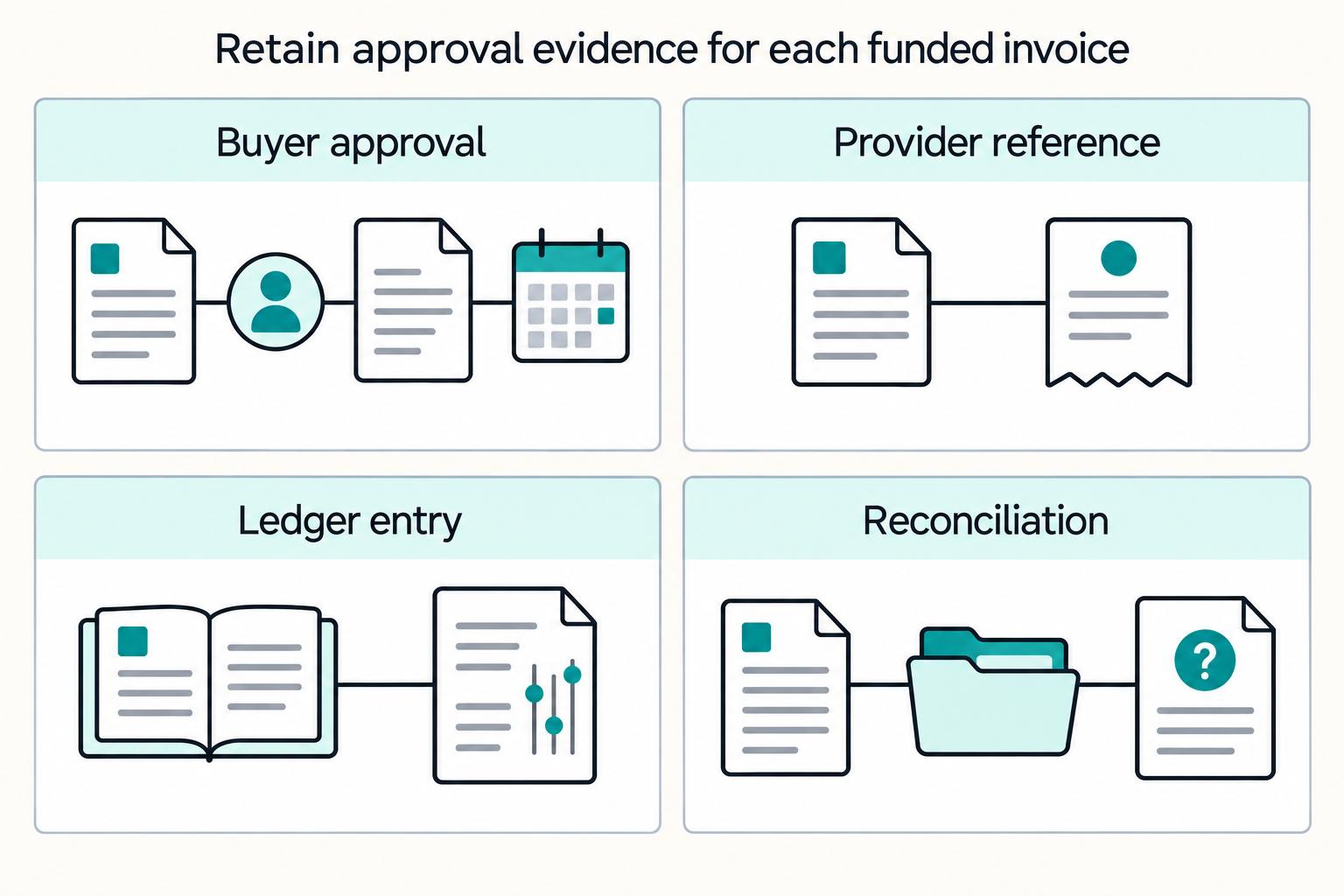
2. Require an evidence pack for every payout#
Keep an evidence pack for every funded invoice: the approval commitment, accepted offer, fee allocation, funding reference, repayment terms and settlement records. Finance can use these records to assess disclosure obligations; having a pack does not determine accounting classification.
Minimum pack:
- Approval record: invoice ID, buyer approval status, approved amount, due date, approval timestamp
- Provider reference: finance decision or payout instruction reference
- Ledger entry: gross amount, financing fee if any, net proceeds, liability treatment tied to invoice
- Reconciliation artifact: link from bank-received payout to the underlying batch, including failed or returned payout notes when relevant
If proof is fragmented across tools, that is a control weakness even when each artifact exists.
3. Make retries replay-safe to prevent duplicate liability#
Retries should never create duplicate payout side effects. Use idempotent handling on every write that can trigger payout execution.
Persist a pending operation before calling the provider, with the approved amount, recipient and stable reference. Reuse the same provider key and identical parameters for retries of that operation within its documented retention window. Exclude concurrent execution and mark completion only after reconciling the result.
A timeout or error can leave the result unknown. Query the provider using the original reference and reconcile any confirmed payment before authorising another request. If idempotency retention expires, block blind replay and resolve the original operation; do not create a new key merely because the old request failed.
4. Prove reconciliation on exceptions before expanding coverage#
Do not judge a rollout only on successful payouts. Expansion should wait until exception handling is clean for unmatched deposits, held or returned funds, and payout status drift.
- Unmatched deposits: reconcile bank-received amounts to payout reconciliation reports or batch records
- Held or returned funds: track provider reasons and the applicable rail's return or investigation windows
- Status drift: compare internal payout status with provider state timelines
Confirm how the financing program associates invoices, funding batches and bank movements. Do not assume an automatic payout supplies a complete transaction mapping. Keep unmatched allocations open for review while recording evidenced cash under finance's posting policy. Unresolved funding or repayment exceptions need owners before coverage expands.
Failure modes that break trust and how to prevent them#
Common trust breaks in reverse factoring are operational: weak approval quality, unclear fee ownership, slow handoffs, and fragmented records. If those issues persist, the offer can feel unreliable even when funding exists.
1 Approved invoices that are not truly final#
Early payment should apply only to invoices the buyer has confirmed as valid. Trust breaks when an invoice is treated as approved, funded, and then later disputed on amount, scope, or timing.
Prevent this by treating approval as a financing-grade state, not a soft milestone. Lock invoice ID, approved amount, due date, and approval timestamp at approval, and require re-approval before financing if any of those fields change. Then sample funded invoices regularly to confirm those fields match across approval, provider reference, and ledger.
2 Financing fee ownership that stays fuzzy until payout#
Fee ambiguity creates immediate distrust. If a supplier expects the approved amount but receives net proceeds without a clear fee explanation, they may treat the program as opaque.
State ownership before opt-in and again at payout confirmation. Show gross invoice amount, financing fee, net proceeds, and what they would receive at the standard due date. Keep payment timing and fee basis explicit to reduce avoidable confusion.
3 Operational lag that creates a new payment timing gap#
An early-pay program can create a new delay if approval, funding, and payout run on different clocks. These flows involve multiple handoffs, so "early" does not automatically mean "fast."
Track elapsed time by step: approval to provider confirmation, confirmation to payout initiation, and initiation to funds received. Monitor queue and cutoff delays at each stage, not just the final payout date, so bottlenecks are visible before they erode trust.
4 Fragmented records that weaken control and visibility#
When records are split across systems, you lose the ability to explain a single invoice quickly. That weakens exception handling and makes liabilities and cash-flow exposure harder to see and manage.
Use one reconciliation source plus a structured exception log. For each funded invoice, keep the approval record, provider reference, ledger entry, payout or bank reconciliation artifact, and any return or mismatch note connected in one place. If you cannot retrieve that chain quickly, treat it as a live trust issue, not just a reporting cleanup task.
For a step-by-step walkthrough, see How to Pay International Contractors With Fewer Delays and Disputes.
How Gruv can support this model in practice#
Gruv is most useful here as the control and traceability layer around an early-pay program, not as the finance provider and not as a substitute for approval discipline. If approved invoices are still editable after approval, fix that before you expand reverse factoring.
1 Fix the approved state first#
Early funding in payables finance depends on invoices the buyer has confirmed as valid, with the strongest standard being an unconditional, irrevocable commitment to pay. Your approval state needs to be financing-grade, not just operationally convenient.
Use your invoicing and payment state tracking process, including Gruv records, to keep four fields fixed at approval: invoice ID, approved amount, due date, and approval timestamp. Then sample approved invoices and verify those same four fields match across approval, provider submission, and ledger records. If they can change without re-approval, exception risk stays high and reliable supply chain finance gets harder to run.
2 Keep contractor payouts gated and traceable#
When evaluating Gruv for payout execution, confirm the supported approval handoff, duplicate prevention, status events and audit records for your chosen provider and corridor. The financier's commitment and funding decision remain separate from payout execution.
Track request creation, required checks, initiation, settlement and returns separately. Confirm market coverage, methods and timelines for the intended contractor cohort before promising an early-pay date.
3 Reconcile early to see real unit economics#
Ask how settlement and reconciliation records can be exported to your systems. Test that funded invoices can be traced to bank evidence and that fees and failures remain visible in the economics report.
For each payout path, keep one connected record: gross invoice amount, any financing fee, net proceeds, provider reference, ledger entry, and settlement or bank artifact. Reconcile exceptions separately instead of blending them into aggregate payout totals. This discipline also supports reporting environments that require clearer supplier-finance term visibility. For IFRS reporters, related disclosure amendments apply for annual periods beginning on or after 1 January 2024.
4 Qualify every launch promise by market#
Program readiness is not the same as product readiness. Gruv's public positioning already qualifies coverage, methods, and timelines by market and by policy or compliance checks, and that is the right operating assumption.
Before committing launch dates, confirm countries, rails, currencies, and contractor cohorts with sales. If you operate across multiple jurisdictions, start with one corridor or buyer cohort, prove payout timing and exception handling, then expand. Keep audit artifacts for the retention period that applies in your context. If rail or policy availability is not confirmed, do not publish the timeline.
Related: What Is Invoice Factoring? How Platforms Can Offer Early Payment to Contractors in Cash Flow Crunch.
Conclusion#
Do not default to early pay. Choose the model your approval quality, fee setup, and operating controls can actually support.
- Match the model to financing-grade approvals
Reverse factoring is buyer-led: a third-party provider pays early on buyer-confirmed invoices, typically for a discount, and the buyer settles under agreed program terms. It can improve cash flow, but only when approval truly means the invoice is valid and payable.
- Set fee ownership and payment terms before launch
If you cannot clearly state who pays the financing fee, when payment happens, and how proceeds are calculated, the offer is not launch-ready. Keep terms explicit in contracts and payout flows, including payment timing and how it is determined.
- Scale deliberately and measure real unit economics
Reverse factoring outcomes are conditional, so treat rollout as a tradeoff decision, not an automatic win. Expand only when adoption, settlement reliability, support load, and margin impact hold up together, and keep records clean for liquidity and disclosure review, including IFRS periods beginning on or after 1 January 2024.
If your launch decision depends on payout controls, reconciliation, and market coverage, talk to Gruv to validate fit before rollout.
Frequently Asked Questions
What is Reverse factoring in one sentence?
Reverse factoring, often called payables finance, is a buyer-led program where a finance provider pays a supplier early on accepted receivables, and the buyer pays the financier on the agreed due date. Some sources treat reverse factoring and supply chain finance as equivalent terms, while the 2016 standard definitions frame payables finance as one specific technique, so terminology varies by source.
How is Reverse factoring different from Invoice factoring and Dynamic discounting?
Invoice factoring is supplier-led: the supplier sells outstanding invoices to a factoring company. Dynamic discounting is buyer-led but funded with the buyer's own cash, and the discount typically increases when payment is made earlier. In practice, the split is buyer plus third-party finance in payables finance, supplier plus factor in invoice factoring, and buyer cash in dynamic discounting.
Who usually pays the Financing fee in Supply chain finance?
There is no universal fee rule, so do not assume the buyer or the supplier always pays. One World Bank reverse factoring product card shows a supplier-paid model, but allocation can differ by program terms. Set fee ownership clearly in contracts and in the payout flow before opt-in.
When should a platform offer early pay to a Contractor?
Offer early pay when contractor cash timing is a real pain point and approval quality is strong enough for financing. In payables finance, supplier participation is an independent choice, so treat early pay as optional rather than default. If approved amount, fee, due date, and expected net proceeds are not clear at decision time, delay launch.
What must be true about Approved invoices before launch?
Approved invoices must meet financing requirements, not just operational approval. The core standard is an unconditional, irrevocable commitment to pay on accepted or confirmed receivables, and that checkpoint should be explicit in your approval record. If key commercial terms can still be changed after submission, financing certainty is lower.
How do early pay programs affect Platform monetization and Unit economics?
They can improve supplier cash timing, but economics depend on fee allocation and who provides liquidity. In payables-finance-style solutions, external financiers can provide liquidity while the buyer payable remains due to maturity. Reporting treatment is also part of the decision context, including active reverse-factoring presentation discussions in IFRS channels.
What are the biggest operational risks after going live?
A documented risk signal is misuse: payables finance has faced controversy when misused. Another live risk area is reporting treatment, including presentation in financial position, cash flow, and note disclosures. Operationally, keep approval commitments and fee terms explicit across approval, funding, payout, and settlement records.
Researched and edited by the Gruv editorial team. Gruv builds cross-border billing, payouts, and finance-operations software for global businesses.
Sources
Includes 6 external sources outside the trusted-domain allowlist.
- thedocs.worldbank.org/en/doc/195821569427524147-0250022019/render/...trusted
- academy.iccwbo.org/trade-finance/article/standard-definitions-f...external
- ifrs.org/news-and-events/news/2023/05/iasb-increases-...external
- ifrs.org/content/dam/ifrs/supporting-implementation/a...external
- storage.fasb.org/ASU%202022-04.pdfexternal
- supplychainfinanceforum.org/techniques/payables-financeexternal
- supplychainfinanceforum.org/techniques/dynamic-discountingexternal
Educational content only. Not legal, tax, or financial advice.
Related Posts

The Freelance Payment Penalty: A Modeled Audit of Platform Fees, FX Spreads, and Payout Delays
The money rarely disappears through a single, easy-to-spot fee. The real loss is stacked. A marketplace takes its commission, a processor adds a charge for international cards, a bank or payment company converts the currency at a spread, a platform holds the funds before release, and a wire sheds a little to intermediaries on the way in. Each layer looks defensible on its own, but the worker feels the combined result as a smaller deposit and a later payday.

How to Respond to a Subpoena for Business Records
Move fast, but do not produce records on instinct. If you need to **respond to a subpoena for business records**, your immediate job is to control deadlines, preserve records, and make any later production defensible.
A US Expat's Guide to Investing in UCITS ETFs to Avoid PFIC Issues
The real problem is a two-system conflict. U.S. tax treatment can punish the wrong fund choice, while local product-access constraints can block the funds you want to buy in the first place. For **us expat ucits etfs**, the practical question is not "Which product is best?" It is "What can I access, report, and keep doing every year without guessing?" Use this four-part filter before any trade: