
Quick Answer
Start by using comparables analysis business valuation as a practical pricing workflow for your service offer, not as a public-company exercise. Build a dated set of relevant peers, filter weak matches, normalize prices into one unit, and anchor your baseline with a central tendency you can defend. Add an upward adjustment only when evidence shows stronger outcomes or lower execution risk for this scope. Then present the logic in a short Statement of Value placed between scope details and the final fee.
A Guide to 'Comparables Analysis' for Business Valuation#
If your pricing feels inconsistent or hard to defend, start with a better market reference. Traditional comparable company analysis is a valid valuation method, but it relies on public-company market prices and valuation multiples. That often does not transfer cleanly to a solo service offer. For your work, the practical goal is simpler: a defensible fee you can explain in a proposal.
| Dimension | Traditional CCA | Solo-service comparables analysis |
|---|---|---|
| Data source | Public-company market data and peer-group multiples | Public freelancer profile rates and priced alternatives in your market |
| Valuation unit | Company value relative to operating metrics | Hourly, fixed-project, or value-based service pricing |
| Decision use case | Estimating an implied valuation range for a business | Setting and defending a fee for your offer |
| Practical output | A valuation range or parameter | A proposal-ready baseline price with clear adjustments |
Use this guide as a Rate Justification Method, not an M&A exercise. You are not trying to force public-company logic onto a one-person business. You are building a market baseline, then explaining why your final price sits at, below, or above it.
The discipline worth borrowing from traditional comps is comparability. Public-company peer groups are screened because true comparability is hard to achieve, and you should apply that same discipline in a simpler way. If a peer does not match your service category, geography, and pricing unit, exclude it.
By the end of this guide, you will have a proposal-ready statement of value: relevant peers, a baseline fee, and justified adjustments for scope or positioning. The first job is building the right peer set.
You might also find this useful: A Guide to Financial Ratios for Business Health.
Step 1: How to Find 'Comparables' for a One-Person Business#
Use economically similar peers as your primary benchmark, and treat public-company data as context rather than direct rate comps. If a candidate is not a realistic substitute for what you sell, exclude it, because a weak peer set can throw off everything that follows. For a one-person business, peer selection is the most important step. Build your peer set around similar cash flow potential, growth, and risk, not just similar job titles.
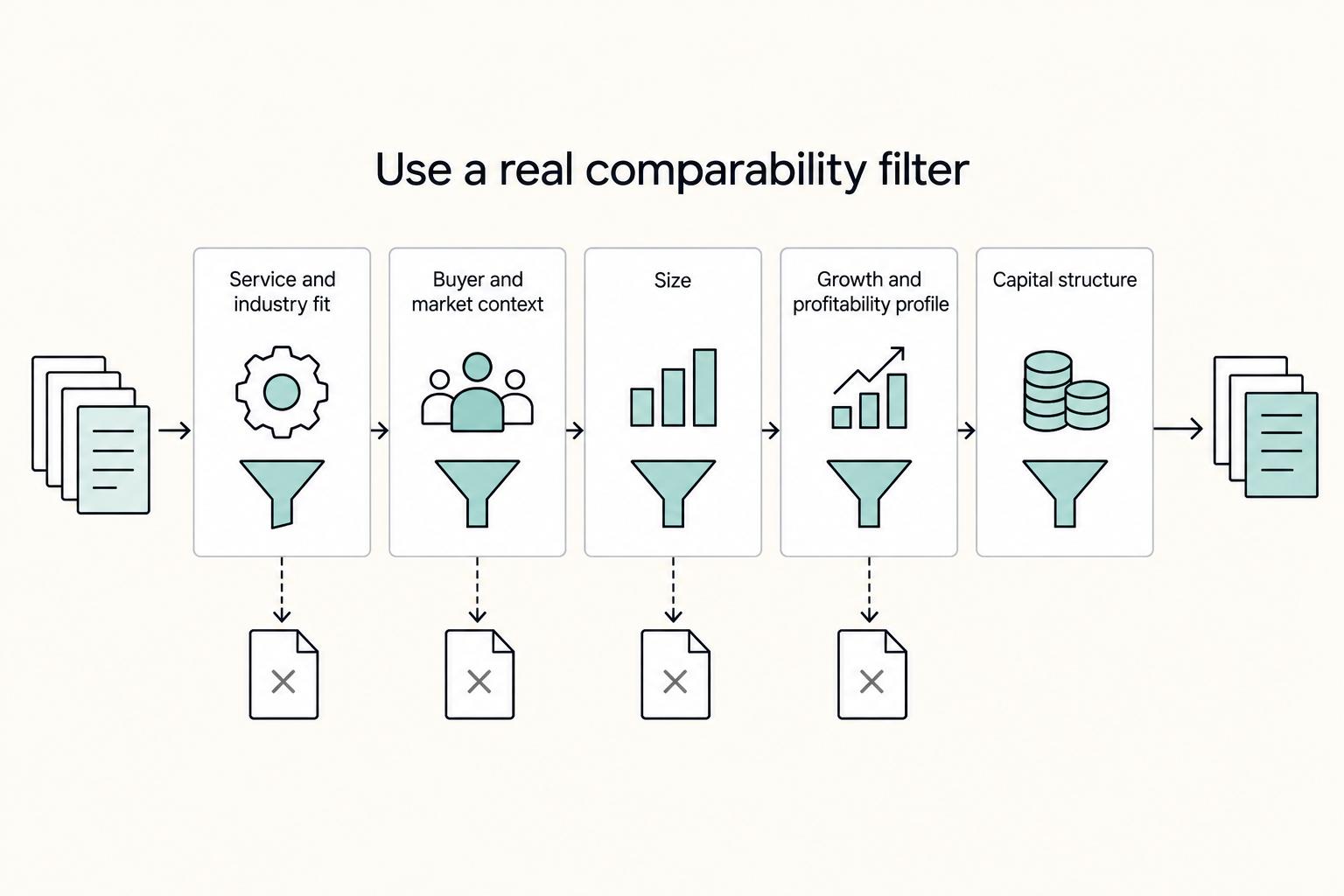
Use a real comparability filter#
Industry overlap alone is not enough. For pricing decisions, screen each candidate against these five filters:
| Filter | What to check |
|---|---|
| Service and industry fit | The work offered and sector context should match your core offer |
| Buyer and market context | Compare candidates serving similar buyer types and markets |
| Size | Keep business scale and engagement size reasonably comparable |
| Growth and profitability profile | Favor candidates with similar growth and margin dynamics |
| Capital structure | Note financing differences that can distort pricing behavior |
Use one practical test: if you cannot explain why a buyer would treat this person as a substitute for you, treat it as noise. Document why you included or excluded each comp. There is no universally applicable formula here, so your judgment notes are part of the evidence.
Pull rate signals in layers#
Start with direct market signals that reflect your buyer and scope, and tag quality on every row. Even when a number looks usable, it may not match your scope, unit, or date.
| Source | Best use | Caution |
|---|---|---|
| Direct market signals | Closest available signals for your buyer and scope | Check scope, pricing unit, and date before you use them |
| Bureau of Labor Statistics OEWS wage data | Help frame the broader role market | Treat as directional, not decision-ready; it excludes the self-employed, owners, and partners in unincorporated firms, and is published annually with a May reference date |
| Form 10-K/public filings | Use as high-confidence context | Not direct freelancer rate anchors; they can be too far removed from one-person service economics to use as direct comps |
Then layer in broader context. Bureau of Labor Statistics OEWS wage data can help frame the role market. It covers about 830 occupations from a sample of about 1.1 million establishments. Treat OEWS as directional, not decision-ready, because it excludes the self-employed, owners, and partners in unincorporated firms. Also record recency, since OEWS is published annually with a May reference date.
Treat public-company filings such as Form 10-K as high-confidence context, not direct freelancer rate anchors. They include audited financial statements, but they can be too far removed from one-person service economics to use as direct comps. If you cannot verify source date, pricing unit, and scope, keep the row as context and mark it directional.
Build the market map you will actually use#
Your Personal Market Map should be a decision sheet, not a scrapbook. Track source type, role fit, pricing-format normalization, confidence, and exclusion reason. A simple 1 to 5 score is enough if you apply it consistently.
| Candidate | Source type | Role-fit score | Original pricing format | Normalized format | Confidence | Exclusion reason |
|---|---|---|---|---|---|---|
| Peer consultant with same buyer profile | Public rate card or shared proposal | 5/5 | Monthly retainer | Retainer kept as-is, scoped by deliverables | High | Include |
| Similar specialist, different delivery model | Marketplace profile | 3/5 | Hourly | Converted to your comparison unit using documented assumptions | Medium | Exclude if they sell staff augmentation and you sell strategy |
| Broad occupation benchmark | OEWS wage data | 2/5 | Hourly wage | Kept as hourly context only | Low | Exclude from final pricing set because self-employed are excluded |
| Large vendor alternative | Form 10-K/public filings | 1/5 | Revenue and segment data | Not normalized into freelancer rate | Medium for context, low for direct comp | Exclude as direct peer |
Normalize mixed prices before you compare them#
Standardize the pricing unit before you move to the next step, and keep your numerator and denominator logic consistent. Do not compare execution hourly rates to strategy project fees unless both tie back to the same scope assumptions.
There is no universal conversion rule, so document each row carefully. Note what is included or excluded, revision and meeting load, and whether the price reflects advisory time, production time, or both.
Once the set is normalized, remove obvious noise before you set your anchor range. Use the median as your primary summary because it is less sensitive to extreme values than the mean. If a row sits far above or below the rest, label why. For example, note a true premium, a one-off concession, or a bad match. Do not delete it without a note.
Related: How to Perform a Business Valuation for a Small Agency.
Step 2: Which 'Multiples' Actually Matter When You Are the Product?#
Use practical pricing anchors, not corporate valuation multiples, for this step. Corporate comparable analysis standardizes market prices so peer prices can be compared. Your version is simpler: standardize peer pricing, choose one baseline method, and turn it into a client-facing anchor.
P/E and EV/EBITDA are corporate relative-valuation tools. For a solo service business, the practical question is which pricing unit matches how this client will buy.
The labels below are working pricing anchors for quoting, not standard corporate-finance multiple terms.
| Pricing anchor (working label) | What it measures | When to use it | Required inputs | Common misread risk |
|---|---|---|---|---|
| Rate multiple | Market price for a unit of labor time (usually hourly or daily) | New scope, uncertain duration, or work that cannot be estimated accurately upfront | Normalized hourly/daily peer rates, scope notes, source date, role fit | Treating all billed hours as equivalent when some peers bundle strategy, revisions, or production differently |
| Project value multiple | Market price for a defined deliverable or fixed-scope engagement | Defined deliverable with clear goals, timeline, and boundaries | Comparable project fees, deliverables list, revision limits, meeting load, exclusions | Comparing projects with similar labels but materially different scope |
| Retainer multiple | Market price for recurring monthly access to your services | Ongoing advisory, embedded support, or recurring implementation after trust is established | Monthly fee, access terms, response expectations, included deliverables, term length | Anchoring to retainers that include broader access or deeper execution than your offer |
Normalize before you benchmark#
Normalize first, then benchmark. Define each benchmark consistently and estimate it the same way across your peer set, or your baseline will drift.
Keep core fields visible for every comp: source date, pricing unit, included scope, exclusions, and buyer type. If a data point is stale, unclear, or mismatched on scope, downgrade it to directional context instead of anchor-grade input. Recency matters, and even market-multiple datasets are explicitly date-stamped.
Choose the lead multiple based on contract reality#
Choose the benchmark that fits how the work will actually be bought.
Lead with a rate multiple when extent or duration cannot be estimated reliably at the start. This fits time-and-materials logic, but it carries efficiency risk. Be explicit about what the rate includes and what can change.
Lead with a project value multiple when deliverables and boundaries are reasonably definite. Use scope limits, revision rules, and change-request triggers so the fixed fee stays tied to a clear workload.
Lead with a retainer multiple when the client is buying ongoing access. Retainers can work well for recurring advisory or embedded support, especially after trust is established. Only compare retainers with similar availability and service depth.
Use median first, then inspect edge cases#
Use the median as your primary benchmark and report the mean as context when the data is skewed. The median is more resistant to outliers, so it is often the safer anchor.
Do not auto-delete extreme values. Investigate them first. A high or low number can reflect a true premium, a stale listing, or a bad scope match.
If you need a quick rule before Step 3, use this one: uncertain scope means rate-led, defined deliverable means project-led, and ongoing advisory means retainer-led. Pick one lead baseline, keep the other two as cross-checks, then convert that into your quoted price.
For a step-by-step walkthrough, see A Guide to Functional Currency for Your Business.
Step 3: The 'Premium Adjustment': How to Justify Charging More#
Your Step 2 baseline is your default quote. Go above it only when you can show lower client risk, stronger expected business outcomes, or both.
Pricing does not happen in isolation. Your market anchor matters, but so do delivery costs, scope reality, and execution uncertainty. In practice, a premium is an evidence-backed adjustment, not a confidence play.
Use a simple premium justification framework#
Use this as a working framework, not a fixed formula: specialization fit, outcome evidence, delivery reliability, and strategic impact. Treat these factors as prompts, not a validated scoring model. Weight the factors by the job in front of you. For narrow, high-stakes problems, fit and outcome proof may matter most. For deadline-heavy or dependency-heavy work, reliability can matter more.
Do not add a premium for general experience alone. Add it when your experience clearly matches the buyer's problem and you can prove that match with current, relevant evidence.
Before you decide on any adjustment, run a full cost review. If your quote does not cover the total expense required to produce and deliver the service, you can lose money even when the client accepts.
| Factor | Proof you can show | How it affects pricing power | Weak evidence to avoid |
|---|---|---|---|
| Specialization fit | Narrow positioning tied to the client use case, recent similar work, relevant portfolio samples | Can increase confidence you can deliver without a learning curve on client time | Broad claims like "I work with all industries" or outdated samples from a different service line |
| Outcome evidence | Verified before/after metric, case study with scope and timeline, client reference if available | Can support a higher quote because expected value is clearer | Vanity metrics, unattributed percentages, screenshots with no context |
| Delivery reliability | Process clarity, milestone history, on-time delivery record, communication cadence, revision boundaries | Can lower perceived execution risk and management overhead | Generic "great to work with" testimonials without operating detail |
| Strategic impact | Proof your work influenced revenue, cost, conversion, retention, or decision quality | Can shift discussion from time spent to business effect | "Strategic" claims with no link to a real decision or result |
What strong evidence looks like#
Strong evidence is specific, recent, and comparable to this engagement. Weak: "Improved performance." Usable: "For a comparable client type, redesigned the relevant asset or process, with the outcome metric, timeframe, and scope boundary verified from source records before use."
Reliability proof is stronger with operating detail, such as reporting rhythm, approval points, revision limits, and change-request triggers. Keep your proof matched to the same pricing unit you selected in Step 2, whether that is rate, project, or retainer.
Apply the adjustment without bluffing#
Write the premium case in plain language before you assign a number. If you cannot explain it in three short points, keep working the evidence.
- Baseline anchor: Confirm the current market baseline from your market records
- Premium basis: Client-problem fit, verified outcome proof, and delivery reliability detail
- Resulting quote: Confirm the resulting premium range from your market records
Avoid unsupported percentages, generic seniority claims, and soft promises. Tie the adjustment to fit, proof, and risk reduction. A price that is too high can push buyers away, and a price that is too low can hurt margin and perceived value. Keep the premium tied to evidence. If evidence is mixed, quote the baseline and keep the premium case in reserve for negotiation.
Test the premium before you quote#
Use this checkpoint before you send the number:
- Do I have current proof for the factors I am using to justify the adjustment?
- Is that proof comparable to this scope, buyer type, and pricing unit?
- Have I completed a full cost review so the quote covers delivery?
- Can I explain the adjustment in three plain-language points?
- If asked "why above market?", can I answer with evidence instead of adjectives?
If evidence is thin, hold the baseline. If evidence is strong across factors, apply the adjustment and defend it in Step 4.
We covered this in detail in A Guide to Selling Your Freelance Business or Agency.
Want a faster way to sanity-check your baseline and premium before you send a proposal? Use the Freelance Rate Calculator.
The Final Output: Building Your 'Statement of Value'#
This is the packaging step: turn your comps baseline and premium rationale into proposal copy the client can scan quickly. Your statement should show three things in order: the market anchor, your proposed fee, and the evidence behind any gap.
In formal proposal reviews, buyers often assess both the proposal and your ability to deliver, not price alone. If the gap is not supported with proof, it can read like positioning language instead of a real decision input.
Write it as a short decision note#
Place this after scope and deliverables, and before the final fee table or signature block. A simple note works well:
Your proposed fee is based on the current market for professionals with comparable experience in this niche delivering this service type.
The baseline market rate for comparable work must be verified from current market records and kept in the same pricing unit as this proposal.
Your fee reflects the documented premium reason, supported by outcome evidence and risk-reduction detail.
Relevant proof attached: case study, sample, testimonial, or delivery plan.
Keep every claim tied to attached evidence. If you cannot document a benefit, remove it or rewrite it more cautiously.
Show the gap clearly#
A compact comparison table makes the logic easy to scan.
| Comparison point | Baseline market rate | Your proposed fee | Why the gap exists |
|---|---|---|---|
| Pricing unit | Current baseline in the same unit used for this proposal, verified from your market records | Your fee in the same unit, as documented in your proposal | Same-unit comparison, with scope differences made explicit |
| Experience and niche fit | General comparable profile from verified market records | Specific experience and niche fit documented in source records | Closer fit for this scope and delivery context |
| Proof and delivery certainty | Market anchor only, verified from your market records | Documented offer | Attached outcome evidence, delivery process, approvals, revision limits, and communication cadence |
Run two checks before you use this table: keep the pricing unit consistent, and make sure the evidence is comparable to this engagement.
Use it where it does the most work#
Use the statement after scope, before price, and with proof attached.
- Place it after scope, before price, so fee logic is read in context.
- Attach proof that matches each claim: a short case study, relevant sample, testimonial with operating detail, or delivery plan.
- Verify before sending: same pricing unit, premium reason tied to this scope, and evidence attached for each concrete benefit claim.
Used this way, your statement helps keep the discussion on risk, delivery confidence, and business value instead of a raw rate comparison.
If you want a deeper dive, read Hiring Your First Subcontractor: Legal and Financial Steps.
Conclusion: Stop Guessing, Start Justifying#
Use comparables analysis only if it changes how you price your next proposal. The shift is straightforward. Stop naming a fee from instinct and present a market-backed range built from a relevant peer set, a defensible baseline multiple, and clear assumptions for any adjustment.
That can change the conversation. Instead of saying, "this is my rate," you can show that your fee is anchored to comparable work in the same pricing unit. Then you can explain how your assumptions map to scope. If a client pushes back, point to your screening criteria, dated comparables snapshot, and any stated uncertainty or limits.
Keep the method tight. Choose peers that are close on industry, geography, size, growth, and profitability, because closer matches improve comparability. Use a central tendency you can defend, whether median or mean, and present the result as a range rather than a single precise answer.
A common failure mode is weak comparability. If pricing units differ, normalize them before comparing. If you cannot explain why a comp belongs in the set, remove it.
What to do before your next send#
| Step | Detail |
|---|---|
| Prepare your comparables snapshot | Build a dated table with peers, pricing units, scope notes, and any translation math |
| Draft your Statement of Value | Write your baseline, any adjustment rationale, and the assumptions you want on record |
| Run a final consistency check | Confirm your fee, scope, terms, and evidence all support the same logic |
This gives you a clearer way to present terms and defend your pricing logic with explicit assumptions and uncertainty. This pairs well with our guide on How to Handle an 'Earn-Out' in a Business Sale Agreement.
When your pricing logic is finalized, turn it into a client-ready bill with the Free Invoice Generator.
Frequently Asked Questions
How should you use comparables to set your rates?
Build a comps table first, then use it as directional support for your fee decision rather than a precise answer. Keep a dated record of the market evidence you used so you can explain your position if challenged.
What makes a comparable valid for a solo consultant, creator, or developer?
A comparable is stronger after you filter for industry, size, and type, then check growth prospects and profitability when available. Because truly identical matches are often hard to find, document why each comparable was included.
How do you value an asset-light service business?
For formal valuation, keep the method choice explicit: comps is relative valuation, while DCF is intrinsic valuation. The supporting material should focus on relevant comparable company or transaction data.
How do you value a one-person company for something more formal than a proposal?
If the context is formal, use valuation methods rather than fee logic alone. One market method source notes that the Guideline Transaction Method is often most relevant for small and mid-sized businesses. You can also test an intrinsic method like DCF. The core support here is filtered sold-company transaction data, followed by a check for value adjustments tied to cash, debt, and non-operating assets.
How reliable is comparables analysis business valuation for private or one-person businesses?
Use comparables as a decision aid, not a precision instrument. Reliability drops when truly similar businesses are hard to find or when market conditions distort multiples. Document weak matches and thin data so those limits are explicit in your analysis.
Try a related tool
Researched and edited by the Gruv editorial team. Gruv builds cross-border billing, payouts, and finance-operations software for global businesses.
Sources
- acquisition.gov/far/16.601trusted
- acquisition.gov/far/16.202-2trusted
- bls.gov/oes/oes_emp.htmtrusted
- bls.gov/oestrusted
- investor.gov/introduction-investing/investing-basics/glos...trusted
- irs.gov/businesses/valuation-of-assetstrusted
- irs.gov/irm/part4/irm_04-048-004trusted
- itl.nist.gov/div898/software/dataplot/refman1/auxillar/me...trusted
Educational content only. Not legal, tax, or financial advice.
Related Posts

Hiring a Subcontractor for the First Time Without Costly Surprises
**Start with a risk-control sequence, not an ad hoc handoff.** As the Contractor, your goal is simple: deliver cleanly, control scope, and release payment only when the work and file are complete.
How to Perform a Business Valuation for a Small Agency
**Treat valuation for a small agency as a risk control system, not a headline multiple, and you are more likely to protect agency value before you ever start selling a business.**
Discounted Cash Flow DCF Valuation for Solo Professionals
When you compare client options, do not start with the headline fee. Start with which option gets you more cash sooner, with less risk. That is what **discounted cash flow (DCF)** means in practice.