
Why payment sales enablement breaks down and what this guide fixes#
Payment sales enablement can break down when teams share content but do not give reps clear decision guidance. This guide is designed to help your team explain complex Payment Processing topics in plain business terms, and to clarify when to answer directly and when to escalate.
Sales enablement should help customer-facing teams move buyers toward better decisions, not just distribute more collateral. In complex deals, things often go wrong when explanations are detached from buyer decisions, or when training is long, generic, and hard to use on live calls. The goal here is practical: give reps a first answer that is useful and internally safe.
This guide is for founders, revenue leaders, product teams, and finance operators making packaging decisions in complex go-to-market environments. Strong enablement is cross-functional, so the message used in sales should also hold up through implementation, finance, and support handoffs.
A Sales Enablement Platform and a centralized content hub still matter, and scripts or product sheets still help. The gap is that generic enablement advice can stop at content access and coaching mechanics, while complex buyer conversations also require judgment about commercial impact and ownership. That is why this guide separates sales operations work, such as tools, data, and workflows, from enablement work, such as capability, clarity, and change management.
Use one operating test throughout: treat your sales team as Customer 0. If reps cannot give one short business answer, one caveat, and one escalation trigger for a complex concept, buyers will not get a consistent story either.
For a deeper look at how to package and explain pricing, see Tiered Pricing Strategies for Payment Platforms with Basic Pro Enterprise.
What to prepare before you roll this out#
Do not roll this out until your guidance is documented against the buyer path and reviewed across teams. Reps should be able to answer clearly without improvising.
Step 1 Build a focused evidence pack#
Start with one end-to-end buyer promise and document the supporting product evidence for that flow. Keep it concrete enough that teams can review the same path and agree on what is confirmed, what is configurable, and what is still an assumption.
If that agreement is hard to reach, the enablement content may still be too abstract for live deals.
Step 2 Translate policy and risk gates into sales language#
Write policy constraints in plain language reps can actually use in calls, including when to escalate. For payment products, legal and regulatory understanding belongs early, not after commercial commitments are made.
If policy details stay buried in specialist documents, teams tend to fill the gap reactively and impact suffers.
Step 3 Ground messaging in real deal pressure#
Test messaging against real buyer engagement signals, not only idealized internal FAQs. Prioritize recurring buyer questions and keep the latest approved guidance in one place so reps can find it quickly.
Use rollout checkpoints to track content performance, buyer engagement, and win rates so gaps are visible before they become repeated deal friction.
Step 4 Set ownership, operating rules, and launch checkpoints#
Set explicit enablement governance before launch and document how disputed answers are resolved. Only 19% of organizations report dynamic alignment between enablement and the buyer path, so treating governance as optional often leaves teams in reactive mode.
Use a centralized content hub or Sales Enablement Platform to reduce search friction, but do not confuse storage with readiness. Before rollout, confirm you have a shared enablement definition and baseline tracking for content performance, buyer engagement, and win rates.
For a closer look at how platforms offer contractor early payment and manage the risk behind it, see Invoice Factoring for Contractors: How Platforms Offer Early Payment and Manage Risk.
Pick the payment concepts that actually change buyer decisions#
Once your evidence pack is in place, do not train everything evenly. Triage the concepts, prioritize the ones most tied to explicit business goals and recurring deal pressure, and defer the rest until evidence says they matter.
Step 1 Build a candidate list from real deal pressure#
Pull your candidate list from active deal signals, such as RFP responses, demo follow-ups, objection notes, and post-call feedback. Keep it short and tied to explicit business goals.
Before a concept stays on the list, confirm it maps to a concrete asset in your shared hub, such as a playbook, case study, RFP template, or demo deck. If you cannot find that artifact trail, the topic may be getting prioritized on internal interest rather than clear deal pressure.
Step 2 Score each concept on impact and misunderstanding risk#
Score each concept with lightweight labels (for example, High, Medium, or Low) so the method stays usable.
- Business impact: likely relevance to stated business goals.
- Misunderstanding risk: likelihood of confusion that creates repeated clarification work.
Treat high misunderstanding risk as a cost signal, not just a messaging problem. Growth can increase value while costs surge, while scaling is associated with adding revenue without proportional cost increases, so concepts that repeatedly force clarification can move up in priority.
Step 3 Define decision rules and specialist review triggers#
Set clear internal decision rules for concepts that touch policy, legal, or compliance interpretation, and define when specialist review is required before proposal language is finalized. That keeps sales conversations useful while controlling promise risk in commercial documents.
Use the proposal checkpoint to verify the rule is working. If sensitive language appears, confirm there is an approval trail and approved wording. For specialist background on licensing-model terms, use EU Payment License Types Explained: EMI vs PI vs Agent Model for Platforms.
Step 4 Publish a keep/defer list#
Publish a visible keep/defer list in your shared enablement hub. Keep topics get active training and approved talk tracks. Defer topics stay out of first-call and standard-deck priority.
This addresses a common failure mode: reps waste time searching disjointed systems. Move a concept from defer to keep only when deal evidence repeats.
For a practical breakdown of 2-way and 3-way matching, see Invoice Matching Explained: How Platforms Automate 2-Way and 3-Way Matching to Prevent Overpayment.
Build a one page explainer for each hard payment topic#
For hard payment topics, one page can be enough when it is structured well. The goal is to simplify the concept and help reps move to the next decision without improvising.
Step 1 Fix one structure and use it every time#
Use the same five blocks for every topic, even when the topic feels unique:
- Concept
What the capability is, in plain business language.
- Business impact
What changes for the buyer operationally or commercially.
- Implementation requirements
Which internal artifacts define what must be built, configured, or verified.
- Constraints
What is conditional, market-dependent, policy-gated, or still under review.
- Next decision
The specific buyer choice or internal escalation point.
If the page does not end with a clear next decision, it is reference content, not a sales explainer. Use the Customer 0 test here too: if a rep who did not draft the page cannot use it cleanly in a mock call, revise it.
Step 2 Anchor each page in concrete internal artifacts#
Every explainer should point to concrete internal sources for technical reality, not memory or generic prose, when a verified artifact exists.
The standard is traceability. A rep should be able to answer “where is that documented?” in seconds. Link to the internal source and name an owner for each artifact so updates do not drift away from sales language.
Step 3 Add compliance and tax caveats as decision guardrails#
Include regulatory, tax, and documentation caveats only when they are relevant to that topic. Keep this as a short caveat box, not legal copy, and state clearly that requirements can vary by market, product setup, or policy.
For regulated or evolving topics, point to the governing artifact instead of paraphrasing from memory. The goal is bounded claims, not confident-sounding guesses.
Step 4 Add explicit “if X, do Y” branches#
Each page needs at least one branch for overpromising risk. For example, if a buyer asks for coverage you have not yet confirmed, verify current support and policy constraints before committing.
Use a simple branch format:
- Triggering request
- Verification action
- Approved next response
This makes call handling more consistent and easier to coach.
Step 5 Add one red-flag box for uncertainty language#
Give reps exact language for moments when certainty is not available yet:
Red flag
“I want to confirm that against the current product and policy configuration before I commit to it. This category may be supported, and I’ll verify the exact scope and rollout path with the owning team.”
If the one-pager cannot survive a live call without extra interpretation, it is not ready to publish.
Set escalation rules for unknowns before reps go live#
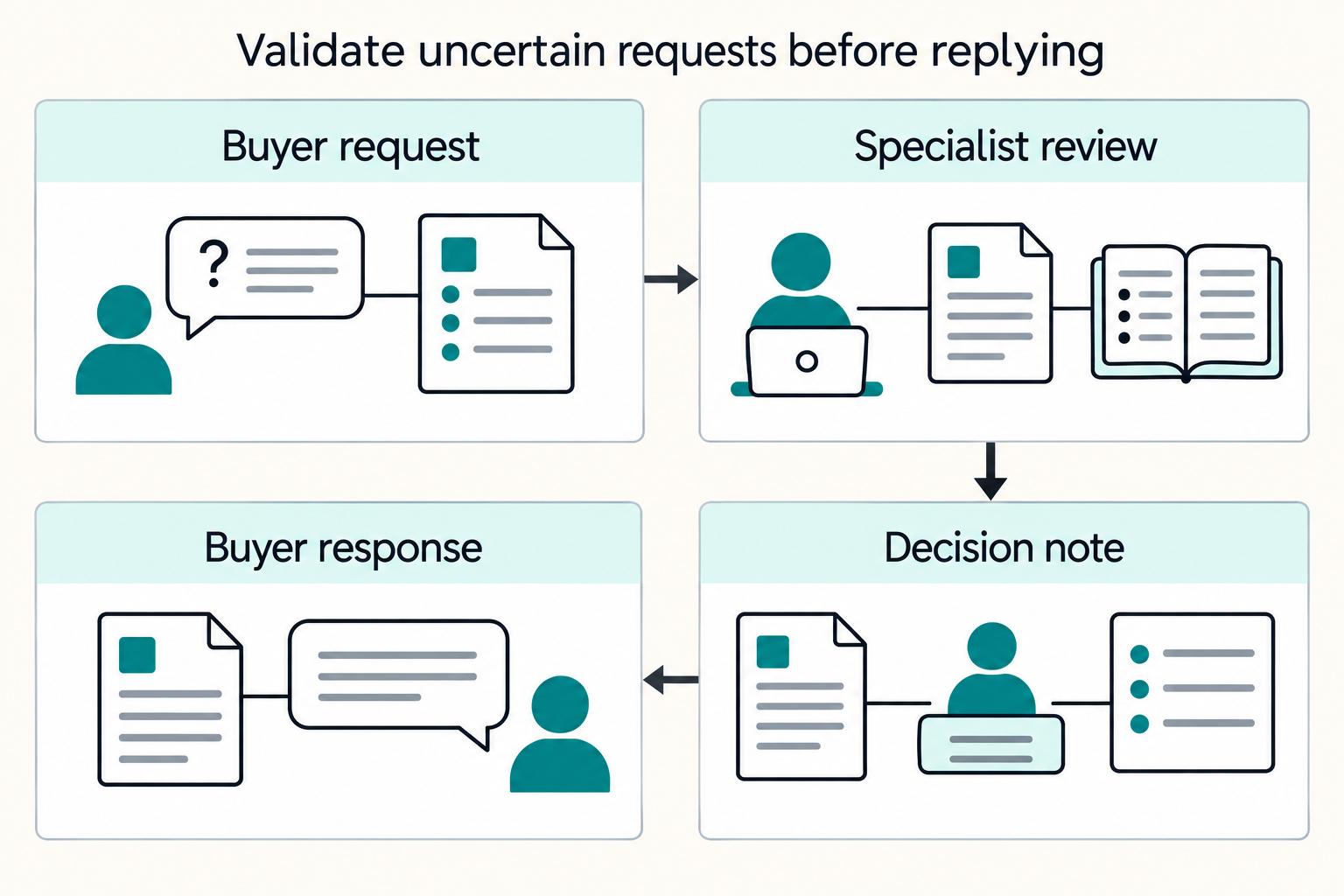
Escalation should be a planned deal step, not a rep failure. When uncertain asks are handled informally, they can drift into concessions or customizations that end in no-decision outcomes.
Step 1 Define the trigger points that force escalation#
Do not leave this to rep judgment alone. Document the request types that require validation before anyone commits scope, timing, or commercial terms.
Start with three trigger families from your own deal history:
- concession or customization requests outside your standard offer
- requirements that are not covered by current product documentation
- questions where reps lack tailored, use-case-specific guidance
These triggers are not impossible by default. They are simply not rep-answerable without validation. If the ask cannot be tied to current product documentation or an approved policy artifact, escalate it.
Step 2 Give reps one standard uncertainty line#
Use one approved sentence so reps do not improvise under pressure:
"I understand the requirement. I need to confirm current product and policy fit with the right specialist, then I'll come back with validated fit and next steps."
This acknowledges the buyer, makes routing explicit, and avoids commitments on unknowns.
Step 3 Route by issue type, not by whoever answers fastest#
Create one visible routing map in the opportunity record or rep-facing guidance.
- product feasibility questions -> engineering or product
- policy, regulatory, or contract-risk questions -> compliance or legal
- pricing pressure and non-standard commercial asks -> finance
Keep ownership explicit so teams answer the question they own. If licensing terminology questions repeat, point reps to one approved explainer, such as EU Payment License Types Explained: EMI vs PI vs Agent Model for Platforms, so terms stay consistent in late-stage calls and RFP responses.
Step 4 Require a close-the-loop artifact before the rep goes back to the buyer#
Do not treat escalation as complete without a reusable record. Require:
- a decision note
- a named owner
- customer-safe summary language
The decision note should capture the original ask, what was checked, the decision, and any conditions. If there is no decision note in the deal record, the rep does not send the answer.
For a step-by-step walkthrough, see ERP Integration for Payment Platforms: How to Connect NetSuite, SAP, and Microsoft Dynamics 365 to Your Payout System.
For broader implementation guidance, read the docs.
Align sales, product, and finance on one decision path#
Escalation alone may not fix coordination problems. To reduce uncoordinated internal activity, sales, product, and finance need one shared path from commercial promise to delivery.
Step 1 Map one shared path from promise to delivery#
Pick one common commercial scenario and map it from buyer-facing promise to internal execution outcome. Keep it simple: what is already stated in approved materials, what teams must do next, and how completion is confirmed.
Turn that path into a customer-safe product sheet or internal one-pager that reps can access during live calls and RFP work. If it is not easy to pull up in the moment, it is not operational.
Step 2 Align on approved messaging boundaries#
Because sales-enablement definitions vary, align internally on one working definition and keep it with the decision path.
Use one operating rule for consistency: if a claim appears in approved materials, reps can use it; if not, route it through your internal review path before it appears in a proposal.
Step 3 Add a finance checkpoint before proposals#
Add a short finance checkpoint before scope and pricing are presented as final. This catches cases where delivery effort may change deal economics before the promise hardens.
Do not assume payment-flow specifics from this map (for example ledger posting, payout initiation, reconciliation, or settlement timing); confirm those details separately with the right owners.
Keep the output explicit: standard as priced, needs pricing adjustment, or needs a different delivery model.
Step 4 Track high-stakes exceptions in one record#
For deals that touch compliance-sensitive terms, tax-document handling, or custom platform behavior, confirm required owners and process with the appropriate internal teams, since requirements vary by organization and jurisdiction.
Close with a reusable decision record: what was requested, what was checked, who approved it, and the exact customer-safe language sales can use. This can help prevent the same exception from being re-litigated and lower handoff risk after signature.
Train with scenario drills that mirror real payment complexity#
Once the decision path is defined, pressure-test it. If reps only study explainers and shadow calls, they may sound informed but still break down when buyers push on feasibility, pricing, or technical uncertainty in real time.
Step 1 Build drills from real late-stage friction#
Build drills from deal moments that actually create confusion: advanced buyer requirements, compatibility questions, integration edge cases, and hard RFP follow-ups. Roleplay is useful because it gives structured practice without live-deal risk and builds execution muscle memory better than concept-heavy training alone.
For each drill, define the buyer role, rep role, core question, on-message talking points, and escalation point. The rep should be able to answer clearly with customer-safe language, state what is still unknown, and avoid bluffing.
Step 2 Include one compliance drill and one finance-friction drill#
Include at least one compliance scenario where a buyer pushes on onboarding controls. For example, a prospect asks to shorten or bypass KYC for a strategic account. The rep should confirm the requirement, state that checks are policy-gated, and escalate without promising an exception or timeline.
Use real market context to anchor why this matters. The 2026 World Bank report includes “Use Case 1: CDD/KYC Credential Issuance through TACH” (p. 24) and treats AML/CFT compliance as a core consideration. You do not need to teach the full use case. You do need reps to treat compliance and identity topics as central in payments conversations.
Then run a finance-friction drill on reporting and reconciliation questions. If a buyer asks detailed reconciliation questions, train reps to clarify what can be shared now, what finance verifies, and what requires follow-up after review, rather than inventing answers on the call.
Step 3 Score decision quality, not confidence#
Evaluate drills on decision quality: did the rep simplify correctly, handle ambiguity without overclaiming, escalate at the right time, and avoid overpromising? A concise scorecard helps you check observable behavior, including use of approved language, correct ownership for next steps, and clear capture of unknowns for product, finance, or compliance follow-through.
Step 4 Convert drill outcomes into reusable field guidance#
Each drill should produce an artifact: updated one-page guidance, approved response language in your enablement system, and clear escalation notes on what sales can and cannot say. If the same question keeps appearing, move the answer into searchable field guidance so reps can use it reliably in live conversations.
Related: Understanding Float: How Payment Platforms Use Your Money Between Collection and Payout.
Instrument enablement so leadership can prove business impact#
Leadership is more likely to trust enablement when you can show business impact, not just content activity. Track a small KPI set tied to real deal moments, map each artifact to an operational checkpoint, and do not mark a topic as ready until the field package is complete.
Sales enablement is a cross-functional practice meant to improve how teams support the customer journey. When concessions and customization requests stack up without clear ownership, deals can drift into rework or no decision.
Step 1 Track a compact KPI set tied to outcomes#
Use a small set of outcome and process metrics so the signal stays clear. Examples include cycle time, proposal rework, escalation turnaround, and handoff quality. Define each metric in your own systems and keep the definitions stable over time.
| KPI | What to track | Where to verify |
|---|---|---|
| Cycle time | Time from qualified stage to decision for complex opportunities | CRM stage history |
| Proposal rework | Commercial or technical sections returned for correction | Proposal versions and approval comments |
| Escalation turnaround | Time from logged question to validated answer back to sales | Escalation tracker timestamps |
| Handoff quality | Closed deals handed off with key questions resolved or clearly flagged | Handoff notes and kickoff checklists |
Step 2 Connect artifacts to operational truth#
An explainer is not enough on its own. Each priority asset should map to a downstream checkpoint. For example, connect the topic to discovery, proposal, and handoff checkpoints so leadership can see whether guidance is holding up in real work.
Treat this as traceability, not proof of strict causality. If the same concept repeatedly causes clarification loops or handoff friction, the guidance probably needs revision.
Step 3 Add quality gates before a topic is marked ready#
A topic is ready only when the minimum field package is complete. Use clear gates:
- One-page explainer covers business impact, requirements, constraints, and next decision.
- Escalation matrix names owners for product, finance, and compliance questions.
- Compliance caveats are written in customer-safe language for policy-gated topics.
- Approved uncertainty language tells reps what is known, unknown, and who validates next.
Step 4 Review on a cadence that fits your team#
If you run a periodic review, keep it evidence-based: KPI trends, repeated escalation themes, recurring rework points, and handoff friction tied to pre-sale explanations. Use the review to retire low-value assets and expand guidance for concepts that keep creating confusion.
Usage data is still useful, but secondary. Leadership needs to see whether enablement is helping reduce rework, improve answer quality, and lower the risk of no-decision outcomes.
Common mistakes that make payment enablement fail#
A common mistake is treating enablement infrastructure as if it were enablement itself. A generic Sales Enablement Platform can store assets, but outcomes can slip when decision guidance, ownership, and review discipline are missing.
Step 1 Separate the tool from decision content#
A Sales Enablement Platform is a container, not the operating model. Sales enablement is cross-functional, and it can turn reactive when teams rely on scattered slides, old RFP language, or verbal workarounds instead of current, approved guidance.
Run recurring content audits so field answers stay aligned with what teams can actually support. A simple checkpoint is to review recent RFP responses or late-stage follow-ups for current guidance, clear escalation ownership, and a visible review date. If those are missing, the issue is content quality and governance, not just usage.
Step 2 Require validation before committing to non-standard requests#
Enthusiasm helps, but commitment without validation creates rework. For non-standard requests, have reps confirm the requirement, route it to the right owner, and return with a validated answer.
For payment-specific capability questions, treat the answer as unknown until it is validated. Make that visible before proposal submission: record what was requested, who reviewed it, and the customer-safe answer. If the answer is still unknown, say that directly. Phrases like “should be possible” can become expensive later when implementation or approvals start.
Step 3 Keep legal-model language controlled#
If your team uses terms like EMI, PI, and Agent Model, avoid treating them as interchangeable shorthand in sales conversations. Use approved language and route final legal framing through legal or compliance review.
A practical pattern is one canonical explainer with clear uncertainty language and a named escalation path. If you need deeper context, link the field team to EU Payment License Types Explained: EMI vs PI vs Agent Model for Platforms instead of improvising in live deals.
Step 4 Track outcomes, not activity alone#
Activity metrics like views and completions are useful, but can be incomplete on their own. Pair them with execution signals such as proposal rework, escalation turnaround, recurring RFP clarification loops, and handoffs that still contain critical unknowns.
Review those patterns with revenue leadership so enablement stays tied to business outcomes. If you cannot trace deal friction back to the guidance used and the escalation decisions made, measurement is probably missing the real failure point.
If the conversation turns to ERP connectivity, see SAP Integration for Payment Platforms: How to Connect Your Payout Infrastructure to SAP ERP.
Adapt the same facts to different buyers without changing the truth#
You should adapt the framing by audience, but the factual core has to stay intact. The same constraints, unknowns, and risk boundaries should hold every time, and the message should stay tied to customer value outcomes rather than promotion alone.
Step 1 Keep one factual core#
Use one shared factual core per concept, then change only the entry point for finance, product, or revenue. The core claim, caveats, open questions, and escalation path should stay consistent across versions so handoffs do not drift.
Step 2 Lead finance with controls#
For finance operators, lead with controls and risk boundaries. Keep the language precise, and include the exception path so control outcomes are explicit rather than implied.
Step 3 Lead product with implementation reality#
For product teams, lead with implementation reality: dependencies, sequencing, and what needs confirmation before rollout. Keep the message grounded in what is known now versus what still needs validation.
Step 4 Lead revenue with explicit tradeoffs#
For revenue leaders, frame the decision around tradeoffs and boundaries, not upside alone. Pair commercial implications with risk limits, including where legal framework adequacy or cross-border stakeholder coordination may constrain commitments.
Use coaching checkpoints to keep this consistent in the field. Track call keywords and conversation milestones so reps show both value and risk ownership in live conversations.
Decide when general enablement is enough and when you need payment specific depth#
General enablement can be fine until it stops helping teams move buyers forward clearly and consistently.
Step 1 Start with the simplest workable depth#
Start with the least depth that still works. General enablement can be enough when customer-facing teams can use standard content, tools, and implementation guidance to explain the offer and advance the next step without recurring confusion.
Step 2 Watch for execution-risk signals#
Go deeper when outcomes show the current approach is too shallow, such as pitches falling flat, missed opportunities, or repeated confusion across customer-facing roles.
Step 3 Fix repeated confusion with dedicated explainers#
If the same concept keeps escalating across calls, threads, or handoffs, create or upgrade a dedicated explainer and align how teams apply it. Treat enablement as change management, not just asset distribution.
Step 4 Tighten checkpoints with data, then adapt tactics#
When inconsistent outcomes continue, tighten enablement checkpoints so customer-facing teams apply shared resources more consistently. Use qualitative and quantitative data to decide where deeper material is needed, and keep adapting tactics as conditions change even when core principles stay the same.
Related reading: 8 Resilient Compliance Controls for Payment Platforms in 2026.
Put this into action this quarter#
Treat enablement as an operating discipline this quarter, not a one-time content push. Set-and-forget libraries lose trust quickly when guidance is outdated or hard to find. The practical sequence is simple: prioritize a short list, publish usable explainers, define ownership paths, drill real scenarios, and review what the field is actually using.
Step 1: Prioritize a short list of high-friction concepts#
Start with the concepts that repeatedly create friction in real conversations. Pull from stalled deals, recurring objections, and handoff confusion, then assign an owner for each concept.
Use a simple intake row for each one: buyer question, commercial risk, owner, and current source of truth. If a concept has no clear owner, treat that as a governance gap before you publish more content.
Step 2: Publish one-page explainers and make them easy to surface#
Standardize each explainer so reps can answer consistently: what it is, why it matters commercially, what must be true operationally, and what decision comes next. Keep these assets in workflow so reps can use them live.
Treat taxonomy and metadata as core infrastructure. Assign taxonomy ownership, keep naming conventions consistent, and run a quarterly audit so search, recommendations, and analytics remain trustworthy.
Step 3: Define escalation paths and close the loop#
Set a visible cross-functional route for unresolved questions before reps go live. Reps should always know who owns the answer and when they can respond to the buyer.
Require a short resolution note each time: decision, owner, what was confirmed, and customer-safe language. That turns one-off answers into reusable enablement assets.
Step 4: Drill real scenarios and score decision quality#
Use scenario drills that mirror live deal pressure, then score judgment, not confidence. Focus on whether reps explained clearly, escalated at the right moment, and avoided unvalidated promises.
If available, use conversation milestones and keyword tracking to coach the talk track itself. That gives you a direct coaching signal alongside content-view metrics.
Step 5: Review execution signals and keep content current#
Track a compact set of execution signals on your normal operating cadence, then update explainers when the same friction repeats. Keep quarterly taxonomy hygiene as a fixed checkpoint so sellers can trust what they find.
For buyer follow-up, keep next steps low-friction and clear so momentum continues after the conversation.
If you’re aligning sales promises with compliance and delivery constraints, confirm ownership and response timing before committing coverage to the buyer.
Frequently Asked Questions
How can sales teams explain complex payment concepts clearly to non-experts?
Lead with the buyer problem, then explain the concept in a consistent sequence: what it is, why it matters, and what decision comes next. Keep the language plain and reusable so different reps do not give conflicting versions. Put short guides, scripts, and templates directly in the rep workflow so the explanation is easy to use in live conversations.
What should a payment-platform enablement program include beyond generic content and coaching?
Include deal-ready artifacts, not just training sessions. Core materials should include guides, scripts, and templates that reps can use in the moment, plus scored practice before full readiness. The program should also involve teams beyond sales and marketing, including support and adjacent functions.
How should reps respond when they are unsure about a payment requirement during a deal?
Do not guess or make a soft promise. Restate the buyer’s requirement in plain language, confirm that you will validate it internally, and return with a confirmed answer. Capture recurring questions and feed validated answers back into shared enablement content.
Are general sales enablement tools enough for complex payment-platform sales?
Not by themselves. In-workflow surfaces can help deliver the right information at the right time, but they only work if the underlying content is clear and usable. A common failure mode is scope confusion, where teams treat enablement as a broad label without improving rep effectiveness.
Which payment concepts should we prioritize first for enablement content?
Prioritize the concepts that repeatedly create confusion in real conversations. Use qualitative and quantitative signals to focus, including recurring question patterns and conversation milestones, rather than internal preference alone. If a topic keeps resurfacing, create or tighten a dedicated explainer before adding more coaching sessions.
How do we measure whether payment enablement is improving revenue outcomes?
Measure behavior change and readiness before judging broad outcomes. Use scored practice and conversation milestones to verify execution quality. Then review those patterns alongside your team’s outcome metrics to assess whether enablement is improving effectiveness.
Researched and edited by the Gruv editorial team. Gruv builds cross-border billing, payouts, and finance-operations software for global businesses.
Sources
Includes 2 external sources outside the trusted-domain allowlist.
- clame.nyu.edu/libweb/E027AA/311381/75-kpis_every-manager.pdftrusted
- congress.gov/event/119th-congress/house-event/LC74985/texttrusted
- elibrary.imf.org/view/journals/063/2022/001/article-A001-en.xmltrusted
- farmingdale.edu/courses/index.shtmltrusted
- fastpayments.worldbank.org/sites/default/files/2026-02/ID%20Meets%20Ins...trusted
- wku.edu/jos/documents/issues/v20n1/aa4.pdftrusted
- alsargent.medium.com/how-to-do-sales-enablement-that-doesnt-suck-...external
- appvizer.com/magazine/customer/sales-mgt/sales-enablementexternal
Educational content only. Not legal, tax, or financial advice.
Related Posts

The Freelance Payment Penalty: A Modeled Audit of Platform Fees, FX Spreads, and Payout Delays
The money rarely disappears through a single, easy-to-spot fee. The real loss is stacked. A marketplace takes its commission, a processor adds a charge for international cards, a bank or payment company converts the currency at a spread, a platform holds the funds before release, and a wire sheds a little to intermediaries on the way in. Each layer looks defensible on its own, but the worker feels the combined result as a smaller deposit and a later payday.

How to Respond to a Subpoena for Business Records
Move fast, but do not produce records on instinct. If you need to **respond to a subpoena for business records**, your immediate job is to control deadlines, preserve records, and make any later production defensible.

A US Expat's Guide to Investing in UCITS ETFs to Avoid PFIC Issues
The real problem is a two-system conflict. U.S. tax treatment can punish the wrong fund choice, while local product-access constraints can block the funds you want to buy in the first place. For **us expat ucits etfs**, the practical question is not "Which product is best?" It is "What can I access, report, and keep doing every year without guessing?" Use this four-part filter before any trade: