
Quick Answer
An EMI can issue e-money and provide authorised payment services; a PI provides specified payment services without issuing e-money under its PI permission. A registered agent acts for a regulated principal within an approved scope. National small-institution waivers do not provide the standard EU passport.
How EMI, PI and agent models differ#
An electronic money institution (EMI) can issue electronic money and provide authorised payment services. A payment institution (PI) provides payment services but cannot issue electronic money under its PI authorisation. A registered payment-services agent acts for a regulated principal within an agreed scope. Choose the route by examining the claim the customer holds, who receives and controls funds, and what payment activities each entity performs.
This comparison uses PSD2, the Electronic Money Directive and national regulator guidance. National implementation and the exact product facts still matter. VAT registration does not establish payment-service authority. Before committing a launch, confirm the applicable legislation and any transition arrangements with the home regulator.
| Model | What it enables | Main boundary | Capital and operating commitment | Cross-border position |
|---|---|---|---|---|
| Authorised EMI | Electronic-money issuance and authorised payment services | E-money is a claim on the issuer, issued for funds and accepted by someone other than the issuer | €350,000 initial capital; ongoing own funds, safeguarding and governance are separate obligations | Passport notifications for authorised services and the relevant operating arrangement |
| Authorised PI | Specified payment services such as transfers, acquiring or remittance | Cannot issue e-money under PI permission; service scope must match the authorisation | €20,000, €50,000 or €125,000 initial capital depending on services; ongoing requirements also apply | Passport notifications for authorised services |
| Small EMI | National waiver route where implemented | Local thresholds and conditions; not an EU-wide entry category | National requirements can be stricter than the directive's waiver ceiling | No standard EMD2 passport under the waiver |
| Small PI | National waiver for eligible payment services where implemented | Local transaction limits, registration and other conditions | National requirements; the route does not exist in every Member State | No standard PSD2 passport under Article 32 |
| Payment-services agent | Activities on behalf of an authorised principal | Registration and principal-approved scope; no independent permission to issue e-money | Principal oversight plus contractual, control and operating costs | Principal must complete the relevant agent and cross-border processes |
The PI figures are initial-capital floors, not a complete launch budget: €20,000 for money remittance only, €50,000 for payment initiation, and €125,000 for services in PSD2 Annex I points 1–5. Account-information-only registration is a separate case. The Central Bank of Ireland's application guidance explains these categories and why required own funds can exceed initial capital.
Start with your platform money flow and control points#
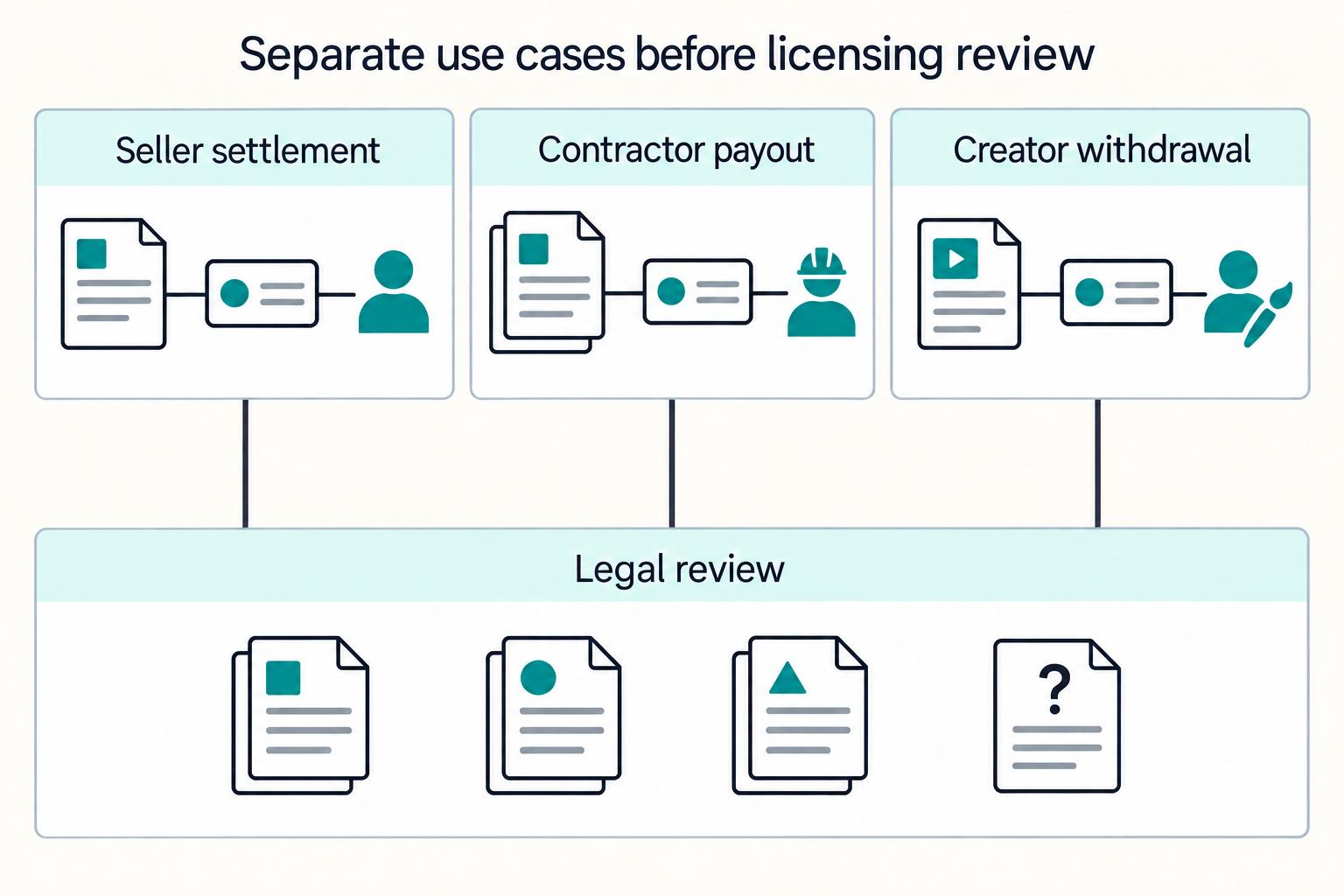
Separate seller settlement, contractor payouts and creator withdrawals before choosing a licence. They may share an interface while having different payers, beneficiaries, contracts and regulated providers. A balance label or an IBAN is insufficient to classify the product.
- Collection: identify the payer, contractual payee, account holder and regulated collector. Does the platform receive funds or only transmit instructions?
- Holding: identify whose claim is recorded, who owes repayment, what the funds can be used for and who safeguards them.
- Conversion: identify the entity executing FX, the quote, fees and when conversion becomes final.
- Payout: identify who accepts the payment order, executes it and handles a return or rejected beneficiary.
- Exceptions: map disputes, refunds, chargebacks, sanctions holds, reconciliation breaks and provider failure.
| Flow point | Evidence to collect | Question it answers |
|---|---|---|
| Customer funds in | Terms, account agreement, collection instructions and ledger entries | Who receives the money and what right does the customer acquire? |
| Balance displayed | Issuer terms, redemption rights, spend rules and transaction records | E-money, a payment-account balance, an amount owed for services, or another arrangement? |
| Payment instruction | API authority, approval logs and provider service scope | Who provides the regulated service and who acts on their behalf? |
| Money out | Provider receipt, bank settlement record and beneficiary reference | Was the obligation actually discharged, or is the transaction still uncertain? |
| Refund or return | Original payment linkage and exception playbook | Who can reverse or reissue without creating a duplicate? |
A worked example: seller settlement versus a reusable wallet#
Suppose a marketplace records €100 owed to a seller after a sale. In model A, an authorised provider collects the buyer payment and settles the seller under its payment-service agreement; the platform displays the receivable and submits approved instructions. In model B, the seller receives €100 of value as a claim on an issuer and can use that value to pay unrelated merchants before redeeming the remainder. Model B introduces an electronic-money question that the settlement display alone does not establish.
These are illustrative fact patterns, not automatic legal classifications. For each, check the actual contracts, acceptance network, repayment obligation and control of funds. If the platform itself performs a payment service in model A, merely connecting to a provider does not settle whether it needs agent registration or its own authorisation. If an EMI issues value in model B, identify the EMI as issuer rather than calling the platform an issuer under an agent contract.
Match contracts to operating reality#
- Compare the customer terms, provider agreement, funds-flow diagram and production instructions.
- Name the legal entity and owner for every regulated activity and exception.
- Keep open questions attached to the affected feature or market; do not mark the whole launch approved while those questions remain unresolved.
- Make product changes reopen the scope memo when funds access, redemption, customer rights or countries change.
When an EMI route is justified#
Electronic money is electronically stored monetary value represented by a claim on the issuer, issued on receipt of funds for payment transactions and accepted by someone other than that issuer. The Central Bank's EMI explanation sets out this definition. A reusable third-party payment wallet warrants examination against it; a payment account or delayed settlement does not become e-money solely because funds remain there.
Own EMI authorisation makes sense to investigate when issuing e-money is central to the product and the business can sustain the required capital, safeguarding, compliance, governance and supervision. Partnering with an EMI can instead place issuance with that partner, but the platform's other activities still need a defined legal and contractual basis.
| Question | What to document | Why it affects the model |
|---|---|---|
| Who is the issuer? | Entity named in customer terms and liability for redemption | The customer needs an identifiable debtor for the stored value |
| Who accepts the value? | Merchant network and permitted payments | Acceptance outside the issuer is part of the e-money definition |
| How is it redeemed? | Redemption process, terms and exception handling | A displayed wallet amount must correspond to an enforceable claim |
| How are funds protected? | Safeguarding method, accounts and reconciliation | Capital does not replace protection of customer funds |
| Can the company operate the institution? | Management, compliance staffing, forecasts and controls | Authorisation is an ongoing operating commitment |
An EMI is not a bank simply because it offers a wallet or an IBAN. Safeguarding and deposit insurance are different protections. The Central Bank's comparison distinguishes payment and e-money institutions from banks for this purpose. Describe the protection that applies to the actual provider and product.
When a PI route fits better#
A PI route is worth investigating when the business provides specified payment services without issuing e-money. Examples include executing transfers, acquiring transactions and money remittance. Authorisation is service-specific: a remittance permission is not permission for every payment activity.
PSD2 Article 18 limits payment accounts held by PIs to accounts used exclusively for payment transactions and distinguishes payment-service funds from deposits and e-money. Map the proposed account's purpose rather than treating any temporary holding of funds as either prohibited or automatically an EMI product.
| Product fact | Candidate question | Evidence needed |
|---|---|---|
| Employer funds contractor transfers | Which execution or remittance service applies, and who supplies it? | Funding account, order acceptance, beneficiary terms and provider authorisation |
| Marketplace collects and settles sellers | Which acquiring or execution activities are performed by each entity? | Buyer/seller contracts, payment chain and account access |
| Customer can repeatedly spend issued value with third parties | Does the product involve e-money issuance? | Issuer claim, receipt of funds, acceptance and redemption terms |
| Platform only supplies software | Does the technical-service exclusion actually apply? | No possession of funds plus analysis of the actual service; payment initiation has its own rules |
A PI application needs more than the correct capital line. The EBA authorisation guidelines cover information about the programme of operations, business plan, governance and controls. Build those around the real transaction and exception paths.
Small EMI and Small PI routes are national waivers#
PSD2 Article 32 permits a national small-PI waiver for eligible services with an average monthly transaction-value ceiling no higher than €3 million over the preceding 12 months, including relevant agents. The EMD2 Article 9 ceiling for a small-EMI waiver is average outstanding e-money no higher than €5 million. Member States can set lower limits and impose conditions; not every country implements both routes.
Neither waiver carries the standard cross-border passport of a fully authorised institution. A small route can therefore fit a genuinely domestic model yet fail a multi-country roadmap. Do not confuse transaction throughput with outstanding e-money: €2 million paid out in a month and €2 million held as average issued value measure different things.
For a concrete national difference, Ireland's authorisation page states that Ireland has no small-PI regime. This alone invalidates a generic plan to register a small PI in any EU country. Check the current national limits, capital, eligible activities and transition obligations before choosing a waiver.
- Confirm that the route exists in the intended home state.
- Calculate the relevant metric from the full business population, not a convenient subset.
- Model growth and the point at which eligibility would be lost.
- Create an authorisation or partner transition plan before that point.
- Keep expansion countries outside approved scope until the required route is established.
Agent model boundaries your legal team must pin down#
A payment-services agent acts on behalf of an authorised institution. Under PSD2 Article 19, agent information and controls go through the principal's regulator, and the agent may begin payment services after entry in the register. Under Article 20 the institution remains fully liable for its agents' acts. That liability does not remove the platform's contractual duties or excuse weak controls.
An EMI can provide payment services through agents. It cannot issue electronic money through agents; EMD2 distinguishes issuance from distribution and redemption through persons acting on its behalf. An e-money distributor and a payment-services agent are therefore different roles. The EBA's distributor Q&A explains the distribution provision.
| Item to pin down | Where it should appear | Red flag |
|---|---|---|
| Principal entity and regulated role | Customer terms, provider agreement, support scripts | Different entities or an unidentified issuer across documents |
| Contractual chain | User agreements, funds-flow diagram and payout terms | A missing party between user, platform and provider |
| Delegated activities | Agent agreement, registration and operating procedures | Staff perform activities beyond the approved scope |
| Control ownership | Onboarding, AML, complaints, incident and reconciliation matrix | No owner for a failed transfer or compliance decision |
| Market scope | National registers, passport evidence and launch terms | The principal's home authorisation is treated as blanket permission everywhere |
Do not confuse a registered payment-services agent with PSD2's commercial-agent exclusion. The latter concerns qualifying negotiation or conclusion of sales on behalf of only the payer or only the payee. A platform's label or a clause saying 'agent' cannot establish either route.
A launch checkpoint with real evidence#
- Obtain the principal's exact legal name, regulator, authorisation and permitted services.
- Confirm the platform's registered role and the countries and activities it covers.
- Align production UX, accepted terms and support scripts with those roles.
- Assign responsibility for customer due diligence, monitoring, complaints, safeguarding information and incidents.
- Agree return handling, data access and an orderly exit plan if the principal stops providing the service.
Choosing a home regulator and verifying registers#
National competent authorities grant authorisations and maintain national registers. The EBA central register aggregates information supplied by those authorities; the EBA does not grant a platform's licence. The EBA register guidance also says inclusion does not itself confer legal status and omission does not invalidate an authorisation.
| Criterion | Evidence to compare | Decision risk |
|---|---|---|
| Local establishment and management | National requirements, proposed head office and operating substance | A mailbox jurisdiction that cannot support supervision |
| Application readiness | Official checklist and actual governance, capital and controls | A timeline quoted before the file is complete |
| Services and market fit | Authorised service categories and passport procedures | Permission that misses the core product or target country |
| Safeguarding and operational fit | Bank arrangements, reconciliations and exception ownership | A licence plan without functioning funds protection |
| Ongoing supervision | Reporting, notifications, audit and staffing requirements | A launch budget that excludes the ongoing institution |
Register-check procedure#
- Find the principal in its home national register using legal name and registration number.
- Confirm the entity category, current status, exact payment services and restrictions.
- Check relevant agent entries and cross-border coverage for the intended market and mode of operation.
- Cross-check the EBA register; investigate discrepancies with the principal and authority.
- Save the dated extract, URL, checker and conclusion, including what the register does not prove.
A register match does not prove that every API product, currency or proposed delegation is covered. Match the entry to the signed agreement and actual activity. Resolve an ambiguous agent-services entry rather than assuming it inherits every service of the principal.
For fully authorised institutions, passporting uses home/host notification procedures for the intended services and arrangement. It is not an automatic approval of every launch. Ireland's EMI passporting guidance distinguishes branches, agents/distributors and cross-border service provision.
Build the pre-launch evidence pack and approval log#
| Artifact | What to include | Failure it prevents |
|---|---|---|
| Scope memo | Model, relied-on product facts, excluded features, legal basis and open questions | Treating a product label as a legal conclusion |
| Funds-flow diagram | Collection, holding, conversion, release, returns and account ownership | Missing a party that possesses or controls funds |
| Controls matrix | Owner, evidence, review trigger and escalation for each activity | Gaps between principal and platform procedures |
| Legal-reference file | Applicable national law, PSD2/EMD2 references, question and interpretation owner | Citations with no connection to product behaviour |
| Register and passport evidence | Dated national extracts, agent role, target markets and restrictions | Relying on a provider badge or stale screenshot |
| Approval log | Legal/risk decisions, conditions, approvers and dissent | A green launch status hiding an unresolved scope question |
Follow a clear sequence: draft the facts, obtain legal assessment, review operational risks, record the decision and approve only the covered launch scope. Keep unresolved dissent visible. Application-processing periods that start with a complete file do not justify promising a fixed time from the first enquiry.
Translate the approved model into onboarding, payment-release and exception procedures. For related operating questions, see building a payout network and Gruv Docs. The legal model and the operational implementation need to describe the same parties and actions.
Set post-launch monitoring and escalation ownership#
| Monitoring area | Suggested trigger | Owner and evidence | Escalate when |
|---|---|---|---|
| Provider and agent status | Before new-market launch, material changes and risk-based periodic review | Compliance: current national register and contract scope | Withdrawal, restrictions or inconsistent entries affect operations |
| Product perimeter | Wallet, funding, spending, redemption or account-control changes | Legal/product: revised facts and scope memo | A new activity exceeds the approved model |
| Funds protection and reconciliation | Operating cadence matched to the flow | Finance/principal: ledger, provider and bank records plus exceptions | Funds or liabilities do not reconcile, or access/protection changes |
| Country expansion | Before accepting users in another market | Legal/compliance: passport and local requirements | Required notification, registration or approval is incomplete |
| Customer incidents and returns | Each incident and trend review | Operations: transaction linkage, resolution and root cause | Repeated failures, missing ownership or uncertain execution |
These are operating-control suggestions; the exact mandatory cadence comes from the applicable law, regulator and principal arrangement. Link incidents to the approved product and control version. If a transfer's status is unknown, retrieve and reconcile it before initiating a replacement; a new provider route is not proof that the first transfer failed.
Common failure modes#
| Failure | Practical consequence | Correction |
|---|---|---|
| Choosing an EMI because the UI says wallet | Unnecessary authorisation work or an incorrectly classified claim | Examine issuance, third-party acceptance and redemption |
| Choosing a PI while issuing e-money | Product exceeds the legal permission | Place issuance with an EMI or pursue the appropriate authorisation |
| Calling an unregistered service provider an agent | Activities start without the required registered arrangement | Complete the principal's registration and scope process first |
| Planning a small licence as an EU passport | Expansion depends on rights the waiver lacks | Use a fully authorised route or valid principal arrangement |
| Equating capital with customer-funds protection | Safeguarding and reconciliation remain unfunded or ownerless | Budget and implement both prudential and funds-protection obligations |
| Treating one register entry as product approval | Delegation or countries exceed confirmed coverage | Check services, agent role, agreement and cross-border position together |
Conclusion#
Start with the actual flow of money and the customer's claim. Compare EMI issuance, PI payment services and the agent's defined role, then test capital, safeguarding, registration and cross-border requirements against the planned countries. Keep the approved scope linked to production controls and revisit it when the product changes. To discuss the operating workflow that follows that decision, contact Gruv.
Frequently Asked Questions
What is the core legal difference between an EMI and a PI in the EU?
An EMI can issue electronic money and provide authorised payment services. A PI provides its authorised payment services but cannot issue electronic money under its PI permission. Electronic money involves a claim on the issuer, issued for funds and accepted by someone other than the issuer.
What minimum capital ranges are commonly cited for EMI and PI licenses?
The EMI initial-capital floor is €350,000. PI floors are €20,000 for money remittance only, €50,000 for payment initiation and €125,000 for services in PSD2 Annex I points 1–5. Ongoing own-funds requirements, safeguarding and operating costs are separate; account-information-only registration is a different case.
Can a Small EMI or Small PI passport services across the EU?
The national waiver routes under EMD2 Article 9 and PSD2 Article 32 do not provide the standard cross-border passport of a fully authorised institution. Availability and conditions vary by country, so a domestic small route should not underpin an EU expansion plan.
Who actually grants authorization, the EBA or national regulators?
The national competent authority grants authorisation. The EBA maintains a central register using information supplied by national authorities; it does not issue the firm's licence. Use the relevant national register to verify the legal entity and permission.
What should a platform verify in the EBA register before launch?
Cross-check the principal's legal entity, institution category, services, agent relationships and cross-border information against its national register and the signed agreement. Save dated evidence and resolve discrepancies. A register entry alone does not establish coverage for every product or activity.
When should a team escalate to specialist legal counsel during license selection?
Obtain a perimeter assessment before committing the model, and reopen it when funds control, customer claims, issuance, redemption, delegated activities or markets change. Attach each question to the affected feature and evidence so review can produce a usable scope decision.
Researched and edited by the Gruv editorial team. Gruv builds cross-border billing, payouts, and finance-operations software for global businesses.
Sources
Includes 3 external sources outside the trusted-domain allowlist.
- eba.europa.eu/risk-and-data-analysis/data/registers/paymen...trusted
- eba.europa.eu/single-rule-book-qa/qna/view/publicId/2020_5624trusted
- eur-lex.europa.eu/legal-content/EN/ALLtrusted
- eur-lex.europa.eu/legal-content/EN/TXTtrusted
- centralbank.ie/regulation/industry-market-sectors/electroni...external
- centralbank.ie/docs/default-source/regulation/industry-mark...external
- edit.centralbank.ie/consumer-hub/explainers/what-do-i-need-to-kn...external
Educational content only. Not legal, tax, or financial advice.
Related Posts

The Freelance Payment Penalty: A Modeled Audit of Platform Fees, FX Spreads, and Payout Delays
The money rarely disappears through a single, easy-to-spot fee. The real loss is stacked. A marketplace takes its commission, a processor adds a charge for international cards, a bank or payment company converts the currency at a spread, a platform holds the funds before release, and a wire sheds a little to intermediaries on the way in. Each layer looks defensible on its own, but the worker feels the combined result as a smaller deposit and a later payday.

How to Respond to a Subpoena for Business Records
Move fast, but do not produce records on instinct. If you need to **respond to a subpoena for business records**, your immediate job is to control deadlines, preserve records, and make any later production defensible.

A US Expat's Guide to Investing in UCITS ETFs to Avoid PFIC Issues
The real problem is a two-system conflict. U.S. tax treatment can punish the wrong fund choice, while local product-access constraints can block the funds you want to buy in the first place. For **us expat ucits etfs**, the practical question is not "Which product is best?" It is "What can I access, report, and keep doing every year without guessing?" Use this four-part filter before any trade: