
Quick Answer
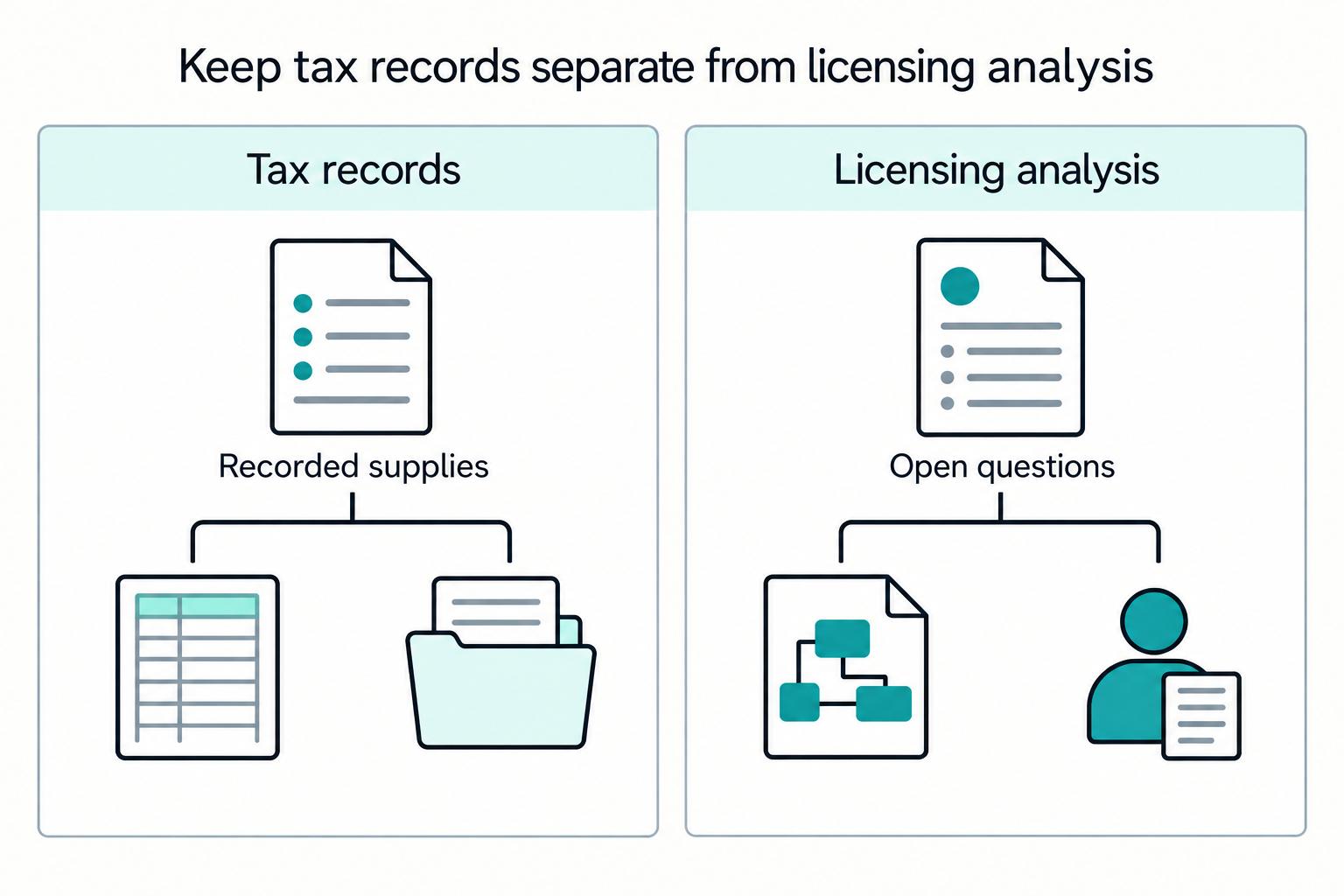
Whether your EU platform needs a PI or EMI license requires jurisdiction-specific legal review. The defensible next step is to map how funds enter, are recorded, controlled, released, or returned, keep VAT OSS and CBR decisions on a separate track, and escalate any wallet-like balances, staged settlement, or conflicting records to jurisdiction-specific legal review before launch.
How Platforms Should Compare PI and EMI Licenses#
For a platform launching in the European Union (EU), start with what you can prove, not the label you want to use. This guide helps you work through an eu payment institution license vs emi license platform question in operational terms. The VAT materials cited here do not, by themselves, determine a PI or EMI legal conclusion.
Build one control-led record of how your model actually works: how funds move, how reporting is produced, and where mismatches appear. If product language, finance treatment, and legal documentation describe different realities, escalate before launch.
EU VAT operations are useful here because they force discipline. Since 1 July 2021, MOSS has been extended to OSS. Businesses can register in one Member State of identification, submit OSS VAT returns electronically, declare all supplies that fall under the chosen scheme, and treat OSS returns as additional to domestic VAT returns, not a replacement. Filing cadence also differs by scheme: quarterly for Union and non-Union, monthly for import.
They also show how early administrative choices can become sticky. In OSS, a Member State of identification choice can bind the business for the calendar year plus two following years. Changes are limited unless the fixed establishment in the current Member State of identification is dissolved.
The scope and limits are straightforward: this guide uses these VAT control patterns as internal decision inputs for controls, reporting readiness, and escalation points. It does not replace country-specific legal advice. Where cross-border interpretation is unclear, local conditions still apply, much like CBR requests filed in the participating country of VAT registration under that country's ruling conditions.
EMI vs PI at a glance for platform operators#
The first practical answer is simple: PI versus EMI legal scope is not established, so use this section as triage, not as a licensing conclusion.
| Criterion | PI from cited materials | EMI from cited materials | Operator action |
|---|---|---|---|
Legal scope (Payment Services Directive vs Electronic Money Directive 2 (EMD2) / Directive 2009/110/EC) | Not established by the cited sources. | Not established by the cited sources. | Escalate to jurisdiction-specific legal review. |
| Ability to issue e-money | Unknown from provided excerpts. | Unknown from provided excerpts. | Do not represent this capability as confirmed. |
| Ability to hold balances | Unknown from provided excerpts. | Unknown from provided excerpts. | If your product shows persistent balances, escalate early. |
| Money remittance | Unknown from provided excerpts. | Unknown from provided excerpts. | Map the actual flow before choosing a label. |
| Payment instruments | Unknown from provided excerpts. | Unknown from provided excerpts. | Keep this as a separate diligence track. |
| Multi-currency wallet | Unknown from provided excerpts. | Unknown from provided excerpts. | Treat wallet behavior as a perimeter-risk trigger. |
| Corporate spend | Unknown from provided excerpts. | Unknown from provided excerpts. | Include it in first-pass legal scoping if planned. |
| Staged settlement | Unknown from provided excerpts. | Unknown from provided excerpts. | Document who controls funds during holds and at release. |
| Passporting implications | Unknown from provided excerpts. | Unknown from provided excerpts. | Do not infer payment passporting from VAT OSS setup. |
Small PI / Small EMI scaling constraints | Unknown from provided excerpts. | Unknown from provided excerpts. | Model expansion and reauthorization risk up front. |
| Banking / scheme diligence expectations | Unknown from provided excerpts. | Unknown from provided excerpts. | Assume partners will run their own diligence. |
| Reader takeaway | Unknown from provided excerpts. | Unknown from provided excerpts. | Use this as escalation logic, not as a licensing conclusion. |
The real risk is false certainty. The record is silent on several scope questions: stored value, wallet behavior, payment instruments, passporting, and small-license scaling.
What the VAT materials do show is administrative mechanics, not payments perimeter answers. From 1 July 2021, businesses can register in one EU Member State for covered OSS declarations. They can use that registration for VAT declaration and payment on covered supplies, but that does not determine PI or EMI scope.
They also show why early structural choices matter. Under the Union scheme, the Member State of identification choice can bind the business for the calendar year of the decision plus the two following calendar years. Change is restricted unless the fixed establishment in the current Member State of identification is dissolved or moved.
Use that same discipline in your launch controls: align product, legal, finance, and compliance around one documented flow showing where funds enter, whether value appears as a balance, and what events release or return funds. If those records conflict, treat that as an escalation point before launch.
For VAT-side cross-border uncertainty, the process is local by design. CBR requests must follow the national VAT-ruling conditions of the EU country where filed. The CBR page also includes a public information notice published 19 APRIL 2024. This is VAT administration context only and does not resolve PI versus EMI licensing scope.
If the UK is also in scope, UK FCA Authorization: When Your Platform Needs a Payment Services License explains when FCA authorization becomes a separate licensing question.
Start with the money flow boundary, not the product label#
Start by separating boundary questions from product labels. The discussion here covers VAT administration through OSS and CBR, not PI-versus-EMI legal perimeter tests.
| Flow point | Grounded instruction |
|---|---|
| Where funds enter | Document it in one shared map before relying on any product label. |
| Where funds are recorded | Document it in the same shared map. |
| Who controls each step | Keep product, legal, finance, and compliance on that same map. |
| What triggers release or return | Document the trigger in the shared map. |
Before you rely on any product label, document the real flow in one shared map: where funds enter, where they are recorded, who controls each step, and what triggers release or return. Keep product, legal, finance, and compliance on the same map so assumptions do not drift.
Run VAT controls in parallel, but do not use them as a proxy for licensing scope. OSS is optional. OSS returns are additional to domestic VAT returns, and CBR requests are filed in the participating EU country where the requester is VAT-registered. If your internal flow map and your chosen label conflict, pause and escalate for jurisdiction-specific legal review.
Map platform scenarios to a license direction you can defend#
Platform flows as Payment Institution (PI), Electronic Money Institution (EMI), or Payment Service Provider (PSP) require jurisdiction-specific legal classification. What you can do is map each scenario, flag the licensing escalation points, and run the VAT controls that are already clear.
Use one matrix for two separate decisions#
Use one matrix, but keep payment licensing and VAT as separate decisions inside it. For each scenario, record who pays in, who receives out, release and return triggers, exception handling, and the customer-facing entity. Then add VAT ownership, registration, and reporting route.
| Scenario | Flow details to pin down | Defensible payment-license direction | VAT control to run now |
|---|---|---|---|
| Contractor platform with instant payout routing | Fund entry, any interim ledger record, failed payout retries, refund path | Escalate for PI/EMI/PSP legal review; no classification is supported here | Confirm VAT-registered entity for the service and whether OSS is relevant; define OSS filing and record-keeping ownership if OSS is used |
| Seller marketplace with batched payouts | Batch timing, delay reasons, hold/reserve logic, release event, return handling | Escalate; do not infer PI/EMI from "marketplace" label | Test deemed-supplier risk in the fact pattern; assign OSS filing and record-keeping ownership if OSS is used |
| Creator platform with wallet-first UX | Top-up flow, internal transfers, withdrawal flow, dormant amounts, user terms | Escalate; product wording does not settle licensing perimeter | Map VAT registration/reporting by entity and define OSS record-keeping responsibilities if OSS is used |
| Staged settlement model | Milestone trigger, approver, reversals, disputes, time from receipt to release | Escalate; no staged-settlement perimeter test is supported here | If cross-border VAT treatment is unclear, assess CBR under the relevant country's national VAT ruling conditions |
| Agent model | Appointment chain, customer contract party, control of messaging, ledger ownership, exception ownership | Escalate; do not rely on agent model label alone | Separate tax-role analysis from agency structure; use CBR only within national VAT ruling conditions |
What this tells you now#
Payment licensing stays on an escalation track in every scenario. VAT operations do not. OSS is optional, includes record-keeping and audit obligations, and has a defined filing cadence: quarterly for Union and non-Union schemes, monthly for import.
Two if-then rules you can use immediately#
If cross-border VAT treatment is unclear, then use CBR only as a VAT clarification route under national ruling conditions, not as a payment-licensing shortcut.
If you choose OSS, then lock the Member State of identification and operating consequences early, because that choice can bind for the calendar year plus the next two calendar years.
The practical takeaway is unchanged: use the scenario matrix to tighten facts and ownership, and keep PI or EMI direction as a jurisdiction-specific legal escalation until counsel tests the flow.
For a broader comparison of EU licensing paths, see EU Payment License Types Explained: EMI vs PI vs Agent Model for Platforms.
Understand small versus authorised scope before you scale#
Treat small versus authorised scope as a regulatory question, not a planning assumption. EU payment-licensing thresholds, passporting rights, and authorised-versus-small scope rules require jurisdiction-specific legal review before making a small-versus-authorised PI or EMI decision.
| Scaling item | What this guide covers | Planning effect |
|---|---|---|
| EU payment-licensing thresholds | This guidance does not provide them. | Confirm small-versus-authorised PI or EMI scope with the relevant authority. |
| Passporting rights | This guidance does not provide them. | If rollout depends on multi-market EU expansion or passporting, log that as an open dependency. |
| Authorised-versus-small scope rules | Not specified here. | Do not treat a "small first" path as validated by this pack. |
Where this leaves the EU scaling question#
If your rollout depends on multi-market EU expansion or passporting, log that as an open dependency and resolve it with jurisdiction-specific advice before you lock launch sequencing. Whether a small or authorised route supports that plan is not established.
Execution warning for planning#
Do not treat a "small first" path as validated. Treat claims about reauthorization triggers, activity limits, or expansion permissions as unsupported, so any scale assumptions on those points are ungrounded.
Keep UK exposure on a separate checkpoint#
For UK exposure, keep payment-licensing analysis separate from UK tax administration controls. One concrete UK checkpoint is supported here: where Self Assessment duties apply for the period referenced in this guidance, you must notify HMRC by 5 October 2025. Late notice can lead to a penalty, and filing without reactivating an existing account may also delay the return. For broader operating context, read How to Hire a CFO for Your Payment Platform.
Non-obvious tradeoffs that change total compliance cost#
Detail on VAT operations is clear; PI versus EMI governance depth, safeguarding, audit burden, onboarding scrutiny, and product-feature licensing outcomes for either route require jurisdiction-specific legal review.
Price the operating burden, not just setup work#
The setup step can look simple: online sellers, including marketplaces and platforms, can register in one EU Member State to declare and pay VAT on covered cross-border supplies through OSS. But that simplification is conditional.
If you use OSS, you must declare all supplies that fall under that scheme via the OSS return. OSS is additional and does not replace domestic VAT returns, so you are creating a parallel compliance stream, not a full replacement.
| Cost driver | What looks cheaper first | What is supported | Practical impact |
|---|---|---|---|
| OSS registration | One registration means less admin | One EU registration can cover declaration/payment for covered cross-border supplies | Useful simplifier when supply mapping is accurate |
| OSS reporting | One portal replaces local returns | OSS returns are additional and do not replace VAT returns | You need OSS and domestic return operations in parallel |
| Scheme scope | Use OSS only for selected items | If you use a scheme, all supplies under that scheme must be declared via OSS | Misclassification can create compliance risk and rework |
| Platform records | Records matter only if deemed supplier | Record-keeping applies to marketplaces/platforms, including when not deemed supplier | Evidence retention remains a standing cost |
The timing tradeoff is procedural lock-in#
One non-obvious cost lever is your Member State of identification choice. In stated Union-scheme cases, it is binding for the calendar year of the decision plus the next two calendar years. A rushed choice can create a multi-year administrative tail.
Filing cadence adds operational weight: Union and non-Union OSS returns are quarterly, while import-scheme returns are monthly. Before you commit, test whether your data model can consistently classify supplies by scheme and support both OSS and domestic VAT reporting.
Keep PI/EMI questions on a separate legal track#
Do not use this section to infer PI versus EMI outcomes, or to conclude that SEPA, SWIFT, corporate spend, or persistent balances determine the licensing path. Treat those points as unsupported.
In practice, align your model to your medium-term product and geographic scope, not only the first release. For the cost model supported here, budget for OSS scope control, parallel VAT reporting, platform record-keeping, including non-deemed-supplier cases, and escalation to a VAT Cross-border Ruling for complex cross-border treatment questions.
If you are planning a broader Europe launch, How to Expand Your Subscription Platform to Europe for Payment and VAT Readiness covers the operational work beyond the license decision.
Failure modes that get PI designs challenged later#
The supported failure mode here is mismatch, not a proven Payment Institution (PI) versus Electronic Money Institution (EMI) outcome under PSD2. The problem is that your product narrative does not match the transactions, records, and reporting you can evidence.
This guide is VAT-focused, so treat stored value, wallet behavior, and any EMD2 perimeter conclusions as separate legal analysis. Do not try to derive a PI or EMI licensing conclusion from OSS materials.
What is supported versus what is not#
Some broader risks may be real in practice, but the narrower control view covers scope drift, incomplete reporting, weak records, and documentation that fails against real cross-border flows.
| Suspected challenge area | What is supported | Why it becomes a problem |
|---|---|---|
| Product story and flow diverge | If you use an OSS scheme, all supplies within that scheme must be declared via the OSS return | Selective handling is difficult to defend when transaction populations are reviewed |
| "Low-admin" assumptions | OSS includes record keeping and audits | Teams underbuild controls and then absorb remediation pressure |
| Deferred setup decisions | In stated Union-scheme cases, Member State of identification choice can bind for the current calendar year plus two following years | Early choices can create a multi-year operating constraint |
Closest supported analogue to functional drift#
Payment-law conclusions about stored value, ambiguous terms, or permissions under PSD2 require jurisdiction-specific counsel. The same control pattern applies in VAT operations: once you opt into OSS, in-scope supplies must be reported through OSS.
Use that as a hard checkpoint. If your commercial description, transaction map, and filed reporting population do not align, you already have a challenge pattern before any PI or EMI debate.
Operational triggers to test now#
Retained balances, staged funds, and wallet-like behavior are not legally resolved by this evidence. The control weakness they can still expose is inconsistent classification in exception states.
For each exception path, confirm three points: whether it is in the OSS population, where it is recorded, and whether that answer is reproducible in audit. If answers vary by team or period, the control risk is already clear. OSS return cadence, quarterly in the Union and non-Union schemes and monthly in the import scheme, makes unresolved exceptions visible quickly.
Due diligence pain points you can prepare for#
Specific claims about bank onboarding delays, scheme-review outcomes, or PI-specific audit findings require direct inquiry with the relevant authority. OSS trader audits and possible exclusion from a scheme by a Member State are established operational risks.
The practical action is straightforward: build evidence that your transaction classification, full in-scope OSS reporting, and record retention match your declared model in your Member State of identification. If cross-border VAT treatment is genuinely complex, escalate early to the VAT Cross-border Rulings mechanism instead of relying on label-based assumptions.
Related reading: How to Maximize Your Xero Investment as a Payment Platform: Integrations and Automation Tips.
Build the evidence pack before regulator and bank review#
Build one evidence pack now, but split it into two clearly labeled layers: what your VAT records can prove today, and what still needs separate PI or EMI legal analysis. The OSS and CBR sources support the records layer. They do not define the PI or EMI perimeter under PSD2 or EMD2, or set payment-licensing evidence standards.
What the sources support versus what stays separate#
| Evidence item | Why include it | Documented support | Separate PI/EMI analysis still needed |
|---|---|---|---|
| End-to-end flow diagrams and customer journey definitions | Show how transactions move across Member States and reporting populations | OSS includes record-keeping obligations, and platforms can have record-keeping duties | Whether the flow is payment execution only or includes stored-value behavior |
| OSS classification by scenario | Shows which supplies you report through OSS and why | OSS returns are submitted electronically and detail the supplies reported under the scheme | Whether the same classification resolves licensing perimeter |
| Member State of identification memo | Fixes registration and reporting jurisdiction | Registration is in one Member State of identification; in some cases the choice binds for the current year plus two following years | Whether that jurisdiction also fits payment-licensing strategy |
| Complex cross-border issue note and CBR escalation memo | Documents that hard VAT questions were escalated, not guessed | CBR allows advance VAT rulings on complex cross-border VAT transactions, subject to national ruling conditions where you are VAT-registered | Any safeguarding, conduct, or licensing conclusion |
| Integration and ledger evidence | Helps reproduce why items were included, excluded, or corrected | API/webhook lineage, idempotency, or ledger standards are not mandated here | Any regulator or bank expectation on API/webhook/rail evidence |
Use that split carefully. Do not present OSS or CBR as if they require payment-control artifacts they do not mention. But do not omit those artifacts when they are the only way to reproduce your records in practice.
The records that carry the review#
The core test is reproducibility. Your pack should let a reviewer trace how in-scope cross-border supplies are identified, recorded, and, where OSS is used, reported, then reproduce the same answer from retained records.
At minimum, keep each material scenario aligned across your flow diagrams, customer-journey definitions, and OSS classification logic. If answers about inclusion in OSS, where records are kept, or exception handling change by team or period, the pack is not review-ready.
Product and integration evidence to keep, with correct labeling#
API/webhook lineage, idempotency controls, ledger event standards, and SEPA/SWIFT status-tracking requirements are not prescribed here. Keep those artifacts as operational evidence when they are necessary to explain status changes and reconcile reporting populations, but label them as internal controls, not OSS or CBR mandates.
| Artifact | Support | How to treat it |
|---|---|---|
| API/webhook lineage | Not prescribed here. | Keep it as operational evidence when necessary and label it as an internal control, not an OSS or CBR mandate. |
| Idempotency controls | Not prescribed here. | Keep them as operational evidence when necessary and label them as internal controls, not OSS or CBR mandates. |
| Ledger event standards | Not prescribed here. | Keep them as operational evidence when necessary and label them as internal controls, not OSS or CBR mandates. |
| SEPA/SWIFT status-tracking requirements | Not prescribed here. | Keep them as operational evidence when necessary and label them as internal controls, not OSS or CBR mandates. |
Sign-off and escalation#
OSS and CBR sources do not define a required sign-off order across product, compliance, legal, finance, and risk. If you set a sign-off sequence, present it as your control design.
If VAT treatment is genuinely complex, escalate through a VAT Cross-border Ruling in line with national ruling conditions in the participating country where you are VAT-registered, rather than relying on assumptions.
Before external review, the minimum defensible position is clear: complete OSS recordability for in-scope supplies now, plus a separate and explicitly scoped PI or EMI analysis.
For a step-by-step walkthrough, see How to Build a Payment Reconciliation Dashboard for Your Subscription Platform.
Use a go or no-go checklist before launch approval#
Treat launch as no-go until you have one signed record aligning your VAT operating position under OSS and your escalation path for complex cross-border VAT issues (CBR where needed). PI-versus-EMI licensing requires separate jurisdiction-specific legal analysis before launch.
| Gate | What to verify now | No-go signal |
|---|---|---|
| OSS scope decision | You have documented whether OSS is being used (it is optional) and, if used, all supplies covered by that scheme are declared via the OSS return | Covered supplies are split between OSS and non-OSS reporting without a clear rule |
| Member State of identification | Registration is set in one Member State of identification, with ownership of any multi-year binding effect where it applies | Teams assume they can switch Member States freely without documented constraints |
| Reporting and payment operations | Filing cadence matches the scheme (quarterly for Union/non-Union, monthly for import), and OSS returns are treated as additional to domestic VAT returns | OSS is treated as a replacement for domestic VAT returns or filing cadence is wrong |
| Record-keeping and audit readiness | Required records, invoices, and bad-debt-relief handling are operationally defined and auditable | Records are incomplete, inconsistent, or not audit-ready |
The strongest pre-launch check is VAT readiness under OSS and CBR. If you use OSS, confirm your Member State of identification, the scheme's reporting cadence, and whether your choice can bind you for the current calendar year plus two following calendar years in applicable cases.
Escalate as soon as documents conflict. If OSS scope, filing operations, and record-keeping controls do not match, pause launch. Do the same when complex cross-border VAT issues are unresolved and not escalated through a CBR request under national ruling conditions where you are VAT-registered.
The hard gate is simple: no launch until VAT scope, reporting behavior, and operational controls are aligned in one signed decision record. Turn that go/no-go checklist into system requirements with the Gruv docs.
If you are still deciding, use one operator test before launch: can you show your sponsor bank, your counsel, and your finance lead the same funds-flow record without rewriting the story for each audience? We use that test because a clean go-live depends on one defensible perimeter view, not three competing explanations.
- Show the same flow to every reviewer. Your product, finance, and compliance teams should be able to walk the same release and return story.
- Record unresolved perimeter points directly. If you still infer wallet treatment or staged-settlement logic, say so before launch approval.
- Name one stop-launch owner. We expect one person to halt launch when facts, controls, or legal assumptions drift.
- Test the evidence pack in one meeting. For example, have legal, finance, compliance, and ops challenge the same file before go-live.
However, you should not treat a clean VAT file as proof that your PI-or-EMI call is settled. For example, if your team cannot show who holds value, who releases it, and which country-specific advice supports the call, we recommend keeping launch on hold.
Know when to escalate to specialist counsel#
Escalate as soon as your launch decision depends on debatable wording instead of confirmed, jurisdiction-specific VAT advice. That matters most when OSS registration choices, multi-country VAT treatment, or multi-entity filing responsibilities are driving the decision.
| Trigger | Why internal review is not enough | What to assemble before counsel |
|---|---|---|
| OSS registration depends on assumptions about the right Member State of identification | The OSS choice can bind you for the calendar year plus the two following calendar years, and changing it is restricted | Current establishment map, planned operating footprint, and the rationale for the proposed Member State of identification |
| Your expected filing cadence is unclear across OSS schemes | Compliance obligations differ by scheme, and wrong assumptions can create avoidable rework | Scheme selection rationale and filing calendar: quarterly for Union/non-Union, monthly for import |
| The cross-border VAT fact pattern is complex, especially with multiple companies involved | Complex transactions may need a VAT Cross-border Ruling (CBR), and CBR requests must follow national VAT-ruling conditions | Transaction flows, jurisdictions involved, VAT-registration details, and a single submitting company acting on behalf of the others where applicable |
Escalate VAT questions in parallel, not later. Under OSS, you register in one Member State of identification, and that choice can bind you for the calendar year plus the two following calendar years. You generally cannot change that Member State unless the fixed establishment in the current one is dissolved or moved.
Before market entry, confirm the OSS return cadence you expect to operate: quarterly for Union and non-Union schemes, monthly for the import scheme. If the cross-border VAT fact pattern is complex, check whether a CBR request is needed. It must follow national VAT-ruling conditions in the participating country where the requester is VAT-registered. If multiple companies are involved, one company should submit on behalf of the others. If your VAT treatment assumptions are still arguable rather than confirmed locally, escalate before registration, launch, or expansion.
Conclusion#
The decision that survives scrutiny is not PI or EMI in the abstract. It is whether your licensing view matches real money movement, and whether you can prove that match.
For this PI-versus-EMI question, the legal boundary is not established, so the final licensing conclusion needs jurisdiction-specific counsel. Treat PI/EMI positioning as unresolved until legal review confirms scope for your exact product design and markets.
Before go-live, make the judgment provable: end-to-end flow diagrams, ledger timestamps for receipt and release, and handling for failed or delayed payouts should all support the same perimeter assessment. If those artifacts conflict, treat that as a launch blocker.
On VAT, the boundary is clearer. OSS allows registration in one Member State of identification, returns are transmitted to Member States of consumption, and OSS returns are additional to domestic VAT returns. Filing cadence is quarterly for Union and non-Union schemes, and monthly for the import scheme. Where relevant, remember that the Member State choice can bind for the current calendar year plus the two following calendar years, and complex cross-border VAT treatment can be escalated through a VAT Cross-border Ruling.
| Area | Decide now | Escalate |
|---|---|---|
| PI vs EMI direction | Document your current operating model and open perimeter questions | Final legal perimeter for your jurisdiction and product design |
| VAT operating model | OSS scheme, Member State of identification, filing cadence | Complex VAT treatment that may need CBR |
| Launch readiness | Evidence pack and documented controls | External confirmation from counsel and relevant counterparties |
Use one final gate: do not approve launch until licensing scope, product behavior, and control evidence sit in one signed decision record, with unresolved perimeter questions stated explicitly. If you need to pressure-test your licensing assumptions against real payout and balance flows, speak with Gruv.
Frequently Asked Questions
Can a Payment Institution (PI) offer wallet-like balances without becoming an Electronic Money Institution (EMI) case?
That legal boundary requires jurisdiction-specific counsel to resolve. Treat wallet-like balances as an unresolved perimeter issue and get jurisdiction-specific counsel to test your exact funds flow.
When does staged settlement move a platform from PI logic to EMI analysis?
This guide does not provide a rule for when staged settlement crosses that line. Validate the actual receipt, hold, release, reversal, and dispute flows with legal counsel before launch.
Can an EMI do everything a PI can, including services like Payment Initiation Services (PIS) and Account Information Services (AIS)?
Not from the materials used here. They do not confirm whether one authorization covers every payment-service variant, including PIS or AIS. Map each planned permission to licensed scope before go-live.
What do small-license limits mean in practice for Small PI and Small EMI growth plans?
Specific Small PI or Small EMI thresholds, rights, and passporting consequences require jurisdiction-specific legal review. Treat small-license growth assumptions as open legal items, not settled planning assumptions.
How does passporting affect an EU platform expanding across multiple member states?
Do not assume payment-license passporting rules apply; local legal advice is still needed. OSS mechanics, by contrast, are clear: you register in one Member State of identification and must declare all supplies under a chosen scheme via its OSS return. In some Union-scheme cases, that choice can bind for the calendar year plus the two following calendar years, so align payment expansion planning with VAT planning.
What should compliance and risk teams prove to regulators, banks, and schemes before go-live?
For PI-versus-EMI scope, this article does not provide regulator-approved proof requirements. For VAT, confirm your OSS scheme, Member State of identification, and filing cadence, and make sure OSS reporting is additional to domestic VAT returns. If treatment is complex, assess whether a VAT Cross-border Ruling is needed and follow national ruling conditions in the participating country where the requester is VAT-registered. If multiple companies are involved, one company should submit on behalf of the others.
Researched and edited by the Gruv editorial team. Gruv builds cross-border billing, payouts, and finance-operations software for global businesses.
Sources
Includes 2 external sources outside the trusted-domain allowlist.
- business.gov.uk/support/business-structures-governance-and-e...trusted
- taxation-customs.ec.europa.eu/archives/taxable-persons/vat-cross-border-ru...trusted
- vat-one-stop-shop.ec.europa.eu/one-stop-shop_entrusted
- vat-one-stop-shop.ec.europa.eu/index_entrusted
- gov.uk/register-for-self-assessmentexternal
- gov.uk/self-assessment-tax-returns/registeringexternal
Educational content only. Not legal, tax, or financial advice.
Related Posts

The Freelance Payment Penalty: A Modeled Audit of Platform Fees, FX Spreads, and Payout Delays
The money rarely disappears through a single, easy-to-spot fee. The real loss is stacked. A marketplace takes its commission, a processor adds a charge for international cards, a bank or payment company converts the currency at a spread, a platform holds the funds before release, and a wire sheds a little to intermediaries on the way in. Each layer looks defensible on its own, but the worker feels the combined result as a smaller deposit and a later payday.

How to Respond to a Subpoena for Business Records
Move fast, but do not produce records on instinct. If you need to **respond to a subpoena for business records**, your immediate job is to control deadlines, preserve records, and make any later production defensible.
A US Expat's Guide to Investing in UCITS ETFs to Avoid PFIC Issues
The real problem is a two-system conflict. U.S. tax treatment can punish the wrong fund choice, while local product-access constraints can block the funds you want to buy in the first place. For **us expat ucits etfs**, the practical question is not "Which product is best?" It is "What can I access, report, and keep doing every year without guessing?" Use this four-part filter before any trade: