
Quick Answer
You cannot confirm a UK FCA payment services license decision without reviewing FCA perimeter rules directly. Map the end-to-end funds flow, log each claim with regulator, source page, and owner, and keep route labels unconfirmed until legal review checks current FCA materials. Keep HMRC dates like 5 October 2025 and 31 January in tax operations, not licensing scope.
How to Tell Whether Your Platform Needs FCA Authorization#
Use this article as a scope guard first. If you are working a UK payment-services licensing question, separate those issues before you design controls or make launch decisions.
The goal is practical. You need one decision path across compliance, legal, finance, and risk, plus a clean internal record of what is confirmed and what is not. By the end, you should have:
- a scoped problem statement for your product flow
- a provisional route decision that is clearly marked for formal FCA and legal validation
- a day-one checklist of control and evidence ownership
Start with source discipline#
This guide covers HMRC tasks such as registering for Self Assessment, using a UTR, keeping records, and meeting tax deadlines, including 31 January. Do not assume it establishes FCA authorization scope, route eligibility, fees, timelines, or evidence standards.
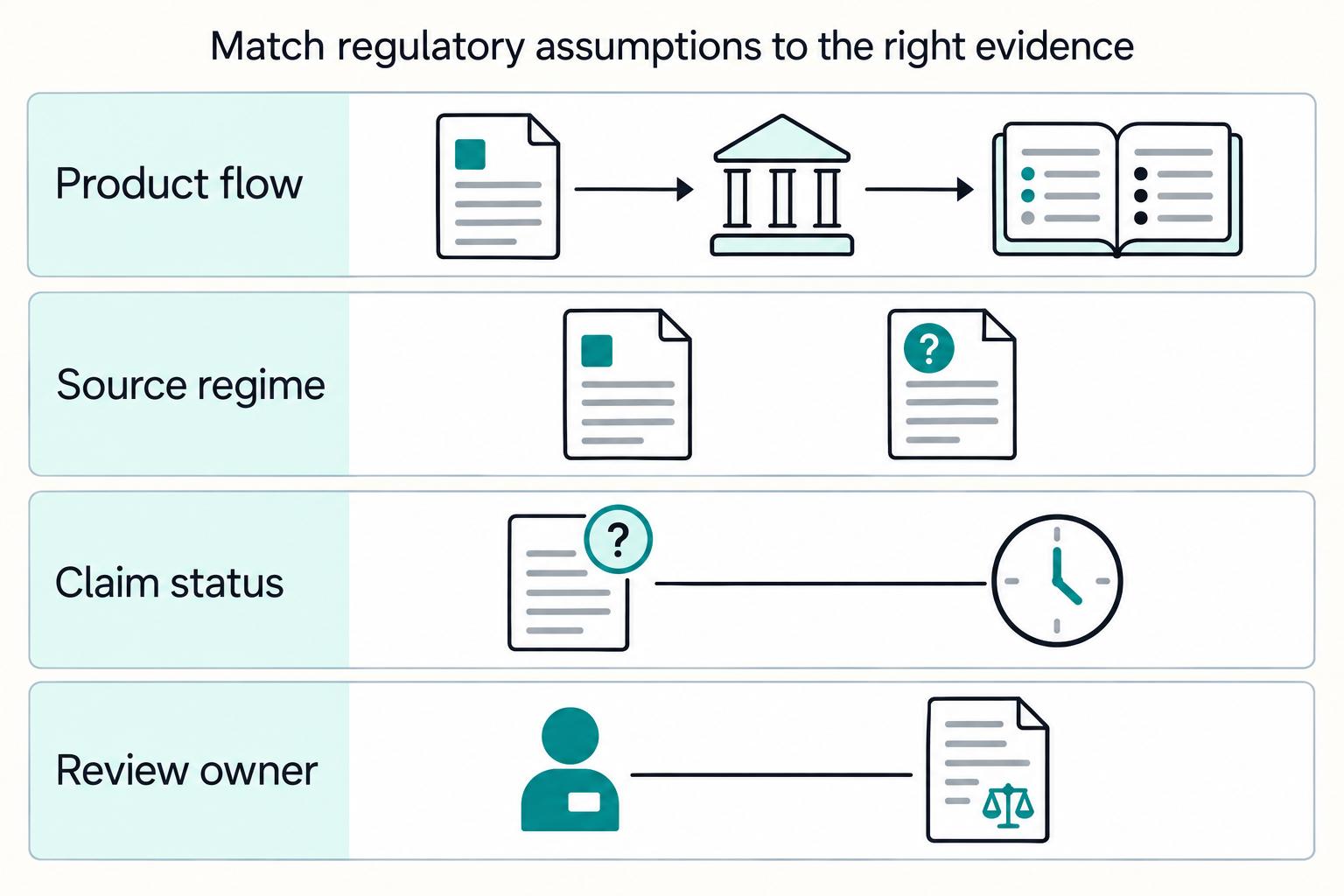
Treat that as a hard process rule. If your team cannot log the regulator, regime, source page, and internal owner for a claim, that claim should not drive product design. In practice, keep one assumptions register beside the product-flow map. Each assumption should show whether it is confirmed, unconfirmed, or awaiting legal review, so teams are not repeating a confident statement that no one has actually sourced.
First failure mode to avoid#
Do not use HMRC tax guidance as a proxy for FCA licensing decisions. HMRC points like the £1,000 sole-trader trigger, 5 October 2025, or the 6 April 2024 to 5 April 2025 tax-year reference are valid in tax context. They do not answer whether FCA permission is required.
An internal mistake to avoid is treating any UK government page as interchangeable proof. A tax filing trigger can be accurate and still be irrelevant to payment-services scope. If your launch meeting includes both tax and licensing work, split the action log so nobody turns a tax checkpoint into a licensing conclusion by accident.
How to use the rest of the article#
Read the rest as a working note for internal decision quality, not as legal advice. The right next step is to escalate to current FCA materials and specialist legal counsel, then document who closes each gap.
Related: Account Updater Services: How to Automatically Refresh Expired Card Data Before Payments Fail.
Define the FCA license paths before debating architecture#
Start with product behavior, not route labels. Terms like payment institution, electronic money institution, and registered account information service provider are not established facts here. Do not treat them as settled classifications until legal validates them against current FCA and legal sources.
That boundary matters. Do not rely on route labels alone to determine fit, eligibility thresholds, application contents, fees, timelines, or usable FCA publication quotes. If a route claim cannot be tied to an exact regulator or legal source, mark it unconfirmed.
Before architecture debates begin, build a one-page behavior map. It should cover:
- who sends funds, who receives them, and whether your entity touches the money flow
- whether you hold customer value, even briefly
- whether you initiate payments or only pass instructions to a provider
- whether you access or display account information
- the source URL, regime name, internal owner, and review date for each regulatory assumption
Keep the map sequential, not descriptive. Show the steps in order from user action through provider handoff, settlement, reconciliation, and any exception handling. Teams can agree in principle but still mean different things when they say "we only route instructions" or "we never hold funds." A timeline view can make those differences visible.
The HMRC material still offers a useful process warning: verify whether account reactivation is needed before filing. Late notification can lead to penalties, and filing without reactivating an existing account may delay a return. Those are tax examples, not FCA licensing rules, so do not carry over dates or thresholds. Carry over the control principle instead: skipped prerequisite checks can create delay and rework.
For a step-by-step walkthrough, see EU Payment Institution vs EMI License for Platforms.
Decide if your platform is in scope before designing controls#
Scope comes first. Treat the licensing route as unconfirmed until specialist legal review validates it against current FCA and legal materials before making any launch go or no-go decision on authorization.
Use a yes-or-no behavior screen as an internal alignment tool, not a legal perimeter test, so product, legal, finance, and compliance are looking at the same flow. Check:
- what the end-to-end flow is from user action to completion, and which entity performs each step
- where responsibilities and handoffs change across that flow
- whether any exception paths bypass the default process
- what evidence proves each answer, for example API calls, ledger events, settlement steps, terms, and flow diagrams
Before you build a full control stack, add an exclusion checkpoint. The HMRC process guidance shows why this matters operationally: check whether a return is required before registering, note that some online routes exclude certain scenarios, and remember that filing without reactivating an existing account may delay a return. Apply that control principle here without treating HMRC tax rules as FCA rules.
A useful internal test is to compare what the user sees with what actually happens behind the scenes. Two products can look identical in the interface while creating different compliance questions underneath. If one flow is a simple relay and another adds extra operational steps or decision points, treat them as different cases until legal confirms otherwise.
Escalate early when your operating model is ambiguous. At that point, pause launch assumptions, document the ambiguity, and get a formal legal view tied to your actual operating model, legal entity, and current regulator sources before engineering hardens the design.
Compare API SPI EMI and RAISP with explicit route triggers#
You cannot make a defensible API, SPI, EMI, or RAISP route choice without legal review. Treat all four labels as placeholders until legal review maps your actual money movement, contracts, and operating model to current FCA materials.
| Route label | Activity type to verify before using the label | Registration vs authorisation posture | Operational burden assumption to avoid |
|---|---|---|---|
| Authorised payment institution | Not established by this pack | Not established by this pack | Assuming this route is required or avoidable from product wording alone |
| Small payment institution | Not established by this pack | Not established by this pack | Assuming this route remains valid without current FCA and legal confirmation |
| Authorised e-money institution | Not established by this pack | Not established by this pack | Assuming product naming alone determines route choice |
| Registered account information service provider | Not established by this pack | Not established by this pack | Assuming a narrow label fits without validating actual flow handling |
Keep route triggers, AIS/PIS-only outcomes, SPI projection rules, and authorisation-vs-registration burden differences as open items and resolve them from current FCA and legal sources before design hardens.
Need the full breakdown? Read How to Conduct an Annual AML Risk Assessment for Your Payment Platform.
Translate authorised versus registered into control burden#
You cannot map "authorised" versus "registered" to specific FCA duties without legal review. Treat both as potentially governance-heavy until current FCA materials and legal review confirm the route.
FCA requirements for safeguarding, conduct, reporting or notifications, complaints, supervision, and enforcement, as well as route-specific thresholds, fees, timelines, and evidence standards, must be confirmed from current FCA and legal sources. If stakeholders are using route labels alone to estimate compliance effort, stop there and escalate.
What registration still means in practice#
"Registered" is not a checkbox. The pattern in these UK government excerpts is that registration-style processes still depend on pre-checks, deadlines, recordkeeping, and the right submission path.
Use the HMRC pre-check as an operating model. Confirm whether filing is required before registering. That is not an FCA rule, but it is a useful control pattern for route decisions. Before selecting a lighter route, require a documented scope memo with current product behavior, near-term assumptions, and clear triggers to reopen the decision.
That scope memo should be specific enough that another team can test it. At minimum, it should describe the user action, the system action, the legal entity involved, the movement of funds or instructions, and the assumptions that would invalidate the conclusion if they changed. If the memo reads like a broad summary, it is too weak to support route selection.
The same excerpts also show concrete failure modes. Late notification can trigger penalties in that context. Filing without reactivating an existing account may delay processing. Some online filing routes exclude certain cases and require alternative forms or software.
Control burden is governance burden#
For leadership, the real question is not the label. It is whether you can prove the chosen route still matches how the business actually operates.
Set baseline controls now:
- assign named owners for route assumptions, evidence quality, and filing or notification readiness
- require a change attestation that legal description, operating flow, and submission path still align
- maintain a third-party-reviewable evidence pack, for example flow maps, entity roles, transaction examples, and the current decision memo
These are a practical discipline so "registered" does not turn into "low attention."
A simple judgment call#
If your team already has weak change control, incomplete records, or inconsistent product descriptions, do not assume lower initial paperwork means lower burden. Confirm your route choice against current FCA materials and legal review, then reassess as scope changes.
The structural lesson here is straightforward. Setup choices affect legal and tax responsibility, and moving structures is possible, with one direction often easier than the reverse. Apply the same caution to route selection. A narrower starting position may be lower-burden only if your evidence stays clean and your model stays within scope.
Assign ownership and escalation points across legal compliance finance and product#
This evidence pack is about HMRC Self Assessment and business-setup guidance, not FCA authorization detail. Set an internal ownership split for registration, record-keeping, and filing, and treat it as an operating control rather than a regulator-prescribed model.
| Function | Default internal owner | Minimum artifact to maintain | Escalate internally when |
|---|---|---|---|
| Legal | General counsel or external counsel | Business-structure note (sole trader vs company), liability assumptions log | Business structure changes or legal responsibility is unclear |
| Compliance | Compliance or tax operations lead | Deadline tracker and filing-status checklist | A key date is at risk (for example, telling HMRC by 5 October in the cited example) or filing status is unclear |
| Finance | Controller or finance operations lead | Record-keeping evidence (for example bank statements or receipts) | Records are incomplete for return preparation |
| Product and engineering | Product owner and engineering manager | Account-access/runbook notes for filing support | An existing account may need reactivation before filing, which can delay the return if missed |
Use this as a living operating record, not a one-time slide. The HMRC excerpts point to practical controls: keep records, confirm account status before filing, file on or after 6 April, and pay the tax bill by 31 January.
Make the handoffs explicit. The person tracking structure and liability should hand off clearly to the person preparing the return. A practical test is whether another team member can follow the records and filing state without needing a separate explanation.
Name the events that force escalation#
Keep escalation events tied to documented process points and confirm FCA escalation triggers from current FCA materials:
- uncertainty about whether Self Assessment registration is required (including sole-trader threshold checks)
- risk of missing the HMRC notification date in the cited guidance
- missing record-keeping evidence for the return
- filing attempted without reactivating an existing account
Add process-stage triggers as well. If structure, records, or account status change, require review before submission rather than after filing.
Add one launch handoff rule#
Set one internal gate. Do not submit until records are complete and account status is confirmed (including reactivation where needed). This is a governance safeguard for the authorization process.
This pairs well with our guide on How to Build a Payment Compliance Training Program for Your Platform Operations Team.
Build the pre-application evidence pack in submission order#
Build the pack in the order your team will review and submit it, and keep regulator-specific steps marked unverified until legal or compliance confirms the live journey. Nothing in this section validates regulator page order, fee mechanics, or route-specific documentation standards.
If your team uses a working sequence, use it only as a filing structure until it is checked against current regulator materials. The goal is a review path that moves cleanly from initial scope decisions to supporting records.
Use one evidence register as the pack index:
| Artifact | Owner | Source system | Review cadence | Approval status |
|---|---|---|---|---|
| Scope memo, entity map, and product flow description | Legal | Document repository | On scope change and before submission | Draft / approved |
| Control sign-off and evidence checklist | Compliance | Compliance workspace | Before submission and on control change | Draft / approved |
| Reconciliation map, report-pack inputs, recordkeeping evidence | Finance | Ledger, bank records, reporting workspace | Monthly and before submission | Draft / approved |
| Change log and implementation notes linked to the scope memo | Product and engineering | Ticketing and release systems | Each release | Draft / approved |
| Complaint handling procedure and test record | Compliance and operations | Case tool and test log | Quarterly and before submission | Draft / approved |
Keep narratives specific to your actual operating model, not generic compliance text. This supports recordkeeping discipline, for example retaining bank statements or receipts. It also shows that account-state mistakes can delay filing. Use both as process checks before final submission.
Review the pack in the same order every time. Start with the scope memo and entity map, then confirm the product flow, then test the finance reconciliation map, then check the control evidence, and only then move to complaint handling and operational records. That sequence helps reduce the chance that teams polish supporting documents before resolving a basic scope contradiction at the top of the file.
Red flags to fix before final review:
- unclear entity mapping across memo, contracts, product flow, and accounts
- inconsistent product descriptions across legal, compliance, and product records
- missing reporting ownership or sign-off accountability
- complaint handling documented but not tested in practice
Design day-one controls that survive real payment operations#
Treat day-one control design as an operational test. Based on the current evidence set, keep this guidance focused on HMRC Self Assessment checkpoints and mark non-HMRC interpretations as pending legal confirmation.
Turn obligations into gates you can observe#
Build controls you can actually see working. Each one should have a named owner, a trigger event, and stored evidence. A practical baseline from the approved sources is:
| Control gate | Grounded detail |
|---|---|
| Need-to-file check | check whether a tax return is needed before registering |
| Account-state check | state check before filing, including reactivation when needed |
| Recordkeeping | recordkeeping requirements, for example bank statements or receipts |
| Channel eligibility | channel-eligibility checks where some scenarios are excluded from an online filing route |
If a control has no trigger, owner, and evidence trail, it is not ready for day one.
A useful design rule is to avoid hidden controls. If the only proof that a check happened is that "the team knows to do it," the control will fail under pressure. Store the evidence where another reviewer can find it later, and make the pass or fail outcome visible in the workflow.
Attach controls to real operating events#
Tie each gate to the exact moment your team acts, then log the outcome so a reviewer can replay the decision later. Keep outcomes explicit: proceed, hold for review, or stop and escalate, each with a reason and owner.
Use recurring checks so filing state and stored records stay aligned. Any unresolved mismatch should move to a named queue with clear ownership. Where you rely on records like statements or receipts, make sure the evidence is linked back to the specific control event rather than stored as a disconnected archive.
Define failure modes before launch#
Write failure modes before launch, then assign owners and response steps before go-live. The grounded risks to model are missing the initial "do I need to file" check, delayed processing when reactivation is missed, missing records, and using the wrong filing channel for the case.
Also test simple but disruptive operational failures: an existing account is not reactivated before filing, required records are incomplete, or a case excluded from the online service is sent through that route. Missed deadlines should also be explicit in runbooks, including the 5 October notification checkpoint (for the relevant tax year scenario) and the 31 January payment due date.
If a flow depends on someone noticing issues later, treat that as a control gap.
Keep UK controls distinct from other markets#
Do not assume one market's control path applies everywhere. The approved sources show that responsibilities and filing routes can change by business structure and scenario, so keep a country or program variance log and mark unresolved legal points clearly.
If you are turning these obligations into production controls, review the integration patterns for idempotency, webhooks, and traceable records in the Gruv docs.
Set reporting and change-notification discipline before launch#
Do not launch with reporting managed by memory and inboxes. Before go-live, set a dated calendar, a live change-notification register, and a clear approval path. Mark any FCA trigger, deadline, or recipient you have not confirmed as an open legal item.
The current evidence set does not establish FCA-specific reporting timetables or notice windows. It does support a discipline pattern from HMRC guidance: use a named date, run a state check before filing (including reactivation where needed), confirm channel eligibility, and retain records, for example bank statements or receipts. Use that pattern for operations, but do not import HMRC dates into FCA obligations.
Build a launch-ready reporting calendar#
From day one, track any submission or notification item your legal review has confirmed, plus any open FCA unknowns.
For each item, store:
- trigger event
- submission owner
- internal approver
- evidence-pack location
- legal basis confirmed (
yes/no)
Add status visibility. A calendar is only useful if people can see what is upcoming, what is blocked pending legal confirmation, and what was completed with evidence attached. Keep one owner responsible for chasing gaps rather than assuming each team will remember its own items.
Keep one live event table#
| Item | Notify whom | Evidence required | Internal approver |
|---|---|---|---|
| HMRC Self Assessment notification (where applicable) | HMRC | records such as bank statements or receipts | Named control owner |
| FCA-related submission or change | Unknown pending legal confirmation | Unknown pending legal confirmation | Unknown pending legal confirmation |
This table is an internal control tool, and FCA categories, recipients, timelines, and evidence requirements remain open legal items until confirmed.
Use one pre-submit checkpoint every time#
Before any submission, confirm:
- account state is valid for filing
- filing channel is eligible
- evidence is attached and reviewable
- approver and control owner are named
The HMRC examples show what breaks when these checks are skipped. Filing can be delayed if an existing account is not reactivated. Notification can draw penalties when it is late, for example after 5 October 2025 in the HMRC context. Online filing can also fail when the service does not cover that route.
Verify providers and counterparties continuously not just at onboarding#
The current evidence set does not confirm FCA-specific provider or counterparty verification requirements. Treat checks like Financial Services Register or FCA Firm Checker use, clone-firm screening, fixed review cadences, and expansion-freeze rules as unknown pending legal confirmation.
| Checkpoint | Timing or condition | Article detail |
|---|---|---|
| Need to send a tax return | Before registering | check whether you need to send a tax return before registering |
| HMRC notification | If required, by 5 October 2025 | for the previous tax year (6 April 2024 to 5 April 2025) |
| UTR availability | For online filing | keep your Unique Taxpayer Reference (UTR) available |
| Account reactivation | Before filing | reactivate an existing account before filing to avoid delays |
| Alternative filing route | When you cannot file through the online service | use commercial software or other forms |
| Registration timing | Avoid late or missed registration | may lead to penalties |
| Tax payment | By 31 January | pay any tax bill |
For controls that are supported, keep Self Assessment obligations actively managed, not one-and-done:
- check whether you need to send a tax return before registering
- if required, tell HMRC by 5 October 2025 for the previous tax year (6 April 2024 to 5 April 2025)
- keep your Unique Taxpayer Reference (UTR) available for online filing
- reactivate an existing account before filing to avoid delays
- use commercial software or other forms when you cannot file through the online service
- avoid late or missed registration, which may lead to penalties
- pay any tax bill by 31 January
Take the next step with a scoped FCA decision#
Treat the next step as a control decision, not a drafting exercise. Run one working session that ends with three written outputs: a scope test, a route comparison, and an ownership matrix for any potential UK FCA payment-services licensing question.
| Output | What to document |
|---|---|
| Scope decision | in scope, out of scope, or ambiguous and escalated |
| Route comparison | plausible paths considered, why each path was included or excluded, and what facts still need confirmation |
| Ownership matrix | who owns legal interpretation, control design, evidence and reconciliations, and implementation or change control |
Work from one agreed fact set. Put the end-to-end funds flow on screen, name the legal entity, and test route options against actual product behavior. If product, legal, and compliance cannot describe the same money movement in the same sequence, stop and fix that first.
Do not start application narratives, control buildout, or launch gates until scope is confirmed. The discipline is the same as checking whether action is required before registering for Self Assessment: confirm scope first, then execute.
Leave the session with documented outputs:
- Scope decision: in scope, out of scope, or ambiguous and escalated
- Route comparison: plausible paths considered, why each path was included or excluded, and what facts still need confirmation
- Ownership matrix: who owns legal interpretation, control design, evidence and reconciliations, and implementation or change control
Capture known unknowns in a short decision log, and assign an owner to each item:
- FCA route criteria
- Fees
- Processing or approval timelines
- Full eligibility evidence
- Exact capital requirements
- Exact safeguarding requirements
- Any point where contracts, product copy, and provider statements describe different flows
When you run the session, force decisions in order. First agree the flow. Then test whether the evidence actually supports that description. Then assign owners for any gap. That sequencing keeps the discussion from jumping straight to application mechanics before the team has even agreed what the product does.
Keep evidence attached to each decision point, and mark unresolved items plainly. Also avoid false certainty from unrelated UK tax signals. HMRC dates like 5 October 2025 or 31 January, and the sole-trader £1,000 trigger, are not FCA licensing milestones or scope tests.
If you take one action now, make it this: complete the scope test, route comparison, and ownership matrix in one session, then implement only the controls your confirmed route requires.
Related reading: Sequencing Your Payment Product Roadmap: What to Build First When Launching a New Platform.
When your scope test and route decision are complete, use that draft to start a practical coverage and rollout discussion with Gruv.
Frequently Asked Questions
Do we always need a UK FCA payment services license if we handle payouts for contractors or sellers?
Map the actual money movement first, then confirm scope using current FCA materials or specialist legal advice instead of assuming payouts are always in scope or always exempt.
How should we choose between `authorised payment institution`, `small payment institution`, `authorised e-money institution`, and `registered account information service provider`?
Treat route selection as unconfirmed and confirm the legal criteria for choosing among those routes from current FCA materials or specialist legal advice.
What does the SPI transaction projection test mean for planning and when should we reassess route choice?
The threshold, calculation method, and reassessment trigger for the SPI projection test should be confirmed from current FCA materials or specialist advice before planning.
What is the fastest reliable way to verify whether a provider is actually authorised in the UK?
Verify authorisation using current FCA sources or specialist legal advice before launch.
What should we prepare before starting an FCA application if details like timelines and fees are still unclear?
Prepare core product and funds-flow documentation, then confirm route-specific requirements, timelines, and fees with current FCA materials or specialist advice.
Which obligations continue after approval under `Payment Services Regulations 2017` and `Electronic Money Regulations 2011`?
Treat post-approval duties under Payment Services Regulations 2017 and Electronic Money Regulations 2011 as a separate workstream and confirm the requirements for your specific route from current FCA materials or specialist advice.
When should we escalate to specialist legal advice instead of relying on internal interpretation?
Escalate when FCA scope, route, or obligations remain unclear from your internal review. Also avoid using HMRC Self Assessment dates such as 5 October 2025 or 31 January as proxies for FCA route, timing, or compliance decisions.
Try a related tool
Researched and edited by the Gruv editorial team. Gruv builds cross-border billing, payouts, and finance-operations software for global businesses.
Sources
Includes 2 external sources outside the trusted-domain allowlist.
Educational content only. Not legal, tax, or financial advice.
Related Posts

The Freelance Payment Penalty: A Modeled Audit of Platform Fees, FX Spreads, and Payout Delays
The money rarely disappears through a single, easy-to-spot fee. The real loss is stacked. A marketplace takes its commission, a processor adds a charge for international cards, a bank or payment company converts the currency at a spread, a platform holds the funds before release, and a wire sheds a little to intermediaries on the way in. Each layer looks defensible on its own, but the worker feels the combined result as a smaller deposit and a later payday.

How to Respond to a Subpoena for Business Records
Move fast, but do not produce records on instinct. If you need to **respond to a subpoena for business records**, your immediate job is to control deadlines, preserve records, and make any later production defensible.

A US Expat's Guide to Investing in UCITS ETFs to Avoid PFIC Issues
The real problem is a two-system conflict. U.S. tax treatment can punish the wrong fund choice, while local product-access constraints can block the funds you want to buy in the first place. For **us expat ucits etfs**, the practical question is not "Which product is best?" It is "What can I access, report, and keep doing every year without guessing?" Use this four-part filter before any trade: