
Quick Answer
An account updater service refreshes stored card details when cards expire or are replaced so recurring or card-on-file payments are less likely to fail from stale credentials. It can reduce authorization declines and manual outreach, but it does not guarantee approval. Results depend on provider setup, timing before billing, network coverage, issuer participation, and whether your team correctly ingests and applies updater responses.
How Account Updater Services Prevent Failed Payments#
Expired or reissued cards can break card-on-file and recurring billing before your team sees the issue. When stored credentials go stale, you usually feel it in two places at once: more authorization declines and more manual work to contact cardholders, with chargebacks also possible. Card account updater, or CAU, is meant to refresh stored card details when cards expire or are replaced, but outcomes still depend on provider setup, timing windows, and issuer participation.
This guide is for product, engineering, and finance owners running subscriptions, marketplaces, and embedded payments. It gives you a decision-ready path for account updater service expired card data refresh. Use it to decide when to run updates, what to verify before launch, how to handle exceptions, and how to avoid common rollout assumptions.
Updater works through the parties that handle card-data changes: the card network, your processor or gateway, and the issuing bank. For recurring and subscription billing, that makes it a practical way to reduce disruption from stale credentials before the next charge attempt.
Before you start. Treat rollout as an operations check, not a feature toggle. Confirm three things before production:
- Which networks and programs your setup actually covers.
- How updater outputs are delivered and consumed, such as enquiry files and response files.
- Whether your stored-credential flow and vendors meet PCI DSS requirements.
Provider behavior differs in ways that affect billing calendars and response handling. Global Payments describes updater in conjunction with Visa Account Updater (VAU) and Mastercard Automatic Billing Updater (ABU), with enquiry and response-file handling. Moneris ABU documentation also includes timing constraints. Request files submitted between 1:00AM and 11:00AM EST are targeted for output pickup by 9AM EST the following day, while missed cutoffs can return data in multiple response files across multiple days.
Set the boundary early: coverage is not uniform, and updates depend on issuer participation. If you are comparing providers, verify network support, delivery method, and exception handling for your merchant setup before rollout. The two major card-network programs above are well covered here, but American Express behavior is not confirmed in the same way.
This pairs well with our guide on How Independent Professionals Build a PCI-Compliant Workflow for Card Payments.
What Account Updater changes and what it does not#
Updater refreshes stale card-on-file credentials, but it does not eliminate payment declines in general.
Understand the actual change. CAU updates stored card details when a card expires or is replaced, usually with little to no customer action. It is offered through card-company and gateway updater programs, and it helps reduce declines at billing or checkout when the underlying card data has changed.
Separate refreshed data from approved payment. The practical benefit is narrower disruption from outdated card details, not guaranteed approval on the next charge. Declines can still happen for reasons unrelated to stale credentials. Before launch, review sample response files and confirm your flow can handle both updated details and accounts that still require customer outreach, including closed accounts.
Validate update types by network and provider. Do not assume identical behavior across card brands. Some implementations support both expiration-date refresh and card-number refresh, but coverage and cadence are provider-specific. In Bank of America's implementation, response files are generated monthly for Visa and Mastercard, and daily for American Express.
| Area | What is known | What is still vendor-specific |
|---|---|---|
| Mechanics | Updater can refresh changed expiry dates and, in some setups, changed card numbers. | Which networks and products in your setup actually receive each update type. |
| Operations | Response files are used to review outcomes and may require manual follow-up, including closed-account outreach. | Exact file fields, delivery method, and update timing in your stack. |
| Commercial impact | Updater can reduce disruptions tied to outdated card information. | Pricing, coverage matrix, and realistic success benchmarks. |
Related reading: FFC Account Number Meaning for Wire Transfers and Further Credit Instructions.
Decide your integration model before you build#
Choose the model your team can operate reliably. If capacity is tight, start with provider-managed enrollment. If you need custom retries, routing, and exception queues from day one, use API-managed orchestration.
Updater can reduce disruption from outdated stored card details, but outcomes still depend on how enrollment, event handling, and exceptions are run.
Step 1 Pick the path that matches your team shape#
A useful framing is the two-path model some providers expose: automated enrollment and manual enrollment control. In one documented example, On-Create Subscription auto-enrolls new cards, while Manual Subscription gives finer control over when and how cards are enrolled.
Use that split as your default rule:
- Choose provider-managed enrollment when your main goal is to reduce stale card-on-file failures without building per-card subscription logic.
- Choose API-managed orchestration when you need per-account control over watch, retry, and exception handling.
Treat webhook handling as a launch gate, not a detail. In the automated model, subscription success is sent by webhook, so confirm that event is received, stored, and mapped to the customer and payment method you bill.
Step 2 Compare control against operating cost#
Provider-managed enrollment can require less upfront integration work, while API-managed designs can offer more operational control.
| Selection criterion | Provider-managed inside a payment gateway | API-managed orchestration |
|---|---|---|
| Implementation effort | Typically lower; often closer to enablement plus webhook handling. | Typically higher; requires enrollment, event, and retry orchestration in your stack. |
| Control over retries | Limited by provider behavior plus your downstream billing rules. | Higher; you define retry, pause, reroute, and escalation logic. |
| Response files access | Must be validated per provider; do not assume uniform access. | Can be designed into your ops flow, but remains provider-specific. |
| Audit traceability | Varies by provider artifacts and your internal logging setup. | Can be stronger when subscription actions, updates, and billing attempts are persisted in one trace. |
| Dependency on provider UI | Varies by provider tooling and your operating process. | Can be lower if internal tools and logs are complete. |
Use one practical test when you choose: can finance and support explain what happened when a payment still fails after an update attempt?
Step 3 Validate network behavior and exceptions before committing#
Do not assume real-time behavior is uniform across networks. One provider documents real-time updater support only for Visa and Mastercard. For Amex and Discover, real-time updates are returned only for cards previously subscribed by that provider.
If you choose API-managed control, confirm whether subscription is required per account. In Mastercard ABU push mode, you must subscribe to watch an account by using /subscriptions. During subscription, the PAN is queried, and outcomes can include account number change, expiry date change, or account closure.
Set a hard readiness rule: if your system cannot cleanly handle closure signals and updater outcomes, defer deeper customization until exception handling is stable.
Step 4 Roll out one provider lane first#
Keep the first launch narrow so you can see what is actually happening. Start with one provider lane, one billing motion, and one enrollment model, then expand only after baseline metrics stabilize.
For the first lane, keep scope tight:
- one billing motion, such as subscription billing
- one enrollment model, provider-managed or API-managed
- one evidence pack, including webhook receipts, updater outcomes, retry decisions, and exception ownership
Use one checkpoint before expansion: can you trace a single card from enrollment to update receipt to the next billing attempt? If not, fix observability first, then scale.
Gather prerequisites and evidence before launch#
Do not enable updater on a live billing lane until you can show clear scope, incident readiness, and ownership for unresolved outcomes.
Step 1 Inventory every payment surface first#
Start by mapping every payment path that can consume refreshed credentials, including retry paths. Your checkpoint is simple: you can trace one payment method from storage to billing attempt to retry handling, without gaps across systems or teams.
Do not treat public network documentation as complete implementation truth. Visa states public rules omit some proprietary and security-related details, so validate behavior in your own environment.
Step 2 Confirm security and incident-response readiness#
Before enrollment, make sure your team can act quickly if compromise is suspected. Mobilize a breach response team immediately, isolate affected equipment, rotate exposed credentials, and preserve forensic evidence. FTC guidance also supports a cross-functional response model across forensics, legal, security, IT, and operations, so confirm those functions are identified before launch.
Step 3 Assign named owners for unresolved outcomes#
Exceptions stall when ownership is vague, so assign it before the first production update. Use clear named ownership across the FTC-aligned functions:
- forensics
- legal
- information security
- information technology
- operations
Step 4 Build a launch evidence pack#
Create one evidence pack for the first provider lane and keep it current. Include:
| Evidence item | What to include |
|---|---|
| Enrollment proof | Enrollment proof. |
| Configuration screenshots | Configuration screenshots. |
| Test cases | Test cases for update, no-change, and exception outcomes. |
| Provider documentation | Links to provider documentation. |
| Supporting migration docs | Supporting migration docs your flow depends on, such as Stripe payment-method import documentation if used. |
| Visa rules edition reviewed | Record the Visa rules edition reviewed, for example the summary of changes since 18 April 2025. |
| Operating geography | Record the operating geography, since some rules apply only by region or country. |
- enrollment proof
- configuration screenshots
- test cases for update, no-change, and exception outcomes
- links to provider documentation
- supporting migration docs your flow depends on, such as Stripe payment-method import documentation if used
Add document control details too. Record the Visa rules edition reviewed, for example the summary of changes since 18 April 2025. Also record the operating geography, since Visa indicates some rules apply only by region or country. If this pack is not ready on demand, the lane is not ready to scale.
If you're evaluating account updater vendors, read How Platforms Evaluate Third-Party Service Providers Before Signing.
Set refresh timing against your billing calendar#
Timing matters most. Work backward from your billing calendar so updates land before charge attempts.
Step 1 Anchor timing to real charge events#
Start with when money should move. For each recurring lane, map the first charge attempt, planned retries, and the point where you stop automated recovery and trigger customer outreach.
Use one fixed sequence:
- billing date or charge window
- updater run window before billing
- retry ladder after updater results are applied
- outreach trigger if recovery fails
Your checkpoint should be concrete: for one subscriber, you can trace stored credentials through updater processing, retry timing, and outreach without gaps.
Step 2 Run refresh ahead of billing, not alongside it#
Updater is meant to reduce disruption from outdated card data, including expired, reissued, closed, or upgraded cards. That only helps if processing finishes before the first billing attempt, with enough time to apply results and handle exceptions.
If billing runs on fixed monthly dates, schedule updater processing early enough to absorb failed updates and reattempts before charge day. A common failure path is simple: a card changes, billing runs, and the charge fails.
Step 3 Connect retries and outreach to updater outcomes#
Do not treat all failures the same after refresh runs. Use refresh outcomes to route recovery: if card details are updated, proceed through your normal retry policy; if details remain outdated, move to customer outreach instead of burning retries on credentials that are still failing. Write this as an explicit rule: which outcomes allow another retry, and which outcomes require assisted recovery.
Step 4 Confirm coverage assumptions before finalizing timing#
Do not lock timing to generic assumptions. Coverage can vary by country, so confirm what your provider supports in each operating geography before finalizing timing. If you run in multiple card programs, verify program specifics through your provider before scaling.
Implement updater processing with idempotent retries#
Build updater processing so the same event can be replayed without changing billing outcomes twice. One updater result should produce one credential decision and one retry decision.
Step 1 Request updates from your billing source of truth#
Generate updater requests from the payment method records your recurring billing job actually uses. Do not use temporary exports or retry queues as the source.
If you run through Spreedly, design around its operating constraints. Account Updater requires Advanced Vault enrollment, default batch runs are on the 1st and 15th, and batch results can return about 5 to 6 days later. Keep a durable batch-to-billing link so each returned result maps back to the intended renewal or invoice.
Step 2 Ingest results first, then apply actions#
When results arrive, store the raw outcome first and record whether that event was already processed. Only then should you apply credential changes and retry decisions. Enforce idempotency at each write point so replays do not duplicate updates, retries, or billing-state changes.
Step 3 Apply credential changes before retry attempts#
Update the stored payment method your billing flow reads, then trigger retries. Keep outcome handling explicit, and do not queue a retry until the credential decision is committed.
Step 4 Trigger retries through your normal dunning flow#
Use updater outcomes inside your existing dunning process, not in a separate ad hoc recovery lane. Dunning typically combines retries and customer communication, such as another attempt at 24 to 48 hours and a third attempt at 5 to 7 days. That keeps updater-driven recovery under the same controls you already use for failed recurring payments.
Step 5 Keep a traceable audit trail and test edge paths in sandbox#
Make the audit trail readable enough that another team can reconstruct what happened without guessing. Log key stages such as request sent, result received, credential decision, retry queued, billing attempt, and payment outcome.
Before rollout, run sandbox checks for the updater and replay paths your billing flow supports. Even if updates can happen behind the scenes with little extra development work, these checks confirm that your own pipeline behaves correctly before production.
Handle failed updates and closed-account paths#
Instead of treating every updater outcome the same way, separate cases where updater returned usable details from cases where it did not, and route each one to a clear next action.
Step 1 Classify updater outcomes by next action#
Updater can refresh stored card details when cards expire or are replaced, but stale card-on-file data can also come from account closures. Do not collapse all outcomes into one status like updater_failed.
Use action-oriented statuses so operators can see both what happened and what happens next: update returned, no usable update returned, account-closure path, or not processed through updater. Each status should map to one disposition in billing and support workflows.
Step 2 Treat closed-account paths as assisted recovery#
If a payment method remains outdated because the account was closed, move that method out of blind automated reuse and into customer payment-update outreach. Updater runs through network, processor, and issuer rails, so you may still end up without usable replacement details.
Make the handoff explicit in your system state: mark the credential as not eligible for automated reuse, store the suppression reason, and record outreach timing in the same audit trail.
Step 3 Cap repeated no-change loops#
No usable update is not the same as a successful refresh. Keep unresolved outcomes visible, and move them to assisted recovery once your policy cutoff is reached instead of letting unchanged outcomes cycle indefinitely.
The control that matters here is traceability. For each unresolved result, store the payment method reference, updater disposition, received timestamp, and current recovery lane so teams can see whether automation is still progressing.
Step 4 Track outcomes with compliance controls#
Report updater outcomes in a way that clearly separates successful refreshes from unresolved cases, and avoid collapsing everything into one headline metric.
Store updater disposition, retry suppression state, and final payment outcome together. That keeps Product, Engineering, and Finance Ops aligned on what is recovering and what needs manual follow-up. Because updater handling touches sensitive payment data, keep logs and operational records within your PCI DSS controls.
For a step-by-step walkthrough, see How to Open a Business Foreign Currency Account Without Costly Rework.
Monitor performance with response files and reconciliation#
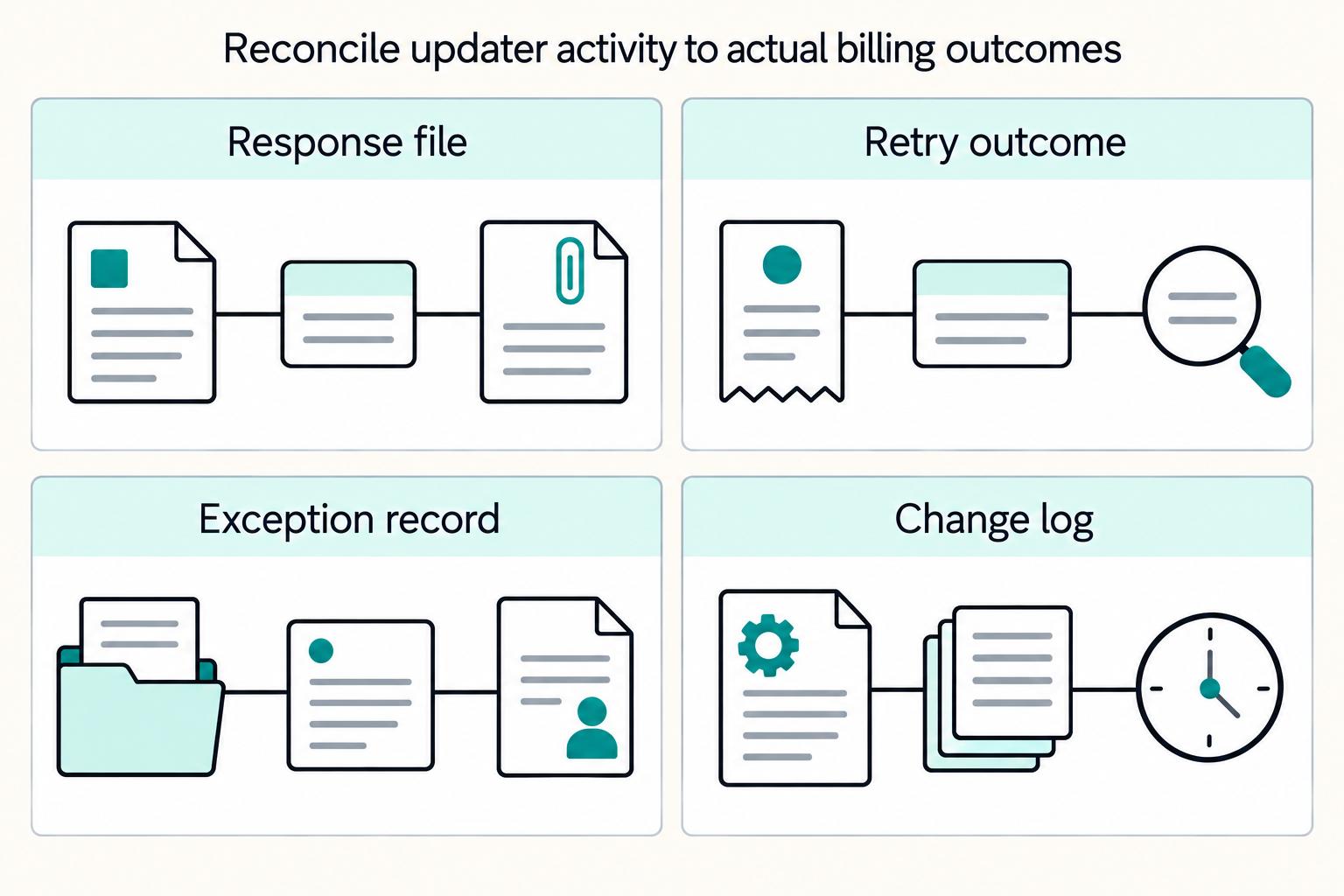
If you cannot connect updater activity to recovered charges, your metrics are not decision-ready. Treat this as an operational control: define a small metric set, reconcile it to processor outcomes, and keep an audit trail for exceptions and overrides.
Step 1 Define the four metrics before you scale#
Track these four metrics by billing lane, such as subscription and other COF flows:
| Metric | What it measures |
|---|---|
| Update success rate | How often the updater returns a usable credential change. |
| Retry recovery rate | How often those updated credentials convert on retry. |
| Residual decline rate | What still declines after updater handling. |
| Time to resolution | How long updater exceptions stay open before recovery, suppression, or outreach closure. |
Keep residual declines explicit. Updater does not recover every decline reason, and Clover notes retry behavior excludes insufficient-funds declines, so some residual decline volume is expected.
Step 2 Reconcile response files to processor transactions on a fixed cadence#
Reconcile on a schedule you can defend. Run daily matching for active volume, then a weekly rollup Finance can sign off on. The goal is to prove whether returned updates actually recovered billing, not just whether files were received.
Join response files to processor transaction records, then classify each record as:
Updated and recoveredUpdated and still declinedNo usable update returned
Treat closed-account outcomes as exception handling, not pending recovery. Also watch parser compatibility: if you rely on GRRCN-style reconciliation files, version changes, such as 4.01 from 3.01, can silently distort metrics if untested.
Step 3 Preserve an audit trail for exceptions and overrides#
Retain the artifacts that let Finance, Ops, and compliance reconstruct outcomes without a code review. At minimum, keep response files, exception dispositions, retry outcomes, and policy overrides. For manual interventions, log who changed what, when, and why, including retry re-enables, suppressions, or timing changes.
Step 4 Run a weekly cross-functional review with a change log#
Make the review routine before you scale. Hold a weekly Product, Engineering, and Ops review of the four metrics by lane and by supported network. Do not blend unsupported network traffic into headline updater rates; Clover CAU applies only to Mastercard- and Visa-issued cards.
Bring a change log that records Account Updater configuration changes, parser updates, retry-policy edits, and provider-side setting changes. If you use custom expired-card update intervals, record change timing and permissions, for example IXOPAY's merchant.account-updater.custom-interval, and note when behavior is sandbox-only so test behavior does not contaminate production baselines.
If you want a deeper dive, read Expired Card Management at Scale: How Platforms Automatically Refresh Payment Credentials.
Resolve coverage, cost, and contract terms before scaling#
Do not scale updater volume on assumptions. Before adding a new region, product, or billing lane, require written sign-off on coverage, prerequisites, pricing mechanics, delivery method, and support ownership.
Step 1 Confirm exact network coverage and prerequisites#
Treat coverage as provider-specific, not universal. Current docs already differ: J.P. Morgan lists Mastercard, Visa, and Discover; Adyen lists Visa, Mastercard, and Cartes Bancaires; Braintree lists Visa, Mastercard, and Discover.
| Provider | Networks listed |
|---|---|
| J.P. Morgan | Mastercard, Visa, and Discover |
| Adyen | Visa, Mastercard, and Cartes Bancaires |
| Braintree | Visa, Mastercard, and Discover |
Then confirm prerequisites in writing. Visa ties participation to its Account Updater Terms of Use and representative contact, Mastercard ABU requires merchant registration before API calls, and some gateways require specific agreements with the provider or acquirer. Also confirm issuer-participation limits, since eligible card types can still be ineligible at the issuing-bank level.
Step 2 Price the program before volume scales#
Do not rely on verbal pricing summaries. Braintree states pricing varies by pricing model, and American Express Cardrefresher routes fee details through your representative.
Get three items documented before expansion:
- pricing model by supported network or updater program
- exact fee trigger events
- how cost changes as updater volume grows across cards, regions, or products
Also clarify first-enable behavior for large vaults. Braintree documents batch and selection behavior tied to vault size and recency rules, which can materially change initial run cost.
Step 3 Lock down delivery and support terms#
Response-file and update-delivery paths vary, so treat them as contract-level details. Depending on provider setup, delivery can involve portal downloads, secure file transfer, API-based file retrieval, or file-based request and result exchanges.
Document the operational terms reconciliation depends on:
- delivery method for response files
- report availability and cadence
- any API or file-handling constraints relevant to your workflow
- retention and access expectations
- production support and escalation ownership
Step 4 Set a formal go/no-go rule#
Do not expand to new regions or products until Product, Engineering, Finance, and Legal have signed a single record covering coverage, prerequisites, pricing basis, fee triggers, response-file delivery, and support ownership.
This helps avoid scale failures where rollout expands before coverage limits, issuer-participation gaps, unsupported networks, or delivery constraints are fully understood.
Related: How to Price a Bookkeeping Service for Small Businesses. Before rollout, verify network coverage, file/API delivery, and operational handling requirements against your go/no-go checklist in Gruv Docs.
Common mistakes that cause silent payment failures#
Silent payment failures can come from operating gaps, not just the feature itself. If no one owns response files, timing, provider differences, and PCI-safe logging, updater can look enabled while avoidable failures still happen.
Step 1 Review response files and assign an owner#
Do not treat updater as set-and-forget. Bank of America calls the output reports response files, and some reports prompt you to contact customers for updated billing information. Closed accounts are also identified in reporting, which is your signal to stop blind retries and move to outreach.
Set one rule: every batch or report needs a named owner and a clear disposition. If a file lands with no review, exceptions can sit until the next failed renewal cycle.
Step 2 Schedule refresh early enough to absorb misses#
Running refresh too close to billing can create preventable failures. Bank of America says you can set the harvest date three to five days before recurring billing, and Visa says acquirers forward VAU responses within two business days. Build your updater window with enough buffer for retries and customer contact.
A clear red flag is any setup where the first human sees a closed-account result only after the charge attempt fails.
Step 3 Verify provider and network behavior instead of assuming sameness#
Do not assume updater behavior is uniform across providers or networks. Stripe notes Mastercard uses a push/pull model while Visa gets direct updates through participating acquirers. Bank of America also documents different report cadences: monthly for Visa and Mastercard, and daily for American Express.
Before launch, verify cadence, delivery path, and issuer-participation dependencies for each billing lane you rely on.
Step 4 Keep logs useful without turning them into a PCI problem#
Track updater activity in a way that supports investigations and PCI controls. PCI DSS Requirement 10 requires tracking and monitoring access to network resources and cardholder data, while PCI guidance says to mask PAN when displayed and not store sensitive authentication data after authorization.
Log event IDs, batch IDs, timestamps, and masked card references, not raw card data. If your audit trail cannot pass compliance review, fix that before scaling retries.
Conclusion#
Card Account Updater delivers the most value when timing, exception handling, and reconciliation are designed as one operating model, not treated as a feature toggle. Use it to reduce preventable declines, then prove lane-level execution before you scale.
Start with one billing lane and validate coverage, prerequisites, and cost. Launch on a single recurring lane first so you can inspect real outcomes, including updates and closed-account outcomes, before broad rollout. Get written confirmation of network and provider coverage for the major brands you support, plus any enrollment or contract prerequisites. Confirm pricing in writing as well, since terms can vary by provider contract model.
Before scaling, verify exactly how updates are delivered, when response files arrive, and whether your team must ingest and apply results before billing.
Align updater timing to your billing calendar. Map charge date, updater run or harvest date, response-file arrival, retry window, and outreach triggers on one timeline. For fixed recurring billing, a grounded starting point is running harvest three to five days before billing, then adjusting to your provider's actual delivery behavior. Visa guidance notes responses can be forwarded within two business days, and at least one provider documents monthly reporting for Visa and Mastercard and daily reporting for American Express.
If updates are not applied before authorization, move the updater run earlier.
Put launch controls in place before production. Use idempotent processing so retries or response-file reprocessing do not create duplicate effects. Keep an audit trail from updater event to credential change to billing attempt. Confirm PCI DSS baseline controls before go-live.
Define explicit handling for closed-account outcomes and other response-file exceptions so they route to owned recovery paths instead of blind retry loops.
Run a controlled launch, then review weekly. Run the first lane, reconcile response files with processor transaction outcomes, and review weekly across Product, Engineering, and Finance Ops. Scale only after you see stable evidence that updates are received, applied once, retried correctly, and reconciled to either recovered billing or an exception queue.
Use this launch checklist:
- Confirm provider and network coverage for your supported brands
- Confirm PCI DSS baseline controls
- Map billing calendar to updater run windows
- Implement idempotent update and retry handling
- Define closed-account and response-file exception recovery rules
- Stand up response-file reconciliation and weekly ops review
Related reading: How to Adjust Status from a K-1 Visa to a Green Card.
If you want a lane-by-lane implementation review before scaling, talk with Gruv to validate coverage, compliance gates, and reconciliation requirements for your program.
Frequently Asked Questions
What is an account updater service, in plain terms?
An account updater service keeps stored card-on-file details current when card data changes. It helps your systems receive updated credentials so the next recurring charge is less likely to fail because of stale card details. Treat it as credential maintenance, not a guarantee of approval.
Does Account Updater automatically refresh expired card data?
Often yes, but only when your provider setup and issuer participation support it. Automatic updates are not universal across all cards. Confirm whether updates are applied automatically or returned in response or batch result files for your team to ingest before billing.
Does it update only expiration dates or also card numbers?
It can update both expiration dates and card numbers, depending on the network program and provider implementation. Some implementations also return closed-account or contact-cardholder advisories. Do not assume it updates profile fields such as cardholder name or billing address.
How often should updater jobs run before recurring billing?
Run updater early enough to apply results before authorization attempts. One provider recommends running three to five days before recurring billing, and Visa notes responses can be forwarded within two business days. There is no single universal cadence, so set timing to your provider's actual schedule and file-delivery pattern.
What happens when the customer account is closed?
Closed accounts are usually returned as a status you must handle, not auto-repaired. Providers can flag them in reporting so you can contact the customer for new billing details. Route these cases to outreach and reconciliation instead of repeating blind retries.
Does Card Account Updater eliminate all payment declines?
No. Updater is meant to reduce preventable declines tied to stale credentials, not eliminate all declines. Coverage and outcomes still depend on issuer participation and program eligibility.
What should we ask a provider before enabling updater in production?
Ask for written confirmation of network coverage and issuer-participation limits, whether the mode is real-time, batch, or both, and how response or result files are delivered and who must ingest them. Also confirm whether runs are fixed-schedule or configurable, pricing model details, prerequisites such as Mastercard ABU registration requirements, and whether your team must apply updater results before requesting authorization.
Researched and edited by the Gruv editorial team. Gruv builds cross-border billing, payouts, and finance-operations software for global businesses.
Sources
- acquisition.gov/far/part-2trusted
- apps.legislature.ky.gov/record/25rs/record(19-2-2025).pdftrusted
- board.oc.gov/sites/bos.egovoc.com/files/2021-06/rev-sup06...trusted
- brownsvilletx.govtrusted
- developer.paypal.com/braintree/articles/guides/account-updatertrusted
- dot.ca.gov/-/media/dot-media/programs/traffic-operation...trusted
- ftc.gov/business-guidance/resources/data-breach-resp...trusted
- hcpf.colorado.gov/sites/hcpf/files/Region%203%20Technical%20Pr...trusted
Educational content only. Not legal, tax, or financial advice.
Related Posts

The Freelance Payment Penalty: A Modeled Audit of Platform Fees, FX Spreads, and Payout Delays
The money rarely disappears through a single, easy-to-spot fee. The real loss is stacked. A marketplace takes its commission, a processor adds a charge for international cards, a bank or payment company converts the currency at a spread, a platform holds the funds before release, and a wire sheds a little to intermediaries on the way in. Each layer looks defensible on its own, but the worker feels the combined result as a smaller deposit and a later payday.

How to Respond to a Subpoena for Business Records
Move fast, but do not produce records on instinct. If you need to **respond to a subpoena for business records**, your immediate job is to control deadlines, preserve records, and make any later production defensible.

A US Expat's Guide to Investing in UCITS ETFs to Avoid PFIC Issues
The real problem is a two-system conflict. U.S. tax treatment can punish the wrong fund choice, while local product-access constraints can block the funds you want to buy in the first place. For **us expat ucits etfs**, the practical question is not "Which product is best?" It is "What can I access, report, and keep doing every year without guessing?" Use this four-part filter before any trade: